1
Resource Management in
Distributed Systems
Task assignment,
Load-balancing and Load-sharing
2
Introduction
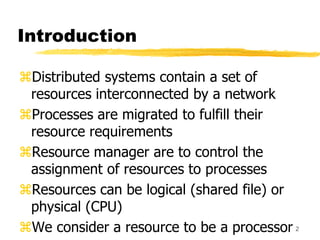
Distributed systems contain a set of
resources interconnected by a network
Processes are migrated to fulfill their
resource requirements
Resource manager are to control the
assignment of resources to processes
Resources can be logical (shared file) or
physical (CPU)
We consider a resource to be a processor
3
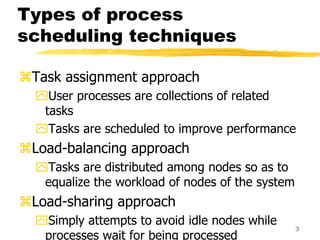
Types of process
scheduling techniques
Task assignment approach
User processes are collections of related
tasks
Tasks are scheduled to improve performance
Load-balancing approach
Tasks are distributed among nodes so as to
equalize the workload of nodes of the system
Load-sharing approach
Simply attempts to avoid idle nodes while
processes wait for being processed
4
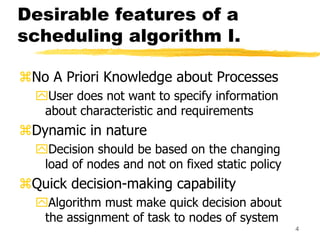
Desirable features of a
scheduling algorithm I.
No A Priori Knowledge about Processes
User does not want to specify information
about characteristic and requirements
Dynamic in nature
Decision should be based on the changing
load of nodes and not on fixed static policy
Quick decision-making capability
Algorithm must make quick decision about
the assignment of task to nodes of system
5
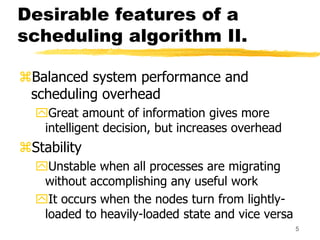
Desirable features of a
scheduling algorithm II.
Balanced system performance and
scheduling overhead
Great amount of information gives more
intelligent decision, but increases overhead
Stability
Unstable when all processes are migrating
without accomplishing any useful work
It occurs when the nodes turn from lightly-
loaded to heavily-loaded state and vice versa
6
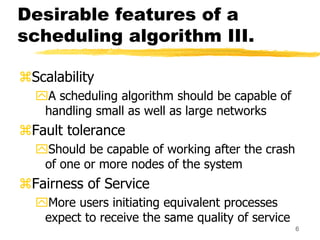
Desirable features of a
scheduling algorithm III.
Scalability
A scheduling algorithm should be capable of
handling small as well as large networks
Fault tolerance
Should be capable of working after the crash
of one or more nodes of the system
Fairness of Service
More users initiating equivalent processes
expect to receive the same quality of service
7
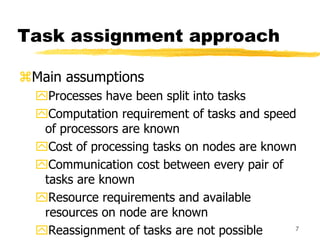
Task assignment approach
Main assumptions
Processes have been split into tasks
Computation requirement of tasks and speed
of processors are known
Cost of processing tasks on nodes are known
Communication cost between every pair of
tasks are known
Resource requirements and available
resources on node are known
Reassignment of tasks are not possible
8
Task assignment approach
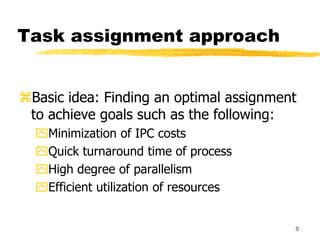
Basic idea: Finding an optimal assignment
to achieve goals such as the following:
Minimization of IPC costs
Quick turnaround time of process
High degree of parallelism
Efficient utilization of resources
9
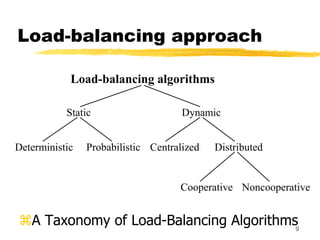
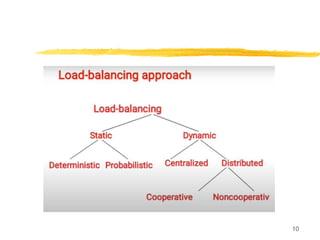
A Taxonomy of Load-Balancing Algorithms
Load-balancing approach
Load-balancing algorithms
Dynamic
Static
Deterministic Probabilistic Centralized Distributed
Cooperative Noncooperative
10
11
12
Load-balancing approach
Type of load-balancing algorithms
Static versus Dynamic
Static algorithms use only information about
the average behavior of the system
Static algorithms ignore the current state or
load of the nodes in the system
Dynamic algorithms collect state information
and react to system state if it changed
Static algorithms are much more simpler
Dynamic algorithms are able to give
significantly better performance
13
Load-balancing approach
Type of static load-balancing algorithms
Deterministic versus Probabilistic
Deterministic algorithms use the information
about the properties of the nodes and the
characteristic of processes to be scheduled
Probabilistic algorithms use information of
static attributes of the system (e.g. number
of nodes, processing capability, topology) to
formulate simple process placement rules
Deterministic approach is difficult to optimize
Probabilistic approach has poor performance
14
Load-balancing approach
Type of dynamic load-balancing algorithms
Centralized versus Distributed
Centralized approach collects information to
server node and makes assignment decision
Distributed approach contains entities to
make decisions on a predefined set of nodes
Centralized algorithms can make efficient
decisions, have lower fault-tolerance
Distributed algorithms avoid the bottleneck
of collecting state information and react
faster
15
Load-balancing approach
Type of distributed load-balancing algorithms
Cooperative versus Noncooperative
In Noncooperative algorithms entities act as
autonomous ones and make scheduling
decisions independently from other entities
In Cooperative algorithms distributed entities
cooperatewith each other
Cooperative algorithms are more complex
and involve larger overhead
Stability of Cooperative algorithms are better
16
Issues in designing Load-
balancing algorithms
 Load estimation policy
determines how to estimate the workload of a node
 Process transfer policy
determines whether to execute a process locally or remote
 State information exchange policy
determines how to exchange load information among nodes
 Location policy
determines to which node the transferable process should be sent
 Priority assignment policy
determines the priority of execution of local and remote processes
 Migration limiting policy
determines the total number of times a process can migrate
17
Load-sharing approach
 Drawbacks of Load-balancing approach
Load balancing technique with attempting equalizing the
workload on all the nodes is not an appropriate object since big
overhead is generated by gathering exact state information
Load balancing is not achievable since number of processes in a
node is always fluctuating and temporal unbalance among the
nodes exists every moment
 Basic ideas for Load-sharing approach
It is necessary and sufficient to prevent nodes from being idle
while some other nodes have more than two processes
Load-sharing is much simpler than load-balancing since it only
attempts to ensure that no node is idle when heavily node exists
Priority assignment policy and migration limiting policy are the
same as that for the load-balancing algorithms

334839757 task-assignment

  • 1.
    1 Resource Management in DistributedSystems Task assignment, Load-balancing and Load-sharing
  • 2.
    2 Introduction Distributed systems containa set of resources interconnected by a network Processes are migrated to fulfill their resource requirements Resource manager are to control the assignment of resources to processes Resources can be logical (shared file) or physical (CPU) We consider a resource to be a processor
  • 3.
    3 Types of process schedulingtechniques Task assignment approach User processes are collections of related tasks Tasks are scheduled to improve performance Load-balancing approach Tasks are distributed among nodes so as to equalize the workload of nodes of the system Load-sharing approach Simply attempts to avoid idle nodes while processes wait for being processed
  • 4.
    4 Desirable features ofa scheduling algorithm I. No A Priori Knowledge about Processes User does not want to specify information about characteristic and requirements Dynamic in nature Decision should be based on the changing load of nodes and not on fixed static policy Quick decision-making capability Algorithm must make quick decision about the assignment of task to nodes of system
  • 5.
    5 Desirable features ofa scheduling algorithm II. Balanced system performance and scheduling overhead Great amount of information gives more intelligent decision, but increases overhead Stability Unstable when all processes are migrating without accomplishing any useful work It occurs when the nodes turn from lightly- loaded to heavily-loaded state and vice versa
  • 6.
    6 Desirable features ofa scheduling algorithm III. Scalability A scheduling algorithm should be capable of handling small as well as large networks Fault tolerance Should be capable of working after the crash of one or more nodes of the system Fairness of Service More users initiating equivalent processes expect to receive the same quality of service
  • 7.
    7 Task assignment approach Mainassumptions Processes have been split into tasks Computation requirement of tasks and speed of processors are known Cost of processing tasks on nodes are known Communication cost between every pair of tasks are known Resource requirements and available resources on node are known Reassignment of tasks are not possible
  • 8.
    8 Task assignment approach Basicidea: Finding an optimal assignment to achieve goals such as the following: Minimization of IPC costs Quick turnaround time of process High degree of parallelism Efficient utilization of resources
  • 9.
    9 A Taxonomy ofLoad-Balancing Algorithms Load-balancing approach Load-balancing algorithms Dynamic Static Deterministic Probabilistic Centralized Distributed Cooperative Noncooperative
  • 10.
  • 11.
  • 12.
    12 Load-balancing approach Type ofload-balancing algorithms Static versus Dynamic Static algorithms use only information about the average behavior of the system Static algorithms ignore the current state or load of the nodes in the system Dynamic algorithms collect state information and react to system state if it changed Static algorithms are much more simpler Dynamic algorithms are able to give significantly better performance
  • 13.
    13 Load-balancing approach Type ofstatic load-balancing algorithms Deterministic versus Probabilistic Deterministic algorithms use the information about the properties of the nodes and the characteristic of processes to be scheduled Probabilistic algorithms use information of static attributes of the system (e.g. number of nodes, processing capability, topology) to formulate simple process placement rules Deterministic approach is difficult to optimize Probabilistic approach has poor performance
  • 14.
    14 Load-balancing approach Type ofdynamic load-balancing algorithms Centralized versus Distributed Centralized approach collects information to server node and makes assignment decision Distributed approach contains entities to make decisions on a predefined set of nodes Centralized algorithms can make efficient decisions, have lower fault-tolerance Distributed algorithms avoid the bottleneck of collecting state information and react faster
  • 15.
    15 Load-balancing approach Type ofdistributed load-balancing algorithms Cooperative versus Noncooperative In Noncooperative algorithms entities act as autonomous ones and make scheduling decisions independently from other entities In Cooperative algorithms distributed entities cooperatewith each other Cooperative algorithms are more complex and involve larger overhead Stability of Cooperative algorithms are better
  • 16.
    16 Issues in designingLoad- balancing algorithms  Load estimation policy determines how to estimate the workload of a node  Process transfer policy determines whether to execute a process locally or remote  State information exchange policy determines how to exchange load information among nodes  Location policy determines to which node the transferable process should be sent  Priority assignment policy determines the priority of execution of local and remote processes  Migration limiting policy determines the total number of times a process can migrate
  • 17.
    17 Load-sharing approach  Drawbacksof Load-balancing approach Load balancing technique with attempting equalizing the workload on all the nodes is not an appropriate object since big overhead is generated by gathering exact state information Load balancing is not achievable since number of processes in a node is always fluctuating and temporal unbalance among the nodes exists every moment  Basic ideas for Load-sharing approach It is necessary and sufficient to prevent nodes from being idle while some other nodes have more than two processes Load-sharing is much simpler than load-balancing since it only attempts to ensure that no node is idle when heavily node exists Priority assignment policy and migration limiting policy are the same as that for the load-balancing algorithms