Top-Down Network Design

            Chapter Four

     Characterizing Network Traffic


     Copyright 2010 Cisco Press & Priscilla Oppenheimer
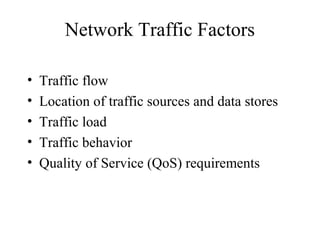
Network Traffic Factors

•   Traffic flow
•   Location of traffic sources and data stores
•   Traffic load
•   Traffic behavior
•   Quality of Service (QoS) requirements
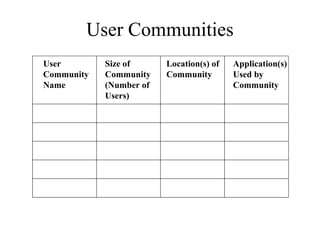
User Communities
User        Size of      Location(s) of   Application(s)
Community   Community    Community        Used by
Name        (Number of                    Community
            Users)
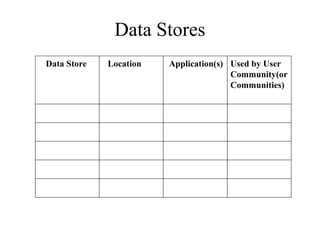
Data Stores
Data Store   Location   Application(s) Used by User
                                       Community(or
                                       Communities)
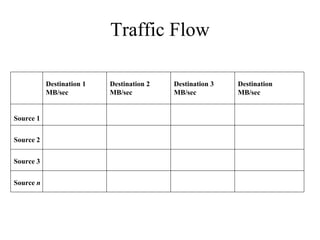
Traffic Flow

           Destination 1   Destination 2   Destination 3   Destination
           MB/sec          MB/sec          MB/sec          MB/sec


Source 1


Source 2


Source 3


Source n
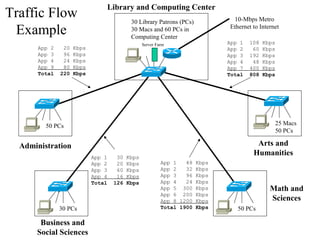
Library and Computing Center
Traffic Flow                               30 Library Patrons (PCs)          10-Mbps Metro

 Example                                   30 Macs and 60 PCs in
                                           Computing Center
                                                                            Ethernet to Internet

                                                 Server Farm                App 1   108   Kbps
      App 2    20   Kbps                                                    App 2    60   Kbps
      App 3    96   Kbps                                                    App 3   192   Kbps
      App 4    24   Kbps                                                    App 4    48   Kbps
      App 9    80   Kbps                                                    App 7   400   Kbps
      Total   220   Kbps                                                    Total   808   Kbps


         50 PCs                                                                               25 Macs
                                                                                              50 PCs

  Administration                                                                      Arts and
                           App 1     30   Kbps
                                                                                     Humanities
                           App 2     20   Kbps            App 1   48 Kbps
                           App 3     60   Kbps            App 2   32 Kbps
                           App 4     16   Kbps            App 3   96 Kbps
                           Total    126   Kbps            App 4   24 Kbps
                                                          App 5 300 Kbps                    Math and
                                                          App 6 200 Kbps
                                                          App 8 1200 Kbps                   Sciences
              30 PCs                                      Total 1900 Kbps      50 PCs

       Business and
      Social Sciences
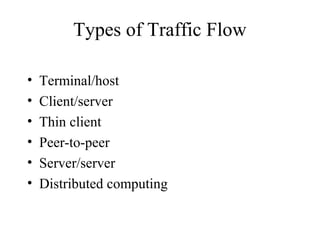
Types of Traffic Flow

•   Terminal/host
•   Client/server
•   Thin client
•   Peer-to-peer
•   Server/server
•   Distributed computing
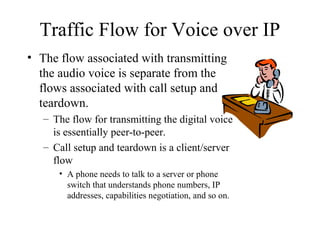
Traffic Flow for Voice over IP
• The flow associated with transmitting
  the audio voice is separate from the
  flows associated with call setup and
  teardown.
   – The flow for transmitting the digital voice
     is essentially peer-to-peer.
   – Call setup and teardown is a client/server
     flow
      • A phone needs to talk to a server or phone
        switch that understands phone numbers, IP
        addresses, capabilities negotiation, and so on.
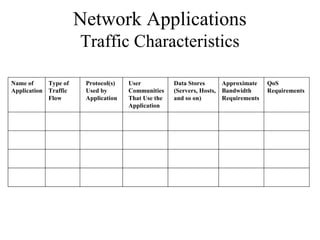
Network Applications
                      Traffic Characteristics

Name of     Type of    Protocol(s)   User           Data Stores      Approximate    QoS
Application Traffic    Used by       Communities    (Servers, Hosts, Bandwidth      Requirements
            Flow       Application   That Use the   and so on)       Requirements
                                     Application
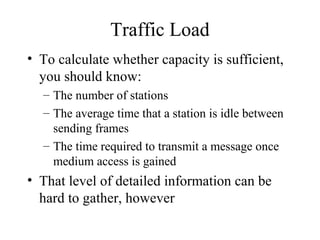
Traffic Load
• To calculate whether capacity is sufficient,
  you should know:
  – The number of stations
  – The average time that a station is idle between
    sending frames
  – The time required to transmit a message once
    medium access is gained
• That level of detailed information can be
  hard to gather, however
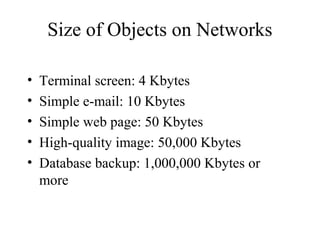
Size of Objects on Networks

•   Terminal screen: 4 Kbytes
•   Simple e-mail: 10 Kbytes
•   Simple web page: 50 Kbytes
•   High-quality image: 50,000 Kbytes
•   Database backup: 1,000,000 Kbytes or
    more
Traffic Behavior
• Broadcasts
   – All ones data-link layer destination address
       • FF: FF: FF: FF: FF: FF
   – Doesn’t necessarily use huge amounts of bandwidth
   – But does disturb every CPU in the broadcast domain
• Multicasts
   – First bit sent is a one
       • 01:00:0C:CC:CC:CC (Cisco Discovery Protocol)
   – Should just disturb NICs that have registered to receive
     it
   – Requires multicast routing protocol on internetworks
Network Efficiency

•   Frame size
•   Protocol interaction
•   Windowing and flow control
•   Error-recovery mechanisms
QoS Requirements

• ATM service specifications
  –   Constant bit rate (CBR)
  –   Realtime variable bit rate (rt-VBR)
  –   Non-realtime variable bit rate (nrt-VBR)
  –   Unspecified bit rate (UBR)
  –   Available bit rate (ABR)
  –   Guaranteed frame rate (GFR)
QoS Requirements per IETF

• IETF integrated services working group
  specifications
  – Controlled load service
     • Provides client data flow with a QoS closely
       approximating the QoS that same flow would
       receive on an unloaded network
  – Guaranteed service
     • Provides firm (mathematically provable) bounds on
       end-to-end packet-queuing delays
QoS Requirements per IETF

• IETF differentiated services working group
  specifications
  – RFC 2475
  – IP packets can be marked with a differentiated
    services codepoint (DSCP) to influence
    queuing and packet-dropping decisions for IP
    datagrams on an output interface of a router
Summary

• Continue to use a systematic, top-down
  approach
• Don’t select products until you understand
  network traffic in terms of:
  –   Flow
  –   Load
  –   Behavior
  –   QoS requirements
Review Questions
• List and describe six different types of traffic flows.
• What makes traffic flow in voice over IP networks
  challenging to characterize and plan for?
• Why should you be concerned about broadcast
  traffic?
• How do ATM and IETF specifications for QoS
  differ?

Chapter04

  • 1.
    Top-Down Network Design Chapter Four Characterizing Network Traffic Copyright 2010 Cisco Press & Priscilla Oppenheimer
  • 2.
    Network Traffic Factors • Traffic flow • Location of traffic sources and data stores • Traffic load • Traffic behavior • Quality of Service (QoS) requirements
  • 3.
    User Communities User Size of Location(s) of Application(s) Community Community Community Used by Name (Number of Community Users)
  • 4.
    Data Stores Data Store Location Application(s) Used by User Community(or Communities)
  • 5.
    Traffic Flow Destination 1 Destination 2 Destination 3 Destination MB/sec MB/sec MB/sec MB/sec Source 1 Source 2 Source 3 Source n
  • 6.
    Library and ComputingCenter Traffic Flow 30 Library Patrons (PCs) 10-Mbps Metro Example 30 Macs and 60 PCs in Computing Center Ethernet to Internet Server Farm App 1 108 Kbps App 2 20 Kbps App 2 60 Kbps App 3 96 Kbps App 3 192 Kbps App 4 24 Kbps App 4 48 Kbps App 9 80 Kbps App 7 400 Kbps Total 220 Kbps Total 808 Kbps 50 PCs 25 Macs 50 PCs Administration Arts and App 1 30 Kbps Humanities App 2 20 Kbps App 1 48 Kbps App 3 60 Kbps App 2 32 Kbps App 4 16 Kbps App 3 96 Kbps Total 126 Kbps App 4 24 Kbps App 5 300 Kbps Math and App 6 200 Kbps App 8 1200 Kbps Sciences 30 PCs Total 1900 Kbps 50 PCs Business and Social Sciences
  • 7.
    Types of TrafficFlow • Terminal/host • Client/server • Thin client • Peer-to-peer • Server/server • Distributed computing
  • 8.
    Traffic Flow forVoice over IP • The flow associated with transmitting the audio voice is separate from the flows associated with call setup and teardown. – The flow for transmitting the digital voice is essentially peer-to-peer. – Call setup and teardown is a client/server flow • A phone needs to talk to a server or phone switch that understands phone numbers, IP addresses, capabilities negotiation, and so on.
  • 9.
    Network Applications Traffic Characteristics Name of Type of Protocol(s) User Data Stores Approximate QoS Application Traffic Used by Communities (Servers, Hosts, Bandwidth Requirements Flow Application That Use the and so on) Requirements Application
  • 10.
    Traffic Load • Tocalculate whether capacity is sufficient, you should know: – The number of stations – The average time that a station is idle between sending frames – The time required to transmit a message once medium access is gained • That level of detailed information can be hard to gather, however
  • 11.
    Size of Objectson Networks • Terminal screen: 4 Kbytes • Simple e-mail: 10 Kbytes • Simple web page: 50 Kbytes • High-quality image: 50,000 Kbytes • Database backup: 1,000,000 Kbytes or more
  • 12.
    Traffic Behavior • Broadcasts – All ones data-link layer destination address • FF: FF: FF: FF: FF: FF – Doesn’t necessarily use huge amounts of bandwidth – But does disturb every CPU in the broadcast domain • Multicasts – First bit sent is a one • 01:00:0C:CC:CC:CC (Cisco Discovery Protocol) – Should just disturb NICs that have registered to receive it – Requires multicast routing protocol on internetworks
  • 13.
    Network Efficiency • Frame size • Protocol interaction • Windowing and flow control • Error-recovery mechanisms
  • 14.
    QoS Requirements • ATMservice specifications – Constant bit rate (CBR) – Realtime variable bit rate (rt-VBR) – Non-realtime variable bit rate (nrt-VBR) – Unspecified bit rate (UBR) – Available bit rate (ABR) – Guaranteed frame rate (GFR)
  • 15.
    QoS Requirements perIETF • IETF integrated services working group specifications – Controlled load service • Provides client data flow with a QoS closely approximating the QoS that same flow would receive on an unloaded network – Guaranteed service • Provides firm (mathematically provable) bounds on end-to-end packet-queuing delays
  • 16.
    QoS Requirements perIETF • IETF differentiated services working group specifications – RFC 2475 – IP packets can be marked with a differentiated services codepoint (DSCP) to influence queuing and packet-dropping decisions for IP datagrams on an output interface of a router
  • 17.
    Summary • Continue touse a systematic, top-down approach • Don’t select products until you understand network traffic in terms of: – Flow – Load – Behavior – QoS requirements
  • 18.
    Review Questions • Listand describe six different types of traffic flows. • What makes traffic flow in voice over IP networks challenging to characterize and plan for? • Why should you be concerned about broadcast traffic? • How do ATM and IETF specifications for QoS differ?