IT Power Management Strategy & Business Case Enterprise Architecture Information Technology Services Saint Louis University
Why Look at Power Issues Now? Proactive financial planning :  the AmerenIP Illinois rate change story, future energy costs Policy opportunity  to define the default power configuration expectations of electronic devices   Environmental stewardship  and the University Mission Scheduled PC replacement , with HD data cleansing, creates opportunity to phase in new lower-power technology Disposal Initiative  already proposed for responsible electronics recycling and disposal
Drivers for Computer Power Management Strategy Billiken InfoShield completion: all PCs could now be power-optimized by managed software settings Generational improvements computer hardware (Energy Star advancement) Laptop interest increasing, especially faculty and students Datacenter power load growth, partly from non-enterprise departmental servers Peripherals and electronics default settings offer Energy Star options CRT-based displays seldom purchased now
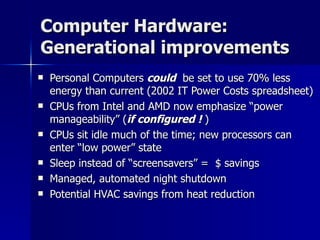
Computer Hardware:  Generational improvements Personal Computers  could   be set to use 70% less energy than current (2002 IT Power Costs spreadsheet) CPUs from Intel and AMD now emphasize “power manageability” ( if configured !  ) CPUs sit idle much of the time; new processors can enter “low power” state Sleep instead of “screensavers” =  $ savings Managed, automated night shutdown Potential HVAC savings from heat reduction
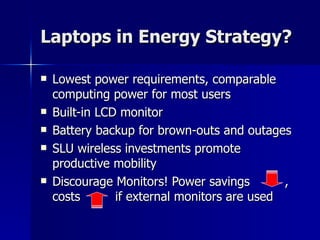
Laptops in Energy Strategy? Lowest power requirements, comparable computing power for most users Built-in LCD monitor  Battery backup for brown-outs and outages SLU wireless investments promote productive mobility Discourage Monitors! Power savings  , costs  if external monitors are used
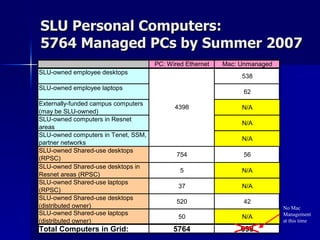
SLU Personal Computers:  5764 Managed PCs by Summer 2007 No Mac Management at this time
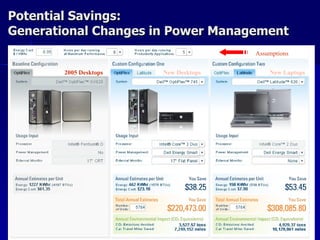
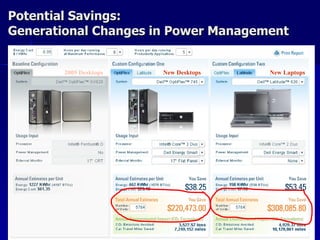
Potential Savings: Generational Changes in Power Management New Laptops New Desktops 2005 Desktops Assumptions
Potential Savings: Generational Changes in Power Management New Laptops New Desktops 2005 Desktops
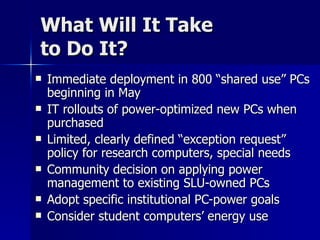
What Will It Take  to Do It? Immediate deployment in 800 “shared use” PCs beginning in May IT rollouts of power-optimized new PCs when purchased Limited, clearly defined “exception request” policy for research computers, special needs Community decision on applying power management to existing SLU-owned PCs Adopt specific institutional PC-power goals Consider student computers’ energy use
Datacenter Power Strategies & Opportunities IT exploring fewer, but more powerful physical servers hosting multiple “virtual” servers for the future Server “high efficiency” power supplies High-efficiency cooling enclosures Policy needed on criteria for housing non-enterprise servers in Datacenters (unmanaged power growth)
Printers, Copiers, Electronics Encourage shared printers/copiers over personal printers Enable “Energy Star” default settings as SLU installation standard Expand “smart” shutdown management tools, such as in classroom presentation systems
IT Helping SLU Stay Affordable through Stewardship & Compliance http://energystar.gov/powermanagement http://www.dell.com/html/us/products/optiplex/calculator/index.html http://weblog.infoworld.com/sustainableit/archives/2007/03/ceo_group_makes.html http:// www.informationweek.com/showArticle.jhtml;jsessionid =QCUZQOBD1R3G4QSNDLPCKH0CJUNN2JVN?articleID=197801530&queryText=green Enterprise Architecture, 3/23/07 – John M. Ashby [email_address]

IT Power Management Strategy

  • 1.
    IT Power ManagementStrategy & Business Case Enterprise Architecture Information Technology Services Saint Louis University
  • 2.
    Why Look atPower Issues Now? Proactive financial planning : the AmerenIP Illinois rate change story, future energy costs Policy opportunity to define the default power configuration expectations of electronic devices Environmental stewardship and the University Mission Scheduled PC replacement , with HD data cleansing, creates opportunity to phase in new lower-power technology Disposal Initiative already proposed for responsible electronics recycling and disposal
  • 3.
    Drivers for ComputerPower Management Strategy Billiken InfoShield completion: all PCs could now be power-optimized by managed software settings Generational improvements computer hardware (Energy Star advancement) Laptop interest increasing, especially faculty and students Datacenter power load growth, partly from non-enterprise departmental servers Peripherals and electronics default settings offer Energy Star options CRT-based displays seldom purchased now
  • 4.
    Computer Hardware: Generational improvements Personal Computers could be set to use 70% less energy than current (2002 IT Power Costs spreadsheet) CPUs from Intel and AMD now emphasize “power manageability” ( if configured ! ) CPUs sit idle much of the time; new processors can enter “low power” state Sleep instead of “screensavers” = $ savings Managed, automated night shutdown Potential HVAC savings from heat reduction
  • 5.
    Laptops in EnergyStrategy? Lowest power requirements, comparable computing power for most users Built-in LCD monitor Battery backup for brown-outs and outages SLU wireless investments promote productive mobility Discourage Monitors! Power savings , costs if external monitors are used
  • 6.
    SLU Personal Computers: 5764 Managed PCs by Summer 2007 No Mac Management at this time
  • 7.
    Potential Savings: GenerationalChanges in Power Management New Laptops New Desktops 2005 Desktops Assumptions
  • 8.
    Potential Savings: GenerationalChanges in Power Management New Laptops New Desktops 2005 Desktops
  • 9.
    What Will ItTake to Do It? Immediate deployment in 800 “shared use” PCs beginning in May IT rollouts of power-optimized new PCs when purchased Limited, clearly defined “exception request” policy for research computers, special needs Community decision on applying power management to existing SLU-owned PCs Adopt specific institutional PC-power goals Consider student computers’ energy use
  • 10.
    Datacenter Power Strategies& Opportunities IT exploring fewer, but more powerful physical servers hosting multiple “virtual” servers for the future Server “high efficiency” power supplies High-efficiency cooling enclosures Policy needed on criteria for housing non-enterprise servers in Datacenters (unmanaged power growth)
  • 11.
    Printers, Copiers, ElectronicsEncourage shared printers/copiers over personal printers Enable “Energy Star” default settings as SLU installation standard Expand “smart” shutdown management tools, such as in classroom presentation systems
  • 12.
    IT Helping SLUStay Affordable through Stewardship & Compliance http://energystar.gov/powermanagement http://www.dell.com/html/us/products/optiplex/calculator/index.html http://weblog.infoworld.com/sustainableit/archives/2007/03/ceo_group_makes.html http:// www.informationweek.com/showArticle.jhtml;jsessionid =QCUZQOBD1R3G4QSNDLPCKH0CJUNN2JVN?articleID=197801530&queryText=green Enterprise Architecture, 3/23/07 – John M. Ashby [email_address]