• Paper Name: Database System
• Staff Name : Ms. D. Saritha M.C.A., M.phil.,
• Class: II Year
• Semester: IV
• Unit: I
• Topic: Introduction Of Database
DATABASE MANAGEMENT SYSTEM
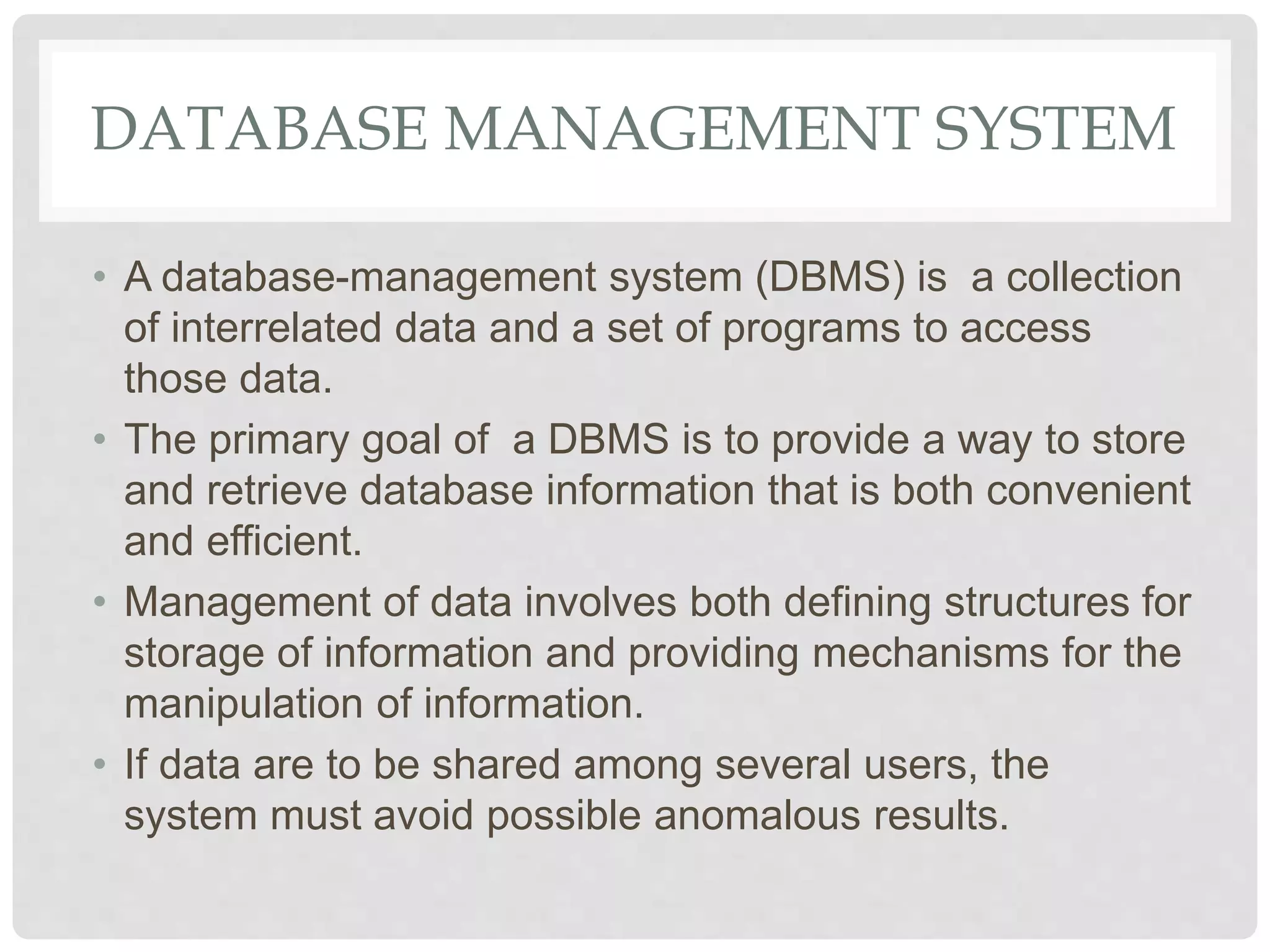
• A database-management system (DBMS) is a collection
of interrelated data and a set of programs to access
those data.
• The primary goal of a DBMS is to provide a way to store
and retrieve database information that is both convenient
and efficient.
• Management of data involves both defining structures for
storage of information and providing mechanisms for the
manipulation of information.
• If data are to be shared among several users, the
system must avoid possible anomalous results.
DATABASE SYSTEM APPLICATION
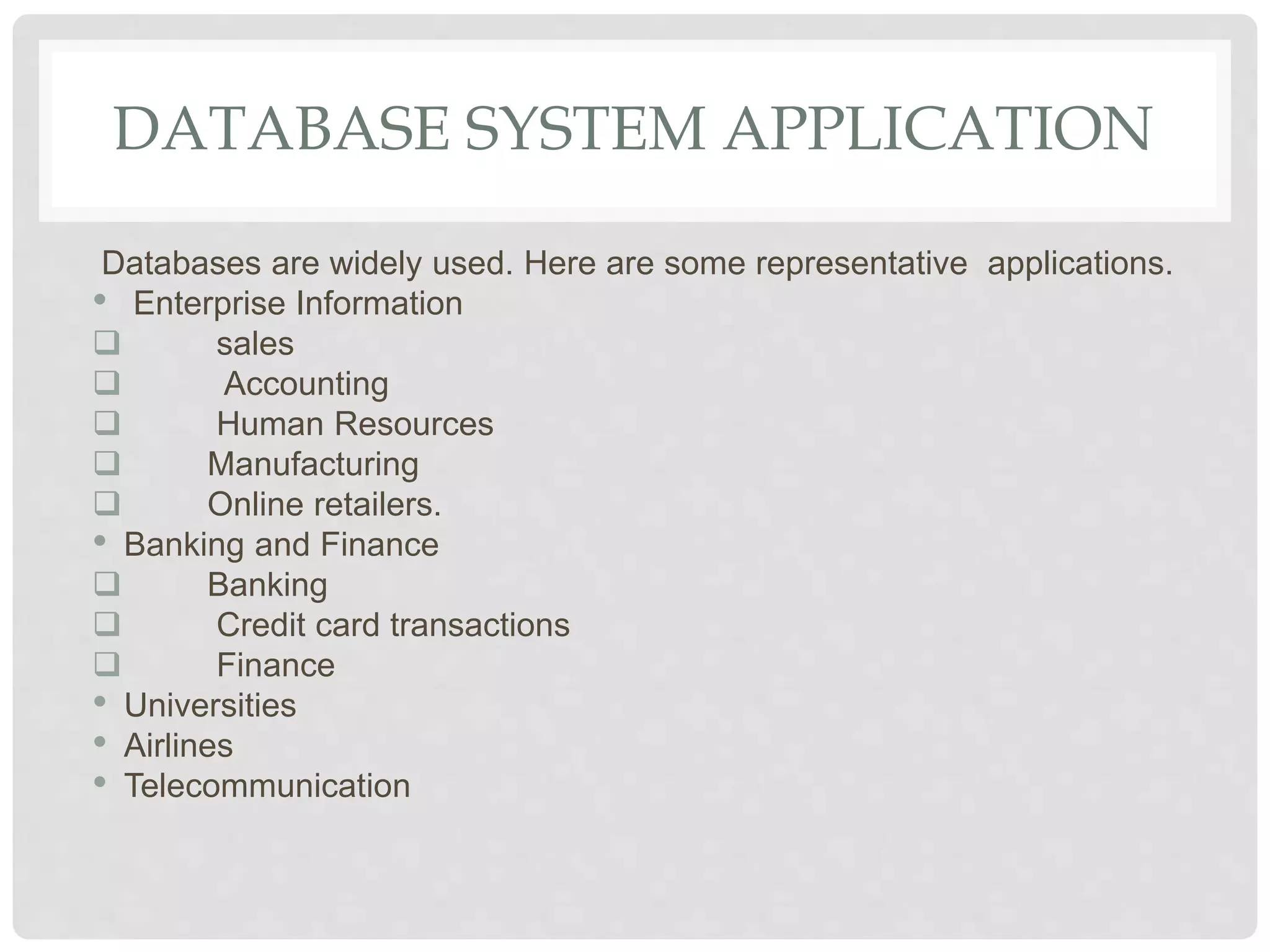
Databases are widely used. Here are some representative applications.
• Enterprise Information
 sales
 Accounting
 Human Resources
 Manufacturing
 Online retailers.
• Banking and Finance
 Banking
 Credit card transactions
 Finance
• Universities
• Airlines
• Telecommunication
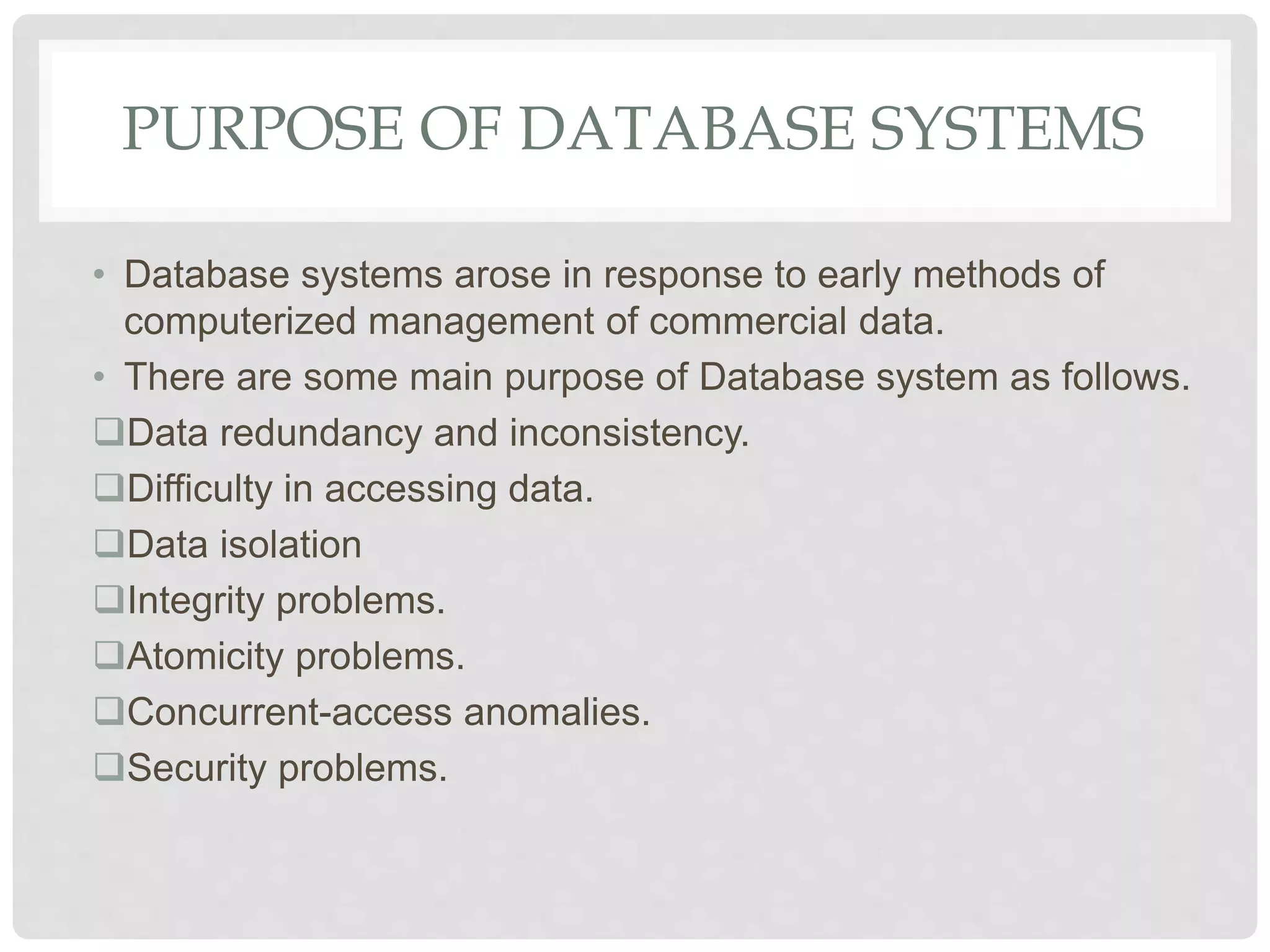
PURPOSE OF DATABASE SYSTEMS
• Database systems arose in response to early methods of
computerized management of commercial data.
• There are some main purpose of Database system as follows.
Data redundancy and inconsistency.
Difficulty in accessing data.
Data isolation
Integrity problems.
Atomicity problems.
Concurrent-access anomalies.
Security problems.
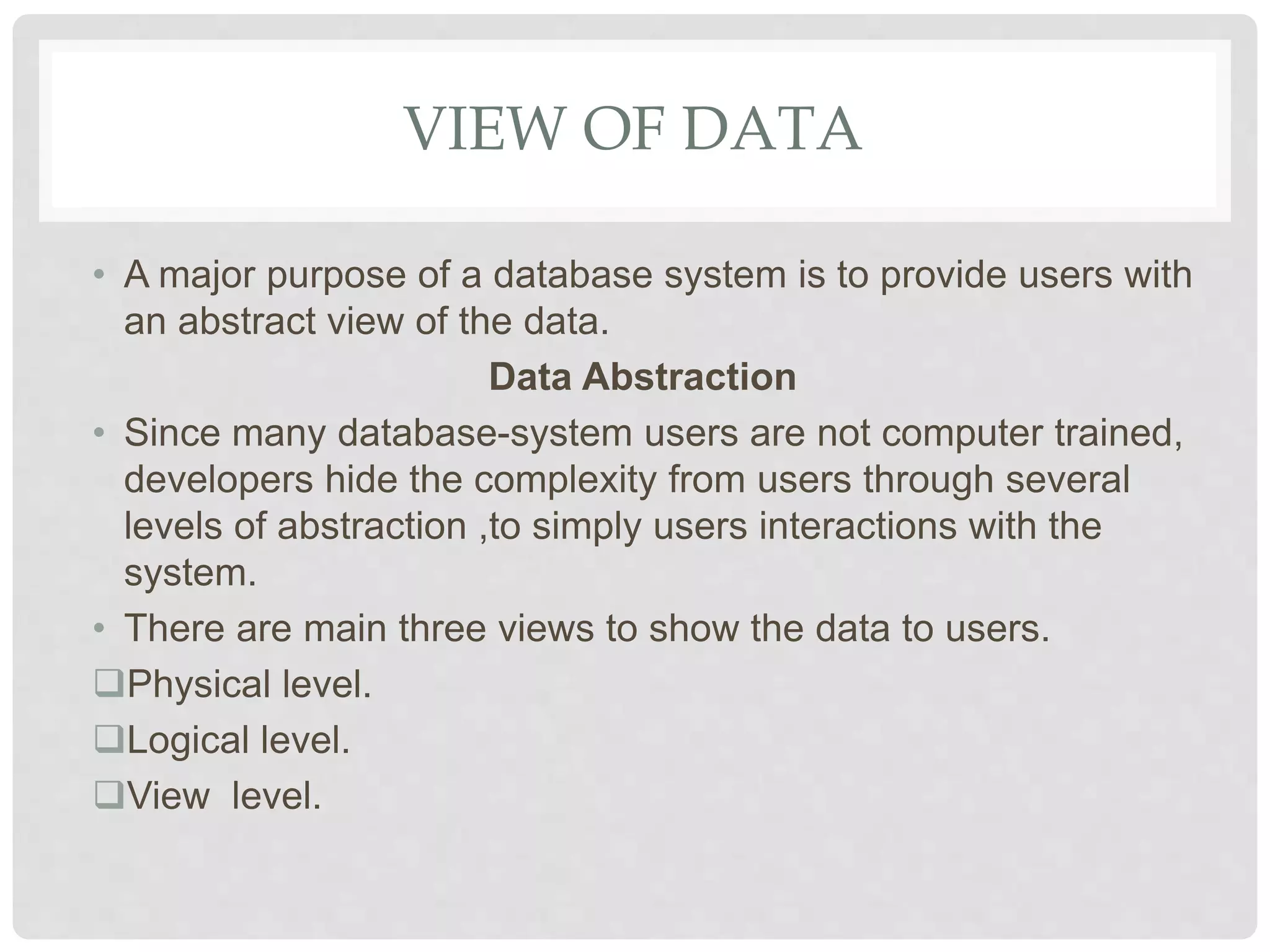
VIEW OF DATA
• A major purpose of a database system is to provide users with
an abstract view of the data.
Data Abstraction
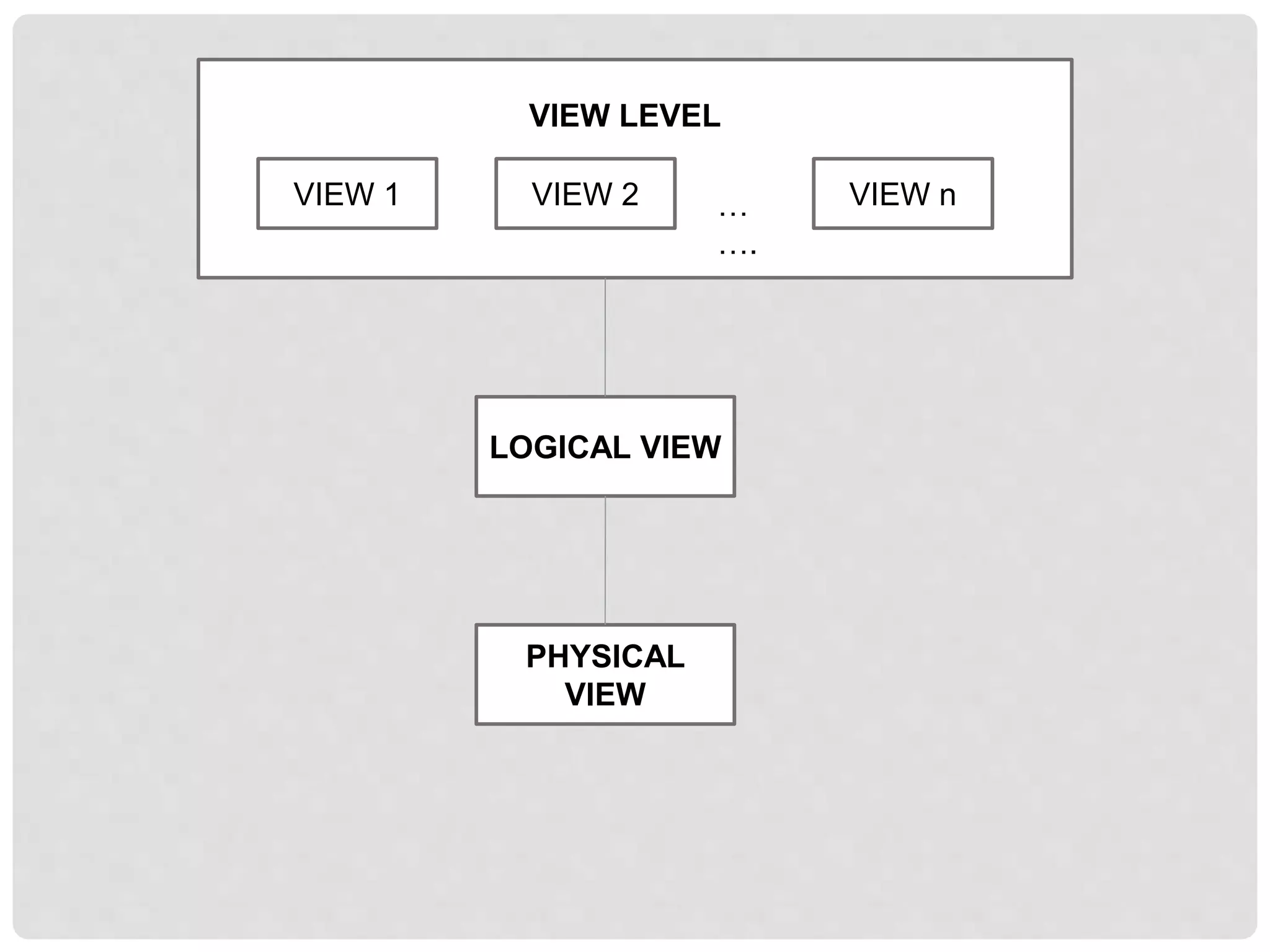
• Since many database-system users are not computer trained,
developers hide the complexity from users through several
levels of abstraction ,to simply users interactions with the
system.
• There are main three views to show the data to users.
Physical level.
Logical level.
View level.
.
VIEW 1 VIEW 2 VIEW n
LOGICAL VIEW
PHYSICAL
VIEW
VIEW LEVEL
…
….
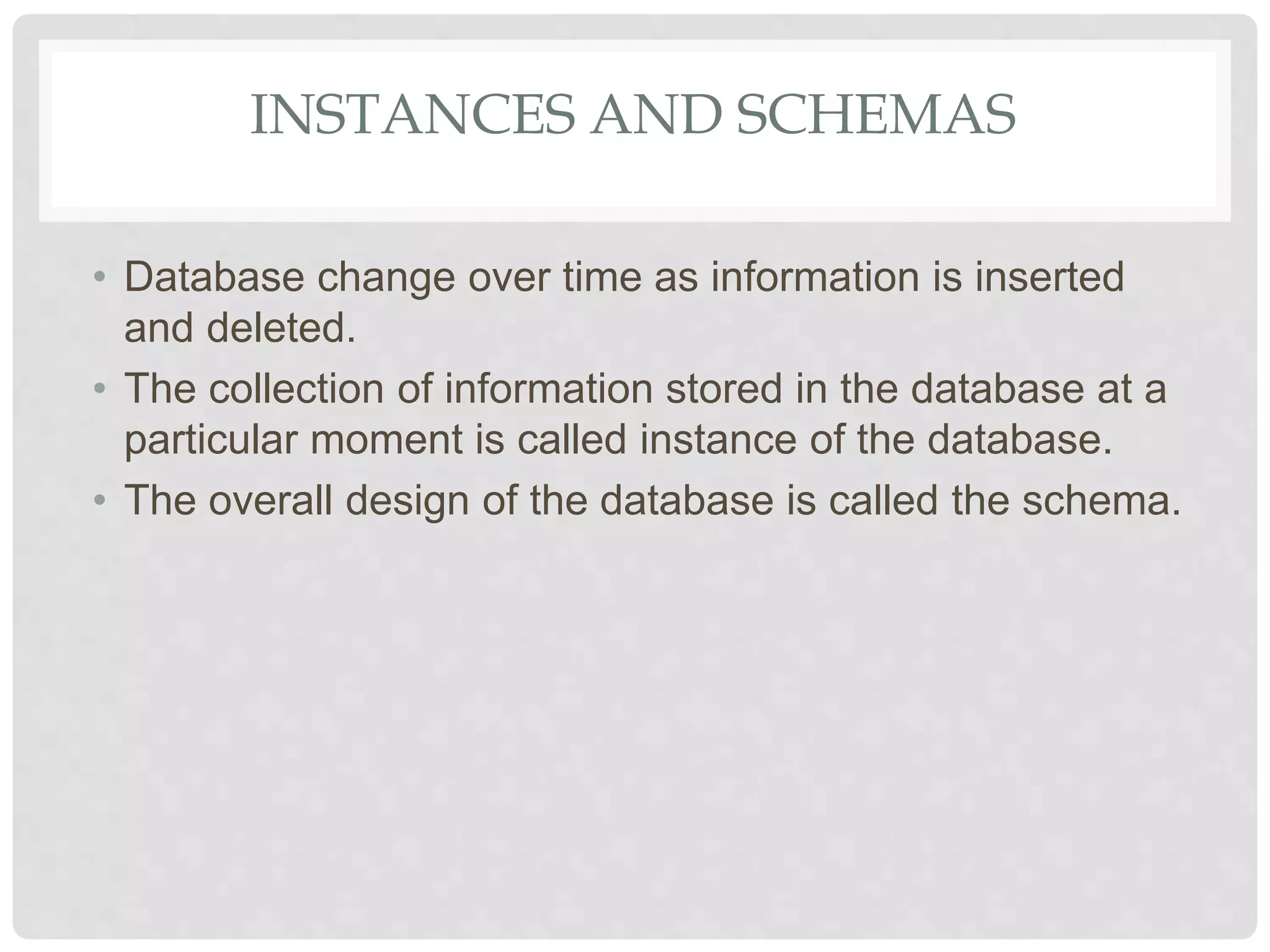
INSTANCES AND SCHEMAS
• Database change over time as information is inserted
and deleted.
• The collection of information stored in the database at a
particular moment is called instance of the database.
• The overall design of the database is called the schema.
DATA MODEL
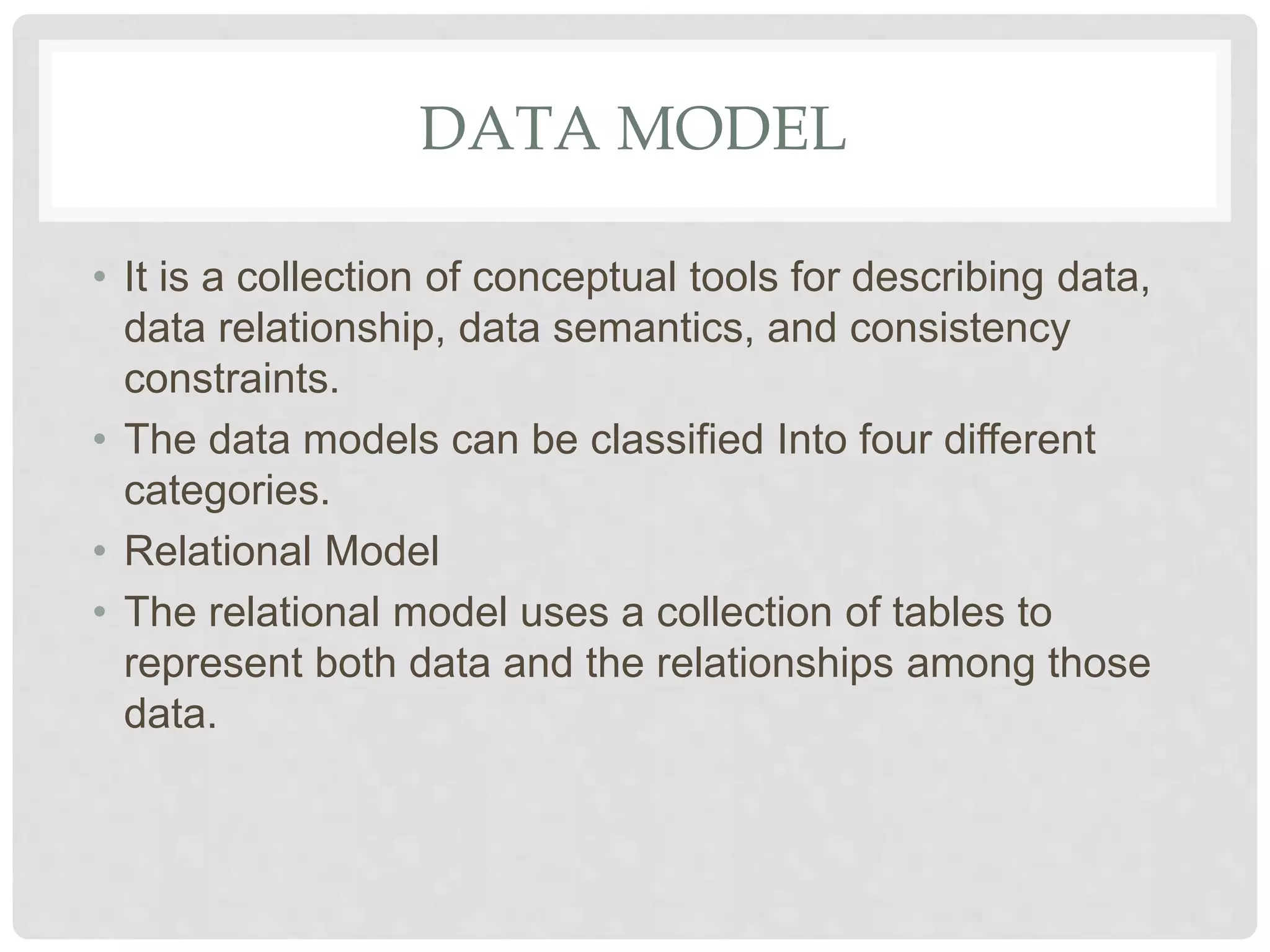
• It is a collection of conceptual tools for describing data,
data relationship, data semantics, and consistency
constraints.
• The data models can be classified Into four different
categories.
• Relational Model
• The relational model uses a collection of tables to
represent both data and the relationships among those
data.
DATA MODEL(CONT..)
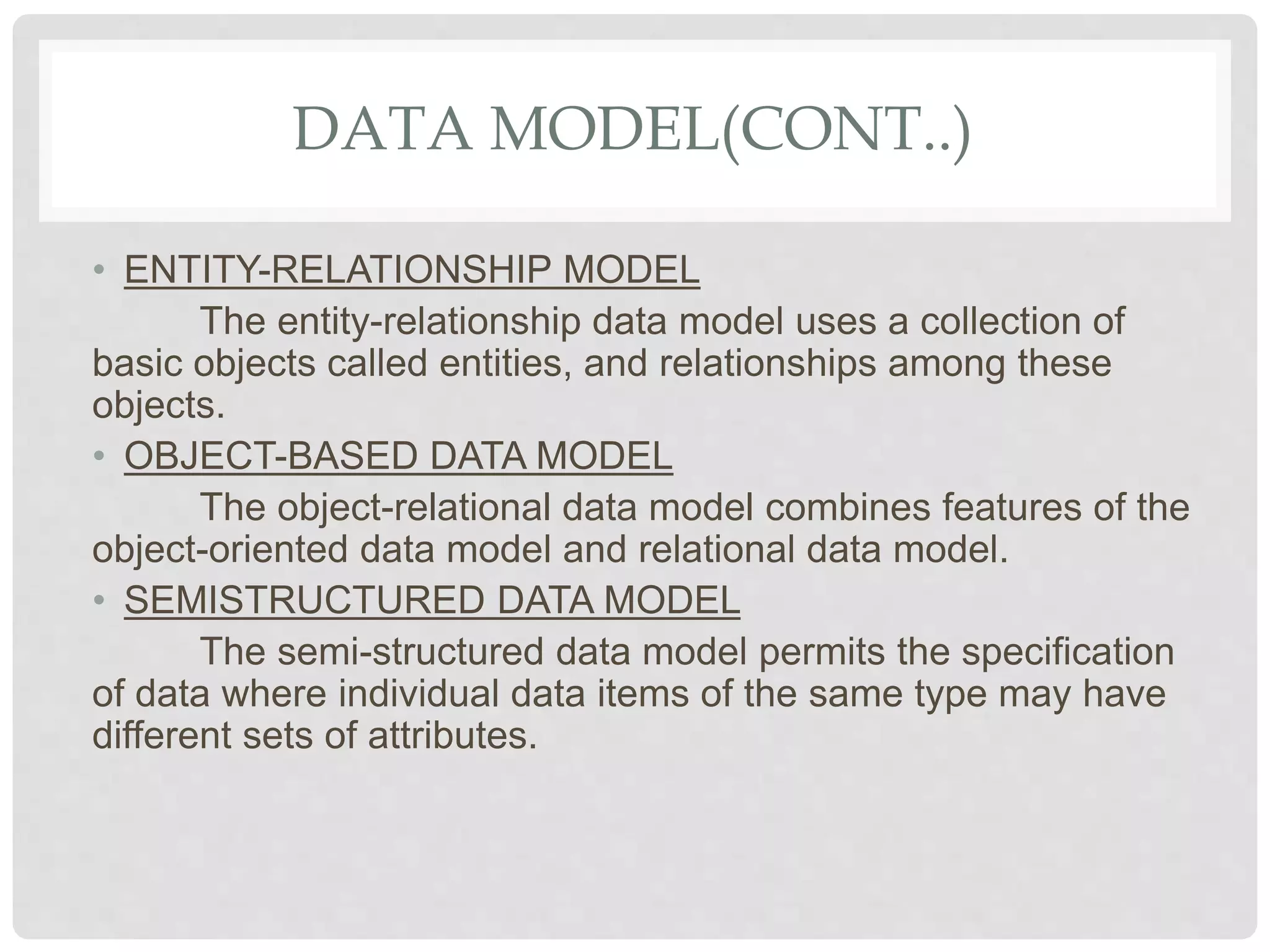
• ENTITY-RELATIONSHIP MODEL
The entity-relationship data model uses a collection of
basic objects called entities, and relationships among these
objects.
• OBJECT-BASED DATA MODEL
The object-relational data model combines features of the
object-oriented data model and relational data model.
• SEMISTRUCTURED DATA MODEL
The semi-structured data model permits the specification
of data where individual data items of the same type may have
different sets of attributes.
DATABASE LANGUAGES
• A database system provides a data-definition language
to specify the database schema and a data-manipulation
language to express database queries and updates.
• A data manipulation language (DML) is a language that
enables users to access or manipulate data as
organized by the appropriate data model.
DATA MANIPULATION LANGUAGE
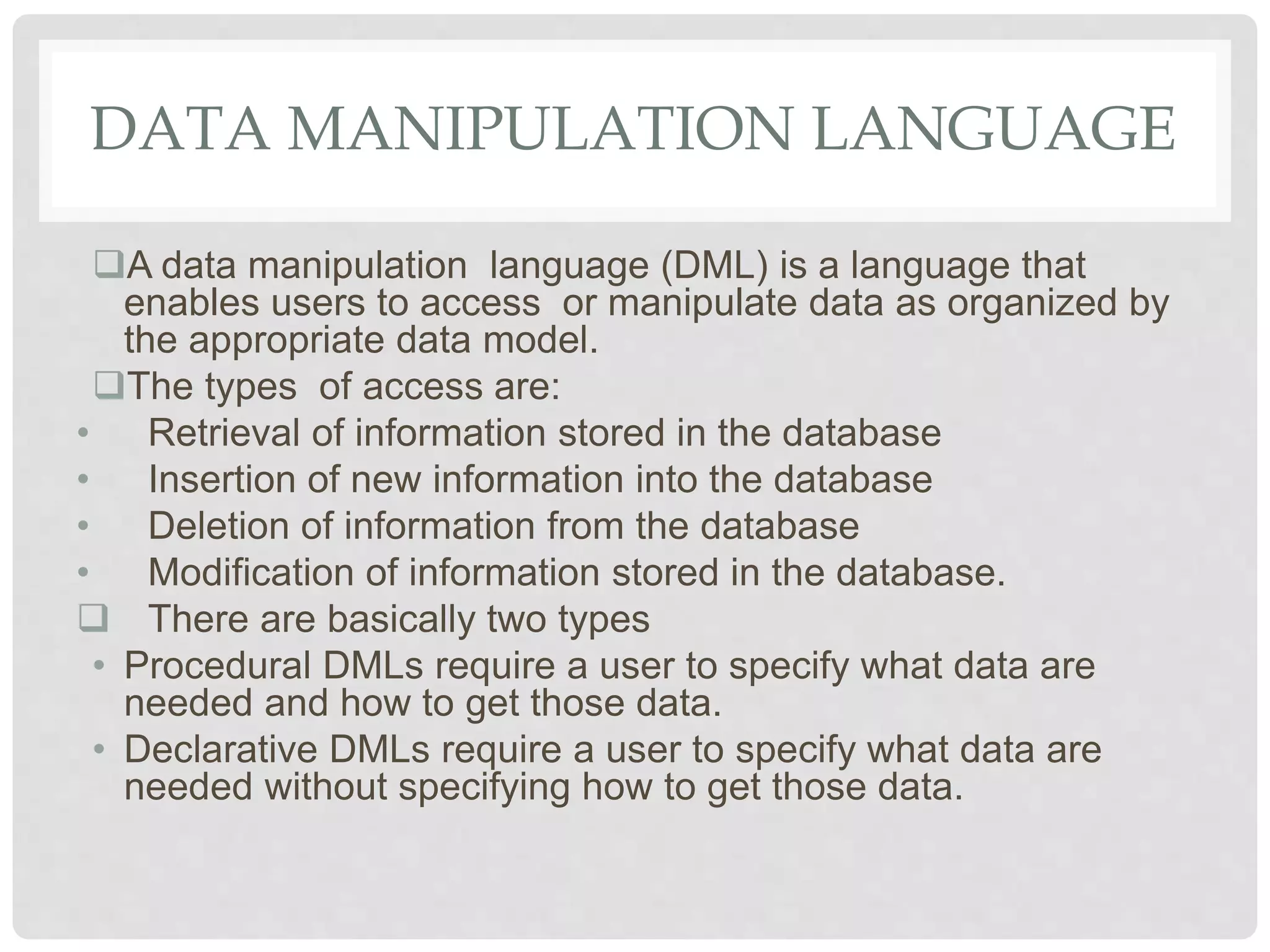
A data manipulation language (DML) is a language that
enables users to access or manipulate data as organized by
the appropriate data model.
The types of access are:
• Retrieval of information stored in the database
• Insertion of new information into the database
• Deletion of information from the database
• Modification of information stored in the database.
 There are basically two types
• Procedural DMLs require a user to specify what data are
needed and how to get those data.
• Declarative DMLs require a user to specify what data are
needed without specifying how to get those data.
DATA DEFINITION LANGUAGE
• We specify a database schema by a set of definitions
expressed by a special language called a data definition
language(DDL).
• The DDL provides facilities to specify such constraints.
• Domain constraints
• Referential Integrity
• Assertions
• Authorization
RELATIONAL DATABASES
• A relational database is based on the relational model
and uses a collection of tables to represent data and the
relationships among those data.
Tables
• Each table has multiple columns and each column has a
unique name.
• The relational model is an example of a record-based
model. Record-based models are so named because the
database is structured in fixed-format records of several
types.
DATA STORAGE AND QUERYING
• A database system is partitioned into modules that deal
with each of the responsibilities of the overall system.
• The functional components of a database system can be
broadly divided into the storage manager and the query
processor components.
• The storage manager is important because typically
require a large amount of storage space.
• The query processor is important because it helps the
database system to simplify and facilitates access to
data.
STORAGE MANAGER
• The storage manager is the component of a database
system provides the interface between the low-level
data stored in the database and the application
programs an queries submitted to the system.
• Thus, the storage manager is responsible for storing,
retrieving and updating data in the database.
QUERY PROCESSOR
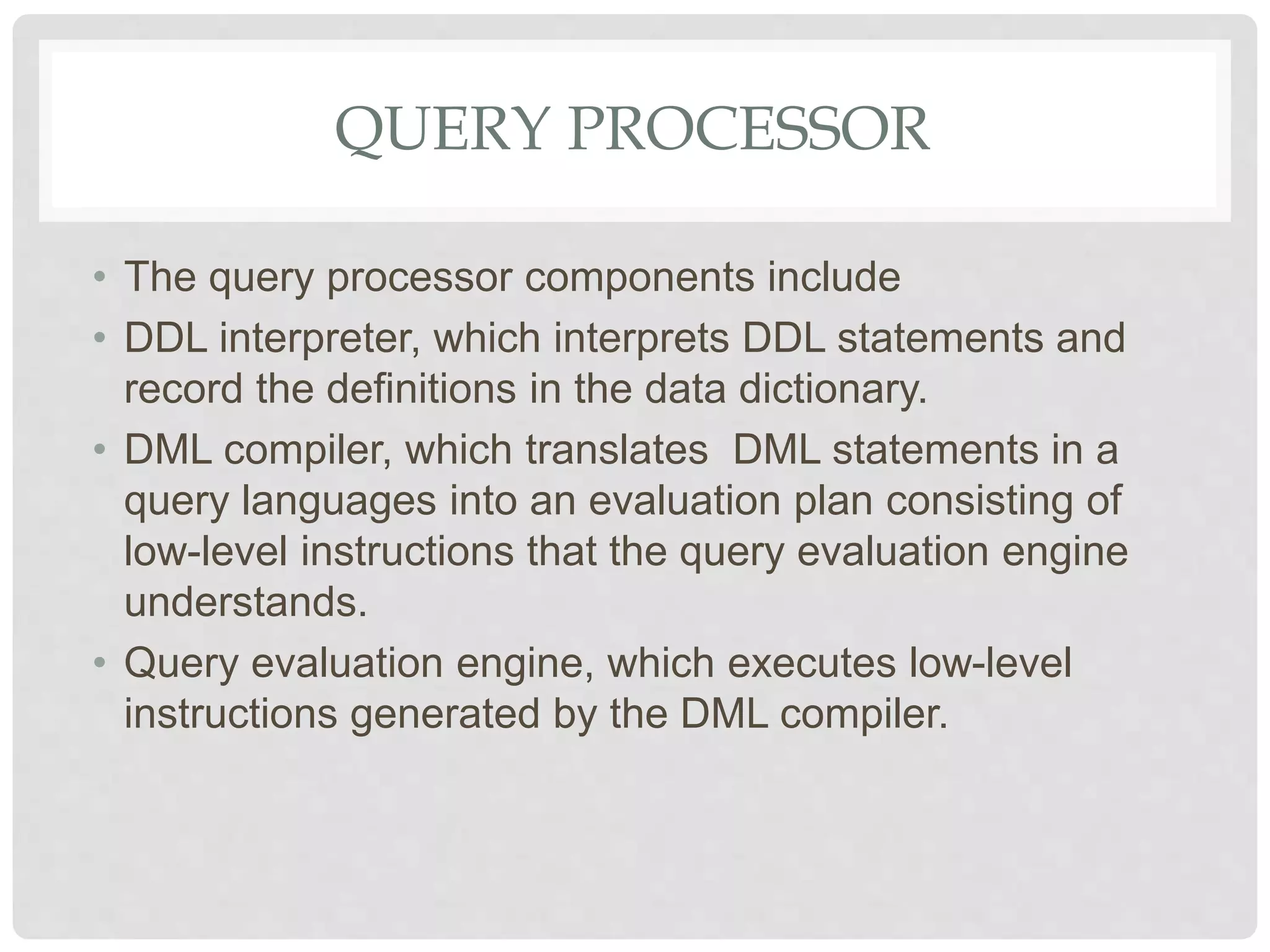
• The query processor components include
• DDL interpreter, which interprets DDL statements and
record the definitions in the data dictionary.
• DML compiler, which translates DML statements in a
query languages into an evaluation plan consisting of
low-level instructions that the query evaluation engine
understands.
• Query evaluation engine, which executes low-level
instructions generated by the DML compiler.
TRANSACTION MANAGEMENT
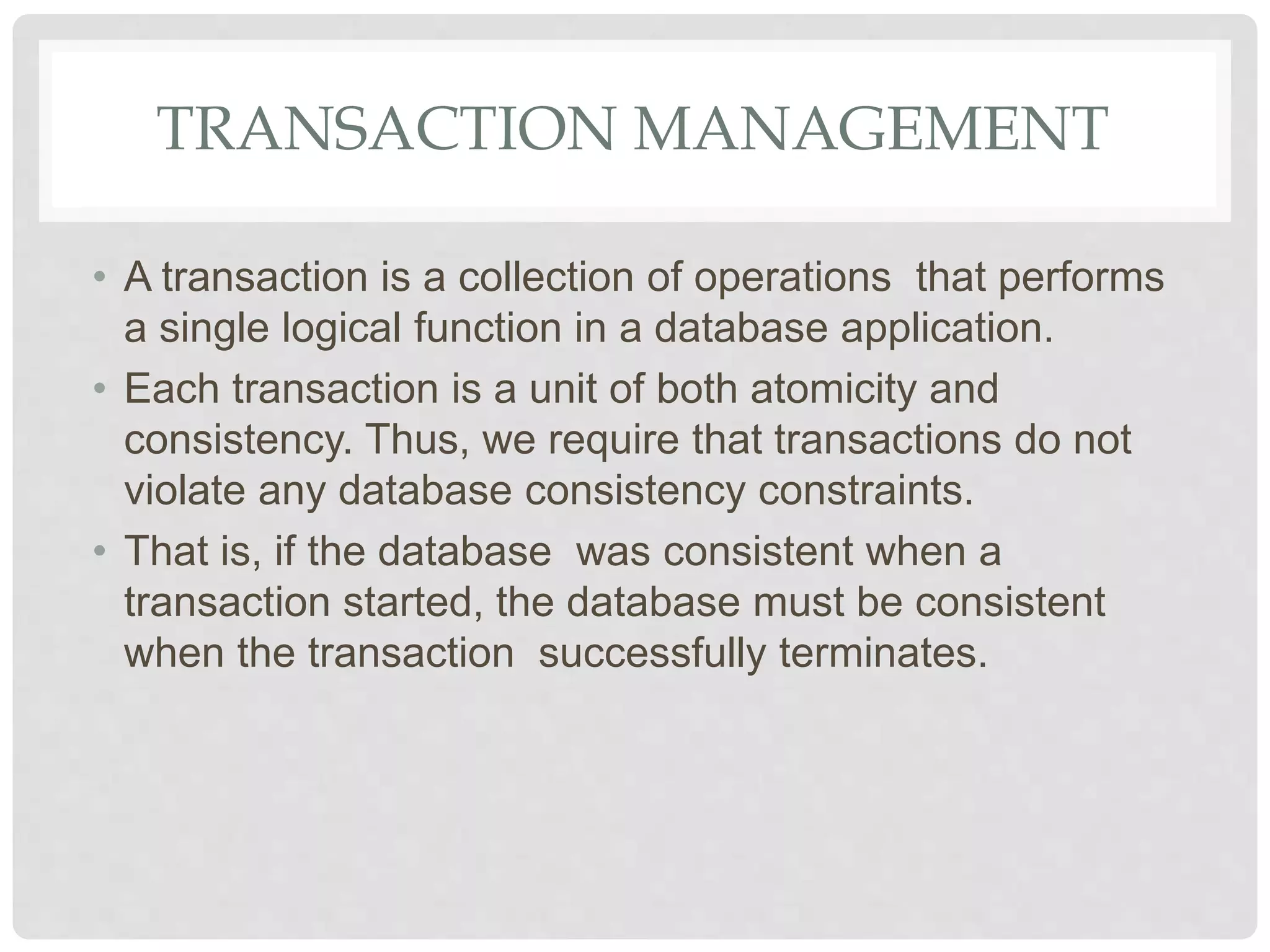
• A transaction is a collection of operations that performs
a single logical function in a database application.
• Each transaction is a unit of both atomicity and
consistency. Thus, we require that transactions do not
violate any database consistency constraints.
• That is, if the database was consistent when a
transaction started, the database must be consistent
when the transaction successfully terminates.
DATABASE ARCHITECTURE
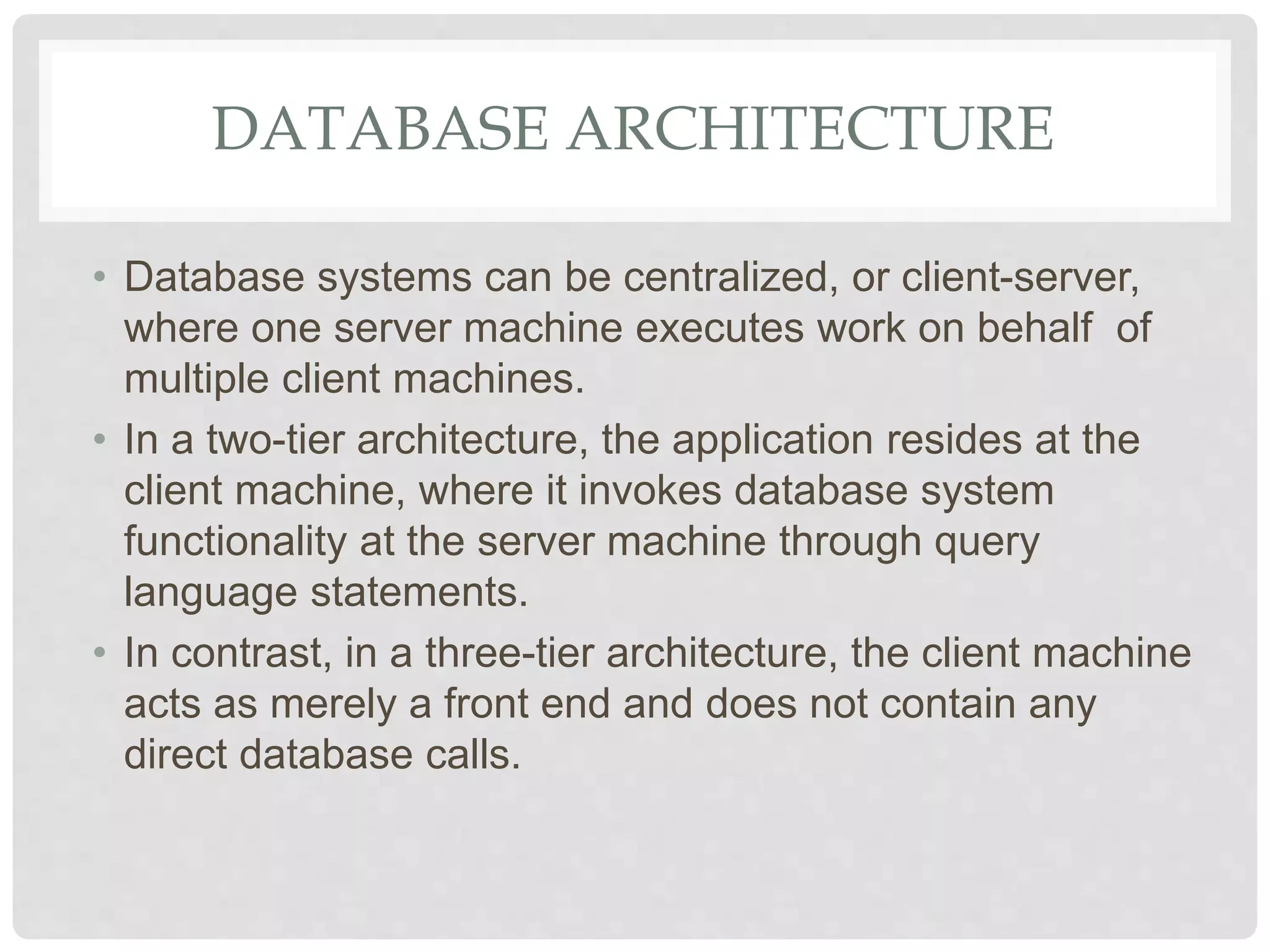
• Database systems can be centralized, or client-server,
where one server machine executes work on behalf of
multiple client machines.
• In a two-tier architecture, the application resides at the
client machine, where it invokes database system
functionality at the server machine through query
language statements.
• In contrast, in a three-tier architecture, the client machine
acts as merely a front end and does not contain any
direct database calls.
DATABASE USERS AND
ADMINISTRATORS
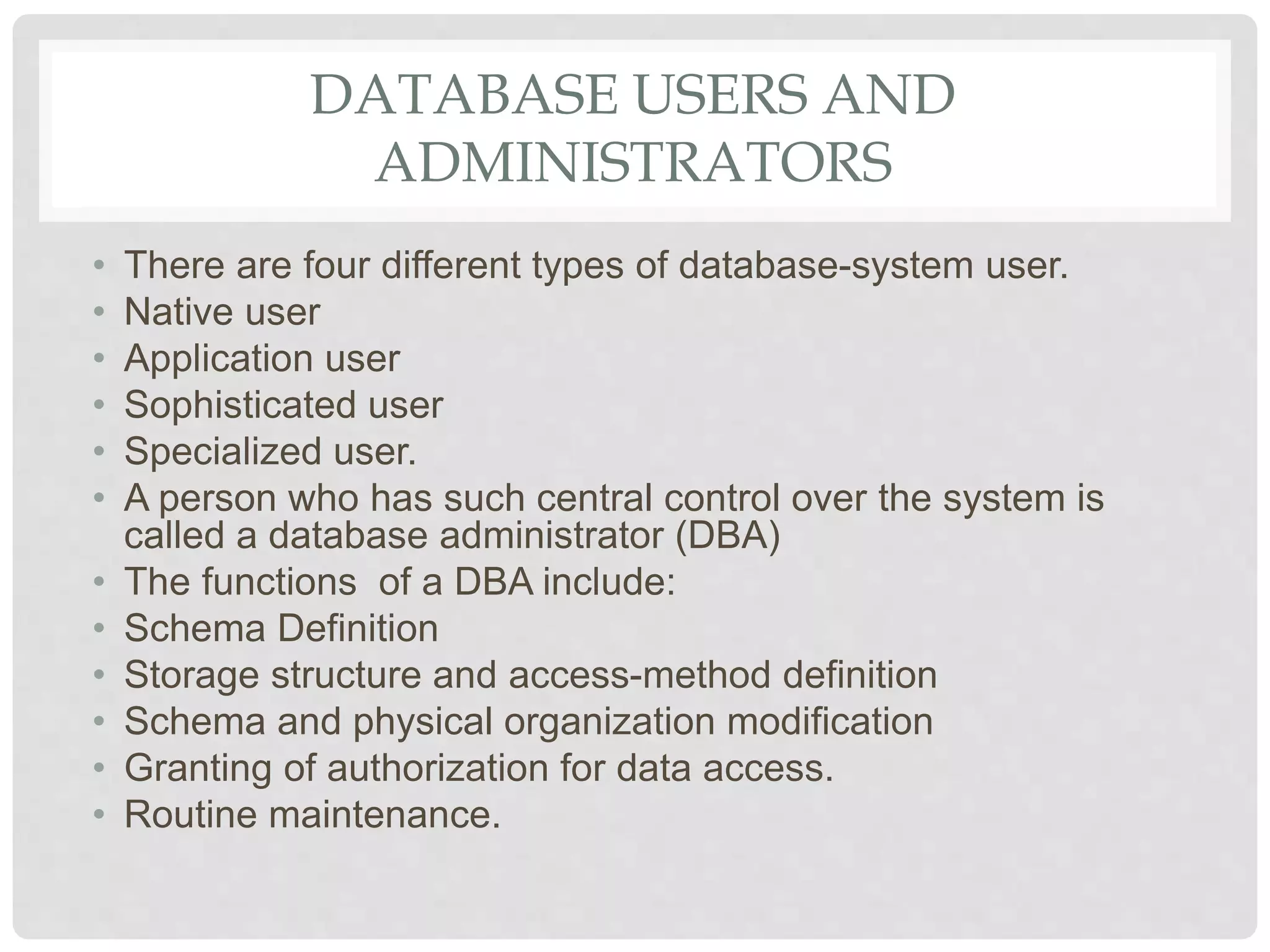
• There are four different types of database-system user.
• Native user
• Application user
• Sophisticated user
• Specialized user.
• A person who has such central control over the system is
called a database administrator (DBA)
• The functions of a DBA include:
• Schema Definition
• Storage structure and access-method definition
• Schema and physical organization modification
• Granting of authorization for data access.
• Routine maintenance.
Introduction of Database

Introduction of Database

  • 1.
    • Paper Name:Database System • Staff Name : Ms. D. Saritha M.C.A., M.phil., • Class: II Year • Semester: IV • Unit: I • Topic: Introduction Of Database
  • 3.
    DATABASE MANAGEMENT SYSTEM •A database-management system (DBMS) is a collection of interrelated data and a set of programs to access those data. • The primary goal of a DBMS is to provide a way to store and retrieve database information that is both convenient and efficient. • Management of data involves both defining structures for storage of information and providing mechanisms for the manipulation of information. • If data are to be shared among several users, the system must avoid possible anomalous results.
  • 4.
    DATABASE SYSTEM APPLICATION Databasesare widely used. Here are some representative applications. • Enterprise Information  sales  Accounting  Human Resources  Manufacturing  Online retailers. • Banking and Finance  Banking  Credit card transactions  Finance • Universities • Airlines • Telecommunication
  • 5.
    PURPOSE OF DATABASESYSTEMS • Database systems arose in response to early methods of computerized management of commercial data. • There are some main purpose of Database system as follows. Data redundancy and inconsistency. Difficulty in accessing data. Data isolation Integrity problems. Atomicity problems. Concurrent-access anomalies. Security problems.
  • 6.
    VIEW OF DATA •A major purpose of a database system is to provide users with an abstract view of the data. Data Abstraction • Since many database-system users are not computer trained, developers hide the complexity from users through several levels of abstraction ,to simply users interactions with the system. • There are main three views to show the data to users. Physical level. Logical level. View level.
  • 7.
    . VIEW 1 VIEW2 VIEW n LOGICAL VIEW PHYSICAL VIEW VIEW LEVEL … ….
  • 8.
    INSTANCES AND SCHEMAS •Database change over time as information is inserted and deleted. • The collection of information stored in the database at a particular moment is called instance of the database. • The overall design of the database is called the schema.
  • 9.
    DATA MODEL • Itis a collection of conceptual tools for describing data, data relationship, data semantics, and consistency constraints. • The data models can be classified Into four different categories. • Relational Model • The relational model uses a collection of tables to represent both data and the relationships among those data.
  • 10.
    DATA MODEL(CONT..) • ENTITY-RELATIONSHIPMODEL The entity-relationship data model uses a collection of basic objects called entities, and relationships among these objects. • OBJECT-BASED DATA MODEL The object-relational data model combines features of the object-oriented data model and relational data model. • SEMISTRUCTURED DATA MODEL The semi-structured data model permits the specification of data where individual data items of the same type may have different sets of attributes.
  • 11.
    DATABASE LANGUAGES • Adatabase system provides a data-definition language to specify the database schema and a data-manipulation language to express database queries and updates. • A data manipulation language (DML) is a language that enables users to access or manipulate data as organized by the appropriate data model.
  • 12.
    DATA MANIPULATION LANGUAGE Adata manipulation language (DML) is a language that enables users to access or manipulate data as organized by the appropriate data model. The types of access are: • Retrieval of information stored in the database • Insertion of new information into the database • Deletion of information from the database • Modification of information stored in the database.  There are basically two types • Procedural DMLs require a user to specify what data are needed and how to get those data. • Declarative DMLs require a user to specify what data are needed without specifying how to get those data.
  • 13.
    DATA DEFINITION LANGUAGE •We specify a database schema by a set of definitions expressed by a special language called a data definition language(DDL). • The DDL provides facilities to specify such constraints. • Domain constraints • Referential Integrity • Assertions • Authorization
  • 14.
    RELATIONAL DATABASES • Arelational database is based on the relational model and uses a collection of tables to represent data and the relationships among those data. Tables • Each table has multiple columns and each column has a unique name. • The relational model is an example of a record-based model. Record-based models are so named because the database is structured in fixed-format records of several types.
  • 15.
    DATA STORAGE ANDQUERYING • A database system is partitioned into modules that deal with each of the responsibilities of the overall system. • The functional components of a database system can be broadly divided into the storage manager and the query processor components. • The storage manager is important because typically require a large amount of storage space. • The query processor is important because it helps the database system to simplify and facilitates access to data.
  • 16.
    STORAGE MANAGER • Thestorage manager is the component of a database system provides the interface between the low-level data stored in the database and the application programs an queries submitted to the system. • Thus, the storage manager is responsible for storing, retrieving and updating data in the database.
  • 17.
    QUERY PROCESSOR • Thequery processor components include • DDL interpreter, which interprets DDL statements and record the definitions in the data dictionary. • DML compiler, which translates DML statements in a query languages into an evaluation plan consisting of low-level instructions that the query evaluation engine understands. • Query evaluation engine, which executes low-level instructions generated by the DML compiler.
  • 18.
    TRANSACTION MANAGEMENT • Atransaction is a collection of operations that performs a single logical function in a database application. • Each transaction is a unit of both atomicity and consistency. Thus, we require that transactions do not violate any database consistency constraints. • That is, if the database was consistent when a transaction started, the database must be consistent when the transaction successfully terminates.
  • 19.
    DATABASE ARCHITECTURE • Databasesystems can be centralized, or client-server, where one server machine executes work on behalf of multiple client machines. • In a two-tier architecture, the application resides at the client machine, where it invokes database system functionality at the server machine through query language statements. • In contrast, in a three-tier architecture, the client machine acts as merely a front end and does not contain any direct database calls.
  • 20.
    DATABASE USERS AND ADMINISTRATORS •There are four different types of database-system user. • Native user • Application user • Sophisticated user • Specialized user. • A person who has such central control over the system is called a database administrator (DBA) • The functions of a DBA include: • Schema Definition • Storage structure and access-method definition • Schema and physical organization modification • Granting of authorization for data access. • Routine maintenance.