1
Module-1
Introduction to Database
08/26/2025 2
 Types of Databases and Database Applications
 Basic Definitions
 Typical DBMS Functionality
 Example of a Database (UNIVERSITY)
 Main Characteristics of the Database Approach
 Database Users
 Advantages of Using the Database Approach
 When Not to Use Databases
Outline
08/26/2025 3
 Traditional Applications:
◦ Numeric and Textual Databases
 More Recent Applications:
◦ Multimedia Databases
◦ Geographic Information Systems (GIS)
◦ Data Warehouses
◦ Real-time and Active Databases
◦ Many other applications
Types of Databases and Database
Applications
08/26/2025 4
 Data:
◦ Known facts that can be recorded and have an implicit
meaning.
 Database:
◦ A collection of related data.
 Mini-world:
◦ Some part of the real world about which data is stored in a
database. For example, student grades and transcripts at a
university.
 Database Management System (DBMS):
◦ A software package/ system to facilitate the creation and
maintenance of a computerized database.
 Database System:
◦ The DBMS software together with the data itself. Sometimes,
the applications are also included.
Basic Definitions
08/26/2025 5
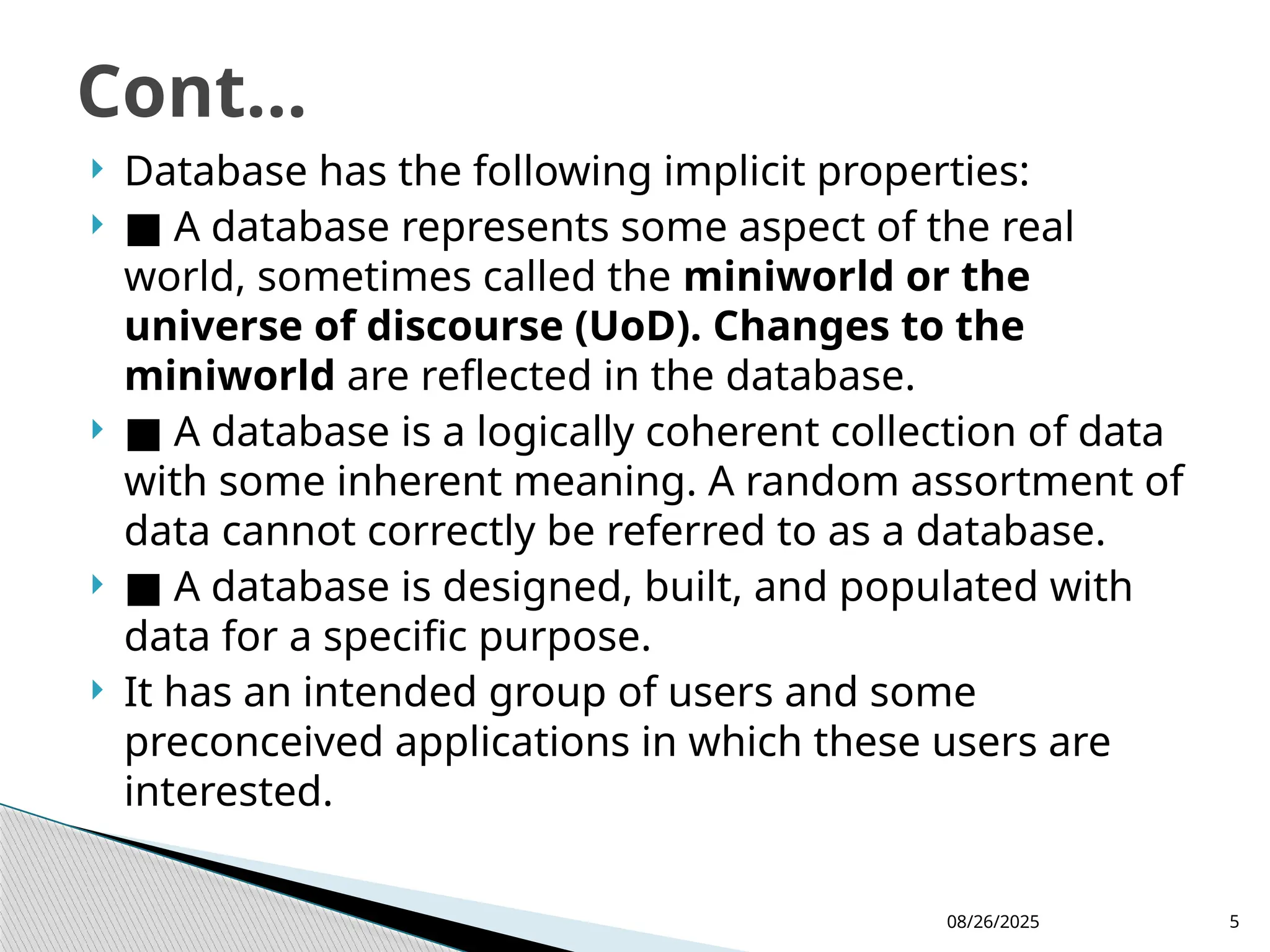
 Database has the following implicit properties:
 ■ A database represents some aspect of the real
world, sometimes called the miniworld or the
universe of discourse (UoD). Changes to the
miniworld are reflected in the database.
 ■ A database is a logically coherent collection of data
with some inherent meaning. A random assortment of
data cannot correctly be referred to as a database.
 ■ A database is designed, built, and populated with
data for a specific purpose.
 It has an intended group of users and some
preconceived applications in which these users are
interested.
Cont...
08/26/2025 6
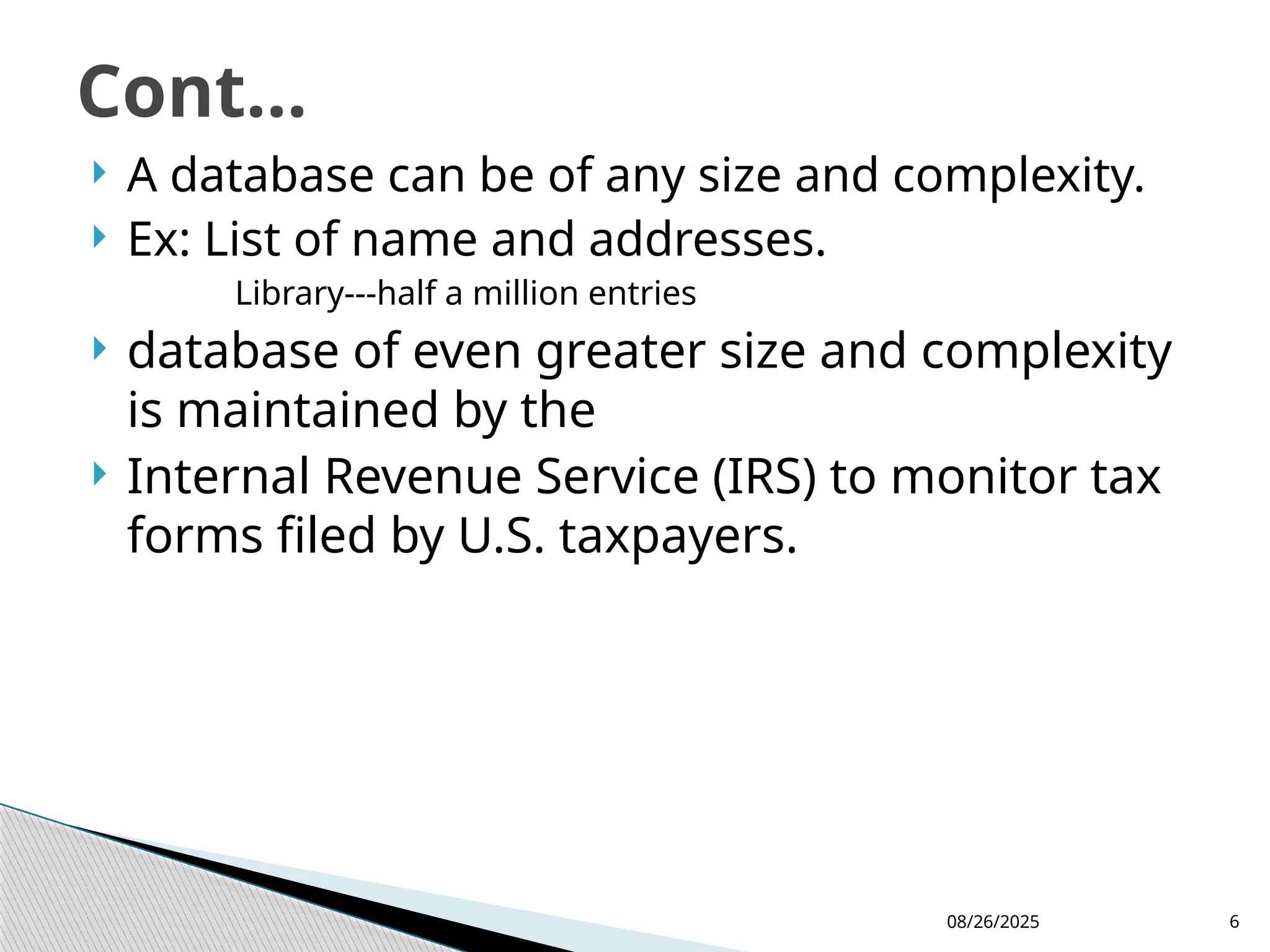
 A database can be of any size and complexity.
 Ex: List of name and addresses.
Library---half a million entries
 database of even greater size and complexity
is maintained by the
 Internal Revenue Service (IRS) to monitor tax
forms filed by U.S. taxpayers.
Cont...
08/26/2025 7
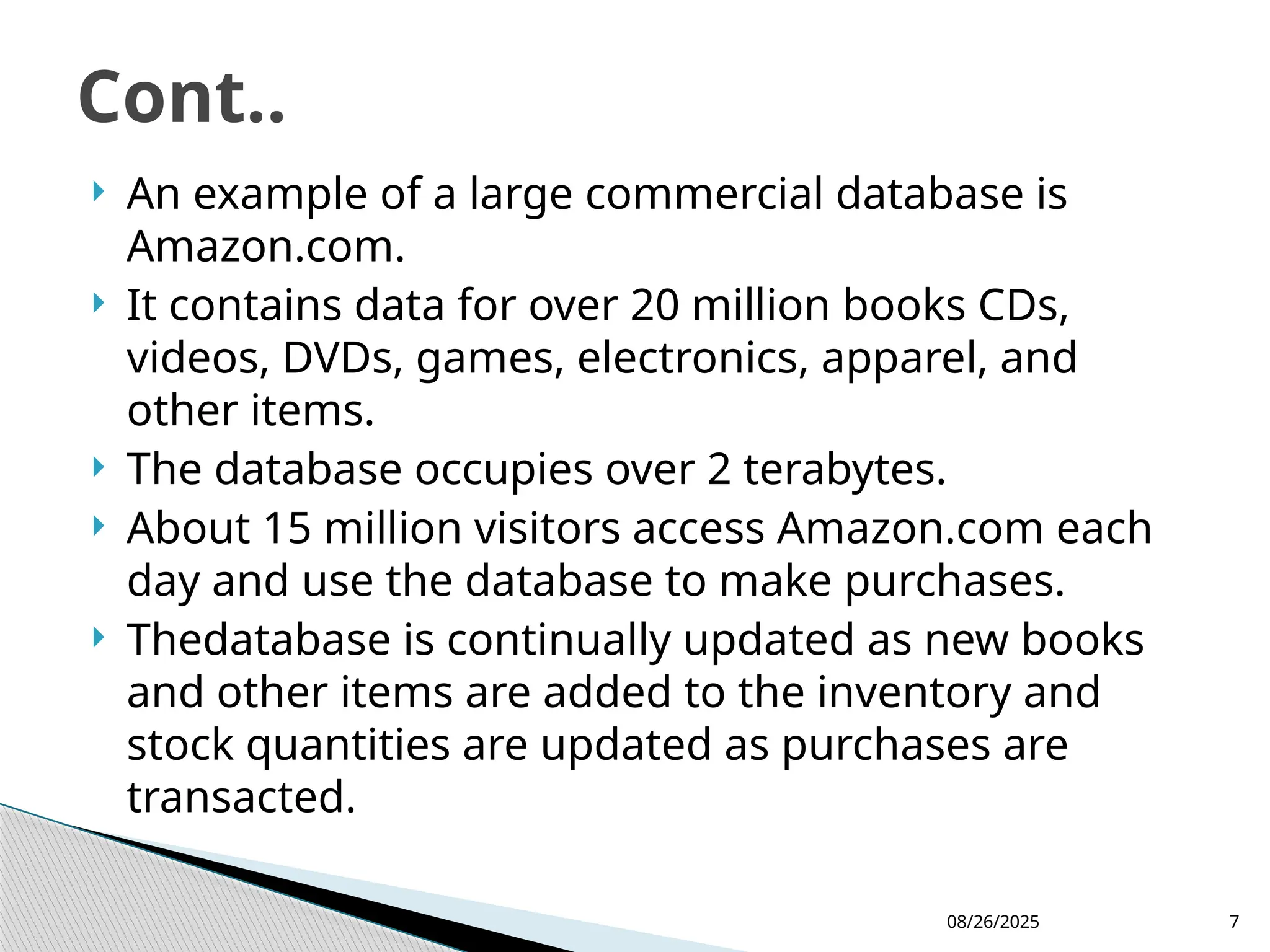
 An example of a large commercial database is
Amazon.com.
 It contains data for over 20 million books CDs,
videos, DVDs, games, electronics, apparel, and
other items.
 The database occupies over 2 terabytes.
 About 15 million visitors access Amazon.com each
day and use the database to make purchases.
 Thedatabase is continually updated as new books
and other items are added to the inventory and
stock quantities are updated as purchases are
transacted.
Cont..
08/26/2025 8
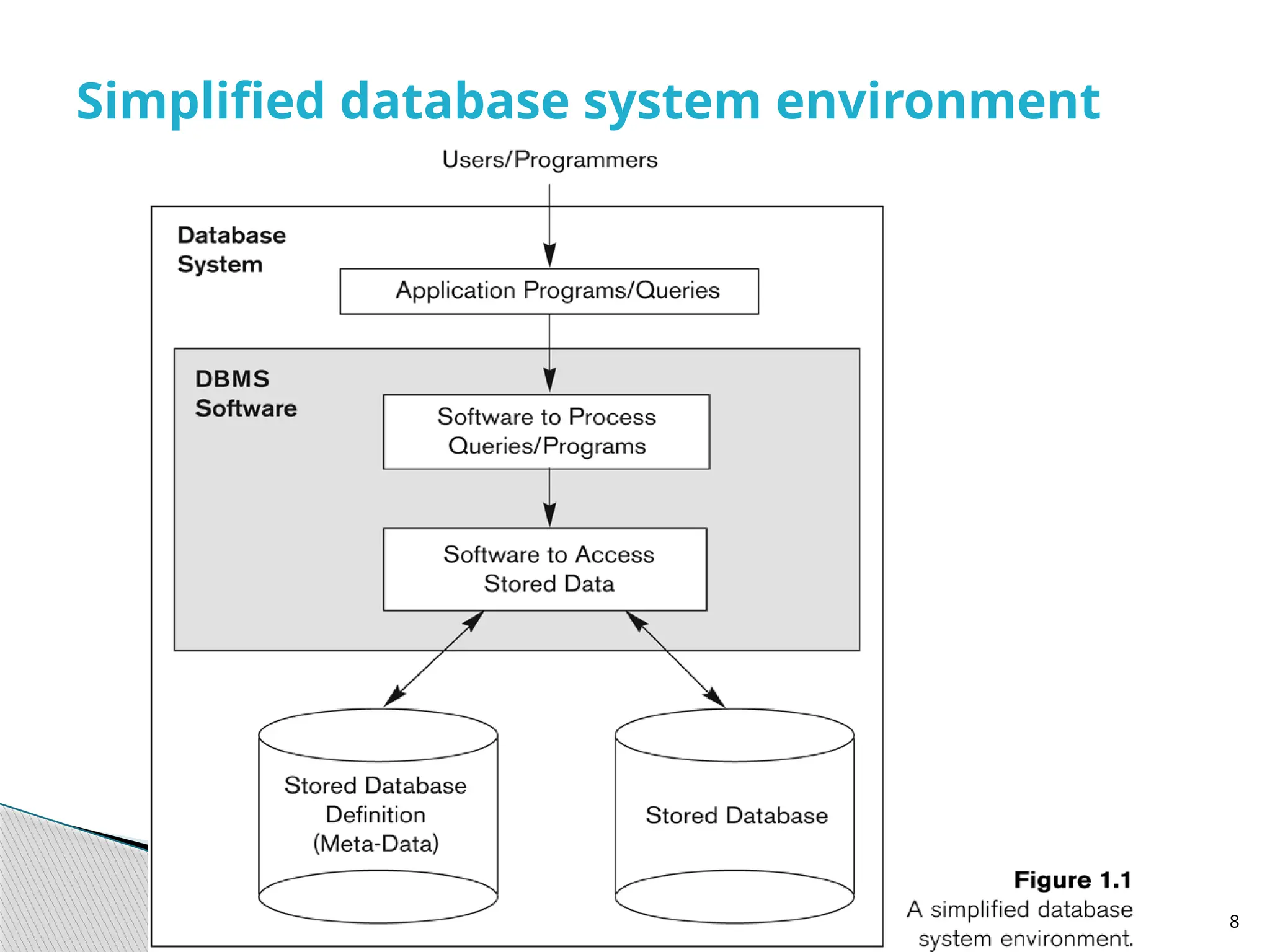
Simplified database system environment
08/26/2025 9
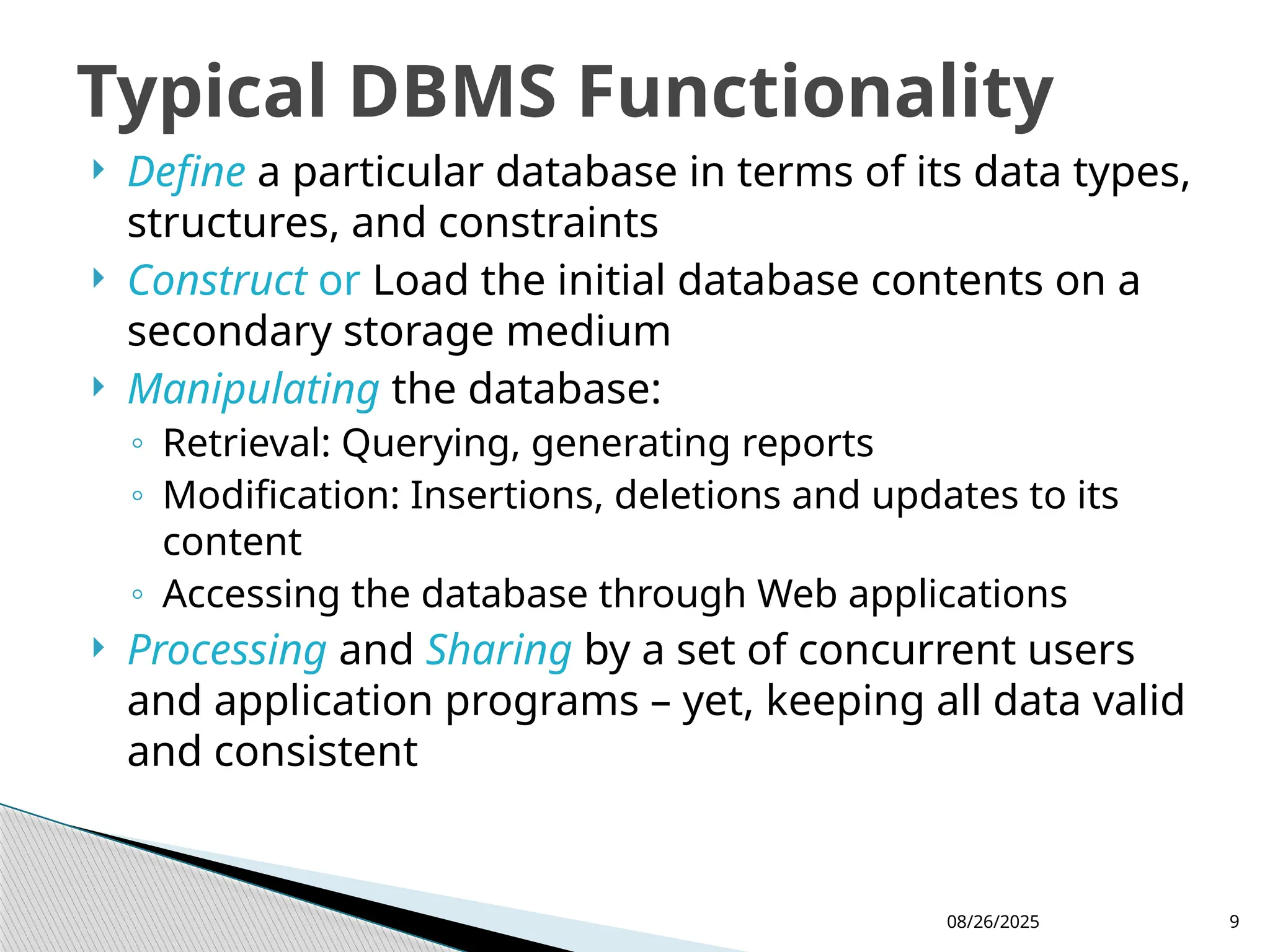
 Define a particular database in terms of its data types,
structures, and constraints
 Construct or Load the initial database contents on a
secondary storage medium
 Manipulating the database:
◦ Retrieval: Querying, generating reports
◦ Modification: Insertions, deletions and updates to its
content
◦ Accessing the database through Web applications
 Processing and Sharing by a set of concurrent users
and application programs – yet, keeping all data valid
and consistent
Typical DBMS Functionality
08/26/2025 10
 Other features:
◦ Protection or Security measures to prevent
unauthorized access
◦ “Active” processing to take internal actions on data
◦ Presentation and Visualization of data
◦ Maintaining the database and associated programs
over the lifetime of the database application
Cont...
08/26/2025 11
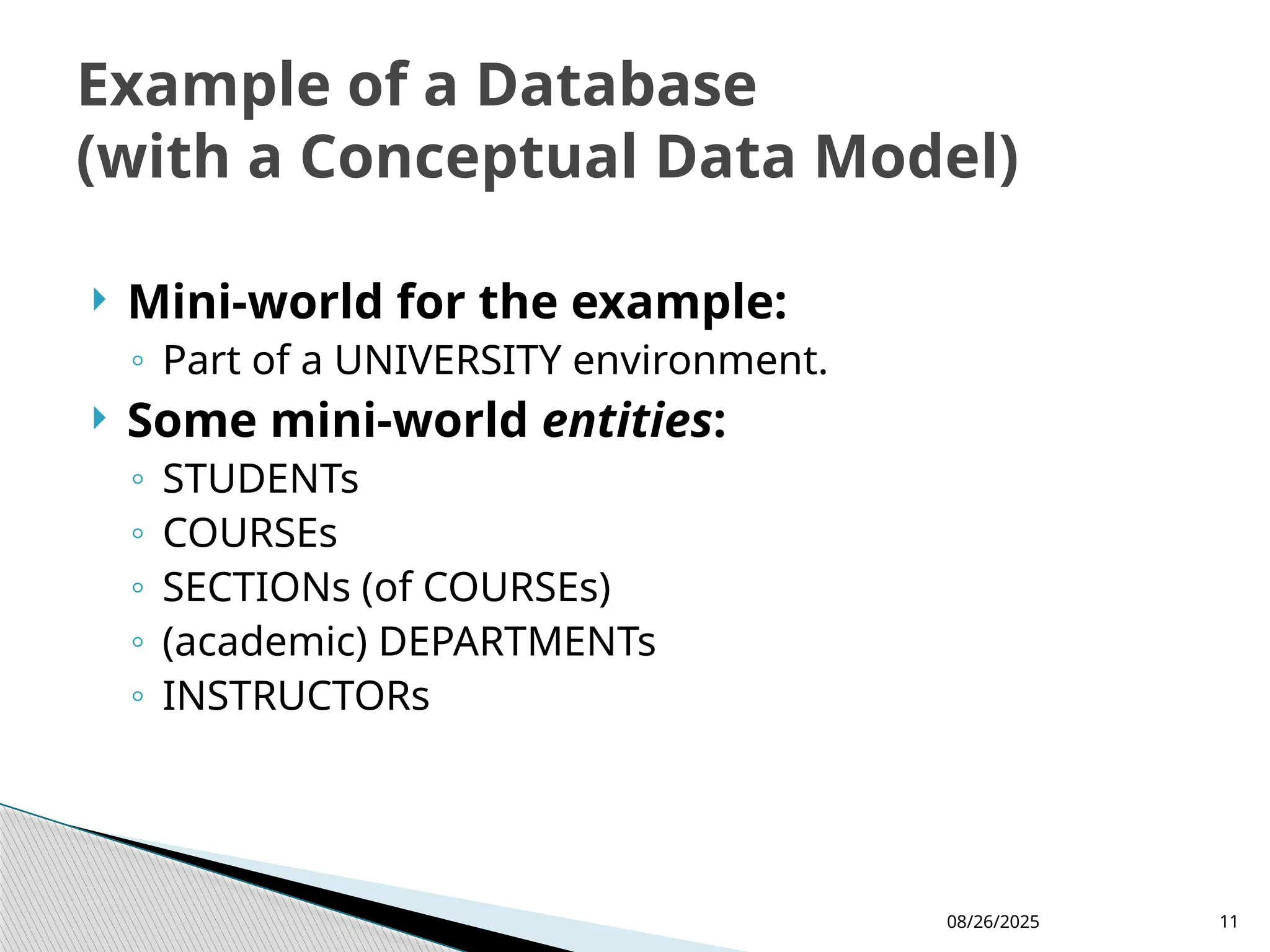
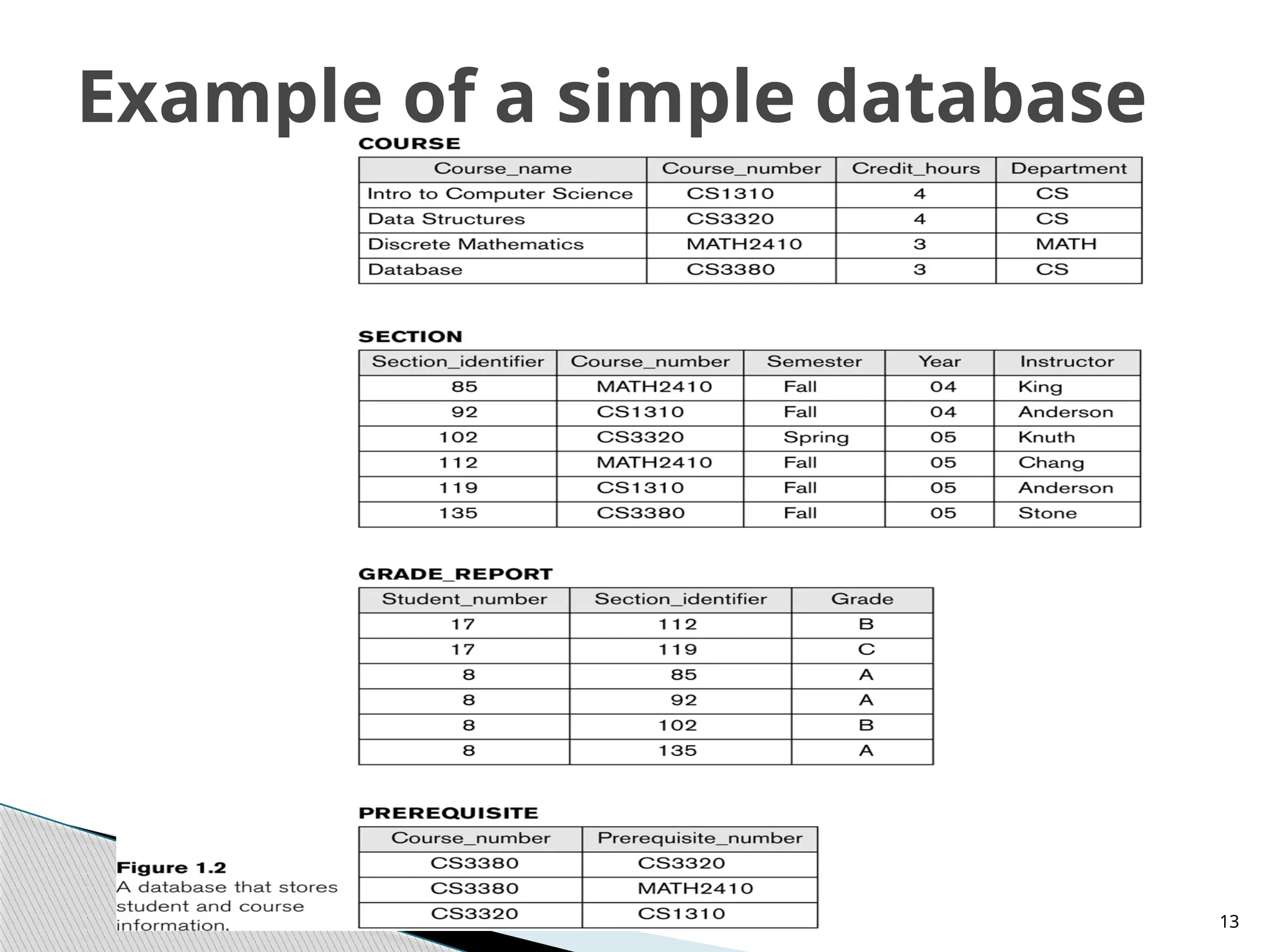
 Mini-world for the example:
◦ Part of a UNIVERSITY environment.
 Some mini-world entities:
◦ STUDENTs
◦ COURSEs
◦ SECTIONs (of COURSEs)
◦ (academic) DEPARTMENTs
◦ INSTRUCTORs
Example of a Database
(with a Conceptual Data Model)
08/26/2025 12
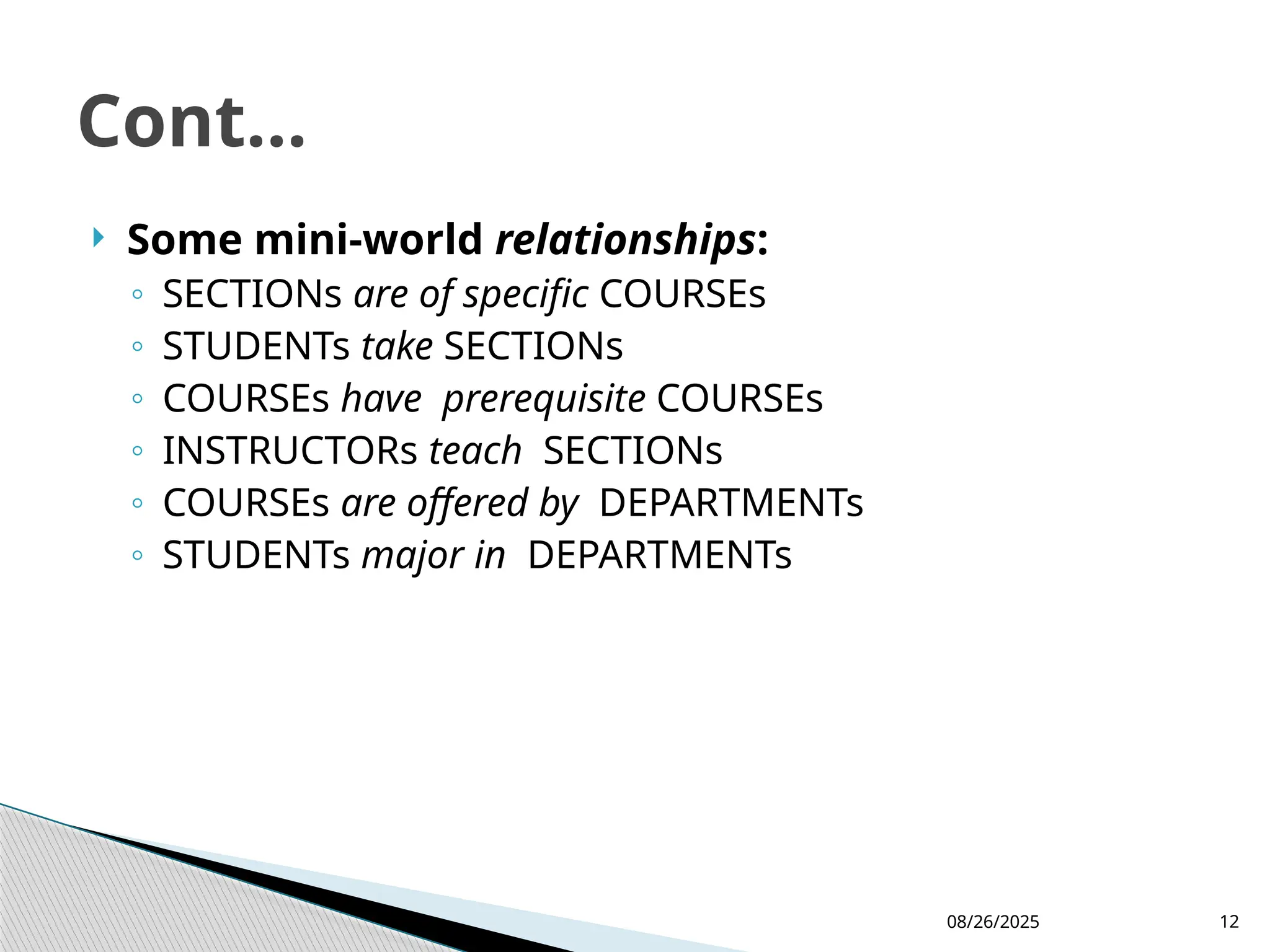
 Some mini-world relationships:
◦ SECTIONs are of specific COURSEs
◦ STUDENTs take SECTIONs
◦ COURSEs have prerequisite COURSEs
◦ INSTRUCTORs teach SECTIONs
◦ COURSEs are offered by DEPARTMENTs
◦ STUDENTs major in DEPARTMENTs
Cont...
08/26/2025 13
Example of a simple database
08/26/2025 14
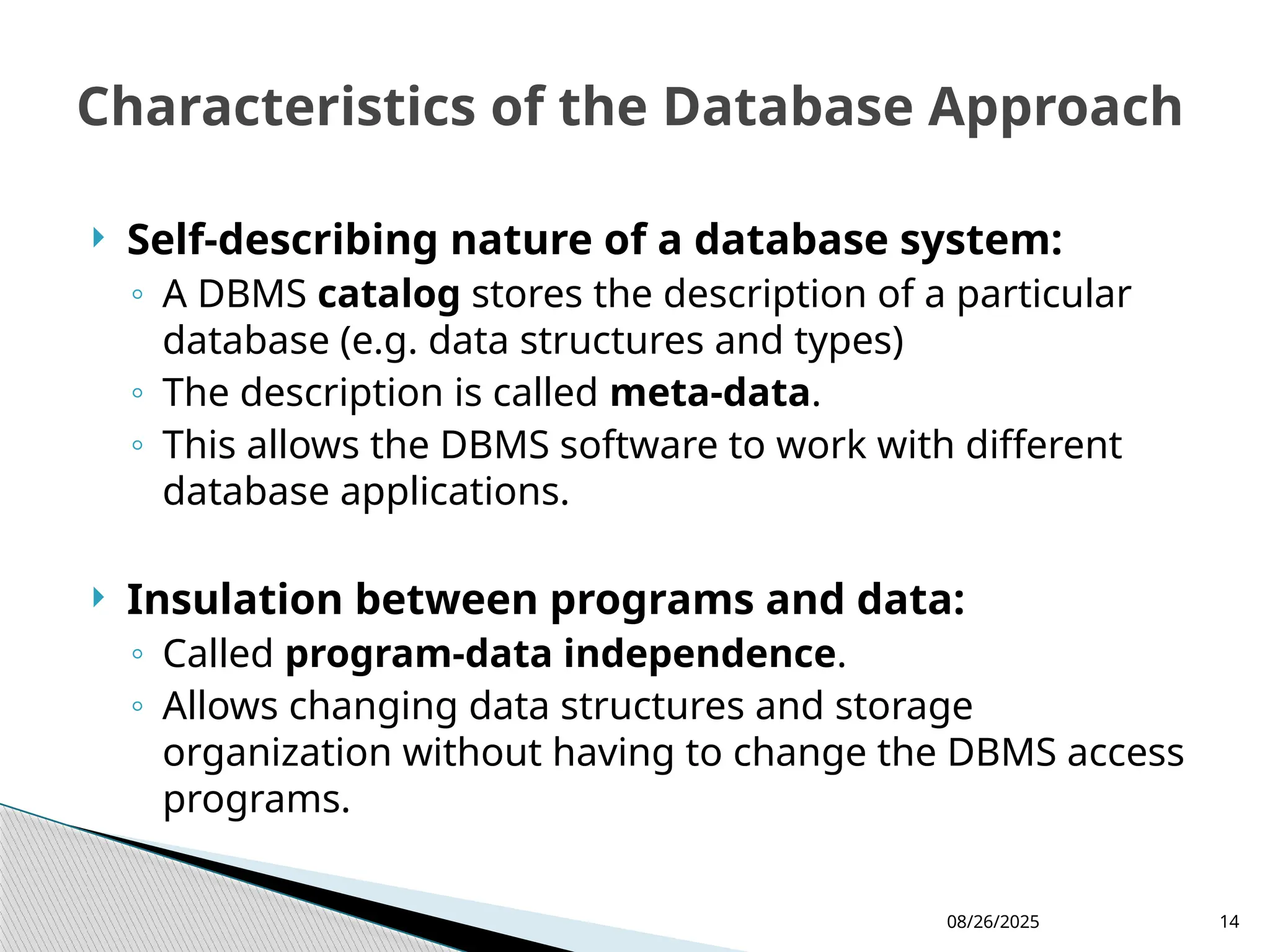
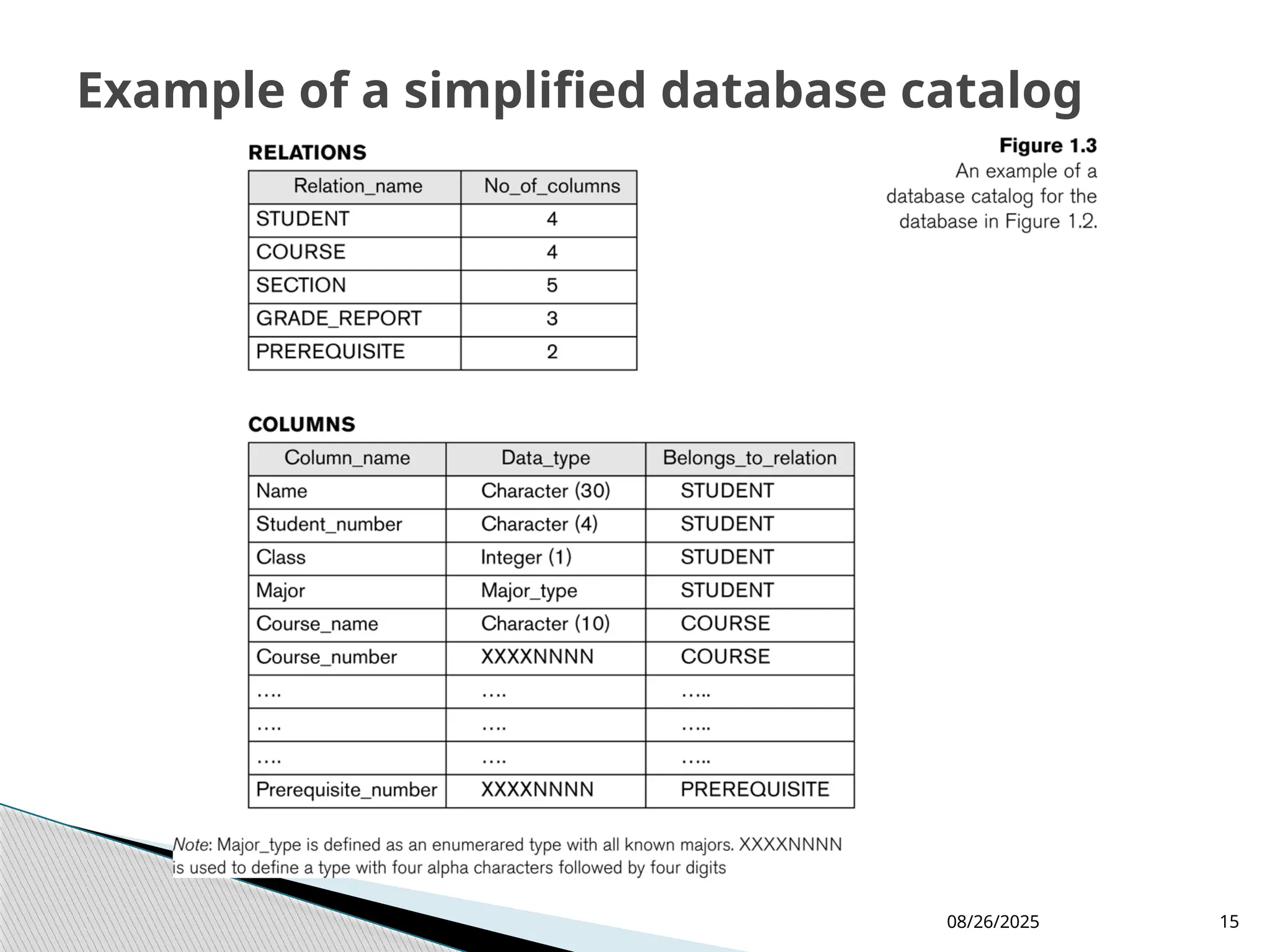
 Self-describing nature of a database system:
◦ A DBMS catalog stores the description of a particular
database (e.g. data structures and types)
◦ The description is called meta-data.
◦ This allows the DBMS software to work with different
database applications.
 Insulation between programs and data:
◦ Called program-data independence.
◦ Allows changing data structures and storage
organization without having to change the DBMS access
programs.
Characteristics of the Database Approach
08/26/2025 15
Example of a simplified database catalog
08/26/2025 16
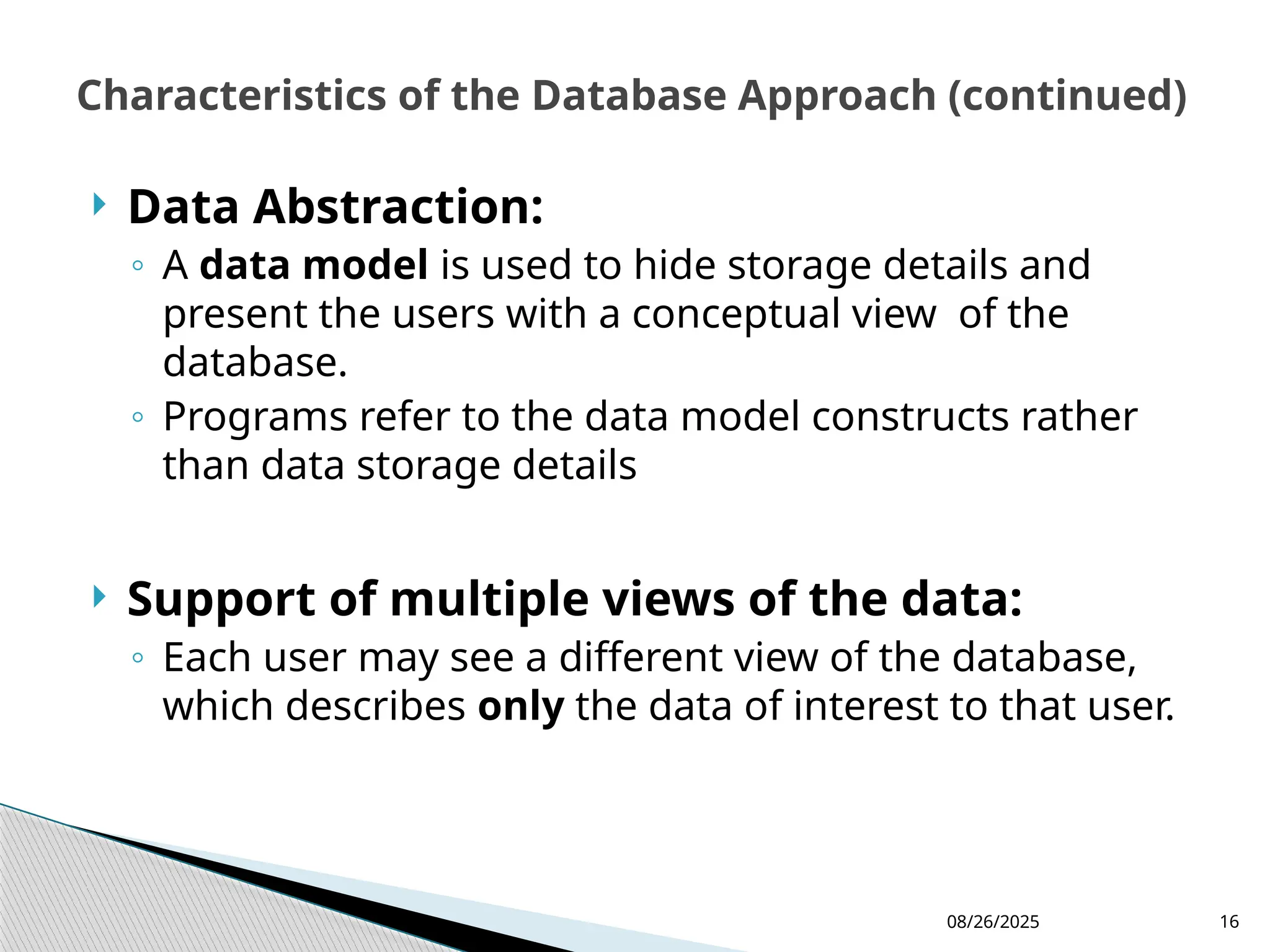
 Data Abstraction:
◦ A data model is used to hide storage details and
present the users with a conceptual view of the
database.
◦ Programs refer to the data model constructs rather
than data storage details
 Support of multiple views of the data:
◦ Each user may see a different view of the database,
which describes only the data of interest to that user.
Characteristics of the Database Approach (continued)
08/26/2025 17
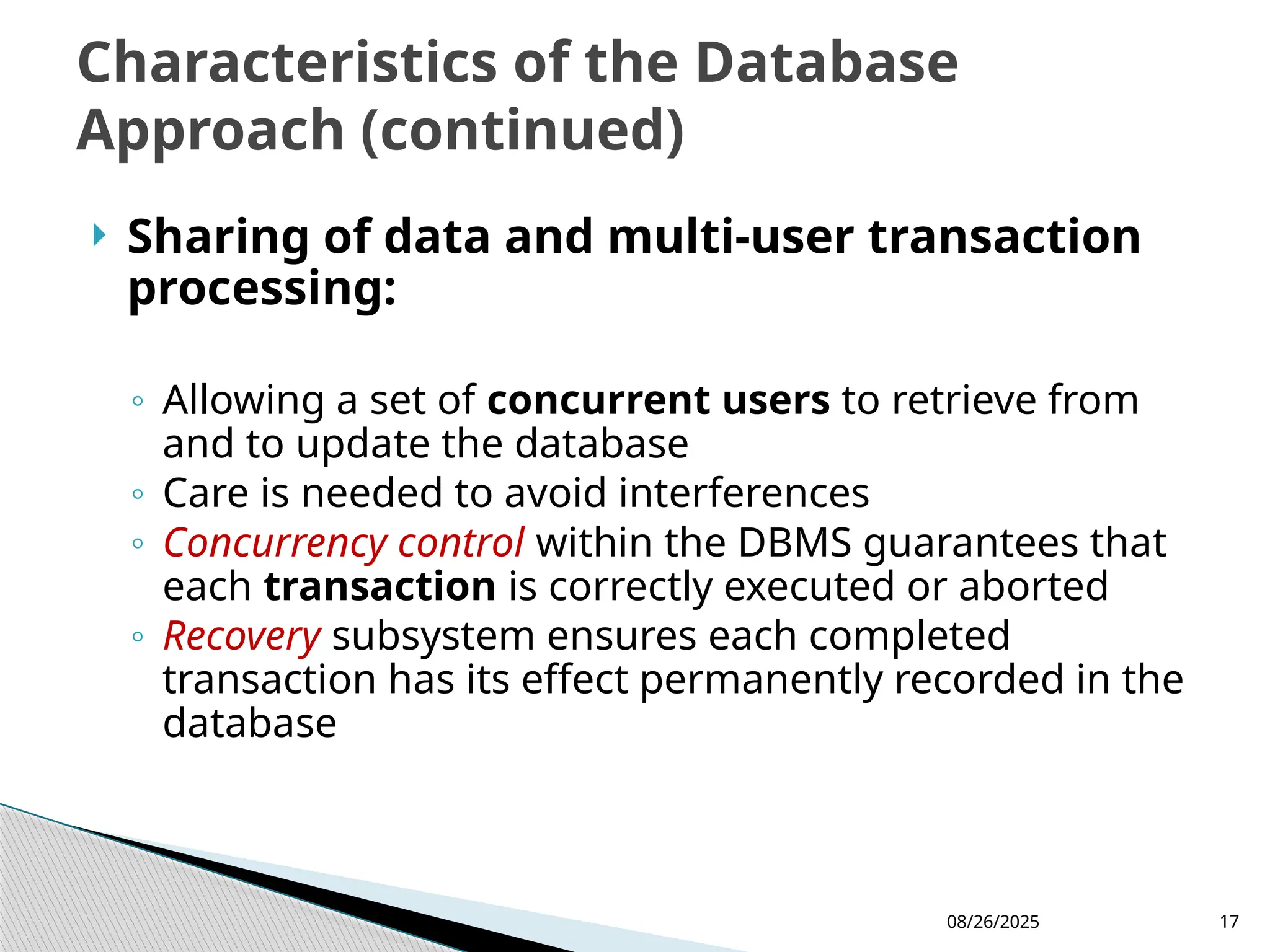
 Sharing of data and multi-user transaction
processing:
◦ Allowing a set of concurrent users to retrieve from
and to update the database
◦ Care is needed to avoid interferences
◦ Concurrency control within the DBMS guarantees that
each transaction is correctly executed or aborted
◦ Recovery subsystem ensures each completed
transaction has its effect permanently recorded in the
database
Characteristics of the Database
Approach (continued)
08/26/2025 18
 Users may be divided into
 Those who actually use and control the database
content, and those who design, develop and maintain
database applications (called “Actors on the Scene”),
and
 Those who design and develop the DBMS software and
related tools, and the computer systems operators
(called “Workers Behind the Scene”).
Database Users
08/26/2025 19
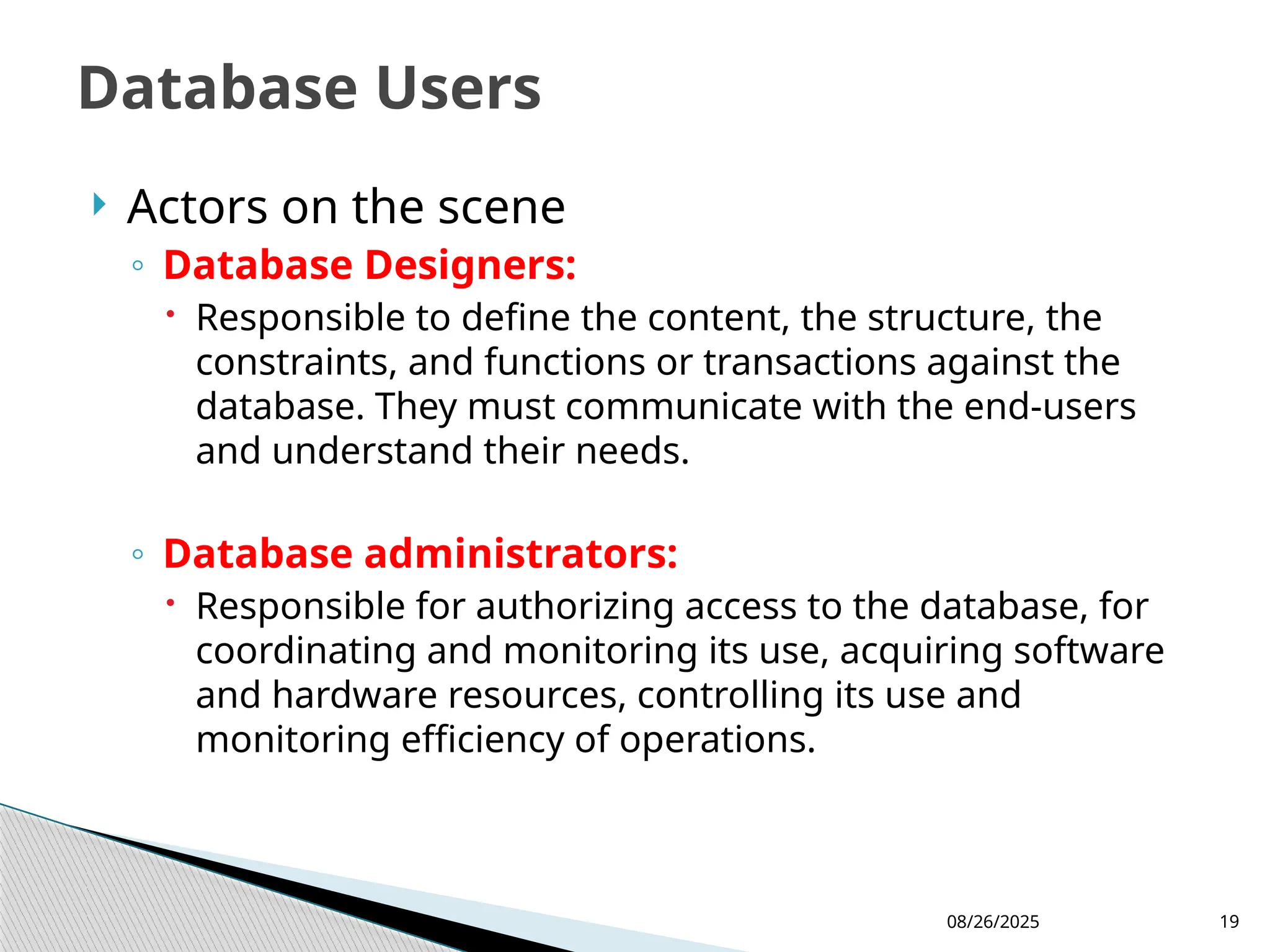
 Actors on the scene
◦ Database Designers:
 Responsible to define the content, the structure, the
constraints, and functions or transactions against the
database. They must communicate with the end-users
and understand their needs.
◦ Database administrators:
 Responsible for authorizing access to the database, for
coordinating and monitoring its use, acquiring software
and hardware resources, controlling its use and
monitoring efficiency of operations.
Database Users
08/26/2025 20
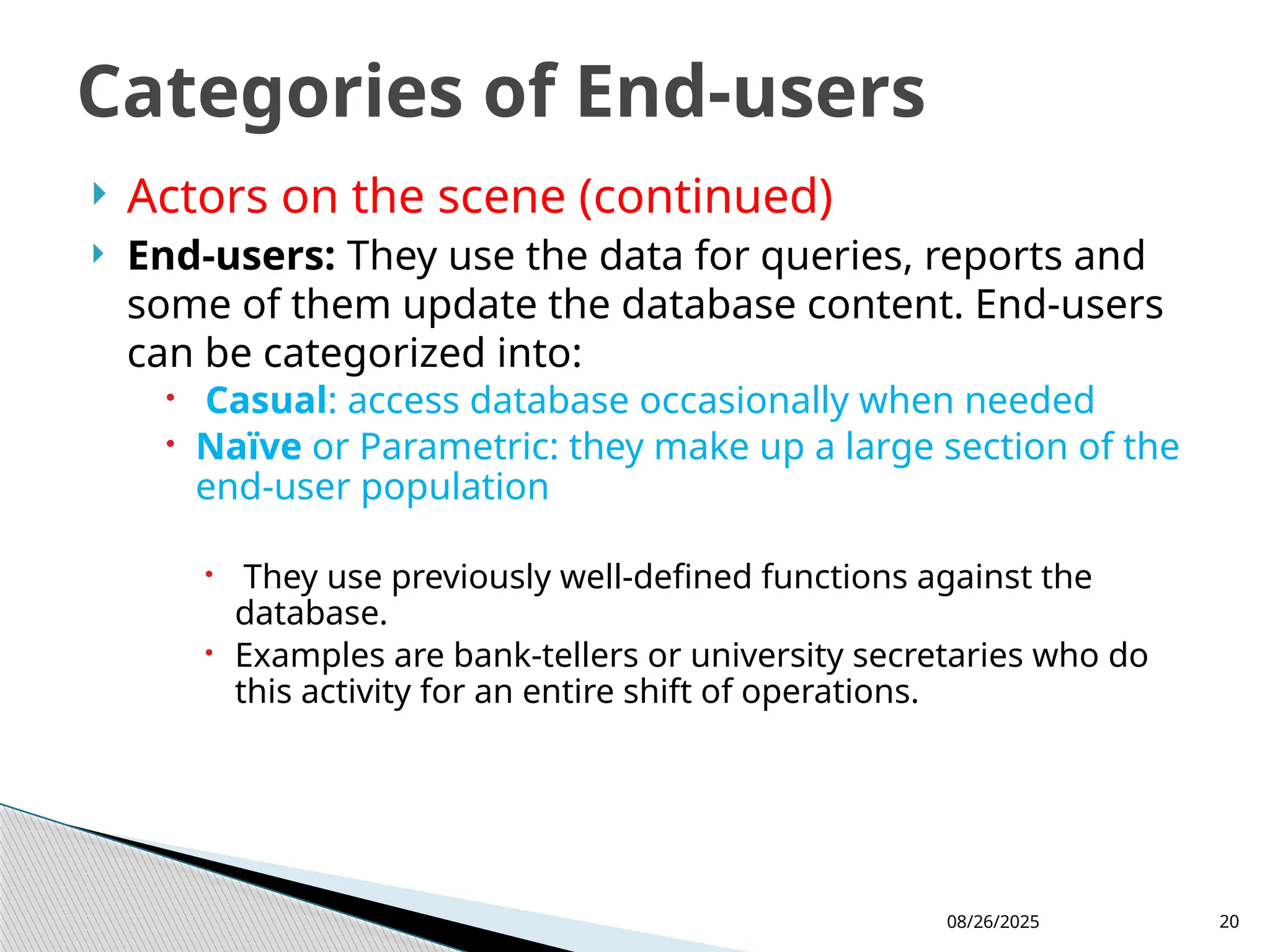
 Actors on the scene (continued)
 End-users: They use the data for queries, reports and
some of them update the database content. End-users
can be categorized into:
 Casual: access database occasionally when needed
 Naïve or Parametric: they make up a large section of the
end-user population
 They use previously well-defined functions against the
database.
 Examples are bank-tellers or university secretaries who do
this activity for an entire shift of operations.
Categories of End-users
08/26/2025 21
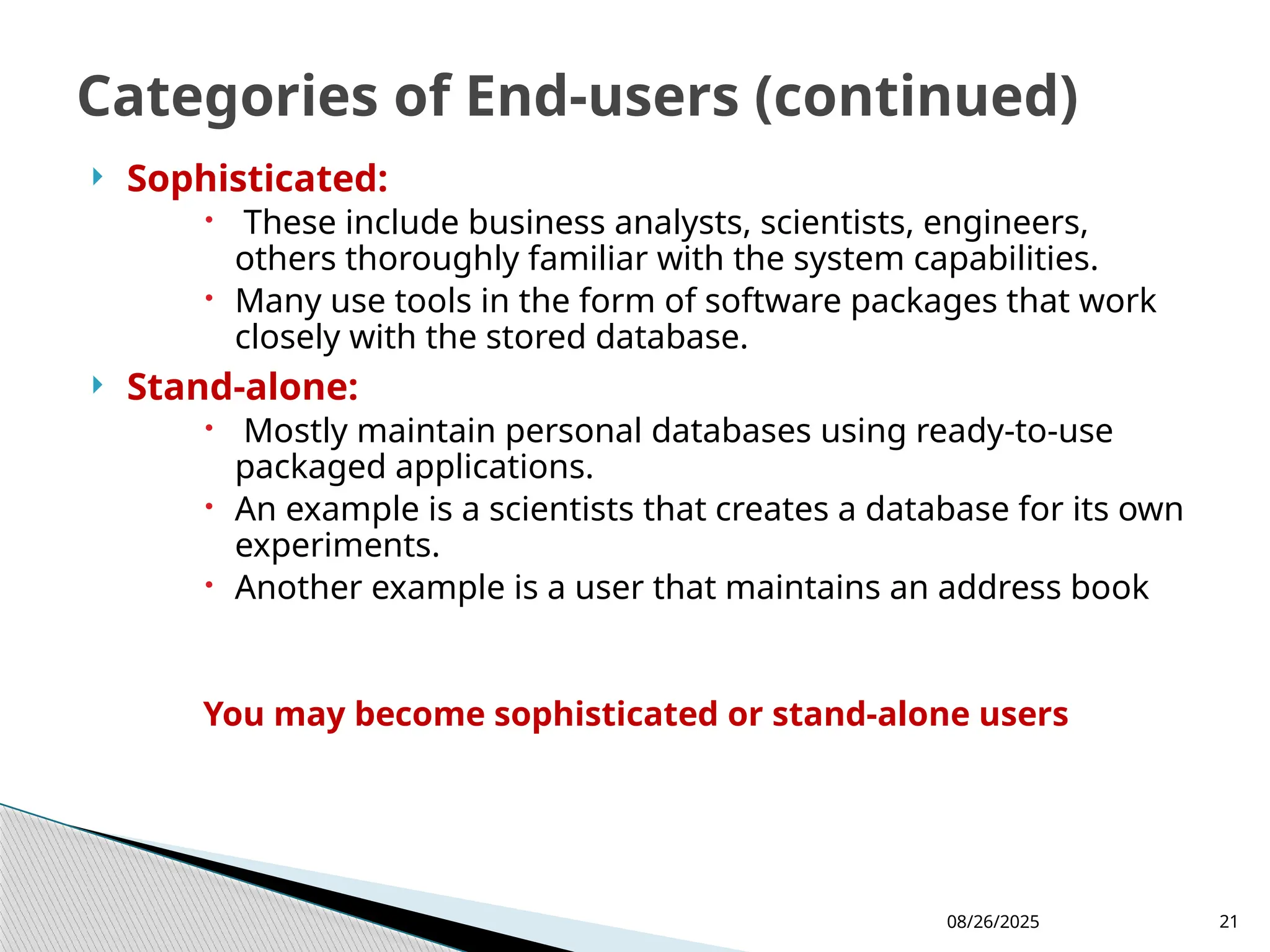
 Sophisticated:
 These include business analysts, scientists, engineers,
others thoroughly familiar with the system capabilities.
 Many use tools in the form of software packages that work
closely with the stored database.
 Stand-alone:
 Mostly maintain personal databases using ready-to-use
packaged applications.
 An example is a scientists that creates a database for its own
experiments.
 Another example is a user that maintains an address book
You may become sophisticated or stand-alone users
Categories of End-users (continued)
Sli
de
1-
22
Advantages of Using the Database
Approach
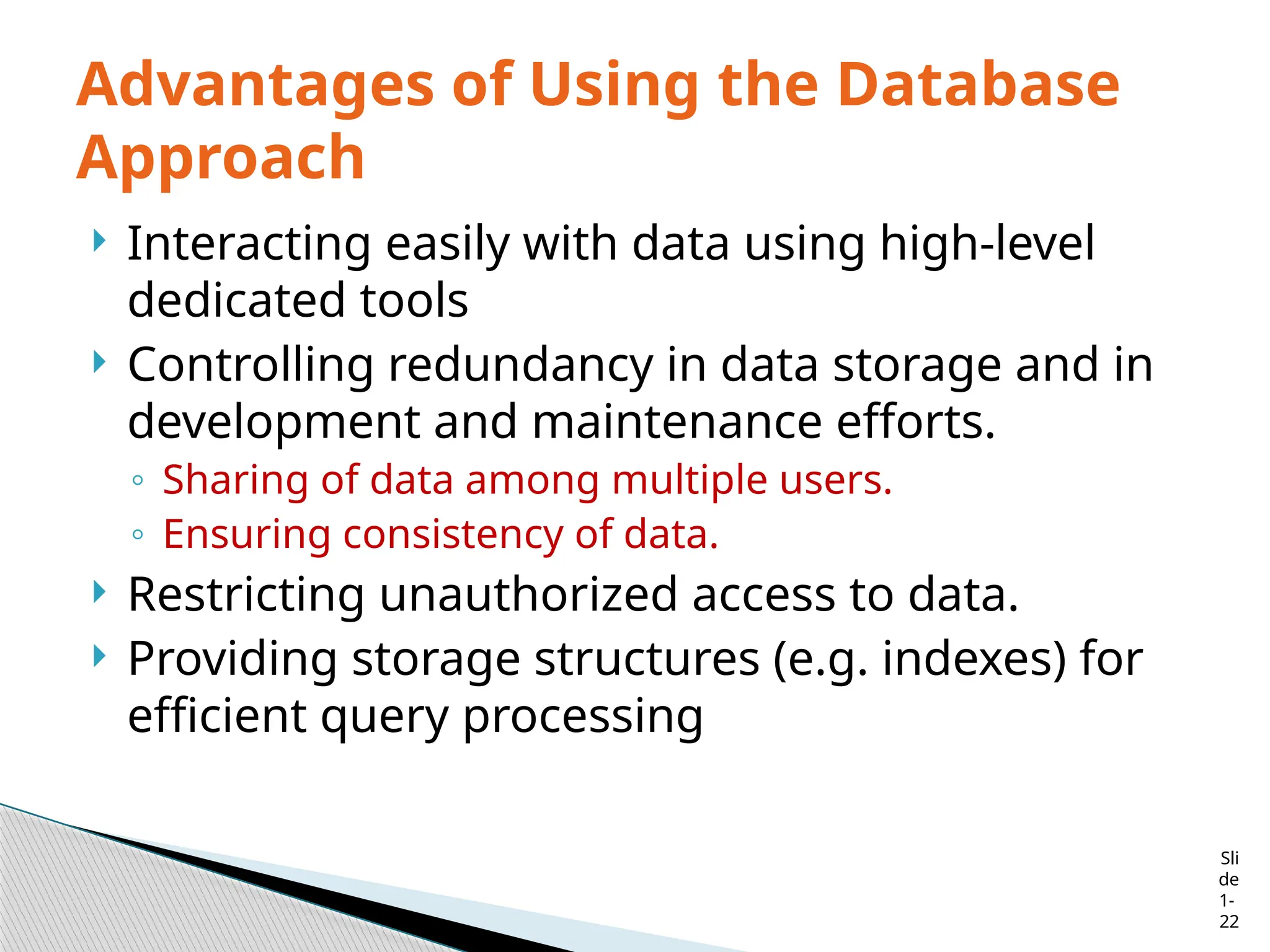
 Interacting easily with data using high-level
dedicated tools
 Controlling redundancy in data storage and in
development and maintenance efforts.
◦ Sharing of data among multiple users.
◦ Ensuring consistency of data.
 Restricting unauthorized access to data.
 Providing storage structures (e.g. indexes) for
efficient query processing
Sli
de
1-
23
Advantages of Using the Database
Approach (continued)
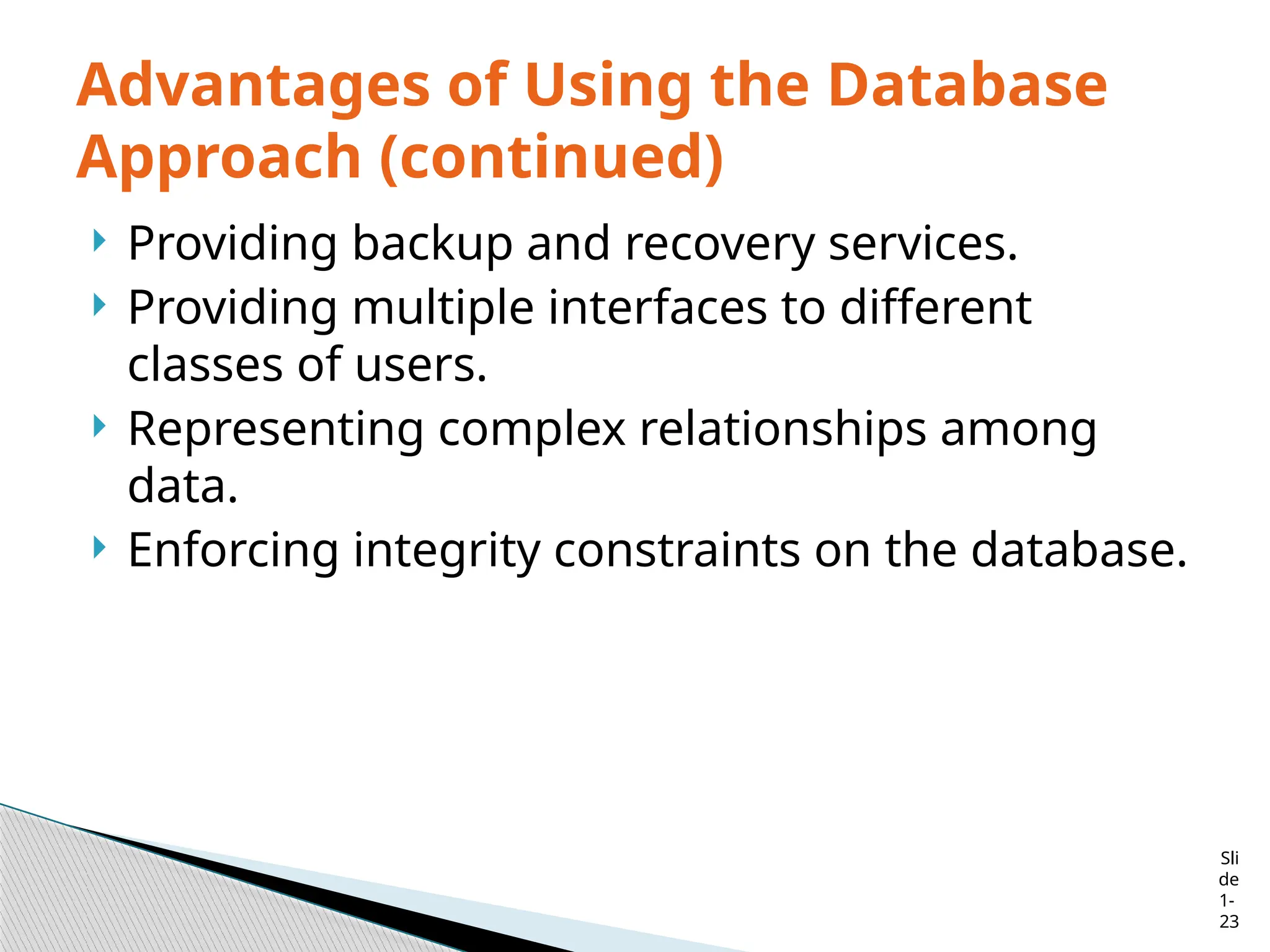
 Providing backup and recovery services.
 Providing multiple interfaces to different
classes of users.
 Representing complex relationships among
data.
 Enforcing integrity constraints on the database.
Sli
de
1-
24
Additional Implications of Using the
Database Approach
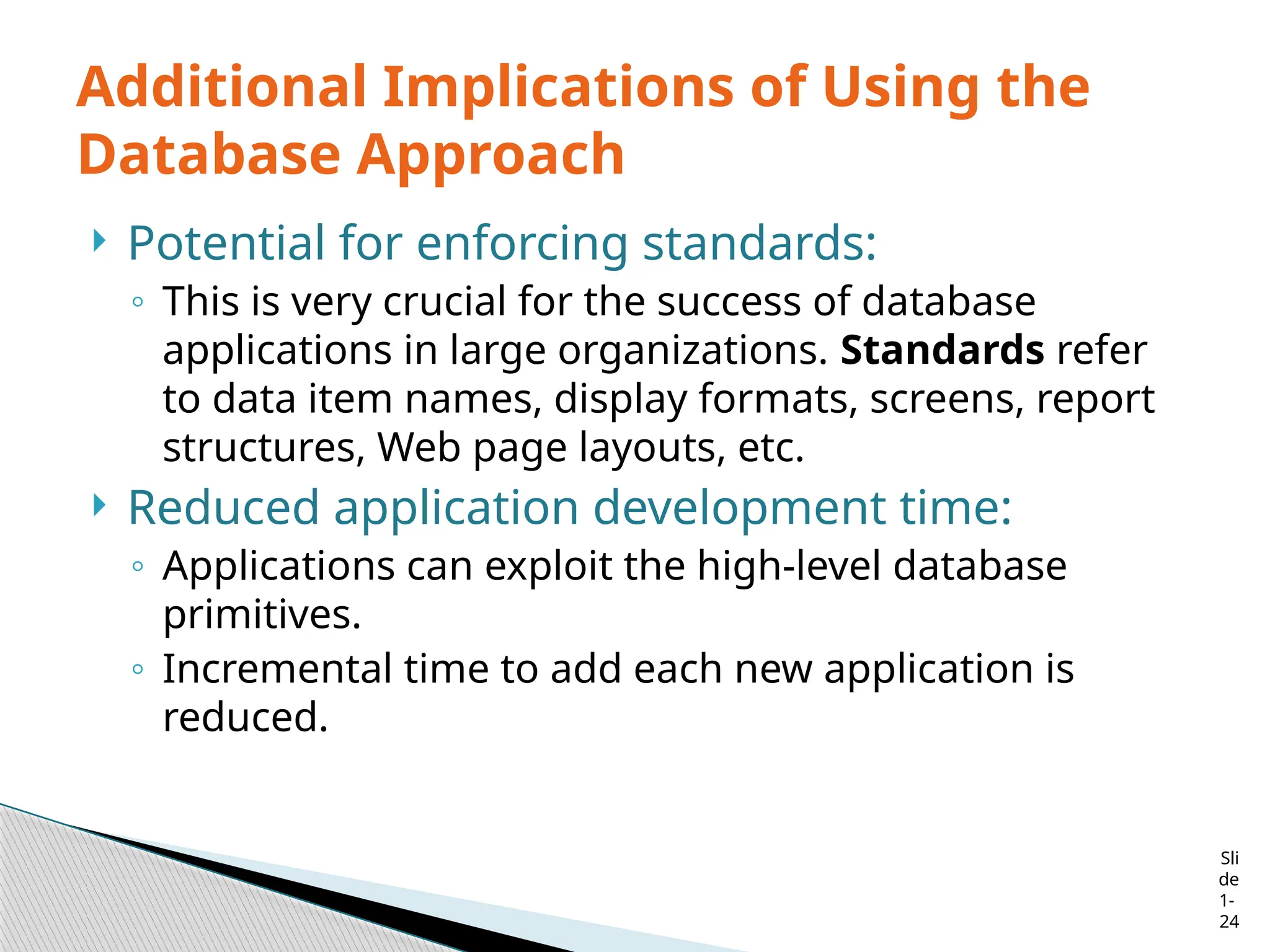
 Potential for enforcing standards:
◦ This is very crucial for the success of database
applications in large organizations. Standards refer
to data item names, display formats, screens, report
structures, Web page layouts, etc.
 Reduced application development time:
◦ Applications can exploit the high-level database
primitives.
◦ Incremental time to add each new application is
reduced.
Sli
de
1-
25
Additional Implications of Using the
Database Approach (continued)
 Flexibility to change data structures:
◦ Database structure may evolve as new requirements
are defined.
 Availability of current information:
◦ Extremely important for on-line transaction systems
such as airline, hotel, car reservations.
 Economies of scale:
◦ Wasteful overlap of resources and personnel can be
avoided by consolidating data and applications across
departments.
Sli
de
1-
26
Historical Development of Database
Technology
 Early Database Applications:
◦ The Hierarchical and Network Models were introduced
in mid 1960s and dominated during the seventies.
◦ A bulk of the worldwide database processing still occurs
using these models, particularly, the hierarchical model.
 Relational Model based Systems:
◦ Relational model was originally introduced in 1970, was
heavily researched and experimented within IBM
Research and several universities.
◦ Relational DBMS Products emerged in the early 1980s.
◦ Most of the systems used today are based on it
(Microsoft Access, MySQL, …)
Sli
de
1-
27
Historical Development of Database
Technology (continued)
 Object-oriented and emerging applications:
◦ Object-Oriented Database Management Systems
(OODBMSs) were introduced in late 1980s and early
1990s to cater to the need of complex data processing
in CAD and other applications.
 Their use has not taken off much.
◦ Many relational DBMSs have incorporated object
database concepts, leading to a new category called
object-relational DBMSs (ORDBMSs)
◦ Extended relational systems add further capabilities (e.g.
for multimedia data, XML, and other data types)
Sli
de
1-
28
Historical Development of Database
Technology (continued)
 Data on the Web and E-commerc Applications:
◦ Web contains data in HTML (Hypertext markup
language) with links among pages.
◦ This has given rise to a new set of applications and E-
commerce is using new standards like XML (eXtended
Markup Language).
◦ Script programming languages such as PHP and
JavaScript allow generation of dynamic Web pages that
are partially generated from a database.
 Also allow database updates through Web pages
Sli
de
1-
29
Extending Database Capabilities
 New functionality is being added to DBMSs in the following
areas:
◦ Scientific Applications
◦ XML (eXtensible Markup Language)
◦ Image Storage and Management
◦ Audio and Video Data Management
◦ Data Warehousing and Data Mining
◦ Spatial Data Management
◦ Time Series and Historical Data Management
 The above gives rise to new research and development in
incorporating new data types, complex data structures, new
operations and storage and indexing schemes in database
systems.
Sli
de
1-
30
When not to use a DBMS
 Main inhibitors (costs) of using a DBMS:
◦ High initial investment and possible need for additional
hardware.
◦ Overhead for providing generality, security, concurrency
control, recovery, and integrity functions.
 When a DBMS may be unnecessary:
◦ If the database and applications are simple, well defined, and
not expected to change.
◦ If there are stringent real-time requirements that may not be
met because of DBMS overhead.
◦ If access to data by multiple users is not required.
Sli
de
1-
31
When not to use a DBMS
 When no DBMS may suffice:
◦ If the database system is not able to handle the
complexity of data because of modeling limitations
◦ If the database users need special operations not
supported by the DBMS.

introduction-to-databaseakash - data - file - ditei hbe.pptx

  • 1.
  • 2.
    08/26/2025 2  Typesof Databases and Database Applications  Basic Definitions  Typical DBMS Functionality  Example of a Database (UNIVERSITY)  Main Characteristics of the Database Approach  Database Users  Advantages of Using the Database Approach  When Not to Use Databases Outline
  • 3.
    08/26/2025 3  TraditionalApplications: ◦ Numeric and Textual Databases  More Recent Applications: ◦ Multimedia Databases ◦ Geographic Information Systems (GIS) ◦ Data Warehouses ◦ Real-time and Active Databases ◦ Many other applications Types of Databases and Database Applications
  • 4.
    08/26/2025 4  Data: ◦Known facts that can be recorded and have an implicit meaning.  Database: ◦ A collection of related data.  Mini-world: ◦ Some part of the real world about which data is stored in a database. For example, student grades and transcripts at a university.  Database Management System (DBMS): ◦ A software package/ system to facilitate the creation and maintenance of a computerized database.  Database System: ◦ The DBMS software together with the data itself. Sometimes, the applications are also included. Basic Definitions
  • 5.
    08/26/2025 5  Databasehas the following implicit properties:  ■ A database represents some aspect of the real world, sometimes called the miniworld or the universe of discourse (UoD). Changes to the miniworld are reflected in the database.  ■ A database is a logically coherent collection of data with some inherent meaning. A random assortment of data cannot correctly be referred to as a database.  ■ A database is designed, built, and populated with data for a specific purpose.  It has an intended group of users and some preconceived applications in which these users are interested. Cont...
  • 6.
    08/26/2025 6  Adatabase can be of any size and complexity.  Ex: List of name and addresses. Library---half a million entries  database of even greater size and complexity is maintained by the  Internal Revenue Service (IRS) to monitor tax forms filed by U.S. taxpayers. Cont...
  • 7.
    08/26/2025 7  Anexample of a large commercial database is Amazon.com.  It contains data for over 20 million books CDs, videos, DVDs, games, electronics, apparel, and other items.  The database occupies over 2 terabytes.  About 15 million visitors access Amazon.com each day and use the database to make purchases.  Thedatabase is continually updated as new books and other items are added to the inventory and stock quantities are updated as purchases are transacted. Cont..
  • 8.
  • 9.
    08/26/2025 9  Definea particular database in terms of its data types, structures, and constraints  Construct or Load the initial database contents on a secondary storage medium  Manipulating the database: ◦ Retrieval: Querying, generating reports ◦ Modification: Insertions, deletions and updates to its content ◦ Accessing the database through Web applications  Processing and Sharing by a set of concurrent users and application programs – yet, keeping all data valid and consistent Typical DBMS Functionality
  • 10.
    08/26/2025 10  Otherfeatures: ◦ Protection or Security measures to prevent unauthorized access ◦ “Active” processing to take internal actions on data ◦ Presentation and Visualization of data ◦ Maintaining the database and associated programs over the lifetime of the database application Cont...
  • 11.
    08/26/2025 11  Mini-worldfor the example: ◦ Part of a UNIVERSITY environment.  Some mini-world entities: ◦ STUDENTs ◦ COURSEs ◦ SECTIONs (of COURSEs) ◦ (academic) DEPARTMENTs ◦ INSTRUCTORs Example of a Database (with a Conceptual Data Model)
  • 12.
    08/26/2025 12  Somemini-world relationships: ◦ SECTIONs are of specific COURSEs ◦ STUDENTs take SECTIONs ◦ COURSEs have prerequisite COURSEs ◦ INSTRUCTORs teach SECTIONs ◦ COURSEs are offered by DEPARTMENTs ◦ STUDENTs major in DEPARTMENTs Cont...
  • 13.
    08/26/2025 13 Example ofa simple database
  • 14.
    08/26/2025 14  Self-describingnature of a database system: ◦ A DBMS catalog stores the description of a particular database (e.g. data structures and types) ◦ The description is called meta-data. ◦ This allows the DBMS software to work with different database applications.  Insulation between programs and data: ◦ Called program-data independence. ◦ Allows changing data structures and storage organization without having to change the DBMS access programs. Characteristics of the Database Approach
  • 15.
    08/26/2025 15 Example ofa simplified database catalog
  • 16.
    08/26/2025 16  DataAbstraction: ◦ A data model is used to hide storage details and present the users with a conceptual view of the database. ◦ Programs refer to the data model constructs rather than data storage details  Support of multiple views of the data: ◦ Each user may see a different view of the database, which describes only the data of interest to that user. Characteristics of the Database Approach (continued)
  • 17.
    08/26/2025 17  Sharingof data and multi-user transaction processing: ◦ Allowing a set of concurrent users to retrieve from and to update the database ◦ Care is needed to avoid interferences ◦ Concurrency control within the DBMS guarantees that each transaction is correctly executed or aborted ◦ Recovery subsystem ensures each completed transaction has its effect permanently recorded in the database Characteristics of the Database Approach (continued)
  • 18.
    08/26/2025 18  Usersmay be divided into  Those who actually use and control the database content, and those who design, develop and maintain database applications (called “Actors on the Scene”), and  Those who design and develop the DBMS software and related tools, and the computer systems operators (called “Workers Behind the Scene”). Database Users
  • 19.
    08/26/2025 19  Actorson the scene ◦ Database Designers:  Responsible to define the content, the structure, the constraints, and functions or transactions against the database. They must communicate with the end-users and understand their needs. ◦ Database administrators:  Responsible for authorizing access to the database, for coordinating and monitoring its use, acquiring software and hardware resources, controlling its use and monitoring efficiency of operations. Database Users
  • 20.
    08/26/2025 20  Actorson the scene (continued)  End-users: They use the data for queries, reports and some of them update the database content. End-users can be categorized into:  Casual: access database occasionally when needed  Naïve or Parametric: they make up a large section of the end-user population  They use previously well-defined functions against the database.  Examples are bank-tellers or university secretaries who do this activity for an entire shift of operations. Categories of End-users
  • 21.
    08/26/2025 21  Sophisticated: These include business analysts, scientists, engineers, others thoroughly familiar with the system capabilities.  Many use tools in the form of software packages that work closely with the stored database.  Stand-alone:  Mostly maintain personal databases using ready-to-use packaged applications.  An example is a scientists that creates a database for its own experiments.  Another example is a user that maintains an address book You may become sophisticated or stand-alone users Categories of End-users (continued)
  • 22.
    Sli de 1- 22 Advantages of Usingthe Database Approach  Interacting easily with data using high-level dedicated tools  Controlling redundancy in data storage and in development and maintenance efforts. ◦ Sharing of data among multiple users. ◦ Ensuring consistency of data.  Restricting unauthorized access to data.  Providing storage structures (e.g. indexes) for efficient query processing
  • 23.
    Sli de 1- 23 Advantages of Usingthe Database Approach (continued)  Providing backup and recovery services.  Providing multiple interfaces to different classes of users.  Representing complex relationships among data.  Enforcing integrity constraints on the database.
  • 24.
    Sli de 1- 24 Additional Implications ofUsing the Database Approach  Potential for enforcing standards: ◦ This is very crucial for the success of database applications in large organizations. Standards refer to data item names, display formats, screens, report structures, Web page layouts, etc.  Reduced application development time: ◦ Applications can exploit the high-level database primitives. ◦ Incremental time to add each new application is reduced.
  • 25.
    Sli de 1- 25 Additional Implications ofUsing the Database Approach (continued)  Flexibility to change data structures: ◦ Database structure may evolve as new requirements are defined.  Availability of current information: ◦ Extremely important for on-line transaction systems such as airline, hotel, car reservations.  Economies of scale: ◦ Wasteful overlap of resources and personnel can be avoided by consolidating data and applications across departments.
  • 26.
    Sli de 1- 26 Historical Development ofDatabase Technology  Early Database Applications: ◦ The Hierarchical and Network Models were introduced in mid 1960s and dominated during the seventies. ◦ A bulk of the worldwide database processing still occurs using these models, particularly, the hierarchical model.  Relational Model based Systems: ◦ Relational model was originally introduced in 1970, was heavily researched and experimented within IBM Research and several universities. ◦ Relational DBMS Products emerged in the early 1980s. ◦ Most of the systems used today are based on it (Microsoft Access, MySQL, …)
  • 27.
    Sli de 1- 27 Historical Development ofDatabase Technology (continued)  Object-oriented and emerging applications: ◦ Object-Oriented Database Management Systems (OODBMSs) were introduced in late 1980s and early 1990s to cater to the need of complex data processing in CAD and other applications.  Their use has not taken off much. ◦ Many relational DBMSs have incorporated object database concepts, leading to a new category called object-relational DBMSs (ORDBMSs) ◦ Extended relational systems add further capabilities (e.g. for multimedia data, XML, and other data types)
  • 28.
    Sli de 1- 28 Historical Development ofDatabase Technology (continued)  Data on the Web and E-commerc Applications: ◦ Web contains data in HTML (Hypertext markup language) with links among pages. ◦ This has given rise to a new set of applications and E- commerce is using new standards like XML (eXtended Markup Language). ◦ Script programming languages such as PHP and JavaScript allow generation of dynamic Web pages that are partially generated from a database.  Also allow database updates through Web pages
  • 29.
    Sli de 1- 29 Extending Database Capabilities New functionality is being added to DBMSs in the following areas: ◦ Scientific Applications ◦ XML (eXtensible Markup Language) ◦ Image Storage and Management ◦ Audio and Video Data Management ◦ Data Warehousing and Data Mining ◦ Spatial Data Management ◦ Time Series and Historical Data Management  The above gives rise to new research and development in incorporating new data types, complex data structures, new operations and storage and indexing schemes in database systems.
  • 30.
    Sli de 1- 30 When not touse a DBMS  Main inhibitors (costs) of using a DBMS: ◦ High initial investment and possible need for additional hardware. ◦ Overhead for providing generality, security, concurrency control, recovery, and integrity functions.  When a DBMS may be unnecessary: ◦ If the database and applications are simple, well defined, and not expected to change. ◦ If there are stringent real-time requirements that may not be met because of DBMS overhead. ◦ If access to data by multiple users is not required.
  • 31.
    Sli de 1- 31 When not touse a DBMS  When no DBMS may suffice: ◦ If the database system is not able to handle the complexity of data because of modeling limitations ◦ If the database users need special operations not supported by the DBMS.