By
Rawal Rafiq Leghari
Medicose Nursing Academy
OBJECTIVES
 At the end of this presentation you will be able to:
 Define sleep and rest pattern
 Define terms related to rest and sleep
 Compare the characteristics of sleep and rest.
 Discuss the characteristics of two kinds of sleep.
 Enumerate the functions of sleep.
 Discuss factors affecting sleep.
 Identify common sleep disorders.
 Identify conditions necessary to promote sleep.
 Discuss nursing process for a patient to promote sleep.
SLEEP AND REST PATTERNS
 Assessment is focused on the person's
sleep, rest, and relaxation practices.
Dysfunctional sleep patterns, fatigue, and
responses to sleep deprivation may be
identified.
 Inquire about Patterns of sleep, rest,
perception of quality and quantity.
SLEEP
 sleep is a naturally recurring state characterized by
altered consciousness, relatively inhibited sensory
activity, and inhibition of nearly all voluntary
muscles.
 It is distinguished from wakefulness by a decreased
ability to react to stimuli, and it is more easily
reversible than being in hibernation or a coma.
Conti……
 The Oxford English Dictionary defines sleep as:
 “a condition of bodyand mind which typicallyrecurs
for several hours every night, in which the nervous
system is inactive, the eyes closed, the postural
muscles relaxed, and consciousness practically
suspended”.
Conti……………..
 In most human societies sleep is conducted during the
night, but in very hot climates it may be done during
the day.
Rest
➢A state of calmness, relaxation with out
emotional stress, and freedom from anxiety
OR
➢The word rest comes from the German rasta
meaning “League of miles.” if you walked that
far, you’d need a good rest too
DEFINING CHARACTERISTICS
• Verbal complaints of difficulty falling asleep
• Awakening earlier or later than desired
• Interrupted sleep
• Verbal complaints of not feeling rested
• Restlessness
• Irritability
• Tired
• Gaping
• Altered mental status
• Difficulty in arousal
• Change in activity level
• Altered facial expression (e.g., blank look, fatigued
appearance)
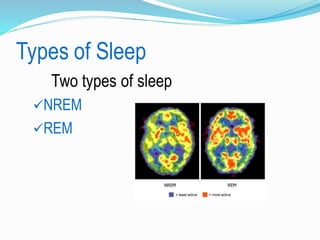
Types of Sleep
Two types of sleep
✓NREM
✓REM
NREM- Non-rapid Eye Movement
 NREM sleep is further divided into progressively
deeper stages of sleep:
 stage N1,
 stage N2,
 stage N3 (deep or delta-wave sleep).
 As NREM stages progress, stronger stimuli are
required to result in an awakening.
Conti…..
 Stage 1 (NREM1 or N1)
 is the stage between wakefulness and sleep, sometimes
referred to as somnolence or drowsy sleep, in which the
muscles are still quite active and the eyes roll around
slowly and may open and close from time to time.
 Stage 2 (NREM2 or N2)
 is the first unequivocal stage of sleep, during which
muscle activity decreases still further and conscious
awareness of the outside world begins to disappear
completely. If any sounds are heard, the sleeper is not able
to understand their content at this point
Conti…
 Stage 3 (NREM3 or N3)
 is also known as deep or delta or slow-wave sleep
(SWS), and during this period the sleeper is even less
responsive to the outside environment, essentially cut
off from the world and unaware of any sounds or
other stimuli.
REM (Rapid Eye Movement)
 REM sleep occurs in cycles of about 90-120 minutes
throughout the night, and it accounts for up to 20-25%
of total sleep time in adult humans,
 The majority of dreams - certainly the most
memorable and colorful dreams - occur during REM
sleep,
 Neurologically, REM sleep is activated by secretion of
the neurotransmitter acetylcholine and inhibited by the
neurotransmitter serotonin, and this effect is
principally generated in the pons region of the
brainstem.
Conti…..
 Stage R sleep (REM sleep) has tonic and phasic
components.
 The phasic component is a sympathetically driven
state characterized by rapid eye movements, muscle
twitches, and respiratory variability.
 Tonic REM is a parasympathetically driven state with
no eye movements.
FUNCTIONS OF SLEEP
 Restores normal levels of activity
 Lack of sleep results in poor
concentration, irritability, difficult
decision making.
 It use to be thought that a regular sleep
pattern was more important than actual
hours slept but sleep deprivation is
associated with cognitive & health
problems.
 Sleep is required to provide energy for
physical and mental activities.
Sleep Cycle
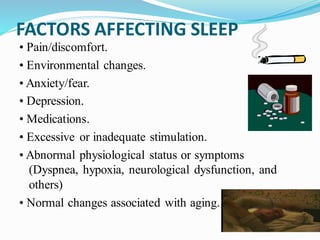
FACTORS AFFECTING SLEEP
• Pain/discomfort.
• Environmental changes.
• Anxiety/fear.
• Depression.
• Medications.
• Excessive or inadequate stimulation.
• Abnormal physiological status or symptoms
(Dyspnea, hypoxia, neurological dysfunction, and
others)
• Normal changes associated with aging.
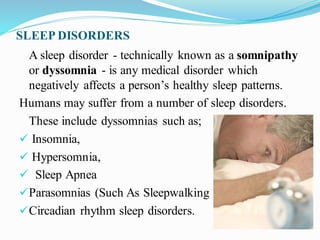
SLEEP DISORDERS
A sleep disorder - technically known as a somnipathy
or dyssomnia - is any medical disorder which
negatively affects a person’s healthy sleep patterns.
Humans may suffer from a number of sleep disorders.
These include dyssomnias such as;
✓ Insomnia,
✓ Hypersomnia,
✓ Sleep Apnea
✓Parasomnias (Such As Sleepwalking )
✓Circadian rhythm sleep disorders.
Insomnia
 Insomnia is a sleep disorder that is characterized by
difficultyfalling and/or staying asleep.
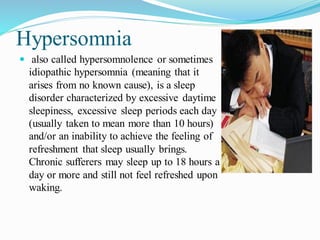
Hypersomnia
 also called hypersomnolence or sometimes
idiopathic hypersomnia (meaning that it
arises from no known cause), is a sleep
disorder characterized by excessive daytime
sleepiness, excessive sleep periods each day
(usually taken to mean more than 10 hours)
and/or an inability to achieve the feeling of
refreshment that sleep usually brings.
Chronic sufferers may sleep up to 18 hours a
day or more and still not feel refreshed upon
waking.
SLEEP APNEA
 is a potentially life-threatening sleep disorder
characterized by abnormal pauses (apneas) in
breathing during sleep.
 Obstructive Sleep Apnea – caused by occlusion of the
airway during sleep.
 TX: CPAP – Continuous Positive Air Pressure
 Central Sleep Apnea – Dysfunction in central
respiratory control
 Mixed Apnea – combination of Obstructive and
Central Sleep Apneas
CPAP
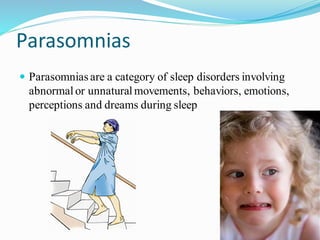
Parasomnias
 Parasomnias are a category of sleep disorders involving
abnormalor unnaturalmovements, behaviors, emotions,
perceptions and dreams during sleep
Circadian rhythms
 Circadianrhythms are physical, mental and
behavioral changes that follow a roughly 24-hour
cycle, responding primarily to light and darkness in an
organism's environment. They are found in most living
things, including animals, plants and many tiny
microbes.
Teaching to promote rest & sleep
▪ Establish regular bedtime & wake up
▪ Eliminate lengthy naps
▪ Exercise just not 2 hrs before bedtime
▪ listen to music,
▪ warm bath,
▪ Avoid heavy meals 3 hrs before bedtime
▪ If you're getting enough sleep, you should wake up
naturally without an alarm.
Assesses sleep and rest patterns.
History (subjective data):
 Generally rested and ready for activity after
sleep?
 Sleep onset problems?
 Aids?
 Dreams(nightmares), early awakening?
 Rest / relaxation periods?
 Sleep routine?
 Sleep apnea symptoms?
 Examination (examplesof objectivedata):
 Observesleep pattern and rest pattern.
Associated Nursing Diagnoses:
➢ Sleep pattern Disturbance: Time-limited disruption of
sleep (natural periodic suspension of consciousness).
➢ Sleep-deprivation: Prolonged periods without sleep.
 other diagnoses:
 Risk for injury
 Ineffective coping
 Fatigue
 Risk for impairedgas exchange
 Deficient knowledge
 Anxiety
 Activityintolerance
Implementation
 Nursing interventions are used to enhance the quantity
and quality of sleep & involve largely non-
pharmacologic measures. Interventions include-
✓ guided imagery
✓ therapeutic message
✓ progressive muscle relaxation
✓ uninterrupted sleep periods.
Implementation
 Client teaching
✓ Individuals need to learn the
importance of rest and sleep in
maintaining active and productive
lifestyles.
 Supporting bedtime rituals
✓ Many are accustomed to rituals or pre-
sleep routines and if altered can affect
sleep.
 Creating Restful Environment
IMPLEMENTATION
 Promoting Comfort and Relaxation
✓ Assist client with hygienic routines
✓ Offer back message
✓ Administer analgesics 30 min before sleep
 Enhancing Sleep with Medications
✓ Nurse responsible for making decisions with the client about
when to administer sedative or hypnotics.
References
 Boyle, J.S; and Andrew. M. M. (1998). Trans-cultural
concept in nursing care. USA; Little Brown.
 Long, B.C. (1995). Adult nursing: a nursing process
approach WolfeMedical Publishers
sleep pattern (1).pdf....................

sleep pattern (1).pdf....................

  • 1.
  • 2.
    OBJECTIVES  At theend of this presentation you will be able to:  Define sleep and rest pattern  Define terms related to rest and sleep  Compare the characteristics of sleep and rest.  Discuss the characteristics of two kinds of sleep.  Enumerate the functions of sleep.  Discuss factors affecting sleep.  Identify common sleep disorders.  Identify conditions necessary to promote sleep.  Discuss nursing process for a patient to promote sleep.
  • 3.
    SLEEP AND RESTPATTERNS  Assessment is focused on the person's sleep, rest, and relaxation practices. Dysfunctional sleep patterns, fatigue, and responses to sleep deprivation may be identified.  Inquire about Patterns of sleep, rest, perception of quality and quantity.
  • 4.
    SLEEP  sleep isa naturally recurring state characterized by altered consciousness, relatively inhibited sensory activity, and inhibition of nearly all voluntary muscles.  It is distinguished from wakefulness by a decreased ability to react to stimuli, and it is more easily reversible than being in hibernation or a coma.
  • 5.
    Conti……  The OxfordEnglish Dictionary defines sleep as:  “a condition of bodyand mind which typicallyrecurs for several hours every night, in which the nervous system is inactive, the eyes closed, the postural muscles relaxed, and consciousness practically suspended”.
  • 6.
    Conti……………..  In mosthuman societies sleep is conducted during the night, but in very hot climates it may be done during the day.
  • 7.
    Rest ➢A state ofcalmness, relaxation with out emotional stress, and freedom from anxiety OR ➢The word rest comes from the German rasta meaning “League of miles.” if you walked that far, you’d need a good rest too
  • 8.
    DEFINING CHARACTERISTICS • Verbalcomplaints of difficulty falling asleep • Awakening earlier or later than desired • Interrupted sleep • Verbal complaints of not feeling rested • Restlessness • Irritability • Tired • Gaping • Altered mental status • Difficulty in arousal • Change in activity level • Altered facial expression (e.g., blank look, fatigued appearance)
  • 9.
    Types of Sleep Twotypes of sleep ✓NREM ✓REM
  • 10.
    NREM- Non-rapid EyeMovement  NREM sleep is further divided into progressively deeper stages of sleep:  stage N1,  stage N2,  stage N3 (deep or delta-wave sleep).  As NREM stages progress, stronger stimuli are required to result in an awakening.
  • 11.
    Conti…..  Stage 1(NREM1 or N1)  is the stage between wakefulness and sleep, sometimes referred to as somnolence or drowsy sleep, in which the muscles are still quite active and the eyes roll around slowly and may open and close from time to time.  Stage 2 (NREM2 or N2)  is the first unequivocal stage of sleep, during which muscle activity decreases still further and conscious awareness of the outside world begins to disappear completely. If any sounds are heard, the sleeper is not able to understand their content at this point
  • 12.
    Conti…  Stage 3(NREM3 or N3)  is also known as deep or delta or slow-wave sleep (SWS), and during this period the sleeper is even less responsive to the outside environment, essentially cut off from the world and unaware of any sounds or other stimuli.
  • 13.
    REM (Rapid EyeMovement)  REM sleep occurs in cycles of about 90-120 minutes throughout the night, and it accounts for up to 20-25% of total sleep time in adult humans,  The majority of dreams - certainly the most memorable and colorful dreams - occur during REM sleep,  Neurologically, REM sleep is activated by secretion of the neurotransmitter acetylcholine and inhibited by the neurotransmitter serotonin, and this effect is principally generated in the pons region of the brainstem.
  • 14.
    Conti…..  Stage Rsleep (REM sleep) has tonic and phasic components.  The phasic component is a sympathetically driven state characterized by rapid eye movements, muscle twitches, and respiratory variability.  Tonic REM is a parasympathetically driven state with no eye movements.
  • 15.
    FUNCTIONS OF SLEEP Restores normal levels of activity  Lack of sleep results in poor concentration, irritability, difficult decision making.  It use to be thought that a regular sleep pattern was more important than actual hours slept but sleep deprivation is associated with cognitive & health problems.  Sleep is required to provide energy for physical and mental activities.
  • 16.
  • 17.
    FACTORS AFFECTING SLEEP •Pain/discomfort. • Environmental changes. • Anxiety/fear. • Depression. • Medications. • Excessive or inadequate stimulation. • Abnormal physiological status or symptoms (Dyspnea, hypoxia, neurological dysfunction, and others) • Normal changes associated with aging.
  • 18.
    SLEEP DISORDERS A sleepdisorder - technically known as a somnipathy or dyssomnia - is any medical disorder which negatively affects a person’s healthy sleep patterns. Humans may suffer from a number of sleep disorders. These include dyssomnias such as; ✓ Insomnia, ✓ Hypersomnia, ✓ Sleep Apnea ✓Parasomnias (Such As Sleepwalking ) ✓Circadian rhythm sleep disorders.
  • 19.
    Insomnia  Insomnia isa sleep disorder that is characterized by difficultyfalling and/or staying asleep.
  • 20.
    Hypersomnia  also calledhypersomnolence or sometimes idiopathic hypersomnia (meaning that it arises from no known cause), is a sleep disorder characterized by excessive daytime sleepiness, excessive sleep periods each day (usually taken to mean more than 10 hours) and/or an inability to achieve the feeling of refreshment that sleep usually brings. Chronic sufferers may sleep up to 18 hours a day or more and still not feel refreshed upon waking.
  • 21.
    SLEEP APNEA  isa potentially life-threatening sleep disorder characterized by abnormal pauses (apneas) in breathing during sleep.
  • 22.
     Obstructive SleepApnea – caused by occlusion of the airway during sleep.  TX: CPAP – Continuous Positive Air Pressure  Central Sleep Apnea – Dysfunction in central respiratory control  Mixed Apnea – combination of Obstructive and Central Sleep Apneas
  • 23.
  • 24.
    Parasomnias  Parasomnias area category of sleep disorders involving abnormalor unnaturalmovements, behaviors, emotions, perceptions and dreams during sleep
  • 25.
    Circadian rhythms  Circadianrhythmsare physical, mental and behavioral changes that follow a roughly 24-hour cycle, responding primarily to light and darkness in an organism's environment. They are found in most living things, including animals, plants and many tiny microbes.
  • 26.
    Teaching to promoterest & sleep ▪ Establish regular bedtime & wake up ▪ Eliminate lengthy naps ▪ Exercise just not 2 hrs before bedtime ▪ listen to music, ▪ warm bath, ▪ Avoid heavy meals 3 hrs before bedtime ▪ If you're getting enough sleep, you should wake up naturally without an alarm.
  • 27.
    Assesses sleep andrest patterns. History (subjective data):  Generally rested and ready for activity after sleep?  Sleep onset problems?  Aids?  Dreams(nightmares), early awakening?  Rest / relaxation periods?  Sleep routine?  Sleep apnea symptoms?
  • 28.
     Examination (examplesofobjectivedata):  Observesleep pattern and rest pattern.
  • 29.
    Associated Nursing Diagnoses: ➢Sleep pattern Disturbance: Time-limited disruption of sleep (natural periodic suspension of consciousness). ➢ Sleep-deprivation: Prolonged periods without sleep.  other diagnoses:  Risk for injury  Ineffective coping  Fatigue  Risk for impairedgas exchange  Deficient knowledge  Anxiety  Activityintolerance
  • 30.
    Implementation  Nursing interventionsare used to enhance the quantity and quality of sleep & involve largely non- pharmacologic measures. Interventions include- ✓ guided imagery ✓ therapeutic message ✓ progressive muscle relaxation ✓ uninterrupted sleep periods.
  • 31.
    Implementation  Client teaching ✓Individuals need to learn the importance of rest and sleep in maintaining active and productive lifestyles.  Supporting bedtime rituals ✓ Many are accustomed to rituals or pre- sleep routines and if altered can affect sleep.  Creating Restful Environment
  • 32.
    IMPLEMENTATION  Promoting Comfortand Relaxation ✓ Assist client with hygienic routines ✓ Offer back message ✓ Administer analgesics 30 min before sleep  Enhancing Sleep with Medications ✓ Nurse responsible for making decisions with the client about when to administer sedative or hypnotics.
  • 33.
    References  Boyle, J.S;and Andrew. M. M. (1998). Trans-cultural concept in nursing care. USA; Little Brown.  Long, B.C. (1995). Adult nursing: a nursing process approach WolfeMedical Publishers