SLEEP DISORDERS
Goal
At the end of the seminar, students will be
able to gain the knowledge regarding sleep
disturbances & its patterns & apply this
knowledge into providing care to the client.
Objectives
At the end of the seminar student will be able to:
*Define sleep.
*Enlist the factors affecting the sleep.
*Discuss about the stages of sleep briefly.
*Explain the short term consciquences of sleep.
*Explain sleep disorder and its management.
*Discuss nursing management of sleep disturbances.
*Explain role of nurse.
Facts
**Man is the only mammal that willingly
delays sleep.
**Divorced, widowed and separated people
report more insomnia.
**Parents of new babies miss out on 6
months worth of sleep in the first 2 years of
their child's life.
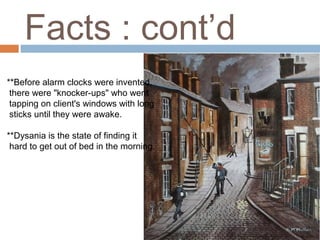
**Before alarm clocks were invented,
there were "knocker-ups" who went
tapping on client's windows with long
sticks until they were awake.
**Dysania is the state of finding it
 hard to get out of bed in the morning.
Facts : cont’d
What is sleep?
“highly structured and well-organized
activity
following a circadian periodicity that is
regulated by the
interplay of internal biological processes
and environmental
factors.”
Physiology of sleep
There are two types of sleep, non-rapid eye movement
(NREM) sleep and rapid eye movement (REM) sleep.
NREM sleep is divided into stages 1, 2, 3, and 4,
representing a continuum of relative depth. Each has
unique characteristics including variations in brain wave
patterns, eye movements, and muscle tone. 
Circadian rhythms, the daily rhythms in physiology and
behavior, regulate the sleep-wake cycle.
Sleep stages
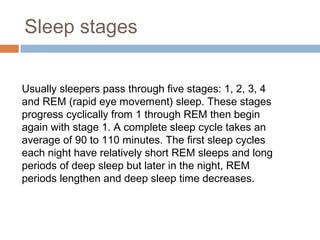
Usually sleepers pass through five stages: 1, 2, 3, 4
and REM (rapid eye movement) sleep. These stages
progress cyclically from 1 through REM then begin
again with stage 1. A complete sleep cycle takes an
average of 90 to 110 minutes. The first sleep cycles
each night have relatively short REM sleeps and long
periods of deep sleep but later in the night, REM
periods lengthen and deep sleep time decreases.
Stage 1
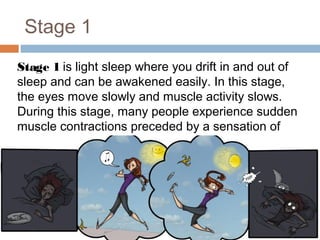
Stage 1 is light sleep where you drift in and out of
sleep and can be awakened easily. In this stage,
the eyes move slowly and muscle activity slows.
During this stage, many people experience sudden
muscle contractions preceded by a sensation of
falling.
Stage 2
eye movement stops and brain
waves become slower with only an
occasional burst of rapid brain
waves
Stage 3
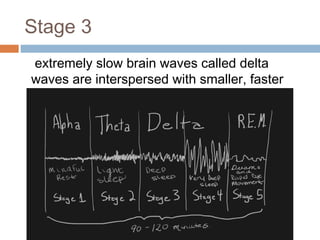
 extremely slow brain waves called delta
waves are interspersed with smaller, faster
waves
Stage 4
The brain produces delta waves almost
exclusively. Stages 3 and 4 are referred to
as deep sleep or delta sleep, and it is very
difficult to wake someone from them. In deep
sleep, there is no eye movement or muscle
activity. This is when some children experience
bedwetting, sleepwalking or night terrors. In 2008
the sleep profession in the US eliminated the use
of stage 4. Stages 3 and 4 are now considered
stage 3
REM stage
In the REM period, breathing becomes more
rapid, irregular and shallow, eyes jerk rapidly
and limb muscles are temporarily paralyzed.
Brain waves during this stage increase to levels
experienced when a person is awake. Also,
heart rate increases, blood pressure rises, and
the body loses some of the ability to regulate its
temperature.
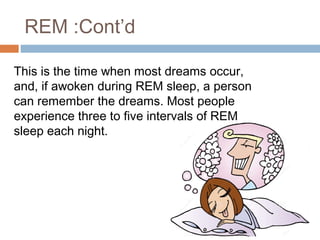
REM :Cont’d
This is the time when most dreams occur,
and, if awoken during REM sleep, a person
can remember the dreams. Most people
experience three to five intervals of REM
sleep each night.
Categories of sleep disorders
There are four major categories of sleep disorders
according to the Sleep Disorders Classification
Committee of the American Academy of Sleep
Medicine:
1. Disorders of initiating and maintaining
sleep(insomnias).
2. Disorders of the sleep–wake cycle.
3. Dysfunctions associated with sleep, sleep stages, or
partial arousals (parasomnias).
4. Disorders of excessive somnolence.
Insomnia
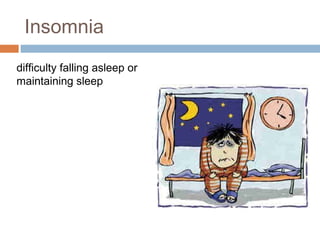
difficulty falling asleep or
maintaining sleep
Predisposing factors
A*The predisposing factors for insomnia are related to
the internal stress
response mechanisms of the awakening system. They
include—the hyperactivity of the hypothalamic-pituitary-
adrenal axis, abnormalities in the circadian rhythm or
internal clock regulating circadian sleep wakefulness,
depression, and anxiety.
B*Biological
a) Age
b) Female gender
c) Hormonal factors such a melatonin
d) Hyper arousal influences
Predisposing factors : cont’d
Precipitating factors
a. Precipitating factors of insomnia are associated with
social cues, behavioral response to the environment and
individual cognitive characteristics. Examples of
precipitating factors include:
i. Conditions affecting sleep which may include pain and
discomfort that affects sleep and energy levels
ii. Medications that affect sleep
iii. Change in sleep environment including noise levels,
lighting,
temperature, and setting, which may alter sleep
iv. Rotating work schedules
b. Psychological stressors also contribute to precipitating
factors and
response.
Assessment of Insomnia
B*evaluations of the sleep environment and sleep
hygiene.
A*complete medical, psychological, and social
Assessment.
Interventions
A*Cognitive behavior therapy (CBT) for acute and
chronic insomnia provided by psychiatric clinical nurse
specialist, or psychologist is the gold standard
treatment for insomnia
B*The use of pharmacological agents may also benefit
both acute and chronic types of insomnia
**hypnotic drugs, which induce sleep.
**Other medications are also used for their
sedating side effects such as anti-psychotics
General sleep Habits
recommendations
• Emphasis placed on maintaining a regular sleep
schedule 7 days per week during the night to promote
rest for the patient & the family
• Encourage gentle, regular, stretching, exercise as
tolerated. Do not exercise 2-3 hours before bed.
• Suggestions to create a calm environment
○ Ensure a quiet & dark sleep room as preferred.
Encourage use of earplugs or head phones
○ Employ white noise (e.g., sound machines, fans, MP3
player, radio with soothing music or sounds)
○ Refrain from watching television in bed, especially
prior to sleep
○ Avoid alcohol, nicotine, & caffeine later in the day &
evening
If unable to fall asleep within 30 minutes of going to bed,
assess for pain &/or other symptoms & treat appropriately to
promote sleep such as extra pre-bedtime dosing of
medications or oxygen therapy. Also if pain & other
symptoms awaken the patient during regular sleeping hours,
attempt a plan to decrease episodes. For example, switch to
long-acting medications for stable symptoms
General sleep Habits
recommendations
Disorders of the sleep-wake
cycle
Disorders of the sleep-wake cycle are characterized by a
temporal discrepancy of the circadian clock relative to the
surrounding environmental .
This may arise due to changes in external cues, as in jet lag
and shift-work sleep disorder. Equally it can originate because
of an abnormality in the timing of the body clock, the result of
which is typically chronic insomnia.
Sleep hygiene
‘Sleep hygiene’ is the term used to describe good sleep
habits.
Considerable research has gone into developing a set of
guidelines and tips which are designed to enhance good
sleeping, and there is much evidence to suggest that
these
strategies can provide long-term solutions to sleep
difficulties.
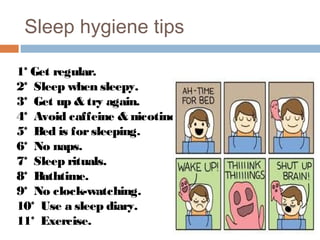
Sleep hygiene tips
1* Get regular.
2* Sleep when sleepy.
3* Get up & try again.
4* Avoid caffeine & nicotine.
5* Bed is forsleeping.
6* No naps.
7* Sleep rituals.
8* Bathtime.
9* No clock-watching.
10* Use a sleep diary.
11* Exercise.
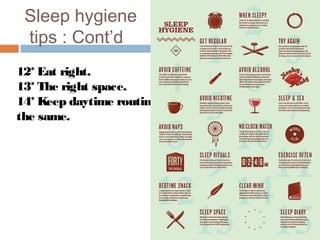
Sleep hygiene
tips : Cont’d
12* Eat right.
13* The right space.
14* Keep daytime routine
the same.
By:
Manal Abul-Haija
raghad Naseem
Ghadeerodeh

Sleep disorders

  • 2.
  • 3.
    Goal At the endof the seminar, students will be able to gain the knowledge regarding sleep disturbances & its patterns & apply this knowledge into providing care to the client.
  • 4.
    Objectives At the endof the seminar student will be able to: *Define sleep. *Enlist the factors affecting the sleep. *Discuss about the stages of sleep briefly. *Explain the short term consciquences of sleep. *Explain sleep disorder and its management. *Discuss nursing management of sleep disturbances. *Explain role of nurse.
  • 5.
    Facts **Man is theonly mammal that willingly delays sleep. **Divorced, widowed and separated people report more insomnia. **Parents of new babies miss out on 6 months worth of sleep in the first 2 years of their child's life.
  • 6.
    **Before alarm clocks wereinvented, there were "knocker-ups" who went tapping on client's windows with long sticks until they were awake. **Dysania is the state of finding it  hard to get out of bed in the morning. Facts : cont’d
  • 7.
    What is sleep? “highlystructured and well-organized activity following a circadian periodicity that is regulated by the interplay of internal biological processes and environmental factors.”
  • 8.
    Physiology of sleep Thereare two types of sleep, non-rapid eye movement (NREM) sleep and rapid eye movement (REM) sleep. NREM sleep is divided into stages 1, 2, 3, and 4, representing a continuum of relative depth. Each has unique characteristics including variations in brain wave patterns, eye movements, and muscle tone.  Circadian rhythms, the daily rhythms in physiology and behavior, regulate the sleep-wake cycle.
  • 9.
    Sleep stages Usually sleeperspass through five stages: 1, 2, 3, 4 and REM (rapid eye movement) sleep. These stages progress cyclically from 1 through REM then begin again with stage 1. A complete sleep cycle takes an average of 90 to 110 minutes. The first sleep cycles each night have relatively short REM sleeps and long periods of deep sleep but later in the night, REM periods lengthen and deep sleep time decreases.
  • 10.
    Stage 1 Stage 1 islight sleep where you drift in and out of sleep and can be awakened easily. In this stage, the eyes move slowly and muscle activity slows. During this stage, many people experience sudden muscle contractions preceded by a sensation of falling.
  • 11.
    Stage 2 eye movementstops and brain waves become slower with only an occasional burst of rapid brain waves
  • 12.
    Stage 3  extremely slowbrain waves called delta waves are interspersed with smaller, faster waves
  • 13.
    Stage 4 The brainproduces delta waves almost exclusively. Stages 3 and 4 are referred to as deep sleep or delta sleep, and it is very difficult to wake someone from them. In deep sleep, there is no eye movement or muscle activity. This is when some children experience bedwetting, sleepwalking or night terrors. In 2008 the sleep profession in the US eliminated the use of stage 4. Stages 3 and 4 are now considered stage 3
  • 15.
    REM stage In the REMperiod, breathing becomes more rapid, irregular and shallow, eyes jerk rapidly and limb muscles are temporarily paralyzed. Brain waves during this stage increase to levels experienced when a person is awake. Also, heart rate increases, blood pressure rises, and the body loses some of the ability to regulate its temperature.
  • 16.
    REM :Cont’d This isthe time when most dreams occur, and, if awoken during REM sleep, a person can remember the dreams. Most people experience three to five intervals of REM sleep each night.
  • 18.
    Categories of sleepdisorders There are four major categories of sleep disorders according to the Sleep Disorders Classification Committee of the American Academy of Sleep Medicine: 1. Disorders of initiating and maintaining sleep(insomnias). 2. Disorders of the sleep–wake cycle. 3. Dysfunctions associated with sleep, sleep stages, or partial arousals (parasomnias). 4. Disorders of excessive somnolence.
  • 19.
  • 20.
    Predisposing factors A*The predisposingfactors for insomnia are related to the internal stress response mechanisms of the awakening system. They include—the hyperactivity of the hypothalamic-pituitary- adrenal axis, abnormalities in the circadian rhythm or internal clock regulating circadian sleep wakefulness, depression, and anxiety.
  • 21.
    B*Biological a) Age b) Femalegender c) Hormonal factors such a melatonin d) Hyper arousal influences Predisposing factors : cont’d
  • 22.
    Precipitating factors a. Precipitatingfactors of insomnia are associated with social cues, behavioral response to the environment and individual cognitive characteristics. Examples of precipitating factors include: i. Conditions affecting sleep which may include pain and discomfort that affects sleep and energy levels ii. Medications that affect sleep iii. Change in sleep environment including noise levels, lighting, temperature, and setting, which may alter sleep iv. Rotating work schedules b. Psychological stressors also contribute to precipitating factors and response.
  • 23.
    Assessment of Insomnia B*evaluationsof the sleep environment and sleep hygiene. A*complete medical, psychological, and social Assessment.
  • 24.
    Interventions A*Cognitive behavior therapy(CBT) for acute and chronic insomnia provided by psychiatric clinical nurse specialist, or psychologist is the gold standard treatment for insomnia B*The use of pharmacological agents may also benefit both acute and chronic types of insomnia **hypnotic drugs, which induce sleep. **Other medications are also used for their sedating side effects such as anti-psychotics
  • 25.
    General sleep Habits recommendations •Emphasis placed on maintaining a regular sleep schedule 7 days per week during the night to promote rest for the patient & the family • Encourage gentle, regular, stretching, exercise as tolerated. Do not exercise 2-3 hours before bed. • Suggestions to create a calm environment ○ Ensure a quiet & dark sleep room as preferred. Encourage use of earplugs or head phones ○ Employ white noise (e.g., sound machines, fans, MP3 player, radio with soothing music or sounds) ○ Refrain from watching television in bed, especially prior to sleep ○ Avoid alcohol, nicotine, & caffeine later in the day & evening
  • 26.
    If unable tofall asleep within 30 minutes of going to bed, assess for pain &/or other symptoms & treat appropriately to promote sleep such as extra pre-bedtime dosing of medications or oxygen therapy. Also if pain & other symptoms awaken the patient during regular sleeping hours, attempt a plan to decrease episodes. For example, switch to long-acting medications for stable symptoms General sleep Habits recommendations
  • 27.
    Disorders of thesleep-wake cycle Disorders of the sleep-wake cycle are characterized by a temporal discrepancy of the circadian clock relative to the surrounding environmental . This may arise due to changes in external cues, as in jet lag and shift-work sleep disorder. Equally it can originate because of an abnormality in the timing of the body clock, the result of which is typically chronic insomnia.
  • 28.
    Sleep hygiene ‘Sleep hygiene’is the term used to describe good sleep habits. Considerable research has gone into developing a set of guidelines and tips which are designed to enhance good sleeping, and there is much evidence to suggest that these strategies can provide long-term solutions to sleep difficulties.
  • 29.
    Sleep hygiene tips 1*Get regular. 2* Sleep when sleepy. 3* Get up & try again. 4* Avoid caffeine & nicotine. 5* Bed is forsleeping. 6* No naps. 7* Sleep rituals. 8* Bathtime. 9* No clock-watching. 10* Use a sleep diary. 11* Exercise.
  • 30.
    Sleep hygiene tips :Cont’d 12* Eat right. 13* The right space. 14* Keep daytime routine the same.
  • 31.

Editor's Notes

  • #6 http://sleepfoundation.org/sleep-news/25-random-facts-about-sleep
  • #7 http://www.factslides.com/s-Sleep#
  • #8 Oxford Textbook of Palliative Nursing
  • #9 http://www.ncbi.nlm.nih.gov/books/NBK19956/
  • #10 http://www.sleepdex.org/stages.htm
  • #11 http://www.sleepdex.org/stages.htm
  • #12 http://www.sleepdex.org/stages.htm
  • #13 http://www.sleepdex.org/stages.htm
  • #14 http://www.sleepdex.org/stages.htm
  • #16 http://www.sleepdex.org/stages.htm
  • #17 http://www.sleepdex.org/stages.htm
  • #19 Oxford Textbook of Palliative Nursing
  • #28 JET LAG SYNDROME The rapid transition across time zones causes a conflict between the body clock and cues that guide it. Upon arrival in the new time zone the environmental and social zeitgebers immediately begin to resynchronise the body clock. The rhythms that the latter controls subsequently follow, although at different rates. http://www.ncbi.nlm.nih.gov/pmc/articles/PMC2360840/+ The result is jet lag. Symptoms include problems of behaviour and performance . Their severity is related to the direction of travel and number of time zones crossed.
  • #30 www.cci.health.wa.gov.au
  • #31 www.cci.health.wa.gov.au