Sleep
It Does a Body Good
Presentation by
Elizabeth Kincade, Ph.D.--Indiana University of PA
Edited for use in Pennsylvania College of Technology’s
First Year Experience Courses by
Ian Detamore
“People say, 'I'm going to sleep now,' as if it were nothing. But it's really a bizarre
activity. 'For the next several hours, while the sun is gone, I'm going to become
unconscious, temporarily losing command over everything I know and understand.
When the sun returns, I will resume my life.'
If you didn't know what sleep was, and you had only seen it in a science fiction movie,
you would think it was weird and tell all your friends about the movie you'd seen.
They had these people, you know? And they would walk around all day and be OK?
And then, once a day, usually after dark, they would lie down on these special
platforms and become unconscious. They would stop functioning almost completely,
except deep in their minds they would have adventures and experiences that were
completely impossible in real life. As they lay there, completely vulnerable to their
enemies, their only movements were to occasionally shift from one position to
another; or, if one of the 'mind adventures' got too real, they would sit up and scream
and be glad they weren't unconscious anymore. Then they would drink a lot of coffee.'
So, next time you see someone sleeping, make believe you're in a science fiction
movie. And whisper, 'The creature is regenerating itself.”
― George Carlin, Brain Droppings
Ah, Sleep…
Sleep Is:
A naturally recurring state characterized by reduced or
absent consciousness, relatively suspended sensory
activity, and inactivity of nearly all voluntary muscles. It
is distinguished from quiet wakefulness by a decreased
ability to react to stimuli and is more easily reversible
than being in hibernation or a coma. Sleep is a
heightened anabolic state, accentuating the growth and
rejuvenation of the immune, nervous, skeletal and
muscular systems. It is observed in all mammals and
birds, as well as many reptiles, amphibians, and fish.
Sleep is…
• NOT a passive and dormant part of our lives.
• A time when our brains are active .
• A state of being that affects daily functioning,
and mental health.
• Something we are still trying to fully
understand.
The Circadian Rhythm
• Maintains temperature, wakefulness, and
other bodily rhythms over a 24-hour period.
• Light triggers brain signals that control the
circadian clock, leading to increased
wakefulness around bright light.
• You can reset your internal clock by adjusting
your sleep schedule. This is why sleeping until
noon on Sunday and then trying to go to bed
at a normal time is so difficult.
What happens when we sleep:
• Nerve signaling chemicals in our brain
(neurotransmitters) control whether we are
asleep or awake
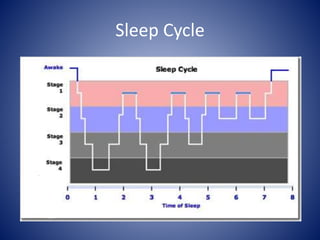
• Sleep is cyclical.
– Stage 1 – Light Sleep
– Stage 2 – Intermediate Sleep
– Stage 3,4- Deep Sleep
– REM sleep (dreams!)
Sleep Cycle
Benefits of Sleep
Good Sleep:
• Strengthens your immune system
• Improves concentration, memory and physical
performance
• Prevents mood swings
• Gives your brain a chance to rest and repair
cells/neurons
• Deep sleeps helps cell growth and repair
damage from stress and ultraviolent rays
What About Dreams?
We don’t really know
• Might be the brain’s way of making sense/telling
stories as it deals with random signals during sleep
• Might be meaningful information about your self and
your desires
• Might be the brain strengthening memories
• Typically, your dreams contain things that occurred
recently, occur frequently, or are emotionally
important to you.
One thing we DO know:
The R.E.M. Stage (Dreams) is one of the stages
of sleep that re-energizes us. Our bodies/our
brains need to dream.
If we don’t have enough sleep...
Continued sleep deprivation or poor sleep
disturbs our ability to enter the REM stage. Once
undisturbed sleep resumes, the body “dives”
into REM sleep more quickly and spends more
time there.
There are physical , emotional and behavioral
impacts.
What are some you have experienced
or seen in others…
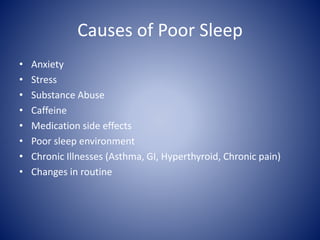
Causes of Poor Sleep
• Anxiety
• Stress
• Substance Abuse
• Caffeine
• Medication side effects
• Poor sleep environment
• Chronic Illnesses (Asthma, GI, Hyperthyroid, Chronic pain)
• Changes in routine
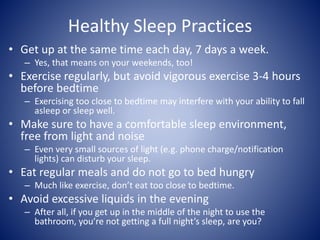
Healthy Sleep Practices
• Get up at the same time each day, 7 days a week.
– Yes, that means on your weekends, too!
• Exercise regularly, but avoid vigorous exercise 3-4 hours
before bedtime
– Exercising too close to bedtime may interfere with your ability to fall
asleep or sleep well.
• Make sure to have a comfortable sleep environment,
free from light and noise
– Even very small sources of light (e.g. phone charge/notification
lights) can disturb your sleep.
• Eat regular meals and do not go to bed hungry
– Much like exercise, don’t eat too close to bedtime.
• Avoid excessive liquids in the evening
– After all, if you get up in the middle of the night to use the
bathroom, you’re not getting a full night’s sleep, are you?
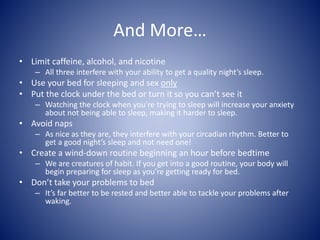
And More…
• Limit caffeine, alcohol, and nicotine
– All three interfere with your ability to get a quality night’s sleep.
• Use your bed for sleeping and sex only
• Put the clock under the bed or turn it so you can’t see it
– Watching the clock when you’re trying to sleep will increase your anxiety
about not being able to sleep, making it harder to sleep.
• Avoid naps
– As nice as they are, they interfere with your circadian rhythm. Better to
get a good night’s sleep and not need one!
• Create a wind-down routine beginning an hour before bedtime
– We are creatures of habit. If you get into a good routine, your body will
begin preparing for sleep as you’re getting ready for bed.
• Don’t take your problems to bed
– It’s far better to be rested and better able to tackle your problems after
waking.
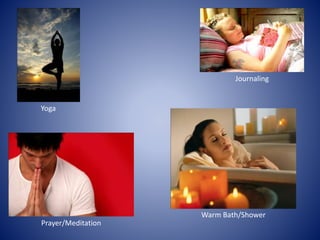
Find a relaxing activity
Yoga
Journaling
Prayer/Meditation
Warm Bath/Shower
What if I still cannot sleep?!
Ask A Sleep Professional
• There are medical and mental health
professionals who specialize in sleep disorders
• These professionals can help you find out why
sleep is difficult for you and help you to
correct your sleep difficulties
• And, before you consult…
Keep a Sleep Journal
and
Include the following :
• What time you go to bed.
• Approximately what time you fall asleep.
• How many times and how long you are up during the night.
• What time you wake up in the morning.
• What time you get out of bed.
• Naps (how many, how long).
• Exercise.
• Alcohol consumption.
• Caffeinated beverages consumption (how many/day).
 Share your journal with your doctor
Helpful Websites
http://www.cdc.gov/sleep/
http://www.sleepassociation.org

Sleep Hygiene

  • 1.
    Sleep It Does aBody Good Presentation by Elizabeth Kincade, Ph.D.--Indiana University of PA Edited for use in Pennsylvania College of Technology’s First Year Experience Courses by Ian Detamore
  • 2.
    “People say, 'I'mgoing to sleep now,' as if it were nothing. But it's really a bizarre activity. 'For the next several hours, while the sun is gone, I'm going to become unconscious, temporarily losing command over everything I know and understand. When the sun returns, I will resume my life.' If you didn't know what sleep was, and you had only seen it in a science fiction movie, you would think it was weird and tell all your friends about the movie you'd seen. They had these people, you know? And they would walk around all day and be OK? And then, once a day, usually after dark, they would lie down on these special platforms and become unconscious. They would stop functioning almost completely, except deep in their minds they would have adventures and experiences that were completely impossible in real life. As they lay there, completely vulnerable to their enemies, their only movements were to occasionally shift from one position to another; or, if one of the 'mind adventures' got too real, they would sit up and scream and be glad they weren't unconscious anymore. Then they would drink a lot of coffee.' So, next time you see someone sleeping, make believe you're in a science fiction movie. And whisper, 'The creature is regenerating itself.” ― George Carlin, Brain Droppings
  • 3.
  • 4.
    Sleep Is: A naturallyrecurring state characterized by reduced or absent consciousness, relatively suspended sensory activity, and inactivity of nearly all voluntary muscles. It is distinguished from quiet wakefulness by a decreased ability to react to stimuli and is more easily reversible than being in hibernation or a coma. Sleep is a heightened anabolic state, accentuating the growth and rejuvenation of the immune, nervous, skeletal and muscular systems. It is observed in all mammals and birds, as well as many reptiles, amphibians, and fish.
  • 5.
    Sleep is… • NOTa passive and dormant part of our lives. • A time when our brains are active . • A state of being that affects daily functioning, and mental health. • Something we are still trying to fully understand.
  • 6.
    The Circadian Rhythm •Maintains temperature, wakefulness, and other bodily rhythms over a 24-hour period. • Light triggers brain signals that control the circadian clock, leading to increased wakefulness around bright light. • You can reset your internal clock by adjusting your sleep schedule. This is why sleeping until noon on Sunday and then trying to go to bed at a normal time is so difficult.
  • 7.
    What happens whenwe sleep: • Nerve signaling chemicals in our brain (neurotransmitters) control whether we are asleep or awake • Sleep is cyclical. – Stage 1 – Light Sleep – Stage 2 – Intermediate Sleep – Stage 3,4- Deep Sleep – REM sleep (dreams!)
  • 8.
  • 9.
    Benefits of Sleep GoodSleep: • Strengthens your immune system • Improves concentration, memory and physical performance • Prevents mood swings • Gives your brain a chance to rest and repair cells/neurons • Deep sleeps helps cell growth and repair damage from stress and ultraviolent rays
  • 10.
    What About Dreams? Wedon’t really know • Might be the brain’s way of making sense/telling stories as it deals with random signals during sleep • Might be meaningful information about your self and your desires • Might be the brain strengthening memories • Typically, your dreams contain things that occurred recently, occur frequently, or are emotionally important to you.
  • 11.
    One thing weDO know: The R.E.M. Stage (Dreams) is one of the stages of sleep that re-energizes us. Our bodies/our brains need to dream.
  • 12.
    If we don’thave enough sleep... Continued sleep deprivation or poor sleep disturbs our ability to enter the REM stage. Once undisturbed sleep resumes, the body “dives” into REM sleep more quickly and spends more time there. There are physical , emotional and behavioral impacts.
  • 13.
    What are someyou have experienced or seen in others…
  • 14.
    Causes of PoorSleep • Anxiety • Stress • Substance Abuse • Caffeine • Medication side effects • Poor sleep environment • Chronic Illnesses (Asthma, GI, Hyperthyroid, Chronic pain) • Changes in routine
  • 15.
    Healthy Sleep Practices •Get up at the same time each day, 7 days a week. – Yes, that means on your weekends, too! • Exercise regularly, but avoid vigorous exercise 3-4 hours before bedtime – Exercising too close to bedtime may interfere with your ability to fall asleep or sleep well. • Make sure to have a comfortable sleep environment, free from light and noise – Even very small sources of light (e.g. phone charge/notification lights) can disturb your sleep. • Eat regular meals and do not go to bed hungry – Much like exercise, don’t eat too close to bedtime. • Avoid excessive liquids in the evening – After all, if you get up in the middle of the night to use the bathroom, you’re not getting a full night’s sleep, are you?
  • 16.
    And More… • Limitcaffeine, alcohol, and nicotine – All three interfere with your ability to get a quality night’s sleep. • Use your bed for sleeping and sex only • Put the clock under the bed or turn it so you can’t see it – Watching the clock when you’re trying to sleep will increase your anxiety about not being able to sleep, making it harder to sleep. • Avoid naps – As nice as they are, they interfere with your circadian rhythm. Better to get a good night’s sleep and not need one! • Create a wind-down routine beginning an hour before bedtime – We are creatures of habit. If you get into a good routine, your body will begin preparing for sleep as you’re getting ready for bed. • Don’t take your problems to bed – It’s far better to be rested and better able to tackle your problems after waking.
  • 17.
  • 18.
  • 19.
    What if Istill cannot sleep?!
  • 20.
    Ask A SleepProfessional • There are medical and mental health professionals who specialize in sleep disorders • These professionals can help you find out why sleep is difficult for you and help you to correct your sleep difficulties • And, before you consult…
  • 21.
    Keep a SleepJournal and Include the following : • What time you go to bed. • Approximately what time you fall asleep. • How many times and how long you are up during the night. • What time you wake up in the morning. • What time you get out of bed. • Naps (how many, how long). • Exercise. • Alcohol consumption. • Caffeinated beverages consumption (how many/day).  Share your journal with your doctor
  • 22.