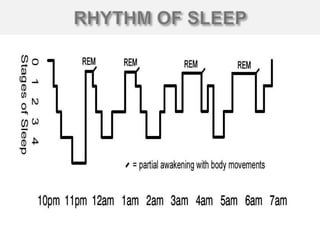
• Sleep is one of the states of consciousness.
• Most individuals spend 1/3rd of their entire
life asleep.
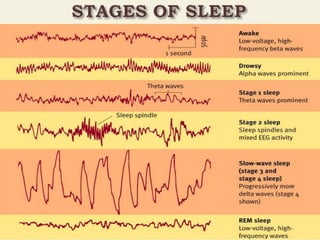
• Much of our knowledge of sleep comes
from E.E.G..
• EEG measures changes in the electrical
activity of brain and has proved very
helpful.
 Reload energy deposits.
 Helps to stay in a good mood.
 Growth and development.
 During REM sleep, body retains products of
new learning, & integrates this new material
with existing memories.
 Helps to cope up with emotion provoking &
threatening experiences.
 Impaired creativity & concentration.
 Diminished immunity to disease.
 Irritability.
 Slow performance.
 Drowsiness.
However , highly motivating tasks
are little affected by sleep deprivation.
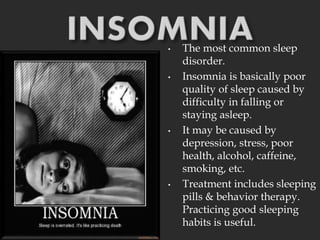
• The most common sleep
disorder.
• Insomnia is basically poor
quality of sleep caused by
difficulty in falling or
staying asleep.
• It may be caused by
depression, stress, poor
health, alcohol, caffeine,
smoking, etc.
• Treatment includes sleeping
pills & behavior therapy.
Practicing good sleeping
habits is useful.
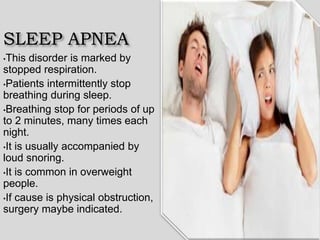
SLEEP APNEA
•This disorder is marked by
stopped respiration.
•Patients intermittently stop
breathing during sleep.
•Breathing stop for periods of up
to 2 minutes, many times each
night.
•It is usually accompanied by
loud snoring.
•It is common in overweight
people.
•If cause is physical obstruction,
surgery maybe indicated.
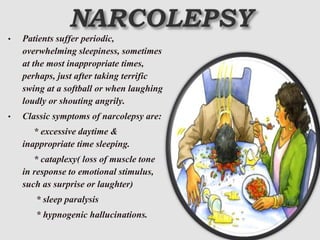
• Patients suffer periodic,
overwhelming sleepiness, sometimes
at the most inappropriate times,
perhaps, just after taking terrific
swing at a softball or when laughing
loudly or shouting angrily.
• Classic symptoms of narcolepsy are:
* excessive daytime &
inappropriate time sleeping.
* cataplexy( loss of muscle tone
in response to emotional stimulus,
such as surprise or laughter)
* sleep paralysis
* hypnogenic hallucinations.
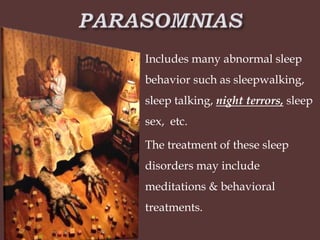
• Includes many abnormal sleep
behavior such as sleepwalking,
sleep talking, night terrors, sleep
sex, etc.
• The treatment of these sleep
disorders may include
meditations & behavioral
treatments.
SELF HELP FOR
SLEEP
DISORDERS
• Improving daytime habits
• Incorporating regular sleep
routine.
•Keeping fixed sleep schedule.
• Proper bedroom ambiance.
•Turning off gadgets before
sleep in advance.
 Bernstein, D.A., Penner, L.P., Clarke-Stewart, E.J.
(2008). Psychology (8th Ed.). N.Y.: Houghton Miffin
 Baron, R.(2004) Psychology. New Delhi : Prentice –
Hall of India.
Aachal P. Taywade
Asst. Prof. (Psychology),
Amity University Mumbai.

Sleep and sleep disorder

  • 3.
    • Sleep isone of the states of consciousness. • Most individuals spend 1/3rd of their entire life asleep. • Much of our knowledge of sleep comes from E.E.G.. • EEG measures changes in the electrical activity of brain and has proved very helpful.
  • 6.
     Reload energydeposits.  Helps to stay in a good mood.  Growth and development.  During REM sleep, body retains products of new learning, & integrates this new material with existing memories.  Helps to cope up with emotion provoking & threatening experiences.
  • 7.
     Impaired creativity& concentration.  Diminished immunity to disease.  Irritability.  Slow performance.  Drowsiness. However , highly motivating tasks are little affected by sleep deprivation.
  • 10.
    • The mostcommon sleep disorder. • Insomnia is basically poor quality of sleep caused by difficulty in falling or staying asleep. • It may be caused by depression, stress, poor health, alcohol, caffeine, smoking, etc. • Treatment includes sleeping pills & behavior therapy. Practicing good sleeping habits is useful.
  • 11.
    SLEEP APNEA •This disorderis marked by stopped respiration. •Patients intermittently stop breathing during sleep. •Breathing stop for periods of up to 2 minutes, many times each night. •It is usually accompanied by loud snoring. •It is common in overweight people. •If cause is physical obstruction, surgery maybe indicated.
  • 12.
    • Patients sufferperiodic, overwhelming sleepiness, sometimes at the most inappropriate times, perhaps, just after taking terrific swing at a softball or when laughing loudly or shouting angrily. • Classic symptoms of narcolepsy are: * excessive daytime & inappropriate time sleeping. * cataplexy( loss of muscle tone in response to emotional stimulus, such as surprise or laughter) * sleep paralysis * hypnogenic hallucinations.
  • 13.
    • Includes manyabnormal sleep behavior such as sleepwalking, sleep talking, night terrors, sleep sex, etc. • The treatment of these sleep disorders may include meditations & behavioral treatments.
  • 14.
    SELF HELP FOR SLEEP DISORDERS •Improving daytime habits • Incorporating regular sleep routine. •Keeping fixed sleep schedule. • Proper bedroom ambiance. •Turning off gadgets before sleep in advance.
  • 15.
     Bernstein, D.A.,Penner, L.P., Clarke-Stewart, E.J. (2008). Psychology (8th Ed.). N.Y.: Houghton Miffin  Baron, R.(2004) Psychology. New Delhi : Prentice – Hall of India.
  • 16.
    Aachal P. Taywade Asst.Prof. (Psychology), Amity University Mumbai.