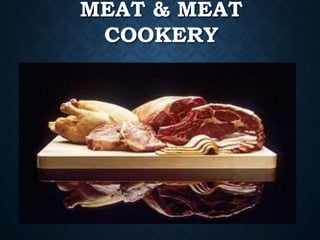
MEAT & MEAT
COOKERY
Meat
• refers to the edibleflesh of
animals
• is animal flesh that is eaten as
food
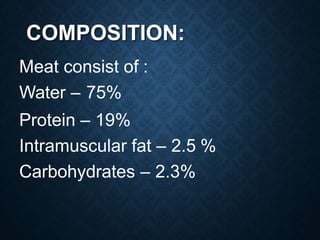
COMPOSITION:
Meat consist of :
Water – 75%
Protein – 19%
Intramuscular fat – 2.5 %
Carbohydrates – 2.3%
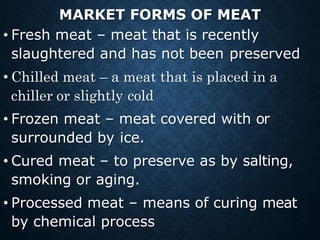
MARKET FORMS OF MEAT
• Fresh meat – meat that is recently
slaughtered and has not been preserved
• Chilled meat – a meat that is placed in a
chiller or slightly cold
• Frozen meat – meat covered with or
surrounded by ice.
• Cured meat – to preserve as by salting,
smoking or aging.
• Processed meat – means of curing meat
by chemical process
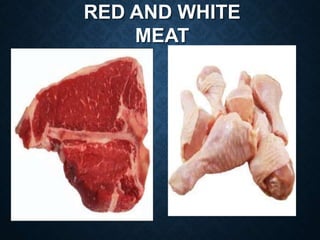
RED AND WHITE
MEAT
RED
MEAT
• The color depends on the concentration of
myoglobin in muscle fiber. When
myoglobin is exposed to oxygen reddish
color appears.
• Redness depends on species, animal
age, and narrow muscle fibres.
Examples :
Red meats: Beef, veal, lamb,
mutton, carabeef
WHITE
MEAT
• white meat may also refer to any lighter-
colored meat.
• It is believe that white meat is healthier
than red meat
Examples: pork, poultry and game, fish and
shellfish
MEATS FROM
DIFF. ANIMALS
• Pork – pig/hog
• Beef – cow/cattle
• Chevron – goat
• Venison – deer
• Lamb (less than 1 yr.) mutton- sheep
(more than 1 yr)
• Carabeef - carabao
STRUCTURE OF
MEAT:
1. Lean Tissue – consist of one or more muscles
which is made up of many bundles of muscle
fibers.
2. Connective Tissue – Surround the fibers and
unites them in bundles.
a)Collagen – arranged in parallel , do not
stretch, color is white, disintegrate in hot water
b)Elastin – yellowish portion, do not tenderize
while cooking
3. Fat – around or between muscles
COMPOSITION OF MEAT:
Water
• Water is about 75% of muscle tissue. Shrinkage
can be a big problem in cooking meat which
result to loss of weight and loss of profit.
Protein
• About 20% of the muscle tissue is a protein.
Protein coagulates when it is heated. This
means firmer and loses moisture. Coagulation is
related to doneness.
Fat
• 5 % of the muscle tissue is fat. A beef
carcass can be as much as 30% fat.
1.Juiciness – Marbling is fat deposited
within the muscle tissue. Juiciness
depends on how
much marble contains in the meat.
2.Tenderness – Marbling separates muscle
fibers, making them easier to chew.
3. Flavor – Flavor depends on the marbling.
CUT IN BEEF
CARCASS
BEEF
• Beef is the meat of domesticated
mature cattle usually over 12 months
of age
• It is usually bright, cherry red in color
with creamy white fat.
• Cattle is the collective name for
all domesticated oxen
Cattle are classified as:
• Bulls – male cattle, usually not raised
to be eaten.
• Calves – young cows or bulls prized for
their meat.
• Cows – female cattle after the first calving,
raised principally for milk and calf
production..
• Steers – male cattle castrated prior to
maturity and principally raised for beef.
VEAL
• Calves under the
age of nine
months. (8-16
weeks)
• lighter in color
than beef,
• more delicate
flavor
• generally more
tender.
• Meat from calves
slaughtered when
they are older than
five months is called
calf.
• deeper red, with
some marbling and
external fat.
• A veal carcass
weighs in a range of
60 to 245 pounds (27-
110 kg.)
VARIETY MEATS/ ORGAN
MEATS
• Sweetbreads – these are the thymus
glands of veal and lamb..
• Liver, heart, kidney, and tongue of beef,
veal, lamb and pork.
• Tripe – the inner lining of the
stomach of ruminant (cud-chewing)
animals.
– blanket tripe - tuwalya
– honeycomb tripe – libro-libro or librilyo
•brains
•chitterlings – cleaned intestines
•other innards – include the lights
(lungs), melt (spleen) and
mesentery (abdominal
membrane)
•Pork / beef blood
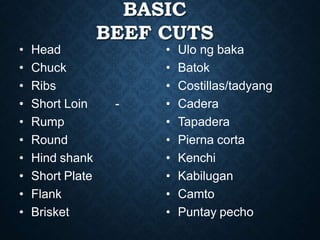
BASIC
BEEF CUTS
-
• Head
• Chuck
• Ribs
• Short Loin
• Rump
• Round
• Hind shank
• Short Plate
• Flank
• Brisket
• Ulo ng baka
• Batok
• Costillas/tadyang
• Cadera
• Tapadera
• Pierna corta
• Kenchi
• Kabilugan
• Camto
• Puntay pecho
CUT IN PORK
CARCASS
PORK
PRODUCTS
• Ham – comes from pork leg. It is usually
cured and smoked.
• Bacon – is smoked pork belly meat
PORK CARCASS BASIC CUTS
•
•
•
•
•
•
•
•
•
•
•
Head
picnic
jowl
Blade roast
fore shank/ hind shank
Spare ribs
Ham
Shank
foot
Picinic shoulder
Side Belly
•
•
•
•
•
•
•
•
•
•
•
Ulo bg baboy
Kasim
Batok/kalamnan
Costillas
Pata
tadyang
Pigue
Bias Pata
Kasim
liempo
CHANGES IN MEAT
AFTER DEATH
1)Muscle is pliant, soft, gel like,
sticky, immediately after death
2)A few minutes to 1 hr. – muscle
shortens, become rigid, hard, inflexible.
Should not be cooked at this time
3)After a few days – gradual tenderization,
after freezing. This is the time to cook the
meat
MARKET FORMS OF MEAT
• Fresh Meat – this is meat
immediately after slaughter,
without undergoing chilling or
freezing.
• Chilled Meat – is meat that has
been cooled to a temperature
just above freezing (1-3°) within
24 hours after slaughter.
• Frozen Meat – are meat cuts
frozen to an eternal temperature of
20°C (-40°C).
MARKET FORMS
OF MEAT
• Cured Meat – are meat products that
have been treated with a curing
agent solution like salt, sodium
nitrate (salitre), sugar, and spices.
• Canned Meat – are cooked
meat products and only
requires to be reheated.
• Dried Meats – dehydrated meats.
EFFECTS OF
COOKING MEATS
• Changes in pigment – myoglobin from bright red color to
grayish brown.
• Changes in meat protein- Decrease in length of fiber causing
shrinkage. Excessive heating makes the meat tougher, stringy
and rubbery.
• Fat melts , causing shrinkage
Loss in moisture
• Heat converts collagen into gelatin. This requires more
heat
• Long cooking develops better flavor
•
•
•
•
•
•
FACTORS
INFLUENCING
FLAVOR
• Flavor is due to decomposition of protein and oxidation of fat.
Saltiness and sweetness of the blood. The distinctive flavor of
animal is affected by specie, sex, age, amount of exercise,
degree of ripening.
• The older the animal the stronger the flavor. More
exercised animals have tougher meat
• The more varied the feed, the more distinctive its flavor.
•
•
•
•
SIX STAGES OF DONENESS:
• very rare - red, juices blood, soft, jelly-like
• rare -raw red portion of meat is small,
around is pink brown outer surface, juices
are red
• medium rare –interior portion is rich
pink. Meat is plump and firm
• medium – modified rose, pink juices are
less
• medium well – pink color disappears,
juices are clear gray, firm to touch
• Well - gray inside and out, shrunken,
little or no juice appear, brown and dry.
STORAGE OF MEATS:
Fresh Meats:
1.Check purchases as soon as it arrives to
ensure the quality.
2.Do not wrap tightly, bacteria and mold
thrive in moist. Allow air to circulate to
inhibits the growth of bacteria.
3.Do not open vacuum packed meats until
it is ready to use.
4.. Store at 32⁰ to 36⁰ F
5.Store fresh meat in the coldest part of the
refrigerator (40°F/5°C or lower).
6.Use refrigerated fresh meats within 3-4
days.
Ground meats and variety meats are
more perishable than other meats, use
them within 1-2 days.
7.Refrigerator cured & smoke meats,
sausages, and ready to serve meats,
unless the label says otherwise. Leave
them in their original wrappers.
8.FREEZE MEATS FOR LONGER
STORAGE. (0°F/18°C OR COLDER)
FOR MAXIMUM KEEPING
QUALITY.
– you can freeze luncheon meat, hotdog, and
ham up to 2 months.
– Ground meats will keep for 3 months.
– Pork cuts for 6 months
– Lamb will keep up to 9 months.
• Beef will keep for a year.
PRINCIPLES OF
COOKING
• To improve its palatability quality.
• To increase tenderness-
–Elastin – is very tough and elastic,
and cooking cannot soften it.
–Collagen – also tough and
elastic, but cooking can soften
and tenderize it.
METHODS OF TENDERIZING
TOUGH MEAT CUTS:
• Mechanical Method
Elastin can be broken down by:
– Pounding/beating
– Slicing thinly
– Grounding
• Marinating – involves soaking meat in a
solution called marinade which contains
acid, such as vinegar, lemon/calamansi
juice or tomato juice that helps tenderize
meat.
• Use of proteolytic enzymes that
tenderize meats
– Papain – from papaya
– Bromelin – from pineapple
– Ficin – from figs
• Aging - when animals are slaughtered,
their muscles are soft and flabby.
Within 6-24 hours, rigor mortis sets in,
causing the muscles to contract and
stiffen.
• During cooking, heat coagulates the
proteins in the, muscle fibers.
• cooking meats at too high temperature or
for too long will make it tough and dry.
• Meats cuts cooked in liquid will fall apart.
This is due to over coagulation of the
proteins.

MEAT COOKERY.pptx

  • 1.
  • 2.
    Meat • refers tothe edibleflesh of animals • is animal flesh that is eaten as food
  • 3.
    COMPOSITION: Meat consist of: Water – 75% Protein – 19% Intramuscular fat – 2.5 % Carbohydrates – 2.3%
  • 4.
    MARKET FORMS OFMEAT • Fresh meat – meat that is recently slaughtered and has not been preserved • Chilled meat – a meat that is placed in a chiller or slightly cold • Frozen meat – meat covered with or surrounded by ice. • Cured meat – to preserve as by salting, smoking or aging. • Processed meat – means of curing meat by chemical process
  • 5.
  • 6.
    RED MEAT • The colordepends on the concentration of myoglobin in muscle fiber. When myoglobin is exposed to oxygen reddish color appears. • Redness depends on species, animal age, and narrow muscle fibres. Examples : Red meats: Beef, veal, lamb, mutton, carabeef
  • 7.
    WHITE MEAT • white meatmay also refer to any lighter- colored meat. • It is believe that white meat is healthier than red meat Examples: pork, poultry and game, fish and shellfish
  • 8.
    MEATS FROM DIFF. ANIMALS •Pork – pig/hog • Beef – cow/cattle • Chevron – goat • Venison – deer • Lamb (less than 1 yr.) mutton- sheep (more than 1 yr) • Carabeef - carabao
  • 9.
    STRUCTURE OF MEAT: 1. LeanTissue – consist of one or more muscles which is made up of many bundles of muscle fibers. 2. Connective Tissue – Surround the fibers and unites them in bundles. a)Collagen – arranged in parallel , do not stretch, color is white, disintegrate in hot water b)Elastin – yellowish portion, do not tenderize while cooking 3. Fat – around or between muscles
  • 10.
    COMPOSITION OF MEAT: Water •Water is about 75% of muscle tissue. Shrinkage can be a big problem in cooking meat which result to loss of weight and loss of profit. Protein • About 20% of the muscle tissue is a protein. Protein coagulates when it is heated. This means firmer and loses moisture. Coagulation is related to doneness.
  • 11.
    Fat • 5 %of the muscle tissue is fat. A beef carcass can be as much as 30% fat. 1.Juiciness – Marbling is fat deposited within the muscle tissue. Juiciness depends on how much marble contains in the meat. 2.Tenderness – Marbling separates muscle fibers, making them easier to chew. 3. Flavor – Flavor depends on the marbling.
  • 12.
  • 13.
    BEEF • Beef isthe meat of domesticated mature cattle usually over 12 months of age • It is usually bright, cherry red in color with creamy white fat. • Cattle is the collective name for all domesticated oxen
  • 14.
    Cattle are classifiedas: • Bulls – male cattle, usually not raised to be eaten. • Calves – young cows or bulls prized for their meat. • Cows – female cattle after the first calving, raised principally for milk and calf production.. • Steers – male cattle castrated prior to maturity and principally raised for beef.
  • 15.
    VEAL • Calves underthe age of nine months. (8-16 weeks) • lighter in color than beef, • more delicate flavor • generally more tender. • Meat from calves slaughtered when they are older than five months is called calf. • deeper red, with some marbling and external fat. • A veal carcass weighs in a range of 60 to 245 pounds (27- 110 kg.)
  • 16.
    VARIETY MEATS/ ORGAN MEATS •Sweetbreads – these are the thymus glands of veal and lamb.. • Liver, heart, kidney, and tongue of beef, veal, lamb and pork. • Tripe – the inner lining of the stomach of ruminant (cud-chewing) animals. – blanket tripe - tuwalya – honeycomb tripe – libro-libro or librilyo
  • 17.
    •brains •chitterlings – cleanedintestines •other innards – include the lights (lungs), melt (spleen) and mesentery (abdominal membrane) •Pork / beef blood
  • 18.
    BASIC BEEF CUTS - • Head •Chuck • Ribs • Short Loin • Rump • Round • Hind shank • Short Plate • Flank • Brisket • Ulo ng baka • Batok • Costillas/tadyang • Cadera • Tapadera • Pierna corta • Kenchi • Kabilugan • Camto • Puntay pecho
  • 19.
  • 20.
    PORK PRODUCTS • Ham –comes from pork leg. It is usually cured and smoked. • Bacon – is smoked pork belly meat
  • 21.
    PORK CARCASS BASICCUTS • • • • • • • • • • • Head picnic jowl Blade roast fore shank/ hind shank Spare ribs Ham Shank foot Picinic shoulder Side Belly • • • • • • • • • • • Ulo bg baboy Kasim Batok/kalamnan Costillas Pata tadyang Pigue Bias Pata Kasim liempo
  • 22.
    CHANGES IN MEAT AFTERDEATH 1)Muscle is pliant, soft, gel like, sticky, immediately after death 2)A few minutes to 1 hr. – muscle shortens, become rigid, hard, inflexible. Should not be cooked at this time 3)After a few days – gradual tenderization, after freezing. This is the time to cook the meat
  • 23.
    MARKET FORMS OFMEAT • Fresh Meat – this is meat immediately after slaughter, without undergoing chilling or freezing. • Chilled Meat – is meat that has been cooled to a temperature just above freezing (1-3°) within 24 hours after slaughter. • Frozen Meat – are meat cuts frozen to an eternal temperature of 20°C (-40°C).
  • 24.
    MARKET FORMS OF MEAT •Cured Meat – are meat products that have been treated with a curing agent solution like salt, sodium nitrate (salitre), sugar, and spices. • Canned Meat – are cooked meat products and only requires to be reheated. • Dried Meats – dehydrated meats.
  • 25.
    EFFECTS OF COOKING MEATS •Changes in pigment – myoglobin from bright red color to grayish brown. • Changes in meat protein- Decrease in length of fiber causing shrinkage. Excessive heating makes the meat tougher, stringy and rubbery. • Fat melts , causing shrinkage Loss in moisture • Heat converts collagen into gelatin. This requires more heat • Long cooking develops better flavor • • • • • •
  • 26.
    FACTORS INFLUENCING FLAVOR • Flavor isdue to decomposition of protein and oxidation of fat. Saltiness and sweetness of the blood. The distinctive flavor of animal is affected by specie, sex, age, amount of exercise, degree of ripening. • The older the animal the stronger the flavor. More exercised animals have tougher meat • The more varied the feed, the more distinctive its flavor. • • • •
  • 27.
    SIX STAGES OFDONENESS: • very rare - red, juices blood, soft, jelly-like • rare -raw red portion of meat is small, around is pink brown outer surface, juices are red • medium rare –interior portion is rich pink. Meat is plump and firm • medium – modified rose, pink juices are less • medium well – pink color disappears, juices are clear gray, firm to touch • Well - gray inside and out, shrunken, little or no juice appear, brown and dry.
  • 28.
    STORAGE OF MEATS: FreshMeats: 1.Check purchases as soon as it arrives to ensure the quality. 2.Do not wrap tightly, bacteria and mold thrive in moist. Allow air to circulate to inhibits the growth of bacteria. 3.Do not open vacuum packed meats until it is ready to use. 4.. Store at 32⁰ to 36⁰ F
  • 29.
    5.Store fresh meatin the coldest part of the refrigerator (40°F/5°C or lower). 6.Use refrigerated fresh meats within 3-4 days. Ground meats and variety meats are more perishable than other meats, use them within 1-2 days. 7.Refrigerator cured & smoke meats, sausages, and ready to serve meats, unless the label says otherwise. Leave them in their original wrappers.
  • 30.
    8.FREEZE MEATS FORLONGER STORAGE. (0°F/18°C OR COLDER) FOR MAXIMUM KEEPING QUALITY. – you can freeze luncheon meat, hotdog, and ham up to 2 months. – Ground meats will keep for 3 months. – Pork cuts for 6 months – Lamb will keep up to 9 months. • Beef will keep for a year.
  • 31.
    PRINCIPLES OF COOKING • Toimprove its palatability quality. • To increase tenderness- –Elastin – is very tough and elastic, and cooking cannot soften it. –Collagen – also tough and elastic, but cooking can soften and tenderize it.
  • 32.
    METHODS OF TENDERIZING TOUGHMEAT CUTS: • Mechanical Method Elastin can be broken down by: – Pounding/beating – Slicing thinly – Grounding • Marinating – involves soaking meat in a solution called marinade which contains acid, such as vinegar, lemon/calamansi juice or tomato juice that helps tenderize meat.
  • 33.
    • Use ofproteolytic enzymes that tenderize meats – Papain – from papaya – Bromelin – from pineapple – Ficin – from figs • Aging - when animals are slaughtered, their muscles are soft and flabby. Within 6-24 hours, rigor mortis sets in, causing the muscles to contract and stiffen.
  • 34.
    • During cooking,heat coagulates the proteins in the, muscle fibers. • cooking meats at too high temperature or for too long will make it tough and dry. • Meats cuts cooked in liquid will fall apart. This is due to over coagulation of the proteins.