Study Skills
How to manage your time more effectively Ownership of your time Planning your schedule  Know your daily alertness pattern Allow sufficient time for each aspect/subject Long term Intermediate Short term Making your schedule work!
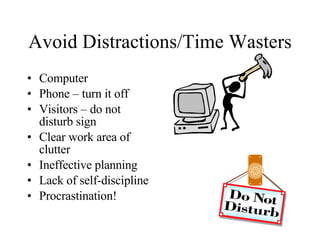
Avoid Distractions/Time Wasters Computer  Phone – turn it off Visitors – do not disturb sign Clear work area of clutter  Ineffective planning Lack of self-discipline Procrastination!
Procrastination Why do we procrastinate? Perfectionism Fear of failure Fear of success Laziness Rebellion
Tips on overcoming procrastination Set personal contract/goals “ Five minute” Plan Reminders Routine Do it when you think of it! Remind yourself of the consequences of procrastination
Start preparing for tests in class Note taking strategies Go to every class Explore listening habits  Outline Abbreviate Identify main points Review notes that day
When to Review Frequently during the semester Attend study sessions run by the teacher Schedule several final review sessions—not one long one The night before– briefly review main points and get some sleep Do not study immediately before test time
Ways to improve studying Develop a schedule Study one subject for one hour at a time Keep all materials for one class in same notebook Have a purpose Predict possible ?’s Go over previous tests (if available) Make Charts
Ways to improve studying--continued Use visual aids Instead of highlighting, use SQ3R Summarize, Question, Read, Recite, Review Avoid Cramming Make information personally meaningful Quiz yourself frequently and in the way you will be tested Get help when struggling
Studying in Groups Keep groups small; 2-5 people Ask each other questions  It’s OK to disagree.  Take a break when needed, whether it’s to energize or cool off after a disagreement
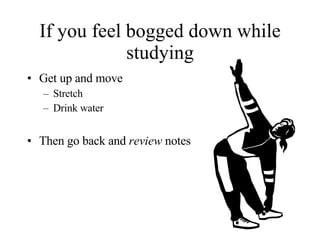
If you feel bogged down while studying Get up and move Stretch Drink water Then go back and  review  notes
Keep yourself in good shape Get plenty of sleep Eat nutritious meals Exercise  Take time out for fun
Where to study Set the right atmosphere Avoid distractions Be comfortable  Organized work area Try to study in the same place every time – this will train your mind for “work mode” Try to study under same conditions as when you will take the exam
Test Anxiety What causes it? Pressure “My parents have invested so much in me, I can’t let them down.” Past experiences “I never do well, no matter how much I study, so why study at all?” Fear of failure If I don’t do well on this test, I won’t get good grades.”
Tips to Reduce Test Anxiety Don’t put your whole future on the line with a single test.  It’s unlikely that one test will “make or break” you Learn relaxation techniques to control anxiety Deep breathing Muscle relaxation Visualization Positive Self-talk
Tips to Reduce Test Anxiety--continued Don’t fall into the trap of having low expectations -  Studying can bring results! Don’t try to compete with others Improve concentration by using self-discipline
Tips to Reduce Test Anxiety--continued Budget your time during the test If you feel anxious, take a mini-break to get some water or fresh air  Don’t change an answer unless you know your second one is correct! Don’t panic when you don’t know an answer Eliminate options that are incorrect and make an educated guess

Studyskills

  • 1.
  • 2.
    How to manageyour time more effectively Ownership of your time Planning your schedule Know your daily alertness pattern Allow sufficient time for each aspect/subject Long term Intermediate Short term Making your schedule work!
  • 3.
    Avoid Distractions/Time WastersComputer Phone – turn it off Visitors – do not disturb sign Clear work area of clutter Ineffective planning Lack of self-discipline Procrastination!
  • 4.
    Procrastination Why dowe procrastinate? Perfectionism Fear of failure Fear of success Laziness Rebellion
  • 5.
    Tips on overcomingprocrastination Set personal contract/goals “ Five minute” Plan Reminders Routine Do it when you think of it! Remind yourself of the consequences of procrastination
  • 6.
    Start preparing fortests in class Note taking strategies Go to every class Explore listening habits Outline Abbreviate Identify main points Review notes that day
  • 7.
    When to ReviewFrequently during the semester Attend study sessions run by the teacher Schedule several final review sessions—not one long one The night before– briefly review main points and get some sleep Do not study immediately before test time
  • 8.
    Ways to improvestudying Develop a schedule Study one subject for one hour at a time Keep all materials for one class in same notebook Have a purpose Predict possible ?’s Go over previous tests (if available) Make Charts
  • 9.
    Ways to improvestudying--continued Use visual aids Instead of highlighting, use SQ3R Summarize, Question, Read, Recite, Review Avoid Cramming Make information personally meaningful Quiz yourself frequently and in the way you will be tested Get help when struggling
  • 10.
    Studying in GroupsKeep groups small; 2-5 people Ask each other questions It’s OK to disagree. Take a break when needed, whether it’s to energize or cool off after a disagreement
  • 11.
    If you feelbogged down while studying Get up and move Stretch Drink water Then go back and review notes
  • 12.
    Keep yourself ingood shape Get plenty of sleep Eat nutritious meals Exercise Take time out for fun
  • 13.
    Where to studySet the right atmosphere Avoid distractions Be comfortable Organized work area Try to study in the same place every time – this will train your mind for “work mode” Try to study under same conditions as when you will take the exam
  • 14.
    Test Anxiety Whatcauses it? Pressure “My parents have invested so much in me, I can’t let them down.” Past experiences “I never do well, no matter how much I study, so why study at all?” Fear of failure If I don’t do well on this test, I won’t get good grades.”
  • 15.
    Tips to ReduceTest Anxiety Don’t put your whole future on the line with a single test. It’s unlikely that one test will “make or break” you Learn relaxation techniques to control anxiety Deep breathing Muscle relaxation Visualization Positive Self-talk
  • 16.
    Tips to ReduceTest Anxiety--continued Don’t fall into the trap of having low expectations - Studying can bring results! Don’t try to compete with others Improve concentration by using self-discipline
  • 17.
    Tips to ReduceTest Anxiety--continued Budget your time during the test If you feel anxious, take a mini-break to get some water or fresh air Don’t change an answer unless you know your second one is correct! Don’t panic when you don’t know an answer Eliminate options that are incorrect and make an educated guess