‫و‬ ‫ووووو‬ ‫وووو‬
‫وووووو‬
‫ووووو‬ ‫وووووو‬
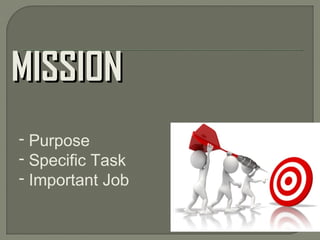
MISSIONMISSION
- Purpose
- Specific Task
- Important Job
• StrengthsStrengths
• WeaknessesWeaknesses
• OpportunitiesOpportunities
• ThreatsThreats
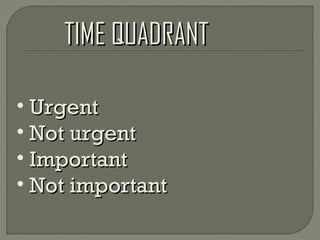
TIME QUADRANTTIME QUADRANT
• UrgentUrgent
• Not urgentNot urgent
• ImportantImportant
• Not importantNot important
02/21/1711
 “Good luck on the final exams you’re
complaining about on Facebook,
instead of studying”
02/21/1712
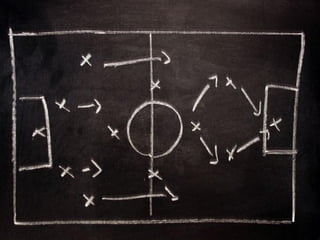
 “You think you can win on talent
alone? Gentlemen,YOU DON'T
HAVE ENOUGH TALENT TO WIN ON
TALENT ALONE!”
 Preparing for an exam is much like
an athlete training for a sporting
event . . . It involves exercising,
eating the right foods, and getting a
good night's sleep! And yes, you
also have to study!
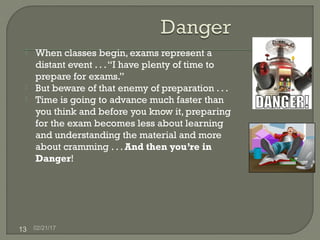
02/21/1713
 When classes begin, exams represent a
distant event . . .“I have plenty of time to
prepare for exams.”
 But beware of that enemy of preparation . . .
 Time is going to advance much faster than
you think and before you know it, preparing
for the exam becomes less about learning
and understanding the material and more
about cramming . . . And then you’re in
Danger!
02/21/1714
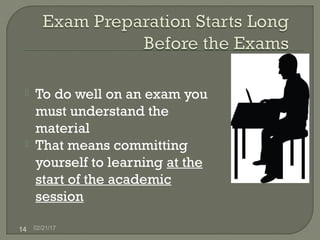
 To do well on an exam you
must understand the
material
 That means committing
yourself to learning at the
start of the academic
session
02/21/1715
In Class – Learning the Material
Be prepared by having your assignments completed
Take good notes during the lectures
Be an engaged student . . . Ask and answer questions
After Class – Learning the Material
Prepare a study schedule for every class and stick to it
Review your notes soon after class
Do all of your homework assignments
*Organize your notes, texts, and assignments according the topics and
problems that will be covered on the exam
Assess the topics and problems that are most difficult for you and schedule
extra time to study these areas
* It is acceptable to ask the professor about the topics to be covered on the exam
Last Minute
Exam
Preparation
1. Start with the Exam – What do I need to know
to do well
2. Plan your Revision:What questions am I going
to answer
3. Make Notes: Revision Aids
4. Practice Recall: Check what you know
5. Practise Questions: Exam Simulation
1. Grading
2. Reasons for losing marks
3. Practice
4. On the Day
Grading
How Your
Subject
Teacher gives
marks ???
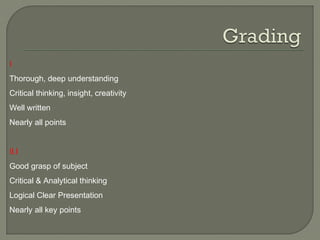
I
Thorough, deep understanding
Critical thinking, insight, creativity
Well written
Nearly all points
II.I
Good grasp of subject
Critical & Analytical thinking
Logical Clear Presentation
Nearly all key points
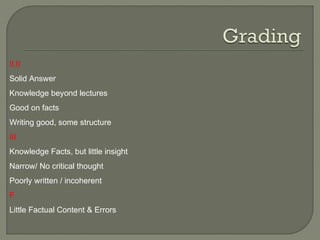
II.II
Solid Answer
Knowledge beyond lectures
Good on facts
Writing good, some structure
III
Knowledge Facts, but little insight
Narrow/ No critical thought
Poorly written / incoherent
F
Little Factual Content & Errors
Where marks
are lost??
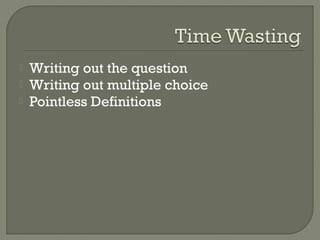
 Writing out the question
 Writing out multiple choice
 Pointless Definitions
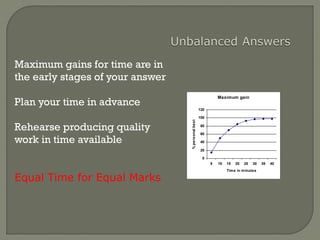
Maximum gains for time are in
the early stages of your answer
Plan your time in advance
Rehearse producing quality
work in time available
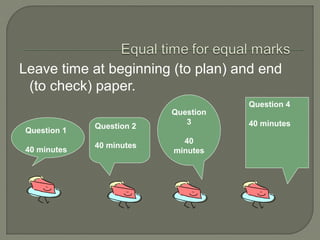
Equal Time for Equal Marks
Maximum gain
0
20
40
60
80
100
120
5 10 15 20 25 30 35 40
Time in minutes
%personalbest
Leave time at beginning (to plan) and end
(to check) paper.
Question 2
40 minutes
Question
3
40
minutes
Question 4
40 minutes
Question 1
40 minutes
 Taking a long time to get to the point
 Irrelevance
 Repetition
 Present what you know
 Add Value
 Get to the point
Think about your
examiner
 Not the same level as assessment
 Keep your writing simple
 Short sentences
 Few sub-clauses
 Practice writing
 Avoid unsupported value judgements
- “World War II was really important.”
 Demonstrating that you understand the
question is the first step in producing an
answer
 How you structure your answer is as important
as what you know
 More is not necessarily better
Understand what is being asked
Only answer the QUESTION
Do not include irrelevant material
Understand the format in which your answers
are required
Practice answering previous exam questions
Simulate Exam Conditions
Practice
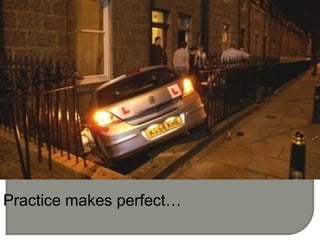
Would you sit your driving test without ever driving a car?
Practice makes perfect…
Study Aids
– index cards
- mind-maps
- audio (podcasts, your voice etc.)
- Anything else?
Develop Your Technique
Deconstruct the question:
 Restate the question in your own words
 Find and use the key words
 Show that you know what the point of the question is
by defining the key words/concepts/theories/etc
 Say how you are going to answer the question
 Deconstruct the question first
 Do quick outline
 Rough notes under headings
 Then begin to write your answer
Practice this
1. Get sample exam questions
2. Practice your starting procedures
3. Practice analysing questions (5 mins)
4. Practice generating ideas (5 mins)
5. Practice developing a structure (5 mins)
6. Practice writing Introduction (5 mins)
7. Practice past exam questions (timed and un
timed)
8. Mark your own answers as critically as
possibly
1. Start with the Exam – What do I need to know
to do well
2. Plan your Revision:What questions am I going
to answer
3. Make Notes: Revision Aids
4. Practice Recall: Check what you know
5. Practise Questions: Exam Simulation
How to Prepare for EXAMS ??

How to Prepare for EXAMS ??

  • 1.
  • 5.
  • 9.
    • StrengthsStrengths • WeaknessesWeaknesses •OpportunitiesOpportunities • ThreatsThreats
  • 10.
    TIME QUADRANTTIME QUADRANT •UrgentUrgent • Not urgentNot urgent • ImportantImportant • Not importantNot important
  • 11.
    02/21/1711  “Good luckon the final exams you’re complaining about on Facebook, instead of studying”
  • 12.
    02/21/1712  “You thinkyou can win on talent alone? Gentlemen,YOU DON'T HAVE ENOUGH TALENT TO WIN ON TALENT ALONE!”  Preparing for an exam is much like an athlete training for a sporting event . . . It involves exercising, eating the right foods, and getting a good night's sleep! And yes, you also have to study!
  • 13.
    02/21/1713  When classesbegin, exams represent a distant event . . .“I have plenty of time to prepare for exams.”  But beware of that enemy of preparation . . .  Time is going to advance much faster than you think and before you know it, preparing for the exam becomes less about learning and understanding the material and more about cramming . . . And then you’re in Danger!
  • 14.
    02/21/1714  To dowell on an exam you must understand the material  That means committing yourself to learning at the start of the academic session
  • 15.
    02/21/1715 In Class –Learning the Material Be prepared by having your assignments completed Take good notes during the lectures Be an engaged student . . . Ask and answer questions After Class – Learning the Material Prepare a study schedule for every class and stick to it Review your notes soon after class Do all of your homework assignments *Organize your notes, texts, and assignments according the topics and problems that will be covered on the exam Assess the topics and problems that are most difficult for you and schedule extra time to study these areas * It is acceptable to ask the professor about the topics to be covered on the exam
  • 16.
  • 17.
    1. Start withthe Exam – What do I need to know to do well 2. Plan your Revision:What questions am I going to answer 3. Make Notes: Revision Aids 4. Practice Recall: Check what you know 5. Practise Questions: Exam Simulation
  • 18.
    1. Grading 2. Reasonsfor losing marks 3. Practice 4. On the Day
  • 19.
  • 20.
    I Thorough, deep understanding Criticalthinking, insight, creativity Well written Nearly all points II.I Good grasp of subject Critical & Analytical thinking Logical Clear Presentation Nearly all key points
  • 21.
    II.II Solid Answer Knowledge beyondlectures Good on facts Writing good, some structure III Knowledge Facts, but little insight Narrow/ No critical thought Poorly written / incoherent F Little Factual Content & Errors
  • 22.
  • 23.
     Writing outthe question  Writing out multiple choice  Pointless Definitions
  • 24.
    Maximum gains fortime are in the early stages of your answer Plan your time in advance Rehearse producing quality work in time available Equal Time for Equal Marks Maximum gain 0 20 40 60 80 100 120 5 10 15 20 25 30 35 40 Time in minutes %personalbest
  • 25.
    Leave time atbeginning (to plan) and end (to check) paper. Question 2 40 minutes Question 3 40 minutes Question 4 40 minutes Question 1 40 minutes
  • 26.
     Taking along time to get to the point  Irrelevance  Repetition  Present what you know  Add Value  Get to the point
  • 27.
  • 29.
     Not thesame level as assessment  Keep your writing simple  Short sentences  Few sub-clauses  Practice writing  Avoid unsupported value judgements - “World War II was really important.”
  • 30.
     Demonstrating thatyou understand the question is the first step in producing an answer  How you structure your answer is as important as what you know  More is not necessarily better
  • 31.
    Understand what isbeing asked Only answer the QUESTION Do not include irrelevant material Understand the format in which your answers are required Practice answering previous exam questions Simulate Exam Conditions
  • 32.
  • 33.
    Would you sityour driving test without ever driving a car?
  • 34.
  • 36.
    Study Aids – indexcards - mind-maps - audio (podcasts, your voice etc.) - Anything else?
  • 38.
    Develop Your Technique Deconstructthe question:  Restate the question in your own words  Find and use the key words  Show that you know what the point of the question is by defining the key words/concepts/theories/etc  Say how you are going to answer the question
  • 39.
     Deconstruct thequestion first  Do quick outline  Rough notes under headings  Then begin to write your answer Practice this
  • 40.
    1. Get sampleexam questions 2. Practice your starting procedures 3. Practice analysing questions (5 mins) 4. Practice generating ideas (5 mins) 5. Practice developing a structure (5 mins) 6. Practice writing Introduction (5 mins) 7. Practice past exam questions (timed and un timed) 8. Mark your own answers as critically as possibly
  • 41.
    1. Start withthe Exam – What do I need to know to do well 2. Plan your Revision:What questions am I going to answer 3. Make Notes: Revision Aids 4. Practice Recall: Check what you know 5. Practise Questions: Exam Simulation

Editor's Notes

  • #2 2 minutes (Student introductions could take up an additional 5 – 7 minutes depending on the size of the session. Plan accordingly – see “optional” below) Room Set-up, Preparation and Materials Ideally, if you have control of the room arrangement, round tables would be the best set-up to allow for a group exercise. But if you are in a classroom set-up that does not allow for any changes you will have to conduct the session as is. Find out the room set-up so you can plan ahead. To conduct the session you will need: Projection screen, projector and extension cords (most classrooms have built in a/v systems) Laptop (with remote if possible) 1 Flip chart, markers and masking tape Handout materials Paper and pens for the participants (optional for the group session) An assistant – this could be one of the student organizers or a volunteer from the audience This person’s role is to record responses on the flip charts and then tape the flip charts to the wall during the session (You want to remain free to facilitate the session Giveaways (Optional) This could be candy or small items you give to attendees when they answer a question or provide feedback. Just make sure you have enough. Opening and Welcome Welcome the students to the session and introduce yourself. Provide a brief bio on yourself and explain your interest in presenting this topic. Optional: Depending on how much time you have and how large the group is, you might want to have the students introduce themselves. Limit the intros to name, major and year. (estimate about 15 seconds for each student) – Plan your time accordingly if you include the student intros.
  • #12 1 minute This slide is meant to lighten the mood a little. Use the input from the last slide to lead into these quotes about exams. The bullet points are animated. Use your own comments when highlighting the points. In this world nothing can be said to be certain, except death and taxes. Oh and exams in college.” With apologies to Benjamin Franklin The first quote modifies Ben Franklins comments on the likelihood that the union would survive with the new constitution. We know that death and taxes are certain, but exams are too. “Good luck on the final exams you’re complaining about on Facebook, instead of studying” An anonymous quote. We complain a lot about exams instead of preparing for them. “Examinations – the only way to know something at least for a few days.” Another anonymous quote. Cramming becomes our preparation strategy instead of learning. The last two quotes are illustrative of a lot of students attitudes toward exams. We complain and cram instead of working to be prepared. And today’s presentation is going to focus on you taking control and being prepared.
  • #13 1 minute And preparation really is the key. You might remember a movie of a few years ago called Miracle, about the 1980 Gold Medal winning US Hockey team. In the movie coach Herb Brooks is really working the players hard and they are complaining. The players thought because they are on the US Olympic Team they are obviously talented athletes. But the coach sets them straight with this quote: You think you can win on talent alone? Gentlemen, YOU DON'T HAVE ENOUGH TALENT TO WIN ON TALENT ALONE!” It’s a really important point that connects to us as students. It doesn’t matter how smart we think we are. Going into an exam unprepared is like not training for an athletic competition. Studying is our training for the exam!
  • #14 1 minute It’s human nature that if something is not immediate, we say “there’s plenty of time to do that.” And when classes begin, that’s how we feel about exams. “I’ll get to it later.” Don’t fall into that trap. Procrastination is the enemy of preparation. So as we begin discussing preparing for exams, be alert for procrastination. Waiting until the end will cause you additional anxiety and most important, it can endanger your academic success.
  • #15 25 – 30 minutes Yes, I’m stating the obvious, but to do well on an exam you must understand the material. And we’ll be repeating this often, that means you must commit yourself to learning at that starts at the beginning of the academic term. If you’re presenting this session just before finals, comment that you will be discussing preparation techniques that will help them now. But they should also commit to making preparation an integral part of their schedule from the first day of class during the next semester/quarter.
  • #16 1 minute To commit to learning the material, here are several general tips you can follow for each course you are taking. You can highlight each point and add your own comments. In Class – Learning the Material Be prepared by having your assignments completed Take good notes during the lectures Be an engaged student . . . Ask and answer questions After Class – Learning the Material Prepare a study schedule for every class and stick to it Review your notes soon after class Do all of your homework assignments *Organize your notes, texts, and assignments according the topics and problems that will be covered on the exam Assess the topics and problems that are most difficult for you and schedule extra time to study these areas * It is acceptable to ask the professor about the topics to be covered on the exam
  • #18 timed brainstorming timed writing
  • #25 If an idea for a future question “pops into your head”, make some very brief notes so that you don’t loose it and go straight back to the answer you are working on If you have completed an answer and something relevant that you have left out “pops into your head”, go back and add the information as dot points at the end of your answer. Do not try to fit it in over your original script – time and legibility
  • #26 Know how much you can write in the time
  • #27 Time wasting
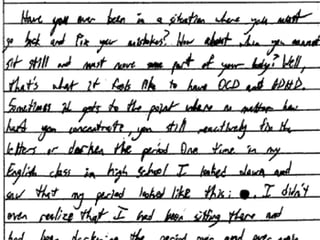
  • #28 Above All the biggest reason for losing marks is poor handwriting
  • #29 Poor Handwriting is one of the biggest reasons for losing marks
  • #32 Outline Headings Clear Writing Clear Language Practice Use subject-specific headings Stick to your plan Know how much you can write in the time Say why the issues raised by the question are important
  • #33 Biggest Reason for Losing Marks
  • #38 The key to both intellectual and emotional preparation for exams is simulation The closer a simulation is to the actual event, the more likely it is that preparation will be effective Bring the exam hall into your study space Role play doing the exam Take your study space into the exam hall Deconstruct the question: Restate the question in your own words Find and use the key words Show that you know what the point of the question is by defining the key words/concepts/theories/etc Say how you are going to answer the question
  • #42 timed brainstorming timed writing