INTRODUCTION
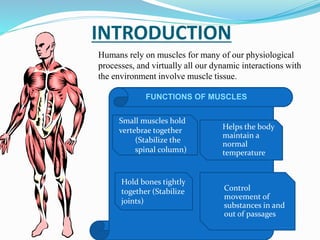
Humans rely on muscles for many of our physiological
processes, and virtually all our dynamic interactions with
the environment involve muscle tissue.
FUNCTIONS OF MUSCLES
Small muscles hold
vertebrae together
(Stabilize the
spinal column)
Hold bones tightly
together (Stabilize
joints)
Helps the body
maintain a
normal
temperature
Control
movement of
substances in and
out of passages
TYPES OF MUSCLES
.
There are three types of muscle tissue:
Skeletal muscle—Skeletal muscle tissue moves the body
by pulling on bones of the skeleton.
Cardiac muscle—Cardiac muscle tissue pushes blood
through the arteries and veins of the circulatory system.
Smooth muscle—Smooth muscle tissues push fluids and
solids along the digestive tract and perform varied functions in
other systems.
Skeletal muscle
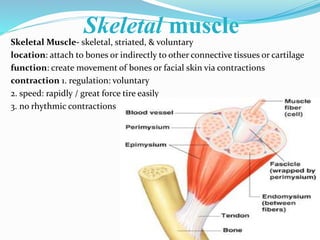
Skeletal Muscle- skeletal, striated, & voluntary
location: attach to bones or indirectly to other connective tissues or cartilage
function: create movement of bones or facial skin via contractions
contraction 1. regulation: voluntary
2. speed: rapidly / great force tire easily
3. no rhythmic contractions
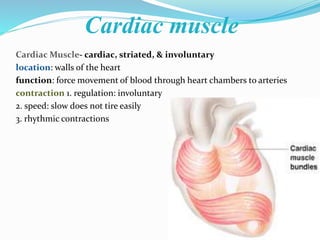
Cardiac muscle
Cardiac Muscle- cardiac, striated, & involuntary
location: walls of the heart
function: force movement of blood through heart chambers to arteries
contraction 1. regulation: involuntary
2. speed: slow does not tire easily
3. rhythmic contractions
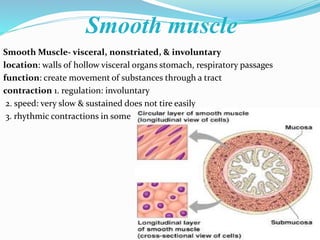
Smooth muscle
Smooth Muscle- visceral, nonstriated, & involuntary
location: walls of hollow visceral organs stomach, respiratory passages
function: create movement of substances through a tract
contraction 1. regulation: involuntary
2. speed: very slow & sustained does not tire easily
3. rhythmic contractions in some
PROPERTIES OF MUSCLE TISSUES
There are four characteristics associated
with muscle tissue:
 Excitability
 Contractility
 Extensibility
 Elasticity
- Tissue can receive & respond to stimulation
- Tissue can shorten & thicken
- Tissue can lengthen
- After contracting or lengthening, tissue
always wants to return to its resting state
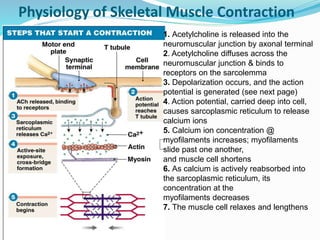
Physiology of Skeletal Muscle Contraction
1. Acetylcholine is released into the
neuromuscular junction by axonal terminal
2. Acetylcholine diffuses across the
neuromuscular junction & binds to
receptors on the sarcolemma
3. Depolarization occurs, and the action
potential is generated (see next page)
4. Action potential, carried deep into cell,
causes sarcoplasmic reticulum to release
calcium ions
5. Calcium ion concentration @
myofilaments increases; myofilaments
slide past one another,
and muscle cell shortens
6. As calcium is actively reabsorbed into
the sarcoplasmic reticulum, its
concentration at the
myofilaments decreases
7. The muscle cell relaxes and lengthens
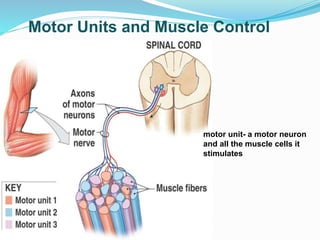
Motor Units and Muscle Control
motor unit- a motor neuron
and all the muscle cells it
stimulates
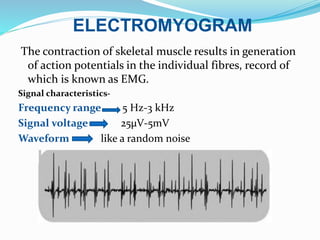
The contraction of skeletal muscle results in generation
of action potentials in the individual fibres, record of
which is known as EMG.
Signal characteristics-
Frequency range 5 Hz-3 kHz
Signal voltage 25µV-5mV
Waveform like a random noise
ELECTROMYOGRAM
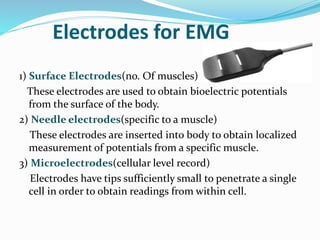
Electrodes for EMG
1) Surface Electrodes(no. Of muscles)
These electrodes are used to obtain bioelectric potentials
from the surface of the body.
2) Needle electrodes(specific to a muscle)
These electrodes are inserted into body to obtain localized
measurement of potentials from a specific muscle.
3) Microelectrodes(cellular level record)
Electrodes have tips sufficiently small to penetrate a single
cell in order to obtain readings from within cell.
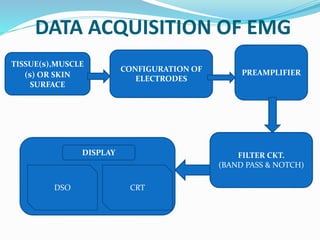
DATA ACQUISITION OF EMG
TISSUE(s),MUSCLE
(s) OR SKIN
SURFACE
PREAMPLIFIER
FILTER CKT.
(BAND PASS & NOTCH)
CONFIGURATION OF
ELECTRODES
DSO CRT
DISPLAY
Diseases of the Muscular System
1) Bursitis :Bursitis is inflammation of a bursa. Bursa is a
fluid-filled sac between a tendon and skin, or between a
tendon and bone. Bursitis is very painful because of the
swelling that occurs.
2) Carpal tunnel syndrome occurs when the median
nerve is pinched. This can be due to swelling of nearby
tendons. When the nerve is pinched, it can cause
numbness and pain of the fingers, hand and forearm.
Without treatment, this damages the nerves and
muscles.
Diseases of the Muscular System
3) Compartment syndrome happens when too much
pressure builds up in and around the muscles. It can result
from injury, pressure on a blood vessel, or swelling which
creates pressure on the muscle tissue. Symptoms are severe
pain, a feeling of fullness or tightness in the muscle and a
tingling feeling. Numbness means death of the muscle cells
and damage may be permanent.
4) Muscular Dystrophy is a group of genetic diseases that
cause the muscle fibers to become easily damaged. There
are over one dozen different types. Symptoms are muscle
weakness, lack of coordination and loss of mobility.
5) Myasthenia gravis is a disease causing weakness of the
skeletal muscles. The name is Latin and Greek for "grave
muscle weakness." Muscle weakness increases during
periods of activity and improves after periods of rest. A
common side effect is droopy eyelids.
6) Poliomyelitis affects mostly children. It spreads through
direct contact with mucous, phlegm, feces, or contact with
food and water contaminated by feces of an infected
person. When it invades the nervous system, it can cause
paralysis or death.
Diseases of the Muscular System
Keeping the Muscular System
Healthy
 The first part of keeping muscles healthy is a good diet. For muscles to
grow, they need the right kinds of food. Do not eat fatty foods. Eat
grains such as bread and pasta. Eat lots of fruits, vegetables and dairy
products. Drink at least eight 8-ounce glasses of water daily. Limit
drinks such as soda and certain juices. They are high in sugar and can
lead to fat storage in the muscles. Get regular exercise. A good exercise
program has five parts:
1) Warm up with light exercise
2) Stretch
3) Raise your heart rate with aerobic exercise
4) Build muscle with resistance exercise such as weights
5) Cool down with slow exercise
Thanks for Watching!


The Muscular System.pptx

  • 2.
    INTRODUCTION Humans rely onmuscles for many of our physiological processes, and virtually all our dynamic interactions with the environment involve muscle tissue. FUNCTIONS OF MUSCLES Small muscles hold vertebrae together (Stabilize the spinal column) Hold bones tightly together (Stabilize joints) Helps the body maintain a normal temperature Control movement of substances in and out of passages
  • 3.
    TYPES OF MUSCLES . Thereare three types of muscle tissue: Skeletal muscle—Skeletal muscle tissue moves the body by pulling on bones of the skeleton. Cardiac muscle—Cardiac muscle tissue pushes blood through the arteries and veins of the circulatory system. Smooth muscle—Smooth muscle tissues push fluids and solids along the digestive tract and perform varied functions in other systems.
  • 4.
    Skeletal muscle Skeletal Muscle-skeletal, striated, & voluntary location: attach to bones or indirectly to other connective tissues or cartilage function: create movement of bones or facial skin via contractions contraction 1. regulation: voluntary 2. speed: rapidly / great force tire easily 3. no rhythmic contractions
  • 5.
    Cardiac muscle Cardiac Muscle-cardiac, striated, & involuntary location: walls of the heart function: force movement of blood through heart chambers to arteries contraction 1. regulation: involuntary 2. speed: slow does not tire easily 3. rhythmic contractions
  • 6.
    Smooth muscle Smooth Muscle-visceral, nonstriated, & involuntary location: walls of hollow visceral organs stomach, respiratory passages function: create movement of substances through a tract contraction 1. regulation: involuntary 2. speed: very slow & sustained does not tire easily 3. rhythmic contractions in some
  • 7.
    PROPERTIES OF MUSCLETISSUES There are four characteristics associated with muscle tissue:  Excitability  Contractility  Extensibility  Elasticity - Tissue can receive & respond to stimulation - Tissue can shorten & thicken - Tissue can lengthen - After contracting or lengthening, tissue always wants to return to its resting state
  • 8.
    Physiology of SkeletalMuscle Contraction 1. Acetylcholine is released into the neuromuscular junction by axonal terminal 2. Acetylcholine diffuses across the neuromuscular junction & binds to receptors on the sarcolemma 3. Depolarization occurs, and the action potential is generated (see next page) 4. Action potential, carried deep into cell, causes sarcoplasmic reticulum to release calcium ions 5. Calcium ion concentration @ myofilaments increases; myofilaments slide past one another, and muscle cell shortens 6. As calcium is actively reabsorbed into the sarcoplasmic reticulum, its concentration at the myofilaments decreases 7. The muscle cell relaxes and lengthens
  • 9.
    Motor Units andMuscle Control motor unit- a motor neuron and all the muscle cells it stimulates
  • 10.
    The contraction ofskeletal muscle results in generation of action potentials in the individual fibres, record of which is known as EMG. Signal characteristics- Frequency range 5 Hz-3 kHz Signal voltage 25µV-5mV Waveform like a random noise ELECTROMYOGRAM
  • 11.
    Electrodes for EMG 1)Surface Electrodes(no. Of muscles) These electrodes are used to obtain bioelectric potentials from the surface of the body. 2) Needle electrodes(specific to a muscle) These electrodes are inserted into body to obtain localized measurement of potentials from a specific muscle. 3) Microelectrodes(cellular level record) Electrodes have tips sufficiently small to penetrate a single cell in order to obtain readings from within cell.
  • 12.
    DATA ACQUISITION OFEMG TISSUE(s),MUSCLE (s) OR SKIN SURFACE PREAMPLIFIER FILTER CKT. (BAND PASS & NOTCH) CONFIGURATION OF ELECTRODES DSO CRT DISPLAY
  • 13.
    Diseases of theMuscular System 1) Bursitis :Bursitis is inflammation of a bursa. Bursa is a fluid-filled sac between a tendon and skin, or between a tendon and bone. Bursitis is very painful because of the swelling that occurs. 2) Carpal tunnel syndrome occurs when the median nerve is pinched. This can be due to swelling of nearby tendons. When the nerve is pinched, it can cause numbness and pain of the fingers, hand and forearm. Without treatment, this damages the nerves and muscles.
  • 14.
    Diseases of theMuscular System 3) Compartment syndrome happens when too much pressure builds up in and around the muscles. It can result from injury, pressure on a blood vessel, or swelling which creates pressure on the muscle tissue. Symptoms are severe pain, a feeling of fullness or tightness in the muscle and a tingling feeling. Numbness means death of the muscle cells and damage may be permanent. 4) Muscular Dystrophy is a group of genetic diseases that cause the muscle fibers to become easily damaged. There are over one dozen different types. Symptoms are muscle weakness, lack of coordination and loss of mobility.
  • 15.
    5) Myasthenia gravisis a disease causing weakness of the skeletal muscles. The name is Latin and Greek for "grave muscle weakness." Muscle weakness increases during periods of activity and improves after periods of rest. A common side effect is droopy eyelids. 6) Poliomyelitis affects mostly children. It spreads through direct contact with mucous, phlegm, feces, or contact with food and water contaminated by feces of an infected person. When it invades the nervous system, it can cause paralysis or death. Diseases of the Muscular System
  • 16.
    Keeping the MuscularSystem Healthy  The first part of keeping muscles healthy is a good diet. For muscles to grow, they need the right kinds of food. Do not eat fatty foods. Eat grains such as bread and pasta. Eat lots of fruits, vegetables and dairy products. Drink at least eight 8-ounce glasses of water daily. Limit drinks such as soda and certain juices. They are high in sugar and can lead to fat storage in the muscles. Get regular exercise. A good exercise program has five parts: 1) Warm up with light exercise 2) Stretch 3) Raise your heart rate with aerobic exercise 4) Build muscle with resistance exercise such as weights 5) Cool down with slow exercise
  • 17.