Skeleton
3/17/2018 1
 Introduction
 Skeleton
 Types of skeleton
 Function of skeleton
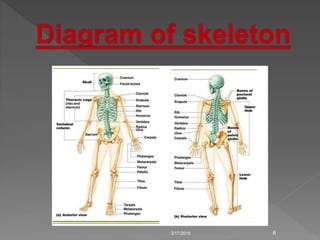
 Bones
 Types of bones
 Distribution of bones
 Joints
 Types of joints
3/17/2018 2
 The average human adult skeleton has
206 bones joined to ligaments and
tendons
 Forms a protective and supportive
framework for the attached muscles and
the soft tissues which underlie it.
 Minor differences between male and
female skeletons: men's bones tend to be
larger and heavier than corresponding
women's bones, and a woman's pelvic
3/17/2018 3
 There are two types of skeleton
 Axial skeleton
 Skull
 Thorasic girdle
 Vertebral column
 Appendicular skeleton
 Shoulder girdle and upper limb
 Pelvic girdle and lower limb
3/17/2018 4
 movement by providing a series of
independently movable levers, which the
muscles can pull to move different parts of
the body
 It supports and protects the internal body
organs
 It is an efficient factory which produces red
blood cells from the bone marrow of certain
bones and white cells from the marrow of
other bones
 The bones are also a storehouse for minerals
- calcium, for example - which can be
supplied to other parts of the body
3/17/2018 5
3/17/2018 6
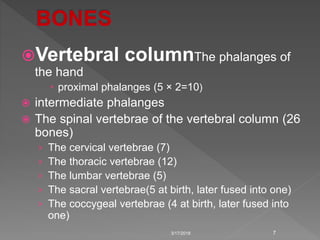
Vertebral columnThe phalanges of
the hand
 proximal phalanges (5 × 2=10)
 intermediate phalanges
 The spinal vertebrae of the vertebral column (26
bones)
› The cervical vertebrae (7)
› The thoracic vertebrae (12)
› The lumbar vertebrae (5)
› The sacral vertebrae(5 at birth, later fused into one)
› The coccygeal vertebrae (4 at birth, later fused into
one)
3/17/2018 7
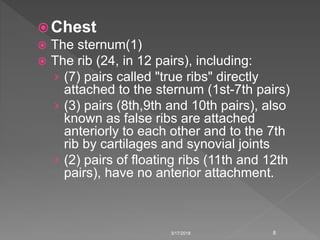
Chest
 The sternum(1)
 The rib (24, in 12 pairs), including:
› (7) pairs called "true ribs" directly
attached to the sternum (1st-7th pairs)
› (3) pairs (8th,9th and 10th pairs), also
known as false ribs are attached
anteriorly to each other and to the 7th
rib by cartilages and synovial joints
› (2) pairs of floating ribs (11th and 12th
pairs), have no anterior attachment.
3/17/2018 8
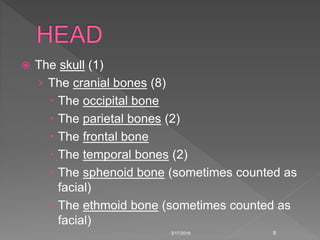
 The skull (1)
› The cranial bones (8)
 The occipital bone
 The parietal bones (2)
 The frontal bone
 The temporal bones (2)
 The sphenoid bone (sometimes counted as
facial)
 The ethmoid bone (sometimes counted as
facial)
3/17/2018 9
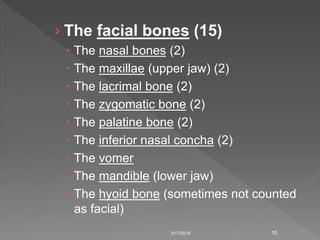
› The facial bones (15)
 The nasal bones (2)
 The maxillae (upper jaw) (2)
 The lacrimal bone (2)
 The zygomatic bone (2)
 The palatine bone (2)
 The inferior nasal concha (2)
 The vomer
 The mandible (lower jaw)
 The hyoid bone (sometimes not counted
as facial)
3/17/2018 10
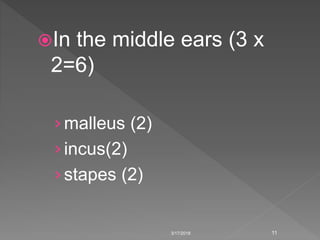
In the middle ears (3 x
2=6)
›malleus (2)
›incus(2)
›stapes (2)
3/17/2018 11
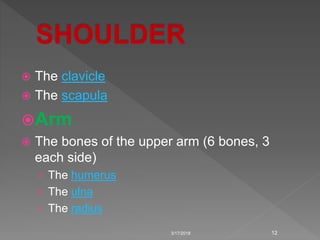
 The clavicle
 The scapula
Arm
 The bones of the upper arm (6 bones, 3
each side)
› The humerus
› The ulna
› The radius
3/17/2018 12
 The hand (54 bones, 27 in each hand)
› The carpals
 scaphoid bone (2)
 lunate bone (2)
 triquetrum bone (2)
 pisiform bone (2)
 trapezium (2)
 trapezoid bone (2)
 capitate bone (2)
 hamate bone (2)
› The metacarpals (5 × 2=10)
 (4 × 2=8)
 distal phalanges (5 × 2
3/17/2018 13
 The hip bone, comprising the
fused ilium, ischium, and pubis (2)
› The sacrum and the coccyx attach to the two hip
bones to form the pelvis
 The femur
 The patella or knee cap
 The tibia
 The fibula
3/17/2018 14
 The foot (52 bones in total, 26 per foot)
› The tarsus
 calcaneus or heel bone (2)
 talus (2)
 navicular bone (2)
 medial cuneiform bone (2)
 intermediate cuneiform bone (2)
 lateral cuneiform bone (2)
 cuboid bone (2)
3/17/2018 15
› The metatarsals
› The phalanges of the foot
proximal phalanges (5 × 2=10)
intermediate phalanges (4 x 2=
8)
distal phalanges (5 x 2=10)
The sesamoid bones
3/17/2018 16
 Joints are sturdy enough to hold the
skeleton together while permitting a range of
motions.
 Joints are lubricated by "synovial" fluid.
 The ends of these joints are coated with
articular (or hyaline) cartilage, which
reduces friction and cushions against jolts.
 Between the bones, in a narrow space, is the
joint "cavity," which gives us freedom of
movement.
 Ligaments then bind these bones to prevent
dislocations and limit the joint's movement
3/17/2018 17
 class of join tmobility stability examples from the skeleton
 diagram
 Fibrous No movement
 Most stable
 Joints between the bones of the skull and between the fused
bones of the sacrum and coccyx
 Cartilaginous Little movement
 StableJoints between the bodies of adjacent vertebrae in the
cervical, thoracic and part of the lumbar spine
 Synovial Free movement
 Least stable
 Joints between the bones of the arms and legs
3/17/2018 18
3/17/2018 19
Joint Types
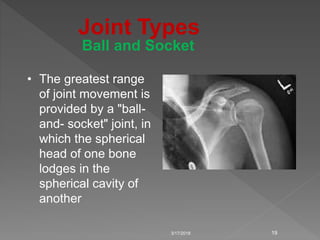
Ball and Socket
• The greatest range
of joint movement is
provided by a "ball-
and- socket" joint, in
which the spherical
head of one bone
lodges in the
spherical cavity of
another
3/17/2018 20
Hinge
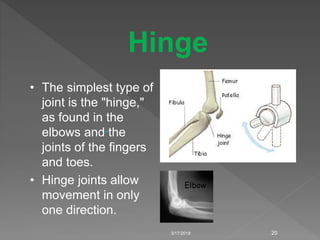
• The simplest type of
joint is the "hinge,"
as found in the
elbows and the
joints of the fingers
and toes.
• Hinge joints allow
movement in only
one direction.
Elbow
3/17/2018 21
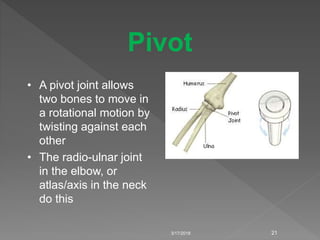
Pivot
• A pivot joint allows
two bones to move in
a rotational motion by
twisting against each
other
• The radio-ulnar joint
in the elbow, or
atlas/axis in the neck
do this
3/17/2018 22
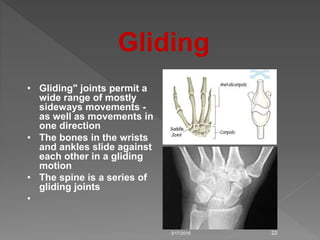
Gliding
• Gliding" joints permit a
wide range of mostly
sideways movements -
as well as movements in
one direction
• The bones in the wrists
and ankles slide against
each other in a gliding
motion
• The spine is a series of
gliding joints
•

Skeleton

  • 1.
  • 2.
     Introduction  Skeleton Types of skeleton  Function of skeleton  Bones  Types of bones  Distribution of bones  Joints  Types of joints 3/17/2018 2
  • 3.
     The averagehuman adult skeleton has 206 bones joined to ligaments and tendons  Forms a protective and supportive framework for the attached muscles and the soft tissues which underlie it.  Minor differences between male and female skeletons: men's bones tend to be larger and heavier than corresponding women's bones, and a woman's pelvic 3/17/2018 3
  • 4.
     There aretwo types of skeleton  Axial skeleton  Skull  Thorasic girdle  Vertebral column  Appendicular skeleton  Shoulder girdle and upper limb  Pelvic girdle and lower limb 3/17/2018 4
  • 5.
     movement byproviding a series of independently movable levers, which the muscles can pull to move different parts of the body  It supports and protects the internal body organs  It is an efficient factory which produces red blood cells from the bone marrow of certain bones and white cells from the marrow of other bones  The bones are also a storehouse for minerals - calcium, for example - which can be supplied to other parts of the body 3/17/2018 5
  • 6.
  • 7.
    Vertebral columnThe phalangesof the hand  proximal phalanges (5 × 2=10)  intermediate phalanges  The spinal vertebrae of the vertebral column (26 bones) › The cervical vertebrae (7) › The thoracic vertebrae (12) › The lumbar vertebrae (5) › The sacral vertebrae(5 at birth, later fused into one) › The coccygeal vertebrae (4 at birth, later fused into one) 3/17/2018 7
  • 8.
    Chest  The sternum(1) The rib (24, in 12 pairs), including: › (7) pairs called "true ribs" directly attached to the sternum (1st-7th pairs) › (3) pairs (8th,9th and 10th pairs), also known as false ribs are attached anteriorly to each other and to the 7th rib by cartilages and synovial joints › (2) pairs of floating ribs (11th and 12th pairs), have no anterior attachment. 3/17/2018 8
  • 9.
     The skull(1) › The cranial bones (8)  The occipital bone  The parietal bones (2)  The frontal bone  The temporal bones (2)  The sphenoid bone (sometimes counted as facial)  The ethmoid bone (sometimes counted as facial) 3/17/2018 9
  • 10.
    › The facialbones (15)  The nasal bones (2)  The maxillae (upper jaw) (2)  The lacrimal bone (2)  The zygomatic bone (2)  The palatine bone (2)  The inferior nasal concha (2)  The vomer  The mandible (lower jaw)  The hyoid bone (sometimes not counted as facial) 3/17/2018 10
  • 11.
    In the middleears (3 x 2=6) ›malleus (2) ›incus(2) ›stapes (2) 3/17/2018 11
  • 12.
     The clavicle The scapula Arm  The bones of the upper arm (6 bones, 3 each side) › The humerus › The ulna › The radius 3/17/2018 12
  • 13.
     The hand(54 bones, 27 in each hand) › The carpals  scaphoid bone (2)  lunate bone (2)  triquetrum bone (2)  pisiform bone (2)  trapezium (2)  trapezoid bone (2)  capitate bone (2)  hamate bone (2) › The metacarpals (5 × 2=10)  (4 × 2=8)  distal phalanges (5 × 2 3/17/2018 13
  • 14.
     The hipbone, comprising the fused ilium, ischium, and pubis (2) › The sacrum and the coccyx attach to the two hip bones to form the pelvis  The femur  The patella or knee cap  The tibia  The fibula 3/17/2018 14
  • 15.
     The foot(52 bones in total, 26 per foot) › The tarsus  calcaneus or heel bone (2)  talus (2)  navicular bone (2)  medial cuneiform bone (2)  intermediate cuneiform bone (2)  lateral cuneiform bone (2)  cuboid bone (2) 3/17/2018 15
  • 16.
    › The metatarsals ›The phalanges of the foot proximal phalanges (5 × 2=10) intermediate phalanges (4 x 2= 8) distal phalanges (5 x 2=10) The sesamoid bones 3/17/2018 16
  • 17.
     Joints aresturdy enough to hold the skeleton together while permitting a range of motions.  Joints are lubricated by "synovial" fluid.  The ends of these joints are coated with articular (or hyaline) cartilage, which reduces friction and cushions against jolts.  Between the bones, in a narrow space, is the joint "cavity," which gives us freedom of movement.  Ligaments then bind these bones to prevent dislocations and limit the joint's movement 3/17/2018 17
  • 18.
     class ofjoin tmobility stability examples from the skeleton  diagram  Fibrous No movement  Most stable  Joints between the bones of the skull and between the fused bones of the sacrum and coccyx  Cartilaginous Little movement  StableJoints between the bodies of adjacent vertebrae in the cervical, thoracic and part of the lumbar spine  Synovial Free movement  Least stable  Joints between the bones of the arms and legs 3/17/2018 18
  • 19.
    3/17/2018 19 Joint Types Balland Socket • The greatest range of joint movement is provided by a "ball- and- socket" joint, in which the spherical head of one bone lodges in the spherical cavity of another
  • 20.
    3/17/2018 20 Hinge • Thesimplest type of joint is the "hinge," as found in the elbows and the joints of the fingers and toes. • Hinge joints allow movement in only one direction. Elbow
  • 21.
    3/17/2018 21 Pivot • Apivot joint allows two bones to move in a rotational motion by twisting against each other • The radio-ulnar joint in the elbow, or atlas/axis in the neck do this
  • 22.
    3/17/2018 22 Gliding • Gliding"joints permit a wide range of mostly sideways movements - as well as movements in one direction • The bones in the wrists and ankles slide against each other in a gliding motion • The spine is a series of gliding joints •