SKIN DISEASES
Introduction
• Few basic principles – critical in understanding
the interpretation of physical signs
• These principles arise from the morphological &
functional diff of the 3 main levels of the skin
Epidermis
Dermis
S/C fat
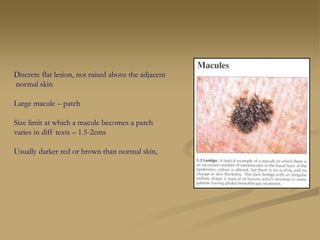
Discrete flat lesion, not raised above the adjacent
normal skin
Large macule – patch
Size limit at which a macule becomes a patch
varies in diff texts – 1.5-2cms
Usually darker red or brown than normal skin,
Papules & nodules –
Discrete lesions – usually visibly raised above the
skin surface
Nodules – may also lie deep to the dermis –
lipoma
Size at which the a papule should be called a
nodule – varies 5-10mm
All nodules starts as papules but not all papules
will grow into nodules
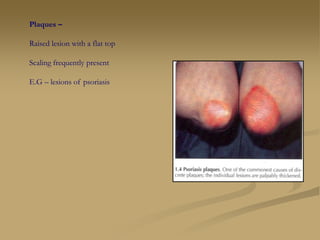
Plaques –
Raised lesion with a flat top
Scaling frequently present
E.G – lesions of psoriasis
Vesicles & bullae –
Both terms – describe diff sizes of blister
Discrete accumulation of fluid – components run out when top is incised
Occur within or just below the epidermis
Vesicle is small & blister is large – cut off –
5-10mm
Useful to note the size range
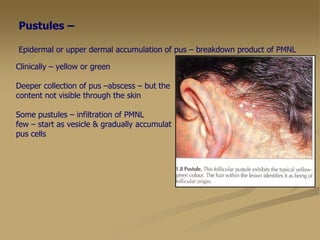
Pustules –
Epidermal or upper dermal accumulation of pus – breakdown product of PMNL
Clinically – yellow or green
Deeper collection of pus –abscess – but the
content not visible through the skin
Some pustules – infiltration of PMNL
few – start as vesicle & gradually accumulat
pus cells
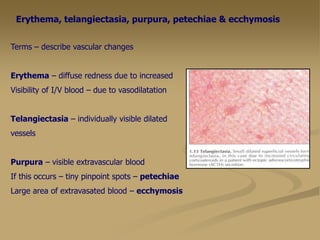
Erythema, telangiectasia, purpura, petechiae & ecchymosis
Terms – describe vascular changes
Erythema – diffuse redness due to increased
Visibility of I/V blood – due to vasodilatation
Telangiectasia – individually visible dilated
vessels
Purpura – visible extravascular blood
If this occurs – tiny pinpoint spots – petechiae
Large area of extravasated blood – ecchymosis
Dermatological diseases with oral
manifestations
 Ectodermal dysplasia
 White sponge naevus
 Heriditary benign intraepithelial dyskeratosis
 Pachyonychia congenita
 Dyskeratosis congenita
 Xeroderma pigmentosum
 Darier’s disease
 Wrty dyskeratoma
 Peutz zegher’s syndrome
 Heriditary hemorrhagic telengiectasia
 Ehler’s danlos syndrome
 Epidermolysis bullosa
Immune mediated skin diseases –
 Pemphigus
 Cicatrial pemphigoid
 Bullous pemphigoid
 Erythema multiforme
 Erythema migrans
 Rieter’s syndrome
 Lichen planus
 Psoriasis
 Lupus erythematosus
 Systemic sclerosis
 CREST syndrome
 Acanthosis nigricans
 Graft versus host disease
Ectodermal dysplasia
 Relatively rare
 X linked recessive inheritance pattern
c/f –
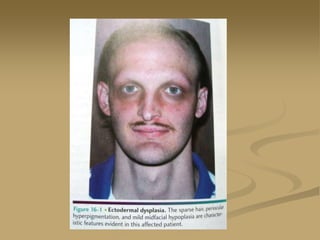
 Soft, smooth dry skin – partial or total loss of sweat glands
 Cannot perspire – unexplained high temp
 Sebaceous glands & hair follicles – absent
 Hair of the scalp & eyebrows – fine, scanty
 Bridge of the nose is depressed
 Frontal bossing
 Lips become protruberant
Oral manifestations
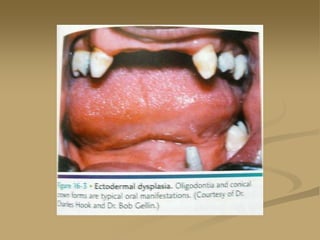
 Anodontia or Oligodontia
 Malformation of both deciduous & permanent teeth
 Truncated or cone shape
 Jaws will be normal but the alveolar process will not develop in the absence
of teeth – reduced vertical dimension – protuberant lips
 High palatal arch & cleft palate may be present
 Salivary glands – hypoplastic – xerostomia
 Hypolasia of nasal & pharyngeal mucous glands – pharyngitis/ rhinitis
Treatment & prognosis
 No treatment
 For dental problems – prosthetic replacement of dentition
White sponge nevus / Cannon’s
disease
 Genodermatologic disease
 Autosomal dominant trait
Etiology –
 Due to defective normal keratinisation of oral mucosa
 Keratins 4 & 14 specifically expressed in spinous layers
c/f –
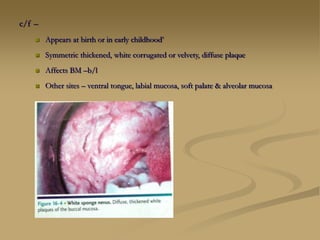
 Appears at birth or in early childhood’
 Symmetric thickened, white corrugated or velvety, diffuse plaque
 Affects BM –b/l
 Other sites – ventral tongue, labial mucosa, soft palate & alveolar mucosa
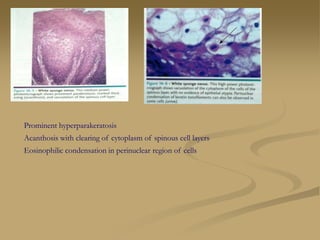
Prominent hyperparakeratosis
Acanthosis with clearing of cytoplasm of spinous cell layers
Eosinophilic condensation in perinuclear region of cells
Treatment & prognosis
 Completely a benign condition
 No treatment required
 Good prognosis
Hereditary benign intraepithelial
dyskeratosis / Witkop’s disease
 Rare autosomal dominant genodermatologic disease
c/f –
 Childhood
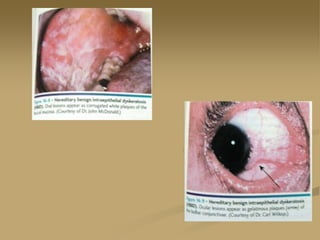
 Oral lesions similar to white sponge nevus
 Milder cases – similar to leukodema
 Ocular lesions develop early in life
 Bulbar conjunctivitis
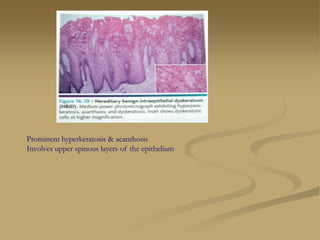
Prominent hyperkeratosis & acanthosis
Involves upper spinous layers of the epithelium
Treatment & prognosis
 Benign condition – no treatment
 If superinfected with candidal infection – antifungal therapy
Darier’s disease (keratosis follicularis)
 Rare genodermatosis – striking skin involvement
 Autosomal dominant trait
 Lack of cohesion among the surface epith cells –
characteristic
 Mutation in genes coding intracellular pump –
identified as the cause for abnormal desmosomal
organization in affected epith cells
C/F –
Erythematous, often pruritic, papules – skin of trunk & scalp
•Accumulation of keratin – rough texture
•Gen becomes worse during summer – due to
sensitivity of patient to UV light
•Palms & soles exhibits pits & keratoses – nails
show longitudinal line
Oral lesions –
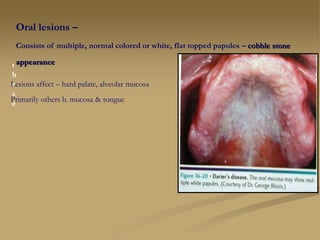
Consists of multiple, normal colored or white, flat topped papules – cobble stone
appearance
t
h
e
s
e
Lesions affect – hard palate, alveolar mucosa
Primarily others b. mucosa & tongue
H/P –
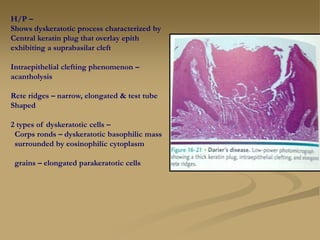
Shows dyskeratotic process characterized by
Central keratin plug that overlay epith
exhibiting a suprabasilar cleft
Intraepithelial clefting phenomenon –
acantholysis
Rete ridges – narrow, elongated & test tube
Shaped
2 types of dyskeratotic cells –
Corps ronds – dyskeratotic basophilic mass
surrounded by eosinophilic cytoplasm
grains – elongated parakeratotic cells
Treatment
 Depends on the severity of the disease
 For mild cases – keratolytic agents
 Severe cases – systemic retinoids
 Condition is nor premalignant nor life
threatening
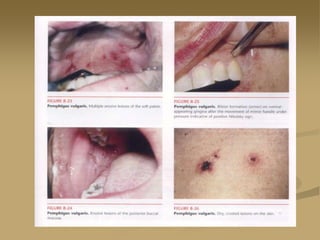
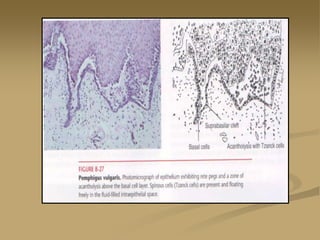
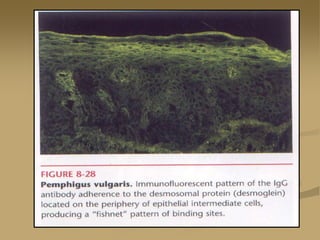
Pemphigus
 Autoimmune mucocutaneous disease characterized by
intraepithelial blister formation
 Due to loss of intercellular adhesion known as acantholysis
 4 types of pemphigus –
 P. vulgaris
 P.vegetans
 P. erytematosus
 P. foliaceous
Affects whole epith & involves oral mucosa
Affects only prickle cell layer
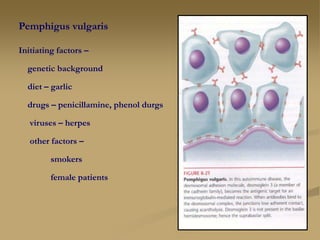
Pemphigus vulgaris
Initiating factors –
genetic background
diet – garlic
drugs – penicillamine, phenol durgs
viruses – herpes
other factors –
smokers
female patients
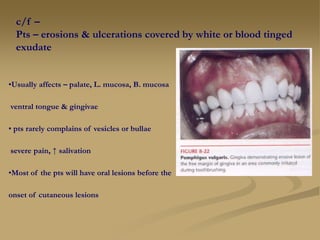
c/f –
Pts – erosions & ulcerations covered by white or blood tinged
exudate
•Usually affects – palate, L. mucosa, B. mucosa
ventral tongue & gingivae
• pts rarely complains of vesicles or bullae
severe pain, ↑ salivation
•Most of the pts will have oral lesions before the
onset of cutaneous lesions
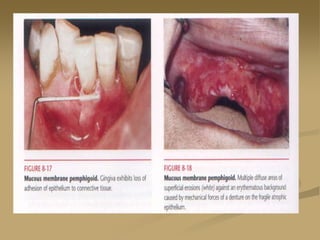
Cicatrial pemphigoid / benign mucous
membrane pemphigoid
 Term pemphigoid – clinically appears like pemphigus
 Cicatrix – scar (scarring of conjunctivitis)
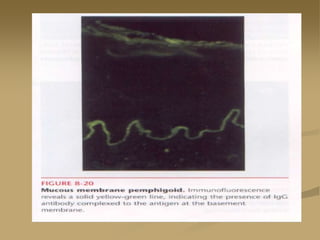
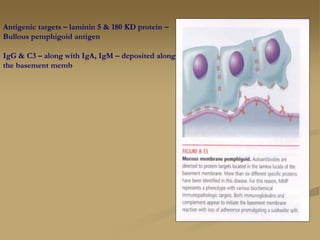
 Group of chronic blistering, mucocutaneous autoimmune
disease in which autoantibodies are directed against any 1 or
more components of basement membrane
Antigenic targets – laminin 5 & 180 KD protein –
Bullous pemphigoid antigen
IgG & C3 – along with IgA, IgM – deposited along
the basement memb
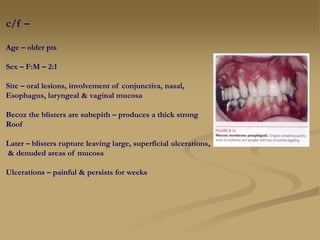
c/f –
Age – older pts
Sex – F:M – 2:1
Site – oral lesions, involvement of conjunctiva, nasal,
Esophagus, laryngeal & vaginal mucosa
Becoz the blisters are subepith – produces a thick strong
Roof
Later – blisters rupture leaving large, superficial ulcerations,
& denuded areas of mucosa
Ulcerations – painful & persists for weeks
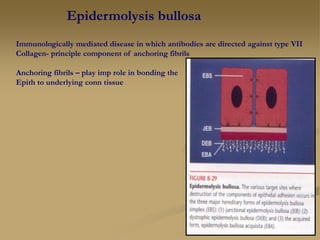
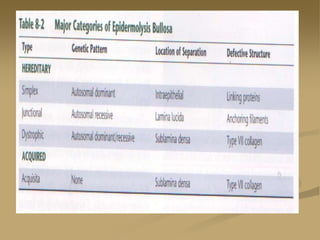
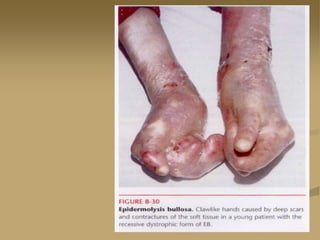
Epidermolysis bullosa
Immunologically mediated disease in which antibodies are directed against type VII
Collagen- principle component of anchoring fibrils
Anchoring fibrils – play imp role in bonding the
Epith to underlying conn tissue
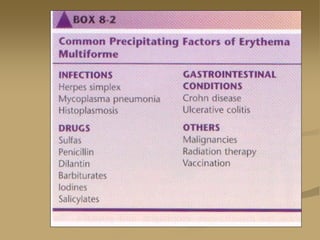
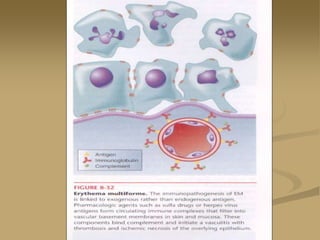
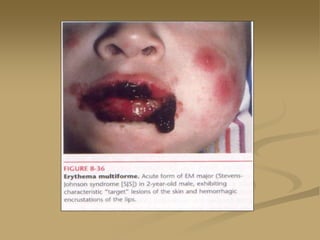
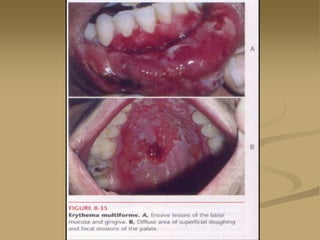
Erythema Multiforme
 Blistering, ulcerative, mucocutaneous condition of uncertain etiology
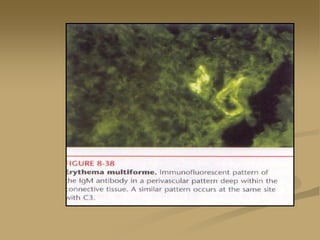
 Probably a immunologically mediated disease – Ag – Ab complexes targeted
against small vessels in skin & mucosa
 In few cases – preceding infection – herpes simplex, mycoplasma
pneumoniae
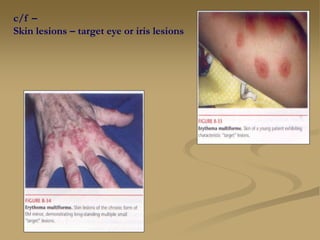
c/f –
Skin lesions – target eye or iris lesions
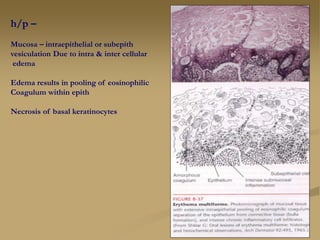
h/p –
Mucosa – intraepithelial or subepith
vesiculation Due to intra & inter cellular
edema
Edema results in pooling of eosinophilic
Coagulum within epith
Necrosis of basal keratinocytes
Lupus erythematous
 Immunologically mediated condition
 Etiology -
 Both humoral or cell mediated arms of immune systems are
involved
 Genetic factors are known to play an imp role
 Autoab against cellular antigens in both nucleus & cytoplasm
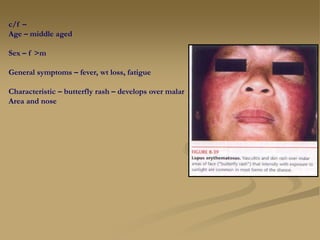
c/f –
Age – middle aged
Sex – f >m
General symptoms – fever, wt loss, fatigue
Characteristic – butterfly rash – develops over malar
Area and nose
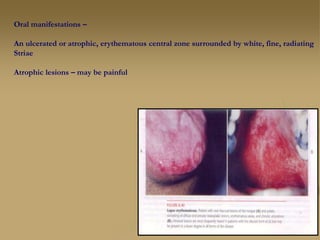
Oral manifestations –
An ulcerated or atrophic, erythematous central zone surrounded by white, fine, radiating
Striae
Atrophic lesions – may be painful
H/P –
 Hyperkeratosis
 Alternating atrophy & thickening spinous layer
 Degeneration of basal layer
 Subepithelial lymphocytic infiltration
Lab diagnosis –
 LE test – LE bodies
 ANA
Systemic sclerosis
 Rare immunologically mediated condition
 Characterized by deposition of dense collagen in tissues in the body
c/f –
 Age – middle age
 Sex – F:M=3:1
 First sign of the disease – Raynaud’s phenomenon – a vasoconstrictive event
triggered by emotional stress or exposure to cold
 CREST syndrome
Oral manifestations
 Microstomia
 Dysphagia
Rad /f –
 Diffuse widening of PDL space throughout the dentition
 Varying degree of resorption – post ramus, coronoid process,
chin and condylar area
h/p –
 Shows diffuse deposition of dense collagen within and around
the normal structure
 Replaces almost all the normal structure of conn tissue
Treatment –
 Systemic medication – D-penicillamine inhibits collagen
production
SKIN DISEASES and more.ppt

SKIN DISEASES and more.ppt

  • 1.
  • 3.
    Introduction • Few basicprinciples – critical in understanding the interpretation of physical signs • These principles arise from the morphological & functional diff of the 3 main levels of the skin Epidermis Dermis S/C fat
  • 4.
    Discrete flat lesion,not raised above the adjacent normal skin Large macule – patch Size limit at which a macule becomes a patch varies in diff texts – 1.5-2cms Usually darker red or brown than normal skin,
  • 5.
    Papules & nodules– Discrete lesions – usually visibly raised above the skin surface Nodules – may also lie deep to the dermis – lipoma Size at which the a papule should be called a nodule – varies 5-10mm All nodules starts as papules but not all papules will grow into nodules
  • 6.
    Plaques – Raised lesionwith a flat top Scaling frequently present E.G – lesions of psoriasis
  • 7.
    Vesicles & bullae– Both terms – describe diff sizes of blister Discrete accumulation of fluid – components run out when top is incised Occur within or just below the epidermis Vesicle is small & blister is large – cut off – 5-10mm Useful to note the size range
  • 8.
    Pustules – Epidermal orupper dermal accumulation of pus – breakdown product of PMNL Clinically – yellow or green Deeper collection of pus –abscess – but the content not visible through the skin Some pustules – infiltration of PMNL few – start as vesicle & gradually accumulat pus cells
  • 9.
    Erythema, telangiectasia, purpura,petechiae & ecchymosis Terms – describe vascular changes Erythema – diffuse redness due to increased Visibility of I/V blood – due to vasodilatation Telangiectasia – individually visible dilated vessels Purpura – visible extravascular blood If this occurs – tiny pinpoint spots – petechiae Large area of extravasated blood – ecchymosis
  • 10.
    Dermatological diseases withoral manifestations  Ectodermal dysplasia  White sponge naevus  Heriditary benign intraepithelial dyskeratosis  Pachyonychia congenita  Dyskeratosis congenita  Xeroderma pigmentosum  Darier’s disease  Wrty dyskeratoma  Peutz zegher’s syndrome  Heriditary hemorrhagic telengiectasia  Ehler’s danlos syndrome  Epidermolysis bullosa
  • 11.
    Immune mediated skindiseases –  Pemphigus  Cicatrial pemphigoid  Bullous pemphigoid  Erythema multiforme  Erythema migrans  Rieter’s syndrome  Lichen planus  Psoriasis  Lupus erythematosus  Systemic sclerosis  CREST syndrome  Acanthosis nigricans  Graft versus host disease
  • 12.
    Ectodermal dysplasia  Relativelyrare  X linked recessive inheritance pattern c/f –  Soft, smooth dry skin – partial or total loss of sweat glands  Cannot perspire – unexplained high temp  Sebaceous glands & hair follicles – absent  Hair of the scalp & eyebrows – fine, scanty  Bridge of the nose is depressed  Frontal bossing  Lips become protruberant
  • 14.
    Oral manifestations  Anodontiaor Oligodontia  Malformation of both deciduous & permanent teeth  Truncated or cone shape  Jaws will be normal but the alveolar process will not develop in the absence of teeth – reduced vertical dimension – protuberant lips  High palatal arch & cleft palate may be present  Salivary glands – hypoplastic – xerostomia  Hypolasia of nasal & pharyngeal mucous glands – pharyngitis/ rhinitis
  • 16.
    Treatment & prognosis No treatment  For dental problems – prosthetic replacement of dentition
  • 17.
    White sponge nevus/ Cannon’s disease  Genodermatologic disease  Autosomal dominant trait Etiology –  Due to defective normal keratinisation of oral mucosa  Keratins 4 & 14 specifically expressed in spinous layers
  • 18.
    c/f –  Appearsat birth or in early childhood’  Symmetric thickened, white corrugated or velvety, diffuse plaque  Affects BM –b/l  Other sites – ventral tongue, labial mucosa, soft palate & alveolar mucosa
  • 19.
    Prominent hyperparakeratosis Acanthosis withclearing of cytoplasm of spinous cell layers Eosinophilic condensation in perinuclear region of cells
  • 20.
    Treatment & prognosis Completely a benign condition  No treatment required  Good prognosis
  • 21.
    Hereditary benign intraepithelial dyskeratosis/ Witkop’s disease  Rare autosomal dominant genodermatologic disease c/f –  Childhood  Oral lesions similar to white sponge nevus  Milder cases – similar to leukodema  Ocular lesions develop early in life  Bulbar conjunctivitis
  • 23.
    Prominent hyperkeratosis &acanthosis Involves upper spinous layers of the epithelium
  • 24.
    Treatment & prognosis Benign condition – no treatment  If superinfected with candidal infection – antifungal therapy
  • 25.
    Darier’s disease (keratosisfollicularis)  Rare genodermatosis – striking skin involvement  Autosomal dominant trait  Lack of cohesion among the surface epith cells – characteristic  Mutation in genes coding intracellular pump – identified as the cause for abnormal desmosomal organization in affected epith cells
  • 26.
    C/F – Erythematous, oftenpruritic, papules – skin of trunk & scalp •Accumulation of keratin – rough texture •Gen becomes worse during summer – due to sensitivity of patient to UV light •Palms & soles exhibits pits & keratoses – nails show longitudinal line
  • 27.
    Oral lesions – Consistsof multiple, normal colored or white, flat topped papules – cobble stone appearance t h e s e Lesions affect – hard palate, alveolar mucosa Primarily others b. mucosa & tongue
  • 28.
    H/P – Shows dyskeratoticprocess characterized by Central keratin plug that overlay epith exhibiting a suprabasilar cleft Intraepithelial clefting phenomenon – acantholysis Rete ridges – narrow, elongated & test tube Shaped 2 types of dyskeratotic cells – Corps ronds – dyskeratotic basophilic mass surrounded by eosinophilic cytoplasm grains – elongated parakeratotic cells
  • 29.
    Treatment  Depends onthe severity of the disease  For mild cases – keratolytic agents  Severe cases – systemic retinoids  Condition is nor premalignant nor life threatening
  • 30.
    Pemphigus  Autoimmune mucocutaneousdisease characterized by intraepithelial blister formation  Due to loss of intercellular adhesion known as acantholysis  4 types of pemphigus –  P. vulgaris  P.vegetans  P. erytematosus  P. foliaceous Affects whole epith & involves oral mucosa Affects only prickle cell layer
  • 31.
    Pemphigus vulgaris Initiating factors– genetic background diet – garlic drugs – penicillamine, phenol durgs viruses – herpes other factors – smokers female patients
  • 32.
    c/f – Pts –erosions & ulcerations covered by white or blood tinged exudate •Usually affects – palate, L. mucosa, B. mucosa ventral tongue & gingivae • pts rarely complains of vesicles or bullae severe pain, ↑ salivation •Most of the pts will have oral lesions before the onset of cutaneous lesions
  • 36.
    Cicatrial pemphigoid /benign mucous membrane pemphigoid  Term pemphigoid – clinically appears like pemphigus  Cicatrix – scar (scarring of conjunctivitis)  Group of chronic blistering, mucocutaneous autoimmune disease in which autoantibodies are directed against any 1 or more components of basement membrane
  • 37.
    Antigenic targets –laminin 5 & 180 KD protein – Bullous pemphigoid antigen IgG & C3 – along with IgA, IgM – deposited along the basement memb
  • 38.
    c/f – Age –older pts Sex – F:M – 2:1 Site – oral lesions, involvement of conjunctiva, nasal, Esophagus, laryngeal & vaginal mucosa Becoz the blisters are subepith – produces a thick strong Roof Later – blisters rupture leaving large, superficial ulcerations, & denuded areas of mucosa Ulcerations – painful & persists for weeks
  • 42.
    Epidermolysis bullosa Immunologically mediateddisease in which antibodies are directed against type VII Collagen- principle component of anchoring fibrils Anchoring fibrils – play imp role in bonding the Epith to underlying conn tissue
  • 46.
    Erythema Multiforme  Blistering,ulcerative, mucocutaneous condition of uncertain etiology  Probably a immunologically mediated disease – Ag – Ab complexes targeted against small vessels in skin & mucosa  In few cases – preceding infection – herpes simplex, mycoplasma pneumoniae
  • 49.
    c/f – Skin lesions– target eye or iris lesions
  • 52.
    h/p – Mucosa –intraepithelial or subepith vesiculation Due to intra & inter cellular edema Edema results in pooling of eosinophilic Coagulum within epith Necrosis of basal keratinocytes
  • 54.
    Lupus erythematous  Immunologicallymediated condition  Etiology -  Both humoral or cell mediated arms of immune systems are involved  Genetic factors are known to play an imp role  Autoab against cellular antigens in both nucleus & cytoplasm
  • 55.
    c/f – Age –middle aged Sex – f >m General symptoms – fever, wt loss, fatigue Characteristic – butterfly rash – develops over malar Area and nose
  • 56.
    Oral manifestations – Anulcerated or atrophic, erythematous central zone surrounded by white, fine, radiating Striae Atrophic lesions – may be painful
  • 57.
    H/P –  Hyperkeratosis Alternating atrophy & thickening spinous layer  Degeneration of basal layer  Subepithelial lymphocytic infiltration Lab diagnosis –  LE test – LE bodies  ANA
  • 58.
    Systemic sclerosis  Rareimmunologically mediated condition  Characterized by deposition of dense collagen in tissues in the body c/f –  Age – middle age  Sex – F:M=3:1  First sign of the disease – Raynaud’s phenomenon – a vasoconstrictive event triggered by emotional stress or exposure to cold  CREST syndrome
  • 59.
    Oral manifestations  Microstomia Dysphagia Rad /f –  Diffuse widening of PDL space throughout the dentition  Varying degree of resorption – post ramus, coronoid process, chin and condylar area
  • 60.
    h/p –  Showsdiffuse deposition of dense collagen within and around the normal structure  Replaces almost all the normal structure of conn tissue Treatment –  Systemic medication – D-penicillamine inhibits collagen production