NESHEENA V K
3RD Year
Roll No: 9
Definition
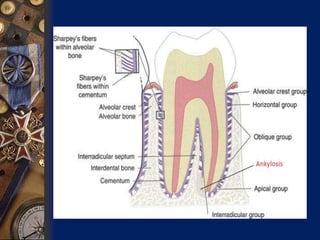
 The union of a tooth root to the alveolar
bone due to the lack of periodontal
ligament space.
ANKYLOSIS
ankyl- adhesion, fixed
-osis -
a process, condition, or state, usually abnormal or dise
ased
.
Submerged teeth are deciduous teeth
that have undergone variable degree of
root resorption and then have become
ankylosed to bone
Ankylosis occurs due to anatomic
fusion of cementum or dentin with
alveolar bone. Unerupted permenent
teeth may become ankylosed by
enostosis of enamel
Ankylosis of teeth is uncommon, but
more in the deciduous teeth
than permanent teeth.
Ankylosis of deciduous teeth
("submerged teeth") . The most
commonly affected tooth is the
mandibular second deciduous molar.
Partial root resorption first occurs and
then the tooth fuses to the bone. This
prevents normal exfoliation of the
deciduous tooth and typically causes
impaction of the permanent successor
Etiology
 Changes in local metabolism –
that will lead to Ankylosis of tooth
in some cases
Familial pattern
Trauma
Infection
Abnormal tongue pressure and
other causes
Clinical feature
Age; it is more commonly in second
decade of life
Commonly affected teeth are
deciduous first and second molar ,
following by anterior teeth
Exfoliation and subsequent replacement
by permanent teeth is prevented due to
Ankylosis
Characteristic solid sound in contrast to
dull, cushioned sound of normal tooth
on percussion.
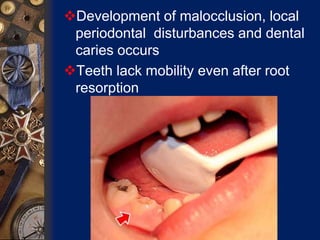
Development of malocclusion, local
periodontal disturbances and dental
caries occurs
Teeth lack mobility even after root
resorption
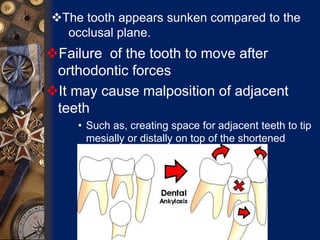
Failure of the tooth to move after
orthodontic forces
It may cause malposition of adjacent
teeth
• Such as, creating space for adjacent teeth to tip
mesially or distally on top of the shortened
tooth
• Super-eruption of opposing teeth
The tooth appears sunken compared to the
occlusal plane.
Radiographic Features
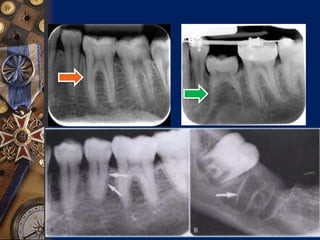
Partial absence of periodontal ligament.
A break in continuity of PDL ,
indicating an area of ankylosis is usually
evident
Loss of lamina Dura
Treatment
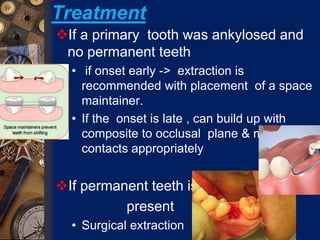
If a primary tooth was ankylosed and
no permanent teeth
• if onset early -> extraction is
recommended with placement of a space
maintainer.
• If the onset is late , can build up with
composite to occlusal plane & maintain
contacts appropriately
If permanent teeth is
present
• Surgical extraction
. Ankylosis itself is not a reason to
remove a permanent tooth, however
teeth which must be removed for other
reasons are made significantly more
difficult to remove if they are ankylosed
• Build up with restorative material to
maintain contacts
If a permanent tooth is
ankylosed
Opposing teeth should never be
allowed to
supra eruption .
If ankylosis occurs in multiple teeth a
segmental alveolar bone osteotomy and
bone graft may be needed
• Textbook of oral pathology SHAFER 8TH
edition.
• Textbook of Oral Pathology
By Anil Ghom, Shubhangi Mhaske
• Internet – Dr. G’S TOOTHPIX
Ask an orthodontidic.com & IBIMA
Publishing
Submerged tooth

Submerged tooth

  • 1.
    NESHEENA V K 3RDYear Roll No: 9
  • 2.
    Definition  The unionof a tooth root to the alveolar bone due to the lack of periodontal ligament space. ANKYLOSIS ankyl- adhesion, fixed -osis - a process, condition, or state, usually abnormal or dise ased .
  • 3.
    Submerged teeth aredeciduous teeth that have undergone variable degree of root resorption and then have become ankylosed to bone Ankylosis occurs due to anatomic fusion of cementum or dentin with alveolar bone. Unerupted permenent teeth may become ankylosed by enostosis of enamel
  • 4.
    Ankylosis of teethis uncommon, but more in the deciduous teeth than permanent teeth. Ankylosis of deciduous teeth ("submerged teeth") . The most commonly affected tooth is the mandibular second deciduous molar. Partial root resorption first occurs and then the tooth fuses to the bone. This prevents normal exfoliation of the deciduous tooth and typically causes impaction of the permanent successor
  • 6.
    Etiology  Changes inlocal metabolism – that will lead to Ankylosis of tooth in some cases Familial pattern Trauma Infection Abnormal tongue pressure and other causes
  • 7.
    Clinical feature Age; itis more commonly in second decade of life Commonly affected teeth are deciduous first and second molar , following by anterior teeth Exfoliation and subsequent replacement by permanent teeth is prevented due to Ankylosis Characteristic solid sound in contrast to dull, cushioned sound of normal tooth on percussion.
  • 8.
    Development of malocclusion,local periodontal disturbances and dental caries occurs Teeth lack mobility even after root resorption
  • 9.
    Failure of thetooth to move after orthodontic forces It may cause malposition of adjacent teeth • Such as, creating space for adjacent teeth to tip mesially or distally on top of the shortened tooth • Super-eruption of opposing teeth The tooth appears sunken compared to the occlusal plane.
  • 10.
    Radiographic Features Partial absenceof periodontal ligament. A break in continuity of PDL , indicating an area of ankylosis is usually evident
  • 12.
  • 15.
    Treatment If a primarytooth was ankylosed and no permanent teeth • if onset early -> extraction is recommended with placement of a space maintainer. • If the onset is late , can build up with composite to occlusal plane & maintain contacts appropriately If permanent teeth is present • Surgical extraction
  • 16.
    . Ankylosis itselfis not a reason to remove a permanent tooth, however teeth which must be removed for other reasons are made significantly more difficult to remove if they are ankylosed • Build up with restorative material to maintain contacts If a permanent tooth is ankylosed
  • 17.
    Opposing teeth shouldnever be allowed to supra eruption . If ankylosis occurs in multiple teeth a segmental alveolar bone osteotomy and bone graft may be needed
  • 19.
    • Textbook oforal pathology SHAFER 8TH edition. • Textbook of Oral Pathology By Anil Ghom, Shubhangi Mhaske • Internet – Dr. G’S TOOTHPIX Ask an orthodontidic.com & IBIMA Publishing