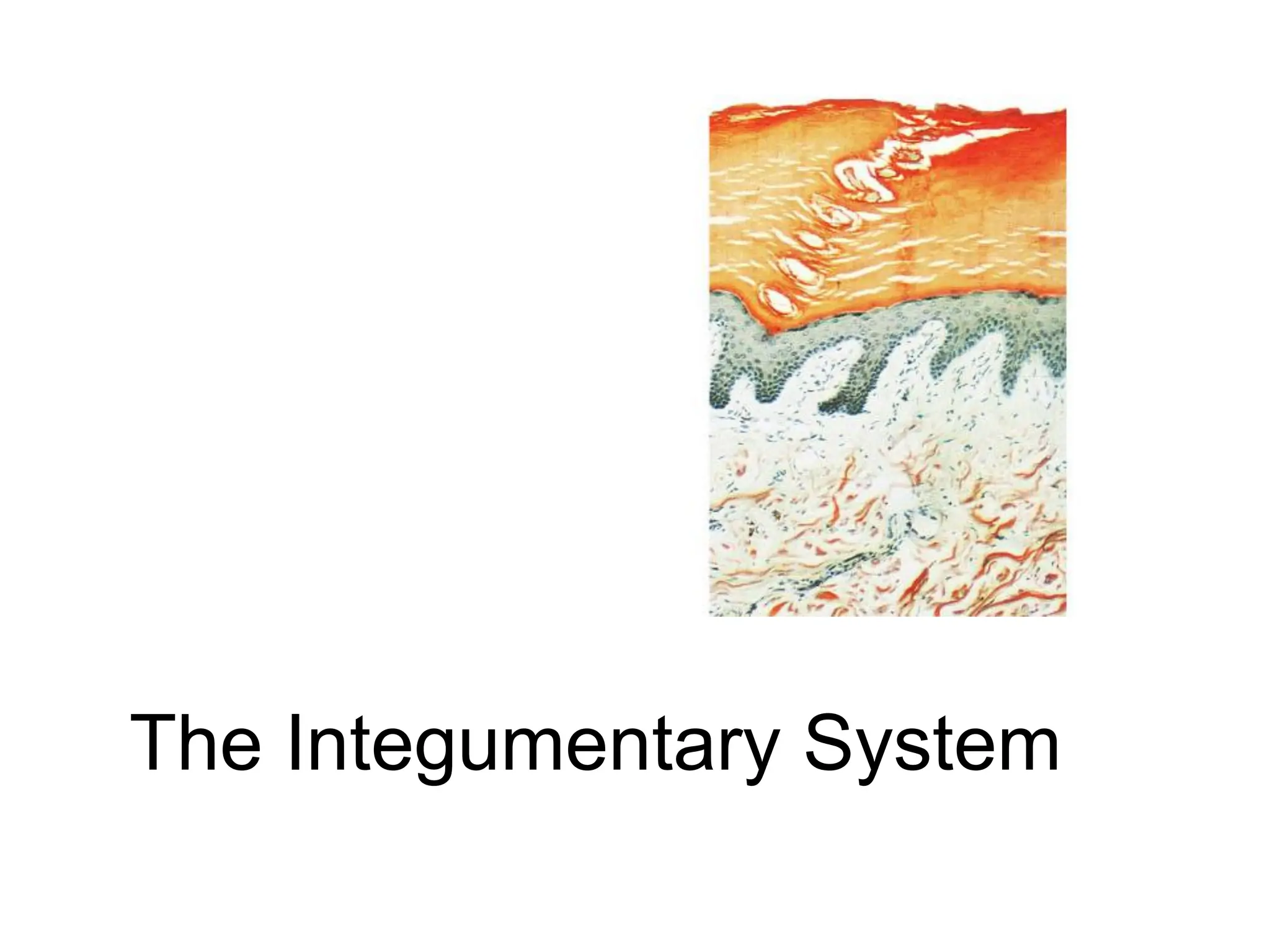
The Integumentary System
 Integument is skin
 Skin and its appendages make up the
integumentary system
 A fatty layer (hypodermis) lies deep to it
 Two distinct regions
Epidermis
Dermis
Epidermis
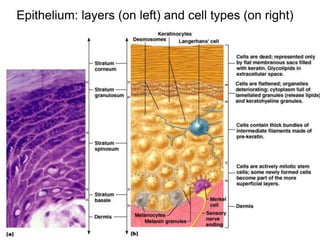
 Keratinized stratified squamous epithelium
 Four types of cells
 Keratinocytes – deepest, produce keratin (tough fibrous protein)
 Melanocytes - make dark skin pigment melanin
 Merkel cells – associated with sensory nerve endings
 Langerhans cells – macrophage-like dendritic cells
 Layers (from deep to superficial)
 Stratum basale or germinativum – single row of cells attached to
dermis; youngest cells
 Stratum spinosum – spinyness is artifactual; tonofilaments
(bundles of protein) resist tension
 Stratum granulosum – layers of flattened keratinocytes producing
keratin (hair and nails made of it also)
 Stratum lucidum (only on palms and soles)
 Stratum corneum – horny layer (cells dead, many layers thick)
(see figure on next slide)
Epithelium: layers (on left) and cell types (on right)
Dermis
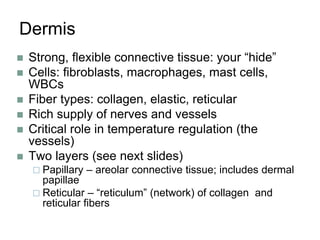
 Strong, flexible connective tissue: your “hide”
 Cells: fibroblasts, macrophages, mast cells,
WBCs
 Fiber types: collagen, elastic, reticular
 Rich supply of nerves and vessels
 Critical role in temperature regulation (the
vessels)
 Two layers (see next slides)
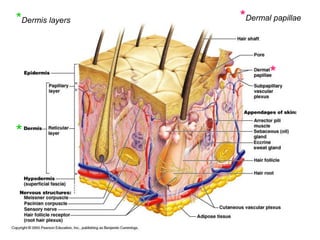
 Papillary – areolar connective tissue; includes dermal
papillae
 Reticular – “reticulum” (network) of collagen and
reticular fibers
*Dermis layers
*
*
*Dermal papillae
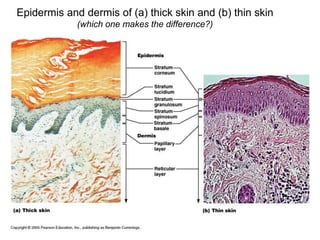
Epidermis and dermis of (a) thick skin and (b) thin skin
(which one makes the difference?)
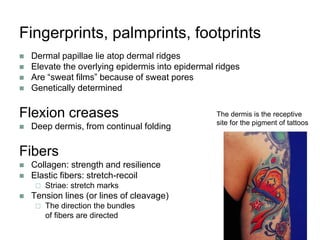
Fingerprints, palmprints, footprints
 Dermal papillae lie atop dermal ridges
 Elevate the overlying epidermis into epidermal ridges
 Are “sweat films” because of sweat pores
 Genetically determined
Flexion creases
 Deep dermis, from continual folding
Fibers
 Collagen: strength and resilience
 Elastic fibers: stretch-recoil
 Striae: stretch marks
 Tension lines (or lines of cleavage)
 The direction the bundles
of fibers are directed
The dermis is the receptive
site for the pigment of tattoos
Hypodermis
 “Hypodermis” (Gk) = below the skin
 “Subcutaneous” (Latin) = below the skin
 Also called “superficial fascia”
“fascia” (Latin) =band; in anatomy: sheet of connective
tissue
 Fatty tissue which stores fat and anchors
skin (areolar tissue and adipose cells)
 Different patterns of accumulation
(male/female)
Skin color
 Three skin pigments
Melanin: the most important
Carotene: from carrots and yellow vegies
Hemoglobin: the pink of light skin
 Melanin in granules passes from
melanocytes (same number in all races)
to keratinocytes in stratum basale
Digested by lysosomes
Variations in color
Protection from UV light vs vitamin D?
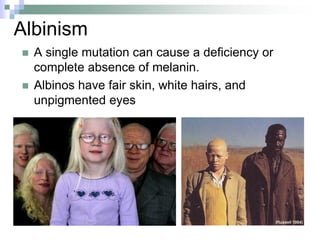
Albinism
 A single mutation can cause a deficiency or
complete absence of melanin.
 Albinos have fair skin, white hairs, and
unpigmented eyes
Functions of Skin
 Mechanical/Chemical damage – keratin
toughens cells; fats cells cushion blows; and
pressure receptors to measure possible
damage
 Bacterial damage – skin secretions are
acidic and inhibit bacteria.
 Ultraviolet radiation – melanin produced to
protect from UV damage
Skin Functions
 Thermal control – regulates body temperature
 Heat loss: sweat to cool the skin
 Heat retention: prevents blood to rush into capillary beds
 Waterproofing – contains lipids to prevent drying out
 Excretion of waste – urea and uric acid secreted in
sweat
 Makes vitamin D – modifies cholesterol molecules in
skin and converts it to vitamin D
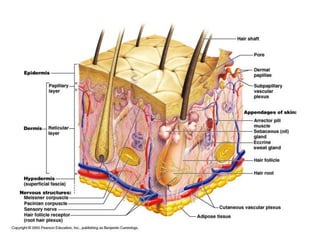
Skin appendages
 Derived from epidermis but extend into
dermis
 Include
Hair and hair follicles
Sebaceous (oil) glands
Sweat (sudoiferous) glands
Nails
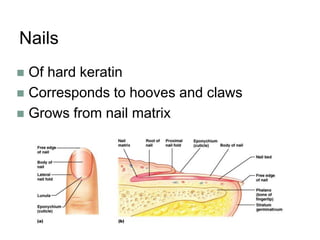
Nails
 Of hard keratin
 Corresponds to hooves and claws
 Grows from nail matrix
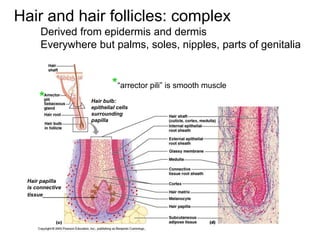
Hair and hair follicles: complex
Derived from epidermis and dermis
Everywhere but palms, soles, nipples, parts of genitalia
*“arrector pili” is smooth muscle
*
Hair papilla
is connective
tissue________________
Hair bulb:
epithelial cells
surrounding
papilla
 Functions of hair
Warmth – less in man than other mammals
Sense light touch of the skin
Protection - scalp
 Parts
Root imbedded in skin
Shaft projecting above skin surface
 Make up of hair – hard keratin
 Three concentric layers
Medulla (core)
Cortex (surrounds medulla)
Cuticle (single layers, overlapping)
 Types of hair
 Vellus: fine, short hairs
 Intermediate hairs
 Terminal: longer, courser hair
 Hair growth: averages 2 mm/week
 Active: growing
 Resting phase then shed
 Hair loss
 Thinning – age related
 Male pattern baldness
 Hair color
 Amount of melanin for black or brown; distinct form of
melanin for red
 White: decreased melanin and air bubbles in the
medulla
 Genetically determined though influenced by
hormones and environment
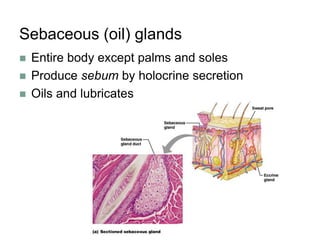
Sebaceous (oil) glands
 Entire body except palms and soles
 Produce sebum by holocrine secretion
 Oils and lubricates
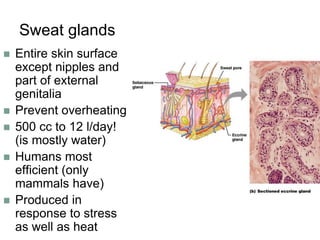
Sweat glands
 Entire skin surface
except nipples and
part of external
genitalia
 Prevent overheating
 500 cc to 12 l/day!
(is mostly water)
 Humans most
efficient (only
mammals have)
 Produced in
response to stress
as well as heat
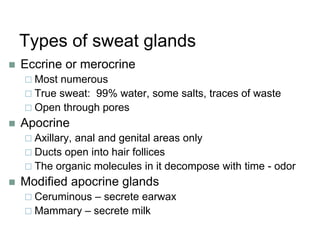
Types of sweat glands
 Eccrine or merocrine
 Most numerous
 True sweat: 99% water, some salts, traces of waste
 Open through pores
 Apocrine
 Axillary, anal and genital areas only
 Ducts open into hair follices
 The organic molecules in it decompose with time - odor
 Modified apocrine glands
 Ceruminous – secrete earwax
 Mammary – secrete milk
Disorders of the integumentary system
 Burns
Threat to life
 Catastrophic loss of body fluids
 Dehydration and fatal circulatory shock
 Infection
Types
 First degree – epidermis: redness (e.g. sunburn)
 Second degree – epidermis and upper dermis: blister
 Third degree - full thickness
 Infections
 Skin cancer
Tumors of the skin
 Benign, e.g. warts
 Cancer – associated with UV exposure
(also skin aging)

Integumentary_System_Physiology_22-02-2019.pdf

  • 1.
  • 2.
    The Integumentary System Integument is skin  Skin and its appendages make up the integumentary system  A fatty layer (hypodermis) lies deep to it  Two distinct regions Epidermis Dermis
  • 3.
    Epidermis  Keratinized stratifiedsquamous epithelium  Four types of cells  Keratinocytes – deepest, produce keratin (tough fibrous protein)  Melanocytes - make dark skin pigment melanin  Merkel cells – associated with sensory nerve endings  Langerhans cells – macrophage-like dendritic cells  Layers (from deep to superficial)  Stratum basale or germinativum – single row of cells attached to dermis; youngest cells  Stratum spinosum – spinyness is artifactual; tonofilaments (bundles of protein) resist tension  Stratum granulosum – layers of flattened keratinocytes producing keratin (hair and nails made of it also)  Stratum lucidum (only on palms and soles)  Stratum corneum – horny layer (cells dead, many layers thick) (see figure on next slide)
  • 4.
    Epithelium: layers (onleft) and cell types (on right)
  • 5.
    Dermis  Strong, flexibleconnective tissue: your “hide”  Cells: fibroblasts, macrophages, mast cells, WBCs  Fiber types: collagen, elastic, reticular  Rich supply of nerves and vessels  Critical role in temperature regulation (the vessels)  Two layers (see next slides)  Papillary – areolar connective tissue; includes dermal papillae  Reticular – “reticulum” (network) of collagen and reticular fibers
  • 6.
  • 7.
    Epidermis and dermisof (a) thick skin and (b) thin skin (which one makes the difference?)
  • 8.
    Fingerprints, palmprints, footprints Dermal papillae lie atop dermal ridges  Elevate the overlying epidermis into epidermal ridges  Are “sweat films” because of sweat pores  Genetically determined Flexion creases  Deep dermis, from continual folding Fibers  Collagen: strength and resilience  Elastic fibers: stretch-recoil  Striae: stretch marks  Tension lines (or lines of cleavage)  The direction the bundles of fibers are directed The dermis is the receptive site for the pigment of tattoos
  • 9.
    Hypodermis  “Hypodermis” (Gk)= below the skin  “Subcutaneous” (Latin) = below the skin  Also called “superficial fascia” “fascia” (Latin) =band; in anatomy: sheet of connective tissue  Fatty tissue which stores fat and anchors skin (areolar tissue and adipose cells)  Different patterns of accumulation (male/female)
  • 10.
    Skin color  Threeskin pigments Melanin: the most important Carotene: from carrots and yellow vegies Hemoglobin: the pink of light skin  Melanin in granules passes from melanocytes (same number in all races) to keratinocytes in stratum basale Digested by lysosomes Variations in color Protection from UV light vs vitamin D?
  • 11.
    Albinism  A singlemutation can cause a deficiency or complete absence of melanin.  Albinos have fair skin, white hairs, and unpigmented eyes
  • 12.
    Functions of Skin Mechanical/Chemical damage – keratin toughens cells; fats cells cushion blows; and pressure receptors to measure possible damage  Bacterial damage – skin secretions are acidic and inhibit bacteria.  Ultraviolet radiation – melanin produced to protect from UV damage
  • 13.
    Skin Functions  Thermalcontrol – regulates body temperature  Heat loss: sweat to cool the skin  Heat retention: prevents blood to rush into capillary beds  Waterproofing – contains lipids to prevent drying out  Excretion of waste – urea and uric acid secreted in sweat  Makes vitamin D – modifies cholesterol molecules in skin and converts it to vitamin D
  • 14.
    Skin appendages  Derivedfrom epidermis but extend into dermis  Include Hair and hair follicles Sebaceous (oil) glands Sweat (sudoiferous) glands Nails
  • 16.
    Nails  Of hardkeratin  Corresponds to hooves and claws  Grows from nail matrix
  • 17.
    Hair and hairfollicles: complex Derived from epidermis and dermis Everywhere but palms, soles, nipples, parts of genitalia *“arrector pili” is smooth muscle * Hair papilla is connective tissue________________ Hair bulb: epithelial cells surrounding papilla
  • 18.
     Functions ofhair Warmth – less in man than other mammals Sense light touch of the skin Protection - scalp  Parts Root imbedded in skin Shaft projecting above skin surface  Make up of hair – hard keratin  Three concentric layers Medulla (core) Cortex (surrounds medulla) Cuticle (single layers, overlapping)
  • 19.
     Types ofhair  Vellus: fine, short hairs  Intermediate hairs  Terminal: longer, courser hair  Hair growth: averages 2 mm/week  Active: growing  Resting phase then shed  Hair loss  Thinning – age related  Male pattern baldness  Hair color  Amount of melanin for black or brown; distinct form of melanin for red  White: decreased melanin and air bubbles in the medulla  Genetically determined though influenced by hormones and environment
  • 20.
    Sebaceous (oil) glands Entire body except palms and soles  Produce sebum by holocrine secretion  Oils and lubricates
  • 21.
    Sweat glands  Entireskin surface except nipples and part of external genitalia  Prevent overheating  500 cc to 12 l/day! (is mostly water)  Humans most efficient (only mammals have)  Produced in response to stress as well as heat
  • 22.
    Types of sweatglands  Eccrine or merocrine  Most numerous  True sweat: 99% water, some salts, traces of waste  Open through pores  Apocrine  Axillary, anal and genital areas only  Ducts open into hair follices  The organic molecules in it decompose with time - odor  Modified apocrine glands  Ceruminous – secrete earwax  Mammary – secrete milk
  • 23.
    Disorders of theintegumentary system  Burns Threat to life  Catastrophic loss of body fluids  Dehydration and fatal circulatory shock  Infection Types  First degree – epidermis: redness (e.g. sunburn)  Second degree – epidermis and upper dermis: blister  Third degree - full thickness  Infections  Skin cancer
  • 24.
    Tumors of theskin  Benign, e.g. warts  Cancer – associated with UV exposure (also skin aging)