Connective Tissue
Dr. Maria Shahzad
Dept: Anatomy
Histology practical online class
Date:11th may 2020
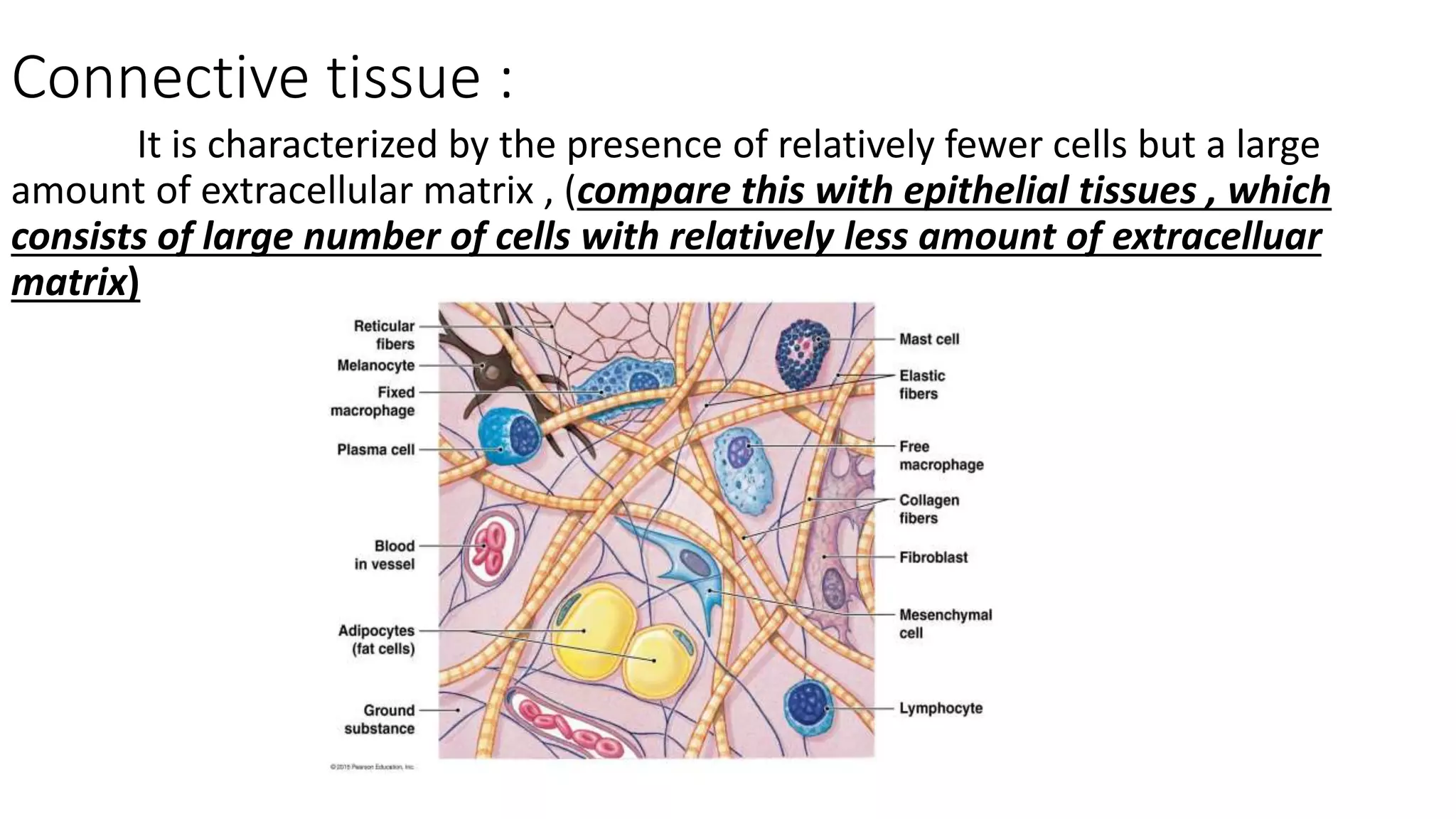
Connective tissue :
It is characterized by the presence of relatively fewer cells but a large
amount of extracellular matrix , (compare this with epithelial tissues , which
consists of large number of cells with relatively less amount of extracelluar
matrix)
Functions Of Connective tissue:
• Provision of structural support
• Role as medium for exchange
• Role in defence and protection of body
• Storage of fat
Connectivetissue A) Embryonic connective tissue
1)Mesenchymal connective tissue
2)Mucoid connective tissue
B)Connective tissue proper
1)Loose connective tissue
2)Dense connective tissue
i)Dense irregular connective tissue
ii)Dense regular connective tissue
a)Collagenous
b)Elastic
c)Specialized connective tissue
1)Cartilage 2)bone 3)blood 4)reticular connective tissue 5)adipose
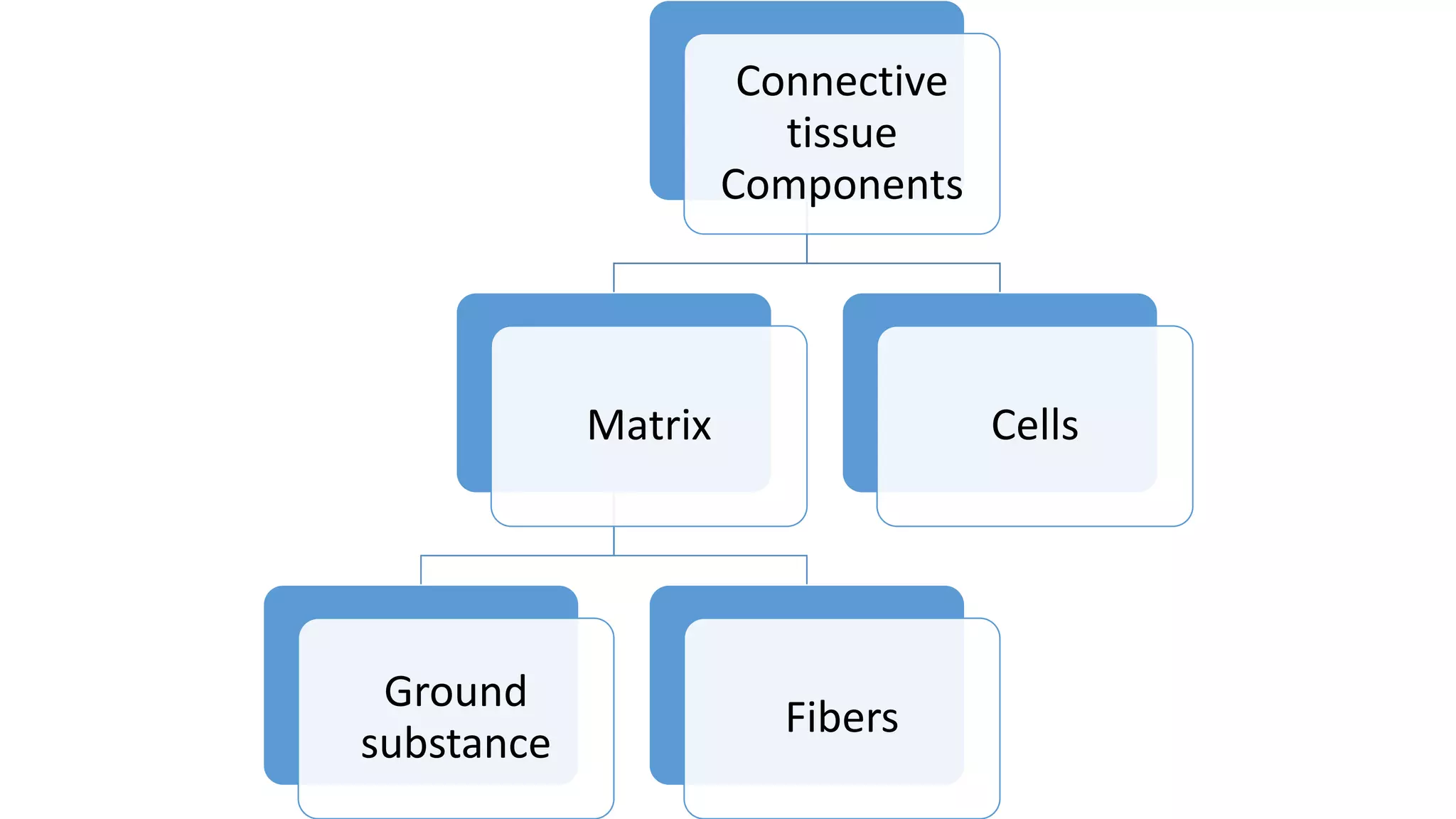
Connective
tissue
Components
Matrix
Ground
substance
Fibers
Cells
Connective tissue cells :
Many types of cells are found in different varieties
of connective tissue. Cells found in the connective tissue proper will be
discussed in this section . Connective tissue proper cells are classified
into two main types ;
1) Resident cells
2) Migrant cells
1) Resident cells of Connective tissue proper ;
• The resident cells (also called fixed cells ) are those cells which
develop and remain with in the connective tissue . These cells
include ;
i. Fibroblast
ii. Adipocytes
iii. Mesenchymal stem cells
1) Resident cells of Connective tissue proper ;
i. Fibroblast;
• Most abundantly present
• Derived from undifferentiated mesenchymal cells
Two forms ;
Inactive fibroblast(fibrocyte );
(usually small ovoid cell containing a small condensed rod shaped
nucleus , cytoplasm- acidophilic )
Active fibroblast;
(is a larger ,spindle shaped cell with radiating processes, ovoid
nucleus,prominent nucleolus .cytoplasm-basophilic )
• Function; to secrete proteins collagen and elastin which polymerize to form
various types of connective tissue fibers .
• Secrete various components of ground substance
ii. Adipocytes;
• Also called fat cells
• May occur as single or found in groups
• Size: 50-150 um in diameter
• Derived from mesenchymal cells
• Cytoplasm contain fat droplets (unilocular and mutilocular fat cells)
• Unilocular gives appearance of signet ring appearance
• Function :
To store lipid in fed state and release it in fasted state
iii.Mesenchymal stem cells;
• Can’t be easily classified in connective tissue
• Derived from embryonic mesenchyme
• Capability to give rise to fibroblast and adipocytes
2)Migrant cells of connective tissue proper;
• The migrant cells include those cells which enter the connective
tissue from blood stream . The migrant cells include;
i. Macrophages
ii. Mast cells
iii. Plasma cells
iv. Various types of white blood cells (leukocytes)
2)Migrant cells of connective tissue proper;
i. Macrophages ; (also called histocytes )
• Motile
• Phagocytic cells found in loose connective tissue
Two forms;
 Inactive macrophages; fusiform or stellate in shape,lie in close association with
collagen fibers , nucleus smaller and cytoplasm contain lysosomes, difficult to
distinguish it from fibroblast .
 Active macrophages; large , spherical or oval cell , eccentric in position and kidney-
shaped , cytoplasm – basophilic ,small vacuoles and dense granules
• In chronic inflammation enlarge and congregate to form epithelioid cells.
• Functions;
• Phagocytosis
• act as antigen presenting cells
• stimulate white blood cells to migrate into connective tissue and help them to combat
infection
ii. Mast cells ;
• Originate from stem cells of bone marrow
• Are large ovoid cells 20-30um in diameter
• Characteristic features – large secretory granules containing heparin
• Cytoplasm contain mitochondria, RER, a golgicomplex
Primary mediators;
contain heparin , histamine, neutral proteases,aryl sulphatase, eosinophil
chemotactic factor (ECF) and neutrophil chemotactic factor (NCF).
Secondary mediators;
leukotrienes C4, D4, and E4, prostaglandin D2 , bradykinin and platelet –
activating factors .
• Function;
Play a key role in development of allergic reactions (immediate
hypersensitivity)
• Plasma cells ;
• Derived from B lymphocytes
• Present in loose connective tissue
• Large ovoid cells (20um in diameter)
• Nucleus is spherical (eccentric position)
• Nucleus exhibits cart wheel or clock face appearence
• Also contain RER , golgi apparatus , centriole and mitochondria
• Function ;
Secrete antibodies belonging to IgE
iv. Leukocytes;
• Type of WBC
• Migrate from blood stream to connective tissue
• Fight against infections
Extracellular matrix of connective tissue :
i. Ground substance ;
includes glycosaminoglycan's , proteoglycans, glycoproteins
ii. Connective tissue fibers ;
includes collagen , elastic and reticular fibres
Connective tissue fibers ;
• Collagen ;
The five most common types are:
• Type I: skin, tendon, vasculature, organs, bone (main component of
the organic part of bone)
• Type II: cartilage (main collagenous component of cartilage)
• Type III: reticulate (main component of reticular fibers), commonly
found alongside type I
• Type IV: forms basal lamina, the epithelium-secreted layer of
the basement membrane
• Type V: cell surfaces, hair, and placenta
• Collagen fibers ;
 common
Made of collagen type1 , which is secreted by fibroblasts
Flexible not elastic
Stain acidophilic
 form bundles (fascicles )
2 to 10 um in diameter
• Reticular fibers ;
 thinner than collagen fiber (o.5 to 2 um )
Donot form bundles
Made of type III collagen
 Found in blood vessles , urinary bladder, uterus , intestine , nerves , lymphnodes,
spleen, liver, bonemarrow
• Elastic fibers ;
 highly elastic
0.2 to 1.0 um in diameter
 impart yellow color to tissues when present
Found in blood vessles,lungs, smooth muscles ,ligameta flava of
vertebral coloumn
Embryonic Connective tissue :
1) Mesenchymal connective tissue ;
 found in developing embryo
 Cells;Roughly star-shaped mesenchymal cells
 Ground substance; abundant(viscous)
 Fibres; reticular fibres
 Gap junctions and mitotic fiqures
2) Mucoid connective tissue ;
 Found at development of adult type of connective tissue from mesenchyme
 Cells; spindle-shaped fibroblast-like cells with branching processess
 Ground substance; abundant jelly-like matrix (contain hyaluronic acid)
 Fibres; type I and type III collagen fibres
 Location ;
in umbilical cord as wharton’s jelly
after birth, in pulp of growing tooth
vitreous body of eye
nucleus pulposus of intervertebral discs
Connective tissue proper:
1) Loose connective tissue;
 Widely distributed in body
 Act as packing and anchoring material
 Forms supporting mash work
 Cells; fibroblast , macrophages ,mast cells and adipocytes
 Ground substance; fluid-like matrix in small areas (areolae)
 Fibres; collagen fibres , elastic fibres and reticular fibres at periphery
 Blood vessles , nerves present
 Location ;
superfacial and deep fascia
mesentry , omentum
2) Dense connective tissue;
• Characterize by close packing of its fibres
• Fewer cells and less amount of ground substance
• Resistant to stress
i) Dense irregular connective tissue;
 Occurs in form of sheets
 Cells; fibroblast
 Ground substance; present
 Fibres; collagen fibres , some elastic fibres (interwoven)
ii) Dense regular connective tissue;
 Cells; fibroblast
 Ground substance; little
 Fibres; collagen fibres
 Occurs in form of ;
a) Dense regular Collagenous connective tissue :
 TENDONS;
cord-like , attaches muscle to bone ,collagen fibres, fibroblasts(tendinocytes)
 LIGAMENTS;
band-like , attaches bone to bone, collagen fibres , some elastic fibres ,
fibroblasts
 APONEUROSES;
broad flattened tendons, attach sheet-like muscles to bones,
Tendon
b) Dense regular elastic connective tissue:
• occur in form of elastic ligaments
• Cells; fibroblast
• Ground substance; little
• Fibres; elastic fibres and collagen fibres in between them
• Location;
vocal cords,ligament flava of vertebral column,suspensory ligament of penis
Specialized connective tissue:
1)Reticular connective tissue;
• Cells; reticular cells (forms meshwork )
• Ground substance; scanty
• Fibres; reticular fibres (collage type III)
• Location;
bone marrow , spleen , lymphnodes
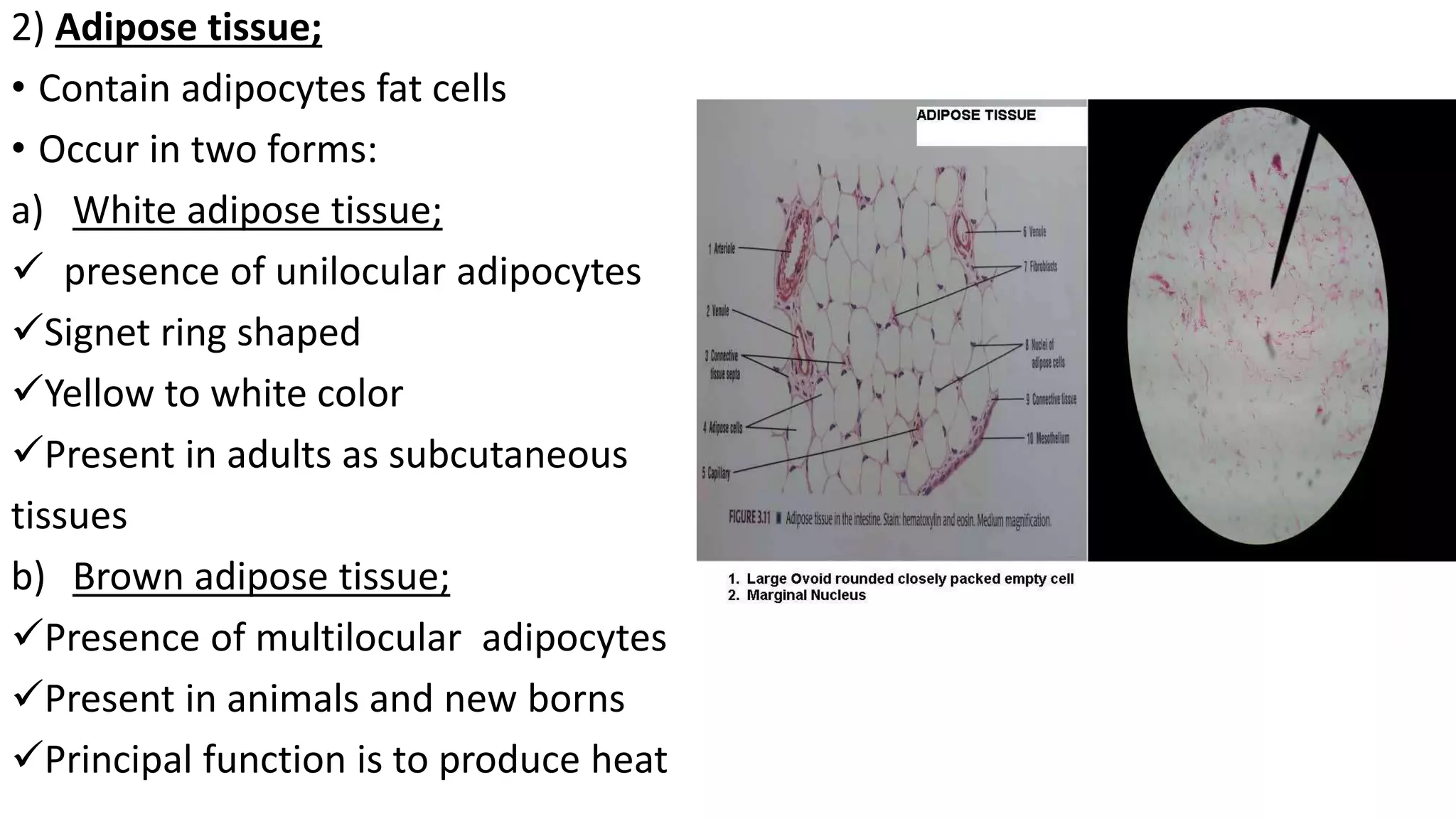
2) Adipose tissue;
• Contain adipocytes fat cells
• Occur in two forms:
a) White adipose tissue;
 presence of unilocular adipocytes
Signet ring shaped
Yellow to white color
Present in adults as subcutaneous
tissues
b) Brown adipose tissue;
Presence of multilocular adipocytes
Present in animals and new borns
Principal function is to produce heat
Thanks

Connective tissue

  • 1.
    Connective Tissue Dr. MariaShahzad Dept: Anatomy Histology practical online class Date:11th may 2020
  • 2.
    Connective tissue : Itis characterized by the presence of relatively fewer cells but a large amount of extracellular matrix , (compare this with epithelial tissues , which consists of large number of cells with relatively less amount of extracelluar matrix)
  • 3.
    Functions Of Connectivetissue: • Provision of structural support • Role as medium for exchange • Role in defence and protection of body • Storage of fat
  • 4.
    Connectivetissue A) Embryonicconnective tissue 1)Mesenchymal connective tissue 2)Mucoid connective tissue B)Connective tissue proper 1)Loose connective tissue 2)Dense connective tissue i)Dense irregular connective tissue ii)Dense regular connective tissue a)Collagenous b)Elastic c)Specialized connective tissue 1)Cartilage 2)bone 3)blood 4)reticular connective tissue 5)adipose
  • 5.
  • 6.
    Connective tissue cells: Many types of cells are found in different varieties of connective tissue. Cells found in the connective tissue proper will be discussed in this section . Connective tissue proper cells are classified into two main types ; 1) Resident cells 2) Migrant cells
  • 8.
    1) Resident cellsof Connective tissue proper ; • The resident cells (also called fixed cells ) are those cells which develop and remain with in the connective tissue . These cells include ; i. Fibroblast ii. Adipocytes iii. Mesenchymal stem cells
  • 9.
    1) Resident cellsof Connective tissue proper ; i. Fibroblast; • Most abundantly present • Derived from undifferentiated mesenchymal cells Two forms ; Inactive fibroblast(fibrocyte ); (usually small ovoid cell containing a small condensed rod shaped nucleus , cytoplasm- acidophilic ) Active fibroblast; (is a larger ,spindle shaped cell with radiating processes, ovoid nucleus,prominent nucleolus .cytoplasm-basophilic ) • Function; to secrete proteins collagen and elastin which polymerize to form various types of connective tissue fibers . • Secrete various components of ground substance
  • 10.
    ii. Adipocytes; • Alsocalled fat cells • May occur as single or found in groups • Size: 50-150 um in diameter • Derived from mesenchymal cells • Cytoplasm contain fat droplets (unilocular and mutilocular fat cells) • Unilocular gives appearance of signet ring appearance • Function : To store lipid in fed state and release it in fasted state iii.Mesenchymal stem cells; • Can’t be easily classified in connective tissue • Derived from embryonic mesenchyme • Capability to give rise to fibroblast and adipocytes
  • 11.
    2)Migrant cells ofconnective tissue proper; • The migrant cells include those cells which enter the connective tissue from blood stream . The migrant cells include; i. Macrophages ii. Mast cells iii. Plasma cells iv. Various types of white blood cells (leukocytes)
  • 12.
    2)Migrant cells ofconnective tissue proper; i. Macrophages ; (also called histocytes ) • Motile • Phagocytic cells found in loose connective tissue Two forms;  Inactive macrophages; fusiform or stellate in shape,lie in close association with collagen fibers , nucleus smaller and cytoplasm contain lysosomes, difficult to distinguish it from fibroblast .  Active macrophages; large , spherical or oval cell , eccentric in position and kidney- shaped , cytoplasm – basophilic ,small vacuoles and dense granules • In chronic inflammation enlarge and congregate to form epithelioid cells. • Functions; • Phagocytosis • act as antigen presenting cells • stimulate white blood cells to migrate into connective tissue and help them to combat infection
  • 13.
    ii. Mast cells; • Originate from stem cells of bone marrow • Are large ovoid cells 20-30um in diameter • Characteristic features – large secretory granules containing heparin • Cytoplasm contain mitochondria, RER, a golgicomplex Primary mediators; contain heparin , histamine, neutral proteases,aryl sulphatase, eosinophil chemotactic factor (ECF) and neutrophil chemotactic factor (NCF). Secondary mediators; leukotrienes C4, D4, and E4, prostaglandin D2 , bradykinin and platelet – activating factors . • Function; Play a key role in development of allergic reactions (immediate hypersensitivity)
  • 14.
    • Plasma cells; • Derived from B lymphocytes • Present in loose connective tissue • Large ovoid cells (20um in diameter) • Nucleus is spherical (eccentric position) • Nucleus exhibits cart wheel or clock face appearence • Also contain RER , golgi apparatus , centriole and mitochondria • Function ; Secrete antibodies belonging to IgE
  • 15.
    iv. Leukocytes; • Typeof WBC • Migrate from blood stream to connective tissue • Fight against infections
  • 16.
    Extracellular matrix ofconnective tissue : i. Ground substance ; includes glycosaminoglycan's , proteoglycans, glycoproteins ii. Connective tissue fibers ; includes collagen , elastic and reticular fibres
  • 17.
    Connective tissue fibers; • Collagen ; The five most common types are: • Type I: skin, tendon, vasculature, organs, bone (main component of the organic part of bone) • Type II: cartilage (main collagenous component of cartilage) • Type III: reticulate (main component of reticular fibers), commonly found alongside type I • Type IV: forms basal lamina, the epithelium-secreted layer of the basement membrane • Type V: cell surfaces, hair, and placenta
  • 18.
    • Collagen fibers;  common Made of collagen type1 , which is secreted by fibroblasts Flexible not elastic Stain acidophilic  form bundles (fascicles ) 2 to 10 um in diameter • Reticular fibers ;  thinner than collagen fiber (o.5 to 2 um ) Donot form bundles Made of type III collagen  Found in blood vessles , urinary bladder, uterus , intestine , nerves , lymphnodes, spleen, liver, bonemarrow
  • 19.
    • Elastic fibers;  highly elastic 0.2 to 1.0 um in diameter  impart yellow color to tissues when present Found in blood vessles,lungs, smooth muscles ,ligameta flava of vertebral coloumn
  • 20.
    Embryonic Connective tissue: 1) Mesenchymal connective tissue ;  found in developing embryo  Cells;Roughly star-shaped mesenchymal cells  Ground substance; abundant(viscous)  Fibres; reticular fibres  Gap junctions and mitotic fiqures
  • 21.
    2) Mucoid connectivetissue ;  Found at development of adult type of connective tissue from mesenchyme  Cells; spindle-shaped fibroblast-like cells with branching processess  Ground substance; abundant jelly-like matrix (contain hyaluronic acid)  Fibres; type I and type III collagen fibres  Location ; in umbilical cord as wharton’s jelly after birth, in pulp of growing tooth vitreous body of eye nucleus pulposus of intervertebral discs
  • 22.
    Connective tissue proper: 1)Loose connective tissue;  Widely distributed in body  Act as packing and anchoring material  Forms supporting mash work  Cells; fibroblast , macrophages ,mast cells and adipocytes  Ground substance; fluid-like matrix in small areas (areolae)  Fibres; collagen fibres , elastic fibres and reticular fibres at periphery  Blood vessles , nerves present  Location ; superfacial and deep fascia mesentry , omentum
  • 24.
    2) Dense connectivetissue; • Characterize by close packing of its fibres • Fewer cells and less amount of ground substance • Resistant to stress i) Dense irregular connective tissue;  Occurs in form of sheets  Cells; fibroblast  Ground substance; present  Fibres; collagen fibres , some elastic fibres (interwoven)
  • 25.
    ii) Dense regularconnective tissue;  Cells; fibroblast  Ground substance; little  Fibres; collagen fibres  Occurs in form of ; a) Dense regular Collagenous connective tissue :  TENDONS; cord-like , attaches muscle to bone ,collagen fibres, fibroblasts(tendinocytes)  LIGAMENTS; band-like , attaches bone to bone, collagen fibres , some elastic fibres , fibroblasts  APONEUROSES; broad flattened tendons, attach sheet-like muscles to bones,
  • 26.
  • 27.
    b) Dense regularelastic connective tissue: • occur in form of elastic ligaments • Cells; fibroblast • Ground substance; little • Fibres; elastic fibres and collagen fibres in between them • Location; vocal cords,ligament flava of vertebral column,suspensory ligament of penis
  • 28.
    Specialized connective tissue: 1)Reticularconnective tissue; • Cells; reticular cells (forms meshwork ) • Ground substance; scanty • Fibres; reticular fibres (collage type III) • Location; bone marrow , spleen , lymphnodes
  • 29.
    2) Adipose tissue; •Contain adipocytes fat cells • Occur in two forms: a) White adipose tissue;  presence of unilocular adipocytes Signet ring shaped Yellow to white color Present in adults as subcutaneous tissues b) Brown adipose tissue; Presence of multilocular adipocytes Present in animals and new borns Principal function is to produce heat
  • 30.