The Skeletal
System
•The skeletal system provides the bony
framework.
•Movement occurs in the joints but
movement per se is done by the muscles.
•The bones will not move unless the
muscle makes them moves.
•The essential purpose of physical
movement is to:
Obtain food and food
Avoid injury and reproduce
•Most of the body movements
done by an individual is
controlled by the will expect for
some movements like the
beating of the heart, digestion
and respiration. The
phenomenon know as reflex
action is done before the
individual becomes aware of it.
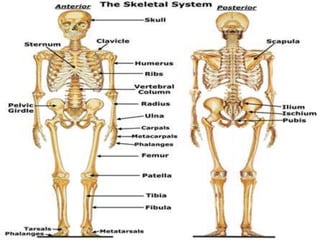
•The bones of the skeleton is
divided into two:
 Axial skeleton
Appendicular skeletons
•The axial skeleton is
compose of:
Skull
Vertebral column
Ribs
Sternum
Cranium – is formed by irregular
bones that provide protection for
the brain.
Base of the skull
-where the brain rests
Vault
-surrounds and protects the
brain
• The bones of the cranium are:
Frontal
Parietal
Temporal
Occipital
Sphenoid
Ethmoid bones
• Verbal column is composed of:
24 separate
Movable
Irregular bones
5 sacrum bones
4 coccyx
•The 24 separate bones are
divided into three groups:
7 cervical groups
12 thoracic bones
5 lumbar bones
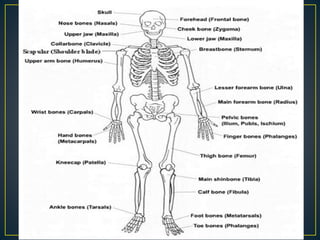
• The appendicular skeleton is
composed of:
Shoulder girdle with the upper
limbs
Pelvic girdle with the lower limbs
• Compact Bone - has a large
number of Haversian canals which
contain blood, lymph vessels and
nerves.
• Haversian Canal – is surrounded
by concentric plates of bones called
lacunae (spaces).
• Cancellous Bone – is similar to a
honeycomb in appearance. It
contains the red bone marrow and its
haversian canals are larger those in
the compact bones.
• Osteoblasts - are the cells responsible for
bone formation which develop
into osteocytes.
- are mature bone cells that
developed from osteoblasts.
• Osteoblasts can be seen present at:
1. The deeper layer of the periosteum
2. The centers of ossification
3. The ends of the diaphyses and
4. The sites of fracture
Aside from providing the frame work of the body,
the bones still perform other functions such as:
1. Provide attachment for muscles and tendons,
2. From a boundary at the cranial, thoracic and
pelvic cavities,
3. They also provide protection for the different
organs located at these cavities,
4. Contain the red bone marrow where
hematopoiesis occurs and
5. They serve as reservoir for calcium,
phosphorous and fats.

Skeletal System

  • 1.
  • 2.
    •The skeletal systemprovides the bony framework. •Movement occurs in the joints but movement per se is done by the muscles. •The bones will not move unless the muscle makes them moves. •The essential purpose of physical movement is to: Obtain food and food Avoid injury and reproduce
  • 3.
    •Most of thebody movements done by an individual is controlled by the will expect for some movements like the beating of the heart, digestion and respiration. The phenomenon know as reflex action is done before the individual becomes aware of it.
  • 4.
    •The bones ofthe skeleton is divided into two:  Axial skeleton Appendicular skeletons
  • 6.
    •The axial skeletonis compose of: Skull Vertebral column Ribs Sternum
  • 9.
    Cranium – isformed by irregular bones that provide protection for the brain. Base of the skull -where the brain rests Vault -surrounds and protects the brain
  • 10.
    • The bonesof the cranium are: Frontal Parietal Temporal Occipital Sphenoid Ethmoid bones
  • 11.
    • Verbal columnis composed of: 24 separate Movable Irregular bones 5 sacrum bones 4 coccyx
  • 12.
    •The 24 separatebones are divided into three groups: 7 cervical groups 12 thoracic bones 5 lumbar bones
  • 14.
    • The appendicularskeleton is composed of: Shoulder girdle with the upper limbs Pelvic girdle with the lower limbs
  • 15.
    • Compact Bone- has a large number of Haversian canals which contain blood, lymph vessels and nerves. • Haversian Canal – is surrounded by concentric plates of bones called lacunae (spaces). • Cancellous Bone – is similar to a honeycomb in appearance. It contains the red bone marrow and its haversian canals are larger those in the compact bones.
  • 16.
    • Osteoblasts -are the cells responsible for bone formation which develop into osteocytes. - are mature bone cells that developed from osteoblasts. • Osteoblasts can be seen present at: 1. The deeper layer of the periosteum 2. The centers of ossification 3. The ends of the diaphyses and 4. The sites of fracture
  • 17.
    Aside from providingthe frame work of the body, the bones still perform other functions such as: 1. Provide attachment for muscles and tendons, 2. From a boundary at the cranial, thoracic and pelvic cavities, 3. They also provide protection for the different organs located at these cavities, 4. Contain the red bone marrow where hematopoiesis occurs and 5. They serve as reservoir for calcium, phosphorous and fats.