Skeletal Maturity Indicator
www.indiandentalacademy.com
Introduction
 Chronological age is often not sufficient for
assessing the developmental stage and
somatic maturity of the patient.
 The biological age is determined from the
skeletal, dental and morphologic age and
the onset of puberty.
 Due to individual variations in timing, duration
and velocity of growth, skeletal age
assessment is essential in formulating viable
orthodontic treatment plans.
www.indiandentalacademy.com
Clinical Importance
 To determine the amount of significant facial
cranial growth potential left and potential
vector of facial development.
 To decide the onset of treatment timing and
type of effective treatment.
 To evaluate the treatment prognosis.
 To understand the role of genetics and
environment on the skeletal maturation
pattern.
www.indiandentalacademy.com
Anatomical Region Suitable For Skeletal
Maturational Assessment
 Head and Neck : Skull
Cervical Vertebrae
 Upper Limb :Shoulder Joint-Scapula
Elbow
Hand Wrist and Fingers
 Lower Limb : Femur and Humerus
Hip joint
Knee
Ankle
Foot tarsals and Meta tarsals
 Tooth mineralization as an indicator.
 Frontal sinus
www.indiandentalacademy.com
Hand Wrist Radiographs
 Assessment of the skeletal age is often made
with the help of a hand radiograph which can
be considered the Biological clock.
 Hand wrist region is made up of numerous
small bones. These bone show a predictable
and scheduled pattern of appearance,
ossification and union from birth to maturity.
Hence, this region is one of the most suited
to study growth.
www.indiandentalacademy.com
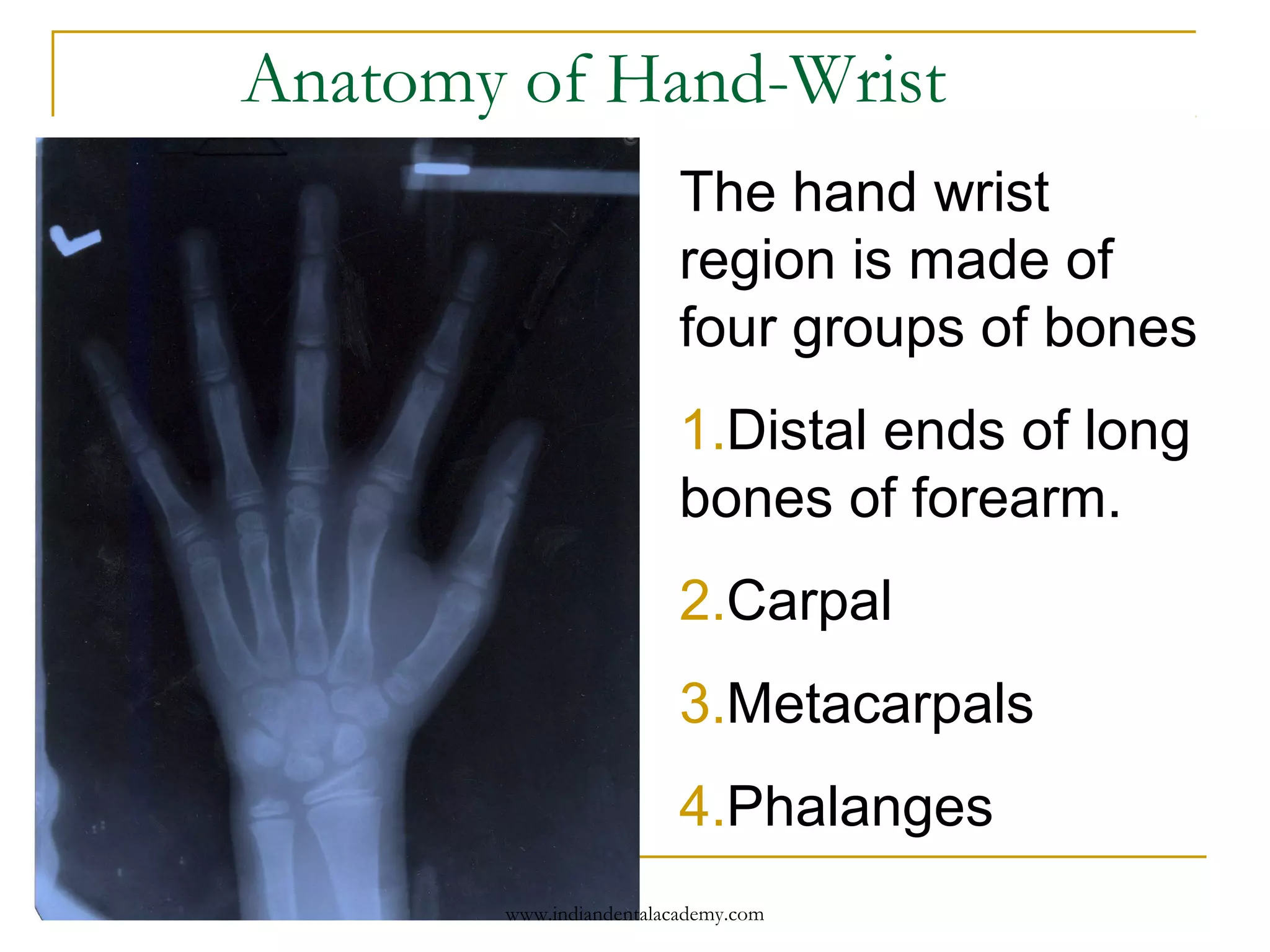
Anatomy of Hand-Wrist
The hand wrist
region is made of
four groups of bones
1.Distal ends of long
bones of forearm.
2.Carpal
3.Metacarpals
4.Phalanges
www.indiandentalacademy.com
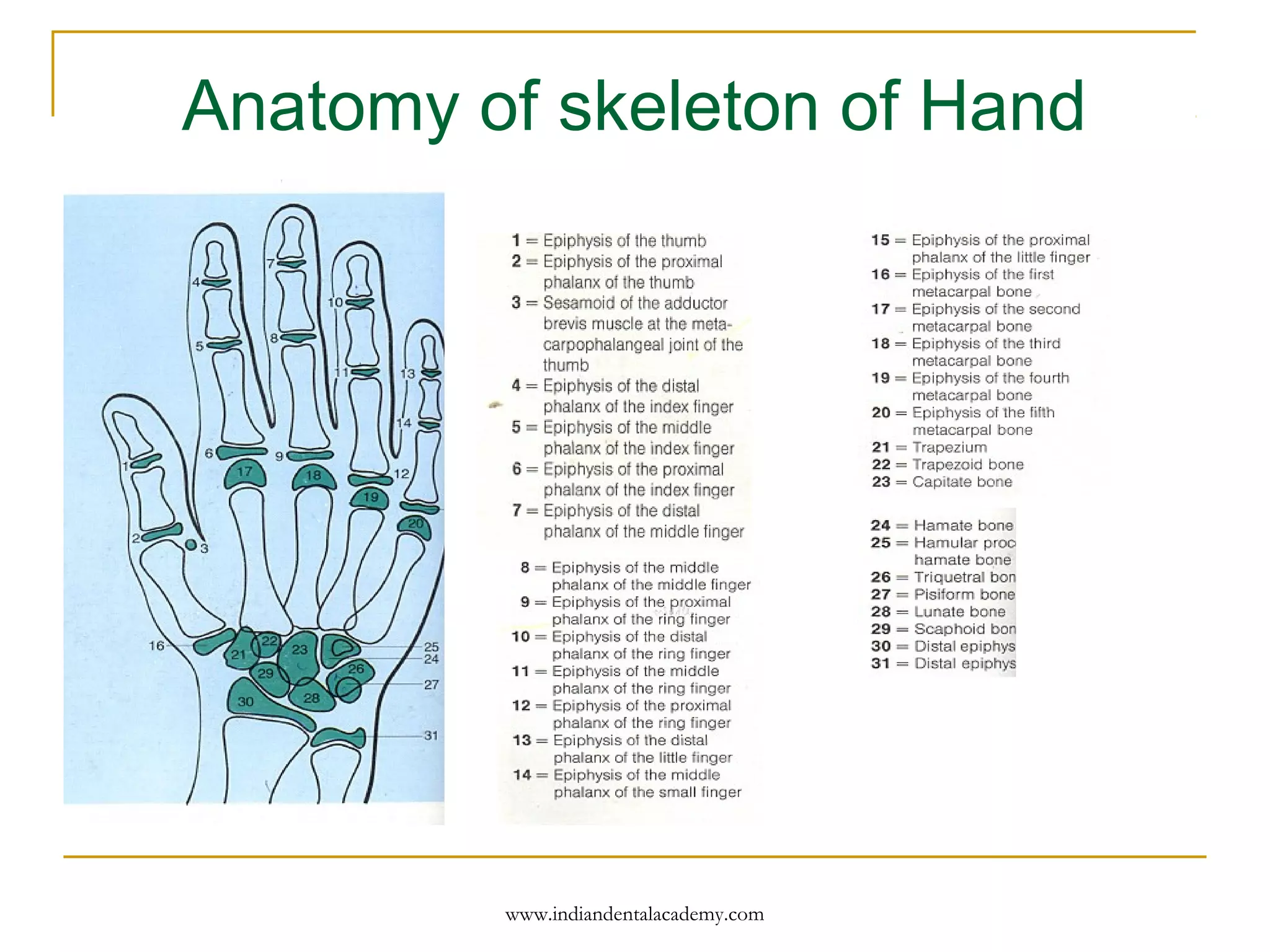
Anatomy of skeleton of Hand
www.indiandentalacademy.com
Indication Of Hand Wrist Radiographs
 In patients who exhibit major discrepancy between
dental and chronologic age.
 Determination of skeletal maturity status prior to
treatment of skeletal malocclusion.
 To assess the skeletal age in a patient whose
growth is affected by infections, neoplastic or
traumatic conditions.
 Help to predict future skeletal maturation rate and
status.
 To predict the pubertal growth spurt.
www.indiandentalacademy.com
Methods Of Assessing Skeletal Age
 Bjork ,Grave and Brown method
 Fishman’s skeletal maturity indicators
 Hagg and Taranger method
 Atlas method by Greulich and Pyle
www.indiandentalacademy.com
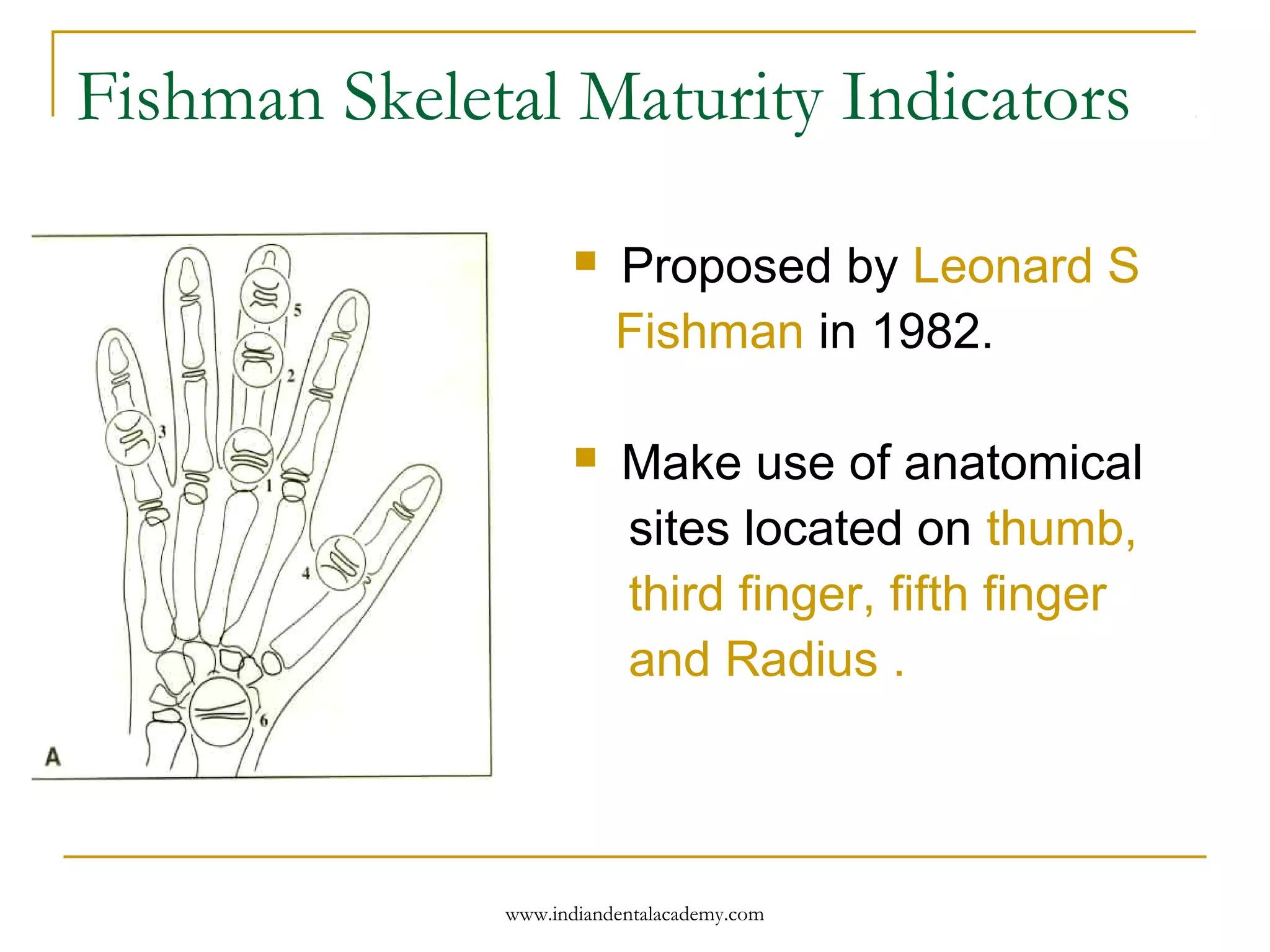
Fishman Skeletal Maturity Indicators
 Proposed by Leonard S
Fishman in 1982.
 Make use of anatomical
sites located on thumb,
third finger, fifth finger
and Radius .
www.indiandentalacademy.com
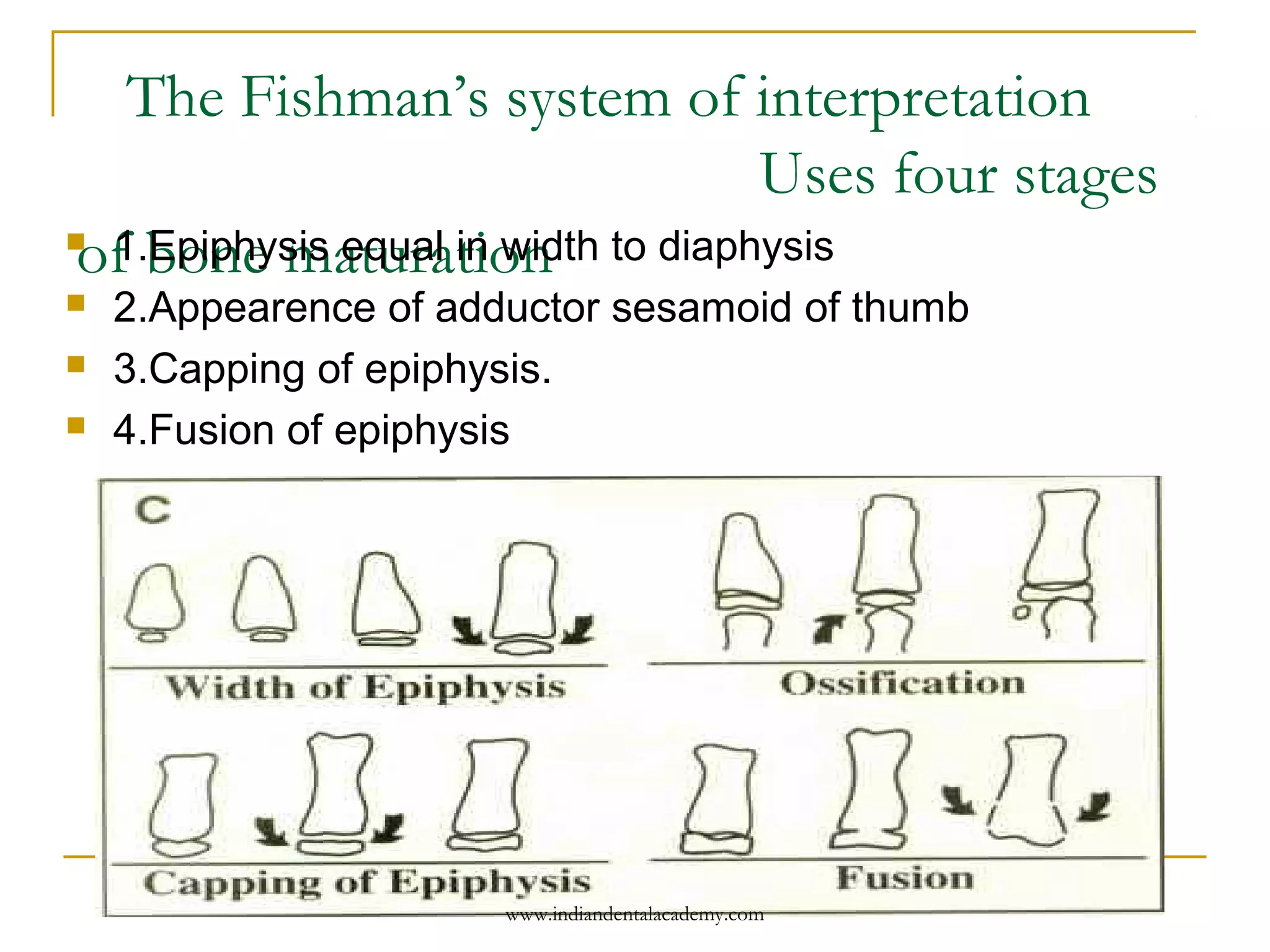
The Fishman’s system of interpretation
Uses four stages
of bone maturation 1.Epiphysis equal in width to diaphysis
 2.Appearence of adductor sesamoid of thumb
 3.Capping of epiphysis.
 4.Fusion of epiphysis
www.indiandentalacademy.com
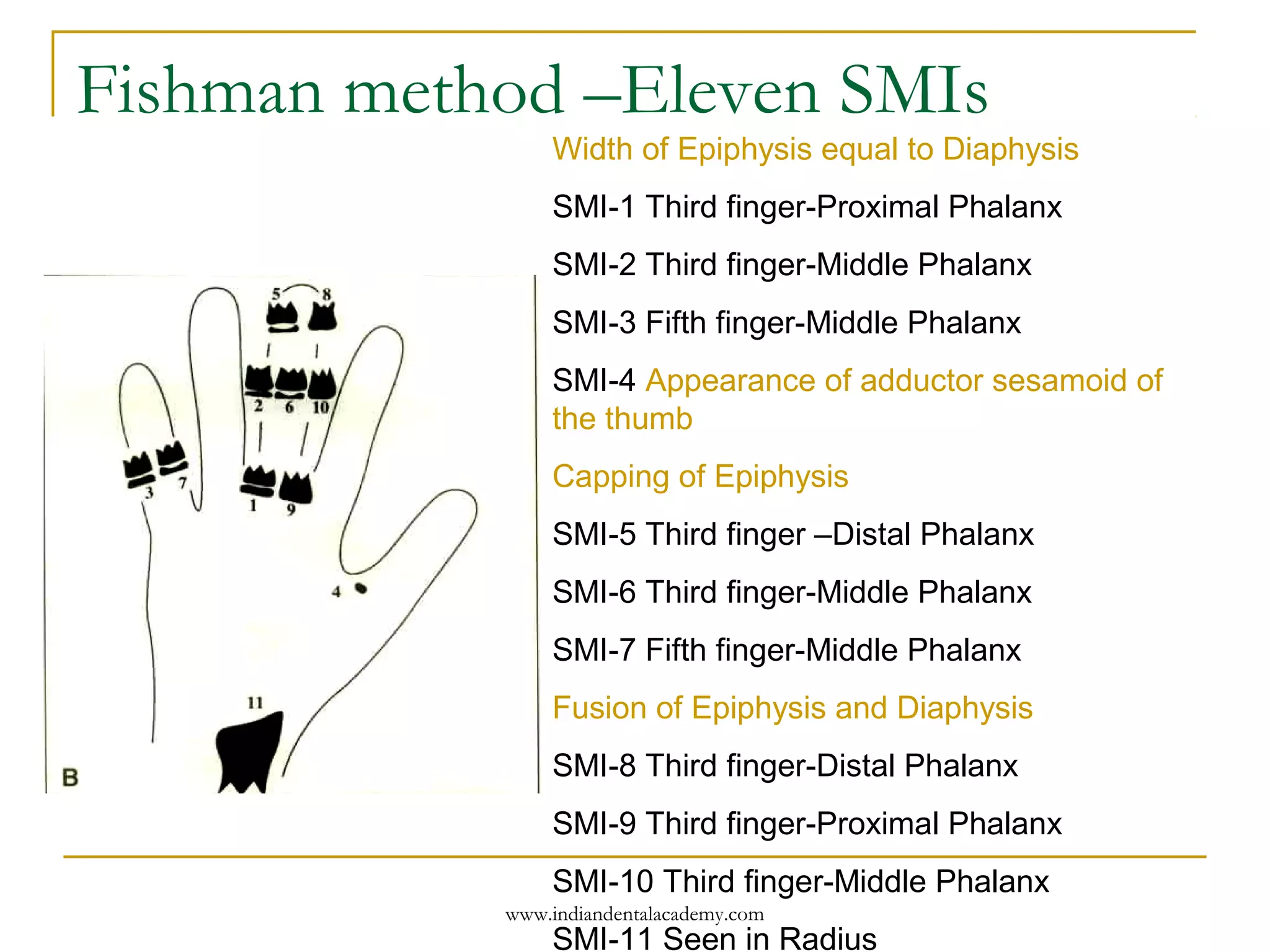
Fishman method –Eleven SMIs
Width of Epiphysis equal to Diaphysis
SMI-1 Third finger-Proximal Phalanx
SMI-2 Third finger-Middle Phalanx
SMI-3 Fifth finger-Middle Phalanx
SMI-4 Appearance of adductor sesamoid of
the thumb
Capping of Epiphysis
SMI-5 Third finger –Distal Phalanx
SMI-6 Third finger-Middle Phalanx
SMI-7 Fifth finger-Middle Phalanx
Fusion of Epiphysis and Diaphysis
SMI-8 Third finger-Distal Phalanx
SMI-9 Third finger-Proximal Phalanx
SMI-10 Third finger-Middle Phalanx
SMI-11 Seen in Radius
www.indiandentalacademy.com
Maturation Assessment by Hagg and
Taranger
 Analyzed from radiograph taken between the
ages of 6 and 18 years, by assessing of the
ossification of the ulnar sesamoid of the
metacarpophalangeal joint of first finger.
 Certain specified stages of 3 epiphyseal bone
-Middle and distal phalanges of third finger
[MP3 and DP3] and distal epiphysis of
Radius.
www.indiandentalacademy.com
Sesamoid
 Sesamoid is usually attained during the
acceleration period of the pubertal growth
spurt [onset of peak height velocity]
www.indiandentalacademy.com
Modified MP3 Cervical Vertebrae
MP3-F Stage
 Start of the curve of pubertal growth spurt .
 Epiphysis is as wide as metaphysis
 End of epiphysis are tapered and rounded.
 Radiolucent gap [cartilageous epiphyseal growth
plate] between epiphysis and metaphysis is wide.
Initiation stage of cervical vertebrae
C2,C3 and C4 inferior vertebral body
borders are flat.
Superior vertebral borders are tapered
from posterior to anterior [wedge shape]
80-100% of pubertal growth remains.
CVMI-1
www.indiandentalacademy.com
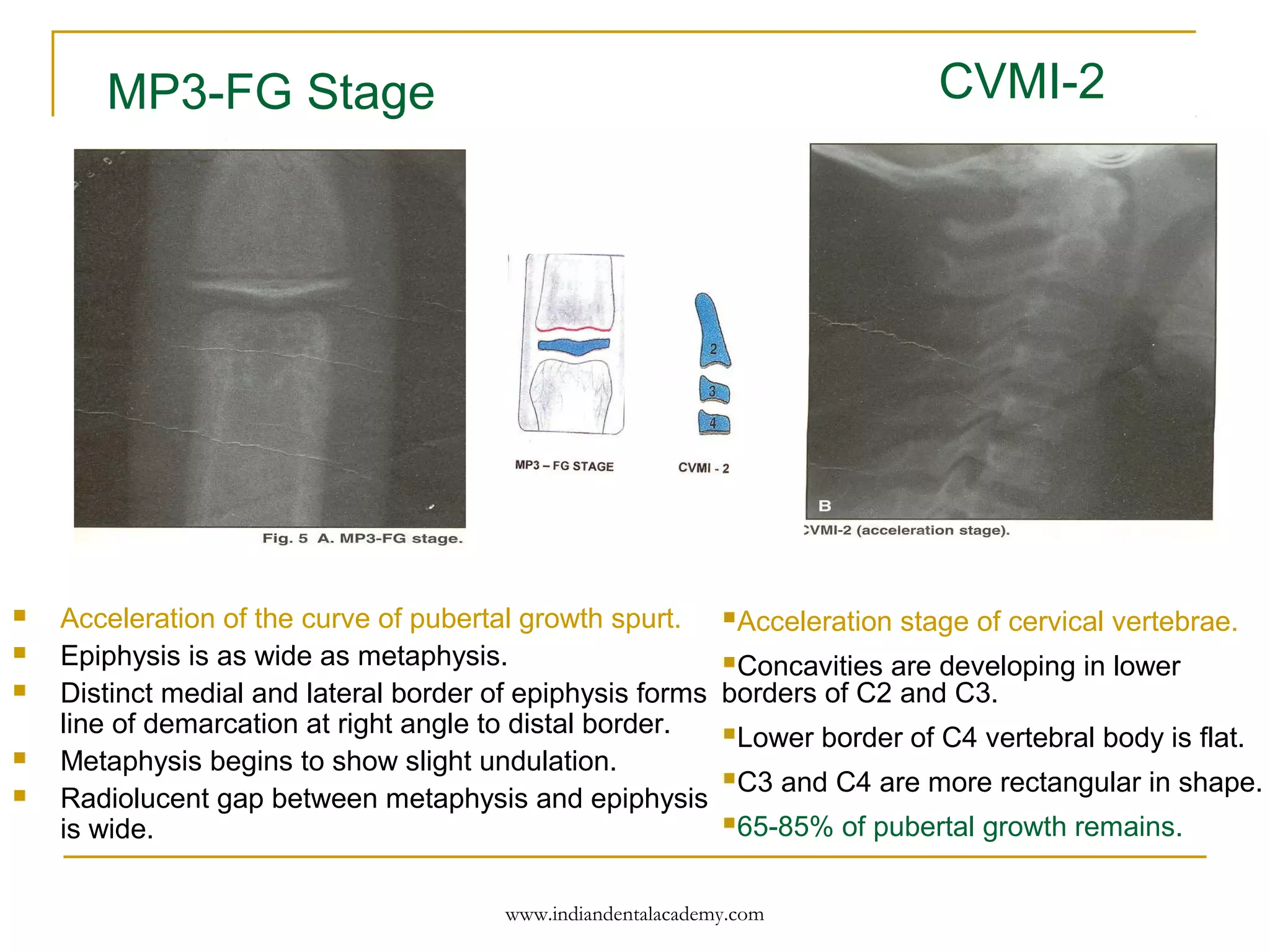
 Acceleration of the curve of pubertal growth spurt.
 Epiphysis is as wide as metaphysis.
 Distinct medial and lateral border of epiphysis forms
line of demarcation at right angle to distal border.
 Metaphysis begins to show slight undulation.
 Radiolucent gap between metaphysis and epiphysis
is wide.
Acceleration stage of cervical vertebrae.
Concavities are developing in lower
borders of C2 and C3.
Lower border of C4 vertebral body is flat.
C3 and C4 are more rectangular in shape.
65-85% of pubertal growth remains.
MP3-FG Stage CVMI-2
www.indiandentalacademy.com
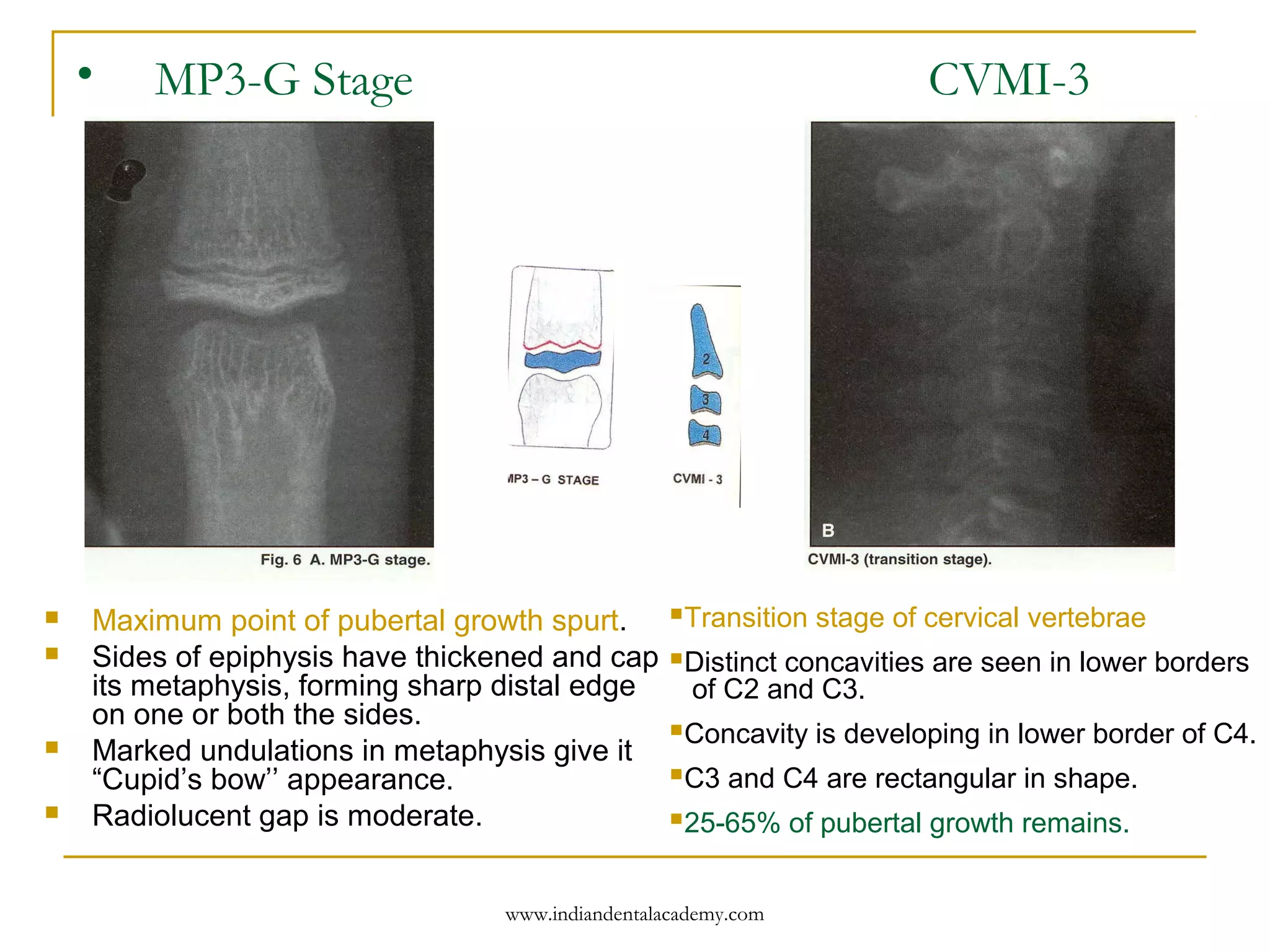
• MP3-G Stage CVMI-3
 Maximum point of pubertal growth spurt.
 Sides of epiphysis have thickened and cap
its metaphysis, forming sharp distal edge
on one or both the sides.
 Marked undulations in metaphysis give it
“Cupid’s bow’’ appearance.
 Radiolucent gap is moderate.
Transition stage of cervical vertebrae
Distinct concavities are seen in lower borders
of C2 and C3.
Concavity is developing in lower border of C4.
C3 and C4 are rectangular in shape.
25-65% of pubertal growth remains.
www.indiandentalacademy.com
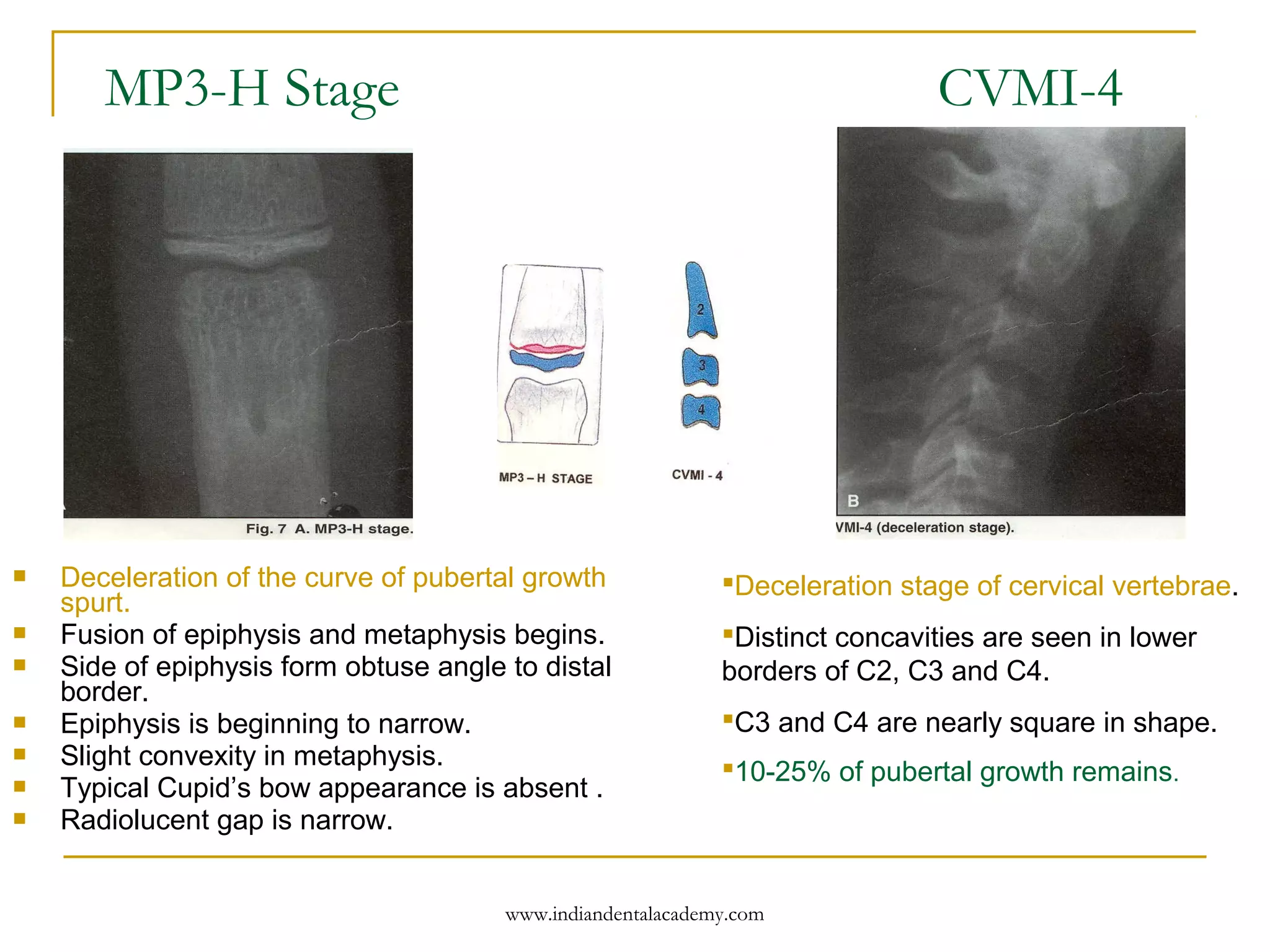
MP3-H Stage CVMI-4
 Deceleration of the curve of pubertal growth
spurt.
 Fusion of epiphysis and metaphysis begins.
 Side of epiphysis form obtuse angle to distal
border.
 Epiphysis is beginning to narrow.
 Slight convexity in metaphysis.
 Typical Cupid’s bow appearance is absent .
 Radiolucent gap is narrow.
Deceleration stage of cervical vertebrae.
Distinct concavities are seen in lower
borders of C2, C3 and C4.
C3 and C4 are nearly square in shape.
10-25% of pubertal growth remains.
www.indiandentalacademy.com
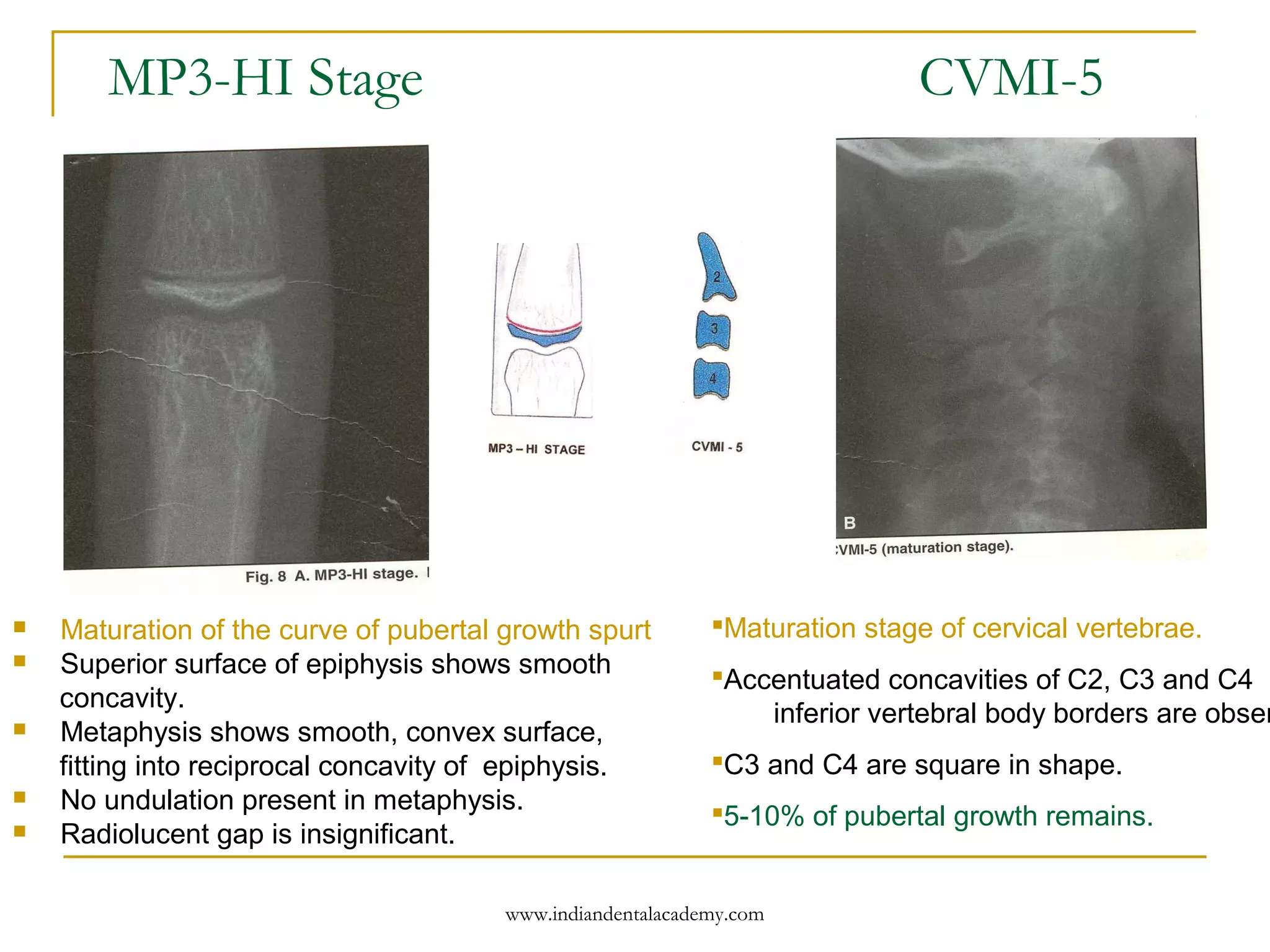
MP3-HI Stage CVMI-5
 Maturation of the curve of pubertal growth spurt
 Superior surface of epiphysis shows smooth
concavity.
 Metaphysis shows smooth, convex surface,
fitting into reciprocal concavity of epiphysis.
 No undulation present in metaphysis.
 Radiolucent gap is insignificant.
Maturation stage of cervical vertebrae.
Accentuated concavities of C2, C3 and C4
inferior vertebral body borders are obser
C3 and C4 are square in shape.
5-10% of pubertal growth remains.
www.indiandentalacademy.com
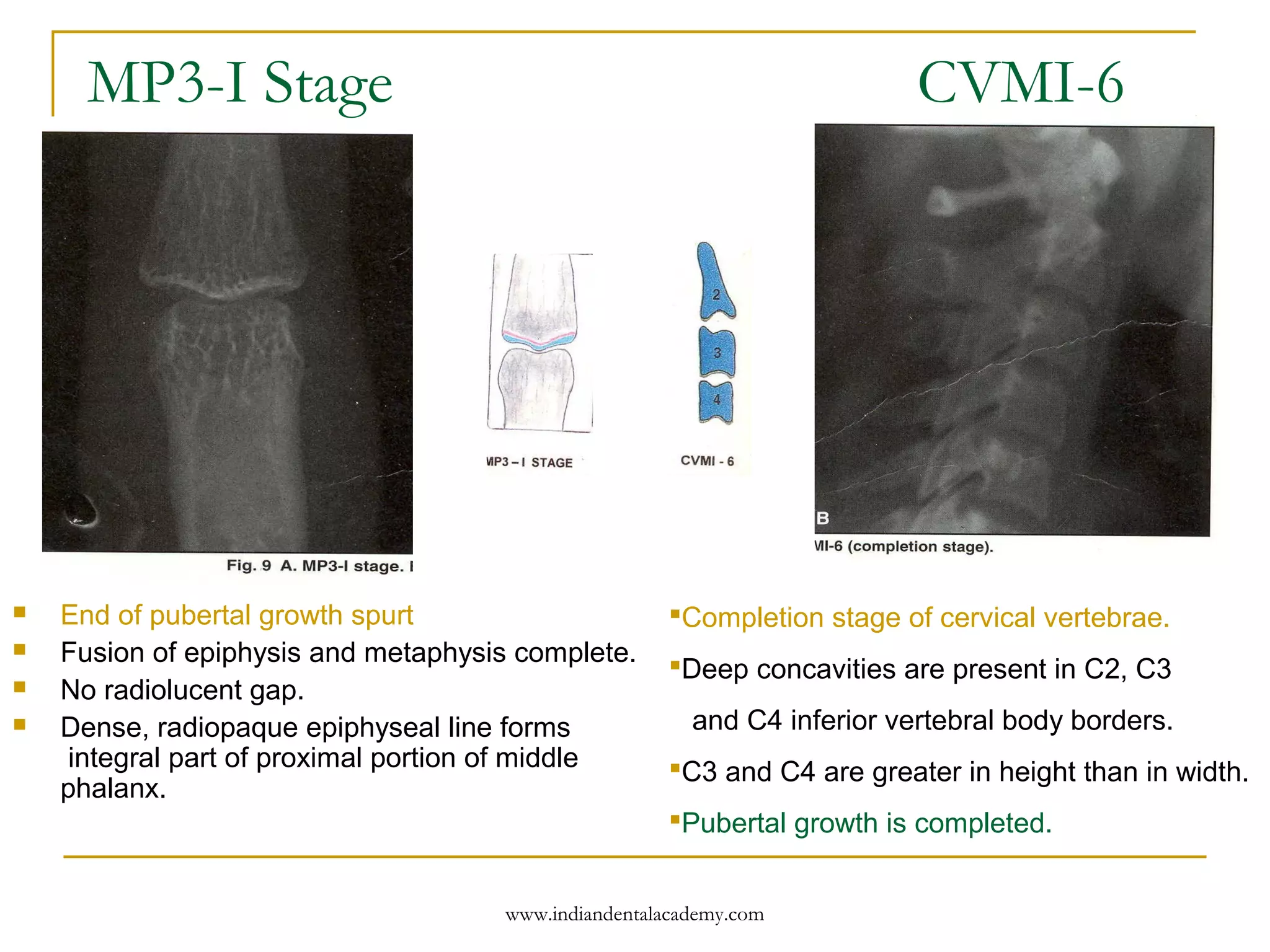
MP3-I Stage CVMI-6
 End of pubertal growth spurt
 Fusion of epiphysis and metaphysis complete.
 No radiolucent gap.
 Dense, radiopaque epiphyseal line forms
integral part of proximal portion of middle
phalanx.
Completion stage of cervical vertebrae.
Deep concavities are present in C2, C3
and C4 inferior vertebral body borders.
C3 and C4 are greater in height than in width.
Pubertal growth is completed.
www.indiandentalacademy.com
Third finger distal phalanx
 DP3-1:Fusion of Epiphysis and Metaphysis is
completed.
-This is attained during the deceleration period
of pubertal growth spurt [ end of PHV] .
www.indiandentalacademy.com
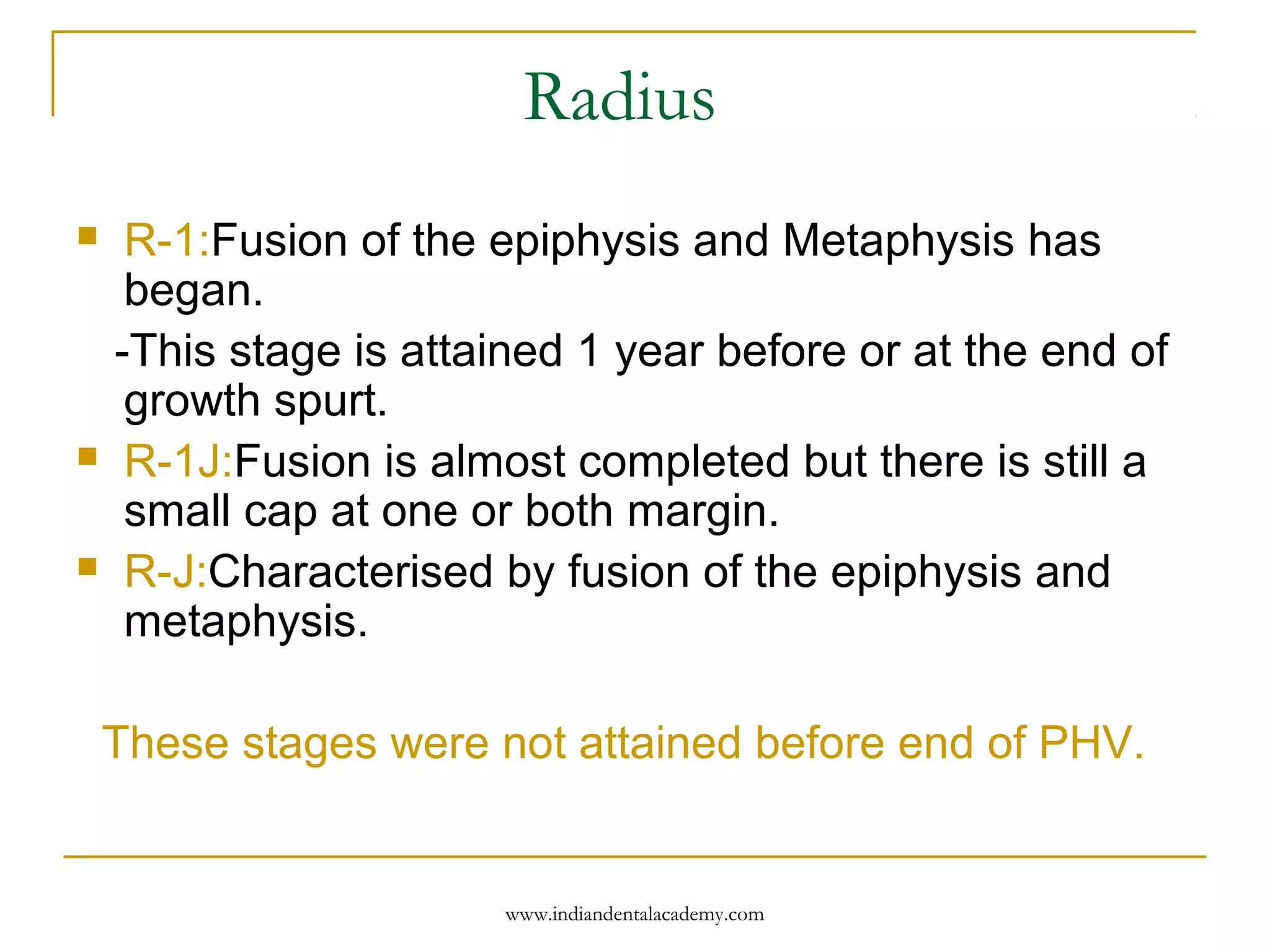
Radius
 R-1:Fusion of the epiphysis and Metaphysis has
began.
-This stage is attained 1 year before or at the end of
growth spurt.
 R-1J:Fusion is almost completed but there is still a
small cap at one or both margin.
 R-J:Characterised by fusion of the epiphysis and
metaphysis.
These stages were not attained before end of PHV.
www.indiandentalacademy.com
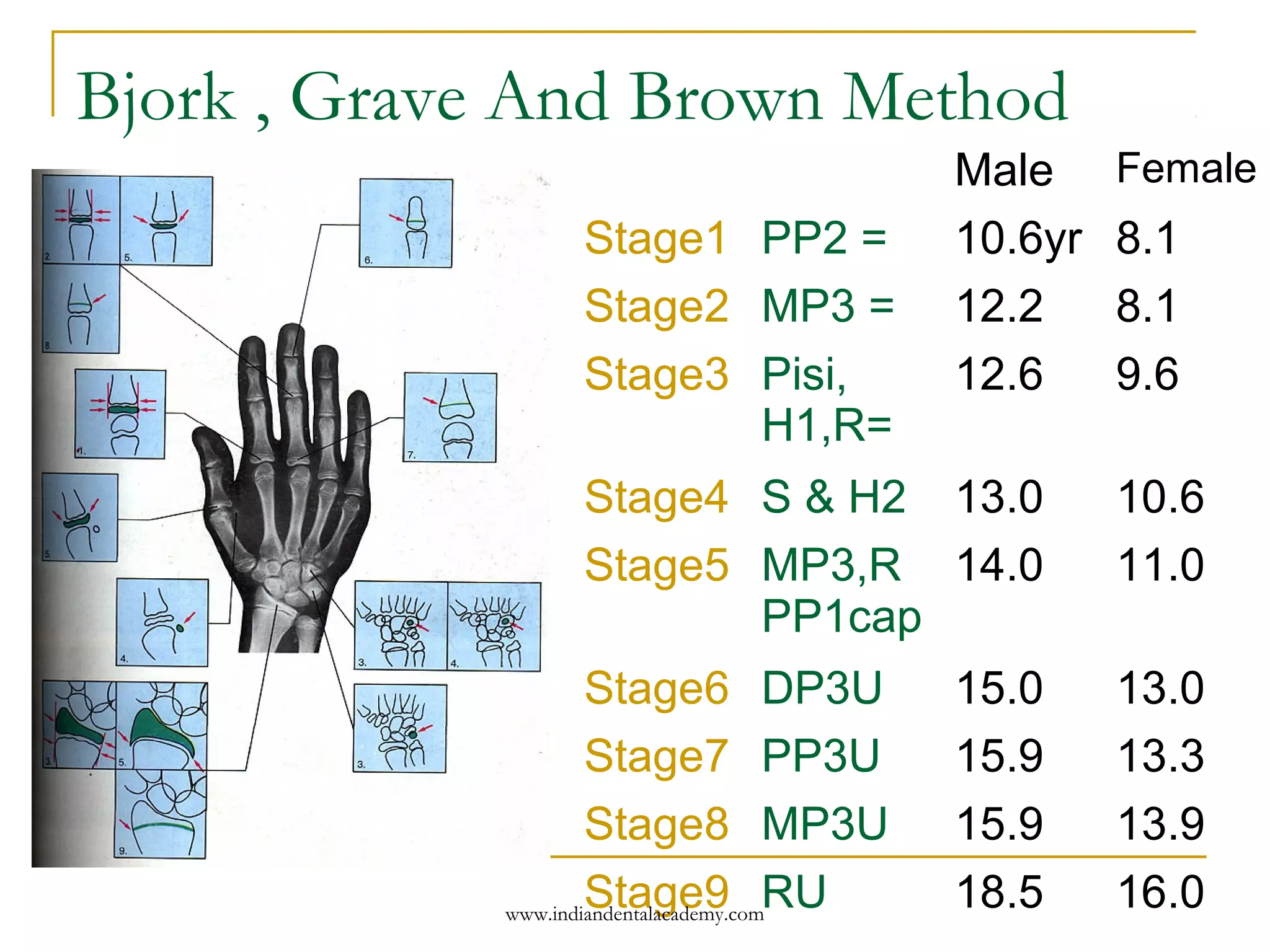
Bjork , Grave And Brown Method
Male Female
Stage1 PP2 = 10.6yr 8.1
Stage2 MP3 = 12.2 8.1
Stage3 Pisi,
H1,R=
12.6 9.6
Stage4 S & H2 13.0 10.6
Stage5 MP3,R
PP1cap
14.0 11.0
Stage6 DP3U 15.0 13.0
Stage7 PP3U 15.9 13.3
Stage8 MP3U 15.9 13.9
Stage9 RU 18.5 16.0www.indiandentalacademy.com

Skeletal maturity indicator 11

  • 1.
  • 2.
    Introduction  Chronological ageis often not sufficient for assessing the developmental stage and somatic maturity of the patient.  The biological age is determined from the skeletal, dental and morphologic age and the onset of puberty.  Due to individual variations in timing, duration and velocity of growth, skeletal age assessment is essential in formulating viable orthodontic treatment plans. www.indiandentalacademy.com
  • 3.
    Clinical Importance  Todetermine the amount of significant facial cranial growth potential left and potential vector of facial development.  To decide the onset of treatment timing and type of effective treatment.  To evaluate the treatment prognosis.  To understand the role of genetics and environment on the skeletal maturation pattern. www.indiandentalacademy.com
  • 4.
    Anatomical Region SuitableFor Skeletal Maturational Assessment  Head and Neck : Skull Cervical Vertebrae  Upper Limb :Shoulder Joint-Scapula Elbow Hand Wrist and Fingers  Lower Limb : Femur and Humerus Hip joint Knee Ankle Foot tarsals and Meta tarsals  Tooth mineralization as an indicator.  Frontal sinus www.indiandentalacademy.com
  • 5.
    Hand Wrist Radiographs Assessment of the skeletal age is often made with the help of a hand radiograph which can be considered the Biological clock.  Hand wrist region is made up of numerous small bones. These bone show a predictable and scheduled pattern of appearance, ossification and union from birth to maturity. Hence, this region is one of the most suited to study growth. www.indiandentalacademy.com
  • 6.
    Anatomy of Hand-Wrist Thehand wrist region is made of four groups of bones 1.Distal ends of long bones of forearm. 2.Carpal 3.Metacarpals 4.Phalanges www.indiandentalacademy.com
  • 7.
    Anatomy of skeletonof Hand www.indiandentalacademy.com
  • 8.
    Indication Of HandWrist Radiographs  In patients who exhibit major discrepancy between dental and chronologic age.  Determination of skeletal maturity status prior to treatment of skeletal malocclusion.  To assess the skeletal age in a patient whose growth is affected by infections, neoplastic or traumatic conditions.  Help to predict future skeletal maturation rate and status.  To predict the pubertal growth spurt. www.indiandentalacademy.com
  • 9.
    Methods Of AssessingSkeletal Age  Bjork ,Grave and Brown method  Fishman’s skeletal maturity indicators  Hagg and Taranger method  Atlas method by Greulich and Pyle www.indiandentalacademy.com
  • 10.
    Fishman Skeletal MaturityIndicators  Proposed by Leonard S Fishman in 1982.  Make use of anatomical sites located on thumb, third finger, fifth finger and Radius . www.indiandentalacademy.com
  • 11.
    The Fishman’s systemof interpretation Uses four stages of bone maturation 1.Epiphysis equal in width to diaphysis  2.Appearence of adductor sesamoid of thumb  3.Capping of epiphysis.  4.Fusion of epiphysis www.indiandentalacademy.com
  • 12.
    Fishman method –ElevenSMIs Width of Epiphysis equal to Diaphysis SMI-1 Third finger-Proximal Phalanx SMI-2 Third finger-Middle Phalanx SMI-3 Fifth finger-Middle Phalanx SMI-4 Appearance of adductor sesamoid of the thumb Capping of Epiphysis SMI-5 Third finger –Distal Phalanx SMI-6 Third finger-Middle Phalanx SMI-7 Fifth finger-Middle Phalanx Fusion of Epiphysis and Diaphysis SMI-8 Third finger-Distal Phalanx SMI-9 Third finger-Proximal Phalanx SMI-10 Third finger-Middle Phalanx SMI-11 Seen in Radius www.indiandentalacademy.com
  • 13.
    Maturation Assessment byHagg and Taranger  Analyzed from radiograph taken between the ages of 6 and 18 years, by assessing of the ossification of the ulnar sesamoid of the metacarpophalangeal joint of first finger.  Certain specified stages of 3 epiphyseal bone -Middle and distal phalanges of third finger [MP3 and DP3] and distal epiphysis of Radius. www.indiandentalacademy.com
  • 14.
    Sesamoid  Sesamoid isusually attained during the acceleration period of the pubertal growth spurt [onset of peak height velocity] www.indiandentalacademy.com
  • 15.
    Modified MP3 CervicalVertebrae MP3-F Stage  Start of the curve of pubertal growth spurt .  Epiphysis is as wide as metaphysis  End of epiphysis are tapered and rounded.  Radiolucent gap [cartilageous epiphyseal growth plate] between epiphysis and metaphysis is wide. Initiation stage of cervical vertebrae C2,C3 and C4 inferior vertebral body borders are flat. Superior vertebral borders are tapered from posterior to anterior [wedge shape] 80-100% of pubertal growth remains. CVMI-1 www.indiandentalacademy.com
  • 16.
     Acceleration ofthe curve of pubertal growth spurt.  Epiphysis is as wide as metaphysis.  Distinct medial and lateral border of epiphysis forms line of demarcation at right angle to distal border.  Metaphysis begins to show slight undulation.  Radiolucent gap between metaphysis and epiphysis is wide. Acceleration stage of cervical vertebrae. Concavities are developing in lower borders of C2 and C3. Lower border of C4 vertebral body is flat. C3 and C4 are more rectangular in shape. 65-85% of pubertal growth remains. MP3-FG Stage CVMI-2 www.indiandentalacademy.com
  • 17.
    • MP3-G StageCVMI-3  Maximum point of pubertal growth spurt.  Sides of epiphysis have thickened and cap its metaphysis, forming sharp distal edge on one or both the sides.  Marked undulations in metaphysis give it “Cupid’s bow’’ appearance.  Radiolucent gap is moderate. Transition stage of cervical vertebrae Distinct concavities are seen in lower borders of C2 and C3. Concavity is developing in lower border of C4. C3 and C4 are rectangular in shape. 25-65% of pubertal growth remains. www.indiandentalacademy.com
  • 18.
    MP3-H Stage CVMI-4 Deceleration of the curve of pubertal growth spurt.  Fusion of epiphysis and metaphysis begins.  Side of epiphysis form obtuse angle to distal border.  Epiphysis is beginning to narrow.  Slight convexity in metaphysis.  Typical Cupid’s bow appearance is absent .  Radiolucent gap is narrow. Deceleration stage of cervical vertebrae. Distinct concavities are seen in lower borders of C2, C3 and C4. C3 and C4 are nearly square in shape. 10-25% of pubertal growth remains. www.indiandentalacademy.com
  • 19.
    MP3-HI Stage CVMI-5 Maturation of the curve of pubertal growth spurt  Superior surface of epiphysis shows smooth concavity.  Metaphysis shows smooth, convex surface, fitting into reciprocal concavity of epiphysis.  No undulation present in metaphysis.  Radiolucent gap is insignificant. Maturation stage of cervical vertebrae. Accentuated concavities of C2, C3 and C4 inferior vertebral body borders are obser C3 and C4 are square in shape. 5-10% of pubertal growth remains. www.indiandentalacademy.com
  • 20.
    MP3-I Stage CVMI-6 End of pubertal growth spurt  Fusion of epiphysis and metaphysis complete.  No radiolucent gap.  Dense, radiopaque epiphyseal line forms integral part of proximal portion of middle phalanx. Completion stage of cervical vertebrae. Deep concavities are present in C2, C3 and C4 inferior vertebral body borders. C3 and C4 are greater in height than in width. Pubertal growth is completed. www.indiandentalacademy.com
  • 21.
    Third finger distalphalanx  DP3-1:Fusion of Epiphysis and Metaphysis is completed. -This is attained during the deceleration period of pubertal growth spurt [ end of PHV] . www.indiandentalacademy.com
  • 22.
    Radius  R-1:Fusion ofthe epiphysis and Metaphysis has began. -This stage is attained 1 year before or at the end of growth spurt.  R-1J:Fusion is almost completed but there is still a small cap at one or both margin.  R-J:Characterised by fusion of the epiphysis and metaphysis. These stages were not attained before end of PHV. www.indiandentalacademy.com
  • 23.
    Bjork , GraveAnd Brown Method Male Female Stage1 PP2 = 10.6yr 8.1 Stage2 MP3 = 12.2 8.1 Stage3 Pisi, H1,R= 12.6 9.6 Stage4 S & H2 13.0 10.6 Stage5 MP3,R PP1cap 14.0 11.0 Stage6 DP3U 15.0 13.0 Stage7 PP3U 15.9 13.3 Stage8 MP3U 15.9 13.9 Stage9 RU 18.5 16.0www.indiandentalacademy.com