SKELETAL
MATURITY
INDICATORS
Moderator :
Dr Devraj
Presented By:
Dr Gavi Krishna K
Why study maturity
indicators?
Key to successful treatment in
growing
patients – harnessing of growth.

 Without exact status of growth –
magnitude and direction-
treatment
planning is futile.
Advantages of Maturity
Indicators
Potential vector of facial development
determined.
Amount of significant craniofacial
growth
potential left.
To decide the onset of treatment
timing.



To evaluate treatment
prognosis
To understand role of genetics and
environment on skeletal
maturation
pattern.


Various Growth Assessment
Methods




Chronologic age Secondary
sexual characteristics
Growth charts Dental
development Skeletal
maturation
Age
Expressed as:
 Chronologic age
Age measured by years
lived since birth
Dental age

Determined according
to
teeth erupted, amount of root
resorption
and amount of root formation.
Skeletal age

Determined by ossification
of various skeletal structures at
different
time.
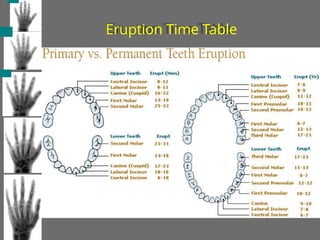
Eruption Time Table
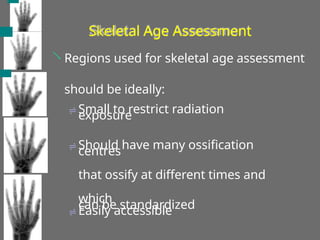
Skeletal Age Assessment
 Regions used for skeletal age assessment
should be ideally:
 Small to restrict radiation
exposure
 Should have many ossification
centres
that ossify at different times and
which
can be standardized
 Easily accessible
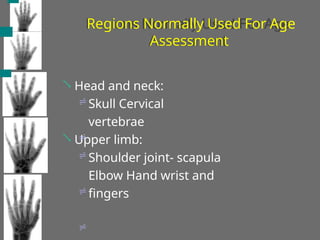
Regions Normally Used For Age
Assessment
Head and neck:
Skull Cervical
vertebrae
Upper limb:
Shoulder joint- scapula
Elbow Hand wrist and
fingers













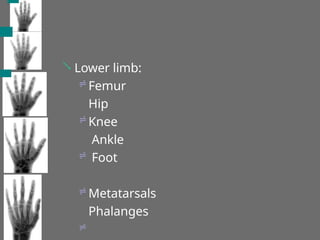
Lower limb:
Femur
Hip
Knee
Ankle
Foot
Metatarsals
Phalanges
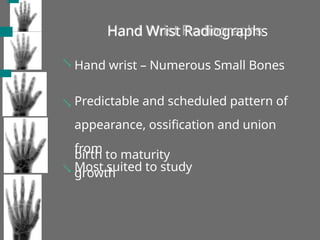
Hand Wrist Radiographs
 Hand wrist – Numerous Small Bones
 Predictable and scheduled pattern of
appearance, ossification and union
from
birth to maturity
 Most suited to study
growth
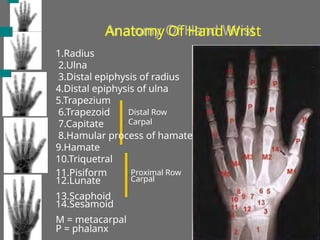
Anatomy Of Hand Wrist
1.Radius
2.Ulna
3.Distal epiphysis of radius
4.Distal epiphysis of ulna
5.Trapezium
6.Trapezoid
7.Capitate
8.Hamular process of hamate
9.Hamate
10.Triquetral
11.Pisiform
12.Lunate
13.Scaphoid
14.Sesamoid
M = metacarpal
Distal Row
Carpal
Proximal Row
Carpal
P = phalanx
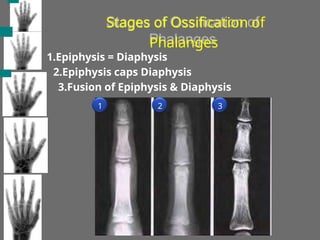
Stages of Ossification of
Phalanges
1.Epiphysis = Diaphysis
2.Epiphysis caps Diaphysis
3.Fusion of Epiphysis & Diaphysis
1 2 3
Radiological Methods of
Assessment and Prediction of
Growth





Greulich and Pyle method
Singer’s method
Fishman’s skeletal maturity
indicators
Bjork, Grave and Brown method
Cervical Vertebrae Maturity
Indicators Maturation assessment
byHagg and Taranger and the KR
(Kansal and Rajagopal) modified MP3
GREULICH AND PYLE METHOD



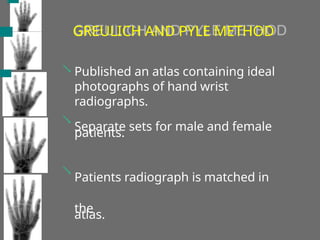
Published an atlas containing ideal
photographs of hand wrist
radiographs.
Separate sets for male and female
patients.
Patients radiograph is matched in
the
atlas.
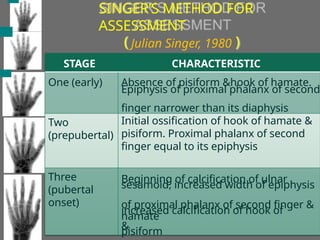
SINGER’S METHOD FOR
ASSESSMENT
Julian Singer, 1980
( )
Three
(pubertal
onset)
STAGE
One (early)
Two
(prepubertal)
CHARACTERISTIC
Absence of pisiform &hook of hamate.
Epiphysis of proximal phalanx of second
finger narrower than its diaphysis
Initial ossification of hook of hamate &
pisiform. Proximal phalanx of second
finger equal to its epiphysis
Beginning of calcification of ulnar
sesamoid, increased width of epiphysis
of proximal phalanx of second finger &
increased calcification of hook of
hamate
&
pisiform
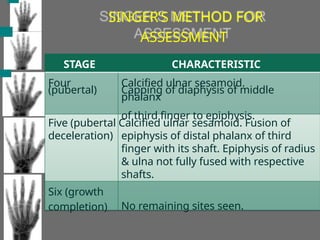
STAGE CHARACTERISTIC
Four
(pubertal)
Calcified ulnar sesamoid.
Capping of diaphysis of middle
phalanx
of third finger to epiphysis.
Five (pubertal Calcified ulnar sesamoid. Fusion of
deceleration) epiphysis of distal phalanx of third
finger with its shaft. Epiphysis of radius
& ulna not fully fused with respective
shafts.
No remaining sites seen.
Six (growth
completion)
SINGER’S METHOD FOR
ASSESSMENT
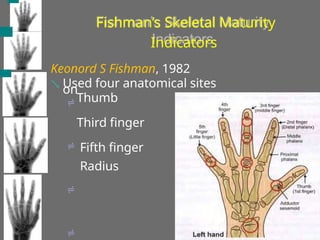
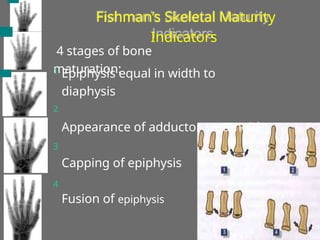
Fishman’s Skeletal Maturity
Indicators
Keonord S Fishman, 1982
 Used four anatomical sites
on




Thumb
Third finger
Fifth finger
Radius
4 stages of bone
maturation:
1
2
3
4
Epiphysis equal in width to
diaphysis
Appearance of adductor sesamoid
Capping of epiphysis
Fusion of epiphysis
Fishman’s Skeletal Maturity
Indicators
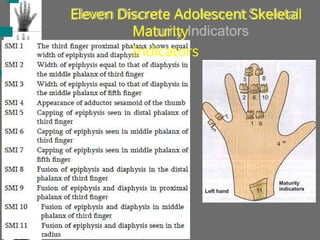
Eleven Discrete Adolescent Skeletal
Maturity
Indicators
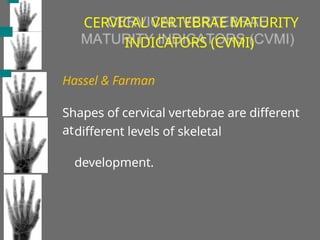
CERVICAL VERTEBRAE MATURITY
INDICATORS (CVMI)
Hassel & Farman
different levels of skeletal
development.
Shapes of cervical vertebrae are different
at
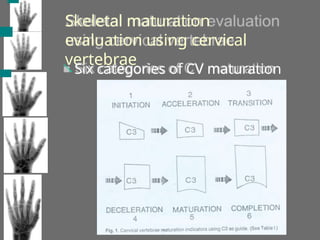
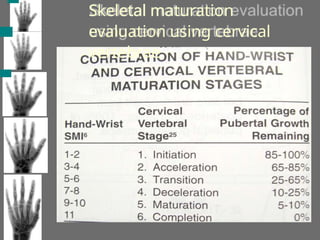
Skeletal maturation
evaluation using cervical
vertebrae
 Six categories of CV maturation
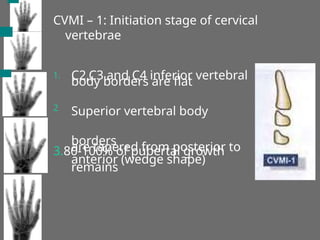
CVMI – 1: Initiation stage of cervical
vertebrae
1. C2,C3 and C4 inferior vertebral
body borders are flat
Superior vertebral body
borders
are tapered from posterior to
anterior (wedge shape)
2
3.80-100% of pubertal growth
remains
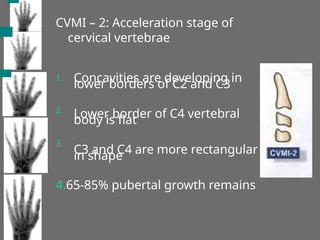
CVMI – 2: Acceleration stage of
cervical vertebrae
1. Concavities are developing in
lower borders of C2 and C3
Lower border of C4 vertebral
body is flat
C3 and C4 are more rectangular
in shape
2.
3.
4.65-85% pubertal growth remains
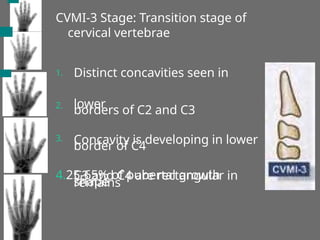
CVMI-3 Stage: Transition stage of
cervical vertebrae
1. Distinct concavities seen in
lower
borders of C2 and C3
Concavity is developing in lower
border of C4
C3 and C4 are rectangular in
shape
2.
3.
4.25-65% of pubertal growth
remains
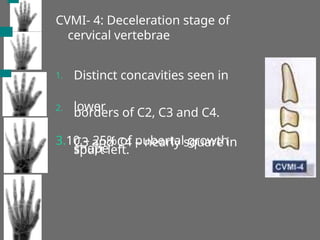
CVMI- 4: Deceleration stage of
cervical vertebrae
1. Distinct concavities seen in
lower
borders of C2, C3 and C4.
C3 and C4 – nearly square in
shape
2.
3.10 – 25% of pubertal growth
spurt left.
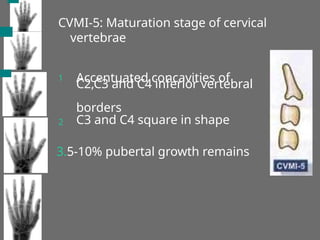
CVMI-5: Maturation stage of cervical
vertebrae
1 Accentuated concavities of
C2,C3 and C4 inferior vertebral
borders
C3 and C4 square in shape
2
3.5-10% pubertal growth remains
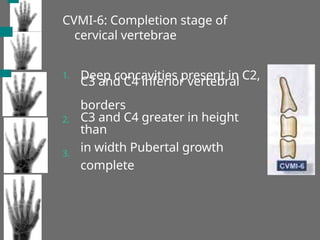
CVMI-6: Completion stage of
cervical vertebrae
1. Deep concavities present in C2,
C3 and C4 inferior vertebral
borders
C3 and C4 greater in height
than
in width Pubertal growth
complete
2.
3.
Skeletal maturation
evaluation using cervical
vertebrae
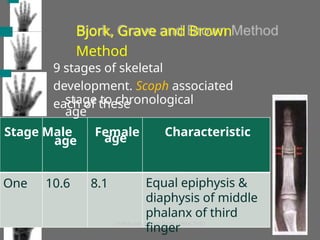
Bjork, Grave and Brown
Method
One 10.6 8.1
9 stages of skeletal
development. Scoph associated
each of these
stage to chronological
age
Stage Male Female
age
Characteristic
age
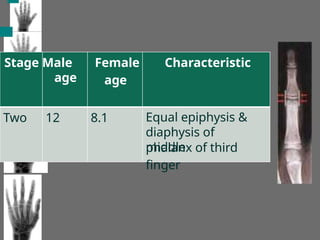
Equal epiphysis &
diaphysis of middle
phalanx of third
finger
Stage Male Female
age
Characteristic
phalanx of third
finger
Two 12
age
8.1 Equal epiphysis &
diaphysis of
middle
Stage Male
age
Female
age
Characteristic
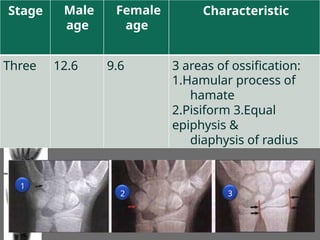
1.Hamular process of
hamate
2.Pisiform 3.Equal
epiphysis &
diaphysis of radius
Three 12.6 9.6 3 areas of ossification:
1
2 3
bone
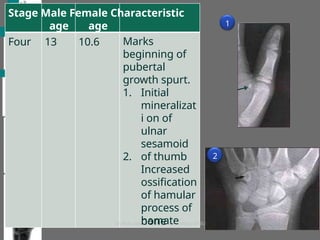
Stage Male Female Characteristic
Four
age
13
age
10.6 Marks
beginning of
pubertal
growth spurt.
1. Initial
mineralizat
i on of
ulnar
sesamoid
of thumb
Increased
ossification
of hamular
process of
hamate
2. 2
1
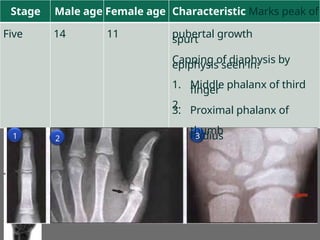
Stage Male age Female age Characteristic Marks peak of
pubertal growth
spurt
Capping of diaphysis by
epiphysis seen in:
Five 14 11
1.
2.
3.
Middle phalanx of third
finger
Proximal phalanx of
thumb
Radius
1 2 3
Stage Male Female Characteristic
age age
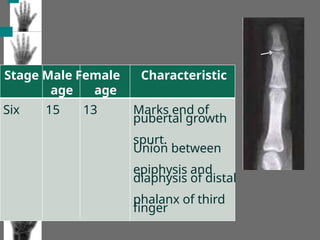
Six 15 13 Marks end of
pubertal growth
spurt.
Union between
epiphysis and
diaphysis of distal
phalanx of third
finger
Stage Male Female Characteristic
age age
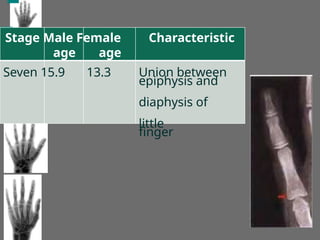
Seven 15.9 13.3 Union between
epiphysis and
diaphysis of
little
finger
Stage Male Female Characteristic
age age
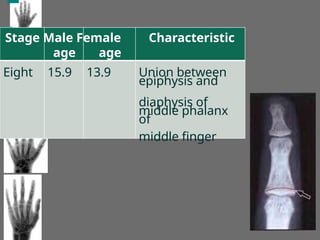
Eight 15.9 13.9 Union between
epiphysis and
diaphysis of
middle phalanx
of
middle finger
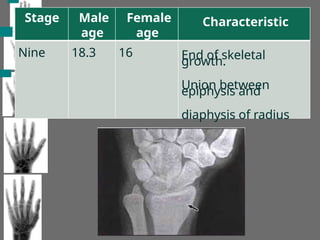
Stage Male
age
Nine 18.3
Female
age
16
Characteristic
End of skeletal
growth.
Union between
epiphysis and
diaphysis of radius
Hagg and Taranger
method
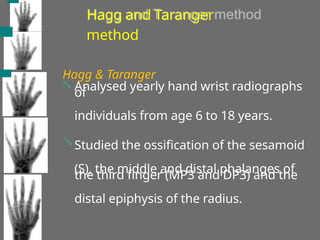
Hagg & Taranger
 Analysed yearly hand wrist radiographs
of
individuals from age 6 to 18 years.
Studied the ossification of the sesamoid
(S), the middle and distal phalanges of
the third finger (MP3 and DP3) and the
distal epiphysis of the radius.

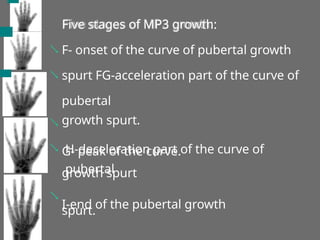
Five stages of MP3 growth:
F- onset of the curve of pubertal growth
spurt FG-acceleration part of the curve of
pubertal
growth spurt.
G- peak of the curve.



 H-deceleration part of the curve of
pubertal
growth spurt
I-end of the pubertal growth
spurt.

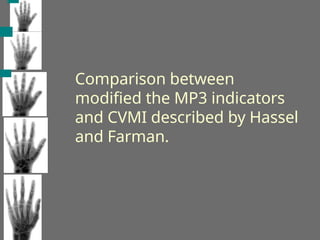
Comparison between
modified the MP3 indicators
and CVMI described by Hassel
and Farman.
MP3-F Stage
Start of the curve of pubertal
growth
spurt
Epiphysis is as wide as
metaphysis
End of epiphysis are tapered
and
rounded.
Radiolucent gap is wide
between
epiphysis & diaphysis.



80-100% of pubertal growth remains.
Initiation stage of cervical vertebrae

C2,C3 and C4 inferior vertebral
body borders are flat.
Superior vertebral borders are tapered from


posterior to anterior [wedge shape]
CVMI-1
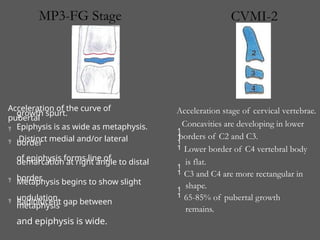
Acceleration of the curve of
pubertal
growth spurt.
Epiphysis is as wide as metaphysis.
Distinct medial and/or lateral
border
of epiphysis forms line of
demarcation at right angle to distal
border.
Metaphysis begins to show slight
undulation.
Radiolucent gap between
metaphysis
and epiphysis is wide.




Lower border of C4 vertebral body
is flat.
C3 and C4 are more rectangular in
shape.
65-85% of pubertal growth
remains.
Acceleration stage of cervical vertebrae.

Concavities are developing in lower



borders of C2 and C3.
MP3-FG Stage CVMI-2
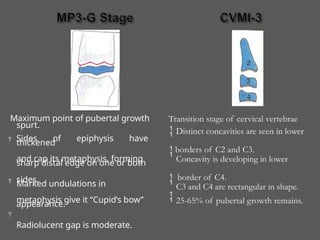
Maximum point of pubertal growth
spurt.
Sides of epiphysis have
thickened
and cap its metaphysis, forming
sharp distal edge on one or both
sides.
Marked undulations in
metaphysis give it “Cupid’s bow’’
appearance.
Radiolucent gap is moderate.



Transition stage of cervical vertebrae
 Distinct concavities are seen in lower
borders of C2 and C3.

Concavity is developing in lower
border of C4.

C3 and C4 are rectangular in shape.
 25-65% of pubertal growth remains.
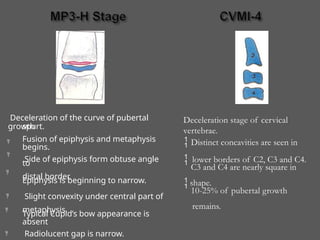
Deceleration of the curve of pubertal
growth
spurt.
Fusion of epiphysis and metaphysis
begins.
Side of epiphysis form obtuse angle
to
distal border.
Epiphysis is beginning to narrow.
Slight convexity under central part of
metaphysis.
Typical Cupid’s bow appearance is
absent
Radiolucent gap is narrow.






Deceleration stage of cervical
vertebrae.
 Distinct concavities are seen in
lower borders of C2, C3 and C4.

C3 and C4 are nearly square in
shape.

10-25% of pubertal growth
remains.
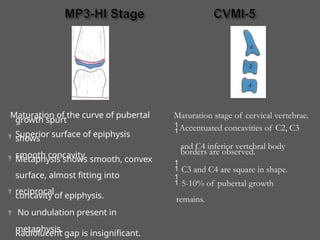
Maturation of the curve of pubertal
growth spurt
Superior surface of epiphysis
shows
smooth concavity.
Metaphysis shows smooth, convex
surface, almost fitting into
reciprocal
concavity of epiphysis.
No undulation present in
metaphysis.
Radiolucent gap is insignificant.




Maturation stage of cervical vertebrae.
Accentuated concavities of C2, C3
and C4 inferior vertebral body
borders are observed.
 C3 and C4 are square in shape.
 5-10% of pubertal growth
remains.
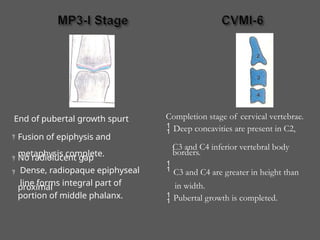
End of pubertal growth spurt
 Fusion of epiphysis and
metaphysis complete.
No radiolucent gap
Dense, radiopaque epiphyseal
line forms integral part of
proximal
portion of middle phalanx.



in width.
Pubertal growth is completed.
Completion stage of cervical vertebrae.
 Deep concavities are present in C2,
C3 and C4 inferior vertebral body
borders.
 C3 and C4 are greater in height than
Risser sign
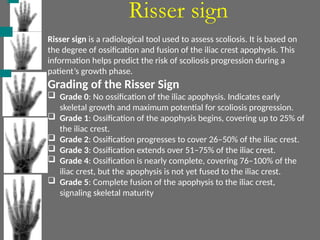
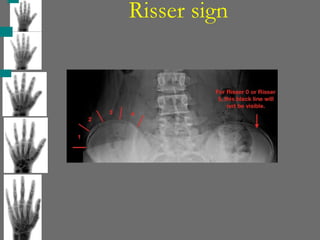
Risser sign is a radiological tool used to assess scoliosis. It is based on
the degree of ossification and fusion of the iliac crest apophysis. This
information helps predict the risk of scoliosis progression during a
patient’s growth phase.
Grading of the Risser Sign
 Grade 0: No ossification of the iliac apophysis. Indicates early
skeletal growth and maximum potential for scoliosis progression.
 Grade 1: Ossification of the apophysis begins, covering up to 25% of
the iliac crest.
 Grade 2: Ossification progresses to cover 26–50% of the iliac crest.
 Grade 3: Ossification extends over 51–75% of the iliac crest.
 Grade 4: Ossification is nearly complete, covering 76–100% of the
iliac crest, but the apophysis is not yet fused to the iliac crest.
 Grade 5: Complete fusion of the apophysis to the iliac crest,
signaling skeletal maturity
Risser sign
Risser sign
Clinical Importance:
The Risser sign is a key component in scoliosis
management, as it helps predict growth potential and the
risk of curve progression.
 Low Risser grades (0–2): Indicate active growth phases
with a higher risk of scoliosis progression.
 High Risser grades (3–5): Suggest reduced growth
potential and a lower risk of scoliosis worsening.
Limitations:
 Differences in Risser grading systems exist between the
U.S. and Europe, with slight variations in interpretation.
 Other methods like the Tanner staging and hand-wrist
radiographs may also be used for growth assessment in
conjunction with the Risser sign.
Dr Shalu Jain, Subharti Dental College, SVSU

SKELETALMATURITYINDICATORS GAVI copy.pptx

  • 1.
  • 2.
    Why study maturity indicators? Keyto successful treatment in growing patients – harnessing of growth.   Without exact status of growth – magnitude and direction- treatment planning is futile.
  • 3.
    Advantages of Maturity Indicators Potentialvector of facial development determined. Amount of significant craniofacial growth potential left. To decide the onset of treatment timing.   
  • 4.
    To evaluate treatment prognosis Tounderstand role of genetics and environment on skeletal maturation pattern.  
  • 5.
    Various Growth Assessment Methods     Chronologicage Secondary sexual characteristics Growth charts Dental development Skeletal maturation
  • 6.
    Age Expressed as:  Chronologicage Age measured by years lived since birth Dental age  Determined according to teeth erupted, amount of root resorption and amount of root formation. Skeletal age  Determined by ossification of various skeletal structures at different time.
  • 7.
  • 8.
    Skeletal Age Assessment Regions used for skeletal age assessment should be ideally:  Small to restrict radiation exposure  Should have many ossification centres that ossify at different times and which can be standardized  Easily accessible
  • 9.
    Regions Normally UsedFor Age Assessment Head and neck: Skull Cervical vertebrae Upper limb: Shoulder joint- scapula Elbow Hand wrist and fingers       
  • 10.
  • 11.
    Hand Wrist Radiographs Hand wrist – Numerous Small Bones  Predictable and scheduled pattern of appearance, ossification and union from birth to maturity  Most suited to study growth
  • 12.
    Anatomy Of HandWrist 1.Radius 2.Ulna 3.Distal epiphysis of radius 4.Distal epiphysis of ulna 5.Trapezium 6.Trapezoid 7.Capitate 8.Hamular process of hamate 9.Hamate 10.Triquetral 11.Pisiform 12.Lunate 13.Scaphoid 14.Sesamoid M = metacarpal Distal Row Carpal Proximal Row Carpal P = phalanx
  • 13.
    Stages of Ossificationof Phalanges 1.Epiphysis = Diaphysis 2.Epiphysis caps Diaphysis 3.Fusion of Epiphysis & Diaphysis 1 2 3
  • 14.
    Radiological Methods of Assessmentand Prediction of Growth      Greulich and Pyle method Singer’s method Fishman’s skeletal maturity indicators Bjork, Grave and Brown method Cervical Vertebrae Maturity Indicators Maturation assessment byHagg and Taranger and the KR (Kansal and Rajagopal) modified MP3
  • 15.
    GREULICH AND PYLEMETHOD    Published an atlas containing ideal photographs of hand wrist radiographs. Separate sets for male and female patients. Patients radiograph is matched in the atlas.
  • 16.
    SINGER’S METHOD FOR ASSESSMENT JulianSinger, 1980 ( ) Three (pubertal onset) STAGE One (early) Two (prepubertal) CHARACTERISTIC Absence of pisiform &hook of hamate. Epiphysis of proximal phalanx of second finger narrower than its diaphysis Initial ossification of hook of hamate & pisiform. Proximal phalanx of second finger equal to its epiphysis Beginning of calcification of ulnar sesamoid, increased width of epiphysis of proximal phalanx of second finger & increased calcification of hook of hamate & pisiform
  • 17.
    STAGE CHARACTERISTIC Four (pubertal) Calcified ulnarsesamoid. Capping of diaphysis of middle phalanx of third finger to epiphysis. Five (pubertal Calcified ulnar sesamoid. Fusion of deceleration) epiphysis of distal phalanx of third finger with its shaft. Epiphysis of radius & ulna not fully fused with respective shafts. No remaining sites seen. Six (growth completion) SINGER’S METHOD FOR ASSESSMENT
  • 18.
    Fishman’s Skeletal Maturity Indicators KeonordS Fishman, 1982  Used four anatomical sites on     Thumb Third finger Fifth finger Radius
  • 19.
    4 stages ofbone maturation: 1 2 3 4 Epiphysis equal in width to diaphysis Appearance of adductor sesamoid Capping of epiphysis Fusion of epiphysis Fishman’s Skeletal Maturity Indicators
  • 20.
    Eleven Discrete AdolescentSkeletal Maturity Indicators
  • 21.
    CERVICAL VERTEBRAE MATURITY INDICATORS(CVMI) Hassel & Farman different levels of skeletal development. Shapes of cervical vertebrae are different at
  • 22.
    Skeletal maturation evaluation usingcervical vertebrae  Six categories of CV maturation
  • 23.
    CVMI – 1:Initiation stage of cervical vertebrae 1. C2,C3 and C4 inferior vertebral body borders are flat Superior vertebral body borders are tapered from posterior to anterior (wedge shape) 2 3.80-100% of pubertal growth remains
  • 24.
    CVMI – 2:Acceleration stage of cervical vertebrae 1. Concavities are developing in lower borders of C2 and C3 Lower border of C4 vertebral body is flat C3 and C4 are more rectangular in shape 2. 3. 4.65-85% pubertal growth remains
  • 25.
    CVMI-3 Stage: Transitionstage of cervical vertebrae 1. Distinct concavities seen in lower borders of C2 and C3 Concavity is developing in lower border of C4 C3 and C4 are rectangular in shape 2. 3. 4.25-65% of pubertal growth remains
  • 26.
    CVMI- 4: Decelerationstage of cervical vertebrae 1. Distinct concavities seen in lower borders of C2, C3 and C4. C3 and C4 – nearly square in shape 2. 3.10 – 25% of pubertal growth spurt left.
  • 27.
    CVMI-5: Maturation stageof cervical vertebrae 1 Accentuated concavities of C2,C3 and C4 inferior vertebral borders C3 and C4 square in shape 2 3.5-10% pubertal growth remains
  • 28.
    CVMI-6: Completion stageof cervical vertebrae 1. Deep concavities present in C2, C3 and C4 inferior vertebral borders C3 and C4 greater in height than in width Pubertal growth complete 2. 3.
  • 29.
  • 30.
    Bjork, Grave andBrown Method One 10.6 8.1 9 stages of skeletal development. Scoph associated each of these stage to chronological age Stage Male Female age Characteristic age Equal epiphysis & diaphysis of middle phalanx of third finger
  • 31.
    Stage Male Female age Characteristic phalanxof third finger Two 12 age 8.1 Equal epiphysis & diaphysis of middle
  • 32.
    Stage Male age Female age Characteristic 1.Hamular processof hamate 2.Pisiform 3.Equal epiphysis & diaphysis of radius Three 12.6 9.6 3 areas of ossification: 1 2 3
  • 33.
    bone Stage Male FemaleCharacteristic Four age 13 age 10.6 Marks beginning of pubertal growth spurt. 1. Initial mineralizat i on of ulnar sesamoid of thumb Increased ossification of hamular process of hamate 2. 2 1
  • 34.
    Stage Male ageFemale age Characteristic Marks peak of pubertal growth spurt Capping of diaphysis by epiphysis seen in: Five 14 11 1. 2. 3. Middle phalanx of third finger Proximal phalanx of thumb Radius 1 2 3
  • 35.
    Stage Male FemaleCharacteristic age age Six 15 13 Marks end of pubertal growth spurt. Union between epiphysis and diaphysis of distal phalanx of third finger
  • 36.
    Stage Male FemaleCharacteristic age age Seven 15.9 13.3 Union between epiphysis and diaphysis of little finger
  • 37.
    Stage Male FemaleCharacteristic age age Eight 15.9 13.9 Union between epiphysis and diaphysis of middle phalanx of middle finger
  • 38.
    Stage Male age Nine 18.3 Female age 16 Characteristic Endof skeletal growth. Union between epiphysis and diaphysis of radius
  • 39.
    Hagg and Taranger method Hagg& Taranger  Analysed yearly hand wrist radiographs of individuals from age 6 to 18 years. Studied the ossification of the sesamoid (S), the middle and distal phalanges of the third finger (MP3 and DP3) and the distal epiphysis of the radius. 
  • 40.
    Five stages ofMP3 growth: F- onset of the curve of pubertal growth spurt FG-acceleration part of the curve of pubertal growth spurt. G- peak of the curve.     H-deceleration part of the curve of pubertal growth spurt I-end of the pubertal growth spurt. 
  • 41.
    Comparison between modified theMP3 indicators and CVMI described by Hassel and Farman.
  • 42.
    MP3-F Stage Start ofthe curve of pubertal growth spurt Epiphysis is as wide as metaphysis End of epiphysis are tapered and rounded. Radiolucent gap is wide between epiphysis & diaphysis.    80-100% of pubertal growth remains. Initiation stage of cervical vertebrae  C2,C3 and C4 inferior vertebral body borders are flat. Superior vertebral borders are tapered from   posterior to anterior [wedge shape] CVMI-1
  • 43.
    Acceleration of thecurve of pubertal growth spurt. Epiphysis is as wide as metaphysis. Distinct medial and/or lateral border of epiphysis forms line of demarcation at right angle to distal border. Metaphysis begins to show slight undulation. Radiolucent gap between metaphysis and epiphysis is wide.     Lower border of C4 vertebral body is flat. C3 and C4 are more rectangular in shape. 65-85% of pubertal growth remains. Acceleration stage of cervical vertebrae.  Concavities are developing in lower    borders of C2 and C3. MP3-FG Stage CVMI-2
  • 44.
    Maximum point ofpubertal growth spurt. Sides of epiphysis have thickened and cap its metaphysis, forming sharp distal edge on one or both sides. Marked undulations in metaphysis give it “Cupid’s bow’’ appearance. Radiolucent gap is moderate.    Transition stage of cervical vertebrae  Distinct concavities are seen in lower borders of C2 and C3.  Concavity is developing in lower border of C4.  C3 and C4 are rectangular in shape.  25-65% of pubertal growth remains.
  • 45.
    Deceleration of thecurve of pubertal growth spurt. Fusion of epiphysis and metaphysis begins. Side of epiphysis form obtuse angle to distal border. Epiphysis is beginning to narrow. Slight convexity under central part of metaphysis. Typical Cupid’s bow appearance is absent Radiolucent gap is narrow.       Deceleration stage of cervical vertebrae.  Distinct concavities are seen in lower borders of C2, C3 and C4.  C3 and C4 are nearly square in shape.  10-25% of pubertal growth remains.
  • 46.
    Maturation of thecurve of pubertal growth spurt Superior surface of epiphysis shows smooth concavity. Metaphysis shows smooth, convex surface, almost fitting into reciprocal concavity of epiphysis. No undulation present in metaphysis. Radiolucent gap is insignificant.     Maturation stage of cervical vertebrae. Accentuated concavities of C2, C3 and C4 inferior vertebral body borders are observed.  C3 and C4 are square in shape.  5-10% of pubertal growth remains.
  • 47.
    End of pubertalgrowth spurt  Fusion of epiphysis and metaphysis complete. No radiolucent gap Dense, radiopaque epiphyseal line forms integral part of proximal portion of middle phalanx.    in width. Pubertal growth is completed. Completion stage of cervical vertebrae.  Deep concavities are present in C2, C3 and C4 inferior vertebral body borders.  C3 and C4 are greater in height than
  • 48.
    Risser sign Risser signis a radiological tool used to assess scoliosis. It is based on the degree of ossification and fusion of the iliac crest apophysis. This information helps predict the risk of scoliosis progression during a patient’s growth phase. Grading of the Risser Sign  Grade 0: No ossification of the iliac apophysis. Indicates early skeletal growth and maximum potential for scoliosis progression.  Grade 1: Ossification of the apophysis begins, covering up to 25% of the iliac crest.  Grade 2: Ossification progresses to cover 26–50% of the iliac crest.  Grade 3: Ossification extends over 51–75% of the iliac crest.  Grade 4: Ossification is nearly complete, covering 76–100% of the iliac crest, but the apophysis is not yet fused to the iliac crest.  Grade 5: Complete fusion of the apophysis to the iliac crest, signaling skeletal maturity
  • 49.
  • 50.
    Risser sign Clinical Importance: TheRisser sign is a key component in scoliosis management, as it helps predict growth potential and the risk of curve progression.  Low Risser grades (0–2): Indicate active growth phases with a higher risk of scoliosis progression.  High Risser grades (3–5): Suggest reduced growth potential and a lower risk of scoliosis worsening. Limitations:  Differences in Risser grading systems exist between the U.S. and Europe, with slight variations in interpretation.  Other methods like the Tanner staging and hand-wrist radiographs may also be used for growth assessment in conjunction with the Risser sign.
  • 51.
    Dr Shalu Jain,Subharti Dental College, SVSU