Dr. Md. Kamal Abdullah
BDS, MS (Orthodontics)
Assistant Professor
Islami Bank Medical College Dental Unit, Rajshahi
SOFT TISSUE
MORPHOLOGY
& BEHAVIOR
SOFT TISSUE MORPHOLOGY & BEHAVIOR
In spite of heredity soft tissues acts as a mould and guide the
development of the dento-alveolar structures. The teeth lie in
a zone of balance between the soft tissues. These balance
maintain by certain forces-
1. Bucco-Lingual Forces
2. Mesio-distal Forces
3. Occlusal Forces
1. BUCCO-LINGUAL FORCES
The lips and cheeks provide buccal force and the tongue
provide the lingual force. They provide passive forces at rest
(Muscle tone) and active forces during function, like-
• Swallowing
• Mastication
• Speech
• Expression
2. MESIO-DISTAL FORCES
These forces are mainly exerted by adjacent teeth. Teeth also
have an inherent mesial force in addition to eruptive force.
3. OCCLUSAL FORCES
Provided by opposing teeth during occlusion.
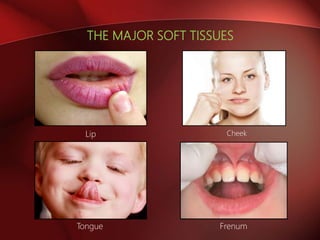
THE MAJOR SOFT TISSUES
Lip Cheek
Tongue Frenum
Variety of lip:
a. According to functional capacity:
i. Competent lip
ii. Incompetent lip
iii. Strap like lower lip
iv. Everted lip
b. According to tonicity [Feel the lip for consistency]:
i. Normal: Minimum consistency present.
ii. Hypertonic: Tends to be firm & redder
iii. Hypotonic: Lip is flaccid
c. According to expressive behavior:
i. Normal
ii. Over active
iii. Under active.
LIPS
LIPS Cont.
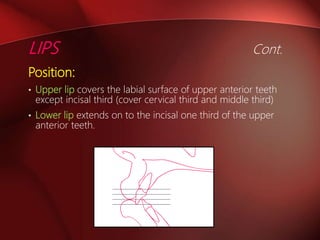
Position:
• Upper lip covers the labial surface of upper anterior teeth
except incisal third (cover cervical third and middle third)
• Lower lip extends on to the incisal one third of the upper
anterior teeth.
Habit:
Usually the lips touch each other lightly or there is interlabial
gap about 0-1 mm.
Lips may be
(a) Habitually together
(b) Habitually apart. Its due to-
• Nasal obstruction.
• Sometime no apparent cause.
LIPS Cont.
LIPS Cont.
Tooth-to-lip relationship
• For optimal esthetics, it is considered that-
- Approximately 2 to 4 mm of the maxillary central
incisors be uncovered by the upper lip at rest (in other words,
the upper lip should cover roughly 2/3 of the maxillary central
incisor crown length at rest).
LIPS Cont.
Tooth-to-lip relationship Cont…
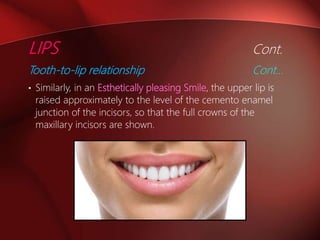
• Similarly, in an Esthetically pleasing Smile, the upper lip is
raised approximately to the level of the cemento enamel
junction of the incisors, so that the full crowns of the
maxillary incisors are shown.
LIPS Cont.
Tooth-to-lip relationship Cont…
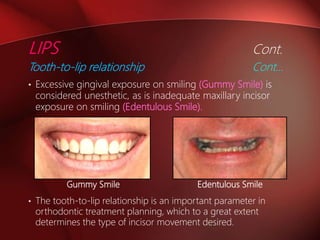
• Excessive gingival exposure on smiling (Gummy Smile) is
considered unesthetic, as is inadequate maxillary incisor
exposure on smiling (Edentulous Smile).
• The tooth-to-lip relationship is an important parameter in
orthodontic treatment planning, which to a great extent
determines the type of incisor movement desired.
Gummy Smile Edentulous Smile
LIPS Cont.
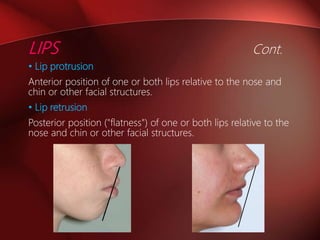
• Lip protrusion
Anterior position of one or both lips relative to the nose and
chin or other facial structures.
• Lip retrusion
Posterior position ("flatness") of one or both lips relative to the
nose and chin or other facial structures.
LIPS Cont.
Lips may be competent or Incompetent
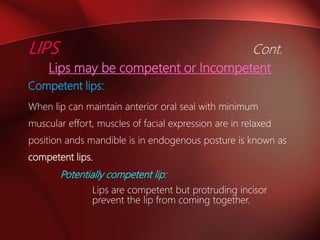
Competent lips:
When lip can maintain anterior oral seal with minimum
muscular effort, muscles of facial expression are in relaxed
position ands mandible is in endogenous posture is known as
competent lips.
Potentially competent lip:
Lips are competent but protruding incisor
prevent the lip from coming together.
Competent Lip
Potentially Competent Lip Incompetent Lip
LIPS Cont.
Competent lip morphology might have the following
behaviors:
1. Competent lip morphology with lips together.
2. Competent lip morphology with the lips habitually apart
(due to nasal obstruction or sometime with no apparent
cause.)
3. Lips are competent but protruding incisors prevent the lips
from coming together (potentially competent lips). In this
case, when the upper incisors are retroclined and overjet
reduced, that will produce anterior seal at rest position in
front of the incisors.
LIPS Cont.
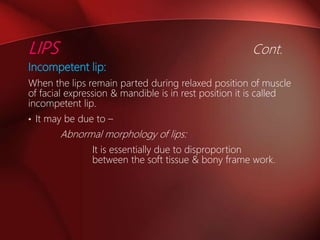
Incompetent lip:
When the lips remain parted during relaxed position of muscle
of facial expression & mandible is in rest position it is called
incompetent lip.
• It may be due to –
Abnormal morphology of lips:
It is essentially due to disproportion
between the soft tissue & bony frame work.
LIPS Cont.
Incompetent lip (Cont..)
Abnormal morphology which causes incompetent lip –
1. Lips may be abnormally short & thus inadequate to
maintain lip seal.
2. Lips may be normal size but there may increase vertical
distance between their attachment.
3. Because of increased horizontal distance between the lips
they cannot maintain a lip seal at rest.
Abnormal behavior of incompetent lip –
1. They may be habitually held together.
2. They may remain habitually apart.
LIPS Cont.
Effect of Incompetent lip:
1. Moderately incompetent lip – Contraction of the circumoral
muscles to maintain the lip seal → retro lining and crowding of
incisor teeth.
2. Sometimes incompetence is great – contraction of circumoral
muscle only, cannot maintain lip seal – Habit postures of lips,
tongue & mandible will take place to produce ant oral seal, this
posture is called “adoptive habit posture → produce
malrelationship of labial segment.
3. Severe incompetence – oral seal is produced by contact
between lower lip & tongue → procline the upper incisors.
• On a class II dental base the lower lip may lies completely behind
upper incisors – proclination of upper incisor and retroclination of
lower incisions also produce increased over jet & incomplete
overbite.
LIPS Cont.
Anterior oral seal:
• The instinctively and reflexly produced sealing off of the
anterior end of the digestive tract, is called the anterior oral
seal. It is instinctive for an individual to maintain an anterior
oral seal to allow nasal respiration and to prevent escape of
saliva.
• It will involve habit posture of lips when the lips are
incompetent, and habit posture of the mandible when the
incisor relationship is not normal.
LIPS Cont.
Adoptive habit postures:
The anterior oral seal is normally maintained by relaxed
position of lips (Competent Lip). But When lips are moderate
to severely incompetent Ant. oral seal is maintained by certain
contraction of circumoral muscle, habit posture of lip, tongue
and/or mandible in various combination and they function as
a integrated unit. These postures to maintain an anterior oral
seal is called Adoptive habit postures (Ballard 1962).
That means instinctively or reflexly they produce and
maintained posture in response to functional need. These
adoptive postures and behaviors may produce mal
relationship of the labial segments.
LIPS Cont.
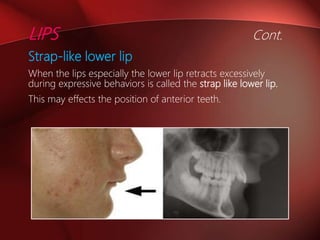
Strap-like lower lip
When the lips especially the lower lip retracts excessively
during expressive behaviors is called the strap like lower lip.
This may effects the position of anterior teeth.
LIPS Cont.
Strap-like lower lip (Cont..)
Etiology- It is due to defect in tissue morphology.
Behaviors of strap like lower lip.
i. it may low lip line.
ii. It may high lip line.
iii. It may retracts normally.
iv. It may retracts firmly.
Affected teeth-
Strap like lower lip usually affect the position of
anterior teeth.
LIPS Cont.
Strap-like lower lip (Cont..)
Effects:
i) Strap like lower lip with competent lips-
 Retroclination of upper teeth.
ii) Strap like lower lip with incompetent lips-
 Retroclination of lower teeth.
iii) When the active lower lip line is low and retracts
excessively-
 Retruded mandibular alveolar process.
 Protruded chin.
 Retroclination of lower incisors.
LIPS Cont.
Strap-like lower lip (Cont..)
Effects: (Cont…)
iv) When the lip is low and firmly retracting
 It will be produce class II div-I mal occlusion.
v) When the lip line is high and firmly reacting type-
 Incase of mild to moderate class-II dental base → It
may produce class-II div-II malocclusion.
 In sever class II dental base → It may produce class Ii
div-II I malocclusion.
LIPS Cont.
Everted lips
Lips are often full and everted.
Effects of everted lip- This type of lip morphology is commonly
associated with proclination of both the upper and lower labial
segments (Bimaxillary Proclination) and such proclination of
anterior segments are difficult to treat successfully.
• The cheek has moulding
effect on the buccal or
posterior teeth. [Lip has
moulding effect on
anterior teeth]
• These effect of cheek
(and lip) are counteracted
by the tongue.
CHEEK
CHEEK Cont.
Effects of cheek on occlusion:
When the tongue thrust forward during atypical swallowing &
give less support to the buccal teeth. These will cause
narrowness of the arch as the check pressure is not adequately
counteracted by the tongue. Similarly negative pressure is
created in the mouth during thumb sucking which may also
cause narrowness of the arches.
The size, position & behavior of tongue is important in
determining the shape & position of dental arch.
Size:
Macroglossia: (Large tongue)
A large tongue that is positioned forward due to any
functional need (speech, swallowing etc) causes proclination of
both upper & lower anterior teeth that is bimaxillary proclination
with spacing.
Microglossia:
A small tongue backwardly placed, give less pressure than
lip cheek, causes narrowing of arch ultimately result cross bite.
TONGUE
TONGUE Cont.
Position:
• Normal position-Tongue rest at the occlusal level with in the
arches, dorsum touching the palate & the tip of the tongue
rest against the lingual surface of the anterior incisor teeth.
• If the tongue is held very high in the roof of the mouth may
produce wide upper arch & a narrow lower arch causing
cross bite.
TONGUE Cont.
Abnormal posture:
– Retracted posture is seen in less than 10% of the children. It is
frequently present in the edentulous patient.
– Protracted tongue posture: This is retention of the infantile
postural pattern. There is neither known cause nor treatment
for this condition.
– Protracted tongue posture: This is due to tonsillitis or
pharyngitis & it can be corrected easily.
TONGUE Cont.
Two posture of tongue have been described by Ballard-
– The resting or relax posture.
– The habit or adaptive posture.
 In relax posture: (Which may be noted by breaking
anterior oral seal.)
• Position: Tongue lies on the floor mouth.
• At this stage, tongue tends to produce a posterior oral
seal by its contact with soft palate.
 The habit or adaptive posture: The tongue assumes a
forward position in contact with the incisor & the cheek
teeth to produce or reinforce anterior oral seal.
TONGUE Cont.
Tongue thrust: Definition: Tongue thrust & the abnormal oral
habit to thrust the tongue forward to enter the space between
upper & lower incisor.
TONGUE Cont.
Type: 2 types-
1. Endogenous tongue thrust:
• It is an inherited atypical pattern of tongue movement due
to neuromuscular activity.
• Its control is very difficult due to its strong intensity
• It is often associated with abnormality of speech.
2. Adaptive tongue thrust:
• It is a less vigorous tongue thrust, mild intensity associated
with functional need.
• It helps to maintain anterior oral seal in case of skeletal
pattern class ii & incompetent lip posture.
TONGUE Cont.
Effect of tongue thrust:
i. Reduced over bite
ii. Incomplete over bite.
iii. Open bite-
a) Anterior open bite
b) Posterior open bite.
iv. Narrowing of upper arch.
v. Increase over jet.
vi. Bi maxillary proclination.
vii. Spacing of the tooth.
viii. Cross bite-
a) Anterior cross bite
b) Posterior cross bite.
ix. Disproportion of dental base.
TONGUE Cont.
Treatment:
1. Tongue guard to prevent tongue thrust.
2. Habit practice.
3. Appliance to correct the proclination
4. Appliance to correct any other malocclusion.
Fig: Fixed Tongue Guard
Fig: Removable
Tongue Guard
Number: 7 in number.
A. 3 in upper jaw
• 1 labial
• 2 buccal
B. 4 in lower jaw
• 1 labial
• 2 buccal
• 1 lingual.
FRENUM
Upper Labial Frenum
Lingual FrenumLower Labial Frenum
FRENUM Cont.
ABNORMAL LABIAL FRENUM
Abnormal labial frenum is commonly seen in upper arch. It
has the following Characteristic feature:
i. Frenum is thick wide & fleshy than normal.
ii. It passes between the central incisions to run in to the
incisive papilla from the lip.
iii. The palatal mucosa blanches on lifting the upper lip.
 Radio graphically – A ‘V’ shaped notch can be seen in the
crest of the alveolus, which indicates persistence of fibrous
tissue in inter-premaxillary suture seen as a dark line.
FRENUM Cont.
ABNORMAL LABIAL FRENUM (Cont…)
Effects:
• Median diastema (rarely) associated with – crowding in ant
segment that is in region.
• Aesthetically ugly.
Treatment:
• Wait for the eruption of upper lateral incisors & canine – in
most cases the diastema will close when these teeth erupt.
• If diastema remains → it is due to abnormal frenum then
frenum is removed (Frenectomy) together the fibrous tissue
of the inter-maxillary suture.
FRENUM Cont.
Lower lingual frenum:
Normal:
Asking the patient to protrude the tongue, the patient is
able to protrude.
Abnormal:
Asking the patient to protrude the tongue, the patient is
unable to protrude it is called tongue tie or ankyloglossia.
Rx of ankyloglossia – Surgery (Lingual Frenectomy).
Soft tissue morphology

Soft tissue morphology

  • 1.
    Dr. Md. KamalAbdullah BDS, MS (Orthodontics) Assistant Professor Islami Bank Medical College Dental Unit, Rajshahi SOFT TISSUE MORPHOLOGY & BEHAVIOR
  • 2.
    SOFT TISSUE MORPHOLOGY& BEHAVIOR In spite of heredity soft tissues acts as a mould and guide the development of the dento-alveolar structures. The teeth lie in a zone of balance between the soft tissues. These balance maintain by certain forces- 1. Bucco-Lingual Forces 2. Mesio-distal Forces 3. Occlusal Forces
  • 3.
    1. BUCCO-LINGUAL FORCES Thelips and cheeks provide buccal force and the tongue provide the lingual force. They provide passive forces at rest (Muscle tone) and active forces during function, like- • Swallowing • Mastication • Speech • Expression
  • 4.
    2. MESIO-DISTAL FORCES Theseforces are mainly exerted by adjacent teeth. Teeth also have an inherent mesial force in addition to eruptive force. 3. OCCLUSAL FORCES Provided by opposing teeth during occlusion.
  • 5.
    THE MAJOR SOFTTISSUES Lip Cheek Tongue Frenum
  • 6.
    Variety of lip: a.According to functional capacity: i. Competent lip ii. Incompetent lip iii. Strap like lower lip iv. Everted lip b. According to tonicity [Feel the lip for consistency]: i. Normal: Minimum consistency present. ii. Hypertonic: Tends to be firm & redder iii. Hypotonic: Lip is flaccid c. According to expressive behavior: i. Normal ii. Over active iii. Under active. LIPS
  • 7.
    LIPS Cont. Position: • Upperlip covers the labial surface of upper anterior teeth except incisal third (cover cervical third and middle third) • Lower lip extends on to the incisal one third of the upper anterior teeth.
  • 8.
    Habit: Usually the lipstouch each other lightly or there is interlabial gap about 0-1 mm. Lips may be (a) Habitually together (b) Habitually apart. Its due to- • Nasal obstruction. • Sometime no apparent cause. LIPS Cont.
  • 9.
    LIPS Cont. Tooth-to-lip relationship •For optimal esthetics, it is considered that- - Approximately 2 to 4 mm of the maxillary central incisors be uncovered by the upper lip at rest (in other words, the upper lip should cover roughly 2/3 of the maxillary central incisor crown length at rest).
  • 10.
    LIPS Cont. Tooth-to-lip relationshipCont… • Similarly, in an Esthetically pleasing Smile, the upper lip is raised approximately to the level of the cemento enamel junction of the incisors, so that the full crowns of the maxillary incisors are shown.
  • 11.
    LIPS Cont. Tooth-to-lip relationshipCont… • Excessive gingival exposure on smiling (Gummy Smile) is considered unesthetic, as is inadequate maxillary incisor exposure on smiling (Edentulous Smile). • The tooth-to-lip relationship is an important parameter in orthodontic treatment planning, which to a great extent determines the type of incisor movement desired. Gummy Smile Edentulous Smile
  • 12.
    LIPS Cont. • Lipprotrusion Anterior position of one or both lips relative to the nose and chin or other facial structures. • Lip retrusion Posterior position ("flatness") of one or both lips relative to the nose and chin or other facial structures.
  • 13.
    LIPS Cont. Lips maybe competent or Incompetent Competent lips: When lip can maintain anterior oral seal with minimum muscular effort, muscles of facial expression are in relaxed position ands mandible is in endogenous posture is known as competent lips. Potentially competent lip: Lips are competent but protruding incisor prevent the lip from coming together.
  • 14.
  • 15.
    LIPS Cont. Competent lipmorphology might have the following behaviors: 1. Competent lip morphology with lips together. 2. Competent lip morphology with the lips habitually apart (due to nasal obstruction or sometime with no apparent cause.) 3. Lips are competent but protruding incisors prevent the lips from coming together (potentially competent lips). In this case, when the upper incisors are retroclined and overjet reduced, that will produce anterior seal at rest position in front of the incisors.
  • 16.
    LIPS Cont. Incompetent lip: Whenthe lips remain parted during relaxed position of muscle of facial expression & mandible is in rest position it is called incompetent lip. • It may be due to – Abnormal morphology of lips: It is essentially due to disproportion between the soft tissue & bony frame work.
  • 17.
    LIPS Cont. Incompetent lip(Cont..) Abnormal morphology which causes incompetent lip – 1. Lips may be abnormally short & thus inadequate to maintain lip seal. 2. Lips may be normal size but there may increase vertical distance between their attachment. 3. Because of increased horizontal distance between the lips they cannot maintain a lip seal at rest. Abnormal behavior of incompetent lip – 1. They may be habitually held together. 2. They may remain habitually apart.
  • 18.
    LIPS Cont. Effect ofIncompetent lip: 1. Moderately incompetent lip – Contraction of the circumoral muscles to maintain the lip seal → retro lining and crowding of incisor teeth. 2. Sometimes incompetence is great – contraction of circumoral muscle only, cannot maintain lip seal – Habit postures of lips, tongue & mandible will take place to produce ant oral seal, this posture is called “adoptive habit posture → produce malrelationship of labial segment. 3. Severe incompetence – oral seal is produced by contact between lower lip & tongue → procline the upper incisors. • On a class II dental base the lower lip may lies completely behind upper incisors – proclination of upper incisor and retroclination of lower incisions also produce increased over jet & incomplete overbite.
  • 19.
    LIPS Cont. Anterior oralseal: • The instinctively and reflexly produced sealing off of the anterior end of the digestive tract, is called the anterior oral seal. It is instinctive for an individual to maintain an anterior oral seal to allow nasal respiration and to prevent escape of saliva. • It will involve habit posture of lips when the lips are incompetent, and habit posture of the mandible when the incisor relationship is not normal.
  • 20.
    LIPS Cont. Adoptive habitpostures: The anterior oral seal is normally maintained by relaxed position of lips (Competent Lip). But When lips are moderate to severely incompetent Ant. oral seal is maintained by certain contraction of circumoral muscle, habit posture of lip, tongue and/or mandible in various combination and they function as a integrated unit. These postures to maintain an anterior oral seal is called Adoptive habit postures (Ballard 1962). That means instinctively or reflexly they produce and maintained posture in response to functional need. These adoptive postures and behaviors may produce mal relationship of the labial segments.
  • 21.
    LIPS Cont. Strap-like lowerlip When the lips especially the lower lip retracts excessively during expressive behaviors is called the strap like lower lip. This may effects the position of anterior teeth.
  • 22.
    LIPS Cont. Strap-like lowerlip (Cont..) Etiology- It is due to defect in tissue morphology. Behaviors of strap like lower lip. i. it may low lip line. ii. It may high lip line. iii. It may retracts normally. iv. It may retracts firmly. Affected teeth- Strap like lower lip usually affect the position of anterior teeth.
  • 23.
    LIPS Cont. Strap-like lowerlip (Cont..) Effects: i) Strap like lower lip with competent lips-  Retroclination of upper teeth. ii) Strap like lower lip with incompetent lips-  Retroclination of lower teeth. iii) When the active lower lip line is low and retracts excessively-  Retruded mandibular alveolar process.  Protruded chin.  Retroclination of lower incisors.
  • 24.
    LIPS Cont. Strap-like lowerlip (Cont..) Effects: (Cont…) iv) When the lip is low and firmly retracting  It will be produce class II div-I mal occlusion. v) When the lip line is high and firmly reacting type-  Incase of mild to moderate class-II dental base → It may produce class-II div-II malocclusion.  In sever class II dental base → It may produce class Ii div-II I malocclusion.
  • 25.
    LIPS Cont. Everted lips Lipsare often full and everted. Effects of everted lip- This type of lip morphology is commonly associated with proclination of both the upper and lower labial segments (Bimaxillary Proclination) and such proclination of anterior segments are difficult to treat successfully.
  • 26.
    • The cheekhas moulding effect on the buccal or posterior teeth. [Lip has moulding effect on anterior teeth] • These effect of cheek (and lip) are counteracted by the tongue. CHEEK
  • 27.
    CHEEK Cont. Effects ofcheek on occlusion: When the tongue thrust forward during atypical swallowing & give less support to the buccal teeth. These will cause narrowness of the arch as the check pressure is not adequately counteracted by the tongue. Similarly negative pressure is created in the mouth during thumb sucking which may also cause narrowness of the arches.
  • 28.
    The size, position& behavior of tongue is important in determining the shape & position of dental arch. Size: Macroglossia: (Large tongue) A large tongue that is positioned forward due to any functional need (speech, swallowing etc) causes proclination of both upper & lower anterior teeth that is bimaxillary proclination with spacing. Microglossia: A small tongue backwardly placed, give less pressure than lip cheek, causes narrowing of arch ultimately result cross bite. TONGUE
  • 29.
    TONGUE Cont. Position: • Normalposition-Tongue rest at the occlusal level with in the arches, dorsum touching the palate & the tip of the tongue rest against the lingual surface of the anterior incisor teeth. • If the tongue is held very high in the roof of the mouth may produce wide upper arch & a narrow lower arch causing cross bite.
  • 30.
    TONGUE Cont. Abnormal posture: –Retracted posture is seen in less than 10% of the children. It is frequently present in the edentulous patient. – Protracted tongue posture: This is retention of the infantile postural pattern. There is neither known cause nor treatment for this condition. – Protracted tongue posture: This is due to tonsillitis or pharyngitis & it can be corrected easily.
  • 31.
    TONGUE Cont. Two postureof tongue have been described by Ballard- – The resting or relax posture. – The habit or adaptive posture.  In relax posture: (Which may be noted by breaking anterior oral seal.) • Position: Tongue lies on the floor mouth. • At this stage, tongue tends to produce a posterior oral seal by its contact with soft palate.  The habit or adaptive posture: The tongue assumes a forward position in contact with the incisor & the cheek teeth to produce or reinforce anterior oral seal.
  • 32.
    TONGUE Cont. Tongue thrust:Definition: Tongue thrust & the abnormal oral habit to thrust the tongue forward to enter the space between upper & lower incisor.
  • 33.
    TONGUE Cont. Type: 2types- 1. Endogenous tongue thrust: • It is an inherited atypical pattern of tongue movement due to neuromuscular activity. • Its control is very difficult due to its strong intensity • It is often associated with abnormality of speech. 2. Adaptive tongue thrust: • It is a less vigorous tongue thrust, mild intensity associated with functional need. • It helps to maintain anterior oral seal in case of skeletal pattern class ii & incompetent lip posture.
  • 34.
    TONGUE Cont. Effect oftongue thrust: i. Reduced over bite ii. Incomplete over bite. iii. Open bite- a) Anterior open bite b) Posterior open bite. iv. Narrowing of upper arch. v. Increase over jet. vi. Bi maxillary proclination. vii. Spacing of the tooth. viii. Cross bite- a) Anterior cross bite b) Posterior cross bite. ix. Disproportion of dental base.
  • 35.
    TONGUE Cont. Treatment: 1. Tongueguard to prevent tongue thrust. 2. Habit practice. 3. Appliance to correct the proclination 4. Appliance to correct any other malocclusion. Fig: Fixed Tongue Guard Fig: Removable Tongue Guard
  • 36.
    Number: 7 innumber. A. 3 in upper jaw • 1 labial • 2 buccal B. 4 in lower jaw • 1 labial • 2 buccal • 1 lingual. FRENUM Upper Labial Frenum Lingual FrenumLower Labial Frenum
  • 37.
    FRENUM Cont. ABNORMAL LABIALFRENUM Abnormal labial frenum is commonly seen in upper arch. It has the following Characteristic feature: i. Frenum is thick wide & fleshy than normal. ii. It passes between the central incisions to run in to the incisive papilla from the lip. iii. The palatal mucosa blanches on lifting the upper lip.  Radio graphically – A ‘V’ shaped notch can be seen in the crest of the alveolus, which indicates persistence of fibrous tissue in inter-premaxillary suture seen as a dark line.
  • 38.
    FRENUM Cont. ABNORMAL LABIALFRENUM (Cont…) Effects: • Median diastema (rarely) associated with – crowding in ant segment that is in region. • Aesthetically ugly. Treatment: • Wait for the eruption of upper lateral incisors & canine – in most cases the diastema will close when these teeth erupt. • If diastema remains → it is due to abnormal frenum then frenum is removed (Frenectomy) together the fibrous tissue of the inter-maxillary suture.
  • 40.
    FRENUM Cont. Lower lingualfrenum: Normal: Asking the patient to protrude the tongue, the patient is able to protrude. Abnormal: Asking the patient to protrude the tongue, the patient is unable to protrude it is called tongue tie or ankyloglossia. Rx of ankyloglossia – Surgery (Lingual Frenectomy).