Faculty-Librarian
par tnership in
infor mation a ge

                      Sudesh Kumar Sood
   Sr. College Librarian(SG), Govt. P.G. College, Una (H.P.)

                               &

                    Sudhir Kumar Gupta
     Asstt. Librarian (SG), UHF, Nauni, Distt. Solan (H.P.)
Abstract
The era of the library as a quiet, orderly repository for
scholarly knowledge is gone. It has morphed into a more
comprehensive institution, the "teaching library." In addition
to tradition, many college librarians have become more
active and involved in instruction. Librarians and teaching
faculty have many mutual goals and concerns.
Unfortunately, not everyone has embraced the idea of the
teaching library and faculty-librarian partnership. Faculty-
librarian collaboration can yield many creative projects that
enhance instruction. Faculty-librarian collaboration is a
relatively new educational trend but, with practice and
demonstrations of success, it will become tradition.
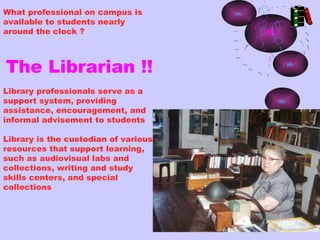
What professional on campus is
available to students nearly
around the clock ?


The Librarian !!
Library professionals serve as a
support system, providing
assistance, encouragement, and
informal advisement to students

Library is the custodian of various
resources that support learning,
such as audiovisual labs and
collections, writing and study
skills centers, and special
collections
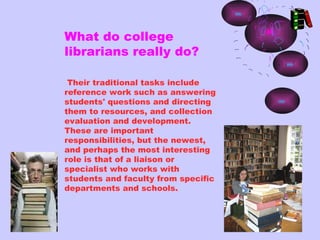
What do college
librarians really do?

 Their traditional tasks include
reference work such as answering
students' questions and directing
them to resources, and collection
evaluation and development.
These are important
responsibilities, but the newest,
and perhaps the most interesting
role is that of a liaison or
specialist who works with
students and faculty from specific
departments and schools.
Why is faculty-librarian
collaboration
worthwhile?
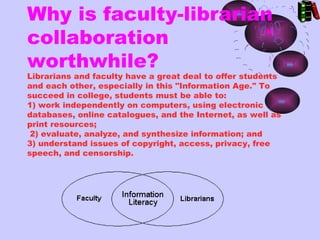
Librarians and faculty have a great deal to offer students
and each other, especially in this "Information Age." To
succeed in college, students must be able to:
1) work independently on computers, using electronic
databases, online catalogues, and the Internet, as well as
print resources;
 2) evaluate, analyze, and synthesize information; and
3) understand issues of copyright, access, privacy, free
speech, and censorship.
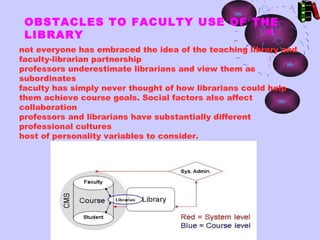
OBSTACLES TO FACULTY USE OF THE
 LIBRARY
not everyone has embraced the idea of the teaching library and
faculty-librarian partnership
professors underestimate librarians and view them as
subordinates
faculty has simply never thought of how librarians could help
them achieve course goals. Social factors also affect
collaboration
professors and librarians have substantially different
professional cultures
host of personality variables to consider.
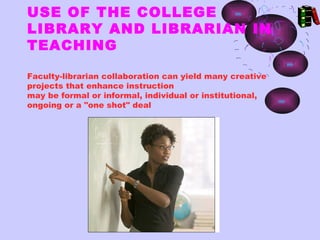
USE OF THE COLLEGE
LIBRARY AND LIBRARIAN IN
TEACHING

Faculty-librarian collaboration can yield many creative
projects that enhance instruction
may be formal or informal, individual or institutional,
ongoing or a "one shot" deal
 
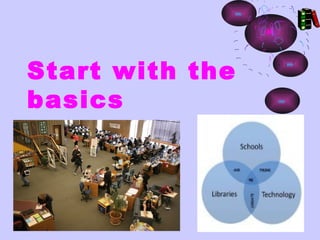
Start with the
basics
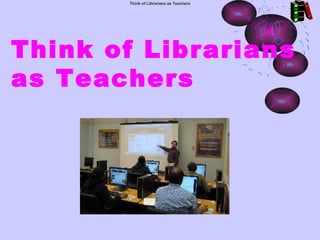
Think of Librarians as Teachers


Think of Librarians
as Teachers
Librarians Are
Indispensable for
Independent Research
Projects
Use Librarians to Help
Students Select
Research Topics 
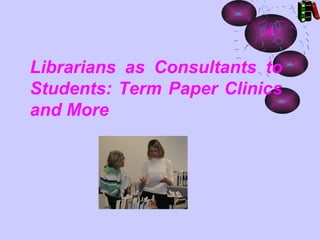
Librarians as Consultants to
Students: Term Paper Clinics
and More
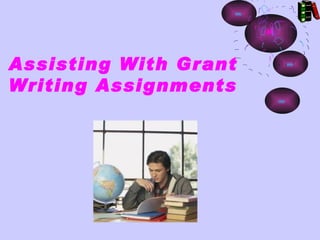
Assisting With Grant
Writing Assignments
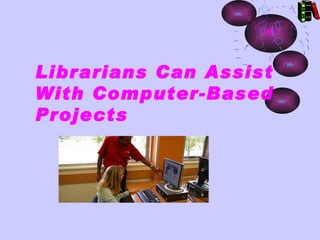
Librarians Can Assist
With Computer-Based
Projects
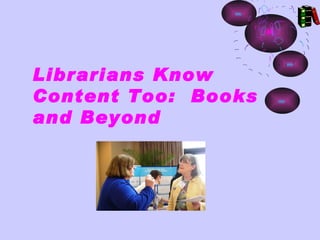
Librarians Know
Content Too: Books
and Beyond
COLLEGE-WIDE
 COLLABORATIVE TEACHING
Evaluate Your Work With Librarians Regularly: Are
Your Students Learning What You Had Hoped?
 faculty-librarian collaboration should be evaluated
frequently and revised as needed
 any evaluation is likely to strengthen the growing belief
that students can benefit greatly from the collective
expertise of professors and librarians
potential is tremendous when requests, comments, and
suggestions flow freely between these professionals.
Faculty-librarian collaboration is a relatively new
educational trend but, with practice and demonstrations of
success, it will become tradition.
CONCLUSION
Higher education is presently subject to a period of substantial
change. The needs of the economy and workforce, together with
the broader educational role of the college, are leading to focus on
lifelong learning as a tool for bringing together the apparently
diverging needs of different groups. Within this broader context, the
emphasis on lifelong learning and associated capabilities is leading
to opportunities’ for newer partnerships between faculty and
librarians, partnership that brings the two groups together in ways
that are helpful to transform the experience of teaching and
learning. This paper has explored emerging partnership in diverse
areas. Although they in the early phases of development and result
from a broad focus on the learning and information literacy needs of
the students, as opposed to a narrow focus on using the library and
its information resources. Taken together, and viewed from a
system-wide perspective, these partnerships reveal a complex
dynamic, that is deserving of wider attention across the Indian
education scenario and internationally.
REFERENCES

     Christensen, P. G. (1994). Using English department library liaisons in a term paper clinic:
Reviving the scholar/librarian model.Research Strategies, 12, 196-208.

Fister, B. (June 14, 2002). Fear of reference. The Chronicle of Higher Education, p. B 20.
Hardesty, L. (1995). Faculty culture and bibliographic instruction: An exploratory analysis. Library
Trends, 44, 339-367.

Murry, Jr., J. W., McKee, E. C., & Hammons, J. O. (1997). Faculty and librarian collaboration: The
road to information literacy for graduate students. Journal on Excellence in College Teaching, 8,
107-121.

Raspa, D., & Ward, D. (Eds.). (2000). The collaborative imperative: Librarians and faculty working
together in the information universe. Chicago: Association of College and Research Libraries

Roth, L. (1999). Educating the cut-and-paste generation. Library Journal, 124, 42-44.

Scott, W. (2000). Engelond: A model for faculty-librarian collaboration in the information
age. Information Technology and Librarians, 19 (1), 34-41.

Stamatopolos, A. (2000). An integrated approach to teaching research in a first-year
seminar. College Teaching, 48 (1), 33-35.

Stein, L. L., & Lamb, J. M. (1998). Not just another BI: Faculty-librarian collaboration to guide
students through the research process.Research Strategies, 16, 29-39.

Stocker, R. L. Class experience on credibility ranking of information sources. Retrieved July 26,
2002 from Indiana University-Purdue University Library Web site: 
http://www-lib.iupui.edu/itt/stocker.html.
Any Questions for me…??
Thank You!!
             धनयवाद


6/13/11

Faculty librarian partnership-in_information_age

  • 1.
    Faculty-Librarian par tnership in information a ge Sudesh Kumar Sood Sr. College Librarian(SG), Govt. P.G. College, Una (H.P.) & Sudhir Kumar Gupta Asstt. Librarian (SG), UHF, Nauni, Distt. Solan (H.P.)
  • 2.
    Abstract The era ofthe library as a quiet, orderly repository for scholarly knowledge is gone. It has morphed into a more comprehensive institution, the "teaching library." In addition to tradition, many college librarians have become more active and involved in instruction. Librarians and teaching faculty have many mutual goals and concerns. Unfortunately, not everyone has embraced the idea of the teaching library and faculty-librarian partnership. Faculty- librarian collaboration can yield many creative projects that enhance instruction. Faculty-librarian collaboration is a relatively new educational trend but, with practice and demonstrations of success, it will become tradition.
  • 3.
    What professional oncampus is available to students nearly around the clock ? The Librarian !! Library professionals serve as a support system, providing assistance, encouragement, and informal advisement to students Library is the custodian of various resources that support learning, such as audiovisual labs and collections, writing and study skills centers, and special collections
  • 4.
    What do college librariansreally do? Their traditional tasks include reference work such as answering students' questions and directing them to resources, and collection evaluation and development. These are important responsibilities, but the newest, and perhaps the most interesting role is that of a liaison or specialist who works with students and faculty from specific departments and schools.
  • 5.
    Why is faculty-librarian collaboration worthwhile? Librariansand faculty have a great deal to offer students and each other, especially in this "Information Age." To succeed in college, students must be able to: 1) work independently on computers, using electronic databases, online catalogues, and the Internet, as well as print resources; 2) evaluate, analyze, and synthesize information; and 3) understand issues of copyright, access, privacy, free speech, and censorship.
  • 6.
    OBSTACLES TO FACULTYUSE OF THE LIBRARY not everyone has embraced the idea of the teaching library and faculty-librarian partnership professors underestimate librarians and view them as subordinates faculty has simply never thought of how librarians could help them achieve course goals. Social factors also affect collaboration professors and librarians have substantially different professional cultures host of personality variables to consider.
  • 7.
    USE OF THECOLLEGE LIBRARY AND LIBRARIAN IN TEACHING Faculty-librarian collaboration can yield many creative projects that enhance instruction may be formal or informal, individual or institutional, ongoing or a "one shot" deal  
  • 8.
  • 9.
    Think of Librariansas Teachers Think of Librarians as Teachers
  • 10.
  • 11.
    Use Librarians toHelp Students Select Research Topics 
  • 12.
    Librarians as Consultantsto Students: Term Paper Clinics and More
  • 13.
  • 14.
    Librarians Can Assist WithComputer-Based Projects
  • 15.
  • 16.
    COLLEGE-WIDE COLLABORATIVE TEACHING EvaluateYour Work With Librarians Regularly: Are Your Students Learning What You Had Hoped? faculty-librarian collaboration should be evaluated frequently and revised as needed any evaluation is likely to strengthen the growing belief that students can benefit greatly from the collective expertise of professors and librarians potential is tremendous when requests, comments, and suggestions flow freely between these professionals. Faculty-librarian collaboration is a relatively new educational trend but, with practice and demonstrations of success, it will become tradition.
  • 17.
    CONCLUSION Higher education ispresently subject to a period of substantial change. The needs of the economy and workforce, together with the broader educational role of the college, are leading to focus on lifelong learning as a tool for bringing together the apparently diverging needs of different groups. Within this broader context, the emphasis on lifelong learning and associated capabilities is leading to opportunities’ for newer partnerships between faculty and librarians, partnership that brings the two groups together in ways that are helpful to transform the experience of teaching and learning. This paper has explored emerging partnership in diverse areas. Although they in the early phases of development and result from a broad focus on the learning and information literacy needs of the students, as opposed to a narrow focus on using the library and its information resources. Taken together, and viewed from a system-wide perspective, these partnerships reveal a complex dynamic, that is deserving of wider attention across the Indian education scenario and internationally.
  • 18.
    REFERENCES Christensen, P. G. (1994). Using English department library liaisons in a term paper clinic: Reviving the scholar/librarian model.Research Strategies, 12, 196-208. Fister, B. (June 14, 2002). Fear of reference. The Chronicle of Higher Education, p. B 20. Hardesty, L. (1995). Faculty culture and bibliographic instruction: An exploratory analysis. Library Trends, 44, 339-367. Murry, Jr., J. W., McKee, E. C., & Hammons, J. O. (1997). Faculty and librarian collaboration: The road to information literacy for graduate students. Journal on Excellence in College Teaching, 8, 107-121. Raspa, D., & Ward, D. (Eds.). (2000). The collaborative imperative: Librarians and faculty working together in the information universe. Chicago: Association of College and Research Libraries Roth, L. (1999). Educating the cut-and-paste generation. Library Journal, 124, 42-44. Scott, W. (2000). Engelond: A model for faculty-librarian collaboration in the information age. Information Technology and Librarians, 19 (1), 34-41. Stamatopolos, A. (2000). An integrated approach to teaching research in a first-year seminar. College Teaching, 48 (1), 33-35. Stein, L. L., & Lamb, J. M. (1998). Not just another BI: Faculty-librarian collaboration to guide students through the research process.Research Strategies, 16, 29-39. Stocker, R. L. Class experience on credibility ranking of information sources. Retrieved July 26, 2002 from Indiana University-Purdue University Library Web site:  http://www-lib.iupui.edu/itt/stocker.html.
  • 19.
  • 20.
    Thank You!! धनयवाद 6/13/11