
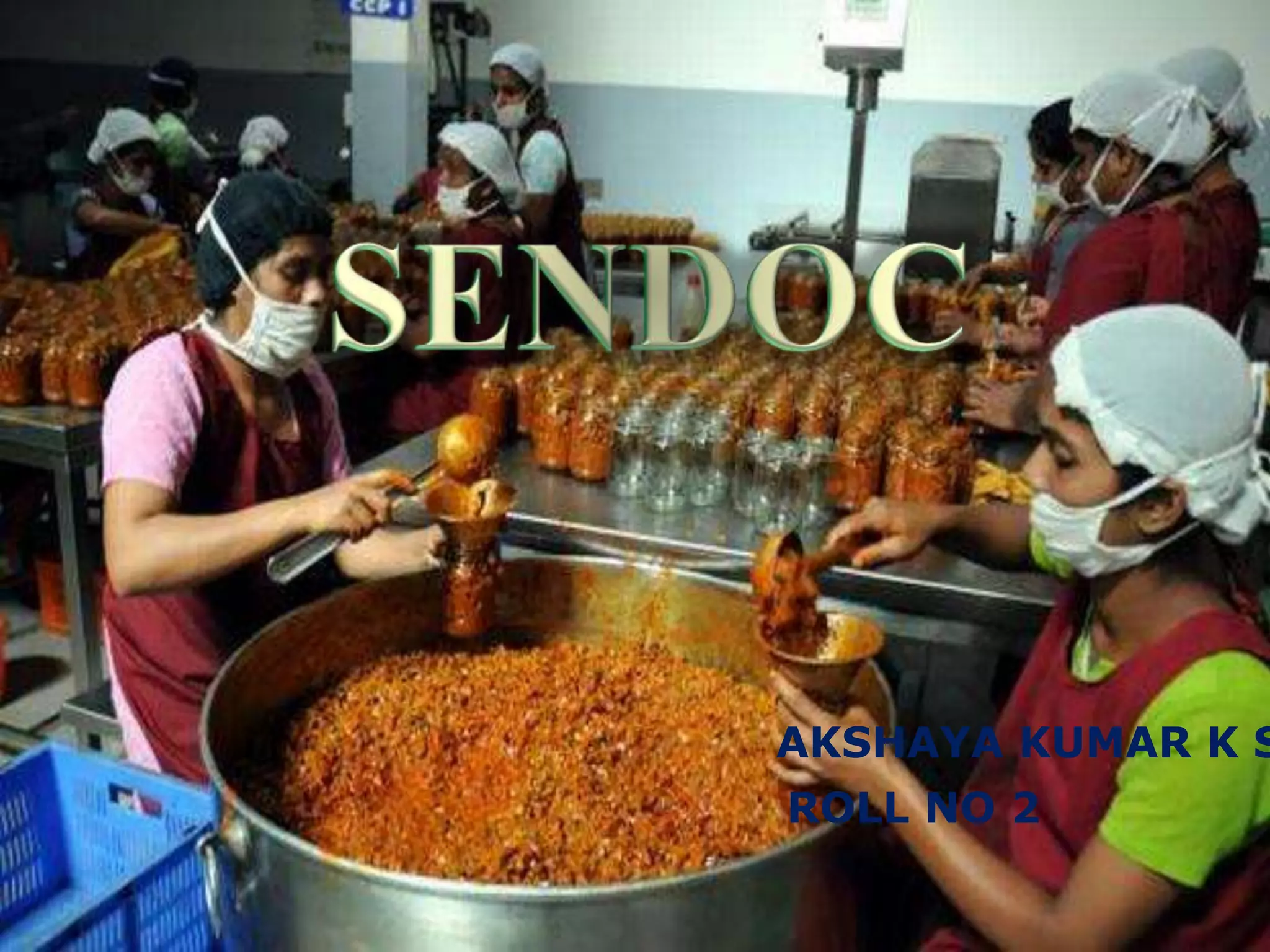


AKSHAYA KUMAR K S
ROLL NO 2
INTRODUCTION
A country’s economic growth is increasingly
dependent on the tempo of scientific research and
on the ability to apply the results of that research
rapidly and Completely to production .The
development of scientific documentation and
information centre and services is a necessity.
DOCUMENTATION
Paul Otlet
The specific activity of gathering,
processing, storing, retrieving and
circulating documents.
E. Hymansas
The collecting, arranging and
disseminating of all manner of
data.
DOCUMENTATION CENTER
Organisation that concerns with
selection, acquisition, processing,
storage and retrieval of specific
documents in response to users
request
Small Enterprises National
Documentation Centre
(SENDOC)
• The Small Enterprises National
Documentation Centre (SENDOC) is
set up to energies MSMEs in India
and the developing countries around
the world with information and
knowledge
• It functions as a clearing house of
information both for entrepreneurs
and extension agents.
• The Micro Small And Medium Enterprises
Development Act, 2006
• MSMED Act was established to provide for
facilitating the promotion and development
and enhancing the competitiveness of micro,
s m a l l a n d m e d i u m e n t e r p r i s e s .
• Became operational from 2nd October 2006
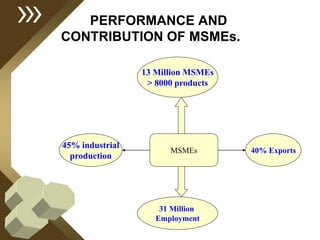
PERFORMANCE AND
CONTRIBUTION OF MSMEs.
13 Million MSMEs
> 8000 products
MSMEs
31 Million
Employment
40% Exports
45% industrial
production
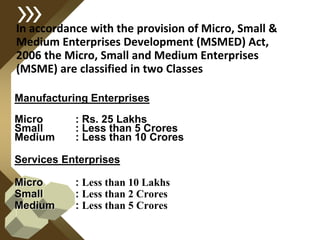
In accordance with the provision of Micro, Small &
Medium Enterprises Development (MSMED) Act,
2006 the Micro, Small and Medium Enterprises
(MSME) are classified in two Classes
Manufacturing Enterprises
Micro : Rs. 25 Lakhs
Small : Less than 5 Crores
Medium : Less than 10 Crores
Services Enterprises
Micro : Less than 10 Lakhs
Small : Less than 2 Crores
Medium : Less than 5 Crores
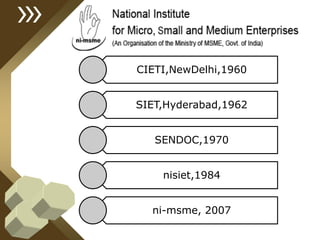
CIETI,NewDelhi,1960
SIET,Hyderabad,1962
SENDOC,1970
nisiet,1984
ni-msme, 2007
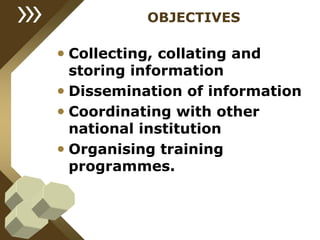
OBJECTIVES
• Collecting, collating and
storing information
• Dissemination of information
• Coordinating with other
national institution
• Organising training
programmes.
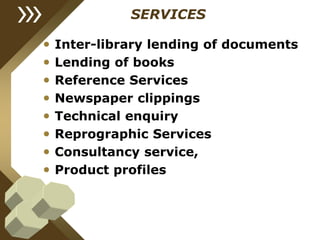
SERVICES
• Inter-library lending of documents
• Lending of books
• Reference Services
• Newspaper clippings
• Technical enquiry
• Reprographic Services
• Consultancy service,
• Product profiles
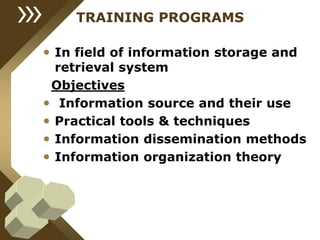
TRAINING PROGRAMS
• In field of information storage and
retrieval system
Objectives
• Information source and their use
• Practical tools & techniques
• Information dissemination methods
• Information organization theory
PUBLICATIONS
• SEDME journal(Annual foreign)
• SEDME Journal (quarterly)
• News Bulletin (monthly)
• SSI Clusters News (quarterly
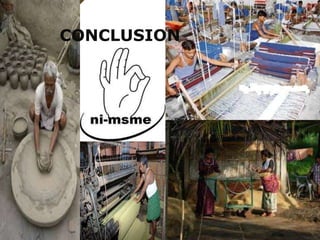
CONCLUSION
REFERENCE
• www.nimsme.org
• Agarwal,s.p, National information system
in social science in India: A Review,
All India library conference, lucknow
,1982. p.273-287
Sendoc
Sendoc

Sendoc

  • 1.
    AKSHAYA KUMAR KS ROLL NO 2
  • 2.
    INTRODUCTION A country’s economicgrowth is increasingly dependent on the tempo of scientific research and on the ability to apply the results of that research rapidly and Completely to production .The development of scientific documentation and information centre and services is a necessity.
  • 3.
    DOCUMENTATION Paul Otlet The specificactivity of gathering, processing, storing, retrieving and circulating documents. E. Hymansas The collecting, arranging and disseminating of all manner of data.
  • 4.
    DOCUMENTATION CENTER Organisation thatconcerns with selection, acquisition, processing, storage and retrieval of specific documents in response to users request
  • 5.
    Small Enterprises National DocumentationCentre (SENDOC) • The Small Enterprises National Documentation Centre (SENDOC) is set up to energies MSMEs in India and the developing countries around the world with information and knowledge • It functions as a clearing house of information both for entrepreneurs and extension agents.
  • 6.
    • The MicroSmall And Medium Enterprises Development Act, 2006 • MSMED Act was established to provide for facilitating the promotion and development and enhancing the competitiveness of micro, s m a l l a n d m e d i u m e n t e r p r i s e s . • Became operational from 2nd October 2006
  • 7.
    PERFORMANCE AND CONTRIBUTION OFMSMEs. 13 Million MSMEs > 8000 products MSMEs 31 Million Employment 40% Exports 45% industrial production
  • 8.
    In accordance withthe provision of Micro, Small & Medium Enterprises Development (MSMED) Act, 2006 the Micro, Small and Medium Enterprises (MSME) are classified in two Classes Manufacturing Enterprises Micro : Rs. 25 Lakhs Small : Less than 5 Crores Medium : Less than 10 Crores Services Enterprises Micro : Less than 10 Lakhs Small : Less than 2 Crores Medium : Less than 5 Crores
  • 9.
  • 10.
    OBJECTIVES • Collecting, collatingand storing information • Dissemination of information • Coordinating with other national institution • Organising training programmes.
  • 11.
    SERVICES • Inter-library lendingof documents • Lending of books • Reference Services • Newspaper clippings • Technical enquiry • Reprographic Services • Consultancy service, • Product profiles
  • 12.
    TRAINING PROGRAMS • Infield of information storage and retrieval system Objectives • Information source and their use • Practical tools & techniques • Information dissemination methods • Information organization theory
  • 13.
    PUBLICATIONS • SEDME journal(Annualforeign) • SEDME Journal (quarterly) • News Bulletin (monthly) • SSI Clusters News (quarterly
  • 14.
  • 15.
    REFERENCE • www.nimsme.org • Agarwal,s.p,National information system in social science in India: A Review, All India library conference, lucknow ,1982. p.273-287