
Six Easy Ways to Control Your
Localization Costs
Bill Swallow


Content Solutions Manager, LinguaLinx
17 years’ experience in technical communication
About LinguaLinx


Headquartered in Cohoes, NY
50 employees country-wide
Founded in 2002
Technologically advanced LSP leveraging a variety of
prevalent language industry tools such as translation
memory and workflow efficiency
Currently provides service to a worldwide base of over
1,000 diverse clients
About GlobalScript


Content Solutions division of LinguaLinx
Content development consulting and services
Global readiness assessment
Workflow improvement
Authoring technology optimization
Definitions


Globalization (G11N)
all company-wide preparations that must be made in
order to enter the international marketplace
Internationalization (I18N)
creating source material that is locale-independent
Localization (L10N)
adapting content and presentation for a particular
country or region
Translation (T9N)
adapting meaning from one language into another in a
written format
Poll: Are you currently translating/localizing your
content?
Six easy ways to control your
localization costs

Plan for all of your localized needs up front
Consult with your translation vendor throughout
Use consistent, controlled content
Design templates and layouts that fit every need
Use localization friendly technologies
Ensure the easiest path for round-tripping content
1. Plan for all of your localized needs up front


It’s not just about translating what you have.

It’s about making sure that your audience has what they
need, in the form that they need it in.
1. Plan for all of your localized needs up front


Localization is not a project-end activity
Start planning for it from the very beginning


Every aspect of your content strategy impacts and is
impacted by localization
1. Plan for all of your localized needs up front


Why is this important?

Translating content is only one piece of the complete
picture.
Technology considerations can impact translation quality,
time, and cost.
Not every experience is the same.
Needs and expectations will continue to shift.
Be prepared to quickly shift with them.
1. Plan for all of your localized needs up front


The 1:10:100 rule

Fixing a problem at the planning stage is cheap
Fixing a problem mid-project can come with a significant
cost
Fixing a problem at the delivery stage can cost a
tremendous amount
1. Plan for all of your localized needs up front


Keep a diverse audience in mind
Strengthen adherence to style
Identify potential issues for target markets
Keep technology decisions in check
Plan for exceptions
Keep costs down
Ensure translators are prepared with the correct
approach
1. Plan for all of your localized needs up front


Develop a global content strategy

Many content types
Diverse audience
Diverse authors
Aligns with corporate goals
Strengthens corporate brand
1. Plan for all of your localized needs up front


A global content strategy is NOT…

A single actionable plan
A technology implementation
A siloed activity
A translation workflow
2. Consult with your translation vendor
throughout


Your translation vendor is your local market SME.
2. Consult with your translation vendor
throughout

Who should be involved?

Writers
Product development
Product management
Marketing & Sales
Support
Localization
Any group involved or impacted
2. Consult with your translation vendor
throughout

Involve everyone from beginning to end

Every group brings unique and critical insights to the
table
Needs vary and may conflict; plan for it
Meet regularly
Keep market needs and expectations in mind
2. Consult with your translation vendor
throughout

How to involve your translation vendor

Contact them at the beginning
Include them in strategic planning
If you can’t, at minimum supply them with updates
Include them in tactical planning
Include when making decisions on style, technology, and
delivery
2. Consult with your translation vendor
throughout

Translation options:

Human translation
Machine translation
Crowdsourced translation
2. Consult with your translation vendor
throughout

Human Translation

Performed by professional translators fluent in both
language and subject matter
Highest accuracy and quality in translation
Able to transcreate content where appropriate
Translators can be engaged in strategy development
Higher cost and longer duration
2. Consult with your translation vendor
throughout

Machine translation

Performed by software
Questionable accuracy and quality in translation
Unable to transcreate content
Post-translation editing required
Low cost and shorter duration
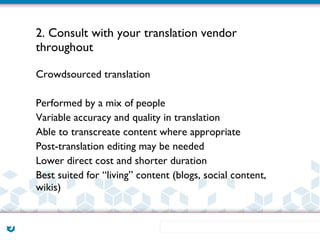
2. Consult with your translation vendor
throughout

Crowdsourced translation

Performed by a mix of people
Variable accuracy and quality in translation
Able to transcreate content where appropriate
Post-translation editing may be needed
Lower direct cost and shorter duration
Best suited for “living” content (blogs, social content,
wikis)
2. Consult with your translation vendor
throughout

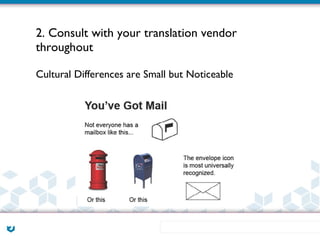
Cultural Differences are Small but Noticeable
Poll: How do you create your content?
3. Use consistent, controlled content


“Translation shouldn’t be a problem
so long as my content’s good, right?”


What is good content?
3. Use consistent, controlled content


Consistency is key

Structured authoring can ensure consistency
Unstructured authoring can as well, though requires
additional effort
Reuse/repurpose content
All hail the Editor!
Linguistic analysis/QA tools (Acrolinx)
3. Use consistent, controlled content


Consistency in unique content is also important

Targeted messaging
Time-sensitive information must still conform
Supporting information for transcreation (document your
content)
Keep your brand intact
3. Use consistent, controlled content


Translations should read as if it were originally crafted in
the target language. Understanding the cultural and
linguistic dynamics of the localization process will help
create better multilingual content.

Lay it out for all the world
Anticipate language expansion
Use consistent terminology
Write clearly and concisely
3. Use consistent, controlled content


Avoid:

Complex or lengthy sentences
Abbreviations, slang, jargon, or undefined acronyms
Invented words (unless they are well defined) or words
with multiple meanings
Anything portraying a way of life or a culture specific to a
particular people, country or region
3. Use consistent, controlled content


Audience Analysis

Cultural understanding is critical
People consume information and react differently
Easier to plan up front than backpedal later
Linguistic and localization analysis and testing
Develop appropriate information for the appropriate
audience, in the appropriate manner, for the greatest
value
Poll: What type of information do you primarily
create?
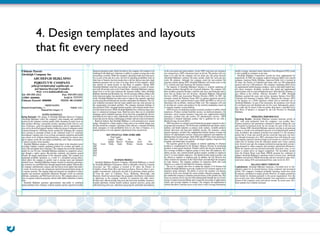
4. Design templates and layouts
that fit every need


Think about text expansion
Think about text reduction
Got graphics? Keep text separate!
Do your needs vary? So should your templates!
4. Design templates and layouts
that fit every need
5. Use localization friendly technologies


Tools should not dictate your localization plan.


They should support it.
5. Use localization friendly technologies


Use a Content Management System

Stores content in purposeful chunks
Each chunk can be used and reused as needed
Write once, translate once, use anywhere
A CMS can export content free of layout and images,
expediting translation turnaround
Most evolve with the times
Most facilitate publishing for multiple outputs
5. Use localization friendly technologies


If you can’t use a CMS

Use XML if possible
If you can’t use XML, use tools supporting reuse
Use tools that import/export in non-proprietary formats
Global control over formatting is critical
5. Use localization friendly technologies


Soft tools for solid gains

Style guides
Glossaries and terminology lists
Workflows and processes
Clear, open, direct communication
6. Ensure the easiest path for
round-tripping content

Most translation happens outside of source content tools
Content must be easily exported for translation
Content must be easily imported after translation
Case Study


North American (US & Canada) vendor
Consolidation of 26 European markets
Introducing XML-based structured authoring process
Established centralized workflows
Centralize translation memories, glossaries and
TermBases
Revamp entire desktop publishing process
Case Study - Results


Shorter time to market for frequently changing and
updated data
Increased enterprise and branding consistency
Significant savings through global costing alignment
Economies of scale gained in project management
Six easy ways to control your
localization costs

Plan for all of your localized needs up front
Consult with your translation vendor throughout
Use consistent, controlled content
Design templates and layouts that fit every need
Use localization friendly technologies
Ensure the easiest path for round-tripping content
For more information


LinguaLinx.com
GlobalScript.com
bswallow@lingualinx.com
@BillSwallow
@LinguaLinx
@GlobalScript

Six easy ways to control your localization costs

  • 1.
    Six Easy Waysto Control Your Localization Costs
  • 2.
    Bill Swallow Content SolutionsManager, LinguaLinx 17 years’ experience in technical communication
  • 3.
    About LinguaLinx Headquartered inCohoes, NY 50 employees country-wide Founded in 2002 Technologically advanced LSP leveraging a variety of prevalent language industry tools such as translation memory and workflow efficiency Currently provides service to a worldwide base of over 1,000 diverse clients
  • 4.
    About GlobalScript Content Solutionsdivision of LinguaLinx Content development consulting and services Global readiness assessment Workflow improvement Authoring technology optimization
  • 5.
    Definitions Globalization (G11N) all company-widepreparations that must be made in order to enter the international marketplace Internationalization (I18N) creating source material that is locale-independent Localization (L10N) adapting content and presentation for a particular country or region Translation (T9N) adapting meaning from one language into another in a written format
  • 6.
    Poll: Are youcurrently translating/localizing your content?
  • 7.
    Six easy waysto control your localization costs Plan for all of your localized needs up front Consult with your translation vendor throughout Use consistent, controlled content Design templates and layouts that fit every need Use localization friendly technologies Ensure the easiest path for round-tripping content
  • 8.
    1. Plan forall of your localized needs up front It’s not just about translating what you have. It’s about making sure that your audience has what they need, in the form that they need it in.
  • 9.
    1. Plan forall of your localized needs up front Localization is not a project-end activity Start planning for it from the very beginning Every aspect of your content strategy impacts and is impacted by localization
  • 10.
    1. Plan forall of your localized needs up front Why is this important? Translating content is only one piece of the complete picture. Technology considerations can impact translation quality, time, and cost. Not every experience is the same. Needs and expectations will continue to shift. Be prepared to quickly shift with them.
  • 11.
    1. Plan forall of your localized needs up front The 1:10:100 rule Fixing a problem at the planning stage is cheap Fixing a problem mid-project can come with a significant cost Fixing a problem at the delivery stage can cost a tremendous amount
  • 12.
    1. Plan forall of your localized needs up front Keep a diverse audience in mind Strengthen adherence to style Identify potential issues for target markets Keep technology decisions in check Plan for exceptions Keep costs down Ensure translators are prepared with the correct approach
  • 13.
    1. Plan forall of your localized needs up front Develop a global content strategy Many content types Diverse audience Diverse authors Aligns with corporate goals Strengthens corporate brand
  • 14.
    1. Plan forall of your localized needs up front A global content strategy is NOT… A single actionable plan A technology implementation A siloed activity A translation workflow
  • 15.
    2. Consult withyour translation vendor throughout Your translation vendor is your local market SME.
  • 16.
    2. Consult withyour translation vendor throughout Who should be involved? Writers Product development Product management Marketing & Sales Support Localization Any group involved or impacted
  • 17.
    2. Consult withyour translation vendor throughout Involve everyone from beginning to end Every group brings unique and critical insights to the table Needs vary and may conflict; plan for it Meet regularly Keep market needs and expectations in mind
  • 18.
    2. Consult withyour translation vendor throughout How to involve your translation vendor Contact them at the beginning Include them in strategic planning If you can’t, at minimum supply them with updates Include them in tactical planning Include when making decisions on style, technology, and delivery
  • 19.
    2. Consult withyour translation vendor throughout Translation options: Human translation Machine translation Crowdsourced translation
  • 20.
    2. Consult withyour translation vendor throughout Human Translation Performed by professional translators fluent in both language and subject matter Highest accuracy and quality in translation Able to transcreate content where appropriate Translators can be engaged in strategy development Higher cost and longer duration
  • 21.
    2. Consult withyour translation vendor throughout Machine translation Performed by software Questionable accuracy and quality in translation Unable to transcreate content Post-translation editing required Low cost and shorter duration
  • 22.
    2. Consult withyour translation vendor throughout Crowdsourced translation Performed by a mix of people Variable accuracy and quality in translation Able to transcreate content where appropriate Post-translation editing may be needed Lower direct cost and shorter duration Best suited for “living” content (blogs, social content, wikis)
  • 23.
    2. Consult withyour translation vendor throughout Cultural Differences are Small but Noticeable
  • 24.
    Poll: How doyou create your content?
  • 25.
    3. Use consistent,controlled content “Translation shouldn’t be a problem so long as my content’s good, right?” What is good content?
  • 26.
    3. Use consistent,controlled content Consistency is key Structured authoring can ensure consistency Unstructured authoring can as well, though requires additional effort Reuse/repurpose content All hail the Editor! Linguistic analysis/QA tools (Acrolinx)
  • 27.
    3. Use consistent,controlled content Consistency in unique content is also important Targeted messaging Time-sensitive information must still conform Supporting information for transcreation (document your content) Keep your brand intact
  • 28.
    3. Use consistent,controlled content Translations should read as if it were originally crafted in the target language. Understanding the cultural and linguistic dynamics of the localization process will help create better multilingual content. Lay it out for all the world Anticipate language expansion Use consistent terminology Write clearly and concisely
  • 29.
    3. Use consistent,controlled content Avoid: Complex or lengthy sentences Abbreviations, slang, jargon, or undefined acronyms Invented words (unless they are well defined) or words with multiple meanings Anything portraying a way of life or a culture specific to a particular people, country or region
  • 30.
    3. Use consistent,controlled content Audience Analysis Cultural understanding is critical People consume information and react differently Easier to plan up front than backpedal later Linguistic and localization analysis and testing Develop appropriate information for the appropriate audience, in the appropriate manner, for the greatest value
  • 31.
    Poll: What typeof information do you primarily create?
  • 32.
    4. Design templatesand layouts that fit every need Think about text expansion Think about text reduction Got graphics? Keep text separate! Do your needs vary? So should your templates!
  • 33.
    4. Design templatesand layouts that fit every need
  • 34.
    5. Use localizationfriendly technologies Tools should not dictate your localization plan. They should support it.
  • 35.
    5. Use localizationfriendly technologies Use a Content Management System Stores content in purposeful chunks Each chunk can be used and reused as needed Write once, translate once, use anywhere A CMS can export content free of layout and images, expediting translation turnaround Most evolve with the times Most facilitate publishing for multiple outputs
  • 36.
    5. Use localizationfriendly technologies If you can’t use a CMS Use XML if possible If you can’t use XML, use tools supporting reuse Use tools that import/export in non-proprietary formats Global control over formatting is critical
  • 37.
    5. Use localizationfriendly technologies Soft tools for solid gains Style guides Glossaries and terminology lists Workflows and processes Clear, open, direct communication
  • 38.
    6. Ensure theeasiest path for round-tripping content Most translation happens outside of source content tools Content must be easily exported for translation Content must be easily imported after translation
  • 39.
    Case Study North American(US & Canada) vendor Consolidation of 26 European markets Introducing XML-based structured authoring process Established centralized workflows Centralize translation memories, glossaries and TermBases Revamp entire desktop publishing process
  • 40.
    Case Study -Results Shorter time to market for frequently changing and updated data Increased enterprise and branding consistency Significant savings through global costing alignment Economies of scale gained in project management
  • 41.
    Six easy waysto control your localization costs Plan for all of your localized needs up front Consult with your translation vendor throughout Use consistent, controlled content Design templates and layouts that fit every need Use localization friendly technologies Ensure the easiest path for round-tripping content
  • 42.