Balancing standardization against
the need for creativity
Flickr: Paxson Woelber
Alan Pringle
Scriptorium
August 3, 2016
@alanpringle
Type questions and
comments in the
Questions module of
GoToWebinar.
Questions? Comments?
Flickr: Veronique Debord
Attendees are muted
during webcast.
Webcast is being recorded,
but your name won't be
shown.
@alanpringle
About me
Chief operating officer,
Scriptorium Publishing
Working with structured
content since 1988
Coauthor, Content Strategy 101
and Technical Writing 101
@alanpringle
About me
@alanpringle
Stereotype of structured authoring
Flickr: Umberto Salvagnin
No creativity!
@alanpringle
Three case studies
Communicating layout specifications for
automated outputs
Considering the true costs of customized
structures
Flexibility in layout as a business
requirement
@alanpringle
Flickr: State Library and Archives of Florida
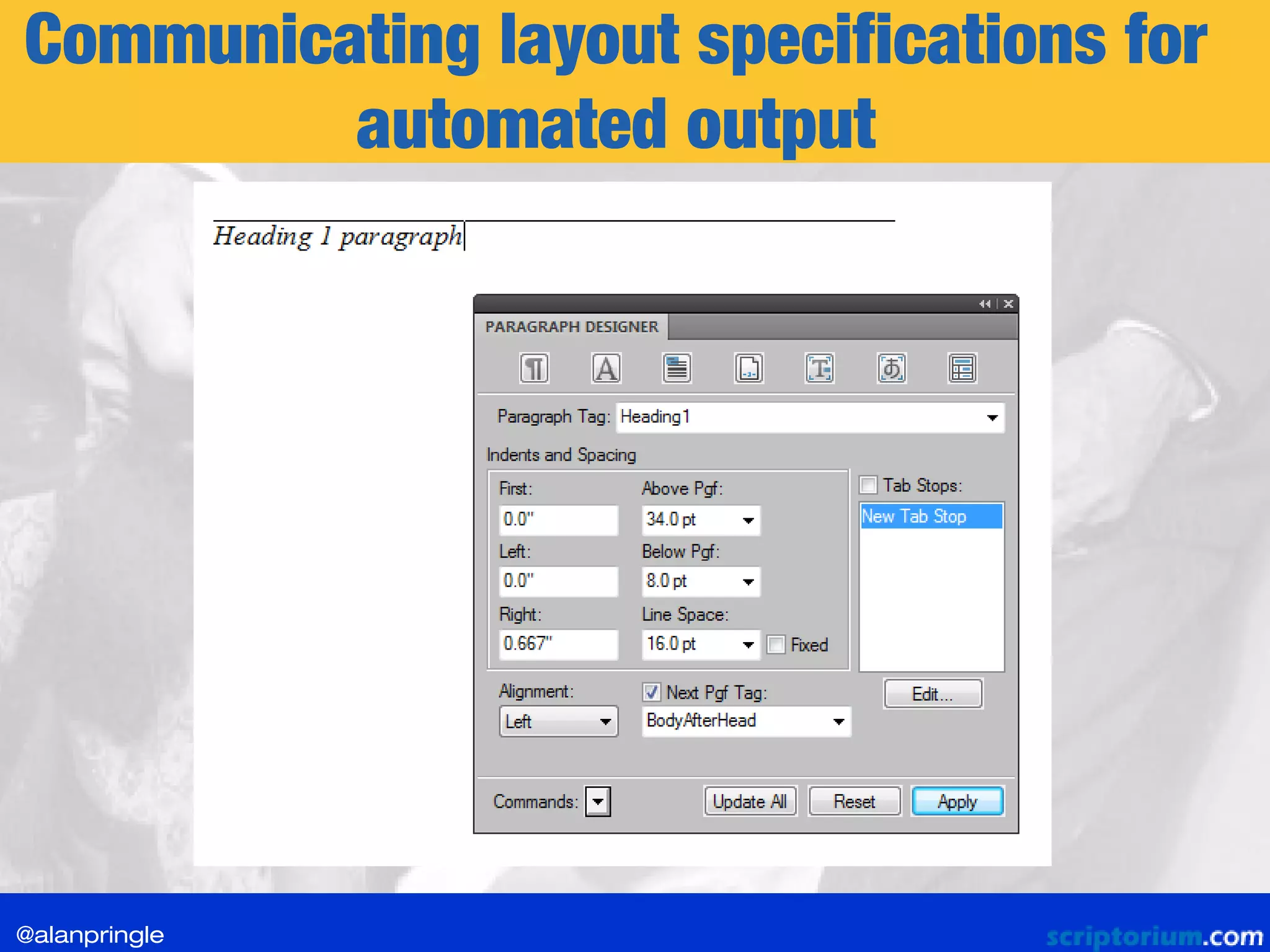
Communicating layout specifications for
automated output
@alanpringle
Communicating layout specifications for
automated output
@alanpringle
Communicating layout specifications for
automated output
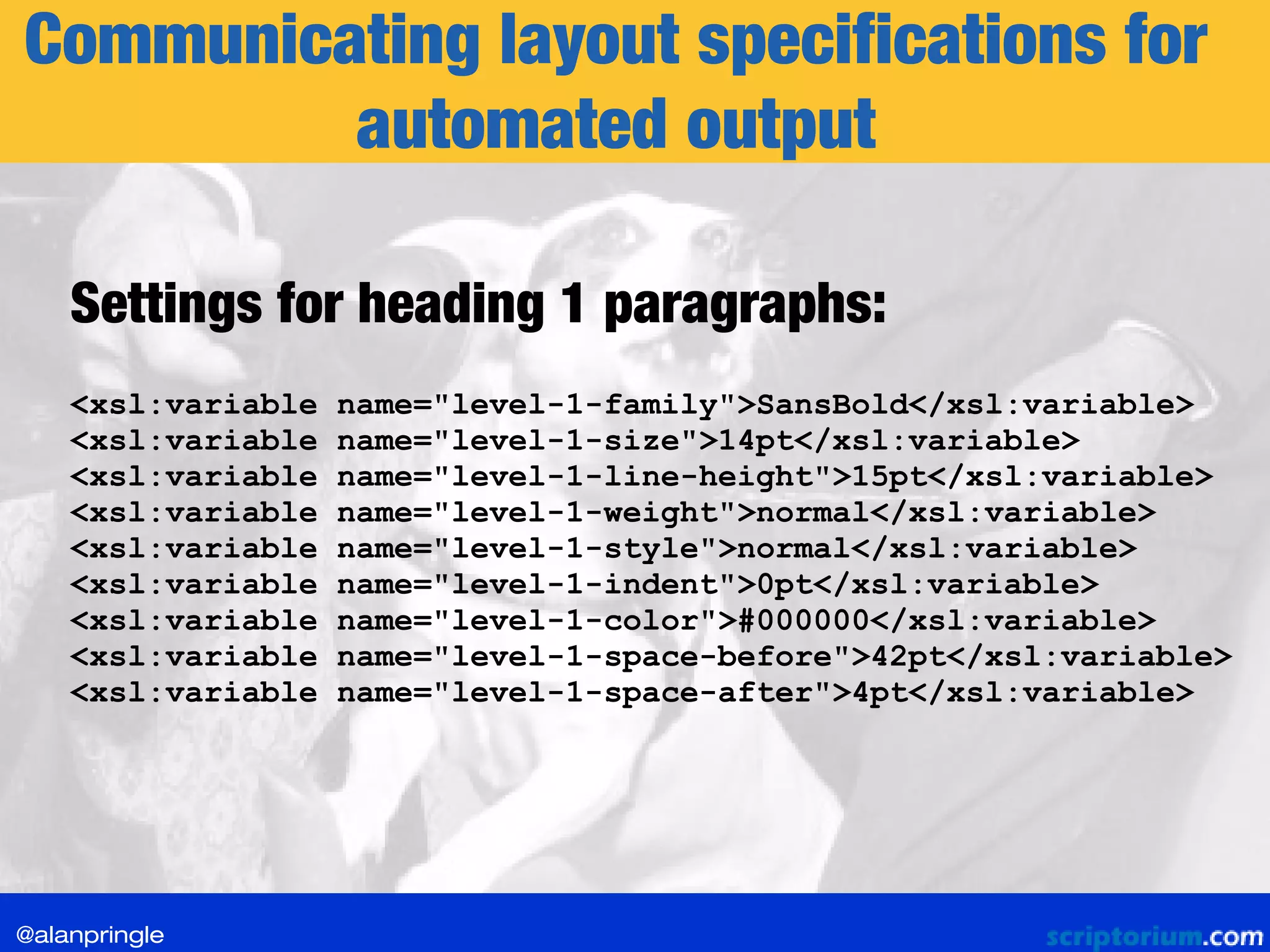
<xsl:variable name="level-1-family">SansBold</xsl:variable>
<xsl:variable name="level-1-size">14pt</xsl:variable>
<xsl:variable name="level-1-line-height">15pt</xsl:variable>
<xsl:variable name="level-1-weight">normal</xsl:variable>
<xsl:variable name="level-1-style">normal</xsl:variable>
<xsl:variable name="level-1-indent">0pt</xsl:variable>
<xsl:variable name="level-1-color">#000000</xsl:variable>
<xsl:variable name="level-1-space-before">42pt</xsl:variable>
<xsl:variable name="level-1-space-after">4pt</xsl:variable>
Settings for heading 1 paragraphs:
@alanpringle
Communicating layout specifications for
automated output
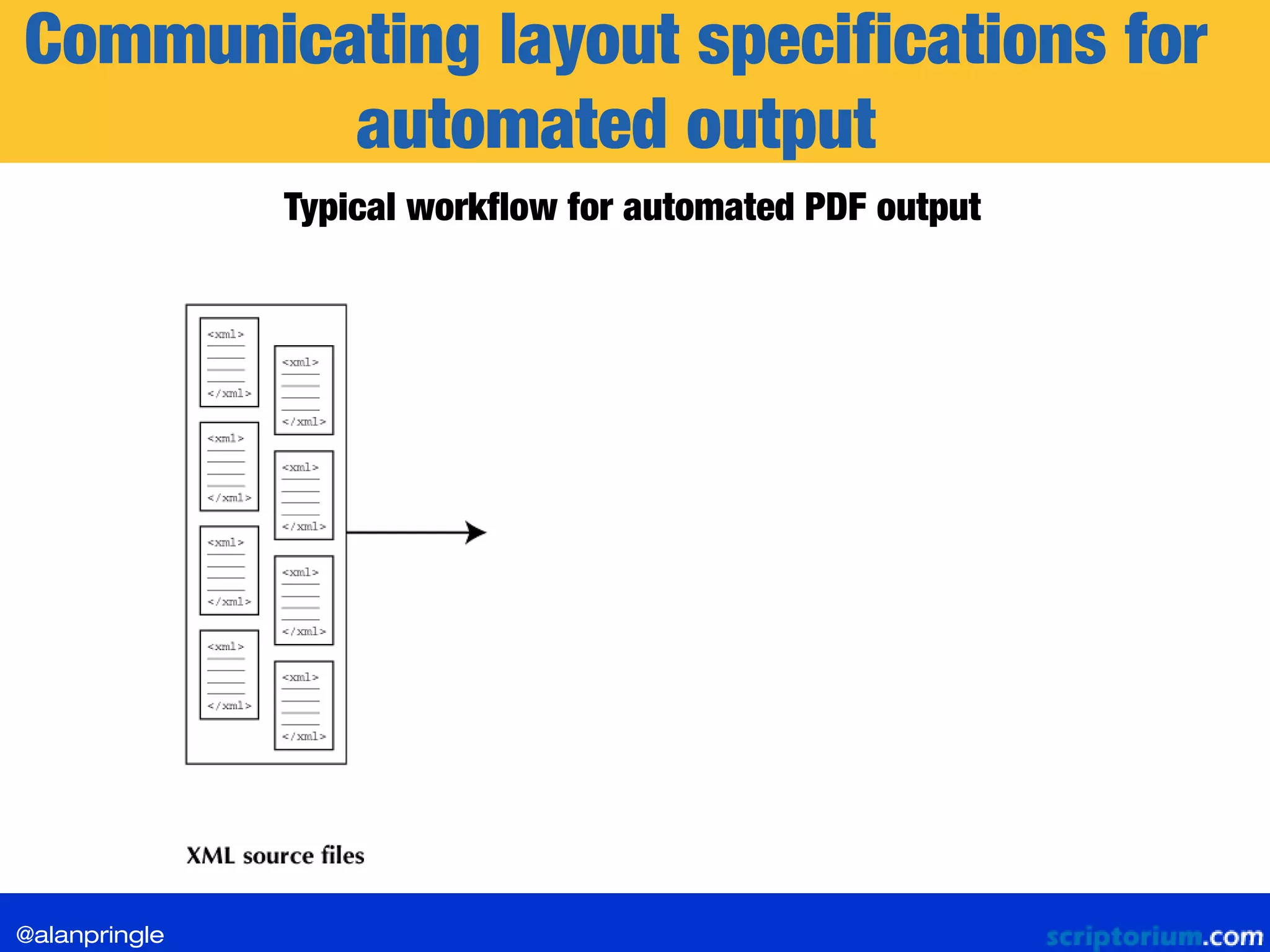
Typical workflow for automated PDF output
@alanpringle
Communicating layout specifications for
automated output
Programmer develops stylesheet in
text/XML editor.
Code specifies page size, font use, and
so on.
@alanpringle
Communicating layout specifications for
automated output
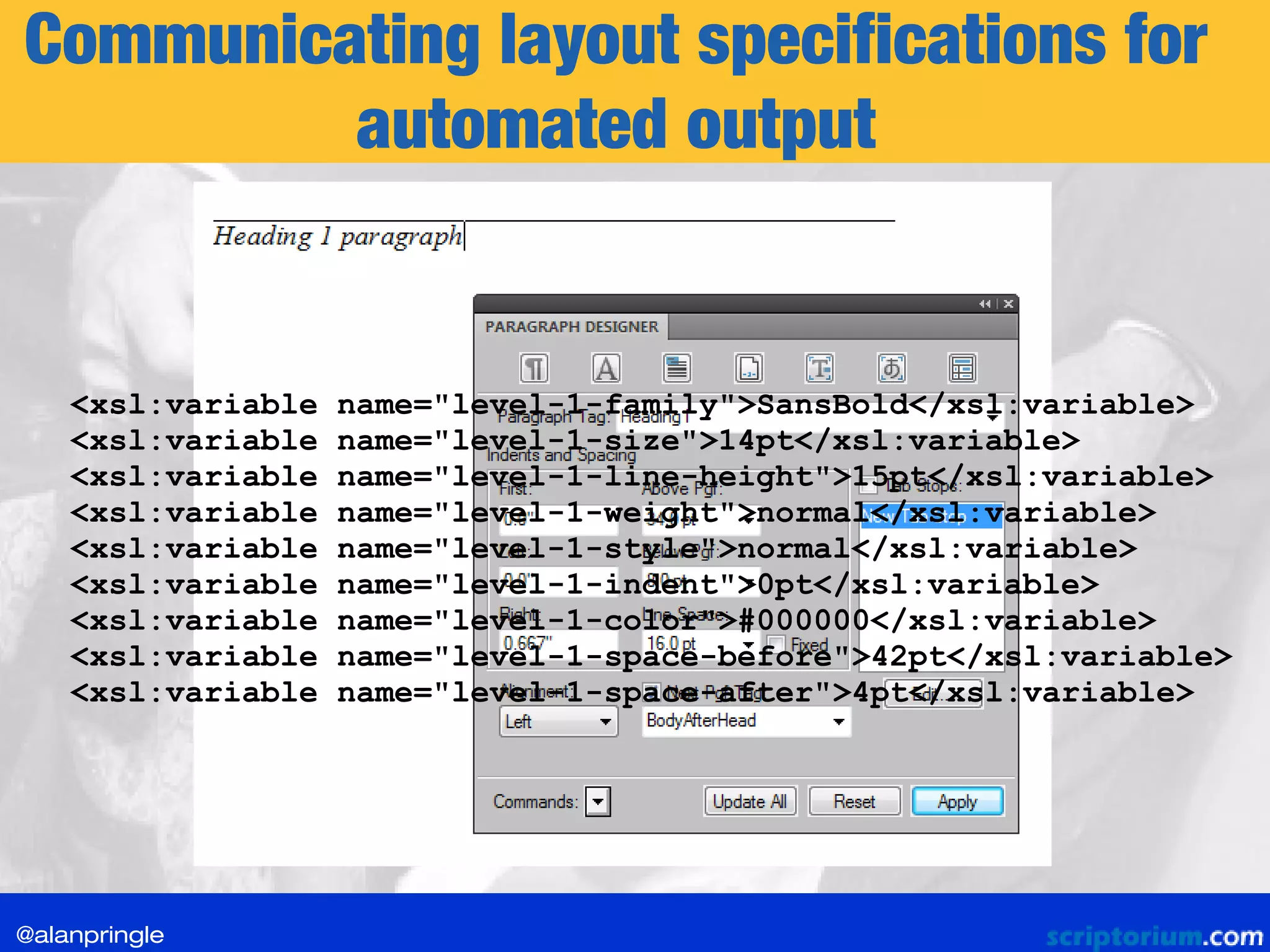
<xsl:variable name="level-1-family">SansBold</xsl:variable>
<xsl:variable name="level-1-size">14pt</xsl:variable>
<xsl:variable name="level-1-line-height">15pt</xsl:variable>
<xsl:variable name="level-1-weight">normal</xsl:variable>
<xsl:variable name="level-1-style">normal</xsl:variable>
<xsl:variable name="level-1-indent">0pt</xsl:variable>
<xsl:variable name="level-1-color">#000000</xsl:variable>
<xsl:variable name="level-1-space-before">42pt</xsl:variable>
<xsl:variable name="level-1-space-after">4pt</xsl:variable>
@alanpringle
Communicating layout specifications for
automated output
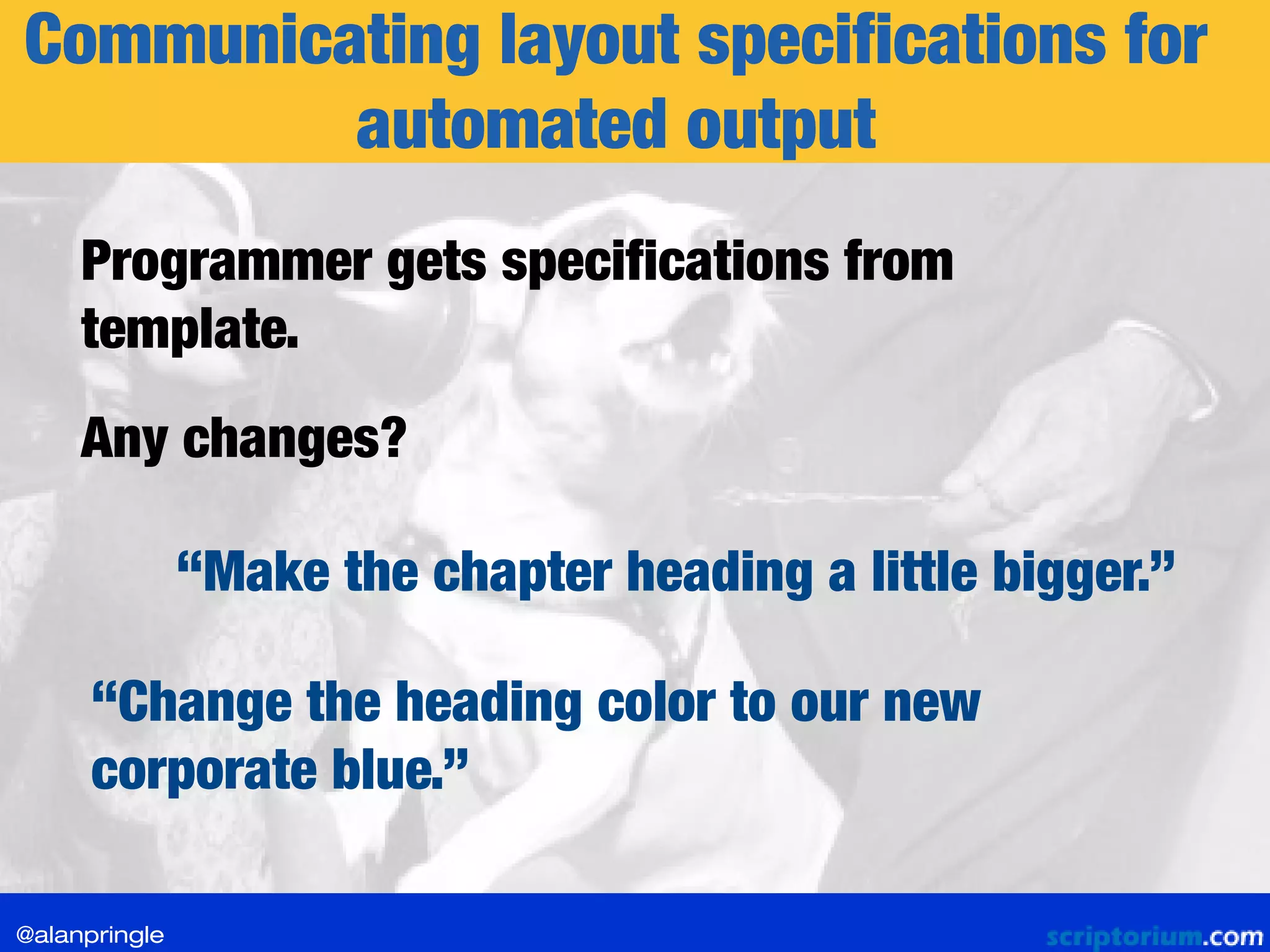
Any changes?
“Change the heading color to our new
corporate blue.”
“Make the chapter heading a little bigger.”
Programmer gets specifications from
template.
@alanpringle
Communicating layout specifications for
automated output
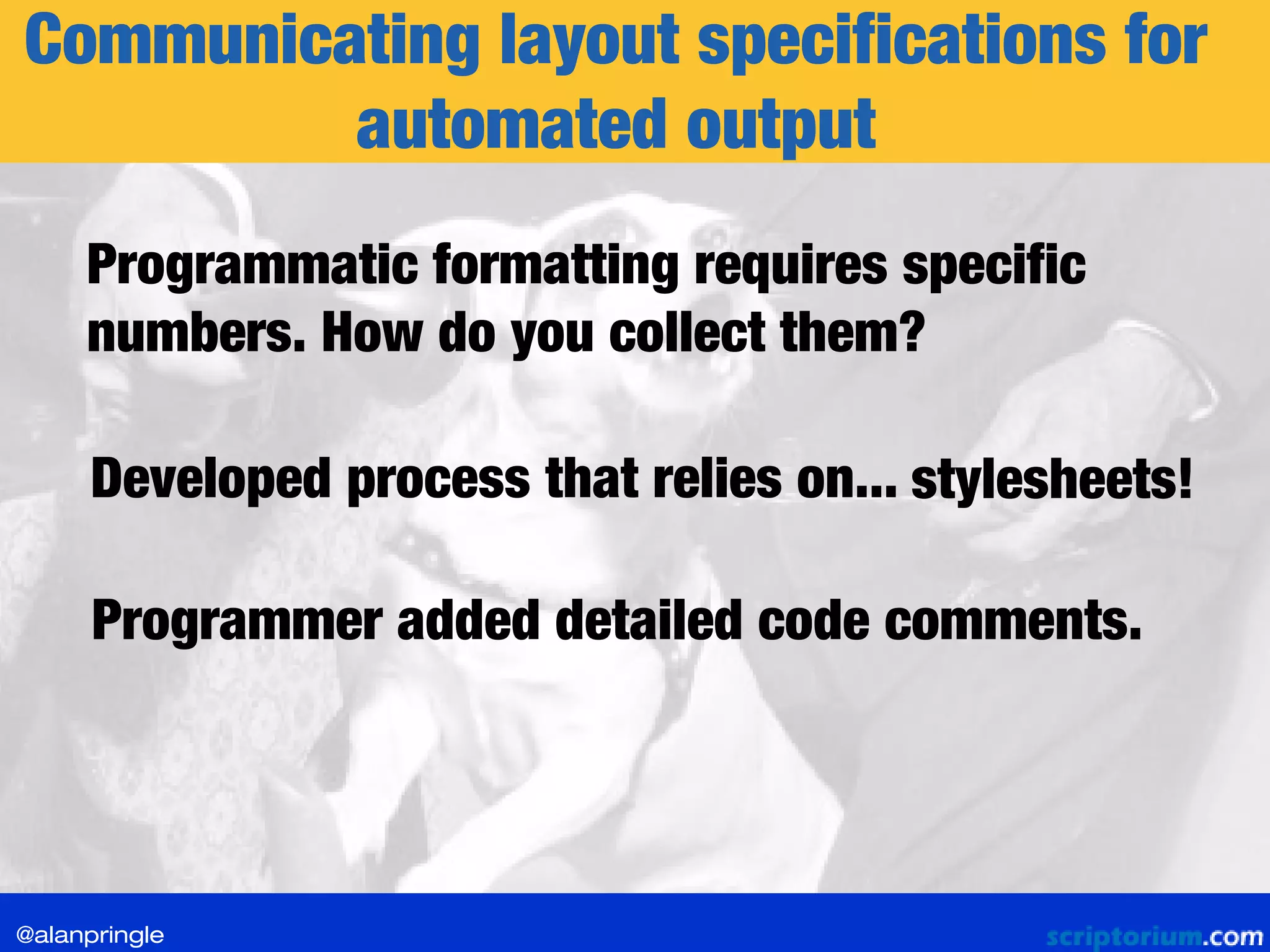
Developed process that relies on... stylesheets!
Programmer added detailed code comments.
Programmatic formatting requires specific
numbers. How do you collect them?
@alanpringle
Communicating layout specifications for
automated output
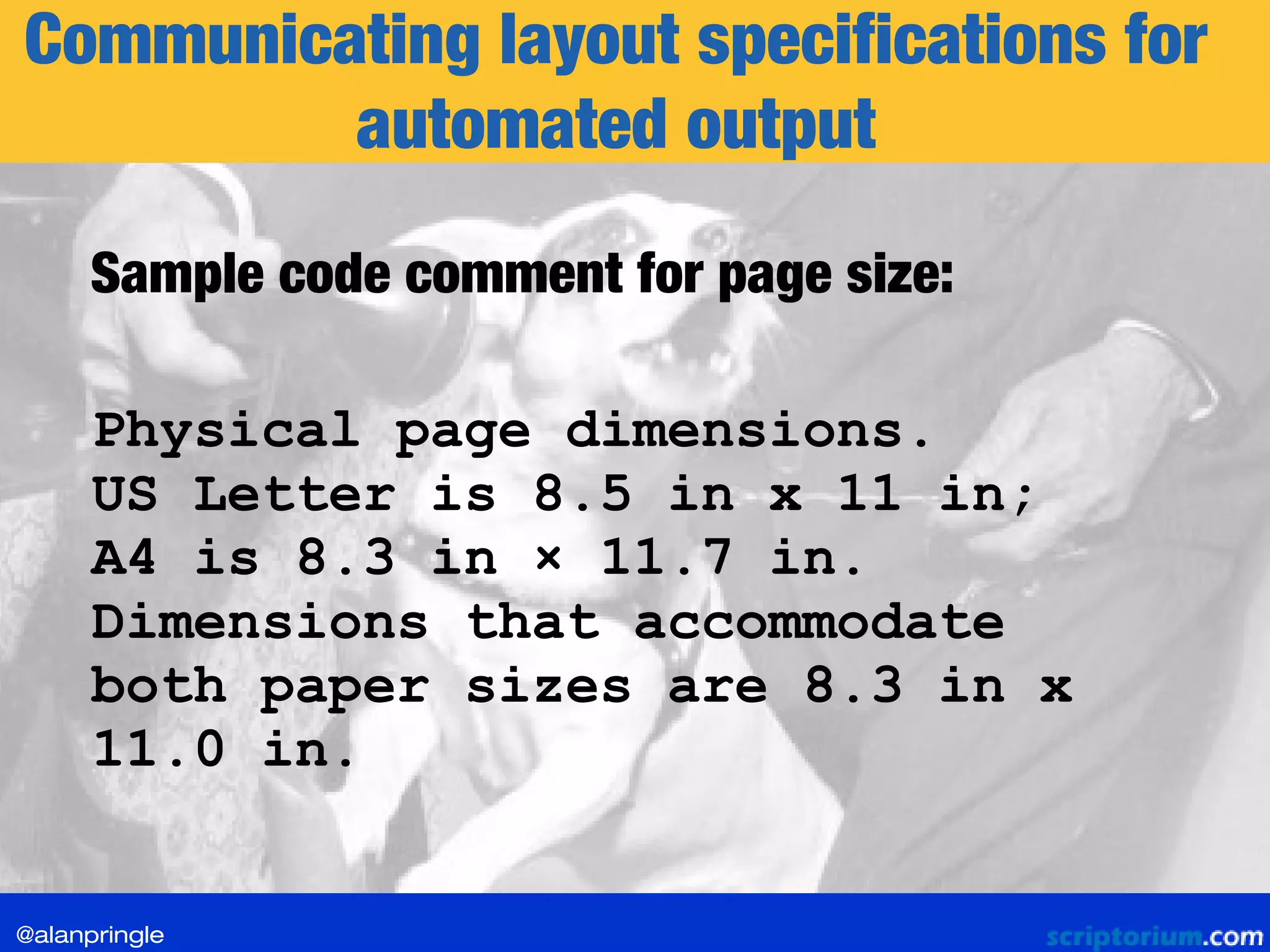
Sample code comment for page size:
Physical page dimensions.
US Letter is 8.5 in x 11 in;
A4 is 8.3 in × 11.7 in.
Dimensions that accommodate
both paper sizes are 8.3 in x
11.0 in.
@alanpringle
Communicating layout specifications for
automated output
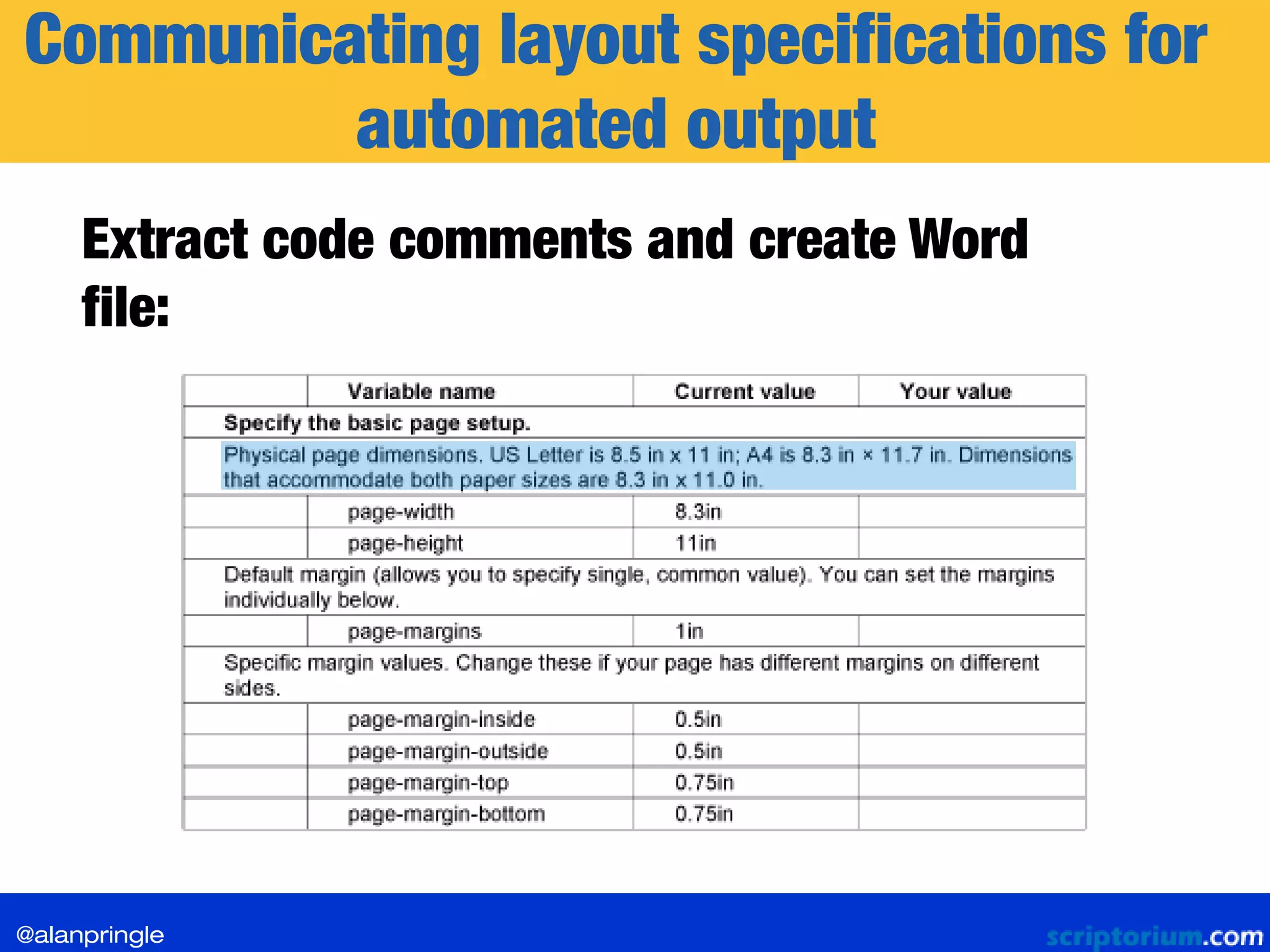
Extract code comments and create Word
file:
@alanpringle
Communicating layout specifications for
automated output
Designer fills out settings and returns file.
Programmer gets specific measurements.
Code comments serve as reference for
later maintenance.
@alanpringle
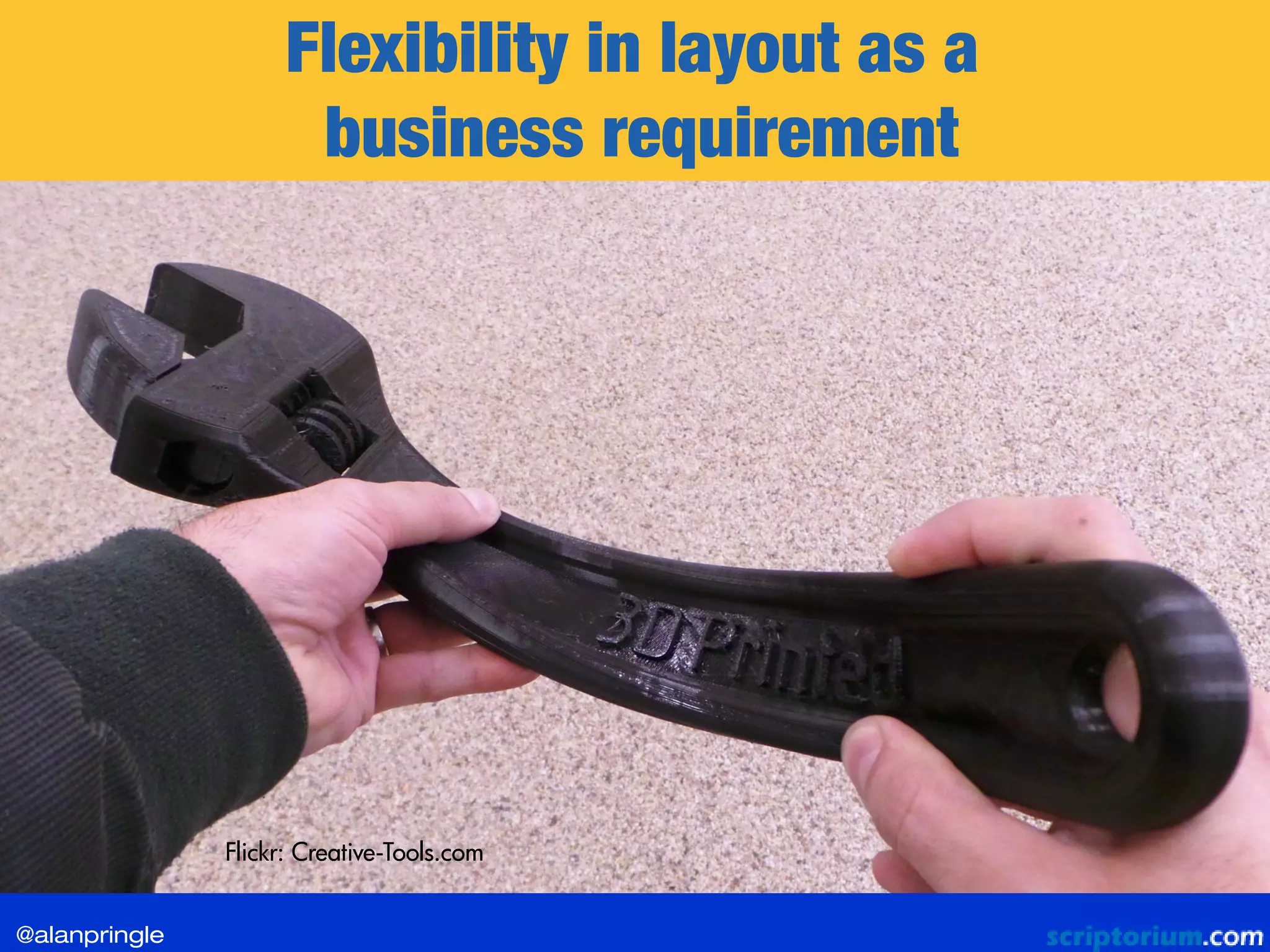
Flexibility in layout as a
business requirement
Flickr: Creative-Tools.com
@alanpringle
Flexibility in layout as a
business requirement
Automated PDF formatting is not for all
information types.
Highly designed study guides required
greater flexibility in layout.
How do you preserve high-quality layouts
for print?
@alanpringle
Flexibility in layout as a
business requirement
Transform source XML into InDesign-
compatible XML.
XML refers to styles in the InDesign
template.
@alanpringle
Flexibility in layout as a
business requirement
<ParagraphStyleRange AppliedParagraphStyle="ParagraphStyle/body">
<CharacterStyleRange AppliedCharacterStyle="CharacterStyle/
$ID/[No character style]">
<Content>When developing a test bed, it is important to
ensure that you cover </Content>
</CharacterStyleRange>
<CharacterStyleRange
AppliedCharacterStyle="CharacterStyle/bold">
<Content>all </Content>
</CharacterStyleRange>
<CharacterStyleRange AppliedCharacterStyle="CharacterStyle/
$ID/[No character style]">
<Content>basic cases for your requirements.</Content>
</CharacterStyleRange>
...
</ParagraphStyleRange>
InDesign Markup Language (IDML) sample:
@alanpringle
Flexibility in layout as a
business requirement
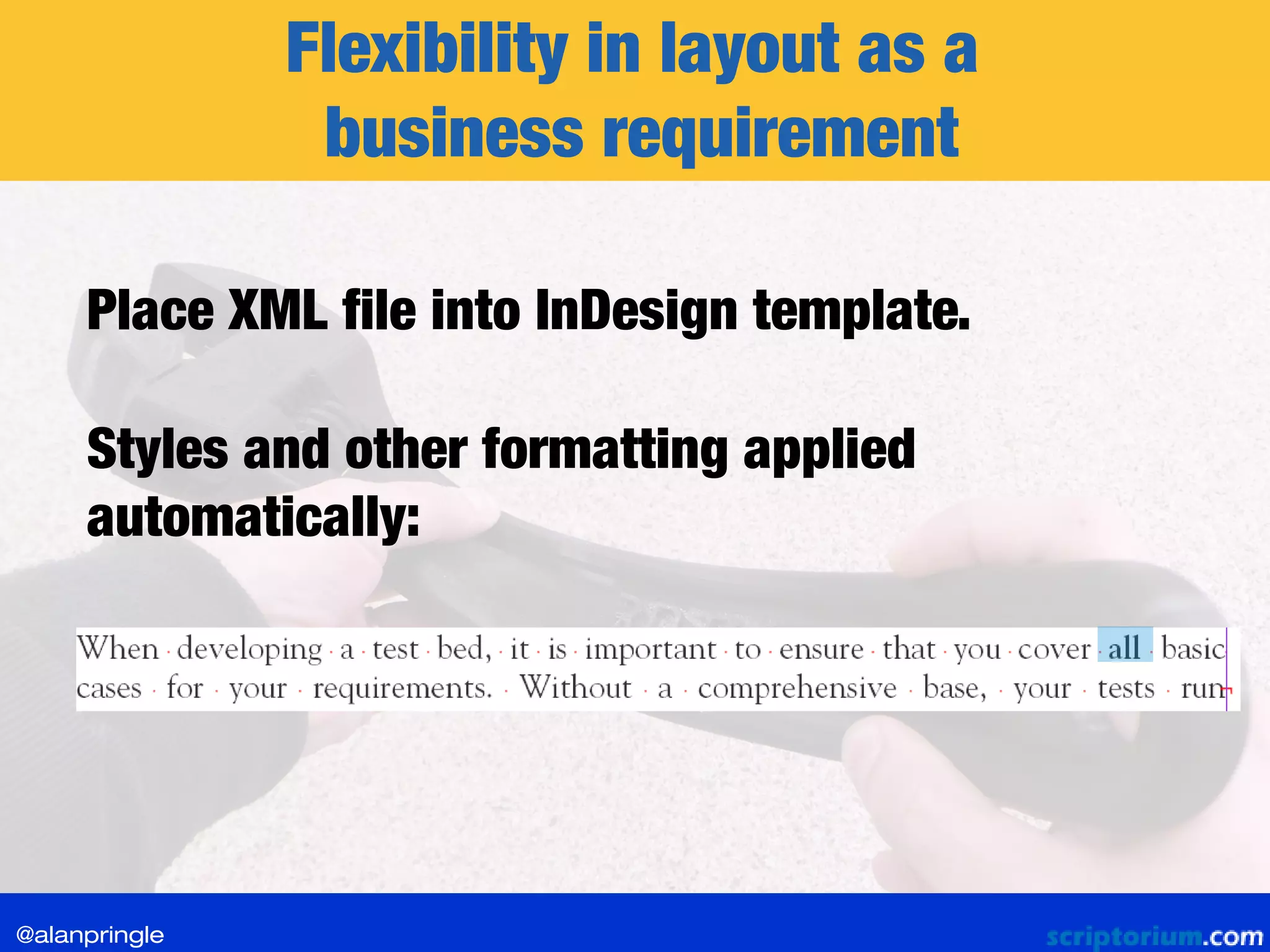
Place XML file into InDesign template.
Styles and other formatting applied
automatically:
@alanpringle
Flexibility in layout as a
business requirement
@alanpringle
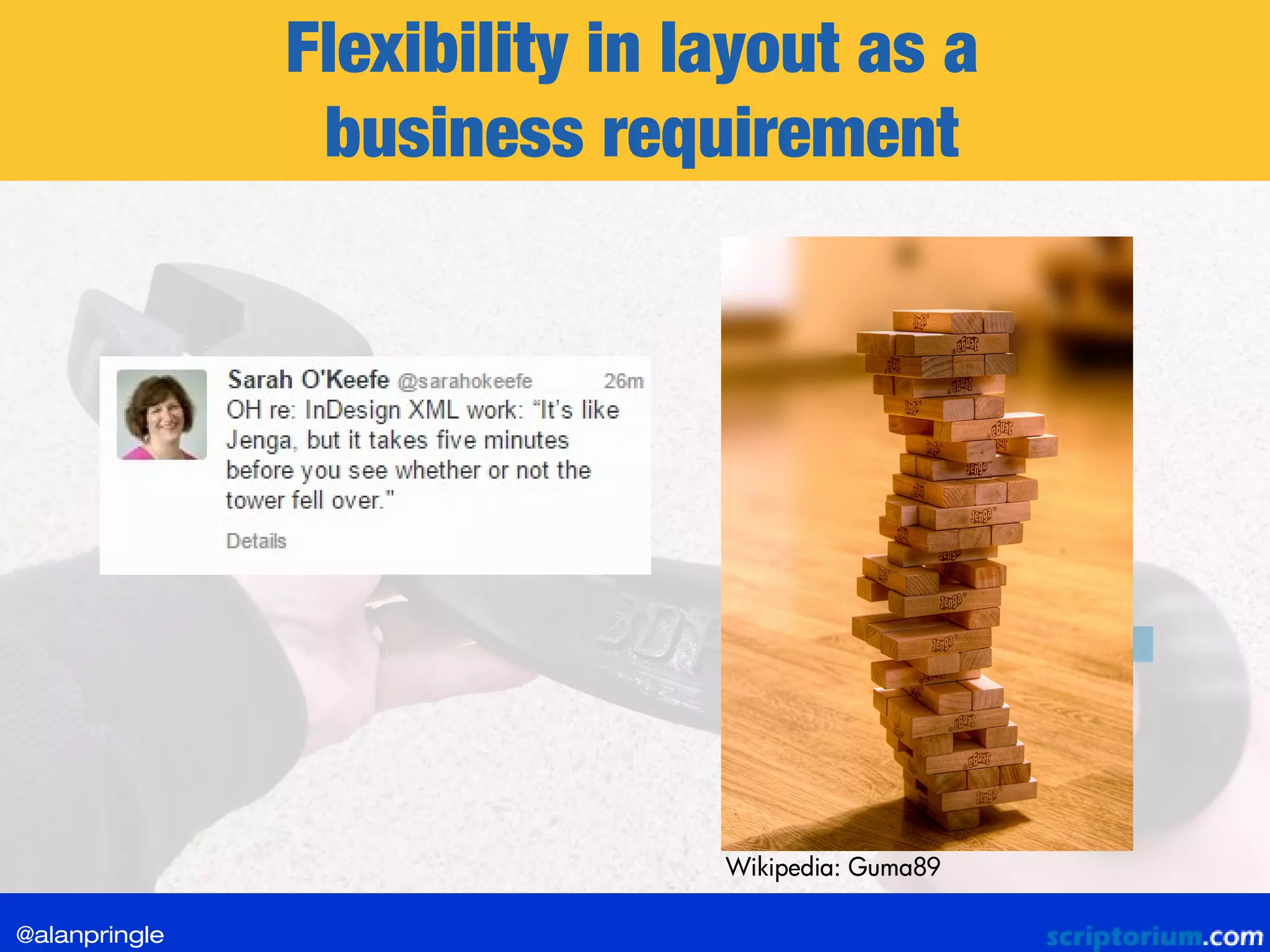
Wikipedia: Guma89
Flexibility in layout as a
business requirement
Adjust line breaks, pagination, image
placement, and so on.
Reduced production time significantly.
Get benefits of structured content (reuse,
in particular).
@alanpringle
Considering the true costs of
customized structures
Flickr: Japanexperterna.se
@alanpringle
Considering the true costs of
customized structures
Standardization versus creativity is not
just about layout.
Create custom structure? Adopt standard?
When should you change a standard's
default structures?
@alanpringle
Considering the true costs of
customized structures
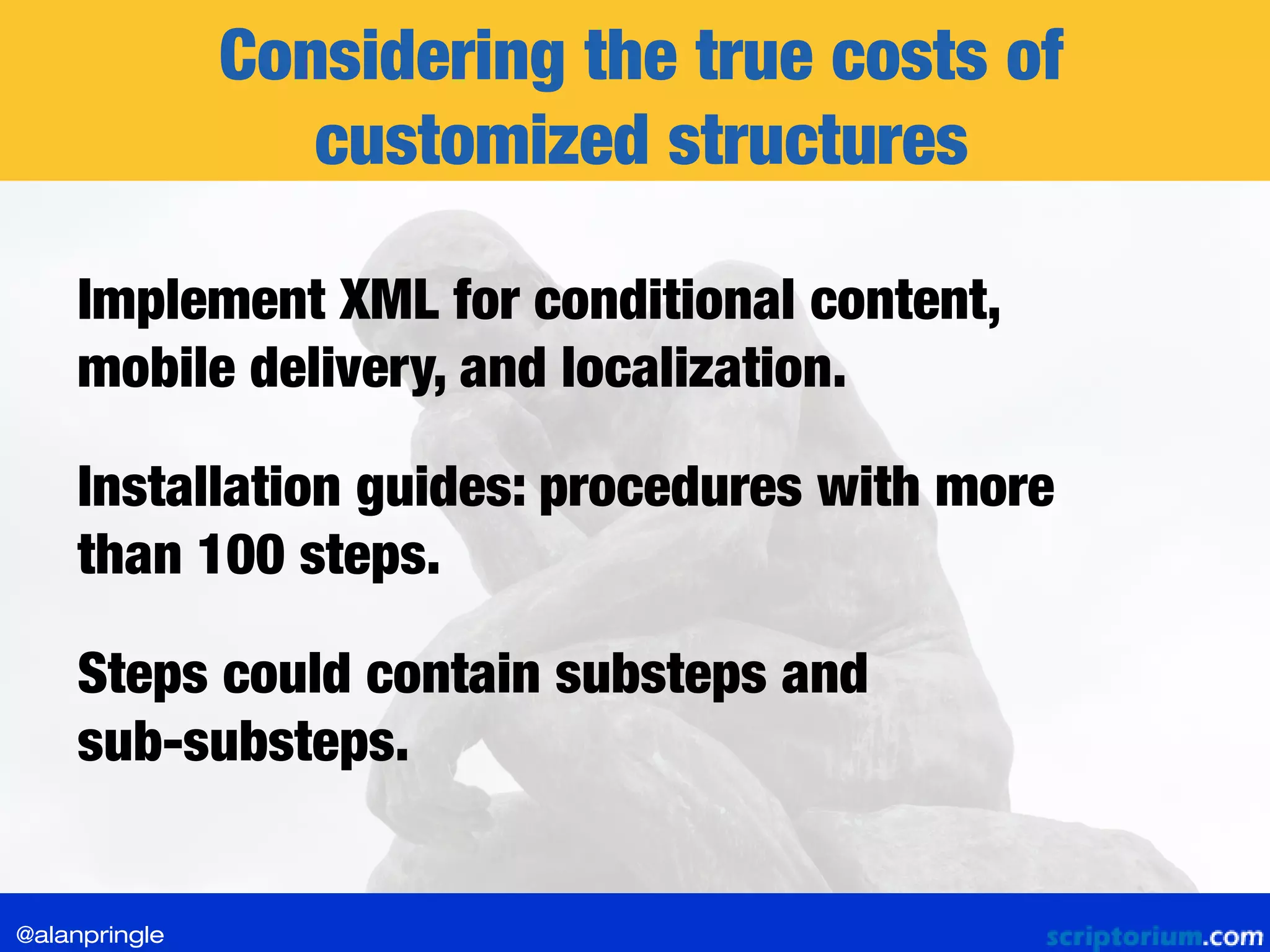
Implement XML for conditional content,
mobile delivery, and localization.
Installation guides: procedures with more
than 100 steps.
Steps could contain substeps and
sub-substeps.
@alanpringle
Considering the true costs of
customized structures
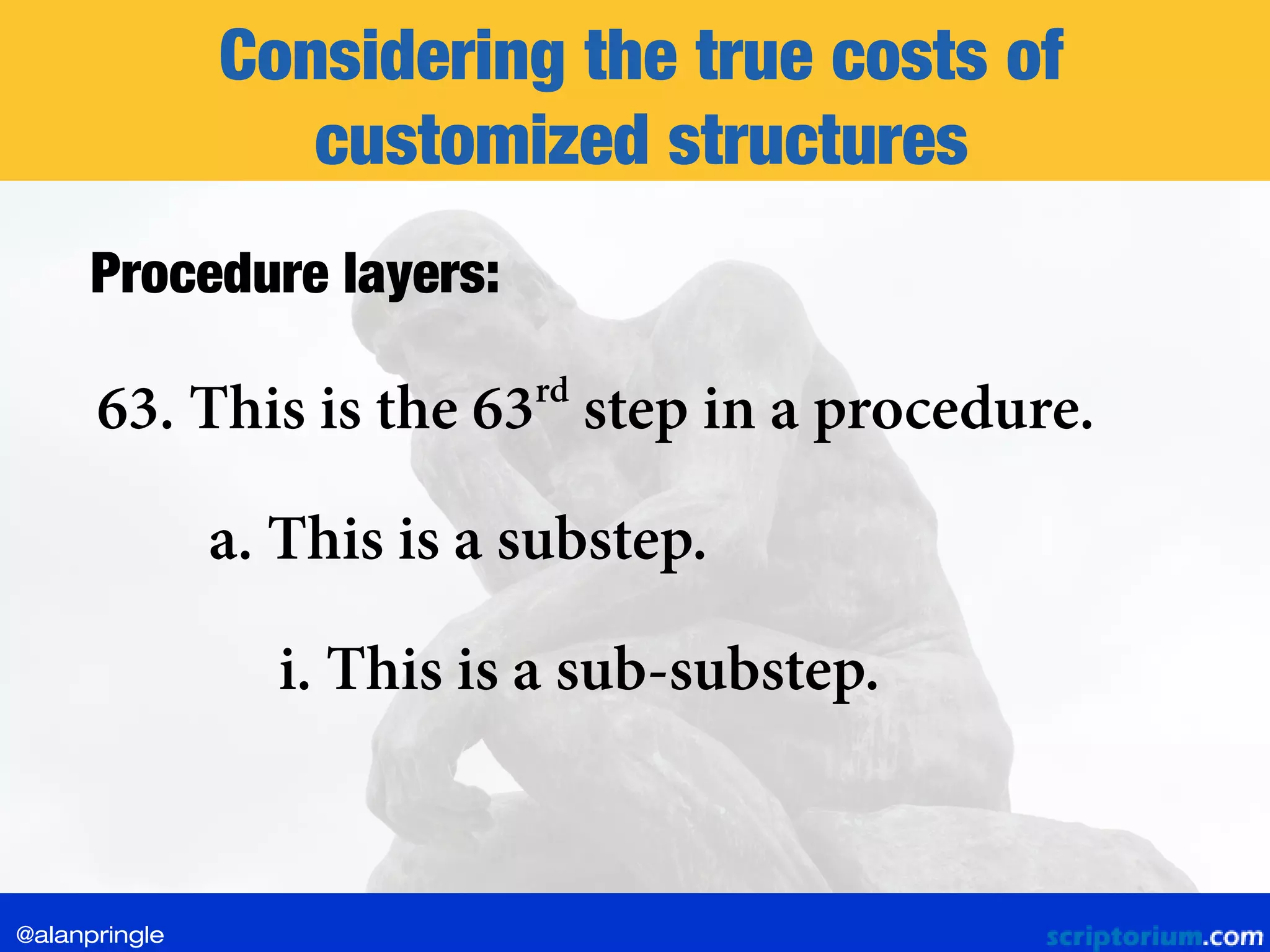
Procedure layers:
63. This is the 63rd
step in a procedure.
a. This is a substep.
i. This is a sub-substep.
@alanpringle
Considering the true costs of
customized structures
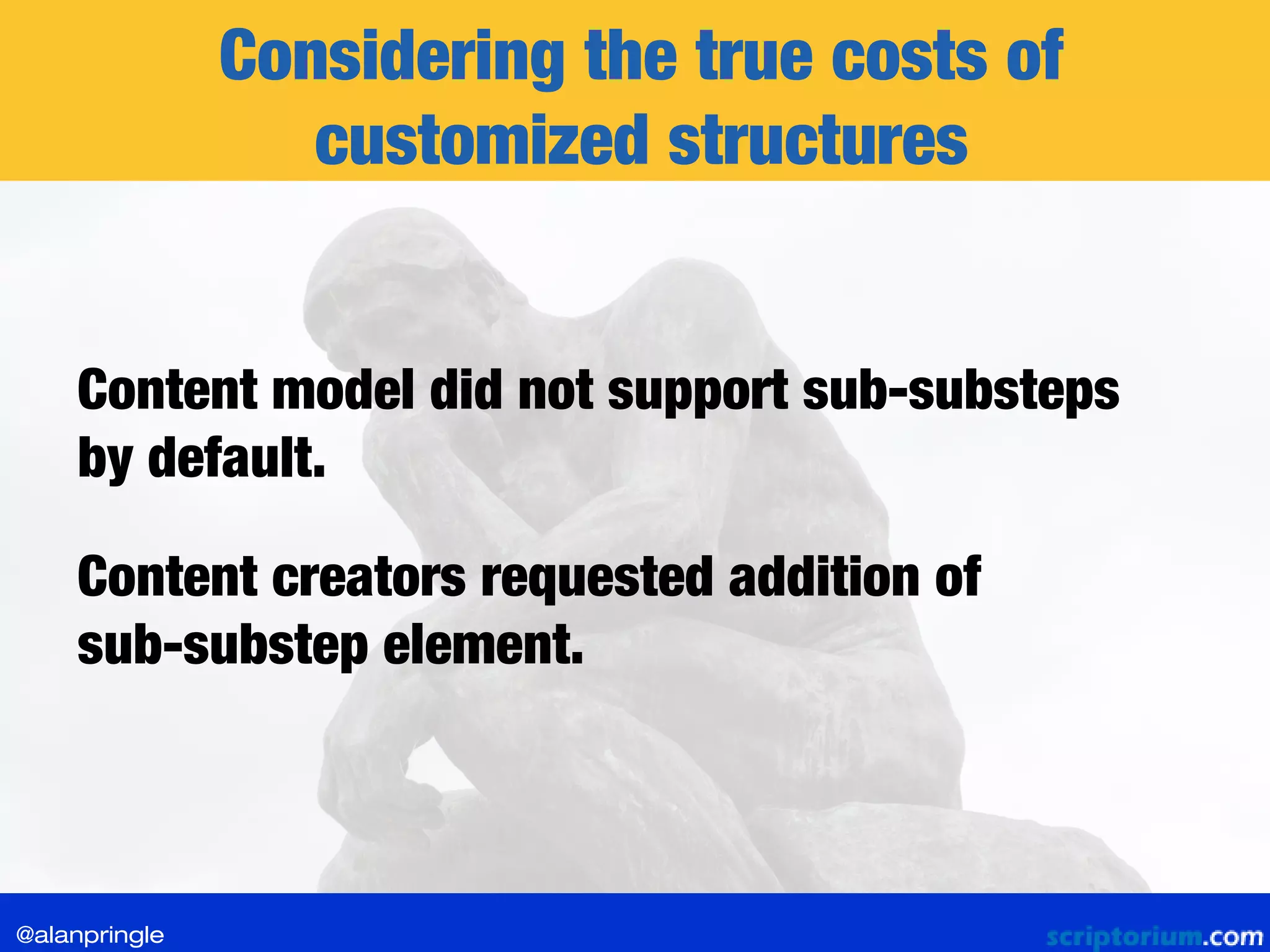
Content model did not support sub-substeps
by default.
Content creators requested addition of
sub-substep element.
@alanpringle
Considering the true costs of
customized structures
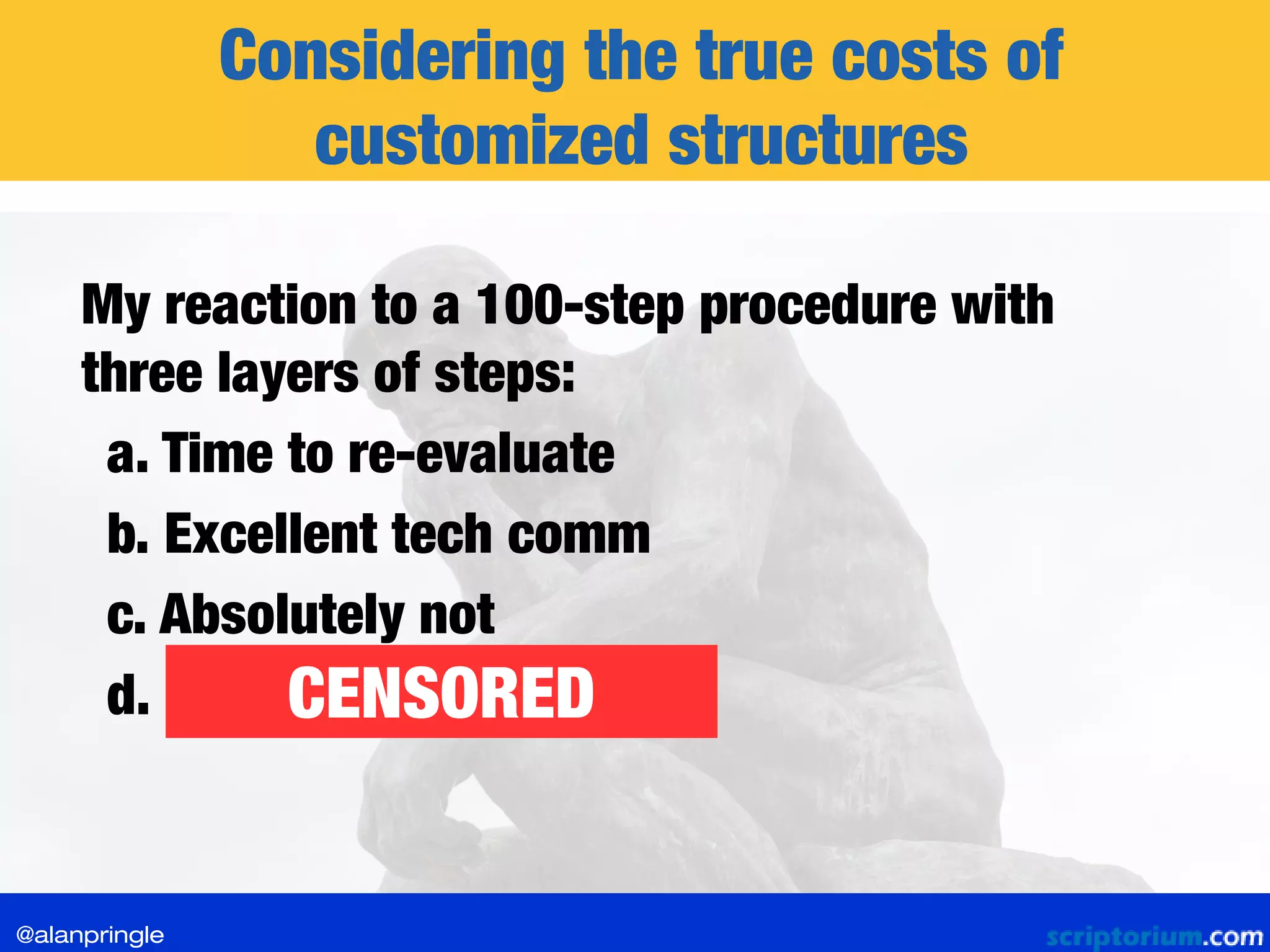
My reaction to a 100-step procedure with
three layers of steps:
a. Time to re-evaluate
b. Excellent tech comm
c. Absolutely not
d. CENSORED
@alanpringle
Considering the true costs of
customized structures
Information architects: reconsider the long
procedures and sub-substeps.
Level of effort: modifying versus
maintaining default structure.
@alanpringle
Please.
Considering the true costs of
customized structures
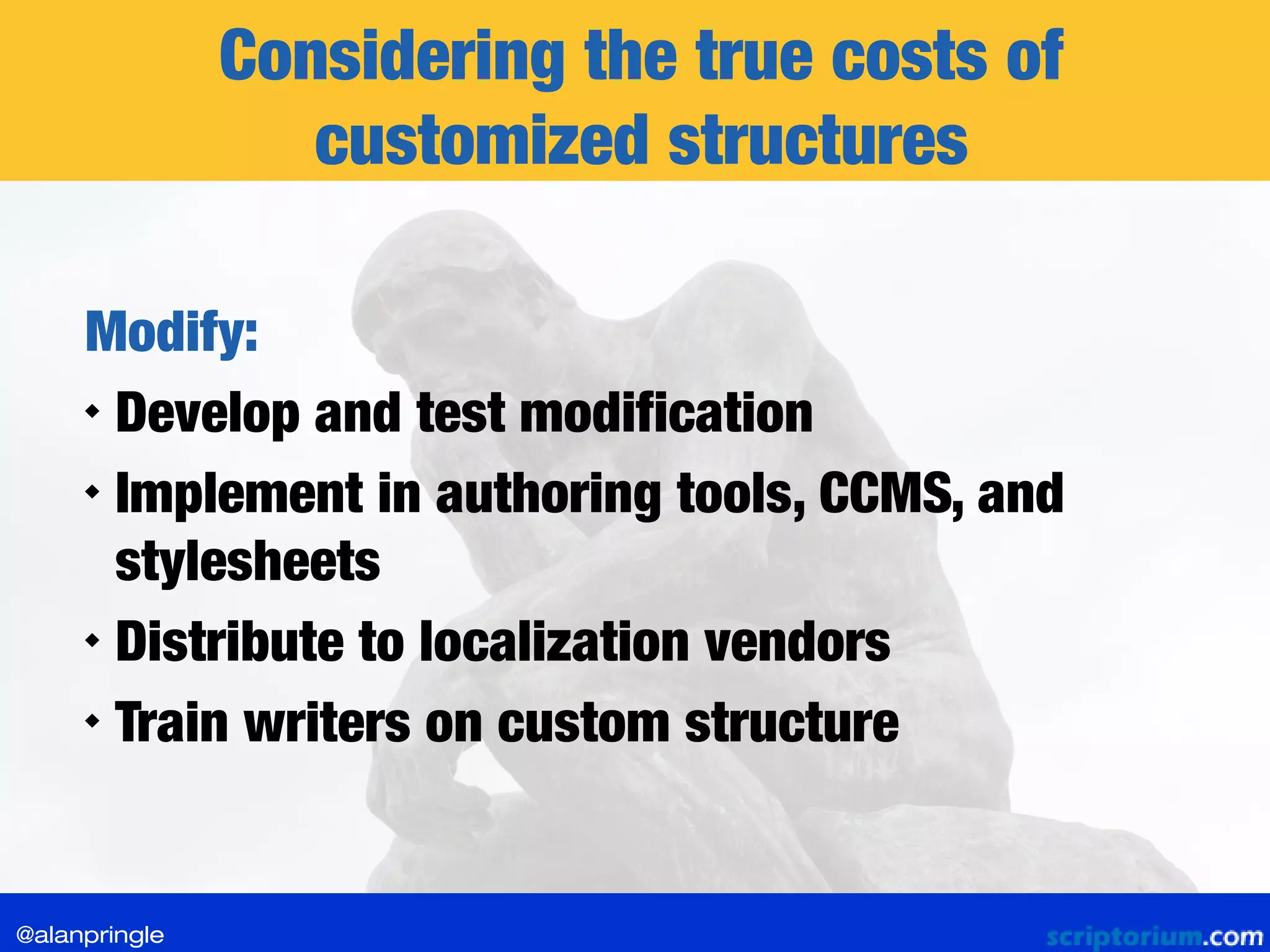
Modify:

Develop and test modification

Implement in authoring tools, CCMS, and
stylesheets

Distribute to localization vendors

Train writers on custom structure
@alanpringle
Considering the true costs of
customized structures
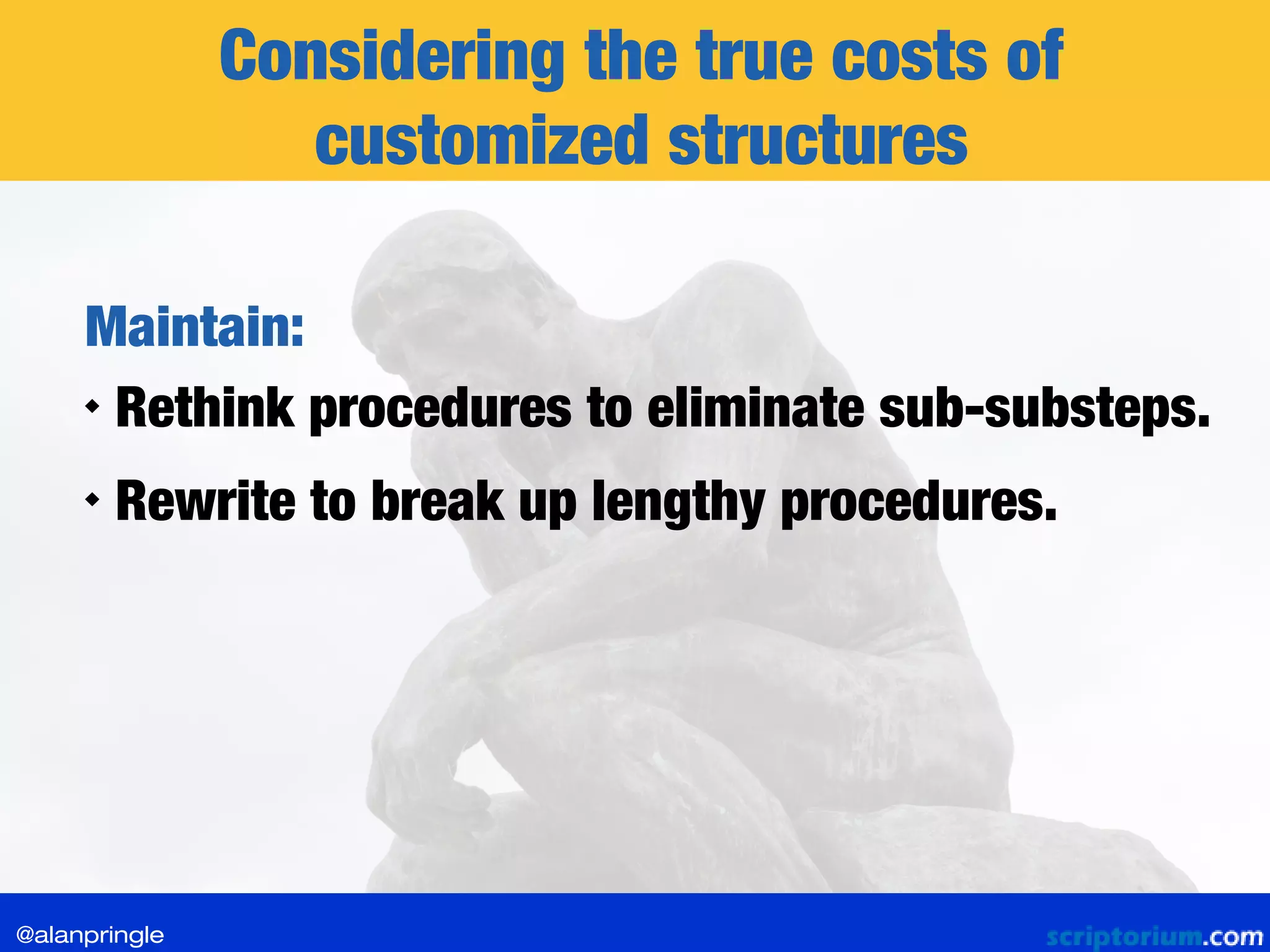
Maintain:

Rethink procedures to eliminate sub-substeps.

Rewrite to break up lengthy procedures.
@alanpringle
Considering the true costs of
customized structures
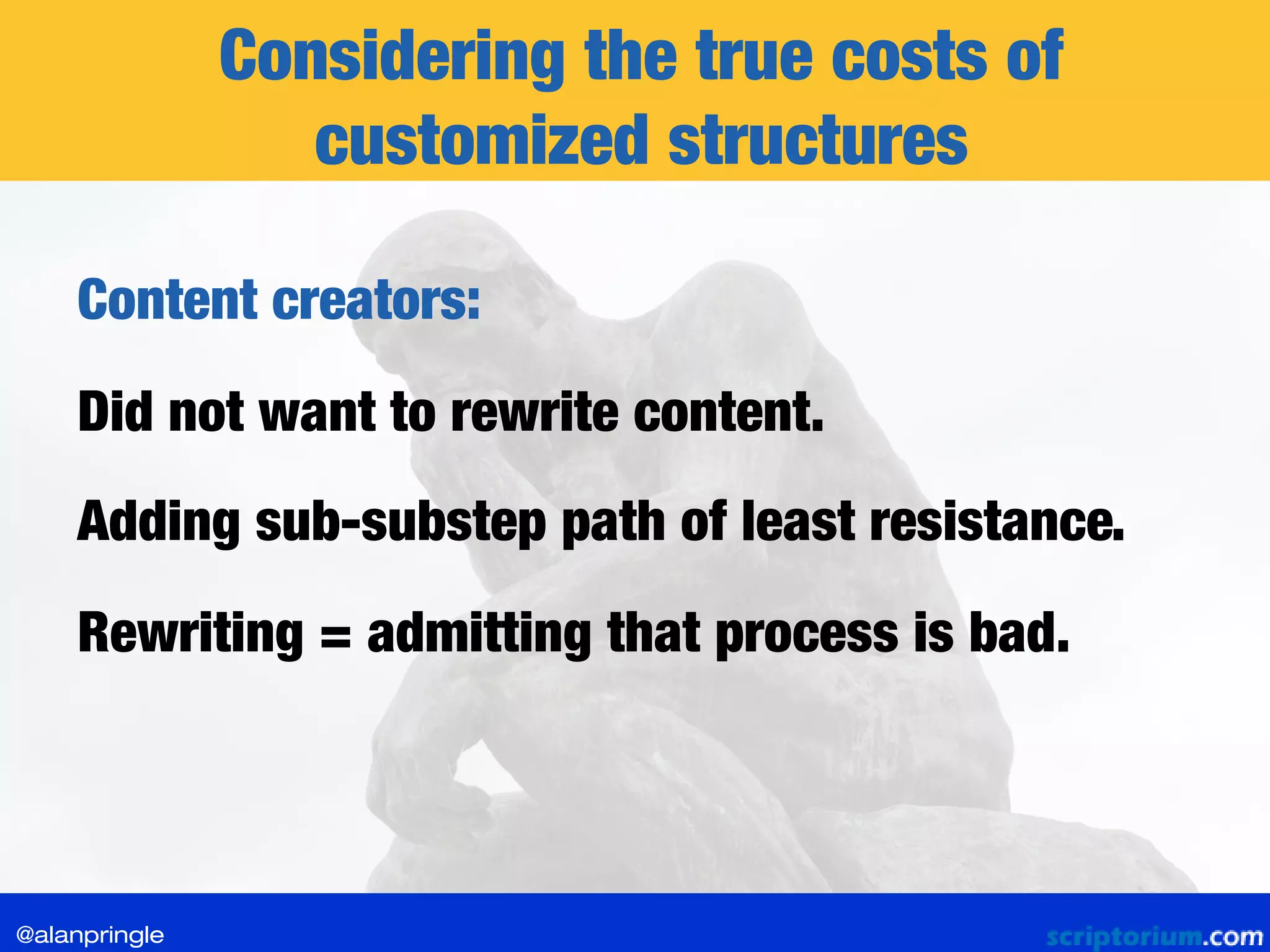
Content creators:
Did not want to rewrite content.
Adding sub-substep path of least resistance.
Rewriting = admitting that process is bad.
@alanpringle
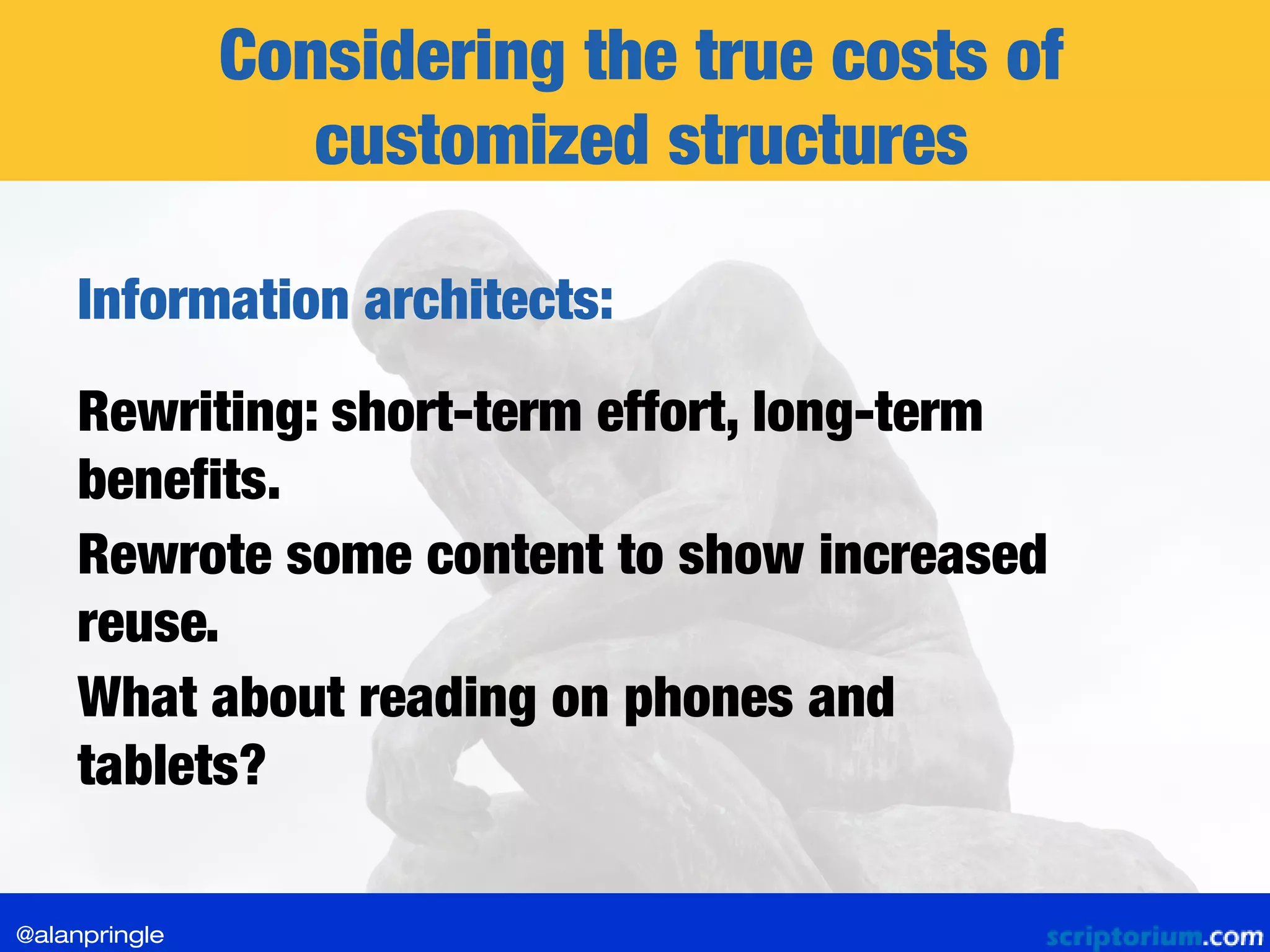
Considering the true costs of
customized structures
Information architects:
Rewriting: short-term effort, long-term
benefits.
Rewrote some content to show increased
reuse.
What about reading on phones and
tablets?
@alanpringle
Considering the true costs of
customized structures
@alanpringle
Considering the true costs of
customized structures
No agreement on approach.
Company planned to re-evaluate later.
Not every consulting engagement has a
happy ending.
@alanpringle
Conclusions
Streamline communication with technology.
Evaluate costs and biases while considering
structural changes.
Get benefits of structure and flexible
formatting.
@alanpringle
Conclusions
Technical ≠ not creative
Need versus want
@alanpringle
Resources
PDF specifications (Word file)
tiny.cc/PDFsettings
Managing change (Content Strategy 101)
tiny.cc/manage-change
InDesign XML
InDesign & DITA post: tiny.cc/indesign-dita
IDML specifications (PDF): tiny.cc/idml
@alanpringle
Resources
Case study summaries:
tiny.cc/balancing-case-studies
@alanpringle
Flickr: Veronique Debord
Questions?
Comments?
@alanpringle
Contact me
Alan Pringle
asp@scriptorium.com
scriptorium.com/blog
@alanpringle

Webcast: Balancing standardization against the need for creativity

  • 1.
    Balancing standardization against theneed for creativity Flickr: Paxson Woelber Alan Pringle Scriptorium August 3, 2016 @alanpringle
  • 2.
    Type questions and commentsin the Questions module of GoToWebinar. Questions? Comments? Flickr: Veronique Debord Attendees are muted during webcast. Webcast is being recorded, but your name won't be shown. @alanpringle
  • 3.
    About me Chief operatingofficer, Scriptorium Publishing Working with structured content since 1988 Coauthor, Content Strategy 101 and Technical Writing 101 @alanpringle
  • 4.
  • 5.
    Stereotype of structuredauthoring Flickr: Umberto Salvagnin No creativity! @alanpringle
  • 6.
    Three case studies Communicatinglayout specifications for automated outputs Considering the true costs of customized structures Flexibility in layout as a business requirement @alanpringle
  • 7.
    Flickr: State Libraryand Archives of Florida Communicating layout specifications for automated output @alanpringle
  • 8.
    Communicating layout specificationsfor automated output @alanpringle
  • 9.
    Communicating layout specificationsfor automated output <xsl:variable name="level-1-family">SansBold</xsl:variable> <xsl:variable name="level-1-size">14pt</xsl:variable> <xsl:variable name="level-1-line-height">15pt</xsl:variable> <xsl:variable name="level-1-weight">normal</xsl:variable> <xsl:variable name="level-1-style">normal</xsl:variable> <xsl:variable name="level-1-indent">0pt</xsl:variable> <xsl:variable name="level-1-color">#000000</xsl:variable> <xsl:variable name="level-1-space-before">42pt</xsl:variable> <xsl:variable name="level-1-space-after">4pt</xsl:variable> Settings for heading 1 paragraphs: @alanpringle
  • 10.
    Communicating layout specificationsfor automated output Typical workflow for automated PDF output @alanpringle
  • 11.
    Communicating layout specificationsfor automated output Programmer develops stylesheet in text/XML editor. Code specifies page size, font use, and so on. @alanpringle
  • 12.
    Communicating layout specificationsfor automated output <xsl:variable name="level-1-family">SansBold</xsl:variable> <xsl:variable name="level-1-size">14pt</xsl:variable> <xsl:variable name="level-1-line-height">15pt</xsl:variable> <xsl:variable name="level-1-weight">normal</xsl:variable> <xsl:variable name="level-1-style">normal</xsl:variable> <xsl:variable name="level-1-indent">0pt</xsl:variable> <xsl:variable name="level-1-color">#000000</xsl:variable> <xsl:variable name="level-1-space-before">42pt</xsl:variable> <xsl:variable name="level-1-space-after">4pt</xsl:variable> @alanpringle
  • 13.
    Communicating layout specificationsfor automated output Any changes? “Change the heading color to our new corporate blue.” “Make the chapter heading a little bigger.” Programmer gets specifications from template. @alanpringle
  • 14.
    Communicating layout specificationsfor automated output Developed process that relies on... stylesheets! Programmer added detailed code comments. Programmatic formatting requires specific numbers. How do you collect them? @alanpringle
  • 15.
    Communicating layout specificationsfor automated output Sample code comment for page size: Physical page dimensions. US Letter is 8.5 in x 11 in; A4 is 8.3 in × 11.7 in. Dimensions that accommodate both paper sizes are 8.3 in x 11.0 in. @alanpringle
  • 16.
    Communicating layout specificationsfor automated output Extract code comments and create Word file: @alanpringle
  • 17.
    Communicating layout specificationsfor automated output Designer fills out settings and returns file. Programmer gets specific measurements. Code comments serve as reference for later maintenance. @alanpringle
  • 18.
    Flexibility in layoutas a business requirement Flickr: Creative-Tools.com @alanpringle
  • 19.
    Flexibility in layoutas a business requirement Automated PDF formatting is not for all information types. Highly designed study guides required greater flexibility in layout. How do you preserve high-quality layouts for print? @alanpringle
  • 20.
    Flexibility in layoutas a business requirement Transform source XML into InDesign- compatible XML. XML refers to styles in the InDesign template. @alanpringle
  • 21.
    Flexibility in layoutas a business requirement <ParagraphStyleRange AppliedParagraphStyle="ParagraphStyle/body"> <CharacterStyleRange AppliedCharacterStyle="CharacterStyle/ $ID/[No character style]"> <Content>When developing a test bed, it is important to ensure that you cover </Content> </CharacterStyleRange> <CharacterStyleRange AppliedCharacterStyle="CharacterStyle/bold"> <Content>all </Content> </CharacterStyleRange> <CharacterStyleRange AppliedCharacterStyle="CharacterStyle/ $ID/[No character style]"> <Content>basic cases for your requirements.</Content> </CharacterStyleRange> ... </ParagraphStyleRange> InDesign Markup Language (IDML) sample: @alanpringle
  • 22.
    Flexibility in layoutas a business requirement Place XML file into InDesign template. Styles and other formatting applied automatically: @alanpringle
  • 23.
    Flexibility in layoutas a business requirement @alanpringle Wikipedia: Guma89
  • 24.
    Flexibility in layoutas a business requirement Adjust line breaks, pagination, image placement, and so on. Reduced production time significantly. Get benefits of structured content (reuse, in particular). @alanpringle
  • 25.
    Considering the truecosts of customized structures Flickr: Japanexperterna.se @alanpringle
  • 26.
    Considering the truecosts of customized structures Standardization versus creativity is not just about layout. Create custom structure? Adopt standard? When should you change a standard's default structures? @alanpringle
  • 27.
    Considering the truecosts of customized structures Implement XML for conditional content, mobile delivery, and localization. Installation guides: procedures with more than 100 steps. Steps could contain substeps and sub-substeps. @alanpringle
  • 28.
    Considering the truecosts of customized structures Procedure layers: 63. This is the 63rd step in a procedure. a. This is a substep. i. This is a sub-substep. @alanpringle
  • 29.
    Considering the truecosts of customized structures Content model did not support sub-substeps by default. Content creators requested addition of sub-substep element. @alanpringle
  • 30.
    Considering the truecosts of customized structures My reaction to a 100-step procedure with three layers of steps: a. Time to re-evaluate b. Excellent tech comm c. Absolutely not d. CENSORED @alanpringle
  • 31.
    Considering the truecosts of customized structures Information architects: reconsider the long procedures and sub-substeps. Level of effort: modifying versus maintaining default structure. @alanpringle Please.
  • 32.
    Considering the truecosts of customized structures Modify:  Develop and test modification  Implement in authoring tools, CCMS, and stylesheets  Distribute to localization vendors  Train writers on custom structure @alanpringle
  • 33.
    Considering the truecosts of customized structures Maintain:  Rethink procedures to eliminate sub-substeps.  Rewrite to break up lengthy procedures. @alanpringle
  • 34.
    Considering the truecosts of customized structures Content creators: Did not want to rewrite content. Adding sub-substep path of least resistance. Rewriting = admitting that process is bad. @alanpringle
  • 35.
    Considering the truecosts of customized structures Information architects: Rewriting: short-term effort, long-term benefits. Rewrote some content to show increased reuse. What about reading on phones and tablets? @alanpringle
  • 36.
    Considering the truecosts of customized structures @alanpringle
  • 37.
    Considering the truecosts of customized structures No agreement on approach. Company planned to re-evaluate later. Not every consulting engagement has a happy ending. @alanpringle
  • 38.
    Conclusions Streamline communication withtechnology. Evaluate costs and biases while considering structural changes. Get benefits of structure and flexible formatting. @alanpringle
  • 39.
    Conclusions Technical ≠ notcreative Need versus want @alanpringle
  • 40.
    Resources PDF specifications (Wordfile) tiny.cc/PDFsettings Managing change (Content Strategy 101) tiny.cc/manage-change InDesign XML InDesign & DITA post: tiny.cc/indesign-dita IDML specifications (PDF): tiny.cc/idml @alanpringle
  • 41.
  • 42.
  • 43.