Translation Integration into the Documentation Process:Translation Integration into the Documentation Process:
Embracing the ChallengeEmbracing the Challenge
Vyacheslav Guzovsky
March 2015
About the presentation
• How the documentation process
and the translation process affect each
other?
• Where are the bottle-necks in
the workflow?
• How can we merge the two so that
our customers can meet their goals?
Who will benefit?
• Translators/interpreters
• Translation & localization teams
• Content creators
• Project managers
Agenda
• Translation as part of content
management
• Documentation process: shifting
priorities vs. meeting deadlines
• Writing for translation
• Understanding the target culture
• Translation integration: impact of
change
Embracing the challenge
• Most organizations will shrink or disappear
in the long term: only a third of excellent
companies remain excellent for decades,
as economic, political, social and
technological change continue to
accelerate, and competitive pressure grows
more intense. (Scott Keller & Colin Price)
Embracing the challenge
• In 2000, there were 360.985.492 people online.
In 2010, we passed 2 billion ... most of the new
users don't speak English. (Internet World Stats)
• The Internet has tripled the amount of text read by
people. In 2009 on average every US citizen
received 12.5 GB worth of text, equivalent to 12
pick-up trucks filled with books. (IDC)
• When making a purchase, only 15% purchasers
are comfortable buying online in non-native
language. (Common Sense Advisory)
What’s trending?
• Transition from project orientation to
content stream orientation
• Increasing integration of machine translation

• Increasing emphasis on velocity rather than
price or quality
• Increasing reliance on global single
language vendor partners
Areas of concern
Areas of concern
• Ridiculous deadlines
• Ambiguities in source text
• Misapplied machine translation
• No proofreading by a native speaker
• No client input
• Poor coordination of large projects
Going global
Going global
• Promise of new technology
• Workflow automation
• Machine translation
• Open market projects
• Virtual teams
• Community translation
Feeling like this?
How bad are our projects?
• Only 32% of all projects succeed
• The average project has 43% cost
overrun
What’s your project?
Translation process
Translation process
• Client inputs
• Translation
• Integration
• Quality check
• Final submission
Content creation
Documentation process
Why integration?
Benefits vs. downsides
Benefits:
• Simultaneous global releases
• High quality products meeting the
needs of all customers
• Improved perception of customer service
Downside:
• Short-term loss of revenue on a
project
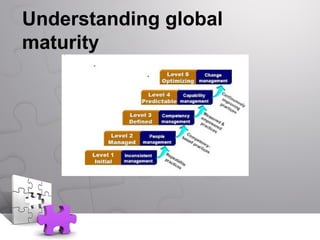
Understanding global
maturity
Understanding global
maturity
• Organization
• Process
• Product
• Documentation
Integration tools
Integration tools
• Start with a pilot project, set up metrics
• Educate the documentation team
• Efficient interface with clients
• Early involvement of project managers
• Early review of templates, terminology
• Split the translation into modules
Writing for translation
• Message and scope
• Layout
• Your copy
• Formatting
• Timelines
• Partnering with vendors
Understanding the culture
• Names and titles
• Images and colors
• Government assigned numbers
• Addresses and postal codes
• Currency
• Weights and measures
Understanding the culture
Benefits of change
Benefits of change
• Faster times to market
• Fewer cultural issues
• Improved customer service
• Larger market share
Benefits of change
Questions?
References
1. About Translation. <http://www.aboutranslation.com/>
2. Center for Information-Development Management. <http://infomanagementcenter.com/>
3. Common Sense Advisory. <http://www.commonsenseadvisory.com/>
4. Globalization and Localization Association. <http://www.gala-global.org/>
5. European Language Industry Association. <http://www.elia-association.org/>
6. MultiLingual. <http://www.multilingual.com/>
7. Multilingual Matters. <http://www.multilingual-matters.com/>
8. ProZ.com Translation Article Knowledgebase. <http://www.proz.com/translation-articles/>
9. The Institute of Localization Professionals. <http://www.tilponline.net/>
Helping customers to succeed
• Thinking international from the start?
• Translation vs. interpreting?
• Does it really need to be translated?
• How much will the translation cost?
• How important is the style?
• Finalizing before the translation starts?
Helping customers to
succeed
• What about translation software?
• Telling the translator what it’s for?
• Knowing the subject inside out?
• Having typeset copy proofread?
• Do you know that typography varies?
• Producing an in-house glossary?
Translation_integration_into_the_documentation_process_en

Translation_integration_into_the_documentation_process_en

  • 1.
    Translation Integration intothe Documentation Process:Translation Integration into the Documentation Process: Embracing the ChallengeEmbracing the Challenge Vyacheslav Guzovsky March 2015
  • 2.
    About the presentation •How the documentation process and the translation process affect each other? • Where are the bottle-necks in the workflow? • How can we merge the two so that our customers can meet their goals?
  • 3.
    Who will benefit? •Translators/interpreters • Translation & localization teams • Content creators • Project managers
  • 4.
    Agenda • Translation aspart of content management • Documentation process: shifting priorities vs. meeting deadlines • Writing for translation • Understanding the target culture • Translation integration: impact of change
  • 5.
    Embracing the challenge •Most organizations will shrink or disappear in the long term: only a third of excellent companies remain excellent for decades, as economic, political, social and technological change continue to accelerate, and competitive pressure grows more intense. (Scott Keller & Colin Price)
  • 6.
    Embracing the challenge •In 2000, there were 360.985.492 people online. In 2010, we passed 2 billion ... most of the new users don't speak English. (Internet World Stats) • The Internet has tripled the amount of text read by people. In 2009 on average every US citizen received 12.5 GB worth of text, equivalent to 12 pick-up trucks filled with books. (IDC) • When making a purchase, only 15% purchasers are comfortable buying online in non-native language. (Common Sense Advisory)
  • 7.
    What’s trending? • Transitionfrom project orientation to content stream orientation • Increasing integration of machine translation • Increasing emphasis on velocity rather than price or quality • Increasing reliance on global single language vendor partners
  • 8.
  • 9.
    Areas of concern •Ridiculous deadlines • Ambiguities in source text • Misapplied machine translation • No proofreading by a native speaker • No client input • Poor coordination of large projects
  • 10.
  • 11.
    Going global • Promiseof new technology • Workflow automation • Machine translation • Open market projects • Virtual teams • Community translation
  • 12.
  • 13.
    How bad areour projects? • Only 32% of all projects succeed • The average project has 43% cost overrun
  • 14.
  • 15.
  • 16.
  • 17.
  • 18.
    Translation process • Clientinputs • Translation • Integration • Quality check • Final submission
  • 19.
  • 20.
  • 21.
  • 22.
    Benefits vs. downsides Benefits: •Simultaneous global releases • High quality products meeting the needs of all customers • Improved perception of customer service Downside: • Short-term loss of revenue on a project
  • 23.
  • 24.
    Understanding global maturity • Organization •Process • Product • Documentation
  • 25.
  • 26.
    Integration tools • Startwith a pilot project, set up metrics • Educate the documentation team • Efficient interface with clients • Early involvement of project managers • Early review of templates, terminology • Split the translation into modules
  • 27.
  • 28.
    Writing for translation •Message and scope • Layout • Your copy • Formatting • Timelines • Partnering with vendors
  • 29.
  • 30.
    Understanding the culture •Names and titles • Images and colors • Government assigned numbers • Addresses and postal codes • Currency • Weights and measures
  • 31.
  • 32.
  • 33.
    Benefits of change •Faster times to market • Fewer cultural issues • Improved customer service • Larger market share
  • 34.
  • 35.
  • 36.
    References 1. About Translation.<http://www.aboutranslation.com/> 2. Center for Information-Development Management. <http://infomanagementcenter.com/> 3. Common Sense Advisory. <http://www.commonsenseadvisory.com/> 4. Globalization and Localization Association. <http://www.gala-global.org/> 5. European Language Industry Association. <http://www.elia-association.org/> 6. MultiLingual. <http://www.multilingual.com/> 7. Multilingual Matters. <http://www.multilingual-matters.com/> 8. ProZ.com Translation Article Knowledgebase. <http://www.proz.com/translation-articles/> 9. The Institute of Localization Professionals. <http://www.tilponline.net/>
  • 39.
    Helping customers tosucceed • Thinking international from the start? • Translation vs. interpreting? • Does it really need to be translated? • How much will the translation cost? • How important is the style? • Finalizing before the translation starts?
  • 40.
    Helping customers to succeed •What about translation software? • Telling the translator what it’s for? • Knowing the subject inside out? • Having typeset copy proofread? • Do you know that typography varies? • Producing an in-house glossary?