Beyond correct spelling, grammar, and syntax, technical translation often involves
highly specific terminology – the accuracy of which can be critical to the health and
safety of the local target market. This resource highlights key aspects of preparing
your technical materials for translation, and enlisting a translation team with the
linguistic skills, subject matter expertise, and cultural knowledge needed for
successful technical translation.
An expert translator is not all that’s
needed for effective technical
translation. The first step is to have a
basic grasp of your target audience
and their culture. Research what is
and isn’t commonplace in that
particular culture when preparing
both marketing communications and
more crucial technical materials in the
fields of engineering, science, and
medicine. This may require working
with a team of experts specialized in
your subject matter as well as
localization.
Once you have an understanding of basic cultural
differences and similarities, it’s time to begin
preparing the document for translation. Keep
these tips in mind:
• Avoid using expressions or idioms if you
aren’t one-hundred percent sure they
pertain to your target audience. Particularly
with technical writing, the last thing you
want is critical information lost in
translation.
• Use an international format for phone and
fax numbers in order to save time and
money during the translation process, and to
avoid ambiguity.
• Don’t highlight facts or case studies that are
local to you in the document, unless they
also matter to your target audience.
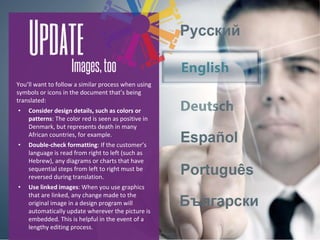
You’ll want to follow a similar process when using
symbols or icons in the document that’s being
translated:
• Consider design details, such as colors or
patterns: The color red is seen as positive in
Denmark, but represents death in many
African countries, for example.
• Double-check formatting: If the customer’s
language is read from right to left (such as
Hebrew), any diagrams or charts that have
sequential steps from left to right must be
reversed during translation.
• Use linked images: When you use graphics
that are linked, any change made to the
original image in a design program will
automatically update wherever the picture is
embedded. This is helpful in the event of a
lengthy editing process.
When hiring, look for a company that offers a
network of native-speaking professional
translators, interpreters, and subject matter
experts. TrueLanguage employs a pool of
highly skilled language professionals to deliver
consistent, top-quality service at a reasonable
cost. TrueLanguage is also:
• ISO-9001 certified
• WBENC certified
• Based conveniently in the United States
(Atlanta), with language resources all
around the world
Make sure you can build a good working
relationship with the translator you hire. In
order to guarantee the best possible quality
in your translation output:
• Provide your translation service with
information about your company and
industry, so they can become familiar
with any specific technical terminology
you want to use.
• Set up regular meetings to ensure
timely turnaround and check-ins during
the process. Look for a company that
offers project management, preferably
located in the United States. Centralized
project management eliminates the
hassle of foreign time zones and makes
for a more responsive experience.
Make sure the translator has everything needed
to make the process as stress-free as possible.
• Provide original (source) files: If the
documents were created in Microsoft Word,
provide the original Word files. If they were
created in a design program, like InDesign,
provide those files too. Note: PDFs are not
source files.
• Supply original graphics, too: Technical
documents often include images and
screenshots including embedded text. Always
provide editable images of this nature to the
translator.
• What if there are no source files?: If no
source files are provided, images often need
to be recreated and text has to be re-keyed.
Technical translation services typically have
the bandwidth to handle re-creating a
document; it will simply lead to an increase in
overall project time and cost.
Don’t let all your meticulous
preparation go to waste in the final
stages of your project. It’s important
to use a translation service that has
built-in quality assurance checkpoints.
Look for a service that offers an
internal review process focused on
editing and proofreading, as well as
authentic localization. After this, you
can confidently review your project
with your team for approval.
TrueLanguage uses the latest technology and a network of professional
translators and subject matter experts to provide accurate, localized translation
in over 60 languages. We translate marketing communications, legal documents,
technical materials, internal communications, and more. To learn how easy it is
to do business with us, visit www.truelanguage.com or call 1-888-926-9245.
Summary
When translating technical writing for your local
target audience, accuracy is crucial. Follow
these tips for obtaining exceptional translation
results for any type of technical project. Enlist
only a highly-experienced team with the skills to
localize your content, provide quality assurance,
and keep your project on track and on budget.

Keys to successful technical translation

  • 2.
    Beyond correct spelling,grammar, and syntax, technical translation often involves highly specific terminology – the accuracy of which can be critical to the health and safety of the local target market. This resource highlights key aspects of preparing your technical materials for translation, and enlisting a translation team with the linguistic skills, subject matter expertise, and cultural knowledge needed for successful technical translation.
  • 3.
    An expert translatoris not all that’s needed for effective technical translation. The first step is to have a basic grasp of your target audience and their culture. Research what is and isn’t commonplace in that particular culture when preparing both marketing communications and more crucial technical materials in the fields of engineering, science, and medicine. This may require working with a team of experts specialized in your subject matter as well as localization.
  • 4.
    Once you havean understanding of basic cultural differences and similarities, it’s time to begin preparing the document for translation. Keep these tips in mind: • Avoid using expressions or idioms if you aren’t one-hundred percent sure they pertain to your target audience. Particularly with technical writing, the last thing you want is critical information lost in translation. • Use an international format for phone and fax numbers in order to save time and money during the translation process, and to avoid ambiguity. • Don’t highlight facts or case studies that are local to you in the document, unless they also matter to your target audience.
  • 5.
    You’ll want tofollow a similar process when using symbols or icons in the document that’s being translated: • Consider design details, such as colors or patterns: The color red is seen as positive in Denmark, but represents death in many African countries, for example. • Double-check formatting: If the customer’s language is read from right to left (such as Hebrew), any diagrams or charts that have sequential steps from left to right must be reversed during translation. • Use linked images: When you use graphics that are linked, any change made to the original image in a design program will automatically update wherever the picture is embedded. This is helpful in the event of a lengthy editing process.
  • 6.
    When hiring, lookfor a company that offers a network of native-speaking professional translators, interpreters, and subject matter experts. TrueLanguage employs a pool of highly skilled language professionals to deliver consistent, top-quality service at a reasonable cost. TrueLanguage is also: • ISO-9001 certified • WBENC certified • Based conveniently in the United States (Atlanta), with language resources all around the world
  • 7.
    Make sure youcan build a good working relationship with the translator you hire. In order to guarantee the best possible quality in your translation output: • Provide your translation service with information about your company and industry, so they can become familiar with any specific technical terminology you want to use. • Set up regular meetings to ensure timely turnaround and check-ins during the process. Look for a company that offers project management, preferably located in the United States. Centralized project management eliminates the hassle of foreign time zones and makes for a more responsive experience.
  • 8.
    Make sure thetranslator has everything needed to make the process as stress-free as possible. • Provide original (source) files: If the documents were created in Microsoft Word, provide the original Word files. If they were created in a design program, like InDesign, provide those files too. Note: PDFs are not source files. • Supply original graphics, too: Technical documents often include images and screenshots including embedded text. Always provide editable images of this nature to the translator. • What if there are no source files?: If no source files are provided, images often need to be recreated and text has to be re-keyed. Technical translation services typically have the bandwidth to handle re-creating a document; it will simply lead to an increase in overall project time and cost.
  • 9.
    Don’t let allyour meticulous preparation go to waste in the final stages of your project. It’s important to use a translation service that has built-in quality assurance checkpoints. Look for a service that offers an internal review process focused on editing and proofreading, as well as authentic localization. After this, you can confidently review your project with your team for approval.
  • 10.
    TrueLanguage uses thelatest technology and a network of professional translators and subject matter experts to provide accurate, localized translation in over 60 languages. We translate marketing communications, legal documents, technical materials, internal communications, and more. To learn how easy it is to do business with us, visit www.truelanguage.com or call 1-888-926-9245.
  • 11.
    Summary When translating technicalwriting for your local target audience, accuracy is crucial. Follow these tips for obtaining exceptional translation results for any type of technical project. Enlist only a highly-experienced team with the skills to localize your content, provide quality assurance, and keep your project on track and on budget.