METHODS OF
COMMUNICATION
Dr. Abhishek Tiwari, MD
Assistant Professor
Department of Community Medicine
Learning objectives
â—Ź To understand the process & types of communication
â—Ź Its components
â—Ź Different skills of communication
â—Ź Barriers
â—Ź Application
Introduction
● Communication “To share meaning and understanding
between the person sending the message and the person
receiving the message”
â—Ź Verbal & Non-verbal
â—Ź Verbal - the tone of voice can communicate feelings and
emotions that are as significant as the words being spoken
Communication Process
â—Ź Definition
â—Ź Types
â—Ź Components of process
â—Ź Communication skills
â—Ź Barriers
Components of communication process
â—Ź The Sender
â—Ź The Receiver
â—Ź The Message
â—Ź The Channel
â—Ź Encoding / Decoding / Feedback
Communication Skills
â—Ź Definition
â—Ź Listening with lot of intent to what the receiver wants to
convey
● Understand your “Target Audience”
â—Ź Friendliness
â—Ź Confidence
Communication Skills
â—Ź Two-way feedback
â—Ź Be understandable
â—Ź Be a good listener
â—Ź Importance of body language
â—Ź Responsiveness
Barriers in Communication
â—Ź Physiological - difficulty in hearing & speech
â—Ź Psychological - emotional disturbance
â—Ź Environmental - noise
â—Ź Cultural - illeteracy, levels of knowledge
â—Ź Semantic barrier - difference in interpretation of meaning
of words
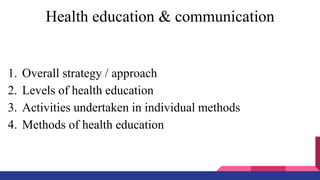
Health education & communication
1. Overall strategy / approach
2. Levels of health education
3. Activities undertaken in individual methods
4. Methods of health education
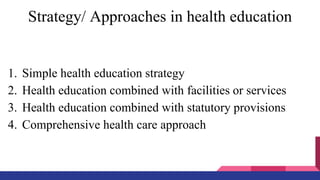
Strategy/ Approaches in health education
1. Simple health education strategy
2. Health education combined with facilities or services
3. Health education combined with statutory provisions
4. Comprehensive health care approach
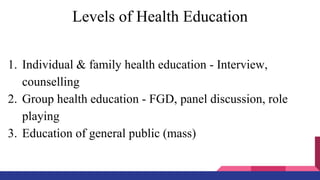
Levels of Health Education
1. Individual & family health education - Interview,
counselling
2. Group health education - FGD, panel discussion, role
playing
3. Education of general public (mass)
Health education
“Multiplicative effect”
“Ascending Education”
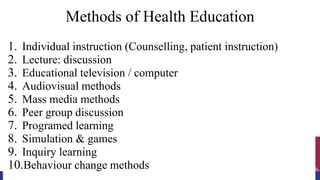
Methods of Health Education
1. Individual instruction (Counselling, patient instruction)
2. Lecture: discussion
3. Educational television / computer
4. Audiovisual methods
5. Mass media methods
6. Peer group discussion
7. Programed learning
8. Simulation & games
9. Inquiry learning
10.Behaviour change methods
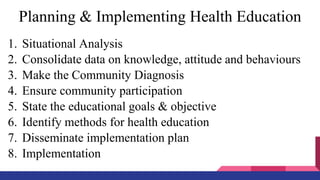
Planning & Implementing Health Education
1. Situational Analysis
2. Consolidate data on knowledge, attitude and behaviours
3. Make the Community Diagnosis
4. Ensure community participation
5. State the educational goals & objective
6. Identify methods for health education
7. Disseminate implementation plan
8. Implementation
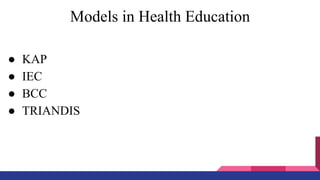
Models in Health Education
â—Ź KAP
â—Ź IEC
â—Ź BCC
â—Ź TRIANDIS
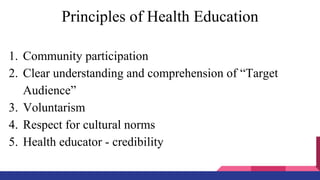
Principles of Health Education
1. Community participation
2. Clear understanding and comprehension of “Target
Audience”
3. Voluntarism
4. Respect for cultural norms
5. Health educator - credibility
Principles of Health Education
1. Evaluation & feedback
2. Accuracy
3. Reinforcement
4. Positive change
5. Hands - on
Propaganda & advocacy
Introduction
â—Ź Non-verbal

METHODS OF COMMUNICATION.pptx

  • 1.
    METHODS OF COMMUNICATION Dr. AbhishekTiwari, MD Assistant Professor Department of Community Medicine
  • 2.
    Learning objectives â—Ź Tounderstand the process & types of communication â—Ź Its components â—Ź Different skills of communication â—Ź Barriers â—Ź Application
  • 3.
    Introduction ● Communication “Toshare meaning and understanding between the person sending the message and the person receiving the message” ● Verbal & Non-verbal ● Verbal - the tone of voice can communicate feelings and emotions that are as significant as the words being spoken
  • 4.
    Communication Process â—Ź Definition â—ŹTypes â—Ź Components of process â—Ź Communication skills â—Ź Barriers
  • 5.
    Components of communicationprocess â—Ź The Sender â—Ź The Receiver â—Ź The Message â—Ź The Channel â—Ź Encoding / Decoding / Feedback
  • 6.
    Communication Skills ● Definition ●Listening with lot of intent to what the receiver wants to convey ● Understand your “Target Audience” ● Friendliness ● Confidence
  • 7.
    Communication Skills â—Ź Two-wayfeedback â—Ź Be understandable â—Ź Be a good listener â—Ź Importance of body language â—Ź Responsiveness
  • 8.
    Barriers in Communication â—ŹPhysiological - difficulty in hearing & speech â—Ź Psychological - emotional disturbance â—Ź Environmental - noise â—Ź Cultural - illeteracy, levels of knowledge â—Ź Semantic barrier - difference in interpretation of meaning of words
  • 9.
    Health education &communication 1. Overall strategy / approach 2. Levels of health education 3. Activities undertaken in individual methods 4. Methods of health education
  • 10.
    Strategy/ Approaches inhealth education 1. Simple health education strategy 2. Health education combined with facilities or services 3. Health education combined with statutory provisions 4. Comprehensive health care approach
  • 11.
    Levels of HealthEducation 1. Individual & family health education - Interview, counselling 2. Group health education - FGD, panel discussion, role playing 3. Education of general public (mass)
  • 12.
  • 13.
    Methods of HealthEducation 1. Individual instruction (Counselling, patient instruction) 2. Lecture: discussion 3. Educational television / computer 4. Audiovisual methods 5. Mass media methods 6. Peer group discussion 7. Programed learning 8. Simulation & games 9. Inquiry learning 10.Behaviour change methods
  • 14.
    Planning & ImplementingHealth Education 1. Situational Analysis 2. Consolidate data on knowledge, attitude and behaviours 3. Make the Community Diagnosis 4. Ensure community participation 5. State the educational goals & objective 6. Identify methods for health education 7. Disseminate implementation plan 8. Implementation
  • 15.
    Models in HealthEducation â—Ź KAP â—Ź IEC â—Ź BCC â—Ź TRIANDIS
  • 16.
    Principles of HealthEducation 1. Community participation 2. Clear understanding and comprehension of “Target Audience” 3. Voluntarism 4. Respect for cultural norms 5. Health educator - credibility
  • 17.
    Principles of HealthEducation 1. Evaluation & feedback 2. Accuracy 3. Reinforcement 4. Positive change 5. Hands - on Propaganda & advocacy
  • 19.