Health Planning Nayyar Raza Kazmi MBBS, DHPM, MPH, M.Sc
What is Planning and Development Planning is Optimal Use of Scarce Resources Development means ''improvement in a country's economic and social conditions''. More specifically, it refers to improvements in ways of managing an area's natural and human resources in order to create wealth and improve people's lives
Levels of Planning Strategic Planning Deals with broader level policy paradigms. Development of Vision, Mission, Values and Strategies Operational Planning Deals with development of Programs and Projects Deals with operationalization of Policy Plans
Strategic Planning Deals with Vision, Mission, Values and Strategies of an Organization Vision: Where do you see yourself in future Mission: Where is the organization today, why it exists Values: reflects the organization culture and priorities
Approaches to Strategic Planning There are many approaches to strategic planning but typically a three-step process may be used: Situation  - evaluate the current situation and how it came about.  Target  - define goals and/or objectives (sometimes called ideal state)  Path  - map a possible route to the goals/objectives
One alternative approach is called  Draw-See-Think Draw  - what is the ideal image or the desired end state?  See  - what is today's situation? What is the gap from ideal and why?  Think  - what specific actions must be taken to close the gap between today's situation and the ideal state?  Plan  - what resources are required to execute the activities?
An alternative to the  Draw-See-Think  approach is called  See-Think-Draw See  - what is today's situation?  Think  - define goals/objectives  Draw  - map a route to achieving the goals/objectives
Strategic Planning


In a given budget of Rs.100,000 How would you improve the health of mothers and children under 5 in a catchment population of 5000.
 
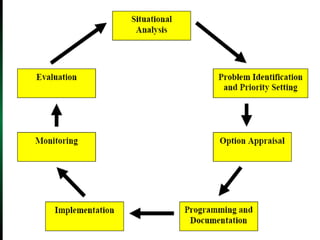
Situational Analysis Situational Analysis refers to the systemic collection, analysis and interpretation of data related to health events in a given geographical area or locality. This data can be gathered by a variety of methods like Surveys, HMIS records, Hospital registers, national registries and databases etc. The collected data is analysed and interpreted for  Problem Identification .
Problem A discrepancy between and ideal state and the current state of affairs,
Example: Health Centre Case Study A health centre receives complaints from users regarding the quality of the services. A discrepancy exists between the numbers of complaints currently being received in comparison to the previous year. The number of complaints is now reaching a volume that is unacceptable
How frequently does the problem occur? Verbal and written complaints are being received on a daily basis. When does it generally occur? It appears to have started following a reduction in staffing levels. Where does it generally occur? The location is not relevant to this situation. Who is most affected? Obviously the users are, but so are the staff as they are becoming quite agitated by the complaints and the workload they are experiencing. The problem can therefore be summarized as: Patient dissatisfaction, affecting both patients and staff, which appears to have started following a reduction in staff .
Once you have described the problem, move on to “analyze” it. analyse its causes and prioritize the most important factors. Acting on those critical causal factors will solve most of the problem. It is suggested that you use the  brainstorming technique
Exercise Why is Multi Drug Resistant TB on the rise? Critically think and make a list of important reasons.(Problem Tree)
Priority Setting Total  points  Feasibility  Importance  Frequency  Issues
Exercise: Part-A Take Five Minutes to make a priority list from the following list of problems 3% Annual Population growth rate 90% illiteracy rate in females Pesticide related health problems in Farmers Measles infection in children under 5 years of age Radiation hazards to Xray technicians in hospitals Diabetis problem in adults.
Options Appraisal The Process of Choosing from among the many options available. While there may be many different ways of preventing or treating a health problem, few are likely to be feasible, either because of cost or other constraints
Cost Effectiveness Analysis The projected costs of the operation are compared with both the tangible (monetary) and intangible benefits. The intangible gains refer to relief of pain associated with disease, feelings of well being, disappearance of stigma attached to diseases, and so forth.
 
Consider two strategies intended to lengthen life in patients with heart disease. One is simple and cheap (e.g., aspirin and -blockers); the other is more complex, more expensive, and more effective (e.g., medication plus cardiac catheterization, angioplasty, stents, and bypass). For simplicity, we will assume that doing nothing has no cost and no effectiveness.
 
Because CEA involves marginal cost and benefits, the choice of which strategies to compare can drive the calculation and the conclusion of a CEA. Consider the effect of repeating the above analysis without the simple strategy
 
Force Field Analysis All the forces in favour of the proposed operation are assigned arbitrary numbers (for instance I for a weak force to 5 for a very strong force) and added up. Like wise all the negative forces are accorded numbers and totaled. The higher the difference in the two scores, the better is the operation under consideration.
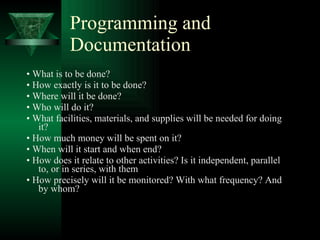
Programming and Documentation •  What is to be done? •  How exactly is it to be done? •  Where will it be done? •  Who will do it? •  What facilities, materials, and supplies will be needed for doing it? •  How much money will be spent on it? •  When will it start and when end? •  How does it relate to other activities? Is it independent, parallel to, or in series, with them •  How precisely will it be monitored? With what frequency? And by whom?
LogFrame Analysis •  Creates a hierarchy of aims •  Highlights external factors that may impact the implementation of the project •  Establishes criteria for M and E •  Clarifies how planned activities will help to achieve the objectives •  States the implications of carrying out the planned activities in terms of resources, assumptions and risks
LogFrame Matrix Activities  Outcome/Output  Objectives  Goal  Risks/ Assumptions  Means of Verification  Indicators
 
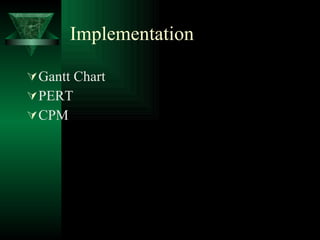
Implementation Gantt Chart PERT CPM
Monitoring  Looking after day to day activities of a Project or a Programme Scheduled or unscheduled visits Quarterly, monthly (etc) meetings Examining performance against preset indicators
Evaluation Assessment of a Program, after the completion of the planned activities. Process Evaluation Output Evaluation Outcome Evaluation Impact Evaluation

Health planning

  • 1.
    Health Planning NayyarRaza Kazmi MBBS, DHPM, MPH, M.Sc
  • 2.
    What is Planningand Development Planning is Optimal Use of Scarce Resources Development means ''improvement in a country's economic and social conditions''. More specifically, it refers to improvements in ways of managing an area's natural and human resources in order to create wealth and improve people's lives
  • 3.
    Levels of PlanningStrategic Planning Deals with broader level policy paradigms. Development of Vision, Mission, Values and Strategies Operational Planning Deals with development of Programs and Projects Deals with operationalization of Policy Plans
  • 4.
    Strategic Planning Dealswith Vision, Mission, Values and Strategies of an Organization Vision: Where do you see yourself in future Mission: Where is the organization today, why it exists Values: reflects the organization culture and priorities
  • 5.
    Approaches to StrategicPlanning There are many approaches to strategic planning but typically a three-step process may be used: Situation - evaluate the current situation and how it came about. Target - define goals and/or objectives (sometimes called ideal state) Path - map a possible route to the goals/objectives
  • 6.
    One alternative approachis called Draw-See-Think Draw - what is the ideal image or the desired end state? See - what is today's situation? What is the gap from ideal and why? Think - what specific actions must be taken to close the gap between today's situation and the ideal state? Plan - what resources are required to execute the activities?
  • 7.
    An alternative tothe Draw-See-Think approach is called See-Think-Draw See - what is today's situation? Think - define goals/objectives Draw - map a route to achieving the goals/objectives
  • 8.
  • 9.
  • 10.
  • 11.
  • 12.
  • 13.
  • 14.
    In a givenbudget of Rs.100,000 How would you improve the health of mothers and children under 5 in a catchment population of 5000.
  • 15.
  • 16.
    Situational Analysis SituationalAnalysis refers to the systemic collection, analysis and interpretation of data related to health events in a given geographical area or locality. This data can be gathered by a variety of methods like Surveys, HMIS records, Hospital registers, national registries and databases etc. The collected data is analysed and interpreted for Problem Identification .
  • 17.
    Problem A discrepancybetween and ideal state and the current state of affairs,
  • 18.
    Example: Health CentreCase Study A health centre receives complaints from users regarding the quality of the services. A discrepancy exists between the numbers of complaints currently being received in comparison to the previous year. The number of complaints is now reaching a volume that is unacceptable
  • 19.
    How frequently doesthe problem occur? Verbal and written complaints are being received on a daily basis. When does it generally occur? It appears to have started following a reduction in staffing levels. Where does it generally occur? The location is not relevant to this situation. Who is most affected? Obviously the users are, but so are the staff as they are becoming quite agitated by the complaints and the workload they are experiencing. The problem can therefore be summarized as: Patient dissatisfaction, affecting both patients and staff, which appears to have started following a reduction in staff .
  • 20.
    Once you havedescribed the problem, move on to “analyze” it. analyse its causes and prioritize the most important factors. Acting on those critical causal factors will solve most of the problem. It is suggested that you use the brainstorming technique
  • 21.
    Exercise Why isMulti Drug Resistant TB on the rise? Critically think and make a list of important reasons.(Problem Tree)
  • 22.
    Priority Setting Total points Feasibility Importance Frequency Issues
  • 23.
    Exercise: Part-A TakeFive Minutes to make a priority list from the following list of problems 3% Annual Population growth rate 90% illiteracy rate in females Pesticide related health problems in Farmers Measles infection in children under 5 years of age Radiation hazards to Xray technicians in hospitals Diabetis problem in adults.
  • 24.
    Options Appraisal TheProcess of Choosing from among the many options available. While there may be many different ways of preventing or treating a health problem, few are likely to be feasible, either because of cost or other constraints
  • 25.
    Cost Effectiveness AnalysisThe projected costs of the operation are compared with both the tangible (monetary) and intangible benefits. The intangible gains refer to relief of pain associated with disease, feelings of well being, disappearance of stigma attached to diseases, and so forth.
  • 26.
  • 27.
    Consider two strategiesintended to lengthen life in patients with heart disease. One is simple and cheap (e.g., aspirin and -blockers); the other is more complex, more expensive, and more effective (e.g., medication plus cardiac catheterization, angioplasty, stents, and bypass). For simplicity, we will assume that doing nothing has no cost and no effectiveness.
  • 28.
  • 29.
    Because CEA involvesmarginal cost and benefits, the choice of which strategies to compare can drive the calculation and the conclusion of a CEA. Consider the effect of repeating the above analysis without the simple strategy
  • 30.
  • 31.
    Force Field AnalysisAll the forces in favour of the proposed operation are assigned arbitrary numbers (for instance I for a weak force to 5 for a very strong force) and added up. Like wise all the negative forces are accorded numbers and totaled. The higher the difference in the two scores, the better is the operation under consideration.
  • 32.
    Programming and Documentation• What is to be done? • How exactly is it to be done? • Where will it be done? • Who will do it? • What facilities, materials, and supplies will be needed for doing it? • How much money will be spent on it? • When will it start and when end? • How does it relate to other activities? Is it independent, parallel to, or in series, with them • How precisely will it be monitored? With what frequency? And by whom?
  • 33.
    LogFrame Analysis • Creates a hierarchy of aims • Highlights external factors that may impact the implementation of the project • Establishes criteria for M and E • Clarifies how planned activities will help to achieve the objectives • States the implications of carrying out the planned activities in terms of resources, assumptions and risks
  • 34.
    LogFrame Matrix Activities Outcome/Output Objectives Goal Risks/ Assumptions Means of Verification Indicators
  • 35.
  • 36.
  • 37.
    Monitoring Lookingafter day to day activities of a Project or a Programme Scheduled or unscheduled visits Quarterly, monthly (etc) meetings Examining performance against preset indicators
  • 38.
    Evaluation Assessment ofa Program, after the completion of the planned activities. Process Evaluation Output Evaluation Outcome Evaluation Impact Evaluation