HEALTH PLANNING
Professor Syed Amin Tabish
FRCP (London), FRCP (Edin.), FAMS, MD (AIIMS)
Responsibilities of a Doctor
 Patient Care: Disease
Prevention, Health Promotion,
Medical care with advanced
technology
 Some level of teaching
competence with
professionalism
 Research
Pressures of Changes
 Knowledge Explosion
 Technological Advances
 Information
Superhighway
(Internet/World Wide
Web)
Roles of Physician
 Medical Expert (clinical decision-
maker)
 Communicator / Educator
 Collaborator (team leader)
 Manager/Leader: managing resources
 Health advocate
 Scientist/Scholar
 Professional: to provide high quality
care with honesty & compassion
What are the responses
 A New Curriculum: Outcome-
based, community-based
 New Educational strategies: PBL,
SDL, Integrated learning, task-
based learning, Core curriculum
& student-selected components
 New Curriculum models:
Communication skills,
preparation for practice, team
work, EB practice
Health Planning
 During the 20th century, the
expectation of life in all parts
of the world has been
transformed
 Concerns for efficient use of
health resources
 Importance of health
planning widely recognized
Planning
 Deciding how resources
should be allocated
 Determining how to
implement these decisions
 Judicious health planning
is crucial
Planning
 A method of trying to
ensure that the
resources available
now and in future are
used in the most
efficient way to obtain
explicit objectives
Planning
 A system of making decisions
about how an organization
will use its resources in the
future
 It involves making of choices
 Requires possibility of real
alternatives
 Resources are limited
Important components
 Where are we going? –
Objectives
 With what? –
Resources
 How? - (efficient
implementation)
 When? – (future)
Health care
 Public Health Services
(environmental sanitation)
 Personal Preventive
Services (immunization)
 Personal Curative Services
(hospitals, health centres)
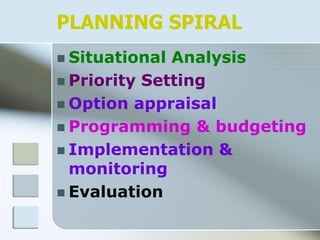
PLANNING SPIRAL
 Situational Analysis
 Priority Setting
 Option appraisal
 Programming & budgeting
 Implementation &
monitoring
 Evaluation
Situational Analysis
 Assessment of present
situation
 Examine the current &
projected health situation,
the demographic pattern,
and present & future
health needs
Situational Analysis
 Looks at the general
socioeconomic & provision
of non-health services &
infrastructure
 Analysis the infrastructure
of health sector & the
pattern of services
provided
Situational Analysis
 Examines the current &
future resources of the health
sector in terms of both
financial resources & real
resources (personnel,
equipment, buildings, etc.)
 Analysis the efficiency &
effectiveness within which
the health sector operates
Situational analysis
 General country
characteristics
 Health Status Needs
 Health Service availability
 Policy & political
environment
Demographic information
 Absolute size & distribution
of population
 Vital statistics (births,
deaths, fertility)
 Population growth rate
 Age & sex structure
Priority Setting
 Determination of goals,
objectives & targets of the
organization
 Ensuring that the
priorities are set are
feasible within the social
& political climate
Option Appraisal
 Generation and
assessment of various
options for achieving each
of the set objectives and
targets
 Appraisal info:
effectiveness, efficiency,
equity, acceptability,
feasibility, resource
availability
Programming & Budgeting
 Translate the results of
the earlier decision into a
series of programmes
each with a budget and
resources
 Option chosen
 Budgetary info
 Resources
Implementation & Monitoring
 Transforming the broad
programs into more specific
times and budgeted sets of
tasks and activities
 Involves the drawing up of a
more operational plan of a
work
 Monitoring of the
implementation of activities
Implementation
Management info at
service provision stage:
 Utilization of services
 Cost
 Constraints
Evaluation
Provides the basis for
the next situational
analysis
Primary Health Care
The Alma-Ata
Declaration (1978)
endorsed PHC as
the key to
achieving HFA goal
National Rural
Health Mission
Essential Components of PHC
 Education concerning
prevailing health problems
and methods of prevention &
control
 Promotion of food
supply/nutrition
 Safe water & basic sanitation
 MCH/RCH
Components of PHC (contd)
 Immunization
 Prevention & control of
locally endemic diseases
 Treatment of common
diseases
 Provision of essential
drugs
Equity
Emerging Issues in HC:
 Equal health
 Equal access to health care
 Equal access to HC according to
need
 Equal utilization of HC according
to need
 Planning requires identification
of disadvantaged groups and
address their needs
Approach to planning
 A clear definition of equity
 A clear process for involving
communities in decision
making about strategies to
improve their health
 A clear process for involving
other sectors in health-
promotive strategies
Approaches to planning
Management
structures consistent
with the principles of
PHC
Criteria for assessing
the appropriateness
of approaches chosen
Data Collection/Information
 Surveys
 Vital registration
 Treatment records
 Notifiable diseases return
 Management reports & return
 Informed opinion (meeting with
individuals/groups)
 Information from other
ministries, institutions, agencies
Information on Health Needs
Basic requisite for a plan
Medically perceived Health Needs:
 Morbidity rates
 Mortality rates
 Disability rates
 Antenatal care
Community perceived Health Needs:
 Service deficiencies
Information of Services/Resources
 Socioeconomic situation &
infrastructure
 Socioeconomic & cultural
characteristics
 Geographical & topographical
characteristics
 Infrastructure
 Services provided by other sectors
(education, water, sanitation,
agriculture, public works)
Information (contd.)
Health Services
 Service facilities (hospitals,
beds)
 Service utilization
(occupancy rates,
immunization)
 Service gaps (areas not
covered by basic facilities;
projected service gaps)
Health service organizational
arrangements
 The degree of
centralization of decision
making
 Opportunities for
community participation
in decision making
 Linkage between sectors
Resources
 The resources currently deployed
in the health sector
The resources likely to be available
in future
 Financial resources (budget)
 Personnel
 Building, land, equipment &
vehicles
 Efficiency, effectiveness, equity
of current services
Setting Priorities
First Stage:
 Involves the production of a
macro situational analysis
setting out the key information
at national level
Second stage:
 Discussion by a national-level
planning group, involving
representatives of major health
related sectors
Priority Setting (contd.)
Third stage:
 The development of local-
level situational analysis
by local level health &
other professionals &
community
representatives
Priority Setting (contd)
Fourth Stage:
The review of these
policies by National
Health Planning Unit
Priority setting involves
a combination of
technique & judgement
Human Resource Planning
 To ensure that there is the
right number of personnel
with the appropriate skills
available in the right place at
the right time
 Health facilities are highly
labour intensive
 50-70% of the health budget
spent on human resources
Human Resource Planning
 Supply of HR: available
personnel
 Demand for HR: funded
requirement for personnel
 An equilibrium (Balance)
situation is required: where
Demand & Supply are equal
for each set of staff for each
year
Human Resource Planning
 Estimating projections
of each side of the
supply & demand
equation
 Estimate demand for
each category (ideally
for a decade)
HR Planning (contd)
 Estimation of the present &
future supply of each
category of health
professionals
 Comparison of demand &
supply
 Establishment control
 Development of training plan
Human Resource Planning
 Demand should be based on
the plans for service implicit
in the broader sectoral plan
 Planning system should be
sustainable
 Ensure that the planning
function will continue despite
broader organizational
changes
HR Planning (contd.)
Disciples required in
planning include:
economics, sociology,
social epidemiology,
community
development,
operations research,
law
Creating a structure for success
A carefully organized
and well-defined
planning structure is
essential
Planning process for
success
Creating a structure for success
There are several options
for developing
steering committees,
advisory committees,
and other structures to
carry out planning work
and involve people in
the process.
SWOT Worksheet
 SWOT is an examination of a
group’s internal strengths
and weaknesses, as well as
the environment’s
opportunities and threats. It
should be used in the
beginning stages of decision
making and strategic
planning.
SWOT
 Strengths What are your state’s
particular strengths? Do you do
something particularly unique?
What could be an asset in
developing objectives for your
state plan?
 Weaknesses Where is your
state lacking? What do others
seem to accomplish that you
cannot? What could limit your
state planning efforts?
Identifying & securing
Resources
“It takes a village to raise a child
(or develop a state plan).”
 Identify resources needed to
develop state plan
 Identify existing internal
resources
 Develop budget # Identify
potential external resources,
including potential donated
resources
Resources (contd.)
 Plan to integrate the plan
into state planning,
budgeting, and programming
processes
 Develop staff and technical
support plan
 Secure identified resources
and develop alternative
resources if necessary
Ask the right questions early
 What is the scope of the state
planning process?
► What does the state want to
accomplish through this process?
► Why should taxpayers or others
fund the development of the
state plan?
► What will it take to support the
planning initiative?
Plan for the future
 Don’t forget to plan for the future—
it’s not over when the plan is released
► Identify resource needs to carry out
a ten-year plan to monitor progress,
publish periodic reviews, and sustain
activities
► Keep a wish list ready for future
funding (e.g., resources for a business
companion document, a special health
disparities consortium, or other ideas
generated planning)
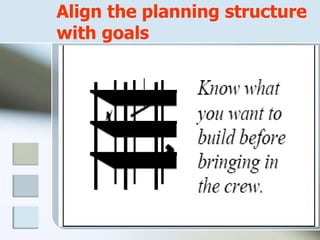
Align the planning structure
with goals
THANK you
Very much
Health Service Providers(1)
 Ministry of Health (MOH)
 King Faisal Specialist Hospital &
Research Center (KFSH&RC)
 Ministry of Defense (MODA)
 Ministry of Interior (SFH)
 National Guard (NGHA)
 Universities Hospitals
 Private Sector
Current Status (1)
 Ministry of Health (MOH)
 195 hospitals
 1760 PHCC
20 are running different HIS & no connection
between them
40 has a connection to MOH WAN but does not
have HIS
A system has been developed in-house for
PHCC’s and applied in 9 of them which has
connectivity
The system can be accessed remotely by dialup
Current Status (2)
 King Faisal Specialist Hospital
 2 hospitals (1 in Riyadh & 1 in Jeddah)
The most advanced EMR in the country
Current Status (3)
 Ministry of Defense (MODA)
 25 hospitals
 150 clinics
(10 are running different HIS & not
connected to each other)
137 are connected to the nearest hospital
Current Status (3)
 Ministry of Defense (MODA)
 25 hospitals
 150 clinics
(10 are running different HIS & not
connected to each other)
137 are connected to the nearest hospital
Current Status (4)
 Ministry of Interior (SFH)
 1 hospital
 30 +- clinics
(hospital is running HIS)
Simple system in clinics & not connected
to the hospital
Current Status (5)
 National Guard (NGHA)
 4 hospitals
 60 clinics
( 4 hospitals are connected through ASP
model + 25 clinics)
1/26/2023 The 4th Regional conference
on e-Health
62
Current Status (6)
 Universities Hospitals
 4 hospitals
2 are running the same HIS through
connectivity
Others are running different HIS
1/26/2023 The 4th Regional conference
on e-Health
63
Current Status (6)
 Universities Hospitals
 4 hospitals
2 are running the same HIS through
connectivity
Others are running different HIS
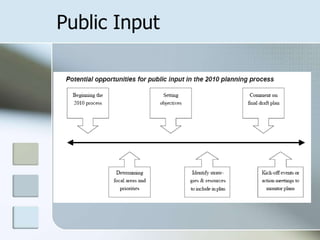
Public Input

HEALTH PLANNING.ppt

  • 1.
    HEALTH PLANNING Professor SyedAmin Tabish FRCP (London), FRCP (Edin.), FAMS, MD (AIIMS)
  • 2.
    Responsibilities of aDoctor  Patient Care: Disease Prevention, Health Promotion, Medical care with advanced technology  Some level of teaching competence with professionalism  Research
  • 3.
    Pressures of Changes Knowledge Explosion  Technological Advances  Information Superhighway (Internet/World Wide Web)
  • 4.
    Roles of Physician Medical Expert (clinical decision- maker)  Communicator / Educator  Collaborator (team leader)  Manager/Leader: managing resources  Health advocate  Scientist/Scholar  Professional: to provide high quality care with honesty & compassion
  • 5.
    What are theresponses  A New Curriculum: Outcome- based, community-based  New Educational strategies: PBL, SDL, Integrated learning, task- based learning, Core curriculum & student-selected components  New Curriculum models: Communication skills, preparation for practice, team work, EB practice
  • 6.
    Health Planning  Duringthe 20th century, the expectation of life in all parts of the world has been transformed  Concerns for efficient use of health resources  Importance of health planning widely recognized
  • 7.
    Planning  Deciding howresources should be allocated  Determining how to implement these decisions  Judicious health planning is crucial
  • 8.
    Planning  A methodof trying to ensure that the resources available now and in future are used in the most efficient way to obtain explicit objectives
  • 9.
    Planning  A systemof making decisions about how an organization will use its resources in the future  It involves making of choices  Requires possibility of real alternatives  Resources are limited
  • 10.
    Important components  Whereare we going? – Objectives  With what? – Resources  How? - (efficient implementation)  When? – (future)
  • 11.
    Health care  PublicHealth Services (environmental sanitation)  Personal Preventive Services (immunization)  Personal Curative Services (hospitals, health centres)
  • 12.
    PLANNING SPIRAL  SituationalAnalysis  Priority Setting  Option appraisal  Programming & budgeting  Implementation & monitoring  Evaluation
  • 13.
    Situational Analysis  Assessmentof present situation  Examine the current & projected health situation, the demographic pattern, and present & future health needs
  • 14.
    Situational Analysis  Looksat the general socioeconomic & provision of non-health services & infrastructure  Analysis the infrastructure of health sector & the pattern of services provided
  • 15.
    Situational Analysis  Examinesthe current & future resources of the health sector in terms of both financial resources & real resources (personnel, equipment, buildings, etc.)  Analysis the efficiency & effectiveness within which the health sector operates
  • 16.
    Situational analysis  Generalcountry characteristics  Health Status Needs  Health Service availability  Policy & political environment
  • 17.
    Demographic information  Absolutesize & distribution of population  Vital statistics (births, deaths, fertility)  Population growth rate  Age & sex structure
  • 18.
    Priority Setting  Determinationof goals, objectives & targets of the organization  Ensuring that the priorities are set are feasible within the social & political climate
  • 19.
    Option Appraisal  Generationand assessment of various options for achieving each of the set objectives and targets  Appraisal info: effectiveness, efficiency, equity, acceptability, feasibility, resource availability
  • 20.
    Programming & Budgeting Translate the results of the earlier decision into a series of programmes each with a budget and resources  Option chosen  Budgetary info  Resources
  • 21.
    Implementation & Monitoring Transforming the broad programs into more specific times and budgeted sets of tasks and activities  Involves the drawing up of a more operational plan of a work  Monitoring of the implementation of activities
  • 22.
    Implementation Management info at serviceprovision stage:  Utilization of services  Cost  Constraints
  • 23.
    Evaluation Provides the basisfor the next situational analysis
  • 24.
    Primary Health Care TheAlma-Ata Declaration (1978) endorsed PHC as the key to achieving HFA goal National Rural Health Mission
  • 25.
    Essential Components ofPHC  Education concerning prevailing health problems and methods of prevention & control  Promotion of food supply/nutrition  Safe water & basic sanitation  MCH/RCH
  • 26.
    Components of PHC(contd)  Immunization  Prevention & control of locally endemic diseases  Treatment of common diseases  Provision of essential drugs
  • 27.
    Equity Emerging Issues inHC:  Equal health  Equal access to health care  Equal access to HC according to need  Equal utilization of HC according to need  Planning requires identification of disadvantaged groups and address their needs
  • 28.
    Approach to planning A clear definition of equity  A clear process for involving communities in decision making about strategies to improve their health  A clear process for involving other sectors in health- promotive strategies
  • 29.
    Approaches to planning Management structuresconsistent with the principles of PHC Criteria for assessing the appropriateness of approaches chosen
  • 30.
    Data Collection/Information  Surveys Vital registration  Treatment records  Notifiable diseases return  Management reports & return  Informed opinion (meeting with individuals/groups)  Information from other ministries, institutions, agencies
  • 31.
    Information on HealthNeeds Basic requisite for a plan Medically perceived Health Needs:  Morbidity rates  Mortality rates  Disability rates  Antenatal care Community perceived Health Needs:  Service deficiencies
  • 32.
    Information of Services/Resources Socioeconomic situation & infrastructure  Socioeconomic & cultural characteristics  Geographical & topographical characteristics  Infrastructure  Services provided by other sectors (education, water, sanitation, agriculture, public works)
  • 33.
    Information (contd.) Health Services Service facilities (hospitals, beds)  Service utilization (occupancy rates, immunization)  Service gaps (areas not covered by basic facilities; projected service gaps)
  • 34.
    Health service organizational arrangements The degree of centralization of decision making  Opportunities for community participation in decision making  Linkage between sectors
  • 35.
    Resources  The resourcescurrently deployed in the health sector The resources likely to be available in future  Financial resources (budget)  Personnel  Building, land, equipment & vehicles  Efficiency, effectiveness, equity of current services
  • 36.
    Setting Priorities First Stage: Involves the production of a macro situational analysis setting out the key information at national level Second stage:  Discussion by a national-level planning group, involving representatives of major health related sectors
  • 37.
    Priority Setting (contd.) Thirdstage:  The development of local- level situational analysis by local level health & other professionals & community representatives
  • 38.
    Priority Setting (contd) FourthStage: The review of these policies by National Health Planning Unit Priority setting involves a combination of technique & judgement
  • 39.
    Human Resource Planning To ensure that there is the right number of personnel with the appropriate skills available in the right place at the right time  Health facilities are highly labour intensive  50-70% of the health budget spent on human resources
  • 40.
    Human Resource Planning Supply of HR: available personnel  Demand for HR: funded requirement for personnel  An equilibrium (Balance) situation is required: where Demand & Supply are equal for each set of staff for each year
  • 41.
    Human Resource Planning Estimating projections of each side of the supply & demand equation  Estimate demand for each category (ideally for a decade)
  • 42.
    HR Planning (contd) Estimation of the present & future supply of each category of health professionals  Comparison of demand & supply  Establishment control  Development of training plan
  • 43.
    Human Resource Planning Demand should be based on the plans for service implicit in the broader sectoral plan  Planning system should be sustainable  Ensure that the planning function will continue despite broader organizational changes
  • 44.
    HR Planning (contd.) Disciplesrequired in planning include: economics, sociology, social epidemiology, community development, operations research, law
  • 45.
    Creating a structurefor success A carefully organized and well-defined planning structure is essential Planning process for success
  • 46.
    Creating a structurefor success There are several options for developing steering committees, advisory committees, and other structures to carry out planning work and involve people in the process.
  • 47.
    SWOT Worksheet  SWOTis an examination of a group’s internal strengths and weaknesses, as well as the environment’s opportunities and threats. It should be used in the beginning stages of decision making and strategic planning.
  • 48.
    SWOT  Strengths Whatare your state’s particular strengths? Do you do something particularly unique? What could be an asset in developing objectives for your state plan?  Weaknesses Where is your state lacking? What do others seem to accomplish that you cannot? What could limit your state planning efforts?
  • 49.
    Identifying & securing Resources “Ittakes a village to raise a child (or develop a state plan).”  Identify resources needed to develop state plan  Identify existing internal resources  Develop budget # Identify potential external resources, including potential donated resources
  • 50.
    Resources (contd.)  Planto integrate the plan into state planning, budgeting, and programming processes  Develop staff and technical support plan  Secure identified resources and develop alternative resources if necessary
  • 51.
    Ask the rightquestions early  What is the scope of the state planning process? ► What does the state want to accomplish through this process? ► Why should taxpayers or others fund the development of the state plan? ► What will it take to support the planning initiative?
  • 52.
    Plan for thefuture  Don’t forget to plan for the future— it’s not over when the plan is released ► Identify resource needs to carry out a ten-year plan to monitor progress, publish periodic reviews, and sustain activities ► Keep a wish list ready for future funding (e.g., resources for a business companion document, a special health disparities consortium, or other ideas generated planning)
  • 53.
    Align the planningstructure with goals
  • 54.
  • 55.
    Health Service Providers(1) Ministry of Health (MOH)  King Faisal Specialist Hospital & Research Center (KFSH&RC)  Ministry of Defense (MODA)  Ministry of Interior (SFH)  National Guard (NGHA)  Universities Hospitals  Private Sector
  • 56.
    Current Status (1) Ministry of Health (MOH)  195 hospitals  1760 PHCC 20 are running different HIS & no connection between them 40 has a connection to MOH WAN but does not have HIS A system has been developed in-house for PHCC’s and applied in 9 of them which has connectivity The system can be accessed remotely by dialup
  • 57.
    Current Status (2) King Faisal Specialist Hospital  2 hospitals (1 in Riyadh & 1 in Jeddah) The most advanced EMR in the country
  • 58.
    Current Status (3) Ministry of Defense (MODA)  25 hospitals  150 clinics (10 are running different HIS & not connected to each other) 137 are connected to the nearest hospital
  • 59.
    Current Status (3) Ministry of Defense (MODA)  25 hospitals  150 clinics (10 are running different HIS & not connected to each other) 137 are connected to the nearest hospital
  • 60.
    Current Status (4) Ministry of Interior (SFH)  1 hospital  30 +- clinics (hospital is running HIS) Simple system in clinics & not connected to the hospital
  • 61.
    Current Status (5) National Guard (NGHA)  4 hospitals  60 clinics ( 4 hospitals are connected through ASP model + 25 clinics)
  • 62.
    1/26/2023 The 4thRegional conference on e-Health 62 Current Status (6)  Universities Hospitals  4 hospitals 2 are running the same HIS through connectivity Others are running different HIS
  • 63.
    1/26/2023 The 4thRegional conference on e-Health 63 Current Status (6)  Universities Hospitals  4 hospitals 2 are running the same HIS through connectivity Others are running different HIS
  • 64.