Where to Begin
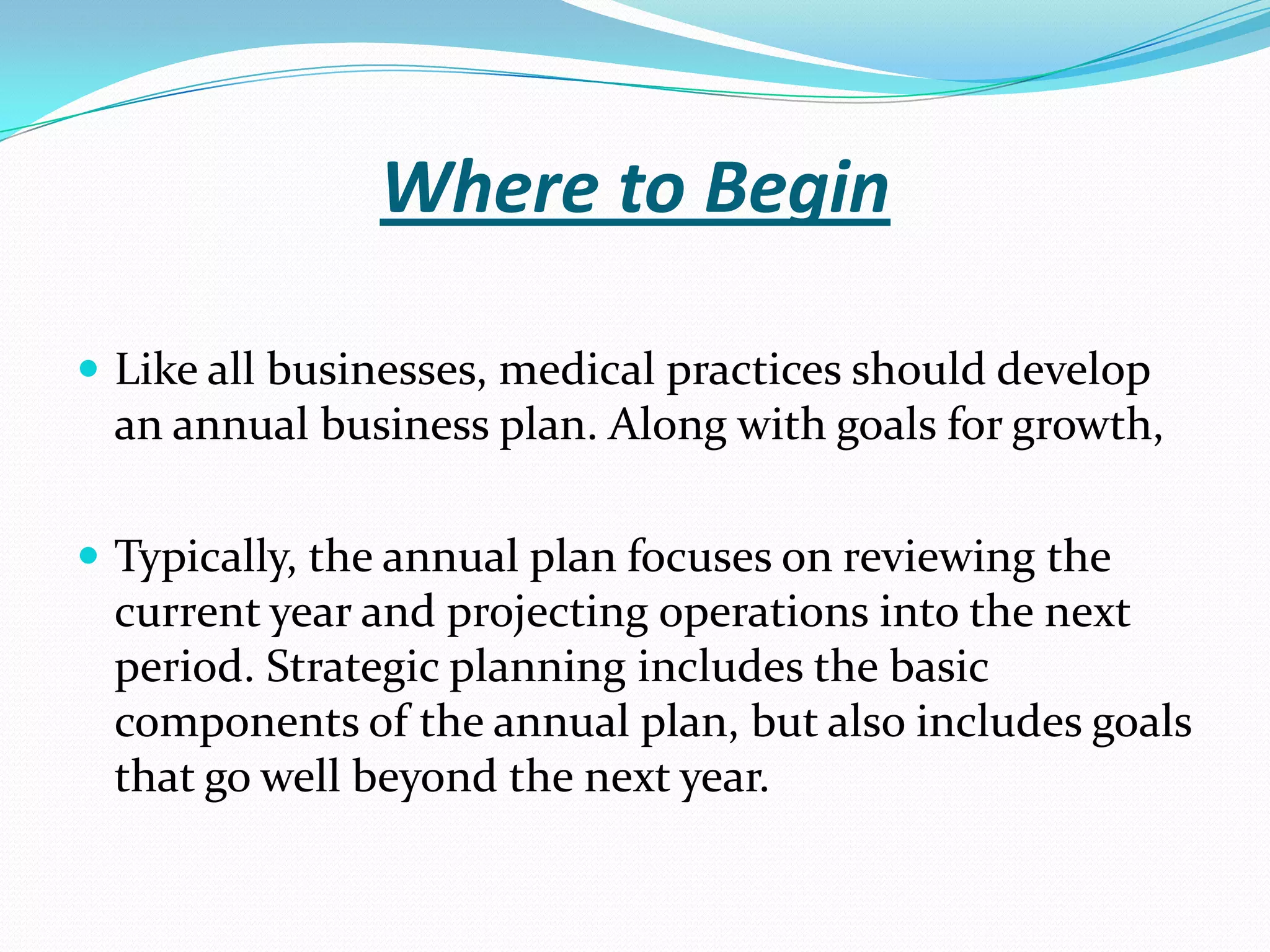
 Like all businesses, medical practices should develop
an annual business plan. Along with goals for growth,
 Typically, the annual plan focuses on reviewing the
current year and projecting operations into the next
period. Strategic planning includes the basic
components of the annual plan, but also includes goals
that go well beyond the next year.
Some definitions of
Strategic Planning
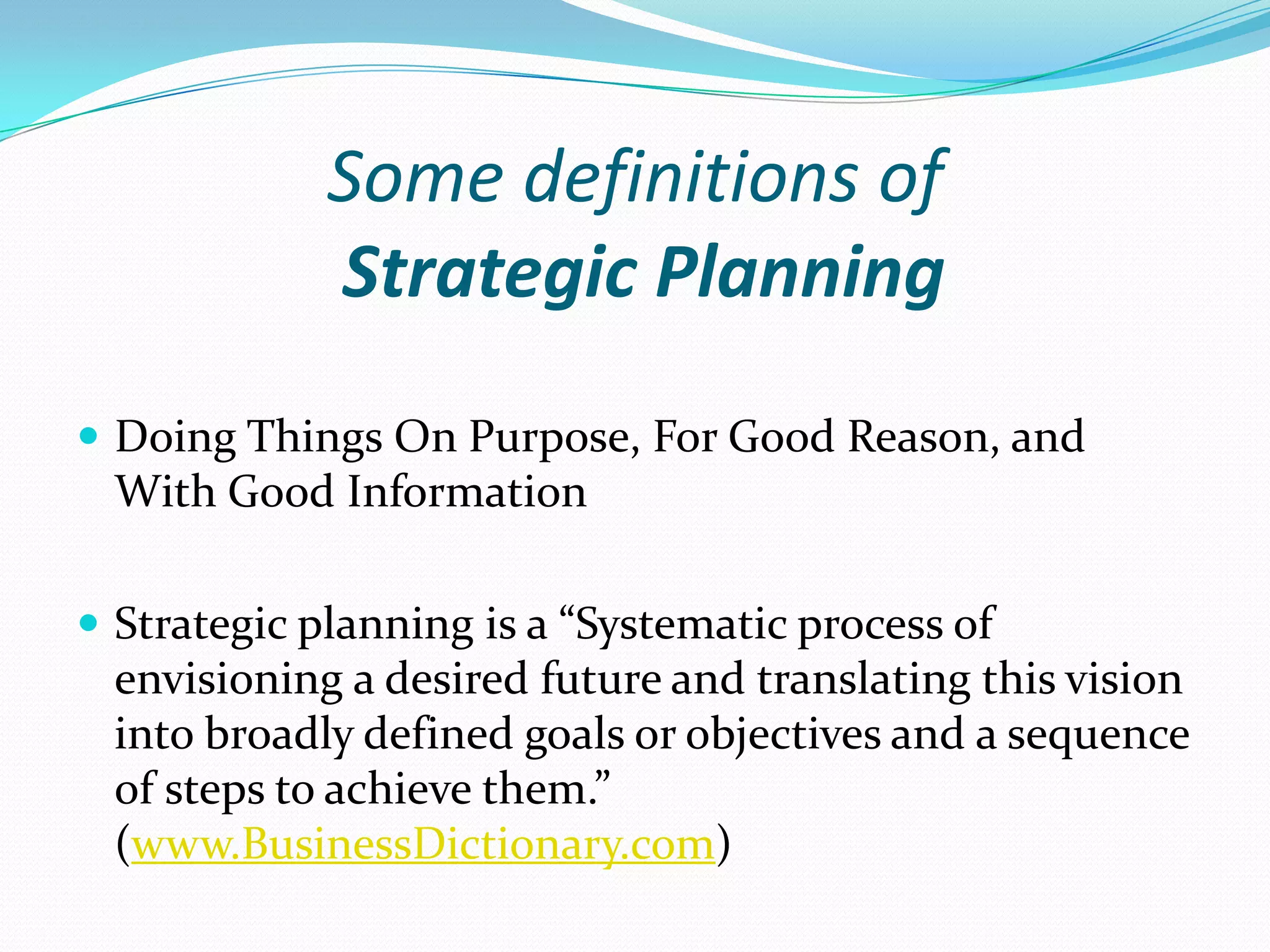
 Doing Things On Purpose, For Good Reason, and
With Good Information
 Strategic planning is a “Systematic process of
envisioning a desired future and translating this vision
into broadly defined goals or objectives and a sequence
of steps to achieve them.”
(www.BusinessDictionary.com)
Cont…
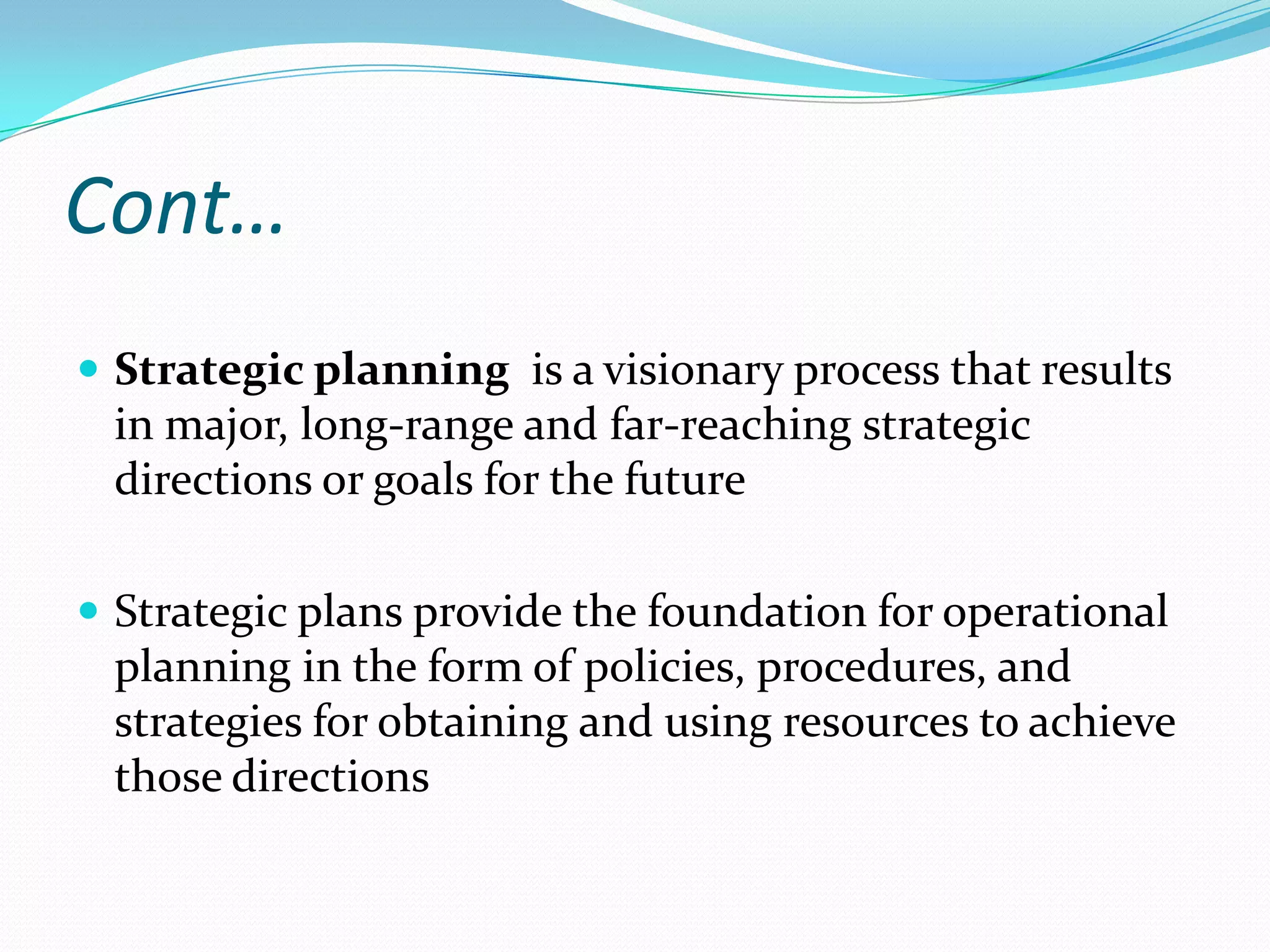
 Strategic planning is a visionary process that results
in major, long-range and far-reaching strategic
directions or goals for the future
 Strategic plans provide the foundation for operational
planning in the form of policies, procedures, and
strategies for obtaining and using resources to achieve
those directions
What is Strategic Planning?
 “Strategic planning is a formal process designed to
help an organization maintain an optimal alignment
with the most important elements of its environment”
(Rowley, Lujan, & Dolence, 1997, p. 15).
 The strategic planning process supplies the
organization with tools that promote future thinking,
applies the systems approach, allows for setting goals
and strategies, provides a common framework for
decisions and communications, and relies on
measuring performance (Steiner, 1979).
Why do Strategic Planning?
 If you fail to plan, then you plan to fail – be proactive
about the future
 Strategic planning improves performance
 Counter excessive inward and short-term thinking
 Solve major issues at a macro level
 Communicate to everyone what is most important
Strategic Planning Session
 An interactive planning session through open
discussion, consensus and commitment to a course of
action to achieve desired outcomes.
 The next step is to identify where the practice is today.
 Once the current situation is summarized, the practice
can develop its vision for the future. This last phase of
the planning retreat includes development of goals,
objectives, strategies and action plans.
How to proceed?
 Strategic planning begins with a work session
involving physicians as well as top managers.
 An independent, experienced and knowledgeable
facilitator should be selected by the practice to guide
the process to ensure impartiality and inclusiveness.
 comparative analysis
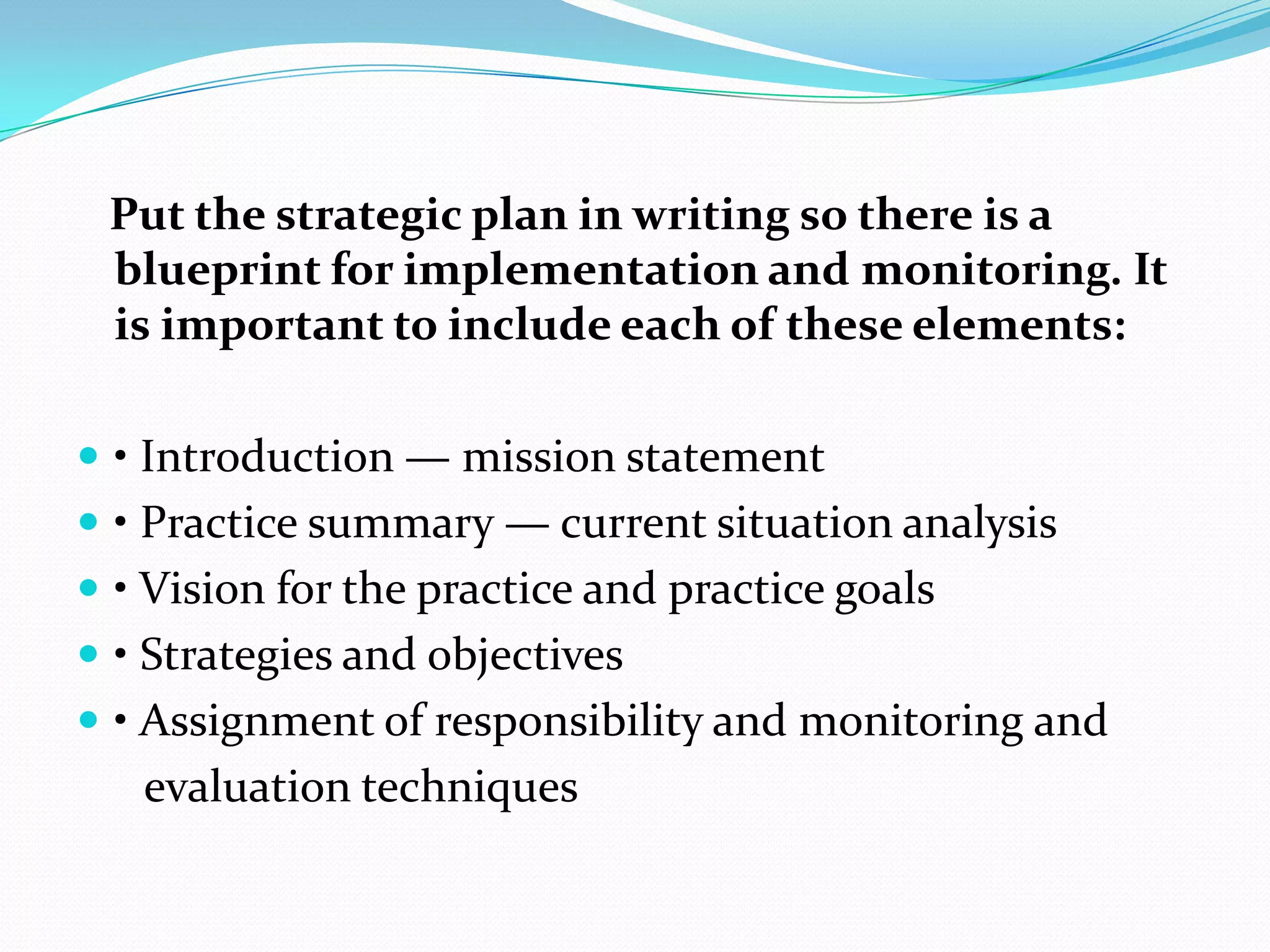
Put the strategic plan in writing so there is a
blueprint for implementation and monitoring. It
is important to include each of these elements:
 • Introduction — mission statement
 • Practice summary — current situation analysis
 • Vision for the practice and practice goals
 • Strategies and objectives
 • Assignment of responsibility and monitoring and
evaluation techniques
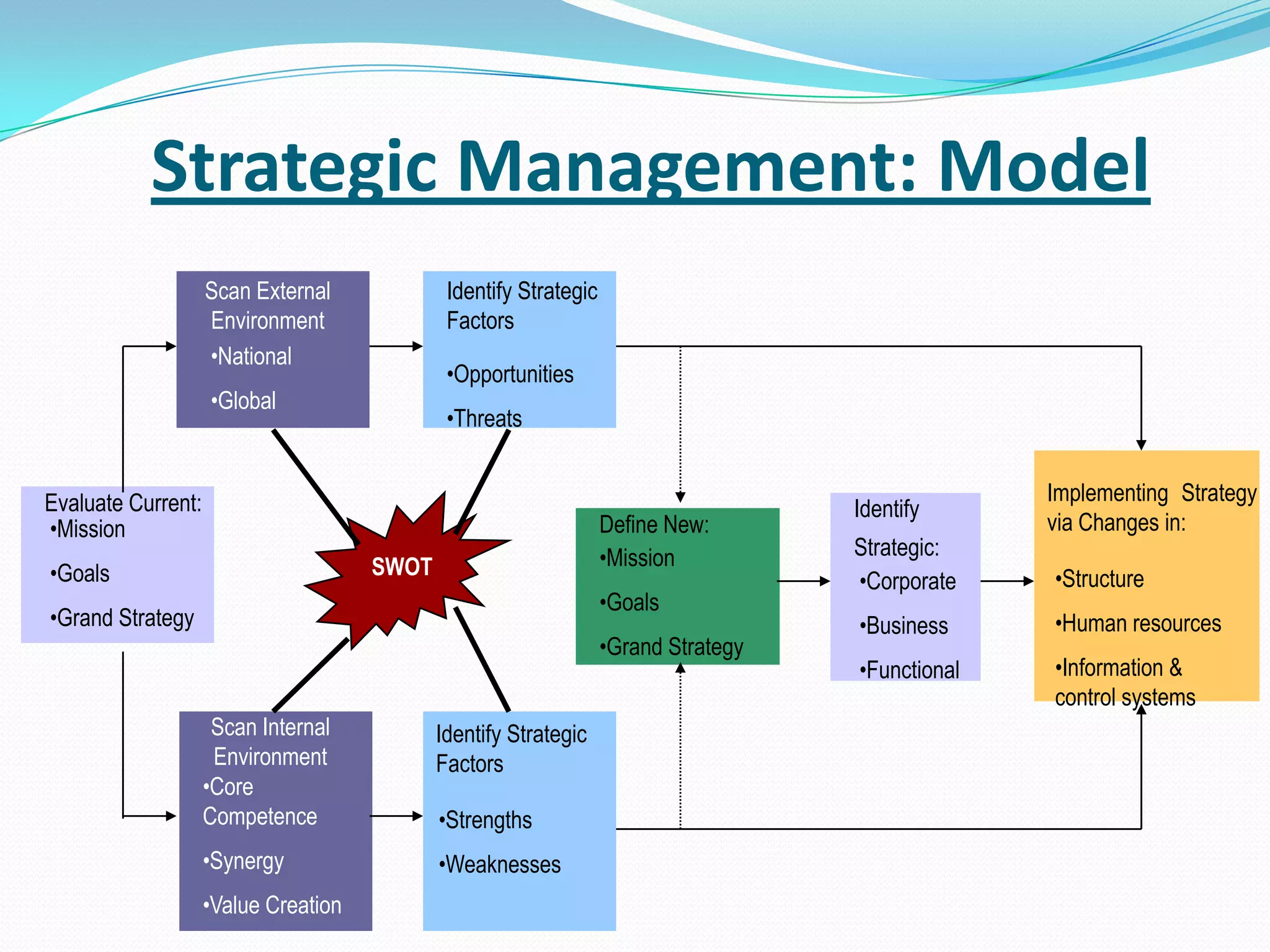
Strategic Management: Model
Identify Strategic
Factors
•Strengths
•Weaknesses
Scan Internal
Environment
•Core
Competence
•Synergy
•Value Creation
Identify
Strategic:
•Corporate
•Business
•Functional
Define New:
•Mission
•Goals
•Grand Strategy
Evaluate Current:
•Mission
•Goals
•Grand Strategy
Scan External
Environment
•National
•Global
•Opportunities
•Threats
Identify Strategic
Factors
SWOT
Implementing Strategy
via Changes in:
•Structure
•Human resources
•Information &
control systems
8
Matt H. Evans, matt@exinfm.com
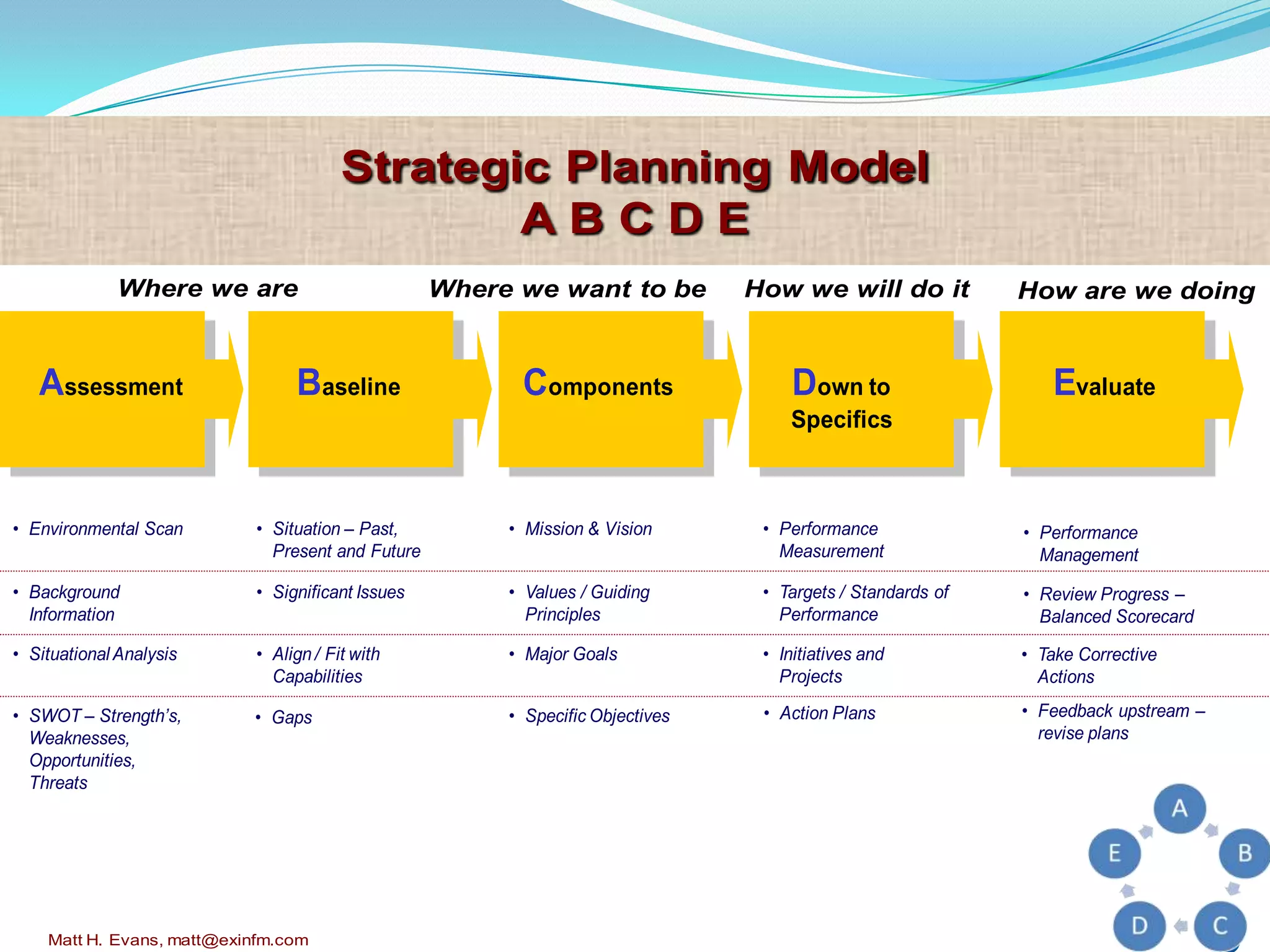
Strategic Planning Model
A B C D E
• Environmental Scan
Assessment
• Background
Information
• Situational Analysis
• SWOT – Strength’s,
Weaknesses,
Opportunities,
Threats
• Situation – Past,
Present and Future
• Significant Issues
• Align / Fit with
Capabilities
• Mission & Vision
• Values / Guiding
Principles
• Major Goals
• Specific Objectives
• Performance
Measurement
• Targets / Standards of
Performance
• Initiatives and
Projects
Baseline Components
• Performance
Management
• Review Progress –
Balanced Scorecard
• Take Corrective
Actions
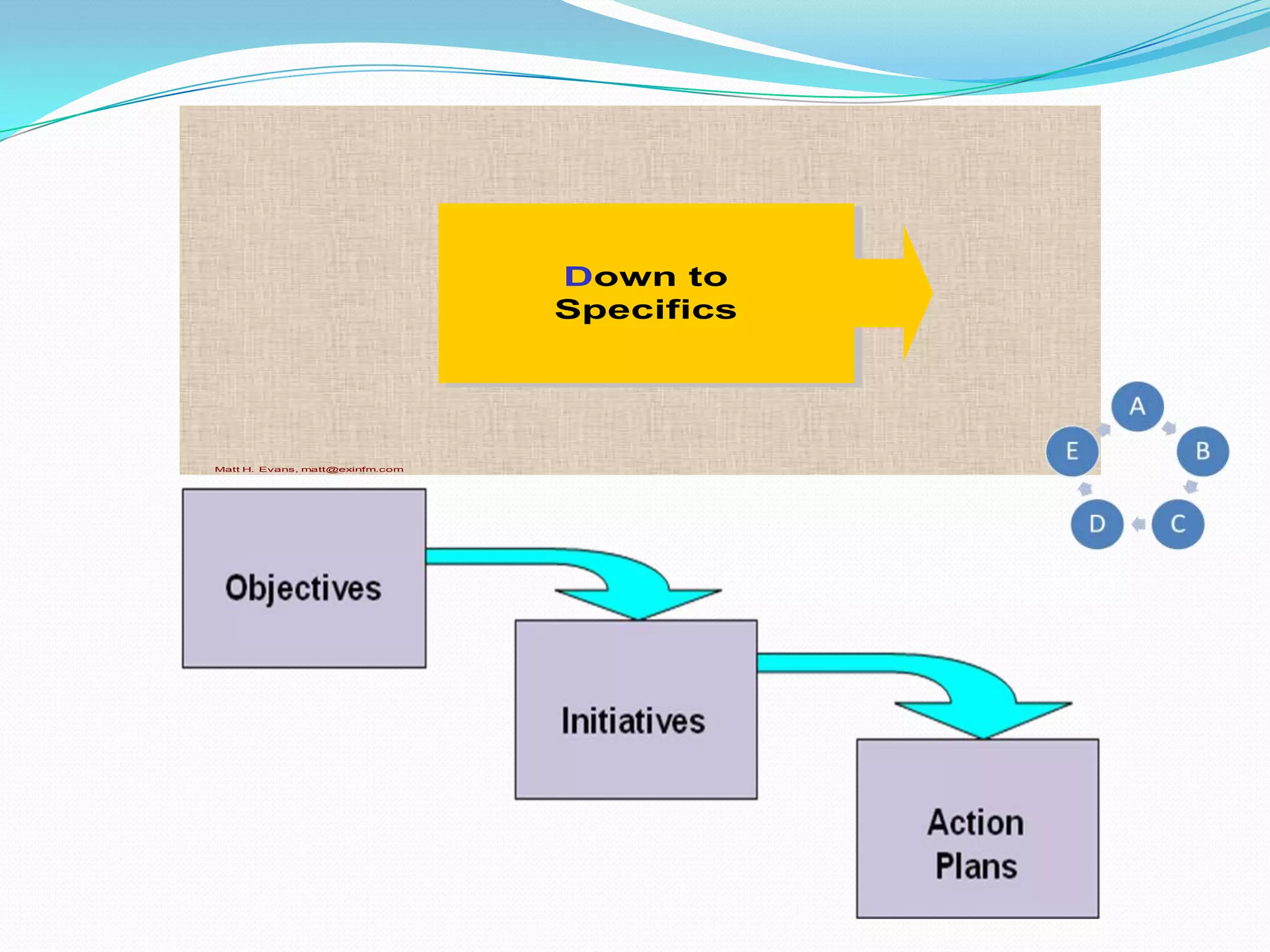
Down to
Specifics
Evaluate
Where we are Where we want to be How we will do it How are we doing
• Gaps • Action Plans • Feedback upstream –
revise plans
11
Matt H. Evans, matt@exinfm.com
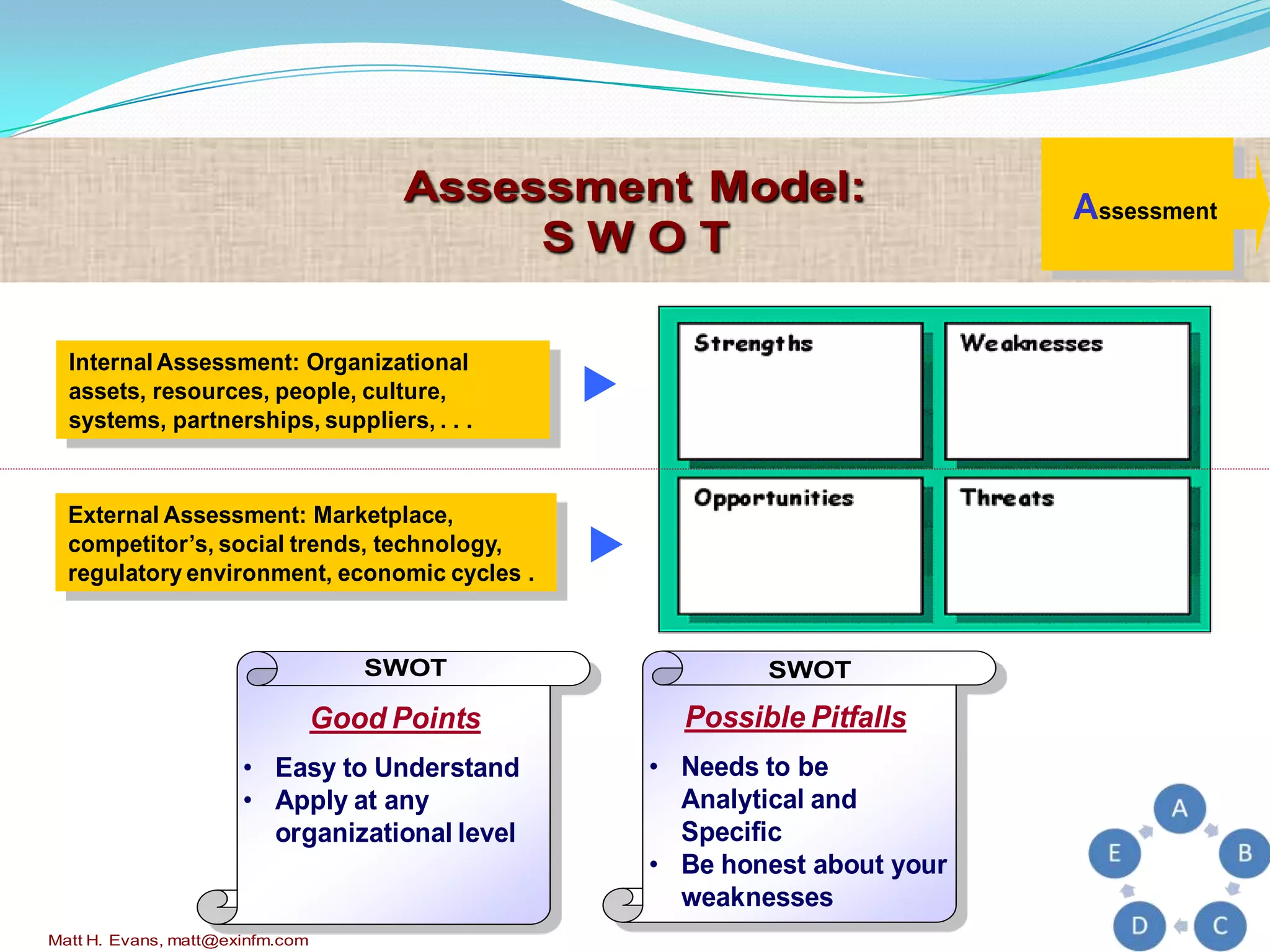
Assessment Model:
S W O T
Assessment
External Assessment: Marketplace,
competitor’s, social trends, technology,
regulatory environment, economic cycles .
Internal Assessment: Organizational
assets, resources, people, culture,
systems, partnerships, suppliers, . . .
• Easy to Understand
• Apply at any
organizational level
• Needs to be
Analytical and
Specific
• Be honest about your
weaknesses
Good Points Possible Pitfalls
SWOT SWOT
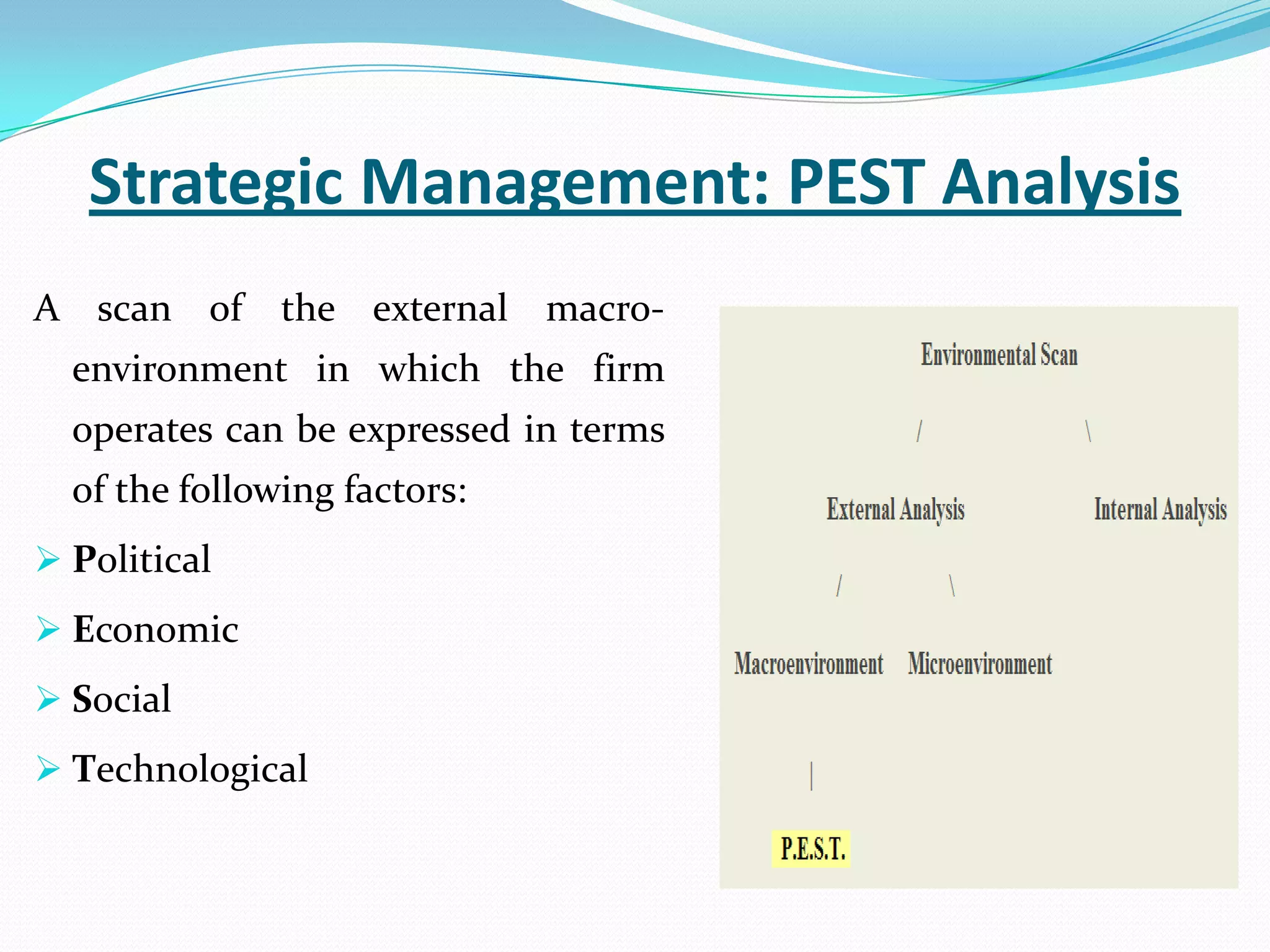
Strategic Management: PEST Analysis
A scan of the external macro-
environment in which the firm
operates can be expressed in terms
of the following factors:
 Political
 Economic
 Social
 Technological
Baseline
Why create a baseline?
 Puts everything about the organization into a single
context for comparability and planning
 Descriptive about the organization, as well as the
overall environment
 Include information about relationships – customers,
suppliers, partners and stakeholders
 Preferred format is the Organizational Profile
23
Matt H. Evans, matt@exinfm.com
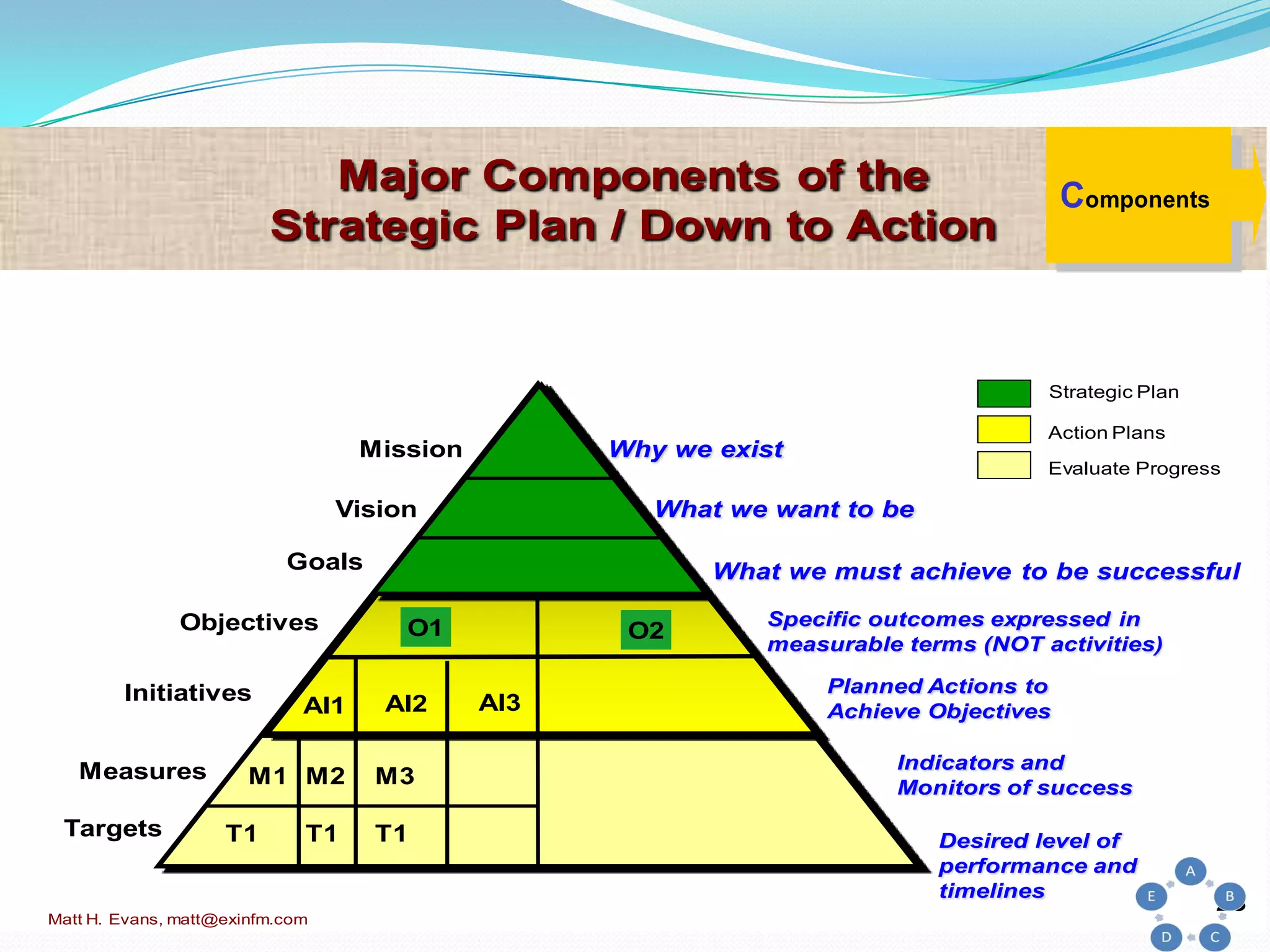
Major Components of the
Strategic Plan / Down to Action
Components
Mission
Vision
Goals
Objectives
Measures
Why we exist
What we want to be
Indicators and
Monitors of success
Desired level of
performance and
timelines
Planned Actions to
Achieve Objectives
O1 O2
AI1 AI2 AI3
M1 M2 M3
T1 T1 T1
Specific outcomes expressed in
measurable terms (NOT activities)
Strategic Plan
Action Plans
Evaluate Progress
Targets
Initiatives
What we must achieve to be successful
Mission & Vision Statements
Mission
 Captures the essence of why the organization exists –
Who we are, what we do
 Explains the basic needs that you fulfill
 Expresses the core values of the organization
Vision
 How the organization wants to be perceived in the future
 An expression of the desired end state, a long-term focus
for the entire organization
Core Values & Goals
Core Values
 Provides an underlying framework for making decisions –
part of the organization’s culture often rooted in ethical
themes.
Goals
 A goal is a specific statement of the desired results to be
achieved over a specified period of time. They shapes the
way ahead in actionable terms.
36
Matt H. Evans, matt@exinfm.com
Down to
Specifics
Objectives
 Tasks/Actions to be achieved
 An objective is a measurable statement or incremental
milestone which specifies a change or benefit that the entity
hopes to achieve as it strives to achieve a specific goal.
 May need several objectives to meet a goal
 Objectives should be S M A R T
(S – Simple, M – Measurable, A – Attainable, R – Realistic, T – Time bounded)
Action Plans & Initiatives?
 The Action Plan identifies the specific steps that will be
taken to achieve the initiatives and strategic objectives
 Each Initiative has a supporting Action Plan(s) attached to it
 They describe who does what, when it will be completed, and
how the organization knows when steps are completed
 Like Initiatives, Action Plans require the monitoring of
progress on Objectives, for which measures are needed
Policy & Procedures
 Policy: (Any decision or rule to a specific issue)
A policy enables or restricts actions, providing specific
information about the ends, the entity desires to achieve.
It is a direction for the leadership and staff .
 Procedure (A methodology or pathway)
Procedures specify how to accomplish any policy. It is a set
of activities which are aimed at planned outputs.
What Resources?
How to Link?
Every Action Plan should identify the following:
 The human resources needed to succeed
 The time resources needed to succeed
 The financial resources needed to succeed
 The physical resources (facilities, technology, etc.)
needed to succeed
48
Matt H. Evans, matt@exinfm.com
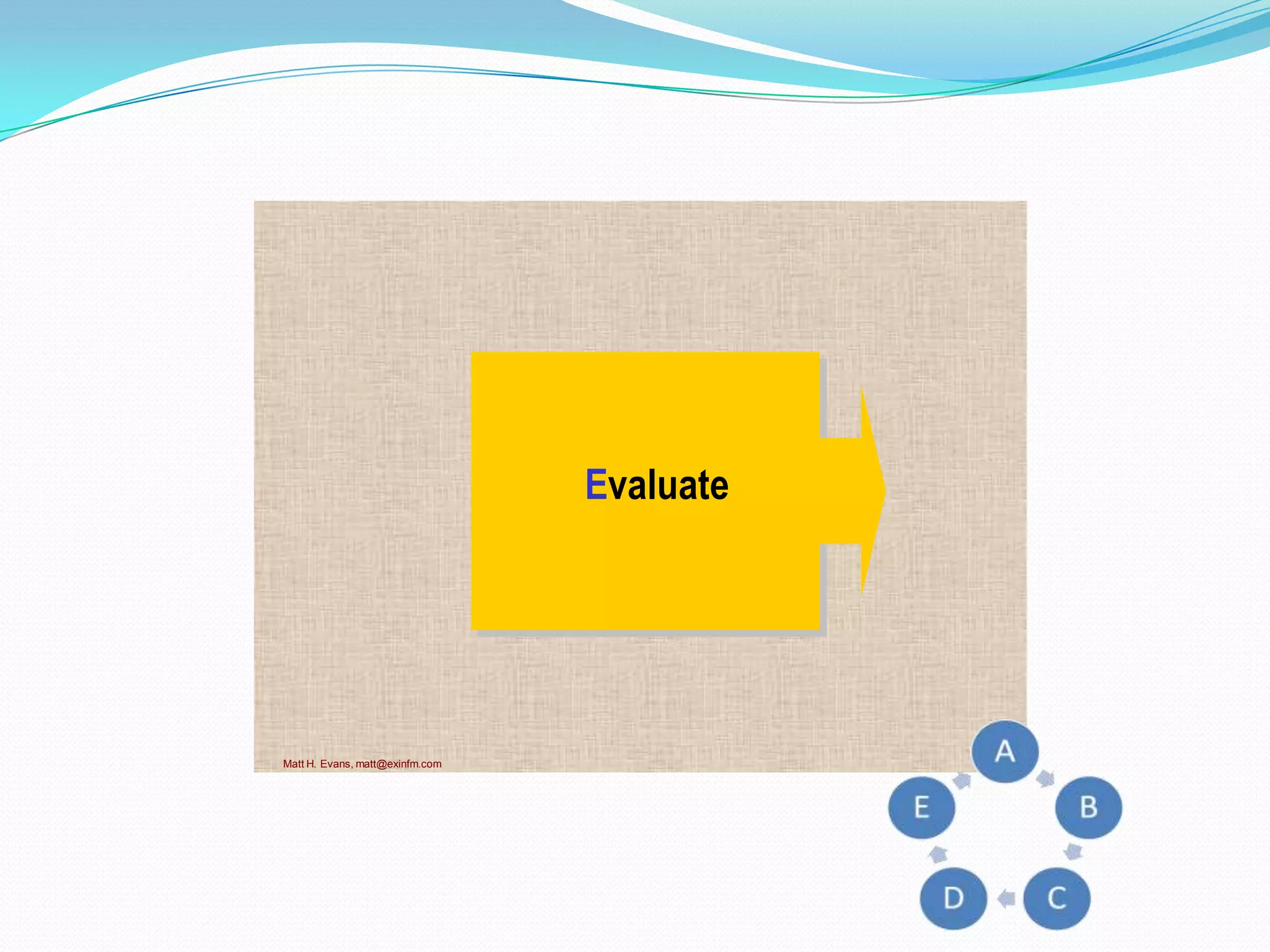
Evaluate
Strategy Evaluation
The implementation of the strategy must be monitored and
adjusted as needed.
Evaluation and control consists of the following steps:
 Define parameters to be measured
 Define target values for those parameters
 Perform measurements
 Compare measured results to the pre-defined standard
 Make necessary changes
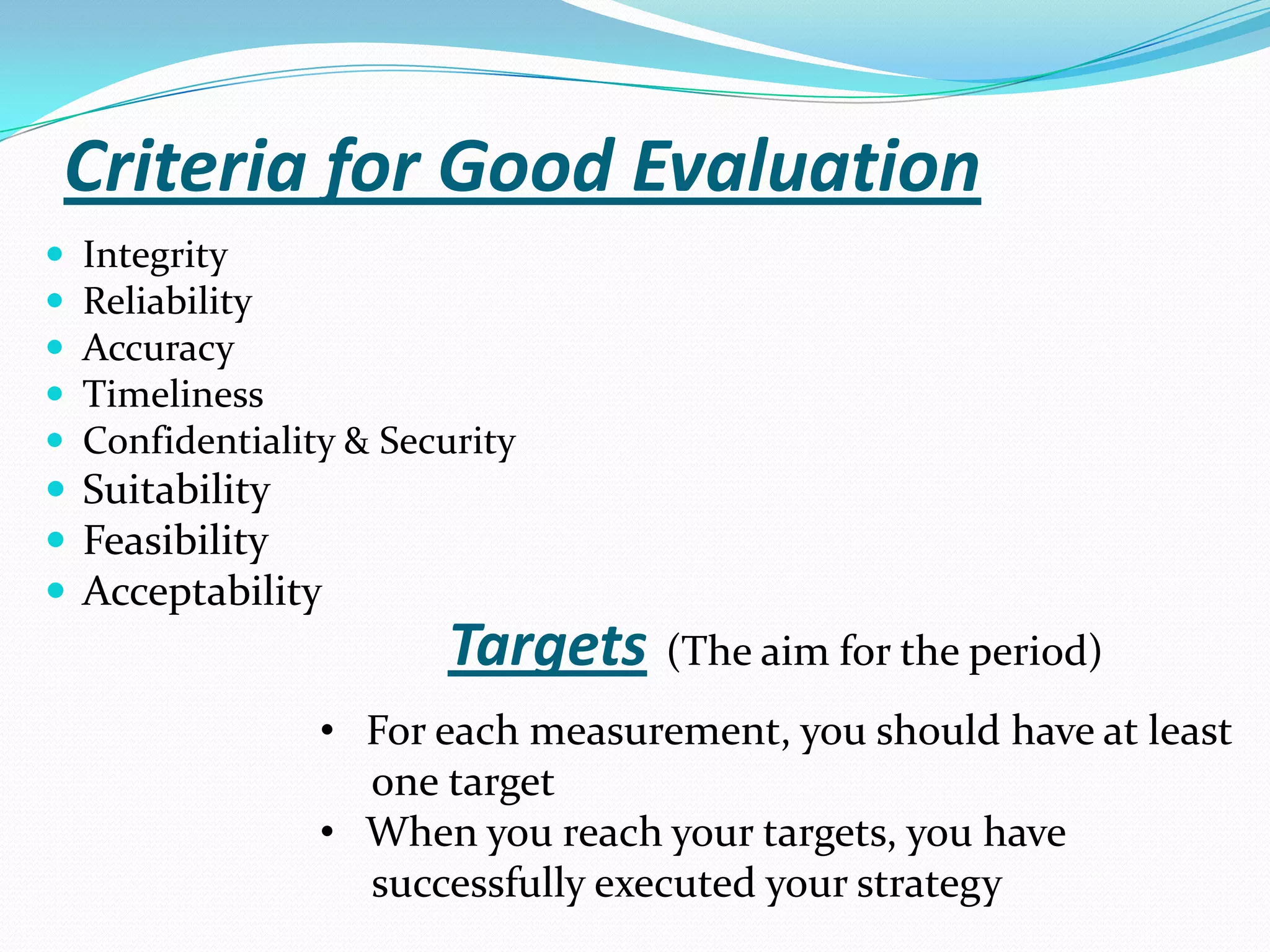
Criteria for Good Evaluation
 Integrity
 Reliability
 Accuracy
 Timeliness
 Confidentiality & Security
 Suitability
 Feasibility
 Acceptability
• For each measurement, you should have at least
one target
• When you reach your targets, you have
successfully executed your strategy
Targets (The aim for the period)
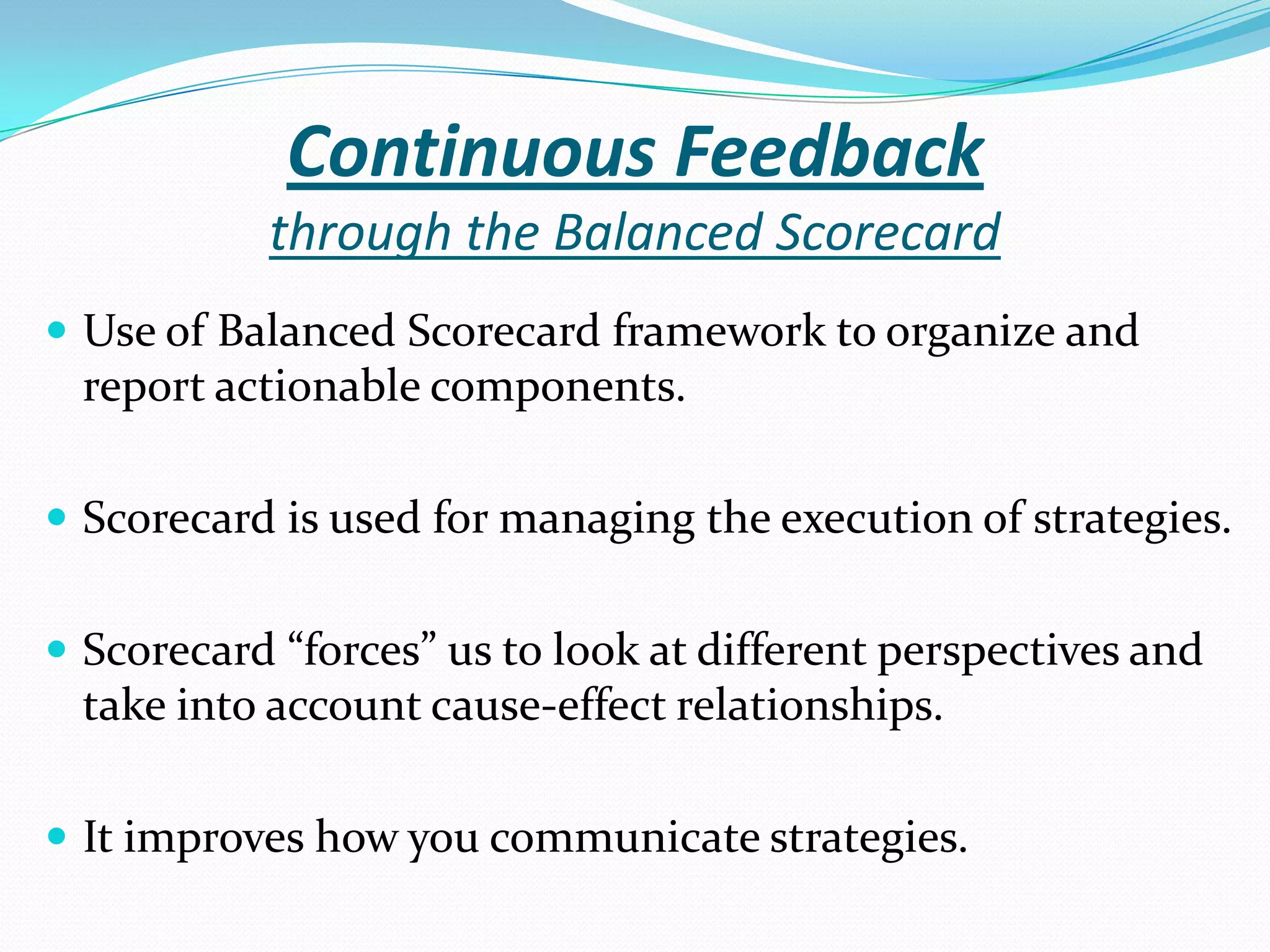
Continuous Feedback
through the Balanced Scorecard
 Use of Balanced Scorecard framework to organize and
report actionable components.
 Scorecard is used for managing the execution of strategies.
 Scorecard “forces” us to look at different perspectives and
take into account cause-effect relationships.
 It improves how you communicate strategies.
51www.studyMarketing.org
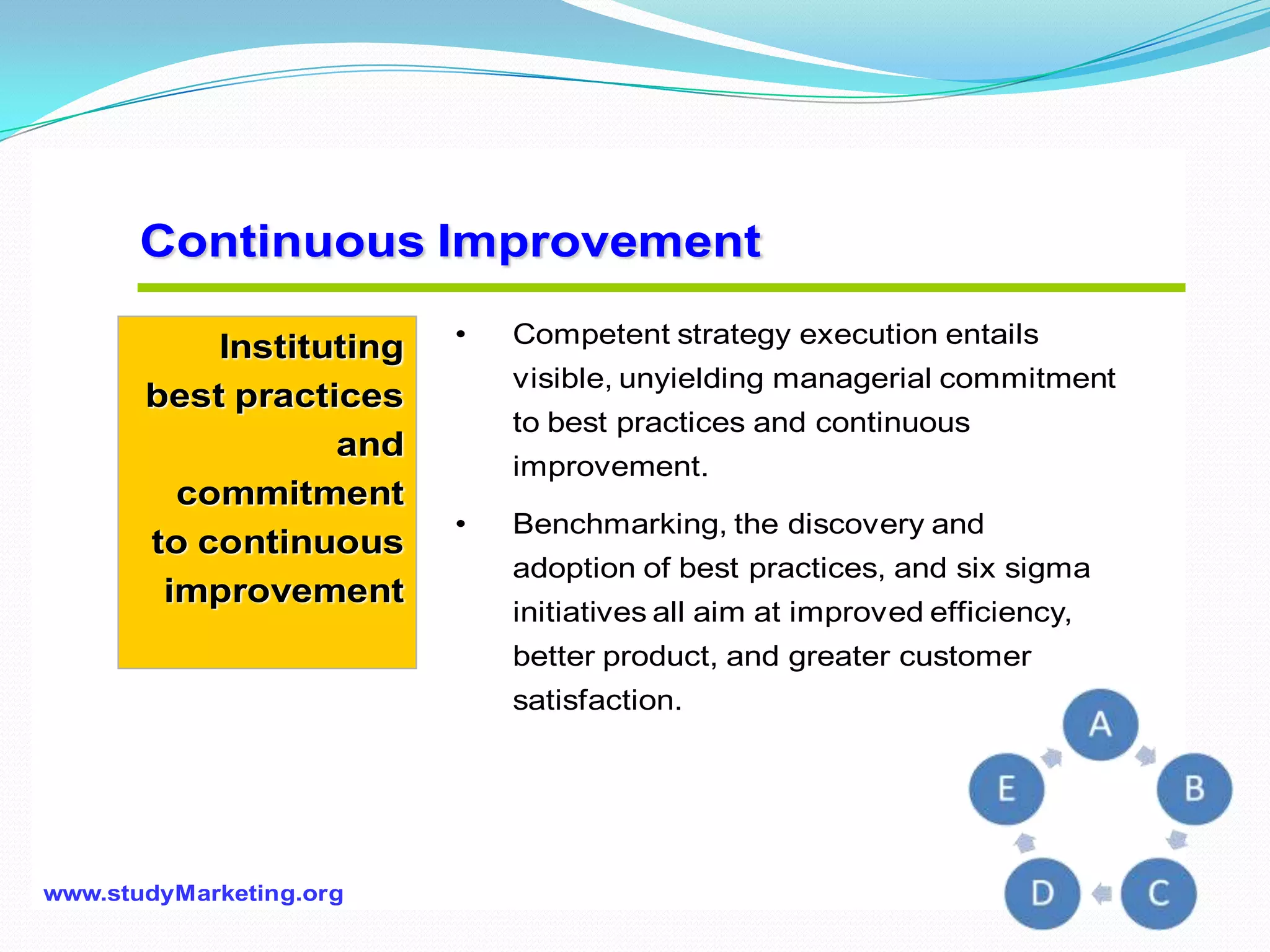
Continuous Improvement
Instituting
best practices
and
commitment
to continuous
improvement
• Competent strategy execution entails
visible, unyielding managerial commitment
to best practices and continuous
improvement.
• Benchmarking, the discovery and
adoption of best practices, and six sigma
initiatives all aim at improved efficiency,
better product, and greater customer
satisfaction.
THANK YOU
Any Questions??

Strategic Planning in Healthcare

  • 2.
    Where to Begin Like all businesses, medical practices should develop an annual business plan. Along with goals for growth,  Typically, the annual plan focuses on reviewing the current year and projecting operations into the next period. Strategic planning includes the basic components of the annual plan, but also includes goals that go well beyond the next year.
  • 3.
    Some definitions of StrategicPlanning  Doing Things On Purpose, For Good Reason, and With Good Information  Strategic planning is a “Systematic process of envisioning a desired future and translating this vision into broadly defined goals or objectives and a sequence of steps to achieve them.” (www.BusinessDictionary.com)
  • 4.
    Cont…  Strategic planningis a visionary process that results in major, long-range and far-reaching strategic directions or goals for the future  Strategic plans provide the foundation for operational planning in the form of policies, procedures, and strategies for obtaining and using resources to achieve those directions
  • 5.
    What is StrategicPlanning?  “Strategic planning is a formal process designed to help an organization maintain an optimal alignment with the most important elements of its environment” (Rowley, Lujan, & Dolence, 1997, p. 15).  The strategic planning process supplies the organization with tools that promote future thinking, applies the systems approach, allows for setting goals and strategies, provides a common framework for decisions and communications, and relies on measuring performance (Steiner, 1979).
  • 6.
    Why do StrategicPlanning?  If you fail to plan, then you plan to fail – be proactive about the future  Strategic planning improves performance  Counter excessive inward and short-term thinking  Solve major issues at a macro level  Communicate to everyone what is most important
  • 7.
    Strategic Planning Session An interactive planning session through open discussion, consensus and commitment to a course of action to achieve desired outcomes.  The next step is to identify where the practice is today.  Once the current situation is summarized, the practice can develop its vision for the future. This last phase of the planning retreat includes development of goals, objectives, strategies and action plans.
  • 8.
    How to proceed? Strategic planning begins with a work session involving physicians as well as top managers.  An independent, experienced and knowledgeable facilitator should be selected by the practice to guide the process to ensure impartiality and inclusiveness.  comparative analysis
  • 9.
    Put the strategicplan in writing so there is a blueprint for implementation and monitoring. It is important to include each of these elements:  • Introduction — mission statement  • Practice summary — current situation analysis  • Vision for the practice and practice goals  • Strategies and objectives  • Assignment of responsibility and monitoring and evaluation techniques
  • 10.
    Strategic Management: Model IdentifyStrategic Factors •Strengths •Weaknesses Scan Internal Environment •Core Competence •Synergy •Value Creation Identify Strategic: •Corporate •Business •Functional Define New: •Mission •Goals •Grand Strategy Evaluate Current: •Mission •Goals •Grand Strategy Scan External Environment •National •Global •Opportunities •Threats Identify Strategic Factors SWOT Implementing Strategy via Changes in: •Structure •Human resources •Information & control systems
  • 11.
    8 Matt H. Evans,matt@exinfm.com Strategic Planning Model A B C D E • Environmental Scan Assessment • Background Information • Situational Analysis • SWOT – Strength’s, Weaknesses, Opportunities, Threats • Situation – Past, Present and Future • Significant Issues • Align / Fit with Capabilities • Mission & Vision • Values / Guiding Principles • Major Goals • Specific Objectives • Performance Measurement • Targets / Standards of Performance • Initiatives and Projects Baseline Components • Performance Management • Review Progress – Balanced Scorecard • Take Corrective Actions Down to Specifics Evaluate Where we are Where we want to be How we will do it How are we doing • Gaps • Action Plans • Feedback upstream – revise plans
  • 12.
    11 Matt H. Evans,matt@exinfm.com Assessment Model: S W O T Assessment External Assessment: Marketplace, competitor’s, social trends, technology, regulatory environment, economic cycles . Internal Assessment: Organizational assets, resources, people, culture, systems, partnerships, suppliers, . . . • Easy to Understand • Apply at any organizational level • Needs to be Analytical and Specific • Be honest about your weaknesses Good Points Possible Pitfalls SWOT SWOT
  • 13.
    Strategic Management: PESTAnalysis A scan of the external macro- environment in which the firm operates can be expressed in terms of the following factors:  Political  Economic  Social  Technological
  • 14.
    Baseline Why create abaseline?  Puts everything about the organization into a single context for comparability and planning  Descriptive about the organization, as well as the overall environment  Include information about relationships – customers, suppliers, partners and stakeholders  Preferred format is the Organizational Profile
  • 15.
    23 Matt H. Evans,matt@exinfm.com Major Components of the Strategic Plan / Down to Action Components Mission Vision Goals Objectives Measures Why we exist What we want to be Indicators and Monitors of success Desired level of performance and timelines Planned Actions to Achieve Objectives O1 O2 AI1 AI2 AI3 M1 M2 M3 T1 T1 T1 Specific outcomes expressed in measurable terms (NOT activities) Strategic Plan Action Plans Evaluate Progress Targets Initiatives What we must achieve to be successful
  • 16.
    Mission & VisionStatements Mission  Captures the essence of why the organization exists – Who we are, what we do  Explains the basic needs that you fulfill  Expresses the core values of the organization Vision  How the organization wants to be perceived in the future  An expression of the desired end state, a long-term focus for the entire organization
  • 17.
    Core Values &Goals Core Values  Provides an underlying framework for making decisions – part of the organization’s culture often rooted in ethical themes. Goals  A goal is a specific statement of the desired results to be achieved over a specified period of time. They shapes the way ahead in actionable terms.
  • 18.
    36 Matt H. Evans,matt@exinfm.com Down to Specifics
  • 19.
    Objectives  Tasks/Actions tobe achieved  An objective is a measurable statement or incremental milestone which specifies a change or benefit that the entity hopes to achieve as it strives to achieve a specific goal.  May need several objectives to meet a goal  Objectives should be S M A R T (S – Simple, M – Measurable, A – Attainable, R – Realistic, T – Time bounded)
  • 20.
    Action Plans &Initiatives?  The Action Plan identifies the specific steps that will be taken to achieve the initiatives and strategic objectives  Each Initiative has a supporting Action Plan(s) attached to it  They describe who does what, when it will be completed, and how the organization knows when steps are completed  Like Initiatives, Action Plans require the monitoring of progress on Objectives, for which measures are needed
  • 21.
    Policy & Procedures Policy: (Any decision or rule to a specific issue) A policy enables or restricts actions, providing specific information about the ends, the entity desires to achieve. It is a direction for the leadership and staff .  Procedure (A methodology or pathway) Procedures specify how to accomplish any policy. It is a set of activities which are aimed at planned outputs.
  • 22.
    What Resources? How toLink? Every Action Plan should identify the following:  The human resources needed to succeed  The time resources needed to succeed  The financial resources needed to succeed  The physical resources (facilities, technology, etc.) needed to succeed
  • 23.
    48 Matt H. Evans,matt@exinfm.com Evaluate
  • 24.
    Strategy Evaluation The implementationof the strategy must be monitored and adjusted as needed. Evaluation and control consists of the following steps:  Define parameters to be measured  Define target values for those parameters  Perform measurements  Compare measured results to the pre-defined standard  Make necessary changes
  • 25.
    Criteria for GoodEvaluation  Integrity  Reliability  Accuracy  Timeliness  Confidentiality & Security  Suitability  Feasibility  Acceptability • For each measurement, you should have at least one target • When you reach your targets, you have successfully executed your strategy Targets (The aim for the period)
  • 26.
    Continuous Feedback through theBalanced Scorecard  Use of Balanced Scorecard framework to organize and report actionable components.  Scorecard is used for managing the execution of strategies.  Scorecard “forces” us to look at different perspectives and take into account cause-effect relationships.  It improves how you communicate strategies.
  • 27.
    51www.studyMarketing.org Continuous Improvement Instituting best practices and commitment tocontinuous improvement • Competent strategy execution entails visible, unyielding managerial commitment to best practices and continuous improvement. • Benchmarking, the discovery and adoption of best practices, and six sigma initiatives all aim at improved efficiency, better product, and greater customer satisfaction.
  • 28.