HEALTH SERVICES
PLANNING
Ashenafi H(MPH/HSM)
Lecturer Arsi University
3/19/2023
1
OUTLINE
 Defining planning
 Unique features of health services planning
 Rational for planning
 Scope of planning
 Features of planning
 Types of planning
 Steps in planning
 Overview of Health Services Planning in Ethiopia
3/19/2023
2
OBJECTIVES
At the end of the class, students will able to:-
 Define planning
 Acquire planning skill so as to plan
 Differentiate types planning.
 Describe the basic steps in health services planning.
 Appreciate current health services planning situation in Ethiopia.
3/19/2023
3
HEALTH SERVICES PLANNING
 Do you have a plan? ……………. Why?
 What is health care planning?
 Do you thing that health care planning is unique?
3/19/2023
4
PLANNING
 Planning,
o Combination of compiling and analyzing information.
o Dreaming up ideas.
o Using logic and imagination and
o Judgment in order to arrive at a decision about what
should be done.
3/19/2023
5
HEALTH SERVICES PLANNING
 Process of defining community health problems.
 Identifying needs and resources
 Establishing priority goals and
 Setting out the administrative action needed to reach
those goals.
3/19/2023
6
HEALTH SERVICES PLANNING …
 Deciding in advance what is to be done
 It is projected course of action for the future.
 To plan is to propose a forward programme for guiding
the future affairs of an organization.
 Starts with the assumption that the future will be
different from the present.
3/19/2023
7
HEALTH SERVICES PLANNING …
 It attempts to determine how the organization can take
advantage of that difference
 Planning thus becomes a device for change.
3/19/2023
8
HEALTH SERVICES PLANNING …
 The important components of this and other similar definitions
are concepts of:-
o Where are we going (objectives)?
o With what (Resources)?
o When (future)?
o Degree for formalization (explicitness, systematic and method)
about the process
3/19/2023
9
UNIQUE FEATURES OF H/S/PLANNING
 Dealing with life-and-death situations.
 Most parties operate independently of most of the other
organizations involved in the provision of health care
 Elasticity in the level of demand presents a challenge to
health planners
3/19/2023
10
UNIQUE FEATURES …
 Healthcare also is characterized by a wide variety of different
customers and the nature of these customers varies
 End-user may not make the consumption decision or pay for the
service provided
 The diversity of functions that often characterize healthcare
providers
3/19/2023
11
THE RATIONALE FOR PLANNING
Importance of planning is unquestionable in every aspects of
human life. It helps:-
 Coping with future uncertainty and change
 Focus attention on objectives
 It obtains economical operation
 Provides performance standards and facilitates control
 Foreseeing and identifying potential risks.
3/19/2023
12
SCOPE OF PLANNING
3.1 What is the target client/customer?
 Population Institution
 Programme
 What the plan intends to address should be clearly defined
3.2 What is the target geographical region or area?
 Village/kebele District/Zonal
 Region
 At what level you are planning has to be clearly defined
3/19/2023
13
SCOPE OF CON’T…
3.3 For what level of comprehensiveness should services be
planned?
The degrees of comprehensiveness to be determined as that of the
following:-
Environmental Determinants Comprehensive Health Care
 Diet-sanitary preparation of food preventive, promotive,
 Avoidance of harmful life style curative, rehabilitative
 Housing- sanitary housing condition
 Unpolluted environment health care
 Freedom from stress
3/19/2023
14
4. FEATURES OF PLANING
4.1. A Good Plan Should Give
 Clear vision/mission, goal and objectives ???
 A clear picture of the tasks to be accomplished
 The resources needed to accomplish the task.
 In terms of human, material, financial and time resources.
4.2 Planning Takes Place at All Levels
 Planning takes place at any level in health system
 Planning takes place continually, it is cyclic/spiral process
3/19/2023
15
4. FEATURES OF PLANING …
Planning methods can be applied to :-
 A large programme at national level
 Example –Malaria control programme
 Small one - at village level
 Example –construction of community health post
4.3 Planning must be Collective Undertaking
It requires the participation of:-
 Different sector/ inter- sectoral collaboration
 Professionals (from health and other sectors)
 Community/Non-Governmental Organizations (NGO)
 Government/Party
3/19/2023
16
5. TYPES OF PLANNING
5.1. STRATEGIC PLANNING
 Often referred as allocative planning
–Normally five years or more. E.g. HSDP, SPM, GTP, MDGs …
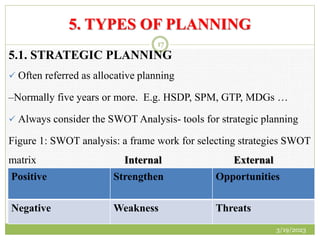
 Always consider the SWOT Analysis- tools for strategic planning
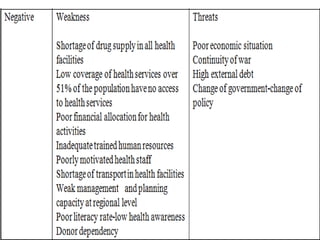
Figure 1: SWOT analysis: a frame work for selecting strategies SWOT
matrix Internal External
.
Positive Strengthen Opportunities
Negative Weakness Threats
3/19/2023
17
5. TYPES OF PLANNING …
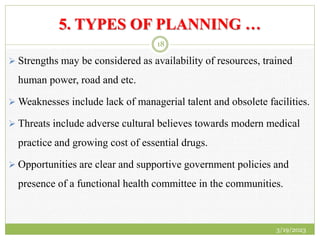
 Strengths may be considered as availability of resources, trained
human power, road and etc.
 Weaknesses include lack of managerial talent and obsolete facilities.
 Threats include adverse cultural believes towards modern medical
practice and growing cost of essential drugs.
 Opportunities are clear and supportive government policies and
presence of a functional health committee in the communities.
3/19/2023
18
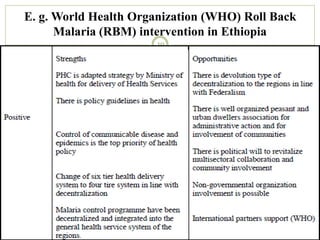
E. g. World Health Organization (WHO) Roll Back
Malaria (RBM) intervention in Ethiopia
3/19/2023
19
3/19/2023
20
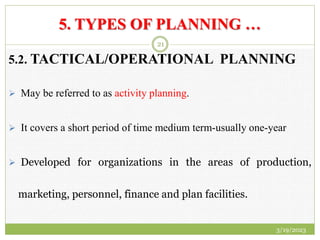
5. TYPES OF PLANNING …
5.2. TACTICAL/OPERATIONAL PLANNING
 May be referred to as activity planning.
 It covers a short period of time medium term-usually one-year
 Developed for organizations in the areas of production,
marketing, personnel, finance and plan facilities.
3/19/2023
21
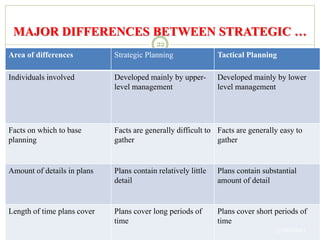
MAJOR DIFFERENCES BETWEEN STRATEGIC …
Area of differences Strategic Planning Tactical Planning
Individuals involved Developed mainly by upper-
level management
Developed mainly by lower
level management
Facts on which to base
planning
Facts are generally difficult to
gather
Facts are generally easy to
gather
Amount of details in plans Plans contain relatively little
detail
Plans contain substantial
amount of detail
Length of time plans cover Plans cover long periods of
time
Plans cover short periods of
time
3/19/2023
22
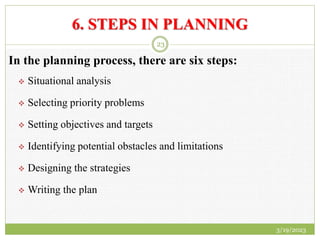
6. STEPS IN PLANNING
In the planning process, there are six steps:
 Situational analysis
 Selecting priority problems
 Setting objectives and targets
 Identifying potential obstacles and limitations
 Designing the strategies
 Writing the plan
3/19/2023
23
6.1. SITUATIONAL ANALYSIS
 Is used to improve the understanding of the current situation.
 This is for two reasons:-
 It provides a common reference point for the rest of the
planning process.
 It allows the selection of priority areas of concern for planning.
3/19/2023
24
6.1. SITUATIONALANALYSIS …
Content of situational analysis
6.1.1 Population characteristics
 Study size, composition and distribution of the population
 Identify target groups
 Determine population size by category
 Estimate overall population growth rate
 Determine religious, educational and cultural characteristics
3/19/2023
25
6.1. SITUATIONALANALYSIS …
Content of situational analysis …
6.1.2 Review area characteristics and infrastructure
- Geographical and topographical situation
- Infrastructure - Transport modes and routes
- Communications - Water supply and sanitation facilities
- Utilities-including distribution of main electricity
- Socio-economic situation
- Change in pattern of income distribution
- Public and private sector structures
3/19/2023
26
6.1. SITUATIONALANALYSIS …
Content of situational analysis …
6.1.3 Policy and political environment
 Consider national health policy and programmes and relate it to
actual situation in your own area
 Analyze political environment
6.1.4 Analysis health needs
Information on health needs is a basic prerequisite for a plan.
However, the issue of measuring health needs is a COMPLEX ONE.
3/19/2023
27
6.1. SITUATIONALANALYSIS …
ACTIVITY 2:
 Discuss, in groups, the difference and relationship
between objective (real) health needs and subjective (felt)
health needs, with reference to your area.
3/19/2023
28
6.1. SITUATIONALANALYSIS …
Content of situational analysis …
 The main categories of health need information are;-
 Medically perceived health needs and
 Community-perceived health needs.
3/19/2023
29
6.1. SITUATIONALANALYSIS …
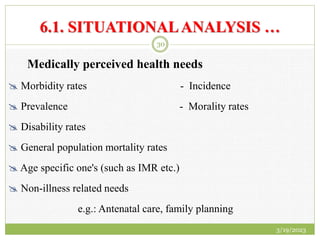
Medically perceived health needs
 Morbidity rates - Incidence
 Prevalence - Morality rates
 Disability rates
 General population mortality rates
 Age specific one's (such as IMR etc.)
 Non-illness related needs
e.g.: Antenatal care, family planning
3/19/2023
30
6.1. SITUATIONALANALYSIS …
Community perceived health needs
§ These are harder to define.
§ Particularly at the national level, often expressed in terns of service
deficiencies rather than health indicators.
3/19/2023
31
6.1. SITUATIONALANALYSIS …
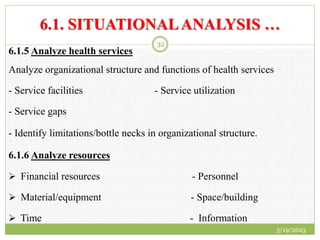
6.1.5 Analyze health services
Analyze organizational structure and functions of health services
- Service facilities - Service utilization
- Service gaps
- Identify limitations/bottle necks in organizational structure.
6.1.6 Analyze resources
 Financial resources - Personnel
 Material/equipment - Space/building
 Time - Information
3/19/2023
32
6.1. SITUATIONALANALYSIS …
6.1.7. Review past implementation experience
Find out information or experiences form activities implemented in
the past
Success
Short comings
3/19/2023
33
6.2. WHAT IS A PROBLEM?
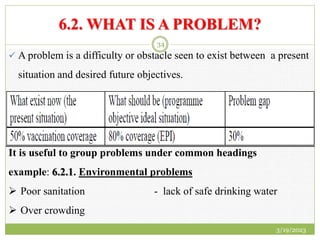
 A problem is a difficulty or obstacle seen to exist between a present
situation and desired future objectives.
It is useful to group problems under common headings
example: 6.2.1. Environmental problems
 Poor sanitation - lack of safe drinking water
 Over crowding
3/19/2023
34
WHAT IS A PROBLEM? …
6.2.2. Disease or Health problems
Malaria Respiratory Diseases
Diarrhea Malnutrition
6.2.3. Socio-economic problems
 Low per capital income
6.2.4. Illiteracy
Poor equity in distribution of health services
Cultural and religious habits
3/19/2023
35
WHAT IS A PROBLEM? …
6.2.5. Health service problems
 In sufficient drugs and materials
 Lack of qualified personnel
 Difficulty in visiting outlying areas
 Making such groups of problems helps seeking common solutions.
 However there are always discrepancies between the health needs
(problems that need to be solved) and available resources.
 So what???????????????????
3/19/2023
36
WHAT IS A PROBLEM? …
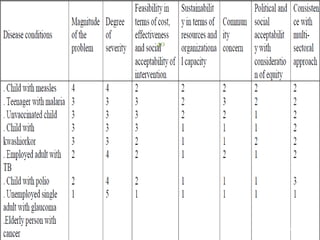
o Hence, the planner is obliged to take priority problems first.
o Priority problems are often selected by setting selection criteria and
giving scores for each problem according to these criteria.
 Magnitude of the problem
 Degree of severity (consequent suffering and disability)
 Feasibility-in terms of cost effectiveness
 Social acceptability of intervention.
3/19/2023
37
WHAT IS A PROBLEM? …
 Sustainability in terms of resources and organizational capacity
 Community concern
 Political and social acceptability with consideration of equity
 Consistence with multi - sectoral approach
 Consistence with governmental planning and budgetary system
 Clear defined system with donors (if linkage exists)
 Ranking which health problems they think were most important.
This can be done by using criteria on five point scale .
3/19/2023
38
WHAT IS A PROBLEM? …
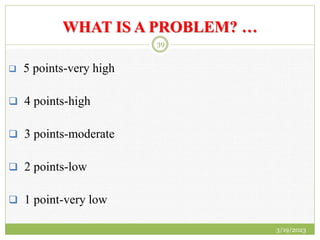
 5 points-very high
 4 points-high
 3 points-moderate
 2 points-low
 1 point-very low
3/19/2023
39
3/19/2023
40
6.3. SETTING OBJECTIVES AND TARGETS
 What are the differences between these related terms which are
important in rational planning?
 Goals, Aims, Objectives and Targets
DISCUSS IN YOUR GROUP
3/19/2023
41
6.3. SETTING OBJECTIVES AND …
 Goals, aims, objectives and targets are all ways of describing the
desired direction of a service.
 They differ in terms of breadth and detail.
 Goals:-
 Are broad statements.
 There is generally one goal for a service.
 This might be:' Health for all by 2000 and beyond.'
3/19/2023
42
6.3. SETTING OBJECTIVES AND …
 Aims:-
 There are a number of aims relating to the goal.
 They are specific to particular health problems.
 One might be: 'To raise the nutritional status of women
and children.‘
To vaccinate all under 5 children.
3/19/2023
43
6.3. SETTING OBJECTIVES AND …
 Objective:-
 For each programme aim, there may be a number of
objectives which are specified in measurable terms.
 An objective for the above aim might be:
' To ensure that 95 % of children are adequately
nourished.'
3/19/2023
44
6.3. SETTING OBJECTIVES AND …
 Targets:-
 For each objective, there may be various targets which specify
various points on the way to the attainment of the objective.
 They are defined in relation to a point in time.
 For example, a target for the above objective might be:
 ' To ensure that 95 % of children are adequately nourished by
2007.'
3/19/2023
45
6.3. SETTING OBJECTIVES AND …
If the programme is made to have an objective and target, it must be
SMART:-
 S –Specific M -Measurable
 A –Achievable R -Realistic
 T -Time specific/Time framed.
e.g. By the end of 2008, 95% of eligible children will be vaccinated
against ten target diseases in Asella town.
3/19/2023
46
6.4. IDENTIFYING OBSTACLES AND
LIMITATIONS
6.4.1. Resources:-
 People - Lack of interest - Equipment – not available
- No skilled people - expensive (if…)
 Money - No budget - Time – people may not have time
 Information - Hard to find - Statistics not available
6.4.2. Environmental obstacles:-
 Geographical features
 Climate
3/19/2023
47
6.4. IDENTIFYING OBSTACLES AND …
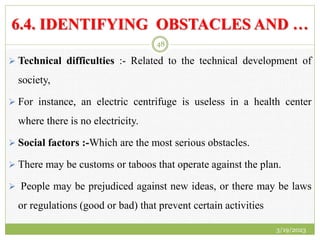
 Technical difficulties :- Related to the technical development of
society,
 For instance, an electric centrifuge is useless in a health center
where there is no electricity.
 Social factors :-Which are the most serious obstacles.
 There may be customs or taboos that operate against the plan.
 People may be prejudiced against new ideas, or there may be laws
or regulations (good or bad) that prevent certain activities
3/19/2023
48
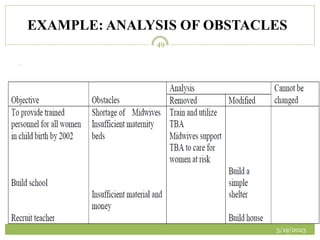
EXAMPLE: ANALYSIS OF OBSTACLES
3/19/2023
49
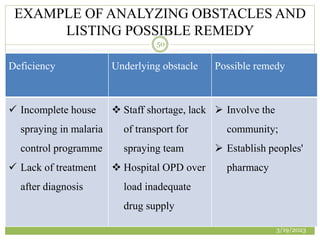
EXAMPLE OF ANALYZING OBSTACLES AND
LISTING POSSIBLE REMEDY
Deficiency Underlying obstacle Possible remedy
 Incomplete house
spraying in malaria
control programme
 Lack of treatment
after diagnosis
 Staff shortage, lack
of transport for
spraying team
 Hospital OPD over
load inadequate
drug supply
 Involve the
community;
 Establish peoples'
pharmacy
3/19/2023
50
6.5. DESIGNING THE STRATEGIES
 They are different ways for achieving the pre- determined objectives
and targets.
 Choosing the best strategy again entails analyzing resources
available and needed for each strategy.
 The potential strategies often includes;-
 technology to be applied,
 procedures to be used and
 defining the role of communities and other sectors.
3/19/2023
51
6.6. WRITING THE PLAN …
The purposes of writing the plan are:-
To request funds or resources from the government or funding
agencies.
For monitoring and evaluating the implementation process by all
concerned.
 A plan can be written in several ways. Some organizations may
require plans to be written on specific way.
3/19/2023
52
6.6. WRITING THE PLAN …
An outline of writing the plan may include:
 Summary
 Problem statement
 Objectives and targets
 Strategies and activities
 Resources needed and how they are going to be utilized specify
budget required
 Monitoring and evaluation (periodic and end of programme
assessment, how, by whom, when, indicators of effectiveness)
3/19/2023
53
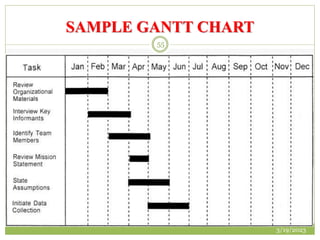
GANTT CHART
 This is a bar graph with time on horizontal axis and the
resources/activities to be scheduled on the vertical axis.
 The main weakness of the GANTT chart, it lacks information on
interrelation of tasks to be performed.
3/19/2023
54
SAMPLE GANTT CHART
3/19/2023
55
WHY PLANS FAIL?????
§ A lack of understanding of the different steps of the planning process.
§ Concerned parties not participated or contributed in the planning
process.
§ Management expects that plans will be realized with little effort.
§ Too much attempted at once
§ Failing to operate by the plan
§ Inadequate input in planning
§ Unforeseen (unexpected) changes in the environment.
3/19/2023
56
OVERVIEW OF PLANNIN PROCESS IN
ETHIOIPIA
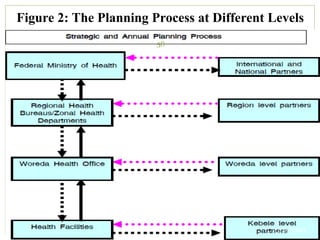
 In Ethiopia, the health sector at all levels will be governed by the
“ONE PLAN” principle in the planning process.
This principles means:
 All levels in the health sector will have one strategic plan and one
annual plan.
 Strategic and annual plans will consider both national as well as
local priorities.
3/19/2023
57
Figure 2: The Planning Process at Different Levels
3/19/2023
58
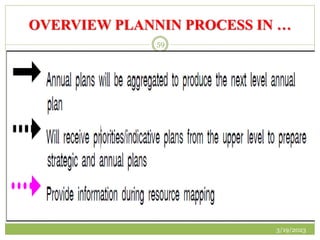
OVERVIEW PLANNIN PROCESS IN …
3/19/2023
59
One Plan, One Budget And One Report
Concepts and definitions
 Harmonization is the coordination of activities amongst all
stakeholders to reduce the transaction cost of delivering aid and
services.
 Alignment means “lined up with government priorities”. the
government and donors are aligned in their commitment to HSDP-
IV and its priorities.
3/19/2023
60
Concepts and definitions …
Harmonization
 relates to increased coordination
of the activities
 Three underlying ideas:
 common arrangements
 simplification of procedures
 sharing of information
Alignment
 lining up with government
priorities and systems
Partners are expected to:
 streamline their plans and
programs with the priorities of
the government
 rely on the government’s
systems and procedures
3/19/2023
61
3/19/2023
62
Individual reading Assignment
READ THE DETAILS OF, three of them related to harmonization
and alighment’systems in ethiopia’
“ONE PLAN, All levels in the health sector will have one strategic plan
and one annual plan from top to botom level
Health sector tranformation plan.
ONE BUDGET . There only one budget system from top to botom GTP- 5-6%
ONE REPORT”there is only one reports system from HEALTH POST TO
FMOH that’s HMIS systems.
3/19/2023
63
Group Assignment
Group 1: Health communication decision making
Group 2: Leadership in health care
Group 3: Health monitoring and evaluation
Instructions:
a) Power point presentation (15-20 minutes)
b) Micro soft word document submission with times
roman font style and 1.5 spacing
3/19/2023
64
REFERENCES
1. Amsalu F., Yigzaw K., Alemayehu M., Zeleke A., Kassa. , Kahsay
H. et al. Health Team Work and Team Training : For the Ethiopian
Health Center Team. University of Gondar, 2005.
2. FMOH. Performance Monitoring and Quality Improvement
Manual for the Ethiopian Health Sector: August, 2008.
3. WHO. On Being in Change. A Guide to management in Primary
health care, 2002.
3/19/2023
65

Health Services Planning, 2016.ppt

  • 1.
  • 2.
    OUTLINE  Defining planning Unique features of health services planning  Rational for planning  Scope of planning  Features of planning  Types of planning  Steps in planning  Overview of Health Services Planning in Ethiopia 3/19/2023 2
  • 3.
    OBJECTIVES At the endof the class, students will able to:-  Define planning  Acquire planning skill so as to plan  Differentiate types planning.  Describe the basic steps in health services planning.  Appreciate current health services planning situation in Ethiopia. 3/19/2023 3
  • 4.
    HEALTH SERVICES PLANNING Do you have a plan? ……………. Why?  What is health care planning?  Do you thing that health care planning is unique? 3/19/2023 4
  • 5.
    PLANNING  Planning, o Combinationof compiling and analyzing information. o Dreaming up ideas. o Using logic and imagination and o Judgment in order to arrive at a decision about what should be done. 3/19/2023 5
  • 6.
    HEALTH SERVICES PLANNING Process of defining community health problems.  Identifying needs and resources  Establishing priority goals and  Setting out the administrative action needed to reach those goals. 3/19/2023 6
  • 7.
    HEALTH SERVICES PLANNING…  Deciding in advance what is to be done  It is projected course of action for the future.  To plan is to propose a forward programme for guiding the future affairs of an organization.  Starts with the assumption that the future will be different from the present. 3/19/2023 7
  • 8.
    HEALTH SERVICES PLANNING…  It attempts to determine how the organization can take advantage of that difference  Planning thus becomes a device for change. 3/19/2023 8
  • 9.
    HEALTH SERVICES PLANNING…  The important components of this and other similar definitions are concepts of:- o Where are we going (objectives)? o With what (Resources)? o When (future)? o Degree for formalization (explicitness, systematic and method) about the process 3/19/2023 9
  • 10.
    UNIQUE FEATURES OFH/S/PLANNING  Dealing with life-and-death situations.  Most parties operate independently of most of the other organizations involved in the provision of health care  Elasticity in the level of demand presents a challenge to health planners 3/19/2023 10
  • 11.
    UNIQUE FEATURES … Healthcare also is characterized by a wide variety of different customers and the nature of these customers varies  End-user may not make the consumption decision or pay for the service provided  The diversity of functions that often characterize healthcare providers 3/19/2023 11
  • 12.
    THE RATIONALE FORPLANNING Importance of planning is unquestionable in every aspects of human life. It helps:-  Coping with future uncertainty and change  Focus attention on objectives  It obtains economical operation  Provides performance standards and facilitates control  Foreseeing and identifying potential risks. 3/19/2023 12
  • 13.
    SCOPE OF PLANNING 3.1What is the target client/customer?  Population Institution  Programme  What the plan intends to address should be clearly defined 3.2 What is the target geographical region or area?  Village/kebele District/Zonal  Region  At what level you are planning has to be clearly defined 3/19/2023 13
  • 14.
    SCOPE OF CON’T… 3.3For what level of comprehensiveness should services be planned? The degrees of comprehensiveness to be determined as that of the following:- Environmental Determinants Comprehensive Health Care  Diet-sanitary preparation of food preventive, promotive,  Avoidance of harmful life style curative, rehabilitative  Housing- sanitary housing condition  Unpolluted environment health care  Freedom from stress 3/19/2023 14
  • 15.
    4. FEATURES OFPLANING 4.1. A Good Plan Should Give  Clear vision/mission, goal and objectives ???  A clear picture of the tasks to be accomplished  The resources needed to accomplish the task.  In terms of human, material, financial and time resources. 4.2 Planning Takes Place at All Levels  Planning takes place at any level in health system  Planning takes place continually, it is cyclic/spiral process 3/19/2023 15
  • 16.
    4. FEATURES OFPLANING … Planning methods can be applied to :-  A large programme at national level  Example –Malaria control programme  Small one - at village level  Example –construction of community health post 4.3 Planning must be Collective Undertaking It requires the participation of:-  Different sector/ inter- sectoral collaboration  Professionals (from health and other sectors)  Community/Non-Governmental Organizations (NGO)  Government/Party 3/19/2023 16
  • 17.
    5. TYPES OFPLANNING 5.1. STRATEGIC PLANNING  Often referred as allocative planning –Normally five years or more. E.g. HSDP, SPM, GTP, MDGs …  Always consider the SWOT Analysis- tools for strategic planning Figure 1: SWOT analysis: a frame work for selecting strategies SWOT matrix Internal External . Positive Strengthen Opportunities Negative Weakness Threats 3/19/2023 17
  • 18.
    5. TYPES OFPLANNING …  Strengths may be considered as availability of resources, trained human power, road and etc.  Weaknesses include lack of managerial talent and obsolete facilities.  Threats include adverse cultural believes towards modern medical practice and growing cost of essential drugs.  Opportunities are clear and supportive government policies and presence of a functional health committee in the communities. 3/19/2023 18
  • 19.
    E. g. WorldHealth Organization (WHO) Roll Back Malaria (RBM) intervention in Ethiopia 3/19/2023 19
  • 20.
  • 21.
    5. TYPES OFPLANNING … 5.2. TACTICAL/OPERATIONAL PLANNING  May be referred to as activity planning.  It covers a short period of time medium term-usually one-year  Developed for organizations in the areas of production, marketing, personnel, finance and plan facilities. 3/19/2023 21
  • 22.
    MAJOR DIFFERENCES BETWEENSTRATEGIC … Area of differences Strategic Planning Tactical Planning Individuals involved Developed mainly by upper- level management Developed mainly by lower level management Facts on which to base planning Facts are generally difficult to gather Facts are generally easy to gather Amount of details in plans Plans contain relatively little detail Plans contain substantial amount of detail Length of time plans cover Plans cover long periods of time Plans cover short periods of time 3/19/2023 22
  • 23.
    6. STEPS INPLANNING In the planning process, there are six steps:  Situational analysis  Selecting priority problems  Setting objectives and targets  Identifying potential obstacles and limitations  Designing the strategies  Writing the plan 3/19/2023 23
  • 24.
    6.1. SITUATIONAL ANALYSIS Is used to improve the understanding of the current situation.  This is for two reasons:-  It provides a common reference point for the rest of the planning process.  It allows the selection of priority areas of concern for planning. 3/19/2023 24
  • 25.
    6.1. SITUATIONALANALYSIS … Contentof situational analysis 6.1.1 Population characteristics  Study size, composition and distribution of the population  Identify target groups  Determine population size by category  Estimate overall population growth rate  Determine religious, educational and cultural characteristics 3/19/2023 25
  • 26.
    6.1. SITUATIONALANALYSIS … Contentof situational analysis … 6.1.2 Review area characteristics and infrastructure - Geographical and topographical situation - Infrastructure - Transport modes and routes - Communications - Water supply and sanitation facilities - Utilities-including distribution of main electricity - Socio-economic situation - Change in pattern of income distribution - Public and private sector structures 3/19/2023 26
  • 27.
    6.1. SITUATIONALANALYSIS … Contentof situational analysis … 6.1.3 Policy and political environment  Consider national health policy and programmes and relate it to actual situation in your own area  Analyze political environment 6.1.4 Analysis health needs Information on health needs is a basic prerequisite for a plan. However, the issue of measuring health needs is a COMPLEX ONE. 3/19/2023 27
  • 28.
    6.1. SITUATIONALANALYSIS … ACTIVITY2:  Discuss, in groups, the difference and relationship between objective (real) health needs and subjective (felt) health needs, with reference to your area. 3/19/2023 28
  • 29.
    6.1. SITUATIONALANALYSIS … Contentof situational analysis …  The main categories of health need information are;-  Medically perceived health needs and  Community-perceived health needs. 3/19/2023 29
  • 30.
    6.1. SITUATIONALANALYSIS … Medicallyperceived health needs  Morbidity rates - Incidence  Prevalence - Morality rates  Disability rates  General population mortality rates  Age specific one's (such as IMR etc.)  Non-illness related needs e.g.: Antenatal care, family planning 3/19/2023 30
  • 31.
    6.1. SITUATIONALANALYSIS … Communityperceived health needs § These are harder to define. § Particularly at the national level, often expressed in terns of service deficiencies rather than health indicators. 3/19/2023 31
  • 32.
    6.1. SITUATIONALANALYSIS … 6.1.5Analyze health services Analyze organizational structure and functions of health services - Service facilities - Service utilization - Service gaps - Identify limitations/bottle necks in organizational structure. 6.1.6 Analyze resources  Financial resources - Personnel  Material/equipment - Space/building  Time - Information 3/19/2023 32
  • 33.
    6.1. SITUATIONALANALYSIS … 6.1.7.Review past implementation experience Find out information or experiences form activities implemented in the past Success Short comings 3/19/2023 33
  • 34.
    6.2. WHAT ISA PROBLEM?  A problem is a difficulty or obstacle seen to exist between a present situation and desired future objectives. It is useful to group problems under common headings example: 6.2.1. Environmental problems  Poor sanitation - lack of safe drinking water  Over crowding 3/19/2023 34
  • 35.
    WHAT IS APROBLEM? … 6.2.2. Disease or Health problems Malaria Respiratory Diseases Diarrhea Malnutrition 6.2.3. Socio-economic problems  Low per capital income 6.2.4. Illiteracy Poor equity in distribution of health services Cultural and religious habits 3/19/2023 35
  • 36.
    WHAT IS APROBLEM? … 6.2.5. Health service problems  In sufficient drugs and materials  Lack of qualified personnel  Difficulty in visiting outlying areas  Making such groups of problems helps seeking common solutions.  However there are always discrepancies between the health needs (problems that need to be solved) and available resources.  So what??????????????????? 3/19/2023 36
  • 37.
    WHAT IS APROBLEM? … o Hence, the planner is obliged to take priority problems first. o Priority problems are often selected by setting selection criteria and giving scores for each problem according to these criteria.  Magnitude of the problem  Degree of severity (consequent suffering and disability)  Feasibility-in terms of cost effectiveness  Social acceptability of intervention. 3/19/2023 37
  • 38.
    WHAT IS APROBLEM? …  Sustainability in terms of resources and organizational capacity  Community concern  Political and social acceptability with consideration of equity  Consistence with multi - sectoral approach  Consistence with governmental planning and budgetary system  Clear defined system with donors (if linkage exists)  Ranking which health problems they think were most important. This can be done by using criteria on five point scale . 3/19/2023 38
  • 39.
    WHAT IS APROBLEM? …  5 points-very high  4 points-high  3 points-moderate  2 points-low  1 point-very low 3/19/2023 39
  • 40.
  • 41.
    6.3. SETTING OBJECTIVESAND TARGETS  What are the differences between these related terms which are important in rational planning?  Goals, Aims, Objectives and Targets DISCUSS IN YOUR GROUP 3/19/2023 41
  • 42.
    6.3. SETTING OBJECTIVESAND …  Goals, aims, objectives and targets are all ways of describing the desired direction of a service.  They differ in terms of breadth and detail.  Goals:-  Are broad statements.  There is generally one goal for a service.  This might be:' Health for all by 2000 and beyond.' 3/19/2023 42
  • 43.
    6.3. SETTING OBJECTIVESAND …  Aims:-  There are a number of aims relating to the goal.  They are specific to particular health problems.  One might be: 'To raise the nutritional status of women and children.‘ To vaccinate all under 5 children. 3/19/2023 43
  • 44.
    6.3. SETTING OBJECTIVESAND …  Objective:-  For each programme aim, there may be a number of objectives which are specified in measurable terms.  An objective for the above aim might be: ' To ensure that 95 % of children are adequately nourished.' 3/19/2023 44
  • 45.
    6.3. SETTING OBJECTIVESAND …  Targets:-  For each objective, there may be various targets which specify various points on the way to the attainment of the objective.  They are defined in relation to a point in time.  For example, a target for the above objective might be:  ' To ensure that 95 % of children are adequately nourished by 2007.' 3/19/2023 45
  • 46.
    6.3. SETTING OBJECTIVESAND … If the programme is made to have an objective and target, it must be SMART:-  S –Specific M -Measurable  A –Achievable R -Realistic  T -Time specific/Time framed. e.g. By the end of 2008, 95% of eligible children will be vaccinated against ten target diseases in Asella town. 3/19/2023 46
  • 47.
    6.4. IDENTIFYING OBSTACLESAND LIMITATIONS 6.4.1. Resources:-  People - Lack of interest - Equipment – not available - No skilled people - expensive (if…)  Money - No budget - Time – people may not have time  Information - Hard to find - Statistics not available 6.4.2. Environmental obstacles:-  Geographical features  Climate 3/19/2023 47
  • 48.
    6.4. IDENTIFYING OBSTACLESAND …  Technical difficulties :- Related to the technical development of society,  For instance, an electric centrifuge is useless in a health center where there is no electricity.  Social factors :-Which are the most serious obstacles.  There may be customs or taboos that operate against the plan.  People may be prejudiced against new ideas, or there may be laws or regulations (good or bad) that prevent certain activities 3/19/2023 48
  • 49.
    EXAMPLE: ANALYSIS OFOBSTACLES 3/19/2023 49
  • 50.
    EXAMPLE OF ANALYZINGOBSTACLES AND LISTING POSSIBLE REMEDY Deficiency Underlying obstacle Possible remedy  Incomplete house spraying in malaria control programme  Lack of treatment after diagnosis  Staff shortage, lack of transport for spraying team  Hospital OPD over load inadequate drug supply  Involve the community;  Establish peoples' pharmacy 3/19/2023 50
  • 51.
    6.5. DESIGNING THESTRATEGIES  They are different ways for achieving the pre- determined objectives and targets.  Choosing the best strategy again entails analyzing resources available and needed for each strategy.  The potential strategies often includes;-  technology to be applied,  procedures to be used and  defining the role of communities and other sectors. 3/19/2023 51
  • 52.
    6.6. WRITING THEPLAN … The purposes of writing the plan are:- To request funds or resources from the government or funding agencies. For monitoring and evaluating the implementation process by all concerned.  A plan can be written in several ways. Some organizations may require plans to be written on specific way. 3/19/2023 52
  • 53.
    6.6. WRITING THEPLAN … An outline of writing the plan may include:  Summary  Problem statement  Objectives and targets  Strategies and activities  Resources needed and how they are going to be utilized specify budget required  Monitoring and evaluation (periodic and end of programme assessment, how, by whom, when, indicators of effectiveness) 3/19/2023 53
  • 54.
    GANTT CHART  Thisis a bar graph with time on horizontal axis and the resources/activities to be scheduled on the vertical axis.  The main weakness of the GANTT chart, it lacks information on interrelation of tasks to be performed. 3/19/2023 54
  • 55.
  • 56.
    WHY PLANS FAIL????? §A lack of understanding of the different steps of the planning process. § Concerned parties not participated or contributed in the planning process. § Management expects that plans will be realized with little effort. § Too much attempted at once § Failing to operate by the plan § Inadequate input in planning § Unforeseen (unexpected) changes in the environment. 3/19/2023 56
  • 57.
    OVERVIEW OF PLANNINPROCESS IN ETHIOIPIA  In Ethiopia, the health sector at all levels will be governed by the “ONE PLAN” principle in the planning process. This principles means:  All levels in the health sector will have one strategic plan and one annual plan.  Strategic and annual plans will consider both national as well as local priorities. 3/19/2023 57
  • 58.
    Figure 2: ThePlanning Process at Different Levels 3/19/2023 58
  • 59.
    OVERVIEW PLANNIN PROCESSIN … 3/19/2023 59
  • 60.
    One Plan, OneBudget And One Report Concepts and definitions  Harmonization is the coordination of activities amongst all stakeholders to reduce the transaction cost of delivering aid and services.  Alignment means “lined up with government priorities”. the government and donors are aligned in their commitment to HSDP- IV and its priorities. 3/19/2023 60
  • 61.
    Concepts and definitions… Harmonization  relates to increased coordination of the activities  Three underlying ideas:  common arrangements  simplification of procedures  sharing of information Alignment  lining up with government priorities and systems Partners are expected to:  streamline their plans and programs with the priorities of the government  rely on the government’s systems and procedures 3/19/2023 61
  • 62.
  • 63.
    Individual reading Assignment READTHE DETAILS OF, three of them related to harmonization and alighment’systems in ethiopia’ “ONE PLAN, All levels in the health sector will have one strategic plan and one annual plan from top to botom level Health sector tranformation plan. ONE BUDGET . There only one budget system from top to botom GTP- 5-6% ONE REPORT”there is only one reports system from HEALTH POST TO FMOH that’s HMIS systems. 3/19/2023 63
  • 64.
    Group Assignment Group 1:Health communication decision making Group 2: Leadership in health care Group 3: Health monitoring and evaluation Instructions: a) Power point presentation (15-20 minutes) b) Micro soft word document submission with times roman font style and 1.5 spacing 3/19/2023 64
  • 65.
    REFERENCES 1. Amsalu F.,Yigzaw K., Alemayehu M., Zeleke A., Kassa. , Kahsay H. et al. Health Team Work and Team Training : For the Ethiopian Health Center Team. University of Gondar, 2005. 2. FMOH. Performance Monitoring and Quality Improvement Manual for the Ethiopian Health Sector: August, 2008. 3. WHO. On Being in Change. A Guide to management in Primary health care, 2002. 3/19/2023 65