C H A P T E R 5
S T R A T E G I C P L A N N I N G
A N D S W O T A N A L Y S I S
I s k a t e w h e r e t h e p u c k i s g o i n g t o b e , n o t
w h e r e i t
h a s b e e n .
— W a y n e G r e t z k y
K e y T e r m s a n d C o n C e p T s
➤➤Force➤field➤analysis
➤➤Opportunities
➤➤Strengths
➤➤SWOT➤analysis
➤➤Threats
➤➤Weaknesses
9 1
Excerpted from Essentials of Strategic Planning in Healthcare
by Jeffrey P. Harrison
(Health Administration Press, 2010).
9 2 E s s e n t i a l s o f S t r a t e g i c P l a n n i n
g i n H e a l t h c a r e
In T r o d u C T I o n
Healthcare organizations must continually make adjustments to
maintain optimal func-
tion (Christiansen 2002). A number of different techniques can
be used to determine
where adjustments need to be made. One essential technique
involves a discussion of an
organization’s strengths, weaknesses, opportunities, and threats,
commonly called SWOT
analysis. SWOT analysis has been used extensively in other
industries but has not been
widely used in healthcare (Kahveci and Meads 2008).
SWOT analysis is a precursor to strategic planning and is
performed by a panel of
experts who can assess the organization from a critical
perspective (Gibis et al. 2001). This
panel could comprise senior leaders, board members,
employees, medical staff, patients,
community leaders, and technical experts. Panel members base
their assessments on utili-
zation rates, outcome measures, patient satisfaction statistics,
organizational performance
measures, and financial status. While based on data and facts,
the conclusions drawn from
SWOT analysis are an expert opinion of the panel.
de f I n I T I o n
SWOT analysis is an examination of an organization’s internal
strengths and weaknesses,
its opportunities for growth and improvement, and the threats
the external environment
presents to its survival. Originally designed for use in other
industries, it is gaining in-
creased use in healthcare.
sT e p s I n sWoT an a l y s I s
The primary aim of strategic planning is to bring an
organization into balance with the
external environment and to maintain that balance over time
(Sackett, Jones, and Erdley
2005). Organizations accomplish this balance by evaluating new
programs and services
with the intent of maximizing organizational performance.
SWOT analysis is a prelimi-
nary decision-making tool that sets the stage for this work.
Step 1 of SWOT analysis involves the collection and evaluation
of key data. De-
pending on the organization, these data might include
population demographics, com-
munity health status, sources of healthcare funding, and/or the
current status of medical
technology. Once the data have been collected and analyzed, the
organization’s capabilities
in these areas are assessed.
In Step 2 of SWOT analysis, data on the organization are
collected and sorted into
four categories: strengths, weaknesses, opportunities, and
threats. Strengths and weak-
nesses generally stem from factors within the organization,
whereas opportunities and
threats usually arise from external factors. Organizational
surveys are an effective means of
gathering some of this information, such as data on an
organization’s finances, operations,
and processes (Carpenter 2006).
SWOT analysis
an examination of an
organization’s internal
strengths and weak-
nesses, its opportuni-
ties for growth and
improvement, and the
threats the external
environment presents
to its survival
Copying and distributing this content is prohibited without
written permission. For permission, please contact Copyright
Clearance Center at [email protected] or visit
www.copyright.com
C h a p t e r 5 : S t r a t e g i c P l a n n i n g a
n d S W O T A n a l y s i s 9 3
Step 3 involves the development of a SWOT matrix for each
business alternative
under consideration. For example, say a hospital is evaluating
the development of an am-
bulatory surgery center (ASC). They are looking at two options;
the first is a wholly owned
ASC, and the second is a joint venture with local physicians.
The hospital’s expert panel
would complete a separate SWOT matrix for each alternative.
Step 4 involves incorporating the SWOT analysis into the
decision-making process
to determine which business alternative best meets the
organization’s overall strategic plan.
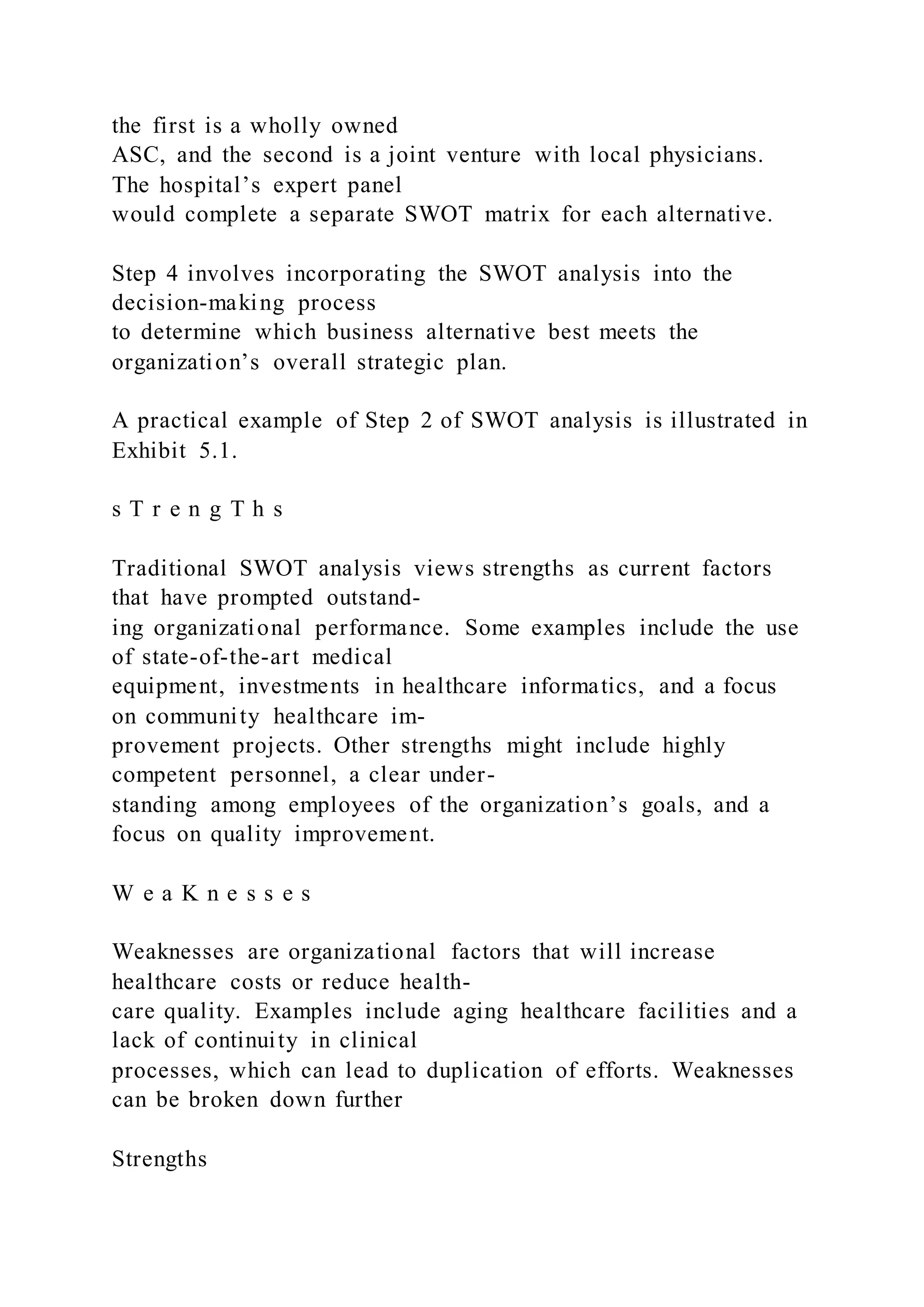
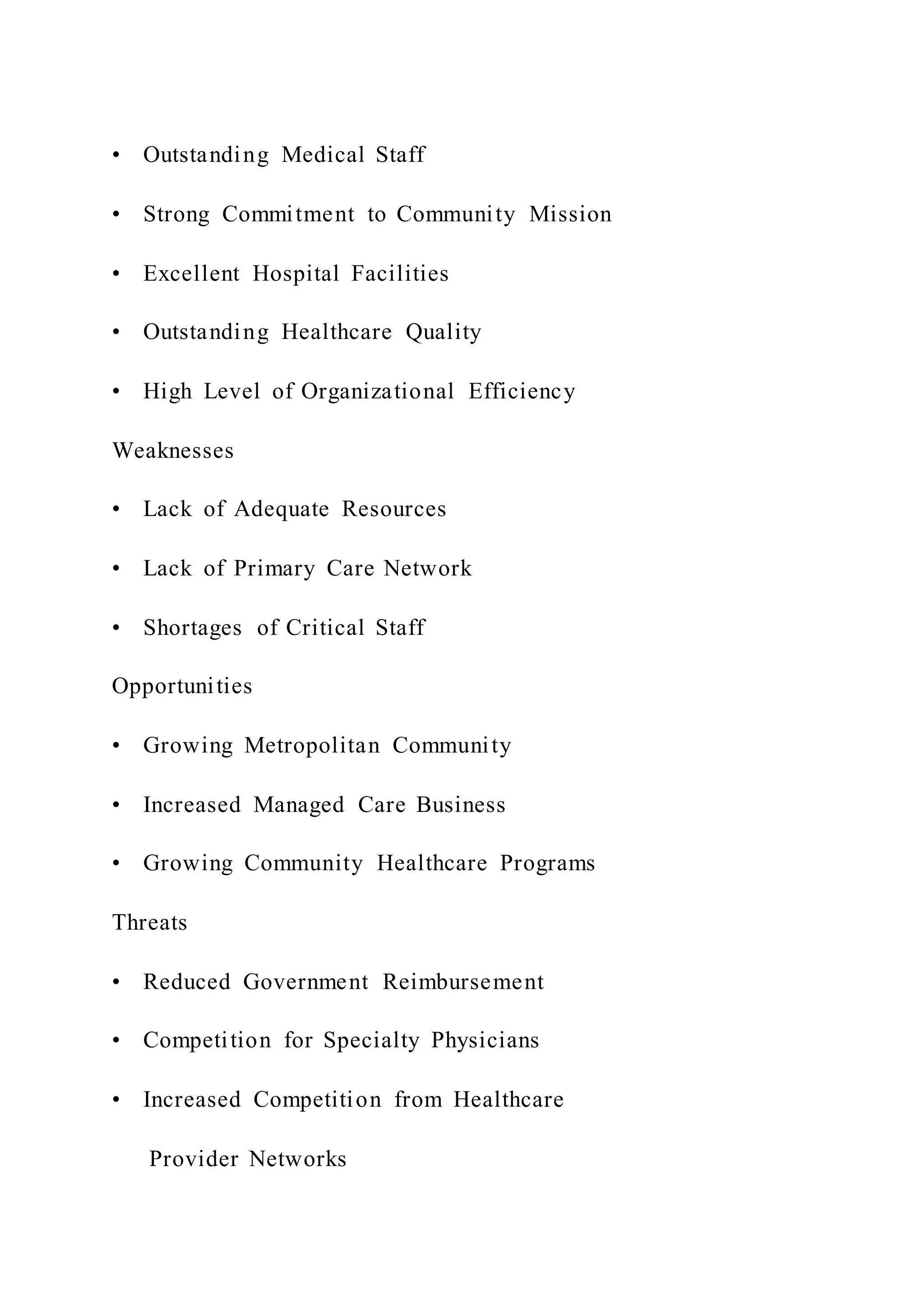
A practical example of Step 2 of SWOT analysis is illustrated in
Exhibit 5.1.
s T r e n g T h s
Traditional SWOT analysis views strengths as current factors
that have prompted outstand-
ing organizational performance. Some examples include the use
of state-of-the-art medical
equipment, investments in healthcare informatics, and a focus
on community healthcare im-
provement projects. Other strengths might include highly
competent personnel, a clear under-
standing among employees of the organization’s goals, and a
focus on quality improvement.
W e a K n e s s e s
Weaknesses are organizational factors that will increase
healthcare costs or reduce health-
care quality. Examples include aging healthcare facilities and a
lack of continuity in clinical
processes, which can lead to duplication of efforts. Weaknesses
can be broken down further
Strengths
• Outstanding Medical Staff
• Strong Commitment to Community Mission
• Excellent Hospital Facilities
• Outstanding Healthcare Quality
• High Level of Organizational Efficiency
Weaknesses
• Lack of Adequate Resources
• Lack of Primary Care Network
• Shortages of Critical Staff
Opportunities
• Growing Metropolitan Community
• Increased Managed Care Business
• Growing Community Healthcare Programs
Threats
• Reduced Government Reimbursement
• Competition for Specialty Physicians
• Increased Competition from Healthcare
Provider Networks
Helpful to Objective Harmful to Objective
E
xt
er
n
al
O
ri
g
in
In
te
rn
al
O
ri
g
in
exhIbIT 5.1
SWOT Matrix
Strengths
current factors that
have prompted out-
standing organizational
performance
Weaknesses
organizational factors
that increase health-
care costs or reduce
healthcare quality
Copying and distributing this content is prohibited without
written permission. For permission, please contact Copyright
Clearance Center at [email protected] or visit
www.copyright.com
9 4 E s s e n t i a l s o f S t r a t e g i c P l a n n i n
g i n H e a l t h c a r e
to identify underlying causes. For example, disruption in the
continuity of care often results
from poor communication. Weaknesses also breed other
weaknesses. Poor communication
disrupts the continuity of care, and then this fragmentation
leads to inefficiencies in the
entire system. Inefficiencies, in turn, deplete financial and other
resources.
Other common weaknesses include poor use of healthcare
informatics, insufficient
management training, a lack of financial resources, and an
organizational structure that
limits collaboration with other healthcare organizations. A
payer mix that includes large
numbers of uninsured patients or Medicaid patients can al so
negatively affect an organiza-
tion’s financial performance, and a lack of relevant and timely
patient data can increase
costs and lower the quality of patient care.
o p p o r T u n I T I e s
Traditional SWOT analysis views opportunities as significa nt
new business initiatives avail-
able to a healthcare organization. Examples include
collaboration among healthcare orga-
nizations through the development of healthcare delivery
networks, increased funding for
healthcare informatics, community partnering to develop new
healthcare programs, and the
introduction of clinical protocols to improve quality and
efficiency. Integrated healthcare
delivery networks have an opportunity to influence healthcare
policy at the local, state, and
national levels. They also have an opportunity to improve
patient satisfaction by increasing
public involvement and ensuring patient representation on
boards and committees. Or-
ganizations that are successful at using data to improve clinical
processes have lower costs
and higher-quality patient care. For example, healthcare
organizations with CMS Hospital
Compare quality scores above the 90th national percentile are
eligible for CMS pay-for-
performance incentives. (See Chapter 6 for information on CMS
Hospital Compare). The
greater the number of organizations achieving such scores, the
greater patients’ access to
quality healthcare. Such scores also enhance an organization’s
reputation in the community.
T h r e a T s
Threats are factors that could negatively affect organizational
performance. Examples include
political or economic instability; increasing demand by patients
and physicians for expensive
medical technology that is not cost-effective; increasing state
and federal budget deficits; a
growing uninsured population; and increasing pressure to
reduce healthcare costs.
fo r C e fI e l d an a l y s I s
Healthcare organizations’ responsibility to implement change
that is beneficial to the pa-
tient, staff, and organization is increasing. The primary areas
driving change in healthcare
include quality improvement, customer satisfaction,
improvement of working conditions,
and diversification of the healthcare workforce.
Opportunities
significant new business
initiatives available to a
healthcare organization
Threats
factors that could neg-
atively affect organiza-
tional performance
Copying and distributing this content is prohibited without
written permission. For permission, please contact Copyright
Clearance Center at [email protected] or visit
www.copyright.com
Force field analysis (see Exhibit 5.2) takes SWOT analysis a
step further by iden-
tifying the forces driving or hindering change—in other words,
the forces driving its
strengths, weaknesses, opportunities, and threats. Forces that
propel an organization to-
ward goal achievement are called helping forces, while those
that block progress toward a
goal are called hindering forces. After identifying these positive
and negative forces, organi-
zations can develop strategies to strengthen the positives and
minimize the negatives. For
an organization to achieve success, the driving forces must
outweigh the resisting forces
(Baulcomb 2003). When this state is reached, organizations are
able to move from their
current reality to a preferred future.
Effective force field analysis considers not only organizational
values but also the
needs, goals, ideals, and concerns of individual stakeholders. A
case can be made that
individuals who promote change are driving forces, whereas
those who resist change are
restraining forces. As a result, it is important to understand
individuals, their attitudes, and
the culture of the organization. It is also important to identify
the key stakeholders in an
issue and to develop a plan to gain their support. Kurt Lewin,
the renowned psychologist
often recognized as the founder of social psychology, stressed
the importance of counter-
acting organizational inertia to maintain the status quo (the
resisting forces) and creating
C h a p t e r 5 : S t r a t e g i c P l a n n i n g a
n d S W O T A n a l y s i s 9 5
Limited Financial Resources
Poor Payer Mix with
Low Reimbursement
Marginal Patient Safety
E
q
u
ili
b
ri
u
m
Low Healthcare Quality
Lack of Motivated and
Skilled Personnel
Culture Opposed to Change
Patient Perception of Quality
Driving Forces Restraining Forces
Culture of Innovation
Adequate Financial Resources
Profitability
Highly Skilled Personnel
Transformational Leadership
High Low
Change
5 4 3 2 1
exhIbIT 5.2
Healthcare Model
for Force Field
Analysis
Force field analysis
an examination of the
forces driving or hin-
dering organizational
change
Copying and distributing this content is prohibited without
written permission. For permission, please contact Copyright
Clearance Center at [email protected] or visit
www.copyright.com
9 6 E s s e n t i a l s o f S t r a t e g i c P l a n n i n
g i n H e a l t h c a r e
an environment that proactively supports future change (the
driving forces) (Lewin 1951).
Such change is accomplished by modifying current attitudes
(“unfreezing” an organiza-
tion’s perspective on a particular issue), emphasizing the
positive aspects of change, and
then incorporating the new attitudes in the organization’s
processes (“refreezing” the new
attitudes so that they and their associated behavior patterns
become entrenched in the
institution).
Many believe that a participative management style that solicits
input from
within the organization is important in implementi ng change. It
also fosters the devel-
opment of consensus within work groups, which helps to
refreeze the new behaviors in
the organization.
ga p an a l y s I s
To further refine planning decisions, SWOT analysis can be
supplemented by gap analysis
(see Chapter 4). Research shows there are significant gaps in
healthcare practice and that
these gaps cause providers to make inaccurate assessments of
patients’ conditions and
provide the wrong types of care. The result is poor clinical
outcomes. Gaps in healthcare
include lack of knowledge, lack of motivation, poor access to
information, variations in
patient culture and education, lack of resources, and system
barriers that limit teamwork.
In one study, Robert Fleetcroft, honorary senior lecturer in
primary care for the School of
Medicine at the University of East Anglia, and his colleagues
used gap analysis to measure
the quality of healthcare services at 8,407 medical practices in
England. Their research
found significant gaps in clinical practice, quality indicators,
and patient satisfaction across
a wide range of outcome measures. Their research was
important because the United
Kingdom provides pay-for-performance payments to providers
based on these critical in-
dicators. In many cases, performance gaps exceeded 25 percent,
and there was evidence to
support increased mortality as a result of poor performance
among some of the outcome
measures (Fleetcroft et al. 2008).
Gaps also exist between the public’s expectation of high-quality
care and situations
in which they receive low-quality healthcare. Characteristics of
low-quality healthcare
include lack of responsiveness, marginal competence,
unreliability, weak communication
skills, and breaches of confidentiality. Performance variations
also result from trade-offs
in the allocation of healthcare resources (Wicks and Chin 2008).
For example, some
healthcare organizations may lack the financial resources to
purchase new equipment or
hire additional staff when experiencing increased demand
because they have allocated
their resources for another purpose; as a result, patients
experience excessive waiting times.
The complex nature of the healthcare industry necessitates a
unified, systems ap-
proach to performance enhancement. For example, many
patients receive only episodic
care during periods of acute illness because they do not have a
primary care physician. A
system that requires patients to have a primary care provider
would coordinate and give
continuity to a patient’s healthcare services. Other
recommended changes include the
Copying and distributing this content is prohibited without
written permission. For permission, please contact Copyright
Clearance Center at [email protected] or visit
www.copyright.com
implementation of evidence-based medicine in clinical
processes (see Highlight 1.10), the
creation of multidisciplinary healthcare teams, and the
implementation of a continuous
quality improvement process (Braithwaite et al. 2007).
su m m a r y
SWOT analysis is a precursor to the strategic planning process.
Ideally, SWOT analy-
sis includes a comprehensive review of the healthcare literature,
in-depth data analysis,
and input from a panel of SWOT analysis experts. Findings
from the analysis are sorted
into four categories: strengths, weaknesses, opportunities, and
threats. Force field analysis
supplements SWOT analysis by identifying the forces driving
the strengths, weaknesses,
opportunities, and threats. To refine these analyses even further,
gap analysis may be per-
formed to determine where deficiencies exist in an
organization’s delivery of care. Such
analyses promote (1) a better understanding of barriers to
change, innovation, and the
transfer of knowledge to practice; (2) improved outcomes; and
(3) more efficient alloca-
tion of healthcare resources.
1.➤➤How➤does➤SWOT➤analysis➤set➤the➤stage➤for➤strateg
ic➤planning?
2.➤➤➤Discuss➤the➤use➤of➤force➤field➤analysis➤in➤promo
ting➤change➤in➤a➤healthcare➤organization.
3.➤➤Provide➤examples➤of➤how➤gap➤analysis➤can➤be➤use
d➤to➤improve➤the➤quality➤of➤healthcare➤
services.
Co a s T a l me d I C a l Ce n T e r Ca s e: ex e r C I s e 5
Using➤the➤four➤steps➤of➤SWOT➤analysis➤discussed➤in➤C
hapter➤5,➤create➤a➤panel➤of➤experts➤and➤
perform➤ a➤SWOT➤ analysis➤ for➤ Coastal➤ Medical➤
Center.➤ Use➤ SWOT➤ analysis➤ to➤ identify➤ key➤
factors➤necessary➤to➤get➤Coastal➤Medical➤Center➤back➤o
n➤track➤and➤moving➤forward➤on➤a➤new➤
road➤to➤success.
C h a p t e r 5 : S t r a t e g i c P l a n n i n g a
n d S W O T A n a l y s i s 9 7
r e v I e W Q u e s T I o n s
Copying and distributing this content is prohibited without
written permission. For permission, please contact Copyright
Clearance Center at [email protected] or visit
www.copyright.com

C H A P T E R 5S T R A T E G I C P L A N N I N G A N D

  • 1.
    C H AP T E R 5 S T R A T E G I C P L A N N I N G A N D S W O T A N A L Y S I S I s k a t e w h e r e t h e p u c k i s g o i n g t o b e , n o t w h e r e i t h a s b e e n . — W a y n e G r e t z k y K e y T e r m s a n d C o n C e p T s ➤➤Force➤field➤analysis ➤➤Opportunities ➤➤Strengths ➤➤SWOT➤analysis ➤➤Threats ➤➤Weaknesses 9 1 Excerpted from Essentials of Strategic Planning in Healthcare by Jeffrey P. Harrison (Health Administration Press, 2010).
  • 2.
    9 2 Es s e n t i a l s o f S t r a t e g i c P l a n n i n g i n H e a l t h c a r e In T r o d u C T I o n Healthcare organizations must continually make adjustments to maintain optimal func- tion (Christiansen 2002). A number of different techniques can be used to determine where adjustments need to be made. One essential technique involves a discussion of an organization’s strengths, weaknesses, opportunities, and threats, commonly called SWOT analysis. SWOT analysis has been used extensively in other industries but has not been widely used in healthcare (Kahveci and Meads 2008). SWOT analysis is a precursor to strategic planning and is performed by a panel of experts who can assess the organization from a critical perspective (Gibis et al. 2001). This panel could comprise senior leaders, board members, employees, medical staff, patients, community leaders, and technical experts. Panel members base their assessments on utili- zation rates, outcome measures, patient satisfaction statistics, organizational performance measures, and financial status. While based on data and facts, the conclusions drawn from SWOT analysis are an expert opinion of the panel. de f I n I T I o n SWOT analysis is an examination of an organization’s internal strengths and weaknesses, its opportunities for growth and improvement, and the threats the external environment
  • 3.
    presents to itssurvival. Originally designed for use in other industries, it is gaining in- creased use in healthcare. sT e p s I n sWoT an a l y s I s The primary aim of strategic planning is to bring an organization into balance with the external environment and to maintain that balance over time (Sackett, Jones, and Erdley 2005). Organizations accomplish this balance by evaluating new programs and services with the intent of maximizing organizational performance. SWOT analysis is a prelimi- nary decision-making tool that sets the stage for this work. Step 1 of SWOT analysis involves the collection and evaluation of key data. De- pending on the organization, these data might include population demographics, com- munity health status, sources of healthcare funding, and/or the current status of medical technology. Once the data have been collected and analyzed, the organization’s capabilities in these areas are assessed. In Step 2 of SWOT analysis, data on the organization are collected and sorted into four categories: strengths, weaknesses, opportunities, and threats. Strengths and weak- nesses generally stem from factors within the organization, whereas opportunities and threats usually arise from external factors. Organizational surveys are an effective means of gathering some of this information, such as data on an organization’s finances, operations, and processes (Carpenter 2006).
  • 4.
    SWOT analysis an examinationof an organization’s internal strengths and weak- nesses, its opportuni- ties for growth and improvement, and the threats the external environment presents to its survival Copying and distributing this content is prohibited without written permission. For permission, please contact Copyright Clearance Center at [email protected] or visit www.copyright.com C h a p t e r 5 : S t r a t e g i c P l a n n i n g a n d S W O T A n a l y s i s 9 3 Step 3 involves the development of a SWOT matrix for each business alternative under consideration. For example, say a hospital is evaluating the development of an am- bulatory surgery center (ASC). They are looking at two options;
  • 5.
    the first isa wholly owned ASC, and the second is a joint venture with local physicians. The hospital’s expert panel would complete a separate SWOT matrix for each alternative. Step 4 involves incorporating the SWOT analysis into the decision-making process to determine which business alternative best meets the organization’s overall strategic plan. A practical example of Step 2 of SWOT analysis is illustrated in Exhibit 5.1. s T r e n g T h s Traditional SWOT analysis views strengths as current factors that have prompted outstand- ing organizational performance. Some examples include the use of state-of-the-art medical equipment, investments in healthcare informatics, and a focus on community healthcare im- provement projects. Other strengths might include highly competent personnel, a clear under- standing among employees of the organization’s goals, and a focus on quality improvement. W e a K n e s s e s Weaknesses are organizational factors that will increase healthcare costs or reduce health- care quality. Examples include aging healthcare facilities and a lack of continuity in clinical processes, which can lead to duplication of efforts. Weaknesses can be broken down further Strengths
  • 6.
    • Outstanding MedicalStaff • Strong Commitment to Community Mission • Excellent Hospital Facilities • Outstanding Healthcare Quality • High Level of Organizational Efficiency Weaknesses • Lack of Adequate Resources • Lack of Primary Care Network • Shortages of Critical Staff Opportunities • Growing Metropolitan Community • Increased Managed Care Business • Growing Community Healthcare Programs Threats • Reduced Government Reimbursement • Competition for Specialty Physicians • Increased Competition from Healthcare Provider Networks
  • 7.
    Helpful to ObjectiveHarmful to Objective E xt er n al O ri g in In te rn al O ri g in exhIbIT 5.1 SWOT Matrix Strengths current factors that
  • 8.
    have prompted out- standingorganizational performance Weaknesses organizational factors that increase health- care costs or reduce healthcare quality Copying and distributing this content is prohibited without written permission. For permission, please contact Copyright Clearance Center at [email protected] or visit www.copyright.com 9 4 E s s e n t i a l s o f S t r a t e g i c P l a n n i n g i n H e a l t h c a r e to identify underlying causes. For example, disruption in the continuity of care often results from poor communication. Weaknesses also breed other weaknesses. Poor communication disrupts the continuity of care, and then this fragmentation leads to inefficiencies in the entire system. Inefficiencies, in turn, deplete financial and other resources. Other common weaknesses include poor use of healthcare
  • 9.
    informatics, insufficient management training,a lack of financial resources, and an organizational structure that limits collaboration with other healthcare organizations. A payer mix that includes large numbers of uninsured patients or Medicaid patients can al so negatively affect an organiza- tion’s financial performance, and a lack of relevant and timely patient data can increase costs and lower the quality of patient care. o p p o r T u n I T I e s Traditional SWOT analysis views opportunities as significa nt new business initiatives avail- able to a healthcare organization. Examples include collaboration among healthcare orga- nizations through the development of healthcare delivery networks, increased funding for healthcare informatics, community partnering to develop new healthcare programs, and the introduction of clinical protocols to improve quality and efficiency. Integrated healthcare delivery networks have an opportunity to influence healthcare policy at the local, state, and national levels. They also have an opportunity to improve patient satisfaction by increasing public involvement and ensuring patient representation on boards and committees. Or- ganizations that are successful at using data to improve clinical processes have lower costs and higher-quality patient care. For example, healthcare organizations with CMS Hospital Compare quality scores above the 90th national percentile are eligible for CMS pay-for- performance incentives. (See Chapter 6 for information on CMS
  • 10.
    Hospital Compare). The greaterthe number of organizations achieving such scores, the greater patients’ access to quality healthcare. Such scores also enhance an organization’s reputation in the community. T h r e a T s Threats are factors that could negatively affect organizational performance. Examples include political or economic instability; increasing demand by patients and physicians for expensive medical technology that is not cost-effective; increasing state and federal budget deficits; a growing uninsured population; and increasing pressure to reduce healthcare costs. fo r C e fI e l d an a l y s I s Healthcare organizations’ responsibility to implement change that is beneficial to the pa- tient, staff, and organization is increasing. The primary areas driving change in healthcare include quality improvement, customer satisfaction, improvement of working conditions, and diversification of the healthcare workforce. Opportunities significant new business initiatives available to a healthcare organization Threats
  • 11.
    factors that couldneg- atively affect organiza- tional performance Copying and distributing this content is prohibited without written permission. For permission, please contact Copyright Clearance Center at [email protected] or visit www.copyright.com Force field analysis (see Exhibit 5.2) takes SWOT analysis a step further by iden- tifying the forces driving or hindering change—in other words, the forces driving its strengths, weaknesses, opportunities, and threats. Forces that propel an organization to- ward goal achievement are called helping forces, while those that block progress toward a goal are called hindering forces. After identifying these positive and negative forces, organi- zations can develop strategies to strengthen the positives and minimize the negatives. For an organization to achieve success, the driving forces must outweigh the resisting forces (Baulcomb 2003). When this state is reached, organizations are able to move from their current reality to a preferred future. Effective force field analysis considers not only organizational values but also the needs, goals, ideals, and concerns of individual stakeholders. A case can be made that individuals who promote change are driving forces, whereas
  • 12.
    those who resistchange are restraining forces. As a result, it is important to understand individuals, their attitudes, and the culture of the organization. It is also important to identify the key stakeholders in an issue and to develop a plan to gain their support. Kurt Lewin, the renowned psychologist often recognized as the founder of social psychology, stressed the importance of counter- acting organizational inertia to maintain the status quo (the resisting forces) and creating C h a p t e r 5 : S t r a t e g i c P l a n n i n g a n d S W O T A n a l y s i s 9 5 Limited Financial Resources Poor Payer Mix with Low Reimbursement Marginal Patient Safety E q u ili b ri u m Low Healthcare Quality
  • 13.
    Lack of Motivatedand Skilled Personnel Culture Opposed to Change Patient Perception of Quality Driving Forces Restraining Forces Culture of Innovation Adequate Financial Resources Profitability Highly Skilled Personnel Transformational Leadership High Low Change 5 4 3 2 1 exhIbIT 5.2 Healthcare Model for Force Field Analysis Force field analysis an examination of the forces driving or hin- dering organizational
  • 14.
    change Copying and distributingthis content is prohibited without written permission. For permission, please contact Copyright Clearance Center at [email protected] or visit www.copyright.com 9 6 E s s e n t i a l s o f S t r a t e g i c P l a n n i n g i n H e a l t h c a r e an environment that proactively supports future change (the driving forces) (Lewin 1951). Such change is accomplished by modifying current attitudes (“unfreezing” an organiza- tion’s perspective on a particular issue), emphasizing the positive aspects of change, and then incorporating the new attitudes in the organization’s processes (“refreezing” the new attitudes so that they and their associated behavior patterns become entrenched in the institution). Many believe that a participative management style that solicits input from within the organization is important in implementi ng change. It also fosters the devel- opment of consensus within work groups, which helps to refreeze the new behaviors in the organization. ga p an a l y s I s To further refine planning decisions, SWOT analysis can be supplemented by gap analysis
  • 15.
    (see Chapter 4).Research shows there are significant gaps in healthcare practice and that these gaps cause providers to make inaccurate assessments of patients’ conditions and provide the wrong types of care. The result is poor clinical outcomes. Gaps in healthcare include lack of knowledge, lack of motivation, poor access to information, variations in patient culture and education, lack of resources, and system barriers that limit teamwork. In one study, Robert Fleetcroft, honorary senior lecturer in primary care for the School of Medicine at the University of East Anglia, and his colleagues used gap analysis to measure the quality of healthcare services at 8,407 medical practices in England. Their research found significant gaps in clinical practice, quality indicators, and patient satisfaction across a wide range of outcome measures. Their research was important because the United Kingdom provides pay-for-performance payments to providers based on these critical in- dicators. In many cases, performance gaps exceeded 25 percent, and there was evidence to support increased mortality as a result of poor performance among some of the outcome measures (Fleetcroft et al. 2008). Gaps also exist between the public’s expectation of high-quality care and situations in which they receive low-quality healthcare. Characteristics of low-quality healthcare include lack of responsiveness, marginal competence, unreliability, weak communication skills, and breaches of confidentiality. Performance variations also result from trade-offs
  • 16.
    in the allocationof healthcare resources (Wicks and Chin 2008). For example, some healthcare organizations may lack the financial resources to purchase new equipment or hire additional staff when experiencing increased demand because they have allocated their resources for another purpose; as a result, patients experience excessive waiting times. The complex nature of the healthcare industry necessitates a unified, systems ap- proach to performance enhancement. For example, many patients receive only episodic care during periods of acute illness because they do not have a primary care physician. A system that requires patients to have a primary care provider would coordinate and give continuity to a patient’s healthcare services. Other recommended changes include the Copying and distributing this content is prohibited without written permission. For permission, please contact Copyright Clearance Center at [email protected] or visit www.copyright.com implementation of evidence-based medicine in clinical processes (see Highlight 1.10), the creation of multidisciplinary healthcare teams, and the implementation of a continuous quality improvement process (Braithwaite et al. 2007). su m m a r y SWOT analysis is a precursor to the strategic planning process. Ideally, SWOT analy-
  • 17.
    sis includes acomprehensive review of the healthcare literature, in-depth data analysis, and input from a panel of SWOT analysis experts. Findings from the analysis are sorted into four categories: strengths, weaknesses, opportunities, and threats. Force field analysis supplements SWOT analysis by identifying the forces driving the strengths, weaknesses, opportunities, and threats. To refine these analyses even further, gap analysis may be per- formed to determine where deficiencies exist in an organization’s delivery of care. Such analyses promote (1) a better understanding of barriers to change, innovation, and the transfer of knowledge to practice; (2) improved outcomes; and (3) more efficient alloca- tion of healthcare resources. 1.➤➤How➤does➤SWOT➤analysis➤set➤the➤stage➤for➤strateg ic➤planning? 2.➤➤➤Discuss➤the➤use➤of➤force➤field➤analysis➤in➤promo ting➤change➤in➤a➤healthcare➤organization. 3.➤➤Provide➤examples➤of➤how➤gap➤analysis➤can➤be➤use d➤to➤improve➤the➤quality➤of➤healthcare➤ services. Co a s T a l me d I C a l Ce n T e r Ca s e: ex e r C I s e 5 Using➤the➤four➤steps➤of➤SWOT➤analysis➤discussed➤in➤C hapter➤5,➤create➤a➤panel➤of➤experts➤and➤ perform➤ a➤SWOT➤ analysis➤ for➤ Coastal➤ Medical➤ Center.➤ Use➤ SWOT➤ analysis➤ to➤ identify➤ key➤
  • 18.
    factors➤necessary➤to➤get➤Coastal➤Medical➤Center➤back➤o n➤track➤and➤moving➤forward➤on➤a➤new➤ road➤to➤success. C h ap t e r 5 : S t r a t e g i c P l a n n i n g a n d S W O T A n a l y s i s 9 7 r e v I e W Q u e s T I o n s Copying and distributing this content is prohibited without written permission. For permission, please contact Copyright Clearance Center at [email protected] or visit www.copyright.com