Value-Based Health Care
Harvard Law School
March 2018
Bob Kaplan, Senior Fellow and Marvin Bower Professor of Leadership
Development, Emeritus
2Copyright © Harvard Business School, 2017
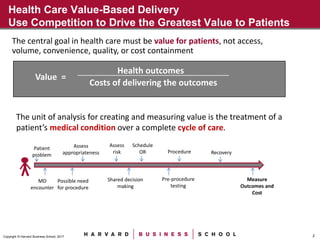
The central goal in health care must be value for patients, not access,
volume, convenience, quality, or cost containment
Value =
Health outcomes
Costs of delivering the outcomes
The unit of analysis for creating and measuring value is the treatment of a
patient’s medical condition over a complete cycle of care.
Health Care Value-Based Delivery
Use Competition to Drive the Greatest Value to Patients
MD
encounter
Assess
appropriateness
Assess
risk
Schedule
OR Procedure Recovery
Possible need
for procedure
Shared decision
making
Pre-procedure
testing
Patient
problem
Measure
Outcomes and
Cost
3Copyright © Harvard Business School, 2017
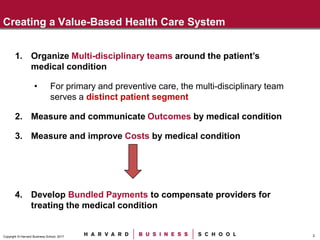
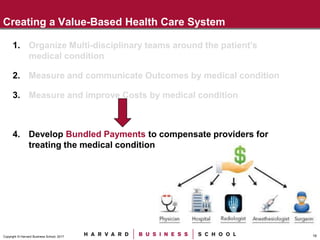
Creating a Value-Based Health Care System
1. Organize Multi-disciplinary teams around the patient’s
medical condition
• For primary and preventive care, the multi-disciplinary team
serves a distinct patient segment
2. Measure and communicate Outcomes by medical condition
3. Measure and improve Costs by medical condition
4. Develop Bundled Payments to compensate providers for
treating the medical condition
4Copyright © Harvard Business School, 2017
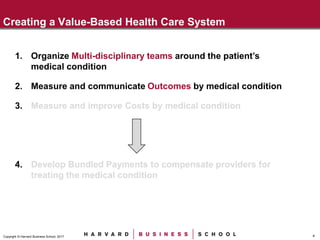
Creating a Value-Based Health Care System
1. Organize Multi-disciplinary teams around the patient’s
medical condition
2. Measure and communicate Outcomes by medical condition
3. Measure and improve Costs by medical condition
4. Develop Bundled Payments to compensate providers for
treating the medical condition
5Copyright © Harvard Business School, 2017
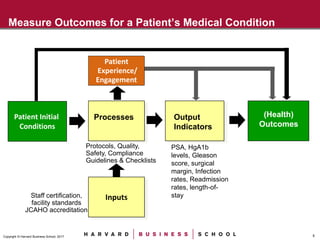
Measure Outcomes for a Patient’s Medical Condition
Patient
Experience/
Engagement
PSA, HgA1b
levels, Gleason
score, surgical
margin, Infection
rates, Readmission
rates, length-of-
stay
Protocols, Quality,
Safety, Compliance
Guidelines & Checklists
Patient Initial
Conditions
Processes Output
Indicators
(Health)
Outcomes
InputsStaff certification,
facility standards
JCAHO accreditation
6Copyright © Harvard Business School, 2017
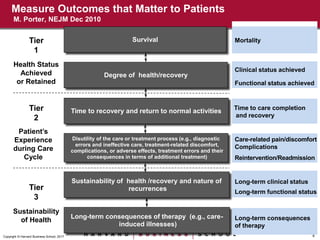
Measure Outcomes that Matter to Patients
M. Porter, NEJM Dec 2010
Survival
Degree of health/recovery
Time to recovery and return to normal activities
Sustainability of health /recovery and nature of
recurrences
Disutility of the care or treatment process (e.g., diagnostic
errors and ineffective care, treatment-related discomfort,
complications, or adverse effects, treatment errors and their
consequences in terms of additional treatment)
Long-term consequences of therapy (e.g., care-
induced illnesses)
Tier
1
Tier
2
Tier
3
Health Status
Achieved
or Retained
Patient’s
Experience
during Care
Cycle
Sustainability
of Health
Mortality
Clinical status achieved
Functional status achieved
Time to care completion
and recovery
Care-related pain/discomfort
Complications
Reintervention/Readmission
Long-term clinical status
Long-term functional status
Long-term consequences
of therapy
7Copyright © Harvard Business School, 2017
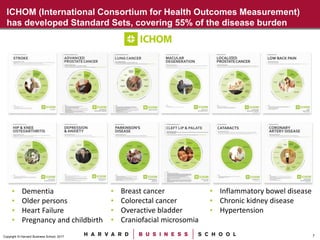
ICHOM (International Consortium for Health Outcomes Measurement)
has developed Standard Sets, covering 55% of the disease burden
▪ Dementia
▪ Older persons
▪ Heart Failure
▪ Pregnancy and childbirth
▪ Breast cancer
▪ Colorectal cancer
▪ Overactive bladder
▪ Craniofacial microsomia
▪ Inflammatory bowel disease
▪ Chronic kidney disease
▪ Hypertension
8Copyright © Harvard Business School, 2017
A case study in multi-disciplinary care and outcomes measurement:
The Martini Klinik Prostate Cancer Surgery Center in Hamburg
Professor Dr. Hartwig Huland
Founder and Chief of Martini Klinik
9Copyright © Harvard Business School, 2017
Clinical and Staff Resources Contained within Martini Klinik
Personnel
• Faculty: Urological Surgeons (9)
• Peri-operative staff: nurses (39) [dedicated to prostate cancer]
• Physiotherapists
• Psychologists *
• Oncologists *
• Anesthesiologists *
• Social Workers
• Biostatisticians for clinical trials and outcomes measurement
Facilities
• Operating rooms (4) [dedicated]
• Inpatient ward
• Physiotherapy unit
• Outpatient clinic
• Central Administration and Scheduling
* Employed by Hospital Department but dedicated to Martini Klinik
10Copyright © Harvard Business School, 2017
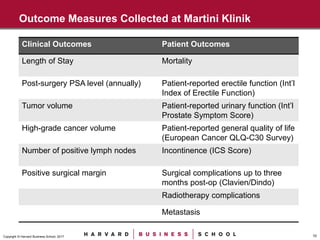
Outcome Measures Collected at Martini Klinik
Clinical Outcomes Patient Outcomes
Length of Stay Mortality
Post-surgery PSA level (annually) Patient-reported erectile function (Int’l
Index of Erectile Function)
Tumor volume Patient-reported urinary function (Int’l
Prostate Symptom Score)
High-grade cancer volume Patient-reported general quality of life
(European Cancer QLQ-C30 Survey)
Number of positive lymph nodes Incontinence (ICS Score)
Positive surgical margin Surgical complications up to three
months post-op (Clavien/Dindo)
Radiotherapy complications
Metastasis
11Copyright © Harvard Business School, 2017
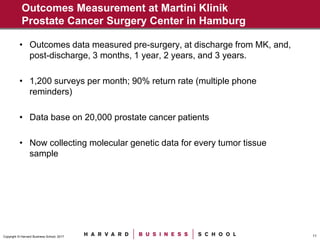
Outcomes Measurement at Martini Klinik
Prostate Cancer Surgery Center in Hamburg
• Outcomes data measured pre-surgery, at discharge from MK, and,
post-discharge, 3 months, 1 year, 2 years, and 3 years.
• 1,200 surveys per month; 90% return rate (multiple phone
reminders)
• Data base on 20,000 prostate cancer patients
• Now collecting molecular genetic data for every tumor tissue
sample
12Copyright © Harvard Business School, 2017
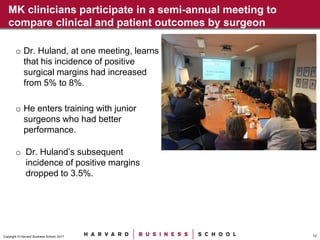
MK clinicians participate in a semi-annual meeting to
compare clinical and patient outcomes by surgeon
o Dr. Huland, at one meeting, learns
that his incidence of positive
surgical margins had increased
from 5% to 8%.
o He enters training with junior
surgeons who had better
performance.
o Dr. Huland’s subsequent
incidence of positive margins
dropped to 3.5%.
13Copyright © Harvard Business School, 2017
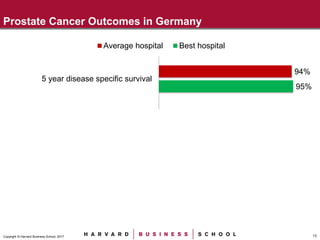
9.2%
17.4%
95%
43.3%
75.5%
94%
Incontinence after one year
Severe erectile dysfunction after one year
5 year disease specific survival
Average hospital Best hospital
Prostate Cancer Outcomes in Germany
14Copyright © Harvard Business School, 2017
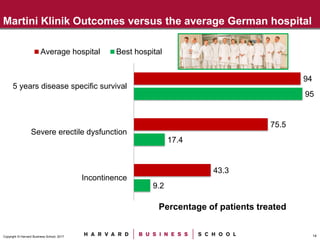
Martini Klinik Outcomes versus the average German hospital
9.2
17.4
95
43.3
75.5
94
Incontinence
Severe erectile dysfunction
5 years disease specific survival
Percentage of patients treated
Average hospital Best hospital
15Copyright © Harvard Business School, 2017
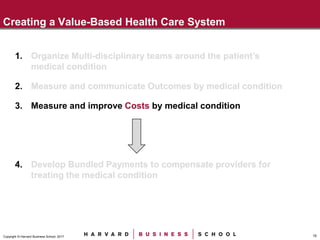
Creating a Value-Based Health Care System
1. Organize Multi-disciplinary teams around the patient’s
medical condition
2. Measure and communicate Outcomes by medical condition
3. Measure and improve Costs by medical condition
4. Develop Bundled Payments to compensate providers for
treating the medical condition
16Copyright © Harvard Business School, 2017
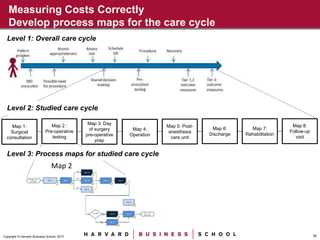
Measuring Costs Correctly
Develop process maps for the care cycle
Level 1: Overall care cycle
Map 1:
Surgical
consultation
Map 2 :
Pre-operative
testing
Map 3: Day
of surgery
pre-operative
prep
Map 4:
Operation
Map 5: Post-
anesthesia
care unit
Map 6:
Discharge
Map 7:
Rehabilitation
Map 8:
Follow-up
visit
Level 2: Studied care cycle
Map 2
Level 3: Process maps for studied care cycle
17Copyright © Harvard Business School, 2017
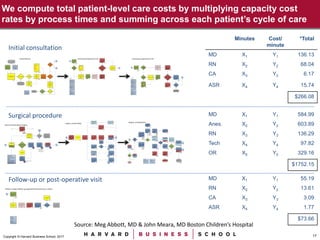
We compute total patient-level care costs by multiplying capacity cost
rates by process times and summing across each patient’s cycle of care
Initial consultation
Minutes Cost/
minute
*Total
MD X1 Y1 136.13
RN X2 Y2 68.04
CA X3 Y3 6.17
ASR X4 Y4 15.74
$266.08
Surgical procedure MD X1 Y1 584.99
Anes. X2 Y2 603.89
RN X3 Y3 136.29
Tech X4 Y4 97.82
OR X5 Y5 329.16
$1752.15
Follow-up or post-operative visit MD X1 Y1 55.19
RN X2 Y2 13.61
CA X3 Y3 3.09
ASR X4 Y4 1.77
$73.66
Source: Meg Abbott, MD & John Meara, MD Boston Children’s Hospital
18Copyright © Harvard Business School, 2017
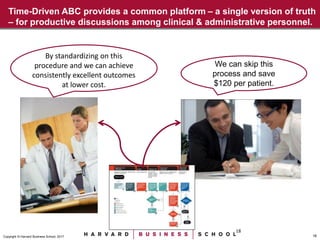
Time-Driven ABC provides a common platform – a single version of truth
– for productive discussions among clinical & administrative personnel.
By standardizing on this
procedure and we can achieve
consistently excellent outcomes
at lower cost.
We can skip this
process and save
$120 per patient.
18
19Copyright © Harvard Business School, 2017
Creating a Value-Based Health Care System
1. Organize Multi-disciplinary teams around the patient’s
medical condition
2. Measure and communicate Outcomes by medical condition
3. Measure and improve Costs by medical condition
4. Develop Bundled Payments to compensate providers for
treating the medical condition
20Copyright © Harvard Business School, 2017
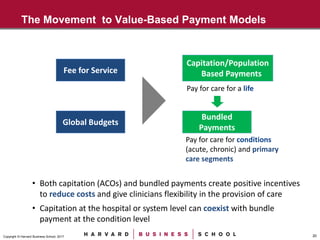
The Movement to Value-Based Payment Models
Capitation/Population
Based Payments
Bundled
Payments
Pay for care for a life
Pay for care for conditions
(acute, chronic) and primary
care segments
• Both capitation (ACOs) and bundled payments create positive incentives
to reduce costs and give clinicians flexibility in the provision of care
• Capitation at the hospital or system level can coexist with bundle
payment at the condition level
Fee for Service
Global Budgets
21Copyright © Harvard Business School, 2017
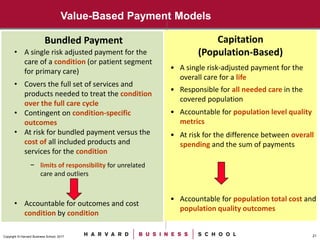
Bundled Payment
• A single risk adjusted payment for the
care of a condition (or patient segment
for primary care)
• Covers the full set of services and
products needed to treat the condition
over the full care cycle
• Contingent on condition-specific
outcomes
• At risk for bundled payment versus the
cost of all included products and
services for the condition
− limits of responsibility for unrelated
care and outliers
• Accountable for outcomes and cost
condition by condition
Value-Based Payment Models
Capitation
(Population-Based)
• A single risk-adjusted payment for the
overall care for a life
• Responsible for all needed care in the
covered population
• Accountable for population level quality
metrics
• At risk for the difference between overall
spending and the sum of payments
• Accountable for population total cost and
population quality outcomes
22Copyright © Harvard Business School, 2017
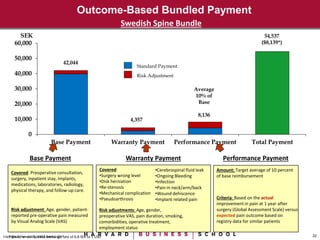
Outcome-Based Bundled Payment
0
10,000
20,000
30,000
40,000
50,000
60,000
Base Payment Warranty Payment Performance Payment Total Payment
SEK
Standard Payment
Risk Adjustment
54,537
($8,139*)
* Based on Jan 1, 2012 exchange rate of 6.8 SEK to 1 USD
42,044
4,357
Average
10% of
Base
8,136
Base Payment
Covered: Preoperative consultation,
surgery, inpatient stay, implants,
medications, laboratories, radiology,
physical therapy, and follow-up care.
Risk adjustment: Age, gender, patient-
reported pre-operative pain measured
by Visual Analog Scale (VAS)
Performance Payment
Amount: Target average of 10 percent
of base reimbursement
Criteria: Based on the actual
improvement in pain at 1 year after
surgery (Global Assessment Scale) versus
expected pain outcome based on
registry data for similar patients
Warranty Payment
Risk adjustments: Age, gender,
preoperative VAS, pain duration, smoking,
comorbidities, operative treatment,
employment status
Covered:
•Surgery wrong level
•Disk herniation
•Re-stenosis
•Mechanical complication
•Pseudoarthrosis
•Cerebrospinal fluid leak
•Ongoing Bleeding
•Infection
•Pain in neck/arm/back
•Wound dehiscence
•Implant related pain
Swedish Spine Bundle
Standard Payment
Risk Adjustment
23Copyright © Harvard Business School, 2017
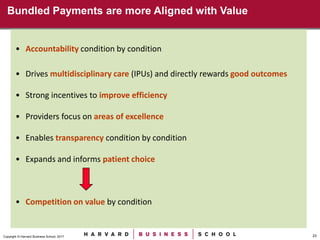
Bundled Payments are more Aligned with Value
• Accountability condition by condition
• Drives multidisciplinary care (IPUs) and directly rewards good outcomes
• Strong incentives to improve efficiency
• Providers focus on areas of excellence
• Enables transparency condition by condition
• Expands and informs patient choice
• Competition on value by condition
24Copyright © Harvard Business School, 2017
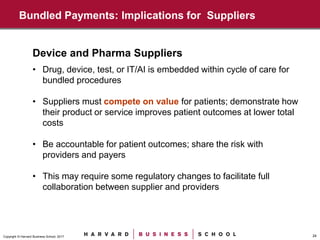
Device and Pharma Suppliers
• Drug, device, test, or IT/AI is embedded within cycle of care for
bundled procedures
• Suppliers must compete on value for patients; demonstrate how
their product or service improves patient outcomes at lower total
costs
• Be accountable for patient outcomes; share the risk with
providers and payers
• This may require some regulatory changes to facilitate full
collaboration between supplier and providers
Bundled Payments: Implications for Suppliers
25Copyright © Harvard Business School, 2017
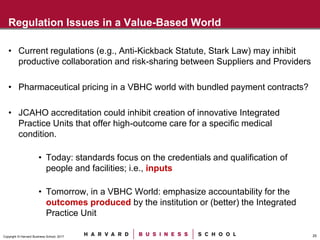
Regulation Issues in a Value-Based World
• Current regulations (e.g., Anti-Kickback Statute, Stark Law) may inhibit
productive collaboration and risk-sharing between Suppliers and Providers
• Pharmaceutical pricing in a VBHC world with bundled payment contracts?
• JCAHO accreditation could inhibit creation of innovative Integrated
Practice Units that offer high-outcome care for a specific medical
condition.
• Today: standards focus on the credentials and qualification of
people and facilities; i.e., inputs
• Tomorrow, in a VBHC World: emphasize accountability for the
outcomes produced by the institution or (better) the Integrated
Practice Unit

Robert Kaplan, Value Based Health Care

  • 1.
    Value-Based Health Care HarvardLaw School March 2018 Bob Kaplan, Senior Fellow and Marvin Bower Professor of Leadership Development, Emeritus
  • 2.
    2Copyright © HarvardBusiness School, 2017 The central goal in health care must be value for patients, not access, volume, convenience, quality, or cost containment Value = Health outcomes Costs of delivering the outcomes The unit of analysis for creating and measuring value is the treatment of a patient’s medical condition over a complete cycle of care. Health Care Value-Based Delivery Use Competition to Drive the Greatest Value to Patients MD encounter Assess appropriateness Assess risk Schedule OR Procedure Recovery Possible need for procedure Shared decision making Pre-procedure testing Patient problem Measure Outcomes and Cost
  • 3.
    3Copyright © HarvardBusiness School, 2017 Creating a Value-Based Health Care System 1. Organize Multi-disciplinary teams around the patient’s medical condition • For primary and preventive care, the multi-disciplinary team serves a distinct patient segment 2. Measure and communicate Outcomes by medical condition 3. Measure and improve Costs by medical condition 4. Develop Bundled Payments to compensate providers for treating the medical condition
  • 4.
    4Copyright © HarvardBusiness School, 2017 Creating a Value-Based Health Care System 1. Organize Multi-disciplinary teams around the patient’s medical condition 2. Measure and communicate Outcomes by medical condition 3. Measure and improve Costs by medical condition 4. Develop Bundled Payments to compensate providers for treating the medical condition
  • 5.
    5Copyright © HarvardBusiness School, 2017 Measure Outcomes for a Patient’s Medical Condition Patient Experience/ Engagement PSA, HgA1b levels, Gleason score, surgical margin, Infection rates, Readmission rates, length-of- stay Protocols, Quality, Safety, Compliance Guidelines & Checklists Patient Initial Conditions Processes Output Indicators (Health) Outcomes InputsStaff certification, facility standards JCAHO accreditation
  • 6.
    6Copyright © HarvardBusiness School, 2017 Measure Outcomes that Matter to Patients M. Porter, NEJM Dec 2010 Survival Degree of health/recovery Time to recovery and return to normal activities Sustainability of health /recovery and nature of recurrences Disutility of the care or treatment process (e.g., diagnostic errors and ineffective care, treatment-related discomfort, complications, or adverse effects, treatment errors and their consequences in terms of additional treatment) Long-term consequences of therapy (e.g., care- induced illnesses) Tier 1 Tier 2 Tier 3 Health Status Achieved or Retained Patient’s Experience during Care Cycle Sustainability of Health Mortality Clinical status achieved Functional status achieved Time to care completion and recovery Care-related pain/discomfort Complications Reintervention/Readmission Long-term clinical status Long-term functional status Long-term consequences of therapy
  • 7.
    7Copyright © HarvardBusiness School, 2017 ICHOM (International Consortium for Health Outcomes Measurement) has developed Standard Sets, covering 55% of the disease burden ▪ Dementia ▪ Older persons ▪ Heart Failure ▪ Pregnancy and childbirth ▪ Breast cancer ▪ Colorectal cancer ▪ Overactive bladder ▪ Craniofacial microsomia ▪ Inflammatory bowel disease ▪ Chronic kidney disease ▪ Hypertension
  • 8.
    8Copyright © HarvardBusiness School, 2017 A case study in multi-disciplinary care and outcomes measurement: The Martini Klinik Prostate Cancer Surgery Center in Hamburg Professor Dr. Hartwig Huland Founder and Chief of Martini Klinik
  • 9.
    9Copyright © HarvardBusiness School, 2017 Clinical and Staff Resources Contained within Martini Klinik Personnel • Faculty: Urological Surgeons (9) • Peri-operative staff: nurses (39) [dedicated to prostate cancer] • Physiotherapists • Psychologists * • Oncologists * • Anesthesiologists * • Social Workers • Biostatisticians for clinical trials and outcomes measurement Facilities • Operating rooms (4) [dedicated] • Inpatient ward • Physiotherapy unit • Outpatient clinic • Central Administration and Scheduling * Employed by Hospital Department but dedicated to Martini Klinik
  • 10.
    10Copyright © HarvardBusiness School, 2017 Outcome Measures Collected at Martini Klinik Clinical Outcomes Patient Outcomes Length of Stay Mortality Post-surgery PSA level (annually) Patient-reported erectile function (Int’l Index of Erectile Function) Tumor volume Patient-reported urinary function (Int’l Prostate Symptom Score) High-grade cancer volume Patient-reported general quality of life (European Cancer QLQ-C30 Survey) Number of positive lymph nodes Incontinence (ICS Score) Positive surgical margin Surgical complications up to three months post-op (Clavien/Dindo) Radiotherapy complications Metastasis
  • 11.
    11Copyright © HarvardBusiness School, 2017 Outcomes Measurement at Martini Klinik Prostate Cancer Surgery Center in Hamburg • Outcomes data measured pre-surgery, at discharge from MK, and, post-discharge, 3 months, 1 year, 2 years, and 3 years. • 1,200 surveys per month; 90% return rate (multiple phone reminders) • Data base on 20,000 prostate cancer patients • Now collecting molecular genetic data for every tumor tissue sample
  • 12.
    12Copyright © HarvardBusiness School, 2017 MK clinicians participate in a semi-annual meeting to compare clinical and patient outcomes by surgeon o Dr. Huland, at one meeting, learns that his incidence of positive surgical margins had increased from 5% to 8%. o He enters training with junior surgeons who had better performance. o Dr. Huland’s subsequent incidence of positive margins dropped to 3.5%.
  • 13.
    13Copyright © HarvardBusiness School, 2017 9.2% 17.4% 95% 43.3% 75.5% 94% Incontinence after one year Severe erectile dysfunction after one year 5 year disease specific survival Average hospital Best hospital Prostate Cancer Outcomes in Germany
  • 14.
    14Copyright © HarvardBusiness School, 2017 Martini Klinik Outcomes versus the average German hospital 9.2 17.4 95 43.3 75.5 94 Incontinence Severe erectile dysfunction 5 years disease specific survival Percentage of patients treated Average hospital Best hospital
  • 15.
    15Copyright © HarvardBusiness School, 2017 Creating a Value-Based Health Care System 1. Organize Multi-disciplinary teams around the patient’s medical condition 2. Measure and communicate Outcomes by medical condition 3. Measure and improve Costs by medical condition 4. Develop Bundled Payments to compensate providers for treating the medical condition
  • 16.
    16Copyright © HarvardBusiness School, 2017 Measuring Costs Correctly Develop process maps for the care cycle Level 1: Overall care cycle Map 1: Surgical consultation Map 2 : Pre-operative testing Map 3: Day of surgery pre-operative prep Map 4: Operation Map 5: Post- anesthesia care unit Map 6: Discharge Map 7: Rehabilitation Map 8: Follow-up visit Level 2: Studied care cycle Map 2 Level 3: Process maps for studied care cycle
  • 17.
    17Copyright © HarvardBusiness School, 2017 We compute total patient-level care costs by multiplying capacity cost rates by process times and summing across each patient’s cycle of care Initial consultation Minutes Cost/ minute *Total MD X1 Y1 136.13 RN X2 Y2 68.04 CA X3 Y3 6.17 ASR X4 Y4 15.74 $266.08 Surgical procedure MD X1 Y1 584.99 Anes. X2 Y2 603.89 RN X3 Y3 136.29 Tech X4 Y4 97.82 OR X5 Y5 329.16 $1752.15 Follow-up or post-operative visit MD X1 Y1 55.19 RN X2 Y2 13.61 CA X3 Y3 3.09 ASR X4 Y4 1.77 $73.66 Source: Meg Abbott, MD & John Meara, MD Boston Children’s Hospital
  • 18.
    18Copyright © HarvardBusiness School, 2017 Time-Driven ABC provides a common platform – a single version of truth – for productive discussions among clinical & administrative personnel. By standardizing on this procedure and we can achieve consistently excellent outcomes at lower cost. We can skip this process and save $120 per patient. 18
  • 19.
    19Copyright © HarvardBusiness School, 2017 Creating a Value-Based Health Care System 1. Organize Multi-disciplinary teams around the patient’s medical condition 2. Measure and communicate Outcomes by medical condition 3. Measure and improve Costs by medical condition 4. Develop Bundled Payments to compensate providers for treating the medical condition
  • 20.
    20Copyright © HarvardBusiness School, 2017 The Movement to Value-Based Payment Models Capitation/Population Based Payments Bundled Payments Pay for care for a life Pay for care for conditions (acute, chronic) and primary care segments • Both capitation (ACOs) and bundled payments create positive incentives to reduce costs and give clinicians flexibility in the provision of care • Capitation at the hospital or system level can coexist with bundle payment at the condition level Fee for Service Global Budgets
  • 21.
    21Copyright © HarvardBusiness School, 2017 Bundled Payment • A single risk adjusted payment for the care of a condition (or patient segment for primary care) • Covers the full set of services and products needed to treat the condition over the full care cycle • Contingent on condition-specific outcomes • At risk for bundled payment versus the cost of all included products and services for the condition − limits of responsibility for unrelated care and outliers • Accountable for outcomes and cost condition by condition Value-Based Payment Models Capitation (Population-Based) • A single risk-adjusted payment for the overall care for a life • Responsible for all needed care in the covered population • Accountable for population level quality metrics • At risk for the difference between overall spending and the sum of payments • Accountable for population total cost and population quality outcomes
  • 22.
    22Copyright © HarvardBusiness School, 2017 Outcome-Based Bundled Payment 0 10,000 20,000 30,000 40,000 50,000 60,000 Base Payment Warranty Payment Performance Payment Total Payment SEK Standard Payment Risk Adjustment 54,537 ($8,139*) * Based on Jan 1, 2012 exchange rate of 6.8 SEK to 1 USD 42,044 4,357 Average 10% of Base 8,136 Base Payment Covered: Preoperative consultation, surgery, inpatient stay, implants, medications, laboratories, radiology, physical therapy, and follow-up care. Risk adjustment: Age, gender, patient- reported pre-operative pain measured by Visual Analog Scale (VAS) Performance Payment Amount: Target average of 10 percent of base reimbursement Criteria: Based on the actual improvement in pain at 1 year after surgery (Global Assessment Scale) versus expected pain outcome based on registry data for similar patients Warranty Payment Risk adjustments: Age, gender, preoperative VAS, pain duration, smoking, comorbidities, operative treatment, employment status Covered: •Surgery wrong level •Disk herniation •Re-stenosis •Mechanical complication •Pseudoarthrosis •Cerebrospinal fluid leak •Ongoing Bleeding •Infection •Pain in neck/arm/back •Wound dehiscence •Implant related pain Swedish Spine Bundle Standard Payment Risk Adjustment
  • 23.
    23Copyright © HarvardBusiness School, 2017 Bundled Payments are more Aligned with Value • Accountability condition by condition • Drives multidisciplinary care (IPUs) and directly rewards good outcomes • Strong incentives to improve efficiency • Providers focus on areas of excellence • Enables transparency condition by condition • Expands and informs patient choice • Competition on value by condition
  • 24.
    24Copyright © HarvardBusiness School, 2017 Device and Pharma Suppliers • Drug, device, test, or IT/AI is embedded within cycle of care for bundled procedures • Suppliers must compete on value for patients; demonstrate how their product or service improves patient outcomes at lower total costs • Be accountable for patient outcomes; share the risk with providers and payers • This may require some regulatory changes to facilitate full collaboration between supplier and providers Bundled Payments: Implications for Suppliers
  • 25.
    25Copyright © HarvardBusiness School, 2017 Regulation Issues in a Value-Based World • Current regulations (e.g., Anti-Kickback Statute, Stark Law) may inhibit productive collaboration and risk-sharing between Suppliers and Providers • Pharmaceutical pricing in a VBHC world with bundled payment contracts? • JCAHO accreditation could inhibit creation of innovative Integrated Practice Units that offer high-outcome care for a specific medical condition. • Today: standards focus on the credentials and qualification of people and facilities; i.e., inputs • Tomorrow, in a VBHC World: emphasize accountability for the outcomes produced by the institution or (better) the Integrated Practice Unit