Masonry Construction
Introduction: Masonry is the construction of buildings from individual units laid in and
bound together by mortar. The common materials of masonry construction are brick,
building stone such as marble, granite, travertine, and limestone, cast stone, concrete
block, glass block, and cob. Brick masonry structures are the structures in which bricks
as uniform units are laid in courses.
Suitability of Masonry Structures: With attractive design possibilities, versatility,
durability, low maintenance and good value for money, masonry applications are found
just about everywhere. Masonry can also be in any size, style and even climate which
make it evermore more interesting. Many public &residential buildings, prayer halls, arch
bridges, pavements, auditoriums are masonry structures. Even our National Assembly is
mainly a brick masonry structure.
Types of Masonry:
Stone Masonry Brick Masonry
(Based on
bonds)
Composite Masonry
Rubble Ashlar 1. Stretcher
2. Header
3. English
4. Flemish
1. Stone and Brick
2. Cement Concrete
3. Hollow Concrete
Block
4. Glass Block
1.
Uncoursed
2. Random
3. Coursed
4. Dry
1. Fine
2. Rough Tooled
3. Rock, rustic , quarry
faced
4. Chamfered
5. Facing
Tools used in Masonry Constructions:
Name Description Picture
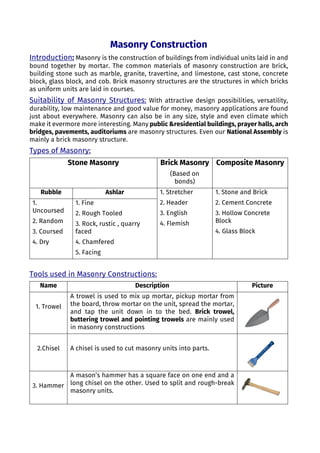
1. Trowel
A trowel is used to mix up mortar, pickup mortar from
the board, throw mortar on the unit, spread the mortar,
and tap the unit down in to the bed. Brick trowel,
buttering trowel and pointing trowels are mainly used
in masonry constructions
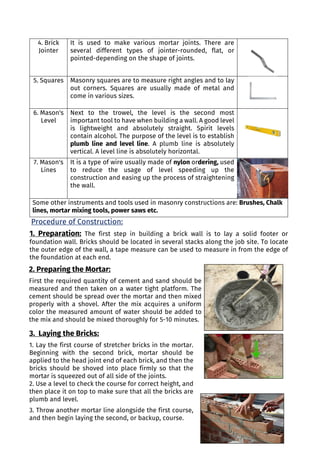
2.Chisel A chisel is used to cut masonry units into parts.
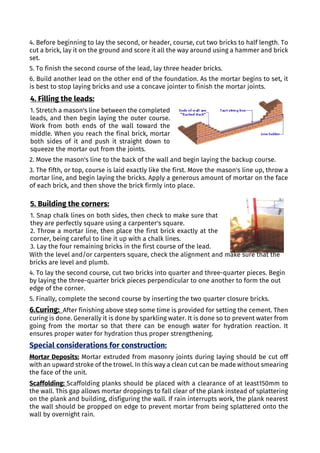
3. Hammer
A mason’s hammer has a square face on one end and a
long chisel on the other. Used to split and rough-break
masonry units.
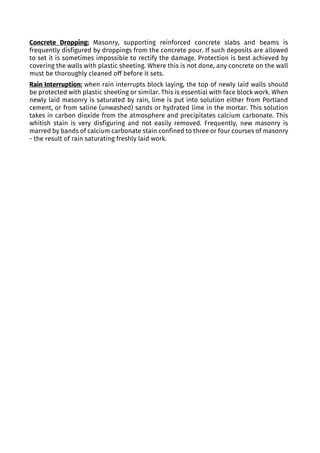
4. Brick
Jointer
It is used to make various mortar joints. There are
several different types of jointer-rounded, flat, or
pointed-depending on the shape of joints.
5. Squares Masonry squares are to measure right angles and to lay
out corners. Squares are usually made of metal and
come in various sizes.
6. Mason's
Level
Next to the trowel, the level is the second most
important tool to have when building a wall. A good level
is lightweight and absolutely straight. Spirit levels
contain alcohol. The purpose of the level is to establish
plumb line and level line. A plumb line is absolutely
vertical. A level line is absolutely horizontal.
7. Mason's
Lines
It is a type of wire usually made of nylon ordering, used
to reduce the usage of level speeding up the
construction and easing up the process of straightening
the wall.
Some other instruments and tools used in masonry constructions are: Brushes, Chalk
lines, mortar mixing tools, power saws etc.
Procedure of Construction:
1. Preparation: The first step in building a brick wall is to lay a solid footer or
foundation wall. Bricks should be located in several stacks along the job site. To locate
the outer edge of the wall, a tape measure can be used to measure in from the edge of
the foundation at each end.
2. Preparing the Mortar:
First the required quantity of cement and sand should be
measured and then taken on a water tight platform. The
cement should be spread over the mortar and then mixed
properly with a shovel. After the mix acquires a uniform
color the measured amount of water should be added to
the mix and should be mixed thoroughly for 5-10 minutes.
3. Laying the Bricks:
1. Lay the first course of stretcher bricks in the mortar.
Beginning with the second brick, mortar should be
applied to the head joint end of each brick, and then the
bricks should be shoved into place firmly so that the
mortar is squeezed out of all side of the joints.
2. Use a level to check the course for correct height, and
then place it on top to make sure that all the bricks are
plumb and level.
3. Throw another mortar line alongside the first course,
and then begin laying the second, or backup, course.
4. Before beginning to lay the second, or header, course, cut two bricks to half length. To
cut a brick, lay it on the ground and score it all the way around using a hammer and brick
set.
5. To finish the second course of the lead, lay three header bricks.
6. Build another lead on the other end of the foundation. As the mortar begins to set, it
is best to stop laying bricks and use a concave jointer to finish the mortar joints.
2. Move the mason's line to the back of the wall and begin laying the backup course.
3. The fifth, or top, course is laid exactly like the first. Move the mason's line up, throw a
mortar line, and begin laying the bricks. Apply a generous amount of mortar on the face
of each brick, and then shove the brick firmly into place.
With the level and/or carpenters square, check the alignment and make sure that the
bricks are level and plumb.
4. To lay the second course, cut two bricks into quarter and three-quarter pieces. Begin
by laying the three-quarter brick pieces perpendicular to one another to form the out
edge of the corner.
5. Finally, complete the second course by inserting the two quarter closure bricks.
6.Curing: After finishing above step some time is provided for setting the cement. Then
curing is done. Generally it is done by sparkling water. It is done so to prevent water from
going from the mortar so that there can be enough water for hydration reaction. It
ensures proper water for hydration thus proper strengthening.
Special considerations for construction:
Mortar Deposits: Mortar extruded from masonry joints during laying should be cut off
with an upward stroke of the trowel. In this way a clean cut can be made without smearing
the face of the unit.
Scaffolding: Scaffolding planks should be placed with a clearance of at least150mm to
the wall. This gap allows mortar droppings to fall clear of the plank instead of splattering
on the plank and building, disfiguring the wall. If rain interrupts work, the plank nearest
the wall should be propped on edge to prevent mortar from being splattered onto the
wall by overnight rain.
4. Filling the leads:
1. Stretch a mason's line between the completed
leads, and then begin laying the outer course.
Work from both ends of the wall toward the
middle. When you reach the final brick, mortar
both sides of it and push it straight down to
squeeze the mortar out from the joints.
5. Building the corners:
1. Snap chalk lines on both sides, then check to make sure that
they are perfectly square using a carpenter's square.
2. Throw a mortar line, then place the first brick exactly at the
corner, being careful to line it up with a chalk lines.
3. Lay the four remaining bricks in the first course of the lead.
Concrete Dropping: Masonry, supporting reinforced concrete slabs and beams is
frequently disfigured by droppings from the concrete pour. If such deposits are allowed
to set it is sometimes impossible to rectify the damage. Protection is best achieved by
covering the walls with plastic sheeting. Where this is not done, any concrete on the wall
must be thoroughly cleaned off before it sets.
Rain Interruption: when rain interrupts block laying, the top of newly laid walls should
be protected with plastic sheeting or similar. This is essential with face block work. When
newly laid masonry is saturated by rain, lime is put into solution either from Portland
cement, or from saline (unwashed) sands or hydrated lime in the mortar. This solution
takes in carbon dioxide from the atmosphere and precipitates calcium carbonate. This
whitish stain is very disfiguring and not easily removed. Frequently, new masonry is
marred by bands of calcium carbonate stain confined to three or four courses of masonry
- the result of rain saturating freshly laid work.

Masonry construction

  • 1.
    Masonry Construction Introduction: Masonryis the construction of buildings from individual units laid in and bound together by mortar. The common materials of masonry construction are brick, building stone such as marble, granite, travertine, and limestone, cast stone, concrete block, glass block, and cob. Brick masonry structures are the structures in which bricks as uniform units are laid in courses. Suitability of Masonry Structures: With attractive design possibilities, versatility, durability, low maintenance and good value for money, masonry applications are found just about everywhere. Masonry can also be in any size, style and even climate which make it evermore more interesting. Many public &residential buildings, prayer halls, arch bridges, pavements, auditoriums are masonry structures. Even our National Assembly is mainly a brick masonry structure. Types of Masonry: Stone Masonry Brick Masonry (Based on bonds) Composite Masonry Rubble Ashlar 1. Stretcher 2. Header 3. English 4. Flemish 1. Stone and Brick 2. Cement Concrete 3. Hollow Concrete Block 4. Glass Block 1. Uncoursed 2. Random 3. Coursed 4. Dry 1. Fine 2. Rough Tooled 3. Rock, rustic , quarry faced 4. Chamfered 5. Facing Tools used in Masonry Constructions: Name Description Picture 1. Trowel A trowel is used to mix up mortar, pickup mortar from the board, throw mortar on the unit, spread the mortar, and tap the unit down in to the bed. Brick trowel, buttering trowel and pointing trowels are mainly used in masonry constructions 2.Chisel A chisel is used to cut masonry units into parts. 3. Hammer A mason’s hammer has a square face on one end and a long chisel on the other. Used to split and rough-break masonry units.
  • 2.
    4. Brick Jointer It isused to make various mortar joints. There are several different types of jointer-rounded, flat, or pointed-depending on the shape of joints. 5. Squares Masonry squares are to measure right angles and to lay out corners. Squares are usually made of metal and come in various sizes. 6. Mason's Level Next to the trowel, the level is the second most important tool to have when building a wall. A good level is lightweight and absolutely straight. Spirit levels contain alcohol. The purpose of the level is to establish plumb line and level line. A plumb line is absolutely vertical. A level line is absolutely horizontal. 7. Mason's Lines It is a type of wire usually made of nylon ordering, used to reduce the usage of level speeding up the construction and easing up the process of straightening the wall. Some other instruments and tools used in masonry constructions are: Brushes, Chalk lines, mortar mixing tools, power saws etc. Procedure of Construction: 1. Preparation: The first step in building a brick wall is to lay a solid footer or foundation wall. Bricks should be located in several stacks along the job site. To locate the outer edge of the wall, a tape measure can be used to measure in from the edge of the foundation at each end. 2. Preparing the Mortar: First the required quantity of cement and sand should be measured and then taken on a water tight platform. The cement should be spread over the mortar and then mixed properly with a shovel. After the mix acquires a uniform color the measured amount of water should be added to the mix and should be mixed thoroughly for 5-10 minutes. 3. Laying the Bricks: 1. Lay the first course of stretcher bricks in the mortar. Beginning with the second brick, mortar should be applied to the head joint end of each brick, and then the bricks should be shoved into place firmly so that the mortar is squeezed out of all side of the joints. 2. Use a level to check the course for correct height, and then place it on top to make sure that all the bricks are plumb and level. 3. Throw another mortar line alongside the first course, and then begin laying the second, or backup, course.
  • 3.
    4. Before beginningto lay the second, or header, course, cut two bricks to half length. To cut a brick, lay it on the ground and score it all the way around using a hammer and brick set. 5. To finish the second course of the lead, lay three header bricks. 6. Build another lead on the other end of the foundation. As the mortar begins to set, it is best to stop laying bricks and use a concave jointer to finish the mortar joints. 2. Move the mason's line to the back of the wall and begin laying the backup course. 3. The fifth, or top, course is laid exactly like the first. Move the mason's line up, throw a mortar line, and begin laying the bricks. Apply a generous amount of mortar on the face of each brick, and then shove the brick firmly into place. With the level and/or carpenters square, check the alignment and make sure that the bricks are level and plumb. 4. To lay the second course, cut two bricks into quarter and three-quarter pieces. Begin by laying the three-quarter brick pieces perpendicular to one another to form the out edge of the corner. 5. Finally, complete the second course by inserting the two quarter closure bricks. 6.Curing: After finishing above step some time is provided for setting the cement. Then curing is done. Generally it is done by sparkling water. It is done so to prevent water from going from the mortar so that there can be enough water for hydration reaction. It ensures proper water for hydration thus proper strengthening. Special considerations for construction: Mortar Deposits: Mortar extruded from masonry joints during laying should be cut off with an upward stroke of the trowel. In this way a clean cut can be made without smearing the face of the unit. Scaffolding: Scaffolding planks should be placed with a clearance of at least150mm to the wall. This gap allows mortar droppings to fall clear of the plank instead of splattering on the plank and building, disfiguring the wall. If rain interrupts work, the plank nearest the wall should be propped on edge to prevent mortar from being splattered onto the wall by overnight rain. 4. Filling the leads: 1. Stretch a mason's line between the completed leads, and then begin laying the outer course. Work from both ends of the wall toward the middle. When you reach the final brick, mortar both sides of it and push it straight down to squeeze the mortar out from the joints. 5. Building the corners: 1. Snap chalk lines on both sides, then check to make sure that they are perfectly square using a carpenter's square. 2. Throw a mortar line, then place the first brick exactly at the corner, being careful to line it up with a chalk lines. 3. Lay the four remaining bricks in the first course of the lead.
  • 4.
    Concrete Dropping: Masonry,supporting reinforced concrete slabs and beams is frequently disfigured by droppings from the concrete pour. If such deposits are allowed to set it is sometimes impossible to rectify the damage. Protection is best achieved by covering the walls with plastic sheeting. Where this is not done, any concrete on the wall must be thoroughly cleaned off before it sets. Rain Interruption: when rain interrupts block laying, the top of newly laid walls should be protected with plastic sheeting or similar. This is essential with face block work. When newly laid masonry is saturated by rain, lime is put into solution either from Portland cement, or from saline (unwashed) sands or hydrated lime in the mortar. This solution takes in carbon dioxide from the atmosphere and precipitates calcium carbonate. This whitish stain is very disfiguring and not easily removed. Frequently, new masonry is marred by bands of calcium carbonate stain confined to three or four courses of masonry - the result of rain saturating freshly laid work.