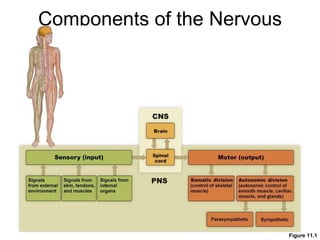
Components of the Nervous System Figure 11.1
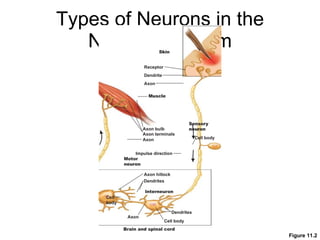
Types of Neurons in the Nervous System Figure 11.2 Sensory neuron Dendrite Receptor Cell body Axon Axon terminals Axon bulb Dendrites Dendrites Cell body Cell body Axon Axon Axon hillock Interneuron Brain and spinal cord Motor neuron Skin Muscle Impulse direction
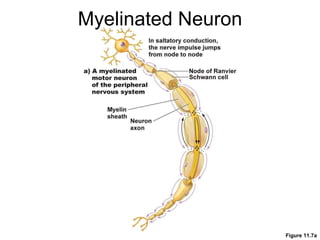
Myelinated Neuron Figure 11.7a
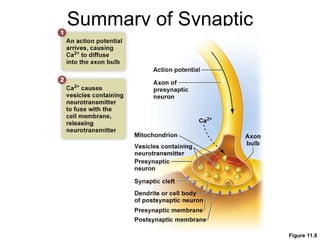
Summary of Synaptic Transmission Figure 11.8
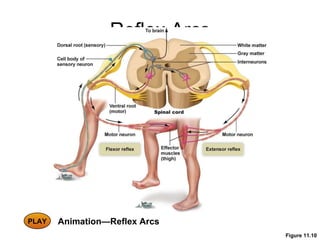
Reflex Arcs Animation—Reflex Arcs Figure 11.10 PLAY
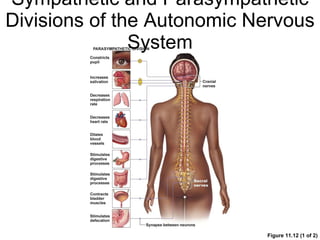
Sympathetic and Parasympathetic Divisions of the Autonomic Nervous System Figure 11.12 (1 of 2)
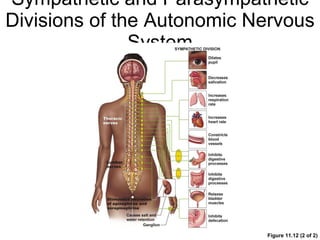
Sympathetic and Parasympathetic Divisions of the Autonomic Nervous System Figure 11.12 (2 of 2)
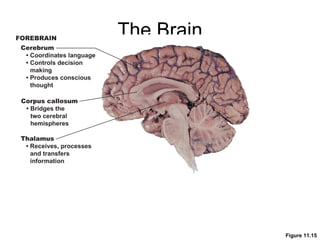
The Brain Figure 11.15 FOREBRAIN Thalamus •   Receives, processes and transfers information Corpus callosum •   Bridges the two cerebral hemispheres Cerebrum •   Coordinates language •   Controls decision making •   Produces conscious thought
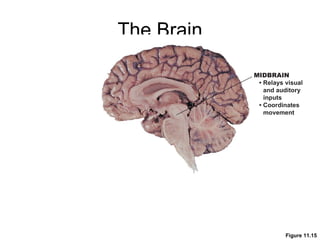
The Brain Figure 11.15 MIDBRAIN •   Relays visual and auditory inputs •   Coordinates movement
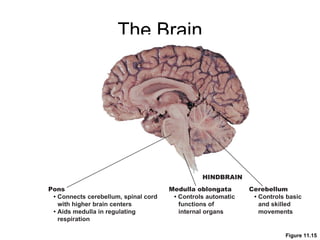
The Brain Figure 11.15 HINDBRAIN Cerebellum •   Controls basic and skilled movements Medulla oblongata •   Controls automatic functions of internal organs Pons •   Connects cerebellum, spinal cord with higher brain centers •   Aids medulla in regulating respiration
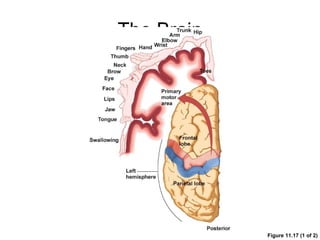
The Brain Figure 11.17 (1 of 2)
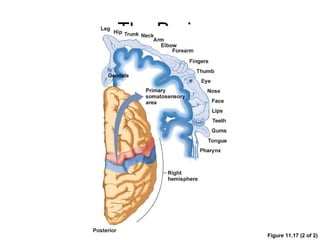
The Brain Figure 11.17 (2 of 2)
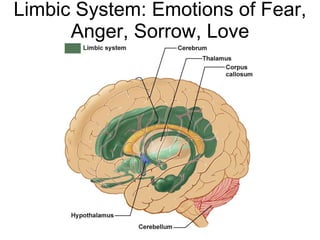
Limbic System: Emotions of Fear, Anger, Sorrow, Love

Sinh ly than kinh p2 (anh)

  • 1.
  • 2.
    Components of theNervous System Figure 11.1
  • 3.
    Types of Neuronsin the Nervous System Figure 11.2 Sensory neuron Dendrite Receptor Cell body Axon Axon terminals Axon bulb Dendrites Dendrites Cell body Cell body Axon Axon Axon hillock Interneuron Brain and spinal cord Motor neuron Skin Muscle Impulse direction
  • 4.
  • 5.
    Summary of SynapticTransmission Figure 11.8
  • 6.
    Reflex Arcs Animation—ReflexArcs Figure 11.10 PLAY
  • 7.
    Sympathetic and ParasympatheticDivisions of the Autonomic Nervous System Figure 11.12 (1 of 2)
  • 8.
    Sympathetic and ParasympatheticDivisions of the Autonomic Nervous System Figure 11.12 (2 of 2)
  • 9.
    The Brain Figure11.15 FOREBRAIN Thalamus • Receives, processes and transfers information Corpus callosum • Bridges the two cerebral hemispheres Cerebrum • Coordinates language • Controls decision making • Produces conscious thought
  • 10.
    The Brain Figure11.15 MIDBRAIN • Relays visual and auditory inputs • Coordinates movement
  • 11.
    The Brain Figure11.15 HINDBRAIN Cerebellum • Controls basic and skilled movements Medulla oblongata • Controls automatic functions of internal organs Pons • Connects cerebellum, spinal cord with higher brain centers • Aids medulla in regulating respiration
  • 12.
    The Brain Figure11.17 (1 of 2)
  • 13.
    The Brain Figure11.17 (2 of 2)
  • 14.
    Limbic System: Emotionsof Fear, Anger, Sorrow, Love