PRESENTED BY
Mrs Nirmala Das
M.Sc.NURSING PREVIOUS
Components of nervous systemComponents of nervous system
Nervous System is divided into 2
CENTRAL NERVOUS SYSTEM
PERIPHERAL NERVOUS SYSTEM
Central Nervous System
•Brain
•Spinal Cord
Brain
• Forebrain
• Midbrain
• Hindbrain
Forebrain
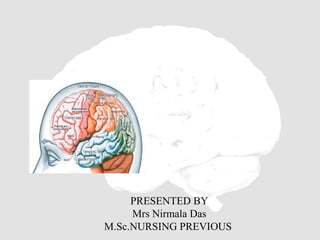
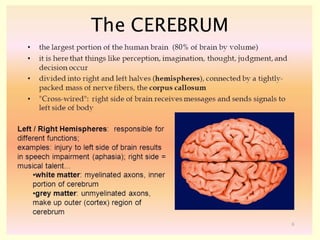
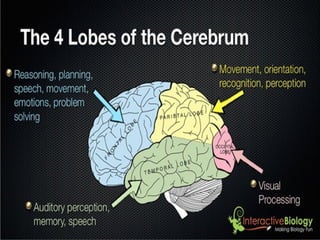
CEREBRUM
oFrontal lobe
oParietal lobe
oTemporal lobe
oOccipital lobe
LETS WATCH A VEDIO ON NERVOUS SYSTEM
Cerebral Cortex
Cerebral Cortex
CEREBRUM
http://www.bioon.com/book/biology/whole/image/1/1-6.tif.jpg
FRONTAL LOBE
VOLUNTARY BODY
MOVEMENTS
MOVEMENTS THAT
PERMIT SPEAKING
THINKING, AND
JUDGEMENT FORMATION
FUNCTIONS
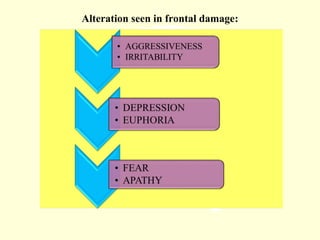
Alteration seen in frontal damage:
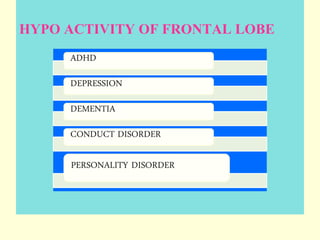
HYPO ACTIVITY OF FRONTAL LOBE
Hyperactivity of frontal lobe
Parietal lobe:
FUNCTIONS
PERCEPTION OF SENSORY
INFORMATIONS
ALTERATIONS SEEN IN PARIETAL DAMAGE:
Temporal lobe
FUNCTIONS HEARING
SHORT TERM
MEMORY
EXPRESSION OF
EMOTIONS
Alterations seen in temporal damage
Occipital lobe:
FUNCTIONS
VISUAL RECEPTION
AND INTERPRETATION
ALTERATIONS SEEN IN OCCIPITAL
DAMAGE
BLINDNESS
VISUAL
HALLUCINATIONS
DIENCEPHALONDIENCEPHALON
DIENCEPHALON
The diencephalon connects the cerebrum
with lower brain structures.
 Its major structures include the thalamus,
hypothalamus, and limbic system.
THALAMUS
•The thalamus integrates all sensory input (except smell) on its
way to the cortex.
•The thalamus is also involved in temporary blocking minor
sensations, so that an individual can concentrate on one
important event when necessary.
•The thalamus also has some involvement with emotions and
mood.
Functions of thalamus
• Receiving visual and sensory signal
• Relay sensory signal to the cerebral cortex
• Memory formation and emotional expression
pain perception
• Control sleep and awake states
Thalamus damage
• Problems related to sensory perception
• Sleep disorders
• Auditory issue
• THE thalamus damage can also lead to
permanent coma
HYPOTHALAMUS
The Hypothalamus is located just below the thalamus
and just above the pituitary gland and has a number of
diverse functions:
Regulation of Appetite
Regulation of temperature
Regulation of the pituitary gland
LIMBIC SYSTEM
The limbic system, which is sometimes called the
“emotional brain,” is associated with fear and
anxiety; anger and aggression; love, joy, and hope;
and sexuality and social behavior.
•
HIPPOCAMPUS
• The hippocampus is located in the inside fold of each
temporal lobe below the thalamus.
• It is the site of the intersection between the storage of
memories and their reproduction with emotional
colouring.
• Alzheimer’s disease cause damage to the
hippocampus.
AMYGDALA
• THE amygdala is responsible for determining
what memories r stored and where memories
are stored.
• It is responsible for fear sexual arousal, and
aggressions
membranes
.Membranes covering the brain and the spinalMembranes covering the brain and the spinal
cordcord
• Dura mater
• Arachnoid mater
• Pia mater
The Dura mater and arachnoid maters are separated by a
potential space, the subdural space. The arachnoid and
pia maters are separated by the subarachnoid space,
containing CSF.
Cerebrospinal Fluid
• CSF is secreted into each ventricles of the brainCSF is secreted into each ventricles of the brain
by choroid plexus. From the roof of the 4thby choroid plexus. From the roof of the 4th
ventricle CSF flows through foramina into theventricle CSF flows through foramina into the
subarachnoid space and completely surroundssubarachnoid space and completely surrounds
the brain and spinal cord.the brain and spinal cord.
• CSF is a clear, slightly alkaline fluid with aCSF is a clear, slightly alkaline fluid with a
specific gravity of 1.005specific gravity of 1.005
FUNCTIONS
• Supports and protects the brain and spinal cordSupports and protects the brain and spinal cord
• Maintains a uniform pressure.Maintains a uniform pressure.
• Act as a cushion and shock absorber .Act as a cushion and shock absorber .
• Keeps brain and spinal cord moist and thereKeeps brain and spinal cord moist and there
may be interchange of substances between CSFmay be interchange of substances between CSF
and nerve cells.and nerve cells.
MESENCEPHALON
The mesencephalon extends from the Pons to
the hypothalamus.
 It is responsible for the integration of various
reflexes, including visual reflexes auditory
reflexes and righting reflexes.
HIND BRAIN
• The Pons is the bulbous structure.
• It also play a key role in sleep
• Forms connection between the cerebellum and the
brainstem.
• It also contains the central connections of cranial
nerves
MEDULLA
It is most important part of brain its function are
involuntary:or done without thought.
 It contains vital centers that regulate heart rate, blood
pressure, and respiration, and reflex centers for
swallowing, sneezing, coughing, and vomiting.
CEREBELLUM

It is situated just below the occipital lobes of the
cerebrum.
 The functions are concerned with involuntary
movement, such as muscular tone and coordination
and the maintenance of posture and equilibrium.
Spinal cordSpinal cord
It is approximately 45 cm long in an adult
male, and is about the thickness of the little
finger.
When specimen of CSF is required it is taken
from a point beyond the end of the cord i.e.
below the level of 2nd
lumbar vertebrae.
The spinal cord is the nervous tissue link
between the brain and the rest of the body.
TYPES OF NERVESTYPES OF NERVES
3 types of nerves3 types of nerves
Sensory nerveSensory nerve
Motor nerveMotor nerve
Mixed nerveMixed nerve
Peripheral Nervous System
SPINAL NERVES
There are 31 pairs of spinal nerves
• 8 cervical
• 12 thoracic
• 5 lumbar
• 5 sacral
• 1 coccygeal
The spinal nerves arise from both sides of the
spinal cord and emerge through the
intervertebral foramina
CRANIAL NERVES
• 1st
olfactory: sensory
• 2nd
optic: sensory
• 3rd:OCULOMOTOR
motor
• 4th
trochlear: motor
• 5th
trigeminal :mixed
• 6th
abducent:motor
• 7th
facial :mixed
• 8th
vestibulocochlear :sensory
• 9th
glossopharyngeal :mixed
• 10th
vagus :mixed
• 11th
accessory :motor
• 12th
hypoglossal :motor
CONCLUSION
FRONTAL LOBE
Q1. What are the alterations seeing in Parietal
damage ?
A.Inablity to keep apointments
B.Loss of hearing
C.Apasia
Answer .
Q2. What are the Functions of Parietal Lobe ?
A.Movement that Permit speaking
B.Judgment formation
C.Perception of sensory information
D.All the Above
Answer .
PARIETAL LOBE
Q1. What is the Full Form of ADHD ?
Answer .
Attention Deflict Hyper Activity
Disorder
Q2. What is the Function of Frontal Lobe
A.Voluntary Body Movements
B.Thinking & Judgment Formation
C.Movement that Permit Speaking
D.All The Above
Answer
D
Temporal Lobe
Q1. What are the alterations seeing in Occipital
damage ?
A.Visual Hallucination
B.Sensory Distortion
C.Rigidness
Answer .
Q2. What is the Function of Cerebrum
Answer .
Senses
Thinking
Imgination
OCCIPITAL LOBE
Q2. What is the Function of Cerebellum
Answer .
Mintanace of
Body Posture & Balance
Nervous system

Nervous system

  • 1.
    PRESENTED BY Mrs NirmalaDas M.Sc.NURSING PREVIOUS
  • 2.
    Components of nervoussystemComponents of nervous system Nervous System is divided into 2 CENTRAL NERVOUS SYSTEM PERIPHERAL NERVOUS SYSTEM
  • 3.
  • 4.
  • 5.
  • 6.
    LETS WATCH AVEDIO ON NERVOUS SYSTEM
  • 8.
  • 10.
    FRONTAL LOBE VOLUNTARY BODY MOVEMENTS MOVEMENTSTHAT PERMIT SPEAKING THINKING, AND JUDGEMENT FORMATION FUNCTIONS
  • 11.
    Alteration seen infrontal damage:
  • 12.
    HYPO ACTIVITY OFFRONTAL LOBE
  • 13.
  • 14.
  • 15.
    ALTERATIONS SEEN INPARIETAL DAMAGE:
  • 17.
    Temporal lobe FUNCTIONS HEARING SHORTTERM MEMORY EXPRESSION OF EMOTIONS
  • 18.
    Alterations seen intemporal damage
  • 19.
  • 20.
    ALTERATIONS SEEN INOCCIPITAL DAMAGE BLINDNESS VISUAL HALLUCINATIONS
  • 21.
  • 22.
    DIENCEPHALON The diencephalon connectsthe cerebrum with lower brain structures.  Its major structures include the thalamus, hypothalamus, and limbic system.
  • 23.
    THALAMUS •The thalamus integratesall sensory input (except smell) on its way to the cortex. •The thalamus is also involved in temporary blocking minor sensations, so that an individual can concentrate on one important event when necessary. •The thalamus also has some involvement with emotions and mood.
  • 24.
    Functions of thalamus •Receiving visual and sensory signal • Relay sensory signal to the cerebral cortex • Memory formation and emotional expression pain perception • Control sleep and awake states
  • 25.
    Thalamus damage • Problemsrelated to sensory perception • Sleep disorders • Auditory issue • THE thalamus damage can also lead to permanent coma
  • 26.
    HYPOTHALAMUS The Hypothalamus islocated just below the thalamus and just above the pituitary gland and has a number of diverse functions: Regulation of Appetite Regulation of temperature
  • 27.
    Regulation of thepituitary gland
  • 28.
    LIMBIC SYSTEM The limbicsystem, which is sometimes called the “emotional brain,” is associated with fear and anxiety; anger and aggression; love, joy, and hope; and sexuality and social behavior. •
  • 29.
    HIPPOCAMPUS • The hippocampusis located in the inside fold of each temporal lobe below the thalamus. • It is the site of the intersection between the storage of memories and their reproduction with emotional colouring. • Alzheimer’s disease cause damage to the hippocampus.
  • 30.
    AMYGDALA • THE amygdalais responsible for determining what memories r stored and where memories are stored. • It is responsible for fear sexual arousal, and aggressions
  • 31.
    membranes .Membranes covering thebrain and the spinalMembranes covering the brain and the spinal cordcord • Dura mater • Arachnoid mater • Pia mater The Dura mater and arachnoid maters are separated by a potential space, the subdural space. The arachnoid and pia maters are separated by the subarachnoid space, containing CSF.
  • 34.
    Cerebrospinal Fluid • CSFis secreted into each ventricles of the brainCSF is secreted into each ventricles of the brain by choroid plexus. From the roof of the 4thby choroid plexus. From the roof of the 4th ventricle CSF flows through foramina into theventricle CSF flows through foramina into the subarachnoid space and completely surroundssubarachnoid space and completely surrounds the brain and spinal cord.the brain and spinal cord. • CSF is a clear, slightly alkaline fluid with aCSF is a clear, slightly alkaline fluid with a specific gravity of 1.005specific gravity of 1.005
  • 35.
    FUNCTIONS • Supports andprotects the brain and spinal cordSupports and protects the brain and spinal cord • Maintains a uniform pressure.Maintains a uniform pressure. • Act as a cushion and shock absorber .Act as a cushion and shock absorber . • Keeps brain and spinal cord moist and thereKeeps brain and spinal cord moist and there may be interchange of substances between CSFmay be interchange of substances between CSF and nerve cells.and nerve cells.
  • 37.
  • 38.
    The mesencephalon extendsfrom the Pons to the hypothalamus.  It is responsible for the integration of various reflexes, including visual reflexes auditory reflexes and righting reflexes.
  • 39.
  • 40.
    • The Ponsis the bulbous structure. • It also play a key role in sleep • Forms connection between the cerebellum and the brainstem. • It also contains the central connections of cranial nerves
  • 41.
    MEDULLA It is mostimportant part of brain its function are involuntary:or done without thought.  It contains vital centers that regulate heart rate, blood pressure, and respiration, and reflex centers for swallowing, sneezing, coughing, and vomiting.
  • 42.
    CEREBELLUM  It is situatedjust below the occipital lobes of the cerebrum.  The functions are concerned with involuntary movement, such as muscular tone and coordination and the maintenance of posture and equilibrium.
  • 43.
  • 44.
    It is approximately45 cm long in an adult male, and is about the thickness of the little finger. When specimen of CSF is required it is taken from a point beyond the end of the cord i.e. below the level of 2nd lumbar vertebrae. The spinal cord is the nervous tissue link between the brain and the rest of the body.
  • 45.
    TYPES OF NERVESTYPESOF NERVES 3 types of nerves3 types of nerves Sensory nerveSensory nerve Motor nerveMotor nerve Mixed nerveMixed nerve
  • 46.
  • 47.
  • 49.
    SPINAL NERVES There are31 pairs of spinal nerves • 8 cervical • 12 thoracic • 5 lumbar • 5 sacral • 1 coccygeal The spinal nerves arise from both sides of the spinal cord and emerge through the intervertebral foramina
  • 50.
    CRANIAL NERVES • 1st olfactory:sensory • 2nd optic: sensory • 3rd:OCULOMOTOR motor • 4th trochlear: motor • 5th trigeminal :mixed • 6th abducent:motor • 7th facial :mixed • 8th vestibulocochlear :sensory
  • 51.
    • 9th glossopharyngeal :mixed •10th vagus :mixed • 11th accessory :motor • 12th hypoglossal :motor
  • 52.
  • 54.
    FRONTAL LOBE Q1. Whatare the alterations seeing in Parietal damage ? A.Inablity to keep apointments B.Loss of hearing C.Apasia Answer .
  • 55.
    Q2. What arethe Functions of Parietal Lobe ? A.Movement that Permit speaking B.Judgment formation C.Perception of sensory information D.All the Above Answer .
  • 56.
    PARIETAL LOBE Q1. Whatis the Full Form of ADHD ? Answer . Attention Deflict Hyper Activity Disorder
  • 57.
    Q2. What isthe Function of Frontal Lobe A.Voluntary Body Movements B.Thinking & Judgment Formation C.Movement that Permit Speaking D.All The Above Answer D
  • 58.
    Temporal Lobe Q1. Whatare the alterations seeing in Occipital damage ? A.Visual Hallucination B.Sensory Distortion C.Rigidness Answer .
  • 59.
    Q2. What isthe Function of Cerebrum Answer . Senses Thinking Imgination
  • 60.
  • 61.
    Q2. What isthe Function of Cerebellum Answer . Mintanace of Body Posture & Balance