Simulation &
Virtual Reality in
Nursing Education
Simulation:
What is it?
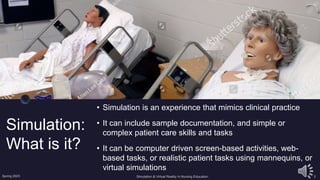
• Simulation is an experience that mimics clinical practice
• It can include sample documentation, and simple or
complex patient care skills and tasks
• It can be computer driven screen-based activities, web-
based tasks, or realistic patient tasks using mannequins, or
virtual simulations
What is Virtual
Reality?
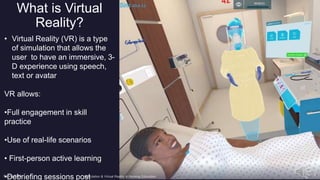
• Virtual Reality (VR) is a type
of simulation that allows the
user to have an immersive, 3-
D experience using speech,
text or avatar
VR allows:
•Full engagement in skill
practice
•Use of real-life scenarios
• First-person active learning
•Debriefing sessions post
Current Use of Simulation in Nursing Education
Simulation Allows Nursing Students To:
• Bridge the gap between theory and practice
• Gain confidence while learning
• Learn decision-making and critical-thinking skills
• Obtain quality training experiences
Current Use of Virtual Reality in Nursing Education
Virtual Reality Allows Nursing Students to:
 Remain Engaged In Learning
 Improve Patient Care Skills
 Increase Knowledge
 Build Confidence
Future Use of Simulation & Virtual Reality in
Nursing Education
Simulation& VR are Effective and Powerful Tools when used Together
(McGonigle & Mastrian, 2022; Chen et al, 2020)
These modalities can:
• Help to Reduce Errors in Practice (McGonigle & Mastrian, 2022; Koukourikos et al, 2021)
• Promote Experiential Learning (McGonigle & Mastrian, 2022; Koukourikos et al, 2021; Chen et al, 2020;
Crowe et al, 2018)
Future Use of Simulation & Virtual Reality in
Nursing Education
These modalities can:
• Encourage Team Building Activities
(Koukourikos et al, 2021; Chen et al, 2020; Crowe et al, 2018)
• Provide Safe Learning Environment for Students & Patients
(McGonigle & Mastrian, 2022; Koukourikos et al, 2021; Chen et al, 2020; Crowe et al, 2018)
• Allows for More Layered Scenarios & Practice of More Complex Skills
(McGonigle & Mastrian, 2022; Chen et al, 2020; Crowe et al, 2018)
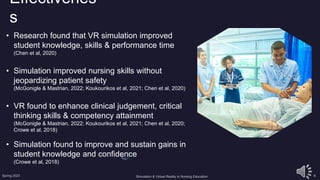
Effectivenes
s
• Research found that VR simulation improved
student knowledge, skills & performance time
(Chen et al, 2020)
• Simulation improved nursing skills without
jeopardizing patient safety
(McGonigle & Mastrian, 2022; Koukourikos et al, 2021; Chen et al, 2020)
• VR found to enhance clinical judgement, critical
thinking skills & competency attainment
(McGonigle & Mastrian, 2022; Koukourikos et al, 2021; Chen et al, 2020;
Crowe et al, 2018)
• Simulation found to improve and sustain gains in
student knowledge and confidence
(Crowe et al, 2018)
Limitations
• Simulations and VR platforms are limited to
uniform patient presentations
(Koukourikos et al, 2021)
• Research has found that although VR learning
is effective, if it not more effective than other
forms of instruction (Chen et al, 2020)
• Simulations and VR learning is a controlled
process that cannot account for all
spontaneous in vivo events
(McGonigle & Mastrian, 2022; Koukourikos et al, 2021)
• Costs to incorporate EHR simulation and VR
simulations into programming
(McGonigle & Mastrian, 2022; Koukourikos et al, 2021)
References
Chen, F. Q., Leng, Y. F., Ge, J. F., Wang, D. W., Li, C., Chen, B., & Sun, Z. L. (2020). Effectiveness of Virtual Reality
in Nursing Education: Meta- Analysis. Journal of medical Internet research, 22(9), e18290.
https://doi.org/10.2196/18290
Crowe, S., Ewart, L., & Derman, S. (2018). The impact of simulation based education on nursing confidence,
knowledge and patient outcomes on general medicine units. Nurse education in practice, 29, 70–75.
https://doi.org/10.1016/j.nepr.2017.11.017
Koukourikos, K., Tsaloglidou, A., Kourkouta, L., Papathanasiou, I. V., Iliadis, C., Fratzana, A., & Panagiotou, A.
(2021). Simulation in Clinical Nursing Education. Acta informatica medica : AIM : journal of the Society for
Medical Informatics of Bosnia & Herzegovina : casopis Drustvaza medicinsku informatiku BiH, 29(1),
15–20. https://doi
McGonigle, D. & Mastrian, K. (2022). Introduction to cognitive science and cognitive informatics. Nursing Informatics
and the Foundation of Knowledge (5th ed.). pp. 481-515. Sudbury, Massachusetts: Jones and Bartlett
Publishers.
.org/10.5455/aim.2021.29.15-20
Thank You

Simulation & Virtual Reality in Nursing Education.v5.ppsx

  • 1.
    Simulation & Virtual Realityin Nursing Education
  • 2.
    Simulation: What is it? •Simulation is an experience that mimics clinical practice • It can include sample documentation, and simple or complex patient care skills and tasks • It can be computer driven screen-based activities, web- based tasks, or realistic patient tasks using mannequins, or virtual simulations
  • 3.
    What is Virtual Reality? •Virtual Reality (VR) is a type of simulation that allows the user to have an immersive, 3- D experience using speech, text or avatar VR allows: •Full engagement in skill practice •Use of real-life scenarios • First-person active learning •Debriefing sessions post
  • 4.
    Current Use ofSimulation in Nursing Education Simulation Allows Nursing Students To: • Bridge the gap between theory and practice • Gain confidence while learning • Learn decision-making and critical-thinking skills • Obtain quality training experiences
  • 5.
    Current Use ofVirtual Reality in Nursing Education Virtual Reality Allows Nursing Students to:  Remain Engaged In Learning  Improve Patient Care Skills  Increase Knowledge  Build Confidence
  • 6.
    Future Use ofSimulation & Virtual Reality in Nursing Education Simulation& VR are Effective and Powerful Tools when used Together (McGonigle & Mastrian, 2022; Chen et al, 2020) These modalities can: • Help to Reduce Errors in Practice (McGonigle & Mastrian, 2022; Koukourikos et al, 2021) • Promote Experiential Learning (McGonigle & Mastrian, 2022; Koukourikos et al, 2021; Chen et al, 2020; Crowe et al, 2018)
  • 7.
    Future Use ofSimulation & Virtual Reality in Nursing Education These modalities can: • Encourage Team Building Activities (Koukourikos et al, 2021; Chen et al, 2020; Crowe et al, 2018) • Provide Safe Learning Environment for Students & Patients (McGonigle & Mastrian, 2022; Koukourikos et al, 2021; Chen et al, 2020; Crowe et al, 2018) • Allows for More Layered Scenarios & Practice of More Complex Skills (McGonigle & Mastrian, 2022; Chen et al, 2020; Crowe et al, 2018)
  • 8.
    Effectivenes s • Research foundthat VR simulation improved student knowledge, skills & performance time (Chen et al, 2020) • Simulation improved nursing skills without jeopardizing patient safety (McGonigle & Mastrian, 2022; Koukourikos et al, 2021; Chen et al, 2020) • VR found to enhance clinical judgement, critical thinking skills & competency attainment (McGonigle & Mastrian, 2022; Koukourikos et al, 2021; Chen et al, 2020; Crowe et al, 2018) • Simulation found to improve and sustain gains in student knowledge and confidence (Crowe et al, 2018)
  • 9.
    Limitations • Simulations andVR platforms are limited to uniform patient presentations (Koukourikos et al, 2021) • Research has found that although VR learning is effective, if it not more effective than other forms of instruction (Chen et al, 2020) • Simulations and VR learning is a controlled process that cannot account for all spontaneous in vivo events (McGonigle & Mastrian, 2022; Koukourikos et al, 2021) • Costs to incorporate EHR simulation and VR simulations into programming (McGonigle & Mastrian, 2022; Koukourikos et al, 2021)
  • 10.
    References Chen, F. Q.,Leng, Y. F., Ge, J. F., Wang, D. W., Li, C., Chen, B., & Sun, Z. L. (2020). Effectiveness of Virtual Reality in Nursing Education: Meta- Analysis. Journal of medical Internet research, 22(9), e18290. https://doi.org/10.2196/18290 Crowe, S., Ewart, L., & Derman, S. (2018). The impact of simulation based education on nursing confidence, knowledge and patient outcomes on general medicine units. Nurse education in practice, 29, 70–75. https://doi.org/10.1016/j.nepr.2017.11.017 Koukourikos, K., Tsaloglidou, A., Kourkouta, L., Papathanasiou, I. V., Iliadis, C., Fratzana, A., & Panagiotou, A. (2021). Simulation in Clinical Nursing Education. Acta informatica medica : AIM : journal of the Society for Medical Informatics of Bosnia & Herzegovina : casopis Drustvaza medicinsku informatiku BiH, 29(1), 15–20. https://doi McGonigle, D. & Mastrian, K. (2022). Introduction to cognitive science and cognitive informatics. Nursing Informatics and the Foundation of Knowledge (5th ed.). pp. 481-515. Sudbury, Massachusetts: Jones and Bartlett Publishers. .org/10.5455/aim.2021.29.15-20
  • 11.