Safe Prescribing and
  Use of Opioids
        April 10-12, 2012
 Walt Disney World Swan Resort
Accepted Learning Objectives:
1. Analyze current professional education
programs on safe use of opioids and new
programs under development.
2. Explain a potentially transformative on-line
educational tool for health professionals that
enable them to train by interacting with “virtual
patients.”
3. Describe a Massachusetts program for training
physicians on safe opioid prescribing, and the
curriculum developed to teach residents
and faculty.
Disclosure Statement
•  Drs. Daniel P. Alford and Sarah Ball
   have  disclosed no relevant, real or
   apparent personal or professional
   financial relationships.
•  Dr. Benjamin Lok has disclosed that he
   has a relationship with Shadow Health,
   Inc.
Simulation-based training
   for health care providers on
     prescription drug abuse

                Benjamin Lok, Ph.D.
        Computer and Information Sciences and
                    Engineering
               University of Florida


National Prescription Drug Abuse Summit
            April 10-12th, 2012
Overview of talk
 Existing approaches
   Level of integration
   Costs and benefits
 New approaches
   What s coming down the pike
   Defining the direction of simulation (what does
   simulation look like in 5 years?)
 Goals:
   Identifying how you can benefit from simulation
   today
   Identifying your part in shaping the future of
   education
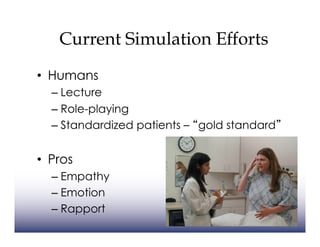
Current Simulation Efforts
•  Humans
  –  Lecture
  –  Role-playing
  –  Standardized patients – gold standard


•  Pros
  –  Empathy
  –  Emotion
  –  Rapport
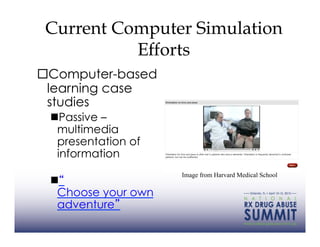
Current Computer Simulation
           Efforts
 Computer-based
 learning case
 studies
  Passive –
  multimedia
  presentation of
  information
                    Image from Harvard Medical School
  
  Choose your own
  adventure
Current state of simulation
  Simulation wings
   UF-Jacksonville has dedicated
    24,000 sq. ft.
   UF-Jacksonville 55 simulators
   Basic understanding of
    integration into curriculums
  [Huang 2007] Virtual patients
   Ad-hoc (26 of 108 schools
    building cases)
   Still images and video (83% of
    virtual patients)
   Expensive (each case $10,000-
    $50,000, 1-2 years to develop)
  Known education potential
   Compliments classrooms
                                     Human Patient Simulator – image
                                     from Samsun Lampotang
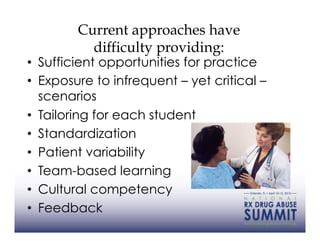
Current approaches have
          difficulty providing:
•  Sufficient opportunities for practice
•  Exposure to infrequent – yet critical –
   scenarios
•  Tailoring for each student
•  Standardization
•  Patient variability
•  Team-based learning
•  Cultural competency
•  Feedback
Addiction Management
          Challenges
•  Large scale deployment (40k+
   learners)

•  Solution: virtual human simulation

•  Effective training using simulation
  –  Track progress
  –  Provide feedback
  –  Implement protocols
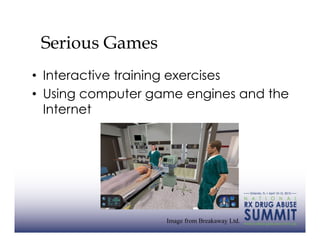
Serious Games
•  Interactive training exercises
•  Using computer game engines and the
   Internet


                   Image from Breakaway Ltd.
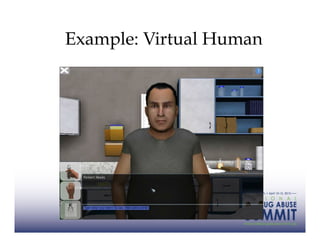
Example: Virtual Human
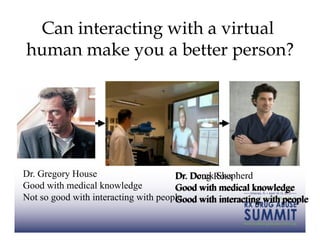
Can interacting with a virtual
human make you a better person?


Dr. Gregory House                         Derek Shepherd
                                      Dr. Doug Ross
Good with medical knowledge           Good with medical knowledge
Not so good with interacting with people
                                      Good with interacting with people
Virtualpatientsgroup.com
•  6 universities, 35 researchers, 8 years of VP research
•  Technologies to:
    –  Create virtual patients
    –  Deploy virtual patients
•  Enable
    –  Curricular building and integration of training
       scenarios
    –  Teaching and training with
      •  Variety of scenarios
      •  Variety of patients
      •  After-action review systems
•  Looking for:
     Research partners
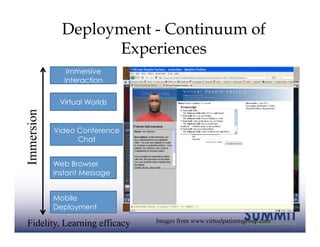
Deployment - Continuum of
                    Experiences
               Immersive
              Interaction


             Virtual Worlds
Immersion


            Video Conference
                  Chat


            Web Browser
            Instant Message


            Mobile
            Deployment
                               Images from www.virtualpatientsgroup.com
 Fidelity, Learning efficacy
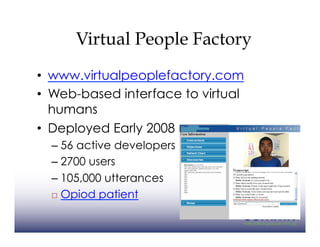
Virtual People Factory
•  www.virtualpeoplefactory.com
•  Web-based interface to virtual
   humans
•  Deployed Early 2008
  –  56 active developers
  –  2700 users
  –  105,000 utterances
    Opiod patient
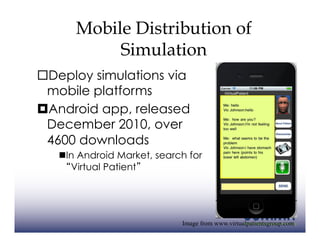
Mobile Distribution of
           Simulation
 Deploy simulations via
 mobile platforms
 Android app, released
 December 2010, over
 4600 downloads
    In Android Market, search for
      Virtual Patient


                             Image from www.virtualpatientsgroup.com
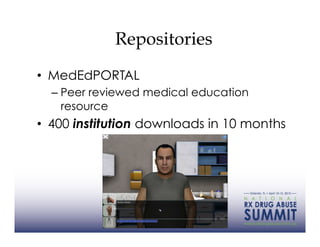
Repositories
•  MedEdPORTAL
  –  Peer reviewed medical education
     resource
•  400 institution downloads in 10 months
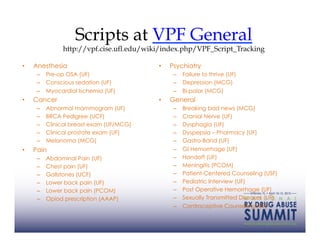
Scripts at VPF General
                http://vpf.cise.ufl.edu/wiki/index.php/VPF_Script_Tracking

•    Anesthesia                            •    Psychiatry
      –  Pre-op OSA (UF)                         –  Failure to thrive (UF)
      –  Conscious sedation (UF)                 –  Depression (MCG)
      –  Myocardial Ischemia (UF)                –  Bi-polar (MCG)
•    Cancer                                •    General
      –    Abnormal mammogram (UF)               –    Breaking bad news (MCG)
      –    BRCA Pedigree (UCF)                   –    Cranial Nerve (UF)
      –    Clinical breast exam (UF/MCG)         –    Dysphagia (UF)
      –    Clinical prostate exam (UF)           –    Dyspepsia – Pharmacy (UF)
      –    Melanoma (MCG)                        –    Gastro-Band (UF)
•    Pain                                        –    GI Hemorrhage (UF)
      –    Abdominal Pain (UF)                   –    Handoff (UF)
      –    Chest pain (UF)                       –    Meningitis (PCOM)
      –    Gallstones (UCF)                      –    Patient-Centered Counseling (USF)
      –    Lower back pain (UF)                  –    Pediatric Interview (UF)
      –    Lower back pain (PCOM)                –    Post Operative Hemorrhage (UF)
      –    Opiod prescription (AAAP)             –    Sexually Transmitted Diseases (UF)
                                                 –    Contraceptive Counseling (UF)
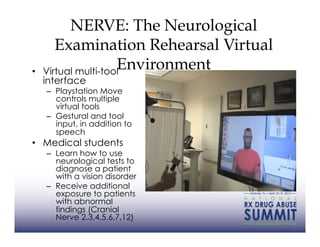
NERVE: The Neurological
        Examination Rehearsal Virtual
• 
                      Environment
     Virtual multi-tool
     interface
     –  Playstation Move
        controls multiple
        virtual tools
     –  Gestural and tool
        input, in addition to
        speech
•  Medical students
     –  Learn how to use
        neurological tests to
        diagnose a patient
        with a vision disorder
     –  Receive additional
        exposure to patients
        with abnormal
        findings (Cranial
        Nerve 2,3,4,5,6,7,12)
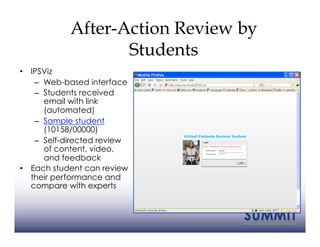
After-Action Review by
                   Students
•  IPSViz
    –  Web-based interface
    –  Students received
       email with link
       (automated)
    –  Sample student
       (10158/00000)
    –  Self-directed review
       of content, video,
       and feedback
•  Each student can review
   their performance and
   compare with experts
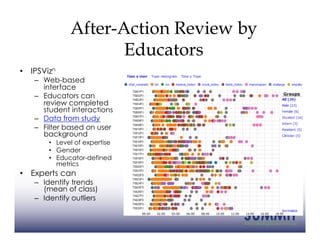
After-Action Review by
                      Educators
•  IPSVizn
    –  Web-based
       interface
    –  Educators can
       review completed
       student interactions
    –  Data from study
    –  Filter based on user
       background
        •  Level of expertise
        •  Gender
        •  Educator-defined
           metrics
•  Experts can
    –  Identify trends
       (mean of class)
    –  Identify outliers
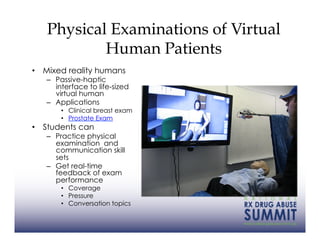
Physical Examinations of Virtual
           Human Patients
•  Mixed reality humans
   –  Passive-haptic
      interface to life-sized
      virtual human
   –  Applications
       •  Clinical breast exam
       •  Prostate Exam
•  Students can
   –  Practice physical
      examination and
      communication skill
      sets
   –  Get real-time
      feedback of exam
      performance
       •  Coverage
       •  Pressure
       •  Conversation topics
Getting Involved
  Now (<6 months)
   Use systems to create web-deployable cases
       Case study-based
       Adaptive raining – could branch depending on trainee s selections
       Example: http://www.md-inc.com/Products/product_details.cfm?
        mm=2&sm=4027&courseno=172
  Near term (<2 years)
   Work with developers to create interactive virtual patients
       Different levels of fidelity
       Requires funding
       More interactive
  Long term (3 years+)
   Coordinated teaching/training/testing using simulation
       Valid and reliable training materials
       Work with professional, licensing, continuing education groups
Demo of Creating Virtual
           Patient
•  www.virtualpatientsgroup.com
Thank You!


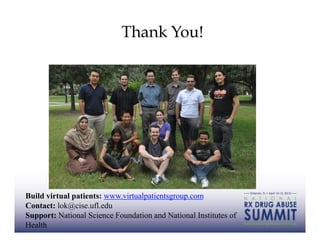
Build virtual patients: www.virtualpatientsgroup.com
Contact: lok@cise.ufl.edu
Support: National Science Foundation and National Institutes of
Health

Benjamin Lok

  • 1.
    Safe Prescribing and Use of Opioids April 10-12, 2012 Walt Disney World Swan Resort
  • 2.
    Accepted Learning Objectives: 1.Analyze current professional education programs on safe use of opioids and new programs under development. 2. Explain a potentially transformative on-line educational tool for health professionals that enable them to train by interacting with “virtual patients.” 3. Describe a Massachusetts program for training physicians on safe opioid prescribing, and the curriculum developed to teach residents and faculty.
  • 3.
    Disclosure Statement •  Drs.Daniel P. Alford and Sarah Ball have  disclosed no relevant, real or apparent personal or professional financial relationships. •  Dr. Benjamin Lok has disclosed that he has a relationship with Shadow Health, Inc.
  • 4.
    Simulation-based training for health care providers on prescription drug abuse Benjamin Lok, Ph.D. Computer and Information Sciences and Engineering University of Florida National Prescription Drug Abuse Summit April 10-12th, 2012
  • 5.
    Overview of talk  Existingapproaches  Level of integration  Costs and benefits  New approaches  What s coming down the pike  Defining the direction of simulation (what does simulation look like in 5 years?)  Goals:  Identifying how you can benefit from simulation today  Identifying your part in shaping the future of education
  • 6.
    Current Simulation Efforts • Humans –  Lecture –  Role-playing –  Standardized patients – gold standard •  Pros –  Empathy –  Emotion –  Rapport
  • 7.
    Current Computer Simulation Efforts  Computer-based learning case studies  Passive – multimedia presentation of information Image from Harvard Medical School   Choose your own adventure
  • 8.
    Current state ofsimulation   Simulation wings  UF-Jacksonville has dedicated 24,000 sq. ft.  UF-Jacksonville 55 simulators  Basic understanding of integration into curriculums   [Huang 2007] Virtual patients  Ad-hoc (26 of 108 schools building cases)  Still images and video (83% of virtual patients)  Expensive (each case $10,000- $50,000, 1-2 years to develop)   Known education potential  Compliments classrooms Human Patient Simulator – image from Samsun Lampotang
  • 9.
    Current approaches have difficulty providing: •  Sufficient opportunities for practice •  Exposure to infrequent – yet critical – scenarios •  Tailoring for each student •  Standardization •  Patient variability •  Team-based learning •  Cultural competency •  Feedback
  • 10.
    Addiction Management Challenges •  Large scale deployment (40k+ learners) •  Solution: virtual human simulation •  Effective training using simulation –  Track progress –  Provide feedback –  Implement protocols
  • 11.
    Serious Games •  Interactivetraining exercises •  Using computer game engines and the Internet Image from Breakaway Ltd.
  • 12.
  • 13.
    Can interacting witha virtual human make you a better person? Dr. Gregory House Derek Shepherd Dr. Doug Ross Good with medical knowledge Good with medical knowledge Not so good with interacting with people Good with interacting with people
  • 14.
    Virtualpatientsgroup.com •  6 universities,35 researchers, 8 years of VP research •  Technologies to: –  Create virtual patients –  Deploy virtual patients •  Enable –  Curricular building and integration of training scenarios –  Teaching and training with •  Variety of scenarios •  Variety of patients •  After-action review systems •  Looking for:  Research partners
  • 15.
    Deployment - Continuumof Experiences Immersive Interaction Virtual Worlds Immersion Video Conference Chat Web Browser Instant Message Mobile Deployment Images from www.virtualpatientsgroup.com Fidelity, Learning efficacy
  • 16.
    Virtual People Factory • www.virtualpeoplefactory.com •  Web-based interface to virtual humans •  Deployed Early 2008 –  56 active developers –  2700 users –  105,000 utterances   Opiod patient
  • 17.
    Mobile Distribution of Simulation  Deploy simulations via mobile platforms  Android app, released December 2010, over 4600 downloads  In Android Market, search for Virtual Patient Image from www.virtualpatientsgroup.com
  • 18.
    Repositories •  MedEdPORTAL –  Peer reviewed medical education resource •  400 institution downloads in 10 months
  • 19.
    Scripts at VPFGeneral http://vpf.cise.ufl.edu/wiki/index.php/VPF_Script_Tracking •  Anesthesia •  Psychiatry –  Pre-op OSA (UF) –  Failure to thrive (UF) –  Conscious sedation (UF) –  Depression (MCG) –  Myocardial Ischemia (UF) –  Bi-polar (MCG) •  Cancer •  General –  Abnormal mammogram (UF) –  Breaking bad news (MCG) –  BRCA Pedigree (UCF) –  Cranial Nerve (UF) –  Clinical breast exam (UF/MCG) –  Dysphagia (UF) –  Clinical prostate exam (UF) –  Dyspepsia – Pharmacy (UF) –  Melanoma (MCG) –  Gastro-Band (UF) •  Pain –  GI Hemorrhage (UF) –  Abdominal Pain (UF) –  Handoff (UF) –  Chest pain (UF) –  Meningitis (PCOM) –  Gallstones (UCF) –  Patient-Centered Counseling (USF) –  Lower back pain (UF) –  Pediatric Interview (UF) –  Lower back pain (PCOM) –  Post Operative Hemorrhage (UF) –  Opiod prescription (AAAP) –  Sexually Transmitted Diseases (UF) –  Contraceptive Counseling (UF)
  • 20.
    NERVE: The Neurological Examination Rehearsal Virtual •  Environment Virtual multi-tool interface –  Playstation Move controls multiple virtual tools –  Gestural and tool input, in addition to speech •  Medical students –  Learn how to use neurological tests to diagnose a patient with a vision disorder –  Receive additional exposure to patients with abnormal findings (Cranial Nerve 2,3,4,5,6,7,12)
  • 21.
    After-Action Review by Students •  IPSViz –  Web-based interface –  Students received email with link (automated) –  Sample student (10158/00000) –  Self-directed review of content, video, and feedback •  Each student can review their performance and compare with experts
  • 22.
    After-Action Review by Educators •  IPSVizn –  Web-based interface –  Educators can review completed student interactions –  Data from study –  Filter based on user background •  Level of expertise •  Gender •  Educator-defined metrics •  Experts can –  Identify trends (mean of class) –  Identify outliers
  • 23.
    Physical Examinations ofVirtual Human Patients •  Mixed reality humans –  Passive-haptic interface to life-sized virtual human –  Applications •  Clinical breast exam •  Prostate Exam •  Students can –  Practice physical examination and communication skill sets –  Get real-time feedback of exam performance •  Coverage •  Pressure •  Conversation topics
  • 24.
    Getting Involved   Now(<6 months)  Use systems to create web-deployable cases   Case study-based   Adaptive raining – could branch depending on trainee s selections   Example: http://www.md-inc.com/Products/product_details.cfm? mm=2&sm=4027&courseno=172   Near term (<2 years)  Work with developers to create interactive virtual patients   Different levels of fidelity   Requires funding   More interactive   Long term (3 years+)  Coordinated teaching/training/testing using simulation   Valid and reliable training materials   Work with professional, licensing, continuing education groups
  • 25.
    Demo of CreatingVirtual Patient •  www.virtualpatientsgroup.com
  • 26.
    Thank You! Build virtualpatients: www.virtualpatientsgroup.com Contact: lok@cise.ufl.edu Support: National Science Foundation and National Institutes of Health