
 The most basic type of probability sampling is the simple
random sample, where each subject, element, event, or
unit in the population has an equal chance of being
selected. If a subject or unit is drawn from the population
and removed from subsequent selections, the procedure
is known as random sampling without replacement—the
most widely used random sampling method.
 Simple random sampling with replacement involves
returning the subject, element, or unit to the population so
that it has a chance of being chosen another time.
10/14/2022
Simple Random Sampling
Muhammad Awais
(facebook.com/awwaiis)

 Researchers often use a table of random numbers to generate a
simple random sample.
 For example, a researcher who wants to analyze 10 prime-time
television programs out of a population of 100 programs to
determine how the medium portrays elderly people can take a
random sample from the 100 programs by numbering each show
from 00 to 99 and then selecting 10 numbers from a table of
random numbers. First, a starting point in the table is selected at
random. There is no specific way to choose a starting point; it is an
arbitrary decision. The researcher then selects the remaining 9
numbers by going up, down, left, or right on the table—or even
randomly throughout the table. For example, if the researcher goes
down the table from the starting point of 44 until a sample of 10
has been drawn, the sample would include television programs
numbered 44, 85, 46, 71, 17, 50, 66, 56, 03, and 49.
10/14/2022
Muhammad Awais
(facebook.com/awwaiis)

10/14/2022
Muhammad Awais
(facebook.com/awwaiis)

 Simple random samples for use in telephone surveys
are often obtained by a process called random digit
dialing, or RDD.
 Address-based Dialing.
 There are other techniques as well to choose sample
randomly, including Magic Hat.
 =RANDBETWEEN(1,100) and press F9
10/14/2022
Muhammad Awais
(facebook.com/awwaiis)

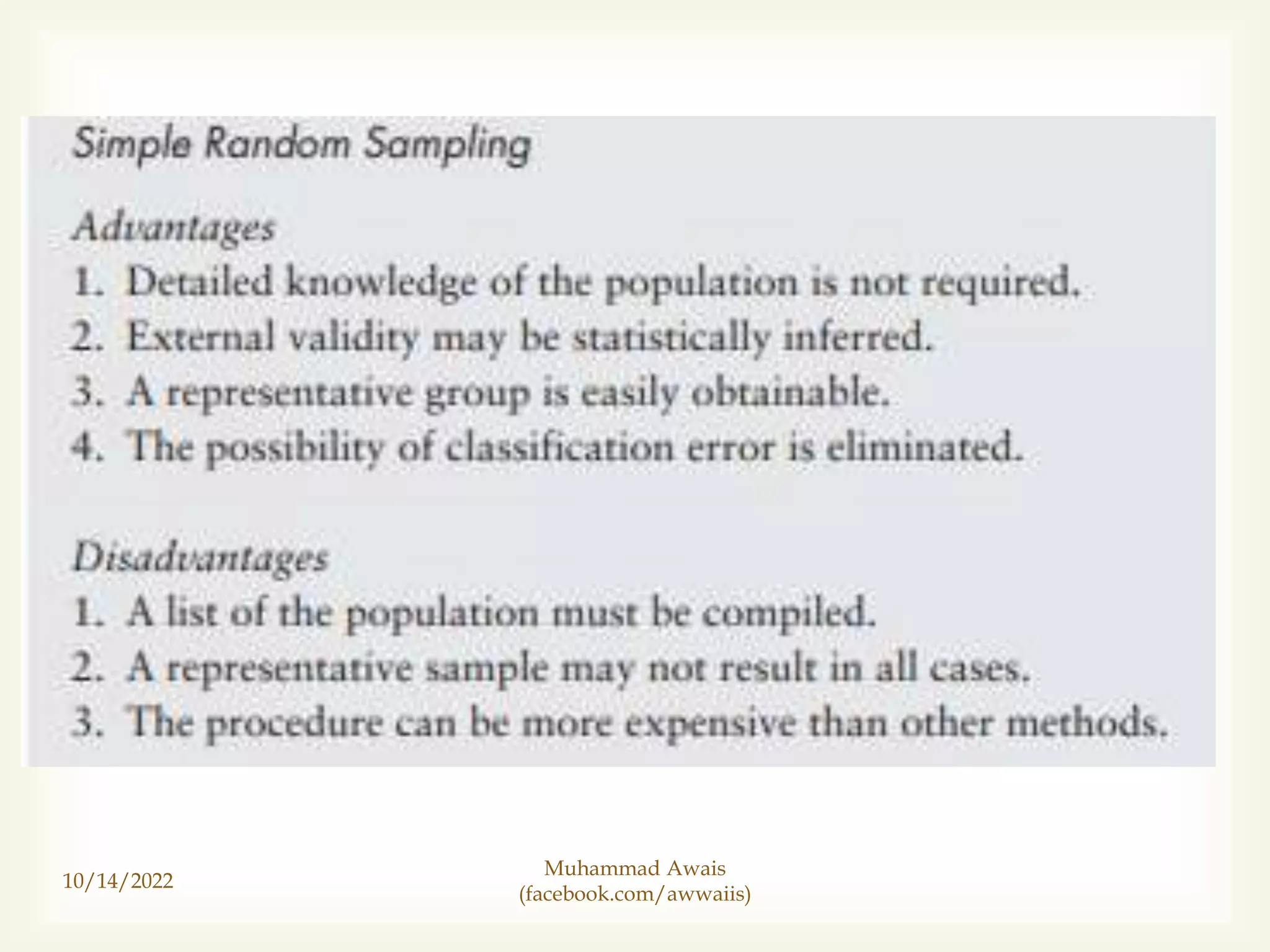
 There are several methods to develop random numbers or
households, but two rules always apply:
 (1) each unit or subject in the population must have an
equal chance of being selected.
 (2) the selection procedure must be free from subjective
intervention by the researcher.
 The purpose of random sampling is to reduce sampling
error; violating random sampling rules only increases the
chance of introducing such error into a study
10/14/2022
Muhammad Awais
(facebook.com/awwaiis)

10/14/2022
Muhammad Awais
(facebook.com/awwaiis)

Simple Random Sampling Technique - Probabiltiy Sampling - Mass Media Research.pptx

  • 1.
      The mostbasic type of probability sampling is the simple random sample, where each subject, element, event, or unit in the population has an equal chance of being selected. If a subject or unit is drawn from the population and removed from subsequent selections, the procedure is known as random sampling without replacement—the most widely used random sampling method.  Simple random sampling with replacement involves returning the subject, element, or unit to the population so that it has a chance of being chosen another time. 10/14/2022 Simple Random Sampling Muhammad Awais (facebook.com/awwaiis)
  • 2.
      Researchers oftenuse a table of random numbers to generate a simple random sample.  For example, a researcher who wants to analyze 10 prime-time television programs out of a population of 100 programs to determine how the medium portrays elderly people can take a random sample from the 100 programs by numbering each show from 00 to 99 and then selecting 10 numbers from a table of random numbers. First, a starting point in the table is selected at random. There is no specific way to choose a starting point; it is an arbitrary decision. The researcher then selects the remaining 9 numbers by going up, down, left, or right on the table—or even randomly throughout the table. For example, if the researcher goes down the table from the starting point of 44 until a sample of 10 has been drawn, the sample would include television programs numbered 44, 85, 46, 71, 17, 50, 66, 56, 03, and 49. 10/14/2022 Muhammad Awais (facebook.com/awwaiis)
  • 3.
  • 4.
      Simple randomsamples for use in telephone surveys are often obtained by a process called random digit dialing, or RDD.  Address-based Dialing.  There are other techniques as well to choose sample randomly, including Magic Hat.  =RANDBETWEEN(1,100) and press F9 10/14/2022 Muhammad Awais (facebook.com/awwaiis)
  • 5.
      There areseveral methods to develop random numbers or households, but two rules always apply:  (1) each unit or subject in the population must have an equal chance of being selected.  (2) the selection procedure must be free from subjective intervention by the researcher.  The purpose of random sampling is to reduce sampling error; violating random sampling rules only increases the chance of introducing such error into a study 10/14/2022 Muhammad Awais (facebook.com/awwaiis)
  • 6.