
 One goal of scientific research is to describe the nature of a
population—a group or class of subjects, variables, concepts, or
phenomena. In some cases, an entire class or group is
investigated, as in a study of prime-time television programs
during the week of September 10–16. The process of examining
every member in a population is called a census.
 In many situations, however, an entire population cannot be
examined due to time and resource constraints. Studying every
member of a population is also generally cost-prohibitive and
may, in fact, confound the research because measurements of
large numbers of people often affect measurement quality
 The usual procedure in these instances is to take a sample from
the population.
Population
10/14/2022
Muhammad Awais
(facebook.com/awwaiis)

 A sample is a subset of the population that is
representative of the entire population.
 An important word in this definition is representative.
 A sample that is not representative of the population,
regardless of its size, is inadequate for testing purposes
because the results cannot be generalized to the
population from which the sample was drawn.
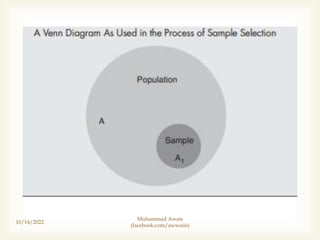
 A census would test or measure every element in the
population (A), whereas a sample would measure or test
a segment of the population (A1).
10/14/2022
What is Sample?
Muhammad Awais
(facebook.com/awwaiis)

10/14/2022
Muhammad Awais
(facebook.com/awwaiis)

 If a sample is chosen according to proper guidelines
and is representative of the population, then the
results from a study using the sample can be
generalized to the population. However, the results
from any research study must be generalized with
some caution because of the error that is inherent in
all research.
10/14/2022
Muhammad Awais
(facebook.com/awwaiis)

Population vs Sample - Mass Media Research.pptx

  • 1.
      One goalof scientific research is to describe the nature of a population—a group or class of subjects, variables, concepts, or phenomena. In some cases, an entire class or group is investigated, as in a study of prime-time television programs during the week of September 10–16. The process of examining every member in a population is called a census.  In many situations, however, an entire population cannot be examined due to time and resource constraints. Studying every member of a population is also generally cost-prohibitive and may, in fact, confound the research because measurements of large numbers of people often affect measurement quality  The usual procedure in these instances is to take a sample from the population. Population 10/14/2022 Muhammad Awais (facebook.com/awwaiis)
  • 2.
      A sampleis a subset of the population that is representative of the entire population.  An important word in this definition is representative.  A sample that is not representative of the population, regardless of its size, is inadequate for testing purposes because the results cannot be generalized to the population from which the sample was drawn.  A census would test or measure every element in the population (A), whereas a sample would measure or test a segment of the population (A1). 10/14/2022 What is Sample? Muhammad Awais (facebook.com/awwaiis)
  • 3.
  • 4.
      If asample is chosen according to proper guidelines and is representative of the population, then the results from a study using the sample can be generalized to the population. However, the results from any research study must be generalized with some caution because of the error that is inherent in all research. 10/14/2022 Muhammad Awais (facebook.com/awwaiis)