
 A stratified sample is the approach used to get
adequate representation of a subsample. The
characteristics of the subsample (strata or segment)
may include almost any variable: age, gender,
religion, income level, or even individuals who listen
to specific radio stations or read certain magazines.
 The strata may be defined by an almost unlimited
number of characteristics; however, each additional
variable or characteristic makes the subsample more
difficult to find and costs to find the sample increase
substantially.
10/14/2022
Stratified Sampling
Muhammad Awais
(facebook.com/awwaiis)

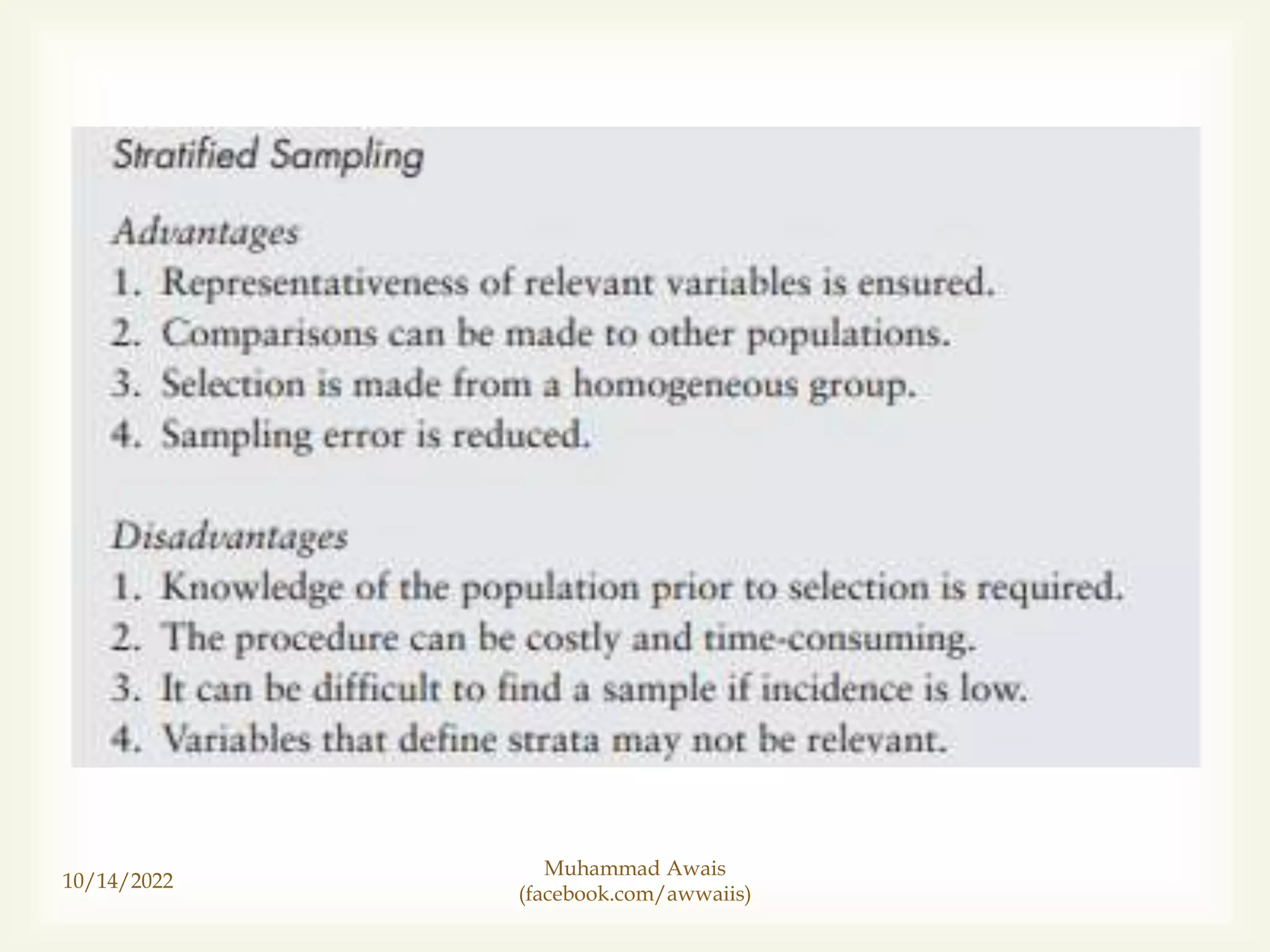
 Stratified sampling ensures that a sample is drawn
from a homogeneous subset of the population—that
is, from a population that has similar characteristics.
Homogeneity helps researchers to reduce sampling
error.
10/14/2022
Muhammad Awais
(facebook.com/awwaiis)

 For example, consider a research study on subjects’
attitudes toward two-way, interactive cable or satellite
television. The investigator, knowing that cable and
satellite subscribers tend to have higher achievement
levels, may wish to stratify the population according to
education. Before randomly selecting subjects, the
researcher divides the population into three education
levels: grade school, high school, and college.
 Then, if it is determined that 10% of the population
completed college, a random sample proportional to the
population should contain 10% of the population who
meet this standard.
10/14/2022
Muhammad Awais
(facebook.com/awwaiis)

 Stratified sampling ensures the proper representation of
the stratification variables to enhance representation of
other variables related to them. Taken as a whole, then, a
stratified sample is likely to be more representative on a
number of variables than a simple random sample.
 Proportionate stratified sampling.
 It includes strata with sizes based on their proportions in
the population. If 30% of the population is adults ages 18–
24, then 30% of the total sample will be subjects in this age
group. This procedure is designed to give each person in
the population an equal chance of being selected.
10/14/2022
Muhammad Awais
(facebook.com/awwaiis)

 Disproportionate stratified sampling
 It is used to oversample or over represent a particular
stratum. The approach is used because that stratum is
considered important for marketing, advertising, or other
similar reason. For example, a radio station that targets 25 to
54 year olds may have ratings problems with the 25- to 34-
year-old group. In a telephone study of 400 respondents, the
station management may wish to have the sample
represented as follows: 70% in the 25–34 group, 20% in the
35–49 group, and 10% in the 50–54 group. This distribution
would allow researchers to break the 25-34 group into
smaller subgroups such as males, females, fans of specific
stations, and other subcategories, and still have reasonable
sample sizes.
10/14/2022
Muhammad Awais
(facebook.com/awwaiis)

10/14/2022
Muhammad Awais
(facebook.com/awwaiis)

Stratified Sampling Technique - Probability Sampling - Mass Media Research.pptx

  • 1.
      A stratifiedsample is the approach used to get adequate representation of a subsample. The characteristics of the subsample (strata or segment) may include almost any variable: age, gender, religion, income level, or even individuals who listen to specific radio stations or read certain magazines.  The strata may be defined by an almost unlimited number of characteristics; however, each additional variable or characteristic makes the subsample more difficult to find and costs to find the sample increase substantially. 10/14/2022 Stratified Sampling Muhammad Awais (facebook.com/awwaiis)
  • 2.
      Stratified samplingensures that a sample is drawn from a homogeneous subset of the population—that is, from a population that has similar characteristics. Homogeneity helps researchers to reduce sampling error. 10/14/2022 Muhammad Awais (facebook.com/awwaiis)
  • 3.
      For example,consider a research study on subjects’ attitudes toward two-way, interactive cable or satellite television. The investigator, knowing that cable and satellite subscribers tend to have higher achievement levels, may wish to stratify the population according to education. Before randomly selecting subjects, the researcher divides the population into three education levels: grade school, high school, and college.  Then, if it is determined that 10% of the population completed college, a random sample proportional to the population should contain 10% of the population who meet this standard. 10/14/2022 Muhammad Awais (facebook.com/awwaiis)
  • 4.
      Stratified samplingensures the proper representation of the stratification variables to enhance representation of other variables related to them. Taken as a whole, then, a stratified sample is likely to be more representative on a number of variables than a simple random sample.  Proportionate stratified sampling.  It includes strata with sizes based on their proportions in the population. If 30% of the population is adults ages 18– 24, then 30% of the total sample will be subjects in this age group. This procedure is designed to give each person in the population an equal chance of being selected. 10/14/2022 Muhammad Awais (facebook.com/awwaiis)
  • 5.
      Disproportionate stratifiedsampling  It is used to oversample or over represent a particular stratum. The approach is used because that stratum is considered important for marketing, advertising, or other similar reason. For example, a radio station that targets 25 to 54 year olds may have ratings problems with the 25- to 34- year-old group. In a telephone study of 400 respondents, the station management may wish to have the sample represented as follows: 70% in the 25–34 group, 20% in the 35–49 group, and 10% in the 50–54 group. This distribution would allow researchers to break the 25-34 group into smaller subgroups such as males, females, fans of specific stations, and other subcategories, and still have reasonable sample sizes. 10/14/2022 Muhammad Awais (facebook.com/awwaiis)
  • 6.