Faculty of Sciences (Section V)
Lebanese University
Chapter 1: Anti-derivatives
Dr. Kamel ATTAR
attar.kamel@gmail.com
Lecture #1 F Tuesday 16/MAR/2021 F
2Ú61
Anti-derivatives
Integration of a Rational Functions
Trigonometric Integrals
Abelian integrals
1 Anti-derivatives
Definition
Integration by Change of Variable
Integration by Parts
2 Integration of a Rational Functions
Denominator Containing Linear Factors
Denominator Containing reducible Quadratic Factor
Denominator Containing Repeated Linear Factors
Denominator Containing Irreducible Quadratic Factor
3 Trigonometric Integrals
Products of Powers of Sines and Cosines
Products of Sines and Cosines
Bioche Rule
4 Abelian integrals
Dr. Kamel ATTAR | Chapter 1: Anti-derivatives
3Ú61
Anti-derivatives
Integration of a Rational Functions
Trigonometric Integrals
Abelian integrals
Definition
Integration by Change of Variable
Integration by Parts
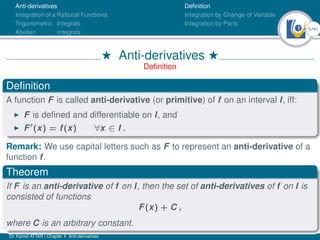
H Anti-derivatives H
Definition
Definition
A function F is called anti-derivative (or primitive) of f on an interval I, iff:
I F is defined and differentiable on I, and
I F0
(x) = f(x) ∀x ∈ I .
Remark: We use capital letters such as F to represent an anti-derivative of a
function f.
Theorem
If F is an anti-derivative of f on I, then the set of anti-derivatives of f on I is
consisted of functions
F(x) + C ,
where C is an arbitrary constant.
Dr. Kamel ATTAR | Chapter 1: Anti-derivatives
4Ú61
Anti-derivatives
Integration of a Rational Functions
Trigonometric Integrals
Abelian integrals
Definition
Integration by Change of Variable
Integration by Parts
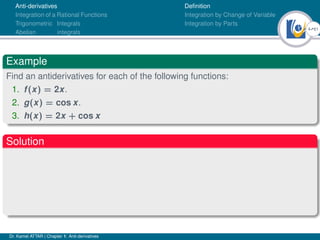
Example
Find an antiderivatives for each of the following functions:
1. f(x) = 2x.
2. g(x) = cos x.
3. h(x) = 2x + cos x
Solution
Dr. Kamel ATTAR | Chapter 1: Anti-derivatives
5Ú61
Anti-derivatives
Integration of a Rational Functions
Trigonometric Integrals
Abelian integrals
Definition
Integration by Change of Variable
Integration by Parts
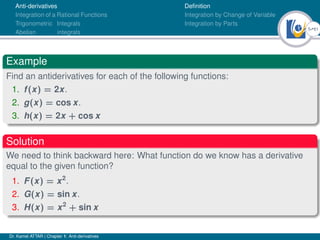
Example
Find an antiderivatives for each of the following functions:
1. f(x) = 2x.
2. g(x) = cos x.
3. h(x) = 2x + cos x
Solution
We need to think backward here: What function do we know has a derivative
equal to the given function?
1. F(x) = x2
.
2. G(x) = sin x.
3. H(x) = x2
+ sin x
Dr. Kamel ATTAR | Chapter 1: Anti-derivatives
6Ú61
Anti-derivatives
Integration of a Rational Functions
Trigonometric Integrals
Abelian integrals
Definition
Integration by Change of Variable
Integration by Parts
Example
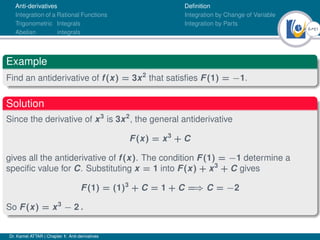
Find an antiderivative of f(x) = 3x2
that satisfies F(1) = −1.
Solution
Since the derivative of x3
is 3x2
, the general antiderivative
F(x) = x3
+ C
gives all the antiderivative of f(x). The condition F(1) = −1 determine a
specific value for C. Substituting x = 1 into F(x) + x3
+ C gives
F(1) = (1)3
+ C = 1 + C =⇒ C = −2
So F(x) = x3
− 2 .
Dr. Kamel ATTAR | Chapter 1: Anti-derivatives
7Ú61
Anti-derivatives
Integration of a Rational Functions
Trigonometric Integrals
Abelian integrals
Definition
Integration by Change of Variable
Integration by Parts
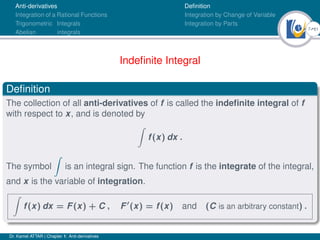
Indefinite Integral
Definition
The collection of all anti-derivatives of f is called the indefinite integral of f
with respect to x, and is denoted by
Z
f(x) dx .
The symbol
Z
is an integral sign. The function f is the integrate of the integral,
and x is the variable of integration.
Z
f(x) dx = F(x) + C , F0
(x) = f(x) and (C is an arbitrary constant) .
Dr. Kamel ATTAR | Chapter 1: Anti-derivatives
8Ú61
Anti-derivatives
Integration of a Rational Functions
Trigonometric Integrals
Abelian integrals
Definition
Integration by Change of Variable
Integration by Parts
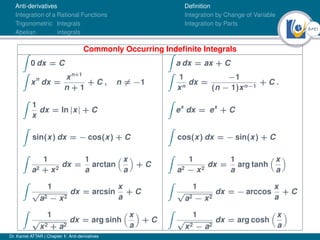
Commonly Occurring Indefinite Integrals
Z
0 dx = C
Z
a dx = ax + C
Z
xn
dx =
xn+1
n + 1
+ C , n 6= −1
Z
1
xn
dx =
−1
(n − 1)xn−1
+ C .
Z
1
x
dx = ln |x| + C
Z
ex
dx = ex
+ C
Z
sin(x) dx = − cos(x) + C
Z
cos(x) dx = − sin(x) + C
Z
1
a2 + x2
dx =
1
a
arctan
x
a

+ C
Z
1
a2 − x2
dx =
1
a
arg tanh
x
a

Z
1
√
a2 − x2
dx = arcsin
x
a
+ C
Z
1
√
a2 − x2
dx = − arccos
x
a
+ C
Z
1
√
x2 + a2
dx = arg sinh
x
a

+ C
Z
1
√
x2 − a2
dx = arg cosh
x
a

Dr. Kamel ATTAR | Chapter 1: Anti-derivatives
9Ú61
Anti-derivatives
Integration of a Rational Functions
Trigonometric Integrals
Abelian integrals
Definition
Integration by Change of Variable
Integration by Parts
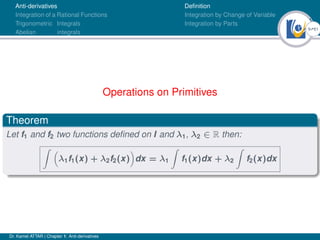
Operations on Primitives
Theorem
Let f1 and f2 two functions defined on I and λ1, λ2 ∈ R then:
Z 
λ1f1(x) + λ2f2(x)

dx = λ1
Z
f1(x)dx + λ2
Z
f2(x)dx
Dr. Kamel ATTAR | Chapter 1: Anti-derivatives
10Ú61
Anti-derivatives
Integration of a Rational Functions
Trigonometric Integrals
Abelian integrals
Definition
Integration by Change of Variable
Integration by Parts
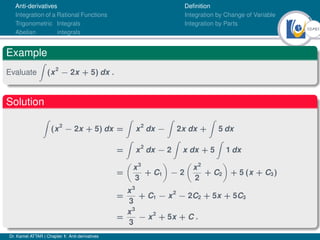
Example
Evaluate
Z
(x2
− 2x + 5) dx .
Solution
Z
(x2
− 2x + 5) dx =
Z
x2
dx −
Z
2x dx +
Z
5 dx
=
Z
x2
dx − 2
Z
x dx + 5
Z
1 dx
=

x3
3
+ C1

− 2

x2
2
+ C2

+ 5 (x + C3)
=
x3
3
+ C1 − x2
− 2C2 + 5x + 5C3
=
x3
3
− x2
+ 5x + C .
Dr. Kamel ATTAR | Chapter 1: Anti-derivatives
11Ú61
Anti-derivatives
Integration of a Rational Functions
Trigonometric Integrals
Abelian integrals
Definition
Integration by Change of Variable
Integration by Parts
Integration by Change of Variable
Theorem
If ϕ : [α, β] → R is a continuously differentiable function and if f is continuous
mapping on an interval contained ϕ

[α, β]

, then :
Z
f

ϕ(x)

ϕ0
(x) dx =
Z
f(t) dt
We can say that we perform the change of variable t = ϕ(x).
Dr. Kamel ATTAR | Chapter 1: Anti-derivatives
12Ú61
Anti-derivatives
Integration of a Rational Functions
Trigonometric Integrals
Abelian integrals
Definition
Integration by Change of Variable
Integration by Parts
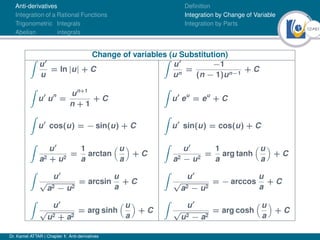
Change of variables (u Substitution)
Z
u0
u
= ln |u| + C
Z
u0
un
=
−1
(n − 1)un−1
+ C
Z
u0
un
=
un+1
n + 1
+ C
Z
u0
eu
= eu
+ C
Z
u0
cos(u) = − sin(u) + C
Z
u0
sin(u) = cos(u) + C
Z
u0
a2 + u2
=
1
a
arctan
u
a

+ C
Z
u0
a2 − u2
=
1
a
arg tanh
u
a

+ C
Z
u0
√
a2 − u2
= arcsin
u
a
+ C
Z
u0
√
a2 − u2
= − arccos
u
a
+ C
Z
u0
√
u2 + a2
= arg sinh
u
a

+ C
Z
u0
√
u2 − a2
= arg cosh
u
a

+ C
Dr. Kamel ATTAR | Chapter 1: Anti-derivatives
13Ú61
Anti-derivatives
Integration of a Rational Functions
Trigonometric Integrals
Abelian integrals
Definition
Integration by Change of Variable
Integration by Parts
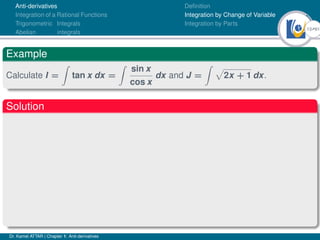
Example
Calculate I =
Z
tan x dx =
Z
sin x
cos x
dx and J =
Z p
2x + 1 dx.
Solution
Dr. Kamel ATTAR | Chapter 1: Anti-derivatives
14Ú61
Anti-derivatives
Integration of a Rational Functions
Trigonometric Integrals
Abelian integrals
Definition
Integration by Change of Variable
Integration by Parts
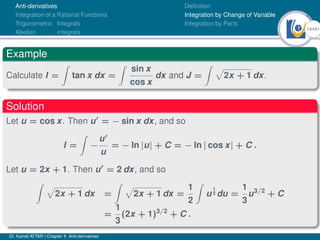
Example
Calculate I =
Z
tan x dx =
Z
sin x
cos x
dx and J =
Z p
2x + 1 dx.
Solution
Let u = cos x. Then u0
= − sin x dx, and so
I =
Z
−
u0
u
= − ln |u| + C = − ln | cos x| + C .
Let u = 2x + 1. Then u0
= 2 dx, and so
Z p
2x + 1 dx =
Z p
2x + 1 dx =
1
2
Z
u
1
2 du =
1
3
u3/2
+ C
=
1
3
(2x + 1)3/2
+ C .
Dr. Kamel ATTAR | Chapter 1: Anti-derivatives
15Ú61
Anti-derivatives
Integration of a Rational Functions
Trigonometric Integrals
Abelian integrals
Definition
Integration by Change of Variable
Integration by Parts
Example
Calculate I =
Z
xdx
p
1 − x2
with x 6= ±1 and J =
Z
(x3
+ x)5
(3x2
+ 1) dx.
Solution
Dr. Kamel ATTAR | Chapter 1: Anti-derivatives
16Ú61
Anti-derivatives
Integration of a Rational Functions
Trigonometric Integrals
Abelian integrals
Definition
Integration by Change of Variable
Integration by Parts
Example
Calculate I =
Z
xdx
p
1 − x2
with x 6= ±1 and J =
Z
(x3
+ x)5
(3x2
+ 1) dx.
Solution
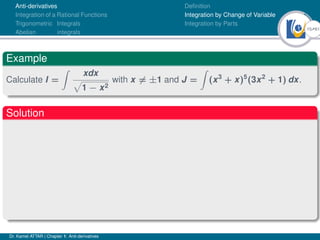
Let u = 1 − x2
. Then u0
= −2x, and so
I = −
Z
−2xdx
2
p
1 − x2
= −
Z
u0
2
√
u
= −
√
u = −
p
1 − x2 + C .
We set u = x3
+ x. Then u0
= (3x2
+ 1)dx , and so by substitution we have
J =
Z
(x3
+ x)5
(3x2
+ 1) dx =
Z
u5
u0
=
u6
6
+ C =
(x3
+ x)6
6
+ C .
Dr. Kamel ATTAR | Chapter 1: Anti-derivatives
17Ú61
Anti-derivatives
Integration of a Rational Functions
Trigonometric Integrals
Abelian integrals
Definition
Integration by Change of Variable
Integration by Parts
Example
Evaluate
Z
2z dz
3
√
z2 + 1
Solutions
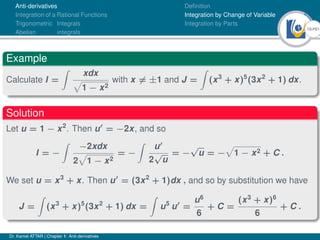
1. Substitute u = z2
+ 1 then du = 2zdz and so
Z
2z dz
3
√
z2 + 1
=
Z
du
u1/3
=
Z
u−1/3
du =
u2/3
2/3
+ C
=
3
2
u2/3
+ C =
3
2
(z2
+ 1)2/3
+ C
2. Substitute u =
3
p
z2 + 1 instead then u3
= z2
+ 1 and 3udu = 2zdz
Z
2z dz
3
√
z2 + 1
=
Z
3u2
du
u
= 3
Z
u du = 3
u2
2
+ C =
3
2
(z2
+ 1)2/3
+ C
Dr. Kamel ATTAR | Chapter 1: Anti-derivatives
18Ú61
Anti-derivatives
Integration of a Rational Functions
Trigonometric Integrals
Abelian integrals
Definition
Integration by Change of Variable
Integration by Parts
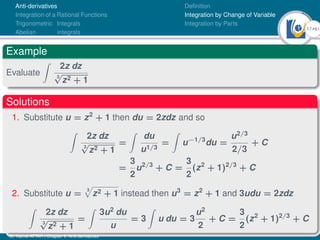
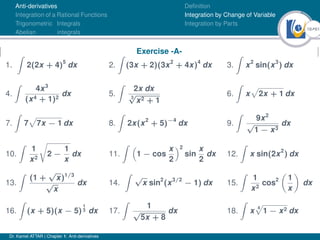
Exercise -A-
1.
Z
2(2x + 4)5
dx 2.
Z
(3x + 2)(3x2
+ 4x)4
dx 3.
Z
x2
sin(x3
) dx
4.
Z
4x3
(x4 + 1)2
dx 5.
Z
2x dx
3
√
x2 + 1
6.
Z
x
p
2x + 1 dx
7.
Z
7
p
7x − 1 dx 8.
Z
2x(x2
+ 5)−4
dx 9.
Z
9x2
√
1 − x3
dx
10.
Z
1
x2
r
2 −
1
x
dx 11.
Z 
1 − cos
x
2
2
sin
x
2
dx 12.
Z
x sin(2x2
) dx
13.
Z
(1 +
√
x)1/3
√
x
dx 14.
Z
√
x sin2
(x3/2
− 1) dx 15.
Z
1
x2
cos2

1
x

dx
16.
Z
(x + 5)(x − 5)
1
3 dx 17.
Z
1
√
5x + 8
dx 18.
Z
x
4
p
1 − x2 dx
Dr. Kamel ATTAR | Chapter 1: Anti-derivatives
19Ú61
Anti-derivatives
Integration of a Rational Functions
Trigonometric Integrals
Abelian integrals
Definition
Integration by Change of Variable
Integration by Parts
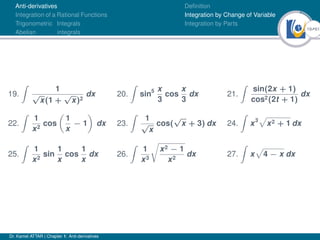
19.
Z
1
√
x(1 +
√
x)2
dx 20.
Z
sin5 x
3
cos
x
3
dx 21.
Z
sin(2x + 1)
cos2(2t + 1)
dx
22.
Z
1
x2
cos

1
x
− 1

dx 23.
Z
1
√
x
cos(
√
x + 3) dx 24.
Z
x3
p
x2 + 1 dx
25.
Z
1
x2
sin
1
x
cos
1
x
dx 26.
Z
1
x3
r
x2 − 1
x2
dx 27.
Z
x
p
4 − x dx
Dr. Kamel ATTAR | Chapter 1: Anti-derivatives
20Ú61
Anti-derivatives
Integration of a Rational Functions
Trigonometric Integrals
Abelian integrals
Definition
Integration by Change of Variable
Integration by Parts
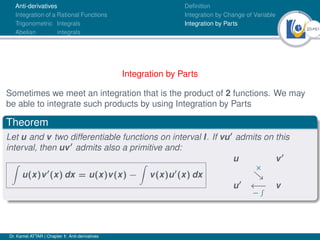
Sometimes we meet an integration that is the product of 2 functions. We may
be able to integrate such products by using Integration by Parts
Theorem
Let u and v two differentiable functions on interval I. If vu0
admits on this
interval, then uv0
admits also a primitive and:
Z
u(x)v0
(x) dx = u(x)v(x) −
Z
v(x)u0
(x) dx
u v0
×

u0
←−
−
R v
Dr. Kamel ATTAR | Chapter 1: Anti-derivatives
21Ú61
Anti-derivatives
Integration of a Rational Functions
Trigonometric Integrals
Abelian integrals
Definition
Integration by Change of Variable
Integration by Parts
Example
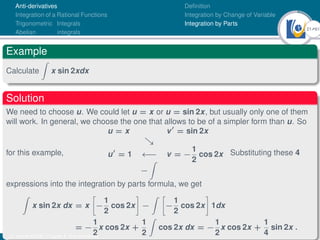
Calculate
Z
x sin 2xdx
Solution
We need to choose u. We could let u = x or u = sin 2x, but usually only one of them
will work. In general, we choose the one that allows to be of a simpler form than u. So
for this example,
u = x v0
= sin 2x

u0
= 1 ←− v = −
1
2
cos 2x
−
Z
Substituting these 4
expressions into the integration by parts formula, we get
Z
x sin 2x dx = x

−
1
2
cos 2x

−
Z 
−
1
2
cos 2x

1dx
= −
1
2
x cos 2x +
1
2
Z
cos 2x dx = −
1
2
x cos 2x +
1
4
sin 2x .
Dr. Kamel ATTAR | Chapter 1: Anti-derivatives
22Ú61
Anti-derivatives
Integration of a Rational Functions
Trigonometric Integrals
Abelian integrals
Definition
Integration by Change of Variable
Integration by Parts
Example
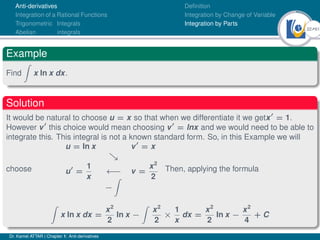
Find
Z
x ln x dx.
Solution
It would be natural to choose u = x so that when we differentiate it we getx0
= 1.
However v0
this choice would mean choosing v0
= lnx and we would need to be able to
integrate this. This integral is not a known standard form. So, in this Example we will
choose
u = ln x v0
= x

u0
=
1
x
←− v =
x2
2
−
Z
Then, applying the formula
Z
x ln x dx =
x2
2
ln x −
Z
x2
2
×
1
x
dx =
x2
2
ln x −
x2
4
+ C
Dr. Kamel ATTAR | Chapter 1: Anti-derivatives
23Ú61
Anti-derivatives
Integration of a Rational Functions
Trigonometric Integrals
Abelian integrals
Definition
Integration by Change of Variable
Integration by Parts
Example
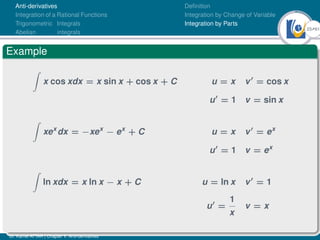
Z
x cos xdx = x sin x + cos x + C u = x v0
= cos x
u0
= 1 v = sin x
Z
xex
dx = −xex
− ex
+ C u = x v0
= ex
u0
= 1 v = ex
Z
ln xdx = x ln x − x + C u = ln x v0
= 1
u0
=
1
x
v = x
Dr. Kamel ATTAR | Chapter 1: Anti-derivatives
24Ú61
Anti-derivatives
Integration of a Rational Functions
Trigonometric Integrals
Abelian integrals
Definition
Integration by Change of Variable
Integration by Parts
Example
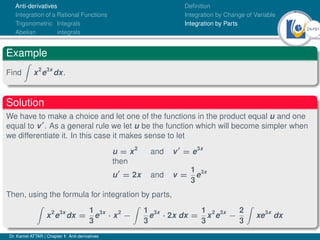
Find
Z
x2
e3x
dx.
Solution
We have to make a choice and let one of the functions in the product equal u and one
equal to v0
. As a general rule we let u be the function which will become simpler when
we differentiate it. In this case it makes sense to let
u = x2
and v0
= e3x
then
u0
= 2x and v =
1
3
e3x
Then, using the formula for integration by parts,
Z
x2
e3x
dx =
1
3
e3x
· x2
−
Z
1
3
e3x
· 2x dx =
1
3
x2
e3x
−
2
3
Z
xe3x
dx
Dr. Kamel ATTAR | Chapter 1: Anti-derivatives
25Ú61
Anti-derivatives
Integration of a Rational Functions
Trigonometric Integrals
Abelian integrals
Definition
Integration by Change of Variable
Integration by Parts
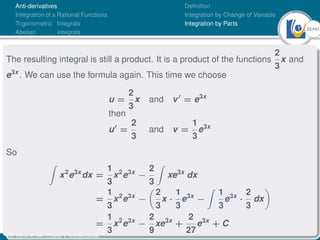
The resulting integral is still a product. It is a product of the functions
2
3
x and
e3x
. We can use the formula again. This time we choose
u =
2
3
x and v0
= e3x
then
u0
=
2
3
and v =
1
3
e3x
So
Z
x2
e3x
dx =
1
3
x2
e3x
−
2
3
Z
xe3x
dx
=
1
3
x2
e3x
−

2
3
x ·
1
3
e3x
−
Z
1
3
e3x
·
2
3
dx

=
1
3
x2
e3x
−
2
9
xe3x
+
2
27
e3x
+ C
Dr. Kamel ATTAR | Chapter 1: Anti-derivatives
26Ú61
Anti-derivatives
Integration of a Rational Functions
Trigonometric Integrals
Abelian integrals
Definition
Integration by Change of Variable
Integration by Parts
Example
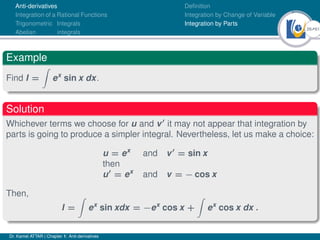
Find I =
Z
ex
sin x dx.
Solution
Whichever terms we choose for u and v0
it may not appear that integration by
parts is going to produce a simpler integral. Nevertheless, let us make a choice:
u = ex
and v0
= sin x
then
u0
= ex
and v = − cos x
Then,
I =
Z
ex
sin xdx = −ex
cos x +
Z
ex
cos x dx .
Dr. Kamel ATTAR | Chapter 1: Anti-derivatives
27Ú61
Anti-derivatives
Integration of a Rational Functions
Trigonometric Integrals
Abelian integrals
Definition
Integration by Change of Variable
Integration by Parts
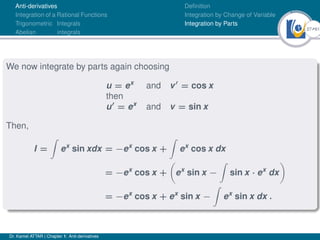
We now integrate by parts again choosing
u = ex
and v0
= cos x
then
u0
= ex
and v = sin x
Then,
I =
Z
ex
sin xdx = −ex
cos x +
Z
ex
cos x dx
= −ex
cos x +

ex
sin x −
Z
sin x · ex
dx

= −ex
cos x + ex
sin x −
Z
ex
sin x dx .
Dr. Kamel ATTAR | Chapter 1: Anti-derivatives
28Ú61
Anti-derivatives
Integration of a Rational Functions
Trigonometric Integrals
Abelian integrals
Definition
Integration by Change of Variable
Integration by Parts
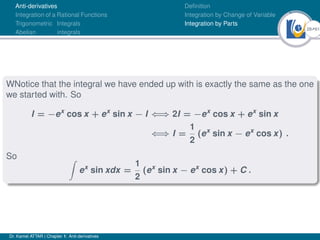
WNotice that the integral we have ended up with is exactly the same as the one
we started with. So
I = −ex
cos x + ex
sin x − I ⇐⇒ 2I = −ex
cos x + ex
sin x
⇐⇒ I =
1
2
(ex
sin x − ex
cos x) .
So Z
ex
sin xdx =
1
2
(ex
sin x − ex
cos x) + C .
Dr. Kamel ATTAR | Chapter 1: Anti-derivatives
29Ú61
Anti-derivatives
Integration of a Rational Functions
Trigonometric Integrals
Abelian integrals
Definition
Integration by Change of Variable
Integration by Parts
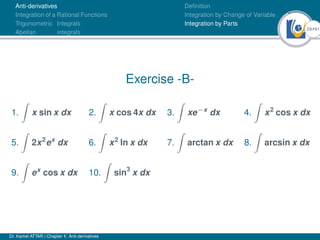
Exercise -B-
1.
Z
x sin x dx 2.
Z
x cos 4x dx 3.
Z
xe−x
dx 4.
Z
x2
cos x dx
5.
Z
2x2
ex
dx 6.
Z
x2
ln x dx 7.
Z
arctan x dx 8.
Z
arcsin x dx
9.
Z
ex
cos x dx 10.
Z
sin3
x dx
Dr. Kamel ATTAR | Chapter 1: Anti-derivatives
30Ú61
Anti-derivatives
Integration of a Rational Functions
Trigonometric Integrals
Abelian integrals
Definition
Integration by Change of Variable
Integration by Parts
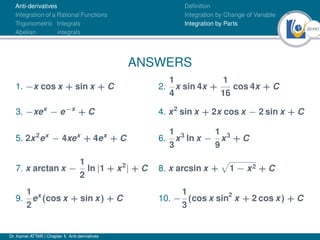
ANSWERS
1. −x cos x + sin x + C 2.
1
4
x sin 4x +
1
16
cos 4x + C
3. −xex
− e−x
+ C 4. x2
sin x + 2x cos x − 2 sin x + C
5. 2x2
ex
− 4xex
+ 4ex
+ C 6.
1
3
x3
ln x −
1
9
x3
+ C
7. x arctan x −
1
2
ln |1 + x2
| + C 8. x arcsin x +
p
1 − x2 + C
9.
1
2
ex
(cos x + sin x) + C 10. −
1
3
(cos x sin2
x + 2 cos x) + C
Dr. Kamel ATTAR | Chapter 1: Anti-derivatives
31Ú61
Anti-derivatives
Integration of a Rational Functions
Trigonometric Integrals
Abelian integrals
Denominator Containing Linear Factors
Denominator Containing reducible Quadratic Facto
Denominator Containing Repeated Linear Factors
Denominator Containing Irreducible Quadratic Fac
H Integration of a Rational Functions H
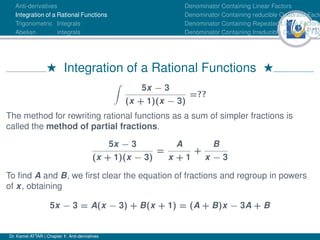
Z
5x − 3
(x + 1)(x − 3)
=??
The method for rewriting rational functions as a sum of simpler fractions is
called the method of partial fractions.
5x − 3
(x + 1)(x − 3)
=
A
x + 1
+
B
x − 3
To find A and B, we first clear the equation of fractions and regroup in powers
of x, obtaining
5x − 3 = A(x − 3) + B(x + 1) = (A + B)x − 3A + B
Dr. Kamel ATTAR | Chapter 1: Anti-derivatives
32Ú61
Anti-derivatives
Integration of a Rational Functions
Trigonometric Integrals
Abelian integrals
Denominator Containing Linear Factors
Denominator Containing reducible Quadratic Facto
Denominator Containing Repeated Linear Factors
Denominator Containing Irreducible Quadratic Fac
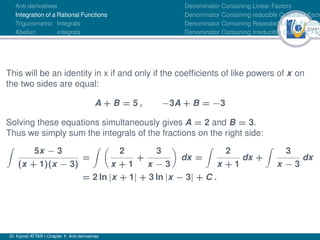
This will be an identity in x if and only if the coefficients of like powers of x on
the two sides are equal:
A + B = 5 , −3A + B = −3
Solving these equations simultaneously gives A = 2 and B = 3.
Thus we simply sum the integrals of the fractions on the right side:
Z
5x − 3
(x + 1)(x − 3)
=
Z 
2
x + 1
+
3
x − 3

dx =
Z
2
x + 1
dx +
Z
3
x − 3
dx
= 2 ln |x + 1| + 3 ln |x − 3| + C .
Dr. Kamel ATTAR | Chapter 1: Anti-derivatives
33Ú61
Anti-derivatives
Integration of a Rational Functions
Trigonometric Integrals
Abelian integrals
Denominator Containing Linear Factors
Denominator Containing reducible Quadratic Facto
Denominator Containing Repeated Linear Factors
Denominator Containing Irreducible Quadratic Fac
H Expressing a Fractional Function In Partial Fractions H
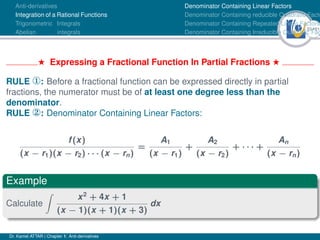
RULE ¬: Before a fractional function can be expressed directly in partial
fractions, the numerator must be of at least one degree less than the
denominator.
RULE ­: Denominator Containing Linear Factors:
f(x)
(x − r1)(x − r2) · · · (x − rn)
=
A1
(x − r1)
+
A2
(x − r2)
+ · · · +
An
(x − rn)
Example
Calculate
Z
x2
+ 4x + 1
(x − 1)(x + 1)(x + 3)
dx
Dr. Kamel ATTAR | Chapter 1: Anti-derivatives
34Ú61
Anti-derivatives
Integration of a Rational Functions
Trigonometric Integrals
Abelian integrals
Denominator Containing Linear Factors
Denominator Containing reducible Quadratic Facto
Denominator Containing Repeated Linear Factors
Denominator Containing Irreducible Quadratic Fac
Solution
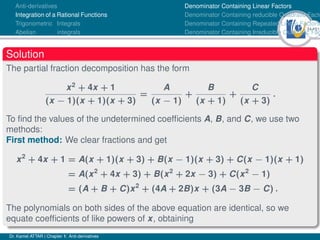
The partial fraction decomposition has the form
x2
+ 4x + 1
(x − 1)(x + 1)(x + 3)
=
A
(x − 1)
+
B
(x + 1)
+
C
(x + 3)
.
To find the values of the undetermined coefficients A, B, and C, we use two
methods:
First method: We clear fractions and get
x2
+ 4x + 1 = A(x + 1)(x + 3) + B(x − 1)(x + 3) + C(x − 1)(x + 1)
= A(x2
+ 4x + 3) + B(x2
+ 2x − 3) + C(x2
− 1)
= (A + B + C)x2
+ (4A + 2B)x + (3A − 3B − C) .
The polynomials on both sides of the above equation are identical, so we
equate coefficients of like powers of x, obtaining
Dr. Kamel ATTAR | Chapter 1: Anti-derivatives
35Ú61
Anti-derivatives
Integration of a Rational Functions
Trigonometric Integrals
Abelian integrals
Denominator Containing Linear Factors
Denominator Containing reducible Quadratic Facto
Denominator Containing Repeated Linear Factors
Denominator Containing Irreducible Quadratic Fac
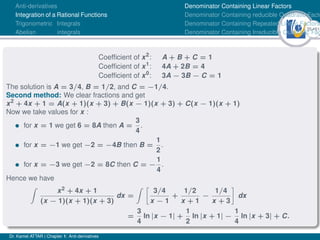
Coefficient of x2
: A + B + C = 1
Coefficient of x1
: 4A + 2B = 4
Coefficient of x0
: 3A − 3B − C = 1
The solution is A = 3/4, B = 1/2, and C = −1/4.
Second method: We clear fractions and get
x2
+ 4x + 1 = A(x + 1)(x + 3) + B(x − 1)(x + 3) + C(x − 1)(x + 1)
Now we take values for x :
• for x = 1 we get 6 = 8A then A =
3
4
.
• for x = −1 we get −2 = −4B then B =
1
2
.
• for x = −3 we get −2 = 8C then C = −
1
4
.
Hence we have
Z
x2 + 4x + 1
(x − 1)(x + 1)(x + 3)
dx =
Z 
3/4
x − 1
+
1/2
x + 1
−
1/4
x + 3

dx
=
3
4
ln |x − 1| +
1
2
ln |x + 1| −
1
4
ln |x + 3| + C.
Dr. Kamel ATTAR | Chapter 1: Anti-derivatives
36Ú61
Anti-derivatives
Integration of a Rational Functions
Trigonometric Integrals
Abelian integrals
Denominator Containing Linear Factors
Denominator Containing reducible Quadratic Facto
Denominator Containing Repeated Linear Factors
Denominator Containing Irreducible Quadratic Fac
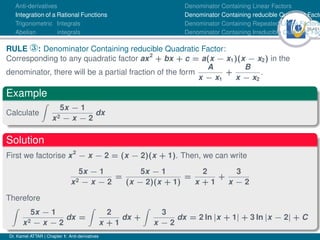
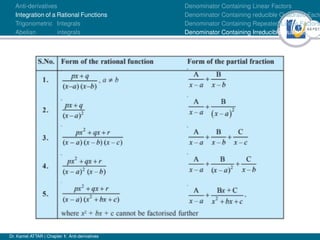
RULE ®: Denominator Containing reducible Quadratic Factor:
Corresponding to any quadratic factor ax2
+ bx + c = a(x − x1)(x − x2) in the
denominator, there will be a partial fraction of the form
A
x − x1
+
B
x − x2
.
Example
Calculate
Z
5x − 1
x2 − x − 2
dx
Solution
First we factorise x2
− x − 2 = (x − 2)(x + 1). Then, we can write
5x − 1
x2 − x − 2
=
5x − 1
(x − 2)(x + 1)
=
2
x + 1
+
3
x − 2
Therefore
Z
5x − 1
x2 − x − 2
dx =
Z
2
x + 1
dx +
Z
3
x − 2
dx = 2 ln |x + 1| + 3 ln |x − 2| + C
Dr. Kamel ATTAR | Chapter 1: Anti-derivatives
37Ú61
Anti-derivatives
Integration of a Rational Functions
Trigonometric Integrals
Abelian integrals
Denominator Containing Linear Factors
Denominator Containing reducible Quadratic Facto
Denominator Containing Repeated Linear Factors
Denominator Containing Irreducible Quadratic Fac
Example
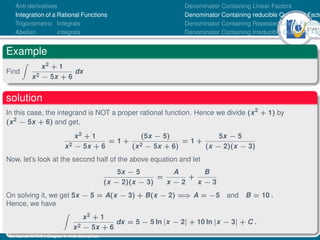
Find
Z
x2 + 1
x2 − 5x + 6
dx
solution
In this case, the integrand is NOT a proper rational function. Hence we divide (x2
+ 1) by
(x2
− 5x + 6) and get,
x2 + 1
x2 − 5x + 6
= 1 +
(5x − 5)
(x2 − 5x + 6)
= 1 +
5x − 5
(x − 2)(x − 3)
Now, let’s look at the second half of the above equation and let
5x − 5
(x − 2)(x − 3)
=
A
x − 2
+
B
x − 3
On solving it, we get 5x − 5 = A(x − 3) + B(x − 2) =
⇒ A = −5 and B = 10 .
Hence, we have
Z
x2 + 1
x2 − 5x + 6
dx = 5 − 5 ln |x − 2| + 10 ln |x − 3| + C .
Dr. Kamel ATTAR | Chapter 1: Anti-derivatives
38Ú61
Anti-derivatives
Integration of a Rational Functions
Trigonometric Integrals
Abelian integrals
Denominator Containing Linear Factors
Denominator Containing reducible Quadratic Facto
Denominator Containing Repeated Linear Factors
Denominator Containing Irreducible Quadratic Fac
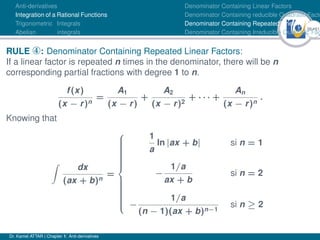
RULE ¯: Denominator Containing Repeated Linear Factors:
If a linear factor is repeated n times in the denominator, there will be n
corresponding partial fractions with degree 1 to n.
f(x)
(x − r)n
=
A1
(x − r)
+
A2
(x − r)2
+ · · · +
An
(x − r)n
.
Knowing that
Z
dx
(ax + b)n
=





















1
a
ln |ax + b| si n = 1
−
1/a
ax + b
si n = 2
−
1/a
(n − 1)(ax + b)n−1
si n ≥ 2
Dr. Kamel ATTAR | Chapter 1: Anti-derivatives
39Ú61
Anti-derivatives
Integration of a Rational Functions
Trigonometric Integrals
Abelian integrals
Denominator Containing Linear Factors
Denominator Containing reducible Quadratic Facto
Denominator Containing Repeated Linear Factors
Denominator Containing Irreducible Quadratic Fac
Example
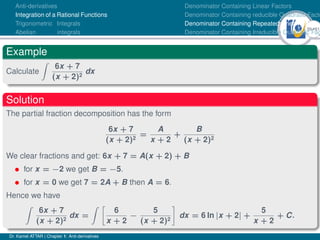
Calculate
Z
6x + 7
(x + 2)2
dx
Solution
The partial fraction decomposition has the form
6x + 7
(x + 2)2
=
A
x + 2
+
B
(x + 2)2
We clear fractions and get: 6x + 7 = A(x + 2) + B
• for x = −2 we get B = −5.
• for x = 0 we get 7 = 2A + B then A = 6.
Hence we have
Z
6x + 7
(x + 2)2
dx =
Z 
6
x + 2
−
5
(x + 2)2

dx = 6 ln |x + 2| +
5
x + 2
+ C.
Dr. Kamel ATTAR | Chapter 1: Anti-derivatives
40Ú61
Anti-derivatives
Integration of a Rational Functions
Trigonometric Integrals
Abelian integrals
Denominator Containing Linear Factors
Denominator Containing reducible Quadratic Facto
Denominator Containing Repeated Linear Factors
Denominator Containing Irreducible Quadratic Fac
Example
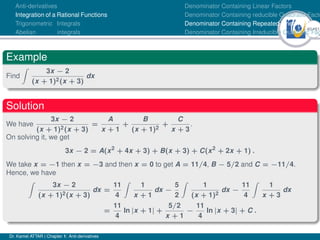
Find
Z
3x − 2
(x + 1)2(x + 3)
dx
Solution
We have
3x − 2
(x + 1)2(x + 3)
=
A
x + 1
+
B
(x + 1)2
+
C
x + 3
.
On solving it, we get
3x − 2 = A(x2
+ 4x + 3) + B(x + 3) + C(x2
+ 2x + 1) .
We take x = −1 then x = −3 and then x = 0 to get A = 11/4, B − 5/2 and C = −11/4.
Hence, we have
Z
3x − 2
(x + 1)2(x + 3)
dx =
11
4
Z
1
x + 1
dx −
5
2
Z
1
(x + 1)2
dx −
11
4
Z
1
x + 3
dx
=
11
4
ln |x + 1| +
5/2
x + 1
−
11
4
ln |x + 3| + C .
Dr. Kamel ATTAR | Chapter 1: Anti-derivatives
41Ú61
Anti-derivatives
Integration of a Rational Functions
Trigonometric Integrals
Abelian integrals
Denominator Containing Linear Factors
Denominator Containing reducible Quadratic Facto
Denominator Containing Repeated Linear Factors
Denominator Containing Irreducible Quadratic Fac
RULE °: Denominator Containing Irreducible Quadratic Factor:
Corresponding to any quadratic factor ax2
+ bx + c with ∆ = b2
− 4c  0 in the denominator,
there will be a partial fraction of the form
Ax + B
ax2 + bx + c
.
Example
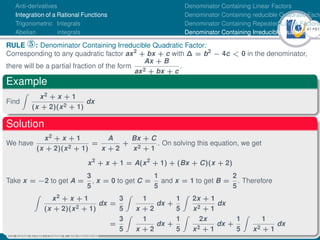
Find
Z
x2 + x + 1
(x + 2)(x2 + 1)
dx
Solution
We have
x2 + x + 1
(x + 2)(x2 + 1)
=
A
x + 2
+
Bx + C
x2 + 1
. On solving this equation, we get
x2
+ x + 1 = A(x2
+ 1) + (Bx + C)(x + 2)
Take x = −2 to get A =
3
5
, x = 0 to get C =
1
5
and x = 1 to get B =
2
5
. Therefore
Z
x2 + x + 1
(x + 2)(x2 + 1)
dx =
3
5
Z
1
x + 2
dx +
1
5
Z
2x + 1
x2 + 1
dx
=
3
5
Z
1
x + 2
dx +
1
5
Z
2x
x2 + 1
dx +
1
5
Z
1
x2 + 1
dx
Dr. Kamel ATTAR | Chapter 1: Anti-derivatives
42Ú61
Anti-derivatives
Integration of a Rational Functions
Trigonometric Integrals
Abelian integrals
Denominator Containing Linear Factors
Denominator Containing reducible Quadratic Facto
Denominator Containing Repeated Linear Factors
Denominator Containing Irreducible Quadratic Fac
Example
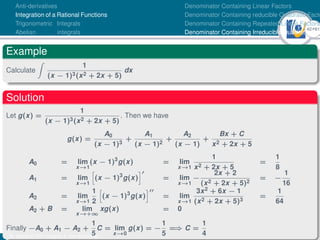
Calculate
Z
1
(x − 1)3(x2 + 2x + 5)
dx
Solution
Let g(x) =
1
(x − 1)3(x2 + 2x + 5)
. Then we have
g(x) =
A0
(x − 1)3
+
A1
(x − 1)2
+
A2
(x − 1)
+
Bx + C
x2 + 2x + 5
A0 = lim
x→1
(x − 1)3
g(x) = lim
x→1
1
x2 + 2x + 5
=
1
8
A1 = lim
x→1
h
(x − 1)3
g(x)
i0
= lim
x→1
−
2x + 2
(x2 + 2x + 5)2
= −
1
16
A2 = lim
x→1
1
2
h
(x − 1)3
g(x)
i00
= lim
x→1
3x2 + 6x − 1
(x2 + 2x + 5)3
=
1
64
A2 + B = lim
x→+∞
xg(x) = 0
Finally −A0 + A1 − A2 +
1
5
C = lim
x→0
g(x) = −
1
5
=
⇒ C =
1
4
Dr. Kamel ATTAR | Chapter 1: Anti-derivatives
43Ú61
Anti-derivatives
Integration of a Rational Functions
Trigonometric Integrals
Abelian integrals
Denominator Containing Linear Factors
Denominator Containing reducible Quadratic Facto
Denominator Containing Repeated Linear Factors
Denominator Containing Irreducible Quadratic Fac
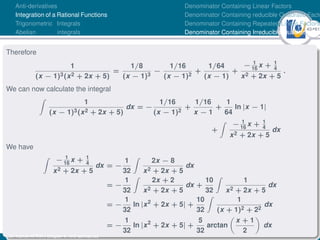
Therefore
1
(x − 1)3(x2 + 2x + 5)
=
1/8
(x − 1)3
−
1/16
(x − 1)2
+
1/64
(x − 1)
+
− 1
16
x + 1
4
x2 + 2x + 5
.
We can now calculate the integral
Z
1
(x − 1)3(x2 + 2x + 5)
dx = −
1/16
(x − 1)2
+
1/16
x − 1
+
1
64
ln |x − 1|
+
Z
− 1
16
x + 1
4
x2 + 2x + 5
dx
We have
Z
− 1
16
x + 1
4
x2 + 2x + 5
dx = −
1
32
Z
2x − 8
x2 + 2x + 5
dx
= −
1
32
Z
2x + 2
x2 + 2x + 5
dx +
10
32
Z
1
x2 + 2x + 5
dx
= −
1
32
ln |x2
+ 2x + 5| +
10
32
Z
1
(x + 1)2 + 22
dx
= −
1
32
ln |x2
+ 2x + 5| +
5
32
arctan

x + 1
2

dx
Dr. Kamel ATTAR | Chapter 1: Anti-derivatives
44Ú61
Anti-derivatives
Integration of a Rational Functions
Trigonometric Integrals
Abelian integrals
Denominator Containing Linear Factors
Denominator Containing reducible Quadratic Facto
Denominator Containing Repeated Linear Factors
Denominator Containing Irreducible Quadratic Fac
Dr. Kamel ATTAR | Chapter 1: Anti-derivatives
45Ú61
Anti-derivatives
Integration of a Rational Functions
Trigonometric Integrals
Abelian integrals
Products of Powers of Sines and Cosines
Products of Sines and Cosines
Bioche Rule
H Trigonometric Integrals H
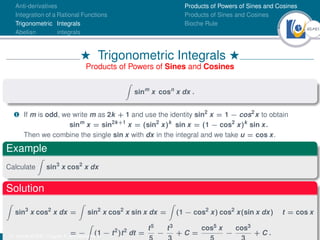
Products of Powers of Sines and Cosines
Z
sinm
x cosn
x dx .
¶ If m is odd, we write m as 2k + 1 and use the identity sin2
x = 1 − cos2
x to obtain
sinm
x = sin2k+1
x = (sin2
x)k
sin x = (1 − cos2
x)k
sin x.
Then we combine the single sin x with dx in the integral and we take u = cos x.
Example
Calculate
Z
sin3
x cos2
x dx
Solution
Z
sin3
x cos2
x dx =
Z
sin2
x cos2
x sin x dx =
Z
(1 − cos2
x) cos2
x(sin x dx) t = cos x
= −
Z
(1 − t2
)t2
dt =
t5
−
t3
+ C =
cos5 x
−
cos3
+ C .
Dr. Kamel ATTAR | Chapter 1: Anti-derivatives
46Ú61
Anti-derivatives
Integration of a Rational Functions
Trigonometric Integrals
Abelian integrals
Products of Powers of Sines and Cosines
Products of Sines and Cosines
Bioche Rule
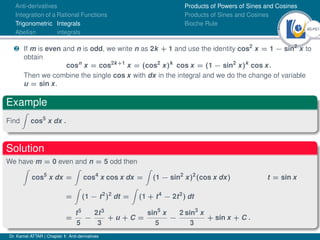
· If m is even and n is odd, we write n as 2k + 1 and use the identity cos2
x = 1 − sin2
x to
obtain
cosn
x = cos2k+1
x = (cos2
x)k
cos x = (1 − sin2
x)k
cos x.
Then we combine the single cos x with dx in the integral and we do the change of variable
u = sin x.
Example
Find
Z
cos5
x dx .
Solution
We have m = 0 even and n = 5 odd then
Z
cos5
x dx =
Z
cos4
x cos x dx =
Z
(1 − sin2
x)2
(cos x dx) t = sin x
=
Z
(1 − t2
)2
dt =
Z
(1 + t4
− 2t2
) dt
=
t5
5
−
2t3
3
+ u + C =
sin5
x
5
−
2 sin3
x
3
+ sin x + C .
Dr. Kamel ATTAR | Chapter 1: Anti-derivatives
47Ú61
Anti-derivatives
Integration of a Rational Functions
Trigonometric Integrals
Abelian integrals
Products of Powers of Sines and Cosines
Products of Sines and Cosines
Bioche Rule
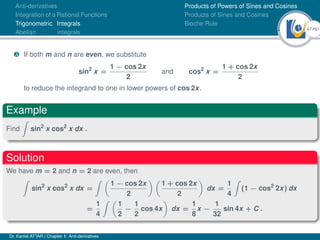
¸ If both m and n are even, we substitute
sin2
x =
1 − cos 2x
2
and cos2
x =
1 + cos 2x
2
to reduce the integrand to one in lower powers of cos 2x.
Example
Find
Z
sin2
x cos2
x dx .
Solution
We have m = 2 and n = 2 are even, then
Z
sin2
x cos2
x dx =
Z 
1 − cos 2x
2
 
1 + cos 2x
2

dx =
1
4
Z
(1 − cos2
2x) dx
=
1
4
Z 
1
2
−
1
2
cos 4x

dx =
1
8
x −
1
32
sin 4x + C .
Dr. Kamel ATTAR | Chapter 1: Anti-derivatives
48Ú61
Anti-derivatives
Integration of a Rational Functions
Trigonometric Integrals
Abelian integrals
Products of Powers of Sines and Cosines
Products of Sines and Cosines
Bioche Rule
Products of Sines and Cosines
Z
sin mx sin nx dx ,
Z
sin mx cos nx dx and
Z
cos mx cos nx dx .
We use the simpler identities:
¶ sin mx sin nx =
1
2
[cos(m − n)x − cos(m + n)x]
· sin mx cos nx =
1
2
[sin(m − n)x + sin(m + n)x]
¸ cos mx cos nx =
1
2
[cos(m − n)x + cos(m + n)x]
Example
Z
cos(5x) sin(3x) dx =
Z
sin(8x) − sin(2x)
2
dx = cos(2x)/4 − cos(8x)/16 + C .
Dr. Kamel ATTAR | Chapter 1: Anti-derivatives
49Ú61
Anti-derivatives
Integration of a Rational Functions
Trigonometric Integrals
Abelian integrals
Products of Powers of Sines and Cosines
Products of Sines and Cosines
Bioche Rule
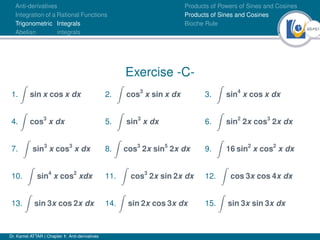
Exercise -C-
1.
Z
sin x cos x dx 2.
Z
cos3
x sin x dx 3.
Z
sin4
x cos x dx
4.
Z
cos3
x dx 5.
Z
sin3
x dx 6.
Z
sin2
2x cos3
2x dx
7.
Z
sin3
x cos3
x dx 8.
Z
cos3
2x sin5
2x dx 9.
Z
16 sin2
x cos2
x dx
10.
Z
sin4
x cos2
xdx 11.
Z
cos3
2x sin 2x dx 12.
Z
cos 3x cos 4x dx
13.
Z
sin 3x cos 2x dx 14.
Z
sin 2x cos 3x dx 15.
Z
sin 3x sin 3x dx
Dr. Kamel ATTAR | Chapter 1: Anti-derivatives
50Ú61
Anti-derivatives
Integration of a Rational Functions
Trigonometric Integrals
Abelian integrals
Products of Powers of Sines and Cosines
Products of Sines and Cosines
Bioche Rule
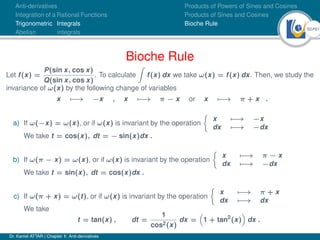
Bioche Rule
Let f(x) =
P(sin x, cos x)
Q(sin x, cos x)
. To calculate
Z
f(x) dx we take ω(x) = f(x) dx. Then, we study the
invariance of ω(x) by the following change of variables
x 7−
→ −x , x 7−
→ π − x or x 7−
→ π + x .
a) If ω(−x) = ω(x), or if ω(x) is invariant by the operation

x 7−
→ −x
dx 7−
→ −dx
We take t = cos(x), dt = − sin(x)dx .
b) If ω(π − x) = ω(x), or if ω(x) is invariant by the operation

x 7−
→ π − x
dx 7−
→ −dx
We take t = sin(x), dt = cos(x)dx .
c) If ω(π + x) = ω(t), or if ω(x) is invariant by the operation

x 7−
→ π + x
dx 7−
→ dx
We take
t = tan(x) , dt =
1
cos2(x)
dx =

1 + tan2
(x)

dx .
Dr. Kamel ATTAR | Chapter 1: Anti-derivatives
51Ú61
Anti-derivatives
Integration of a Rational Functions
Trigonometric Integrals
Abelian integrals
Products of Powers of Sines and Cosines
Products of Sines and Cosines
Bioche Rule
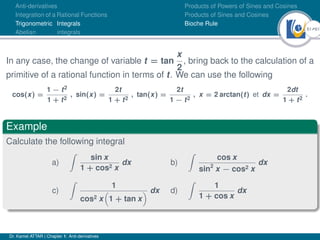
In any case, the change of variable t = tan
x
2
, bring back to the calculation of a
primitive of a rational function in terms of t. We can use the following
cos(x) =
1 − t2
1 + t2
, sin(x) =
2t
1 + t2
, tan(x) =
2t
1 − t2
, x = 2 arctan(t) et dx =
2dt
1 + t2
.
Example
Calculate the following integral
a)
Z
sin x
1 + cos2 x
dx b)
Z
cos x
sin2
x − cos2 x
dx
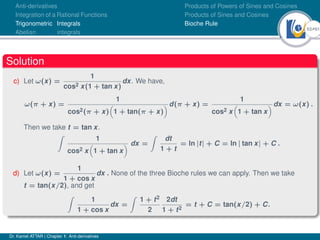
c)
Z
1
cos2 x

1 + tan x
 dx d)
Z
1
1 + cos x
dx
Dr. Kamel ATTAR | Chapter 1: Anti-derivatives
52Ú61
Anti-derivatives
Integration of a Rational Functions
Trigonometric Integrals
Abelian integrals
Products of Powers of Sines and Cosines
Products of Sines and Cosines
Bioche Rule
Solution
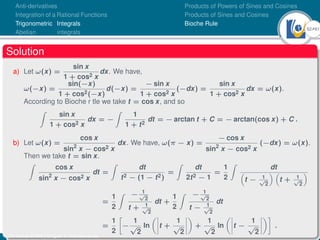
a) Let ω(x) =
sin x
1 + cos2 x
dx. We have,
ω(−x) =
sin(−x)
1 + cos2(−x)
d(−x) =
− sin x
1 + cos2 x
(−dx) =
sin x
1 + cos2 x
dx = ω(x).
According to Bioche r tle we take t = cos x, and so
Z
sin x
1 + cos2 x
dx = −
Z
1
1 + t2
dt = − arctan t + C = − arctan(cos x) + C .
b) Let ω(x) =
cos x
sin2
x − cos2 x
dx. We have, ω(π − x) =
− cos x
sin2
x − cos2 x
(−dx) = ω(x).
Then we take t = sin x.
Z
cos x
sin2
x − cos2 x
dt =
Z
dt
t2 − (1 − t2)
=
Z
dt
2t2 − 1
=
1
2
Z
dt

t − 1
√
2
 
t + 1
√
2

=
1
2
Z − 1
√
2
t + 1
√
2
dt +
1
2
Z − 1
√
2
t − 1
√
2
dt
=
1
2

−
1
√
2
ln
t +
1
√
2
+
1
√
2
ln

Simple integral

  • 1.
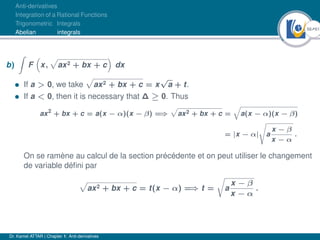
    Faculty of Sciences(Section V) Lebanese University Chapter 1: Anti-derivatives Dr. Kamel ATTAR attar.kamel@gmail.com Lecture #1 F Tuesday 16/MAR/2021 F
  • 2.
    2Ú61 Anti-derivatives Integration of aRational Functions Trigonometric Integrals Abelian integrals 1 Anti-derivatives Definition Integration by Change of Variable Integration by Parts 2 Integration of a Rational Functions Denominator Containing Linear Factors Denominator Containing reducible Quadratic Factor Denominator Containing Repeated Linear Factors Denominator Containing Irreducible Quadratic Factor 3 Trigonometric Integrals Products of Powers of Sines and Cosines Products of Sines and Cosines Bioche Rule 4 Abelian integrals Dr. Kamel ATTAR | Chapter 1: Anti-derivatives
  • 3.
    3Ú61 Anti-derivatives Integration of aRational Functions Trigonometric Integrals Abelian integrals Definition Integration by Change of Variable Integration by Parts H Anti-derivatives H Definition Definition A function F is called anti-derivative (or primitive) of f on an interval I, iff: I F is defined and differentiable on I, and I F0 (x) = f(x) ∀x ∈ I . Remark: We use capital letters such as F to represent an anti-derivative of a function f. Theorem If F is an anti-derivative of f on I, then the set of anti-derivatives of f on I is consisted of functions F(x) + C , where C is an arbitrary constant. Dr. Kamel ATTAR | Chapter 1: Anti-derivatives
  • 4.
    4Ú61 Anti-derivatives Integration of aRational Functions Trigonometric Integrals Abelian integrals Definition Integration by Change of Variable Integration by Parts Example Find an antiderivatives for each of the following functions: 1. f(x) = 2x. 2. g(x) = cos x. 3. h(x) = 2x + cos x Solution Dr. Kamel ATTAR | Chapter 1: Anti-derivatives
  • 5.
    5Ú61 Anti-derivatives Integration of aRational Functions Trigonometric Integrals Abelian integrals Definition Integration by Change of Variable Integration by Parts Example Find an antiderivatives for each of the following functions: 1. f(x) = 2x. 2. g(x) = cos x. 3. h(x) = 2x + cos x Solution We need to think backward here: What function do we know has a derivative equal to the given function? 1. F(x) = x2 . 2. G(x) = sin x. 3. H(x) = x2 + sin x Dr. Kamel ATTAR | Chapter 1: Anti-derivatives
  • 6.
    6Ú61 Anti-derivatives Integration of aRational Functions Trigonometric Integrals Abelian integrals Definition Integration by Change of Variable Integration by Parts Example Find an antiderivative of f(x) = 3x2 that satisfies F(1) = −1. Solution Since the derivative of x3 is 3x2 , the general antiderivative F(x) = x3 + C gives all the antiderivative of f(x). The condition F(1) = −1 determine a specific value for C. Substituting x = 1 into F(x) + x3 + C gives F(1) = (1)3 + C = 1 + C =⇒ C = −2 So F(x) = x3 − 2 . Dr. Kamel ATTAR | Chapter 1: Anti-derivatives
  • 7.
    7Ú61 Anti-derivatives Integration of aRational Functions Trigonometric Integrals Abelian integrals Definition Integration by Change of Variable Integration by Parts Indefinite Integral Definition The collection of all anti-derivatives of f is called the indefinite integral of f with respect to x, and is denoted by Z f(x) dx . The symbol Z is an integral sign. The function f is the integrate of the integral, and x is the variable of integration. Z f(x) dx = F(x) + C , F0 (x) = f(x) and (C is an arbitrary constant) . Dr. Kamel ATTAR | Chapter 1: Anti-derivatives
  • 8.
    8Ú61 Anti-derivatives Integration of aRational Functions Trigonometric Integrals Abelian integrals Definition Integration by Change of Variable Integration by Parts Commonly Occurring Indefinite Integrals Z 0 dx = C Z a dx = ax + C Z xn dx = xn+1 n + 1 + C , n 6= −1 Z 1 xn dx = −1 (n − 1)xn−1 + C . Z 1 x dx = ln |x| + C Z ex dx = ex + C Z sin(x) dx = − cos(x) + C Z cos(x) dx = − sin(x) + C Z 1 a2 + x2 dx = 1 a arctan x a + C Z 1 a2 − x2 dx = 1 a arg tanh x a Z 1 √ a2 − x2 dx = arcsin x a + C Z 1 √ a2 − x2 dx = − arccos x a + C Z 1 √ x2 + a2 dx = arg sinh x a + C Z 1 √ x2 − a2 dx = arg cosh x a Dr. Kamel ATTAR | Chapter 1: Anti-derivatives
  • 9.
    9Ú61 Anti-derivatives Integration of aRational Functions Trigonometric Integrals Abelian integrals Definition Integration by Change of Variable Integration by Parts Operations on Primitives Theorem Let f1 and f2 two functions defined on I and λ1, λ2 ∈ R then: Z λ1f1(x) + λ2f2(x) dx = λ1 Z f1(x)dx + λ2 Z f2(x)dx Dr. Kamel ATTAR | Chapter 1: Anti-derivatives
  • 10.
    10Ú61 Anti-derivatives Integration of aRational Functions Trigonometric Integrals Abelian integrals Definition Integration by Change of Variable Integration by Parts Example Evaluate Z (x2 − 2x + 5) dx . Solution Z (x2 − 2x + 5) dx = Z x2 dx − Z 2x dx + Z 5 dx = Z x2 dx − 2 Z x dx + 5 Z 1 dx = x3 3 + C1 − 2 x2 2 + C2 + 5 (x + C3) = x3 3 + C1 − x2 − 2C2 + 5x + 5C3 = x3 3 − x2 + 5x + C . Dr. Kamel ATTAR | Chapter 1: Anti-derivatives
  • 11.
    11Ú61 Anti-derivatives Integration of aRational Functions Trigonometric Integrals Abelian integrals Definition Integration by Change of Variable Integration by Parts Integration by Change of Variable Theorem If ϕ : [α, β] → R is a continuously differentiable function and if f is continuous mapping on an interval contained ϕ [α, β] , then : Z f ϕ(x) ϕ0 (x) dx = Z f(t) dt We can say that we perform the change of variable t = ϕ(x). Dr. Kamel ATTAR | Chapter 1: Anti-derivatives
  • 12.
    12Ú61 Anti-derivatives Integration of aRational Functions Trigonometric Integrals Abelian integrals Definition Integration by Change of Variable Integration by Parts Change of variables (u Substitution) Z u0 u = ln |u| + C Z u0 un = −1 (n − 1)un−1 + C Z u0 un = un+1 n + 1 + C Z u0 eu = eu + C Z u0 cos(u) = − sin(u) + C Z u0 sin(u) = cos(u) + C Z u0 a2 + u2 = 1 a arctan u a + C Z u0 a2 − u2 = 1 a arg tanh u a + C Z u0 √ a2 − u2 = arcsin u a + C Z u0 √ a2 − u2 = − arccos u a + C Z u0 √ u2 + a2 = arg sinh u a + C Z u0 √ u2 − a2 = arg cosh u a + C Dr. Kamel ATTAR | Chapter 1: Anti-derivatives
  • 13.
    13Ú61 Anti-derivatives Integration of aRational Functions Trigonometric Integrals Abelian integrals Definition Integration by Change of Variable Integration by Parts Example Calculate I = Z tan x dx = Z sin x cos x dx and J = Z p 2x + 1 dx. Solution Dr. Kamel ATTAR | Chapter 1: Anti-derivatives
  • 14.
    14Ú61 Anti-derivatives Integration of aRational Functions Trigonometric Integrals Abelian integrals Definition Integration by Change of Variable Integration by Parts Example Calculate I = Z tan x dx = Z sin x cos x dx and J = Z p 2x + 1 dx. Solution Let u = cos x. Then u0 = − sin x dx, and so I = Z − u0 u = − ln |u| + C = − ln | cos x| + C . Let u = 2x + 1. Then u0 = 2 dx, and so Z p 2x + 1 dx = Z p 2x + 1 dx = 1 2 Z u 1 2 du = 1 3 u3/2 + C = 1 3 (2x + 1)3/2 + C . Dr. Kamel ATTAR | Chapter 1: Anti-derivatives
  • 15.
    15Ú61 Anti-derivatives Integration of aRational Functions Trigonometric Integrals Abelian integrals Definition Integration by Change of Variable Integration by Parts Example Calculate I = Z xdx p 1 − x2 with x 6= ±1 and J = Z (x3 + x)5 (3x2 + 1) dx. Solution Dr. Kamel ATTAR | Chapter 1: Anti-derivatives
  • 16.
    16Ú61 Anti-derivatives Integration of aRational Functions Trigonometric Integrals Abelian integrals Definition Integration by Change of Variable Integration by Parts Example Calculate I = Z xdx p 1 − x2 with x 6= ±1 and J = Z (x3 + x)5 (3x2 + 1) dx. Solution Let u = 1 − x2 . Then u0 = −2x, and so I = − Z −2xdx 2 p 1 − x2 = − Z u0 2 √ u = − √ u = − p 1 − x2 + C . We set u = x3 + x. Then u0 = (3x2 + 1)dx , and so by substitution we have J = Z (x3 + x)5 (3x2 + 1) dx = Z u5 u0 = u6 6 + C = (x3 + x)6 6 + C . Dr. Kamel ATTAR | Chapter 1: Anti-derivatives
  • 17.
    17Ú61 Anti-derivatives Integration of aRational Functions Trigonometric Integrals Abelian integrals Definition Integration by Change of Variable Integration by Parts Example Evaluate Z 2z dz 3 √ z2 + 1 Solutions 1. Substitute u = z2 + 1 then du = 2zdz and so Z 2z dz 3 √ z2 + 1 = Z du u1/3 = Z u−1/3 du = u2/3 2/3 + C = 3 2 u2/3 + C = 3 2 (z2 + 1)2/3 + C 2. Substitute u = 3 p z2 + 1 instead then u3 = z2 + 1 and 3udu = 2zdz Z 2z dz 3 √ z2 + 1 = Z 3u2 du u = 3 Z u du = 3 u2 2 + C = 3 2 (z2 + 1)2/3 + C Dr. Kamel ATTAR | Chapter 1: Anti-derivatives
  • 18.
    18Ú61 Anti-derivatives Integration of aRational Functions Trigonometric Integrals Abelian integrals Definition Integration by Change of Variable Integration by Parts Exercise -A- 1. Z 2(2x + 4)5 dx 2. Z (3x + 2)(3x2 + 4x)4 dx 3. Z x2 sin(x3 ) dx 4. Z 4x3 (x4 + 1)2 dx 5. Z 2x dx 3 √ x2 + 1 6. Z x p 2x + 1 dx 7. Z 7 p 7x − 1 dx 8. Z 2x(x2 + 5)−4 dx 9. Z 9x2 √ 1 − x3 dx 10. Z 1 x2 r 2 − 1 x dx 11. Z 1 − cos x 2 2 sin x 2 dx 12. Z x sin(2x2 ) dx 13. Z (1 + √ x)1/3 √ x dx 14. Z √ x sin2 (x3/2 − 1) dx 15. Z 1 x2 cos2 1 x dx 16. Z (x + 5)(x − 5) 1 3 dx 17. Z 1 √ 5x + 8 dx 18. Z x 4 p 1 − x2 dx Dr. Kamel ATTAR | Chapter 1: Anti-derivatives
  • 19.
    19Ú61 Anti-derivatives Integration of aRational Functions Trigonometric Integrals Abelian integrals Definition Integration by Change of Variable Integration by Parts 19. Z 1 √ x(1 + √ x)2 dx 20. Z sin5 x 3 cos x 3 dx 21. Z sin(2x + 1) cos2(2t + 1) dx 22. Z 1 x2 cos 1 x − 1 dx 23. Z 1 √ x cos( √ x + 3) dx 24. Z x3 p x2 + 1 dx 25. Z 1 x2 sin 1 x cos 1 x dx 26. Z 1 x3 r x2 − 1 x2 dx 27. Z x p 4 − x dx Dr. Kamel ATTAR | Chapter 1: Anti-derivatives
  • 20.
    20Ú61 Anti-derivatives Integration of aRational Functions Trigonometric Integrals Abelian integrals Definition Integration by Change of Variable Integration by Parts Integration by Parts Sometimes we meet an integration that is the product of 2 functions. We may be able to integrate such products by using Integration by Parts Theorem Let u and v two differentiable functions on interval I. If vu0 admits on this interval, then uv0 admits also a primitive and: Z u(x)v0 (x) dx = u(x)v(x) − Z v(x)u0 (x) dx u v0 × u0 ←− − R v Dr. Kamel ATTAR | Chapter 1: Anti-derivatives
  • 21.
    21Ú61 Anti-derivatives Integration of aRational Functions Trigonometric Integrals Abelian integrals Definition Integration by Change of Variable Integration by Parts Example Calculate Z x sin 2xdx Solution We need to choose u. We could let u = x or u = sin 2x, but usually only one of them will work. In general, we choose the one that allows to be of a simpler form than u. So for this example, u = x v0 = sin 2x u0 = 1 ←− v = − 1 2 cos 2x − Z Substituting these 4 expressions into the integration by parts formula, we get Z x sin 2x dx = x − 1 2 cos 2x − Z − 1 2 cos 2x 1dx = − 1 2 x cos 2x + 1 2 Z cos 2x dx = − 1 2 x cos 2x + 1 4 sin 2x . Dr. Kamel ATTAR | Chapter 1: Anti-derivatives
  • 22.
    22Ú61 Anti-derivatives Integration of aRational Functions Trigonometric Integrals Abelian integrals Definition Integration by Change of Variable Integration by Parts Example Find Z x ln x dx. Solution It would be natural to choose u = x so that when we differentiate it we getx0 = 1. However v0 this choice would mean choosing v0 = lnx and we would need to be able to integrate this. This integral is not a known standard form. So, in this Example we will choose u = ln x v0 = x u0 = 1 x ←− v = x2 2 − Z Then, applying the formula Z x ln x dx = x2 2 ln x − Z x2 2 × 1 x dx = x2 2 ln x − x2 4 + C Dr. Kamel ATTAR | Chapter 1: Anti-derivatives
  • 23.
    23Ú61 Anti-derivatives Integration of aRational Functions Trigonometric Integrals Abelian integrals Definition Integration by Change of Variable Integration by Parts Example Z x cos xdx = x sin x + cos x + C u = x v0 = cos x u0 = 1 v = sin x Z xex dx = −xex − ex + C u = x v0 = ex u0 = 1 v = ex Z ln xdx = x ln x − x + C u = ln x v0 = 1 u0 = 1 x v = x Dr. Kamel ATTAR | Chapter 1: Anti-derivatives
  • 24.
    24Ú61 Anti-derivatives Integration of aRational Functions Trigonometric Integrals Abelian integrals Definition Integration by Change of Variable Integration by Parts Example Find Z x2 e3x dx. Solution We have to make a choice and let one of the functions in the product equal u and one equal to v0 . As a general rule we let u be the function which will become simpler when we differentiate it. In this case it makes sense to let u = x2 and v0 = e3x then u0 = 2x and v = 1 3 e3x Then, using the formula for integration by parts, Z x2 e3x dx = 1 3 e3x · x2 − Z 1 3 e3x · 2x dx = 1 3 x2 e3x − 2 3 Z xe3x dx Dr. Kamel ATTAR | Chapter 1: Anti-derivatives
  • 25.
    25Ú61 Anti-derivatives Integration of aRational Functions Trigonometric Integrals Abelian integrals Definition Integration by Change of Variable Integration by Parts The resulting integral is still a product. It is a product of the functions 2 3 x and e3x . We can use the formula again. This time we choose u = 2 3 x and v0 = e3x then u0 = 2 3 and v = 1 3 e3x So Z x2 e3x dx = 1 3 x2 e3x − 2 3 Z xe3x dx = 1 3 x2 e3x − 2 3 x · 1 3 e3x − Z 1 3 e3x · 2 3 dx = 1 3 x2 e3x − 2 9 xe3x + 2 27 e3x + C Dr. Kamel ATTAR | Chapter 1: Anti-derivatives
  • 26.
    26Ú61 Anti-derivatives Integration of aRational Functions Trigonometric Integrals Abelian integrals Definition Integration by Change of Variable Integration by Parts Example Find I = Z ex sin x dx. Solution Whichever terms we choose for u and v0 it may not appear that integration by parts is going to produce a simpler integral. Nevertheless, let us make a choice: u = ex and v0 = sin x then u0 = ex and v = − cos x Then, I = Z ex sin xdx = −ex cos x + Z ex cos x dx . Dr. Kamel ATTAR | Chapter 1: Anti-derivatives
  • 27.
    27Ú61 Anti-derivatives Integration of aRational Functions Trigonometric Integrals Abelian integrals Definition Integration by Change of Variable Integration by Parts We now integrate by parts again choosing u = ex and v0 = cos x then u0 = ex and v = sin x Then, I = Z ex sin xdx = −ex cos x + Z ex cos x dx = −ex cos x + ex sin x − Z sin x · ex dx = −ex cos x + ex sin x − Z ex sin x dx . Dr. Kamel ATTAR | Chapter 1: Anti-derivatives
  • 28.
    28Ú61 Anti-derivatives Integration of aRational Functions Trigonometric Integrals Abelian integrals Definition Integration by Change of Variable Integration by Parts WNotice that the integral we have ended up with is exactly the same as the one we started with. So I = −ex cos x + ex sin x − I ⇐⇒ 2I = −ex cos x + ex sin x ⇐⇒ I = 1 2 (ex sin x − ex cos x) . So Z ex sin xdx = 1 2 (ex sin x − ex cos x) + C . Dr. Kamel ATTAR | Chapter 1: Anti-derivatives
  • 29.
    29Ú61 Anti-derivatives Integration of aRational Functions Trigonometric Integrals Abelian integrals Definition Integration by Change of Variable Integration by Parts Exercise -B- 1. Z x sin x dx 2. Z x cos 4x dx 3. Z xe−x dx 4. Z x2 cos x dx 5. Z 2x2 ex dx 6. Z x2 ln x dx 7. Z arctan x dx 8. Z arcsin x dx 9. Z ex cos x dx 10. Z sin3 x dx Dr. Kamel ATTAR | Chapter 1: Anti-derivatives
  • 30.
    30Ú61 Anti-derivatives Integration of aRational Functions Trigonometric Integrals Abelian integrals Definition Integration by Change of Variable Integration by Parts ANSWERS 1. −x cos x + sin x + C 2. 1 4 x sin 4x + 1 16 cos 4x + C 3. −xex − e−x + C 4. x2 sin x + 2x cos x − 2 sin x + C 5. 2x2 ex − 4xex + 4ex + C 6. 1 3 x3 ln x − 1 9 x3 + C 7. x arctan x − 1 2 ln |1 + x2 | + C 8. x arcsin x + p 1 − x2 + C 9. 1 2 ex (cos x + sin x) + C 10. − 1 3 (cos x sin2 x + 2 cos x) + C Dr. Kamel ATTAR | Chapter 1: Anti-derivatives
  • 31.
    31Ú61 Anti-derivatives Integration of aRational Functions Trigonometric Integrals Abelian integrals Denominator Containing Linear Factors Denominator Containing reducible Quadratic Facto Denominator Containing Repeated Linear Factors Denominator Containing Irreducible Quadratic Fac H Integration of a Rational Functions H Z 5x − 3 (x + 1)(x − 3) =?? The method for rewriting rational functions as a sum of simpler fractions is called the method of partial fractions. 5x − 3 (x + 1)(x − 3) = A x + 1 + B x − 3 To find A and B, we first clear the equation of fractions and regroup in powers of x, obtaining 5x − 3 = A(x − 3) + B(x + 1) = (A + B)x − 3A + B Dr. Kamel ATTAR | Chapter 1: Anti-derivatives
  • 32.
    32Ú61 Anti-derivatives Integration of aRational Functions Trigonometric Integrals Abelian integrals Denominator Containing Linear Factors Denominator Containing reducible Quadratic Facto Denominator Containing Repeated Linear Factors Denominator Containing Irreducible Quadratic Fac This will be an identity in x if and only if the coefficients of like powers of x on the two sides are equal: A + B = 5 , −3A + B = −3 Solving these equations simultaneously gives A = 2 and B = 3. Thus we simply sum the integrals of the fractions on the right side: Z 5x − 3 (x + 1)(x − 3) = Z 2 x + 1 + 3 x − 3 dx = Z 2 x + 1 dx + Z 3 x − 3 dx = 2 ln |x + 1| + 3 ln |x − 3| + C . Dr. Kamel ATTAR | Chapter 1: Anti-derivatives
  • 33.
    33Ú61 Anti-derivatives Integration of aRational Functions Trigonometric Integrals Abelian integrals Denominator Containing Linear Factors Denominator Containing reducible Quadratic Facto Denominator Containing Repeated Linear Factors Denominator Containing Irreducible Quadratic Fac H Expressing a Fractional Function In Partial Fractions H RULE ¬: Before a fractional function can be expressed directly in partial fractions, the numerator must be of at least one degree less than the denominator. RULE ­: Denominator Containing Linear Factors: f(x) (x − r1)(x − r2) · · · (x − rn) = A1 (x − r1) + A2 (x − r2) + · · · + An (x − rn) Example Calculate Z x2 + 4x + 1 (x − 1)(x + 1)(x + 3) dx Dr. Kamel ATTAR | Chapter 1: Anti-derivatives
  • 34.
    34Ú61 Anti-derivatives Integration of aRational Functions Trigonometric Integrals Abelian integrals Denominator Containing Linear Factors Denominator Containing reducible Quadratic Facto Denominator Containing Repeated Linear Factors Denominator Containing Irreducible Quadratic Fac Solution The partial fraction decomposition has the form x2 + 4x + 1 (x − 1)(x + 1)(x + 3) = A (x − 1) + B (x + 1) + C (x + 3) . To find the values of the undetermined coefficients A, B, and C, we use two methods: First method: We clear fractions and get x2 + 4x + 1 = A(x + 1)(x + 3) + B(x − 1)(x + 3) + C(x − 1)(x + 1) = A(x2 + 4x + 3) + B(x2 + 2x − 3) + C(x2 − 1) = (A + B + C)x2 + (4A + 2B)x + (3A − 3B − C) . The polynomials on both sides of the above equation are identical, so we equate coefficients of like powers of x, obtaining Dr. Kamel ATTAR | Chapter 1: Anti-derivatives
  • 35.
    35Ú61 Anti-derivatives Integration of aRational Functions Trigonometric Integrals Abelian integrals Denominator Containing Linear Factors Denominator Containing reducible Quadratic Facto Denominator Containing Repeated Linear Factors Denominator Containing Irreducible Quadratic Fac Coefficient of x2 : A + B + C = 1 Coefficient of x1 : 4A + 2B = 4 Coefficient of x0 : 3A − 3B − C = 1 The solution is A = 3/4, B = 1/2, and C = −1/4. Second method: We clear fractions and get x2 + 4x + 1 = A(x + 1)(x + 3) + B(x − 1)(x + 3) + C(x − 1)(x + 1) Now we take values for x : • for x = 1 we get 6 = 8A then A = 3 4 . • for x = −1 we get −2 = −4B then B = 1 2 . • for x = −3 we get −2 = 8C then C = − 1 4 . Hence we have Z x2 + 4x + 1 (x − 1)(x + 1)(x + 3) dx = Z 3/4 x − 1 + 1/2 x + 1 − 1/4 x + 3 dx = 3 4 ln |x − 1| + 1 2 ln |x + 1| − 1 4 ln |x + 3| + C. Dr. Kamel ATTAR | Chapter 1: Anti-derivatives
  • 36.
    36Ú61 Anti-derivatives Integration of aRational Functions Trigonometric Integrals Abelian integrals Denominator Containing Linear Factors Denominator Containing reducible Quadratic Facto Denominator Containing Repeated Linear Factors Denominator Containing Irreducible Quadratic Fac RULE ®: Denominator Containing reducible Quadratic Factor: Corresponding to any quadratic factor ax2 + bx + c = a(x − x1)(x − x2) in the denominator, there will be a partial fraction of the form A x − x1 + B x − x2 . Example Calculate Z 5x − 1 x2 − x − 2 dx Solution First we factorise x2 − x − 2 = (x − 2)(x + 1). Then, we can write 5x − 1 x2 − x − 2 = 5x − 1 (x − 2)(x + 1) = 2 x + 1 + 3 x − 2 Therefore Z 5x − 1 x2 − x − 2 dx = Z 2 x + 1 dx + Z 3 x − 2 dx = 2 ln |x + 1| + 3 ln |x − 2| + C Dr. Kamel ATTAR | Chapter 1: Anti-derivatives
  • 37.
    37Ú61 Anti-derivatives Integration of aRational Functions Trigonometric Integrals Abelian integrals Denominator Containing Linear Factors Denominator Containing reducible Quadratic Facto Denominator Containing Repeated Linear Factors Denominator Containing Irreducible Quadratic Fac Example Find Z x2 + 1 x2 − 5x + 6 dx solution In this case, the integrand is NOT a proper rational function. Hence we divide (x2 + 1) by (x2 − 5x + 6) and get, x2 + 1 x2 − 5x + 6 = 1 + (5x − 5) (x2 − 5x + 6) = 1 + 5x − 5 (x − 2)(x − 3) Now, let’s look at the second half of the above equation and let 5x − 5 (x − 2)(x − 3) = A x − 2 + B x − 3 On solving it, we get 5x − 5 = A(x − 3) + B(x − 2) = ⇒ A = −5 and B = 10 . Hence, we have Z x2 + 1 x2 − 5x + 6 dx = 5 − 5 ln |x − 2| + 10 ln |x − 3| + C . Dr. Kamel ATTAR | Chapter 1: Anti-derivatives
  • 38.
    38Ú61 Anti-derivatives Integration of aRational Functions Trigonometric Integrals Abelian integrals Denominator Containing Linear Factors Denominator Containing reducible Quadratic Facto Denominator Containing Repeated Linear Factors Denominator Containing Irreducible Quadratic Fac RULE ¯: Denominator Containing Repeated Linear Factors: If a linear factor is repeated n times in the denominator, there will be n corresponding partial fractions with degree 1 to n. f(x) (x − r)n = A1 (x − r) + A2 (x − r)2 + · · · + An (x − r)n . Knowing that Z dx (ax + b)n =                      1 a ln |ax + b| si n = 1 − 1/a ax + b si n = 2 − 1/a (n − 1)(ax + b)n−1 si n ≥ 2 Dr. Kamel ATTAR | Chapter 1: Anti-derivatives
  • 39.
    39Ú61 Anti-derivatives Integration of aRational Functions Trigonometric Integrals Abelian integrals Denominator Containing Linear Factors Denominator Containing reducible Quadratic Facto Denominator Containing Repeated Linear Factors Denominator Containing Irreducible Quadratic Fac Example Calculate Z 6x + 7 (x + 2)2 dx Solution The partial fraction decomposition has the form 6x + 7 (x + 2)2 = A x + 2 + B (x + 2)2 We clear fractions and get: 6x + 7 = A(x + 2) + B • for x = −2 we get B = −5. • for x = 0 we get 7 = 2A + B then A = 6. Hence we have Z 6x + 7 (x + 2)2 dx = Z 6 x + 2 − 5 (x + 2)2 dx = 6 ln |x + 2| + 5 x + 2 + C. Dr. Kamel ATTAR | Chapter 1: Anti-derivatives
  • 40.
    40Ú61 Anti-derivatives Integration of aRational Functions Trigonometric Integrals Abelian integrals Denominator Containing Linear Factors Denominator Containing reducible Quadratic Facto Denominator Containing Repeated Linear Factors Denominator Containing Irreducible Quadratic Fac Example Find Z 3x − 2 (x + 1)2(x + 3) dx Solution We have 3x − 2 (x + 1)2(x + 3) = A x + 1 + B (x + 1)2 + C x + 3 . On solving it, we get 3x − 2 = A(x2 + 4x + 3) + B(x + 3) + C(x2 + 2x + 1) . We take x = −1 then x = −3 and then x = 0 to get A = 11/4, B − 5/2 and C = −11/4. Hence, we have Z 3x − 2 (x + 1)2(x + 3) dx = 11 4 Z 1 x + 1 dx − 5 2 Z 1 (x + 1)2 dx − 11 4 Z 1 x + 3 dx = 11 4 ln |x + 1| + 5/2 x + 1 − 11 4 ln |x + 3| + C . Dr. Kamel ATTAR | Chapter 1: Anti-derivatives
  • 41.
    41Ú61 Anti-derivatives Integration of aRational Functions Trigonometric Integrals Abelian integrals Denominator Containing Linear Factors Denominator Containing reducible Quadratic Facto Denominator Containing Repeated Linear Factors Denominator Containing Irreducible Quadratic Fac RULE °: Denominator Containing Irreducible Quadratic Factor: Corresponding to any quadratic factor ax2 + bx + c with ∆ = b2 − 4c 0 in the denominator, there will be a partial fraction of the form Ax + B ax2 + bx + c . Example Find Z x2 + x + 1 (x + 2)(x2 + 1) dx Solution We have x2 + x + 1 (x + 2)(x2 + 1) = A x + 2 + Bx + C x2 + 1 . On solving this equation, we get x2 + x + 1 = A(x2 + 1) + (Bx + C)(x + 2) Take x = −2 to get A = 3 5 , x = 0 to get C = 1 5 and x = 1 to get B = 2 5 . Therefore Z x2 + x + 1 (x + 2)(x2 + 1) dx = 3 5 Z 1 x + 2 dx + 1 5 Z 2x + 1 x2 + 1 dx = 3 5 Z 1 x + 2 dx + 1 5 Z 2x x2 + 1 dx + 1 5 Z 1 x2 + 1 dx Dr. Kamel ATTAR | Chapter 1: Anti-derivatives
  • 42.
    42Ú61 Anti-derivatives Integration of aRational Functions Trigonometric Integrals Abelian integrals Denominator Containing Linear Factors Denominator Containing reducible Quadratic Facto Denominator Containing Repeated Linear Factors Denominator Containing Irreducible Quadratic Fac Example Calculate Z 1 (x − 1)3(x2 + 2x + 5) dx Solution Let g(x) = 1 (x − 1)3(x2 + 2x + 5) . Then we have g(x) = A0 (x − 1)3 + A1 (x − 1)2 + A2 (x − 1) + Bx + C x2 + 2x + 5 A0 = lim x→1 (x − 1)3 g(x) = lim x→1 1 x2 + 2x + 5 = 1 8 A1 = lim x→1 h (x − 1)3 g(x) i0 = lim x→1 − 2x + 2 (x2 + 2x + 5)2 = − 1 16 A2 = lim x→1 1 2 h (x − 1)3 g(x) i00 = lim x→1 3x2 + 6x − 1 (x2 + 2x + 5)3 = 1 64 A2 + B = lim x→+∞ xg(x) = 0 Finally −A0 + A1 − A2 + 1 5 C = lim x→0 g(x) = − 1 5 = ⇒ C = 1 4 Dr. Kamel ATTAR | Chapter 1: Anti-derivatives
  • 43.
    43Ú61 Anti-derivatives Integration of aRational Functions Trigonometric Integrals Abelian integrals Denominator Containing Linear Factors Denominator Containing reducible Quadratic Facto Denominator Containing Repeated Linear Factors Denominator Containing Irreducible Quadratic Fac Therefore 1 (x − 1)3(x2 + 2x + 5) = 1/8 (x − 1)3 − 1/16 (x − 1)2 + 1/64 (x − 1) + − 1 16 x + 1 4 x2 + 2x + 5 . We can now calculate the integral Z 1 (x − 1)3(x2 + 2x + 5) dx = − 1/16 (x − 1)2 + 1/16 x − 1 + 1 64 ln |x − 1| + Z − 1 16 x + 1 4 x2 + 2x + 5 dx We have Z − 1 16 x + 1 4 x2 + 2x + 5 dx = − 1 32 Z 2x − 8 x2 + 2x + 5 dx = − 1 32 Z 2x + 2 x2 + 2x + 5 dx + 10 32 Z 1 x2 + 2x + 5 dx = − 1 32 ln |x2 + 2x + 5| + 10 32 Z 1 (x + 1)2 + 22 dx = − 1 32 ln |x2 + 2x + 5| + 5 32 arctan x + 1 2 dx Dr. Kamel ATTAR | Chapter 1: Anti-derivatives
  • 44.
    44Ú61 Anti-derivatives Integration of aRational Functions Trigonometric Integrals Abelian integrals Denominator Containing Linear Factors Denominator Containing reducible Quadratic Facto Denominator Containing Repeated Linear Factors Denominator Containing Irreducible Quadratic Fac Dr. Kamel ATTAR | Chapter 1: Anti-derivatives
  • 45.
    45Ú61 Anti-derivatives Integration of aRational Functions Trigonometric Integrals Abelian integrals Products of Powers of Sines and Cosines Products of Sines and Cosines Bioche Rule H Trigonometric Integrals H Products of Powers of Sines and Cosines Z sinm x cosn x dx . ¶ If m is odd, we write m as 2k + 1 and use the identity sin2 x = 1 − cos2 x to obtain sinm x = sin2k+1 x = (sin2 x)k sin x = (1 − cos2 x)k sin x. Then we combine the single sin x with dx in the integral and we take u = cos x. Example Calculate Z sin3 x cos2 x dx Solution Z sin3 x cos2 x dx = Z sin2 x cos2 x sin x dx = Z (1 − cos2 x) cos2 x(sin x dx) t = cos x = − Z (1 − t2 )t2 dt = t5 − t3 + C = cos5 x − cos3 + C . Dr. Kamel ATTAR | Chapter 1: Anti-derivatives
  • 46.
    46Ú61 Anti-derivatives Integration of aRational Functions Trigonometric Integrals Abelian integrals Products of Powers of Sines and Cosines Products of Sines and Cosines Bioche Rule · If m is even and n is odd, we write n as 2k + 1 and use the identity cos2 x = 1 − sin2 x to obtain cosn x = cos2k+1 x = (cos2 x)k cos x = (1 − sin2 x)k cos x. Then we combine the single cos x with dx in the integral and we do the change of variable u = sin x. Example Find Z cos5 x dx . Solution We have m = 0 even and n = 5 odd then Z cos5 x dx = Z cos4 x cos x dx = Z (1 − sin2 x)2 (cos x dx) t = sin x = Z (1 − t2 )2 dt = Z (1 + t4 − 2t2 ) dt = t5 5 − 2t3 3 + u + C = sin5 x 5 − 2 sin3 x 3 + sin x + C . Dr. Kamel ATTAR | Chapter 1: Anti-derivatives
  • 47.
    47Ú61 Anti-derivatives Integration of aRational Functions Trigonometric Integrals Abelian integrals Products of Powers of Sines and Cosines Products of Sines and Cosines Bioche Rule ¸ If both m and n are even, we substitute sin2 x = 1 − cos 2x 2 and cos2 x = 1 + cos 2x 2 to reduce the integrand to one in lower powers of cos 2x. Example Find Z sin2 x cos2 x dx . Solution We have m = 2 and n = 2 are even, then Z sin2 x cos2 x dx = Z 1 − cos 2x 2 1 + cos 2x 2 dx = 1 4 Z (1 − cos2 2x) dx = 1 4 Z 1 2 − 1 2 cos 4x dx = 1 8 x − 1 32 sin 4x + C . Dr. Kamel ATTAR | Chapter 1: Anti-derivatives
  • 48.
    48Ú61 Anti-derivatives Integration of aRational Functions Trigonometric Integrals Abelian integrals Products of Powers of Sines and Cosines Products of Sines and Cosines Bioche Rule Products of Sines and Cosines Z sin mx sin nx dx , Z sin mx cos nx dx and Z cos mx cos nx dx . We use the simpler identities: ¶ sin mx sin nx = 1 2 [cos(m − n)x − cos(m + n)x] · sin mx cos nx = 1 2 [sin(m − n)x + sin(m + n)x] ¸ cos mx cos nx = 1 2 [cos(m − n)x + cos(m + n)x] Example Z cos(5x) sin(3x) dx = Z sin(8x) − sin(2x) 2 dx = cos(2x)/4 − cos(8x)/16 + C . Dr. Kamel ATTAR | Chapter 1: Anti-derivatives
  • 49.
    49Ú61 Anti-derivatives Integration of aRational Functions Trigonometric Integrals Abelian integrals Products of Powers of Sines and Cosines Products of Sines and Cosines Bioche Rule Exercise -C- 1. Z sin x cos x dx 2. Z cos3 x sin x dx 3. Z sin4 x cos x dx 4. Z cos3 x dx 5. Z sin3 x dx 6. Z sin2 2x cos3 2x dx 7. Z sin3 x cos3 x dx 8. Z cos3 2x sin5 2x dx 9. Z 16 sin2 x cos2 x dx 10. Z sin4 x cos2 xdx 11. Z cos3 2x sin 2x dx 12. Z cos 3x cos 4x dx 13. Z sin 3x cos 2x dx 14. Z sin 2x cos 3x dx 15. Z sin 3x sin 3x dx Dr. Kamel ATTAR | Chapter 1: Anti-derivatives
  • 50.
    50Ú61 Anti-derivatives Integration of aRational Functions Trigonometric Integrals Abelian integrals Products of Powers of Sines and Cosines Products of Sines and Cosines Bioche Rule Bioche Rule Let f(x) = P(sin x, cos x) Q(sin x, cos x) . To calculate Z f(x) dx we take ω(x) = f(x) dx. Then, we study the invariance of ω(x) by the following change of variables x 7− → −x , x 7− → π − x or x 7− → π + x . a) If ω(−x) = ω(x), or if ω(x) is invariant by the operation x 7− → −x dx 7− → −dx We take t = cos(x), dt = − sin(x)dx . b) If ω(π − x) = ω(x), or if ω(x) is invariant by the operation x 7− → π − x dx 7− → −dx We take t = sin(x), dt = cos(x)dx . c) If ω(π + x) = ω(t), or if ω(x) is invariant by the operation x 7− → π + x dx 7− → dx We take t = tan(x) , dt = 1 cos2(x) dx = 1 + tan2 (x) dx . Dr. Kamel ATTAR | Chapter 1: Anti-derivatives
  • 51.
    51Ú61 Anti-derivatives Integration of aRational Functions Trigonometric Integrals Abelian integrals Products of Powers of Sines and Cosines Products of Sines and Cosines Bioche Rule In any case, the change of variable t = tan x 2 , bring back to the calculation of a primitive of a rational function in terms of t. We can use the following cos(x) = 1 − t2 1 + t2 , sin(x) = 2t 1 + t2 , tan(x) = 2t 1 − t2 , x = 2 arctan(t) et dx = 2dt 1 + t2 . Example Calculate the following integral a) Z sin x 1 + cos2 x dx b) Z cos x sin2 x − cos2 x dx c) Z 1 cos2 x 1 + tan x dx d) Z 1 1 + cos x dx Dr. Kamel ATTAR | Chapter 1: Anti-derivatives
  • 52.
    52Ú61 Anti-derivatives Integration of aRational Functions Trigonometric Integrals Abelian integrals Products of Powers of Sines and Cosines Products of Sines and Cosines Bioche Rule Solution a) Let ω(x) = sin x 1 + cos2 x dx. We have, ω(−x) = sin(−x) 1 + cos2(−x) d(−x) = − sin x 1 + cos2 x (−dx) = sin x 1 + cos2 x dx = ω(x). According to Bioche r tle we take t = cos x, and so Z sin x 1 + cos2 x dx = − Z 1 1 + t2 dt = − arctan t + C = − arctan(cos x) + C . b) Let ω(x) = cos x sin2 x − cos2 x dx. We have, ω(π − x) = − cos x sin2 x − cos2 x (−dx) = ω(x). Then we take t = sin x. Z cos x sin2 x − cos2 x dt = Z dt t2 − (1 − t2) = Z dt 2t2 − 1 = 1 2 Z dt t − 1 √ 2 t + 1 √ 2 = 1 2 Z − 1 √ 2 t + 1 √ 2 dt + 1 2 Z − 1 √ 2 t − 1 √ 2 dt = 1 2 − 1 √ 2 ln
  • 56.
  • 60.