
Faculty of Economics and Business Administration
Lebanese University
Dual Problem and Sensitivity Analysis
Sensitivity Analysis
Dr. Kamel ATTAR
attar.kamel@gmail.com
Tabel of contents I
1 Change in the right-hand side of the constraint
2 Change in the objective Coefficient
Non-basic Variables
Basic variables
Dr. Kamel ATTAR | Sensitivity Analysis and dual problem | Sensitivity Analysis
# Introduction #
While solving a linear programming problem for optimal solution, we assume that:
Dr. Kamel ATTAR | Sensitivity Analysis and dual problem | Sensitivity Analysis
# Introduction #
While solving a linear programming problem for optimal solution, we assume that:
(a) Technology is fixed,
Dr. Kamel ATTAR | Sensitivity Analysis and dual problem | Sensitivity Analysis
# Introduction #
While solving a linear programming problem for optimal solution, we assume that:
(a) Technology is fixed,
(b) Fixed prices,
Dr. Kamel ATTAR | Sensitivity Analysis and dual problem | Sensitivity Analysis
# Introduction #
While solving a linear programming problem for optimal solution, we assume that:
(a) Technology is fixed,
(b) Fixed prices,
(c) Fixed levels of resources or requirements,
Dr. Kamel ATTAR | Sensitivity Analysis and dual problem | Sensitivity Analysis
# Introduction #
While solving a linear programming problem for optimal solution, we assume that:
(a) Technology is fixed,
(b) Fixed prices,
(c) Fixed levels of resources or requirements,
(d) The coefficients of variables in structural constraints (i.e. time required by a product on
a particular resource) are fixed,
Dr. Kamel ATTAR | Sensitivity Analysis and dual problem | Sensitivity Analysis
# Introduction #
While solving a linear programming problem for optimal solution, we assume that:
(a) Technology is fixed,
(b) Fixed prices,
(c) Fixed levels of resources or requirements,
(d) The coefficients of variables in structural constraints (i.e. time required by a product on
a particular resource) are fixed,
(e) profit contribution of the product will not vary during the planning period.
Dr. Kamel ATTAR | Sensitivity Analysis and dual problem | Sensitivity Analysis
# Introduction #
While solving a linear programming problem for optimal solution, we assume that:
(a) Technology is fixed,
(b) Fixed prices,
(c) Fixed levels of resources or requirements,
(d) The coefficients of variables in structural constraints (i.e. time required by a product on
a particular resource) are fixed,
(e) profit contribution of the product will not vary during the planning period.
The condition in the real world however, might be different from those that are assumed by
the model. It is, therefore, desirable to determine how sensitive the optimal solution is to
different types of changes in the problem data and parameters.
Dr. Kamel ATTAR | Sensitivity Analysis and dual problem | Sensitivity Analysis
# Why we use sensitivity analysis? #
Dr. Kamel ATTAR | Sensitivity Analysis and dual problem | Sensitivity Analysis
# Why we use sensitivity analysis? #
(a) Sensitivity analysis allow us to determine how "sensitive" the optimal solution is to changes in
data values.
Dr. Kamel ATTAR | Sensitivity Analysis and dual problem | Sensitivity Analysis
# Why we use sensitivity analysis? #
(a) Sensitivity analysis allow us to determine how "sensitive" the optimal solution is to changes in
data values.
(b) Sensitivity analysis is important to the manager who must operate in a dynamic environment
with imprecise estimates of the coefficients.
Dr. Kamel ATTAR | Sensitivity Analysis and dual problem | Sensitivity Analysis
# Why we use sensitivity analysis? #
(a) Sensitivity analysis allow us to determine how "sensitive" the optimal solution is to changes in
data values.
(b) Sensitivity analysis is important to the manager who must operate in a dynamic environment
with imprecise estimates of the coefficients.
(c) Sensitivity analysis is used to determine how the optimal solution is affected by changes, within
specified ranges, in:
Dr. Kamel ATTAR | Sensitivity Analysis and dual problem | Sensitivity Analysis
# Why we use sensitivity analysis? #
(a) Sensitivity analysis allow us to determine how "sensitive" the optimal solution is to changes in
data values.
(b) Sensitivity analysis is important to the manager who must operate in a dynamic environment
with imprecise estimates of the coefficients.
(c) Sensitivity analysis is used to determine how the optimal solution is affected by changes, within
specified ranges, in:
(i) the objective function coefficients (cj ), which include:
Dr. Kamel ATTAR | Sensitivity Analysis and dual problem | Sensitivity Analysis
# Why we use sensitivity analysis? #
(a) Sensitivity analysis allow us to determine how "sensitive" the optimal solution is to changes in
data values.
(b) Sensitivity analysis is important to the manager who must operate in a dynamic environment
with imprecise estimates of the coefficients.
(c) Sensitivity analysis is used to determine how the optimal solution is affected by changes, within
specified ranges, in:
(i) the objective function coefficients (cj ), which include:
• Coefficients of basic variables.
Dr. Kamel ATTAR | Sensitivity Analysis and dual problem | Sensitivity Analysis
# Why we use sensitivity analysis? #
(a) Sensitivity analysis allow us to determine how "sensitive" the optimal solution is to changes in
data values.
(b) Sensitivity analysis is important to the manager who must operate in a dynamic environment
with imprecise estimates of the coefficients.
(c) Sensitivity analysis is used to determine how the optimal solution is affected by changes, within
specified ranges, in:
(i) the objective function coefficients (cj ), which include:
• Coefficients of basic variables.
• Coefficients of non basic variables.
Dr. Kamel ATTAR | Sensitivity Analysis and dual problem | Sensitivity Analysis
# Why we use sensitivity analysis? #
(a) Sensitivity analysis allow us to determine how "sensitive" the optimal solution is to changes in
data values.
(b) Sensitivity analysis is important to the manager who must operate in a dynamic environment
with imprecise estimates of the coefficients.
(c) Sensitivity analysis is used to determine how the optimal solution is affected by changes, within
specified ranges, in:
(i) the objective function coefficients (cj ), which include:
• Coefficients of basic variables.
• Coefficients of non basic variables.
(ii) the right-hand side (RHS) values (bi ), (i.e. resource or requirement levels).
Dr. Kamel ATTAR | Sensitivity Analysis and dual problem | Sensitivity Analysis
# Why we use sensitivity analysis? #
(a) Sensitivity analysis allow us to determine how "sensitive" the optimal solution is to changes in
data values.
(b) Sensitivity analysis is important to the manager who must operate in a dynamic environment
with imprecise estimates of the coefficients.
(c) Sensitivity analysis is used to determine how the optimal solution is affected by changes, within
specified ranges, in:
(i) the objective function coefficients (cj ), which include:
• Coefficients of basic variables.
• Coefficients of non basic variables.
(ii) the right-hand side (RHS) values (bi ), (i.e. resource or requirement levels).
The above changes may results in one of the following three cases:
Dr. Kamel ATTAR | Sensitivity Analysis and dual problem | Sensitivity Analysis
# Why we use sensitivity analysis? #
(a) Sensitivity analysis allow us to determine how "sensitive" the optimal solution is to changes in
data values.
(b) Sensitivity analysis is important to the manager who must operate in a dynamic environment
with imprecise estimates of the coefficients.
(c) Sensitivity analysis is used to determine how the optimal solution is affected by changes, within
specified ranges, in:
(i) the objective function coefficients (cj ), which include:
• Coefficients of basic variables.
• Coefficients of non basic variables.
(ii) the right-hand side (RHS) values (bi ), (i.e. resource or requirement levels).
The above changes may results in one of the following three cases:
Case I. The optimal solution remains unchanged, that is the basic variables and their values
remain essentially unchanged.
Dr. Kamel ATTAR | Sensitivity Analysis and dual problem | Sensitivity Analysis
# Why we use sensitivity analysis? #
(a) Sensitivity analysis allow us to determine how "sensitive" the optimal solution is to changes in
data values.
(b) Sensitivity analysis is important to the manager who must operate in a dynamic environment
with imprecise estimates of the coefficients.
(c) Sensitivity analysis is used to determine how the optimal solution is affected by changes, within
specified ranges, in:
(i) the objective function coefficients (cj ), which include:
• Coefficients of basic variables.
• Coefficients of non basic variables.
(ii) the right-hand side (RHS) values (bi ), (i.e. resource or requirement levels).
The above changes may results in one of the following three cases:
Case I. The optimal solution remains unchanged, that is the basic variables and their values
remain essentially unchanged.
Case II. The basic variables remain the same but their values are changed.
Dr. Kamel ATTAR | Sensitivity Analysis and dual problem | Sensitivity Analysis
# Why we use sensitivity analysis? #
(a) Sensitivity analysis allow us to determine how "sensitive" the optimal solution is to changes in
data values.
(b) Sensitivity analysis is important to the manager who must operate in a dynamic environment
with imprecise estimates of the coefficients.
(c) Sensitivity analysis is used to determine how the optimal solution is affected by changes, within
specified ranges, in:
(i) the objective function coefficients (cj ), which include:
• Coefficients of basic variables.
• Coefficients of non basic variables.
(ii) the right-hand side (RHS) values (bi ), (i.e. resource or requirement levels).
The above changes may results in one of the following three cases:
Case I. The optimal solution remains unchanged, that is the basic variables and their values
remain essentially unchanged.
Case II. The basic variables remain the same but their values are changed.
Case III. The basic solution changes completely.
Dr. Kamel ATTAR | Sensitivity Analysis and dual problem | Sensitivity Analysis
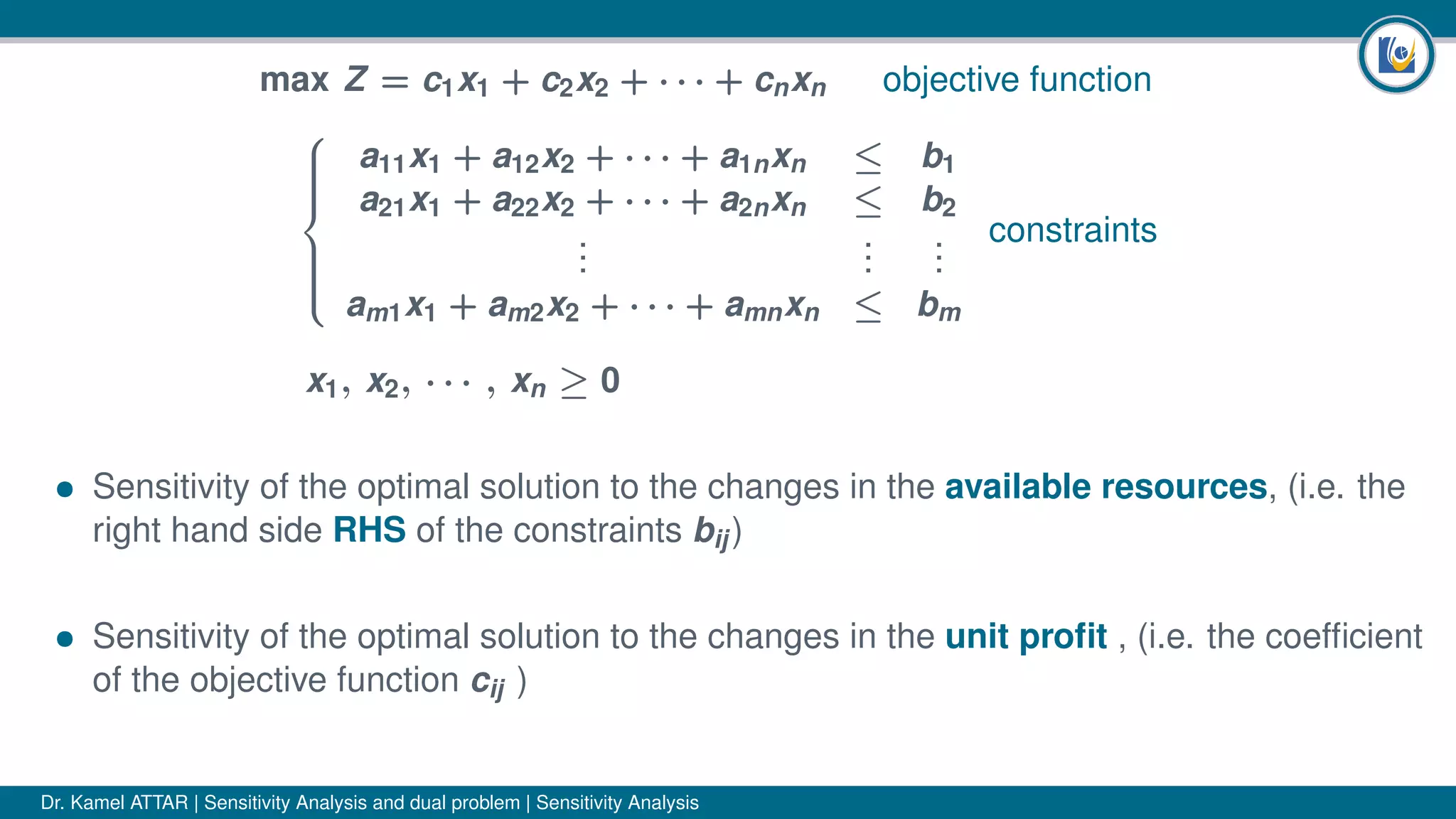
max Z = c1x1 + c2x2 + · · · + cnxn objective function



a11x1 + a12x2 + · · · + a1nxn ≤ b1
a21x1 + a22x2 + · · · + a2nxn ≤ b2
...
...
...
am1x1 + am2x2 + · · · + amnxn ≤ bm
constraints
x1, x2, · · · , xn ≥ 0
• Sensitivity of the optimal solution to the changes in the available resources, (i.e. the
right hand side RHS of the constraints bij)
• Sensitivity of the optimal solution to the changes in the unit profit , (i.e. the coefficient
of the objective function cij )
Dr. Kamel ATTAR | Sensitivity Analysis and dual problem | Sensitivity Analysis
Change in the right-hand side of the constraint
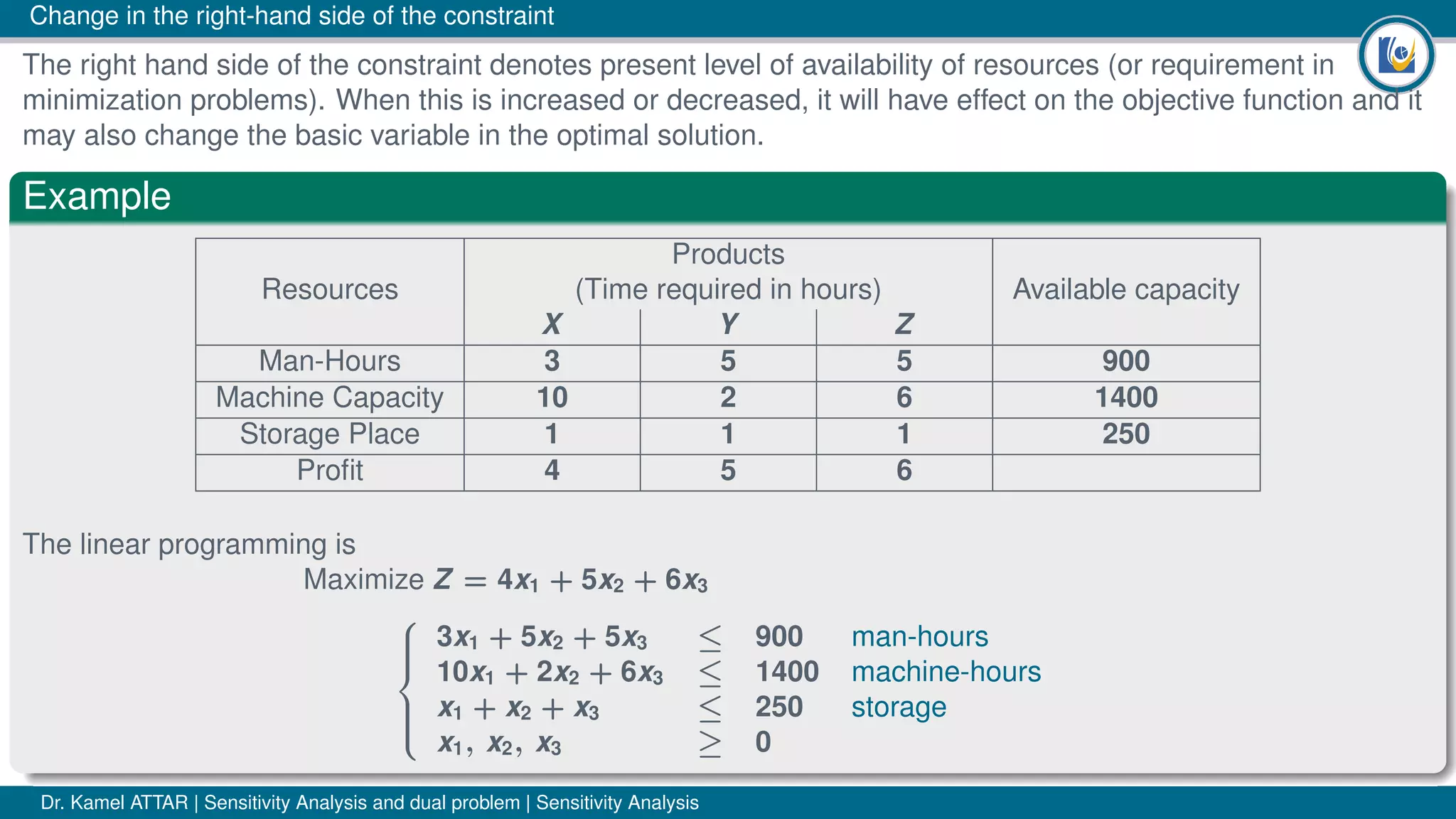
The right hand side of the constraint denotes present level of availability of resources (or requirement in
minimization problems). When this is increased or decreased, it will have effect on the objective function and it
may also change the basic variable in the optimal solution.
Example
Products
Resources (Time required in hours) Available capacity
X Y Z
Man-Hours 3 5 5 900
Machine Capacity 10 2 6 1400
Storage Place 1 1 1 250
Profit 4 5 6
The linear programming is
Maximize Z = 4x1 + 5x2 + 6x3



3x1 + 5x2 + 5x3 ≤ 900 man-hours
10x1 + 2x2 + 6x3 ≤ 1400 machine-hours
x1 + x2 + x3 ≤ 250 storage
x1, x2, x3 ≥ 0
Dr. Kamel ATTAR | Sensitivity Analysis and dual problem | Sensitivity Analysis
Change in the right-hand side of the constraint
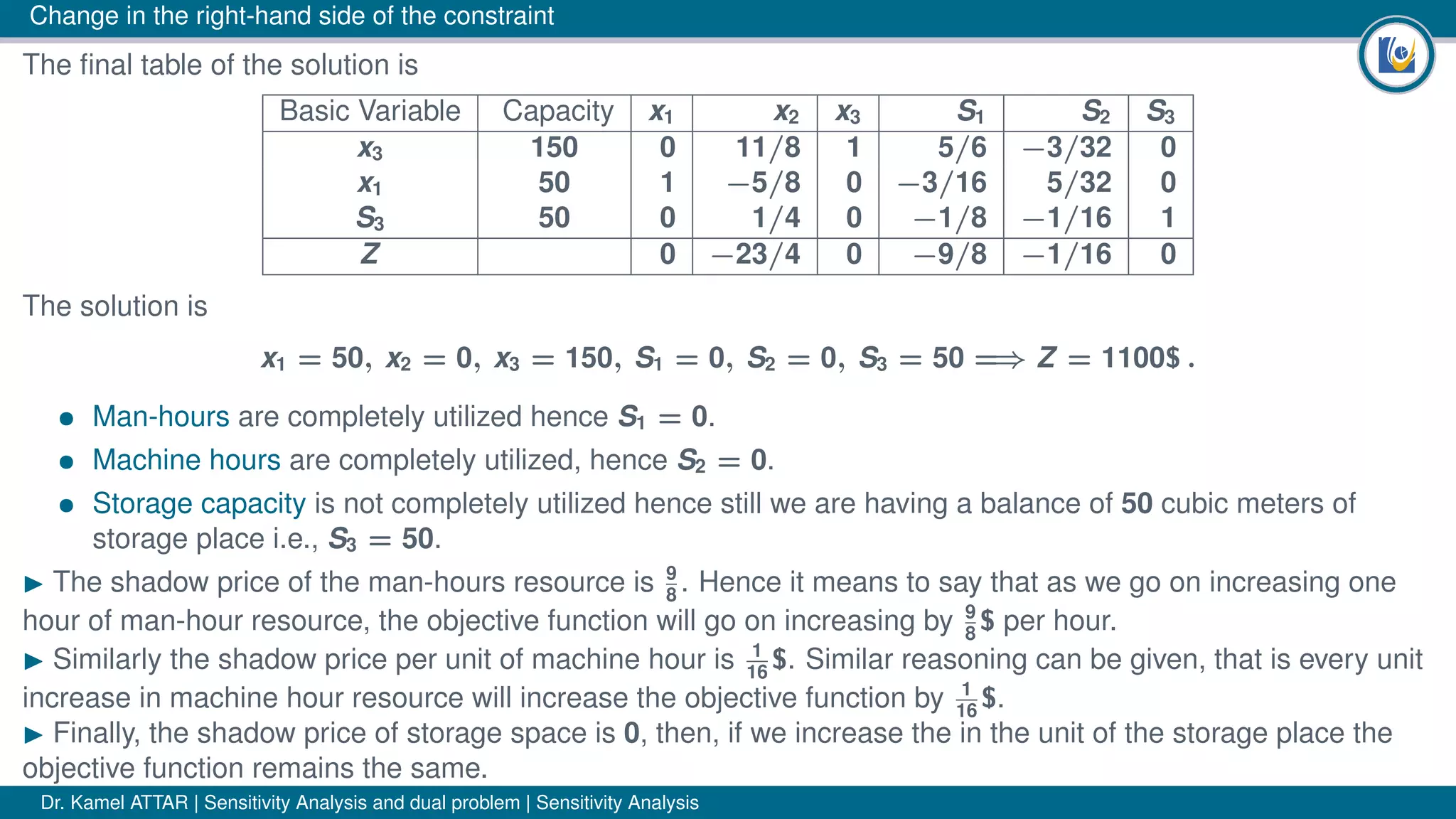
The final table of the solution is
Basic Variable Capacity x1 x2 x3 S1 S2 S3
x3 150 0 11/8 1 5/6 −3/32 0
x1 50 1 −5/8 0 −3/16 5/32 0
S3 50 0 1/4 0 −1/8 −1/16 1
Z 0 −23/4 0 −9/8 −1/16 0
The solution is
x1 = 50, x2 = 0, x3 = 150, S1 = 0, S2 = 0, S3 = 50 =⇒ Z = 1100$ .
• Man-hours are completely utilized hence S1 = 0.
• Machine hours are completely utilized, hence S2 = 0.
• Storage capacity is not completely utilized hence still we are having a balance of 50 cubic meters of
storage place i.e., S3 = 50.
The shadow price of the man-hours resource is 9
8
. Hence it means to say that as we go on increasing one
hour of man-hour resource, the objective function will go on increasing by 9
8
$ per hour.
Similarly the shadow price per unit of machine hour is 1
16
$. Similar reasoning can be given, that is every unit
increase in machine hour resource will increase the objective function by 1
16
$.
Finally, the shadow price of storage space is 0, then, if we increase the in the unit of the storage place the
objective function remains the same.
Dr. Kamel ATTAR | Sensitivity Analysis and dual problem | Sensitivity Analysis
Change in the right-hand side of the constraint
# Question. 1 #
If the management want to increase the capacity of both man-hours and machine-hours,
which one should receive priority?
Dr. Kamel ATTAR | Sensitivity Analysis and dual problem | Sensitivity Analysis
Change in the right-hand side of the constraint
# Question. 1 #
If the management want to increase the capacity of both man-hours and machine-hours,
which one should receive priority?
The answer is man-hours, since it is shadow price is greater than the shadow price of
machine-hours.
Dr. Kamel ATTAR | Sensitivity Analysis and dual problem | Sensitivity Analysis
Change in the right-hand side of the constraint
# Question. 2 #
If the management considers to increase man-hours by 100 hours i.e., from 900 hours to
1000 hours and machine hours by 200 hours i.e., 1400 hours to 1600 hours will the optimal
solution remain unchanged?
Dr. Kamel ATTAR | Sensitivity Analysis and dual problem | Sensitivity Analysis
Change in the right-hand side of the constraint
# Question. 2 #
If the management considers to increase man-hours by 100 hours i.e., from 900 hours to
1000 hours and machine hours by 200 hours i.e., 1400 hours to 1600 hours will the optimal
solution remain unchanged?
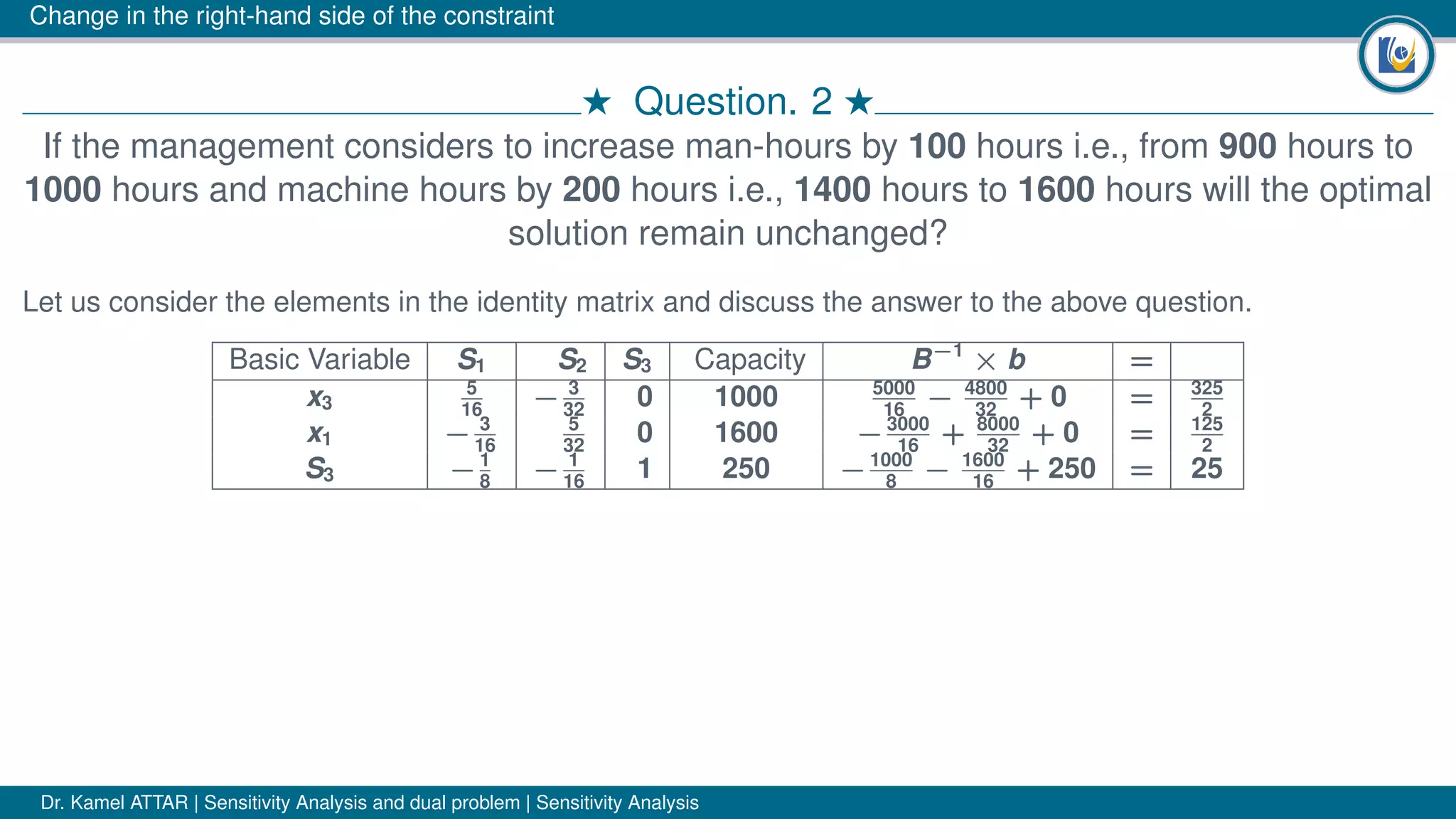
Let us consider the elements in the identity matrix and discuss the answer to the above question.
Basic Variable S1 S2 S3 Capacity B−1
× b =
x3
5
16
− 3
32
0 1000 5000
16
− 4800
32
+ 0 = 325
2
x1 − 3
16
5
32
0 1600 −3000
16
+ 8000
32
+ 0 = 125
2
S3 −1
8
− 1
16
1 250 −1000
8
− 1600
16
+ 250 = 25
Dr. Kamel ATTAR | Sensitivity Analysis and dual problem | Sensitivity Analysis
Change in the right-hand side of the constraint
# Question. 2 #
If the management considers to increase man-hours by 100 hours i.e., from 900 hours to
1000 hours and machine hours by 200 hours i.e., 1400 hours to 1600 hours will the optimal
solution remain unchanged?
Let us consider the elements in the identity matrix and discuss the answer to the above question.
Basic Variable S1 S2 S3 Capacity B−1
× b =
x3
5
16
− 3
32
0 1000 5000
16
− 4800
32
+ 0 = 325
2
x1 − 3
16
5
32
0 1600 −3000
16
+ 8000
32
+ 0 = 125
2
S3 −1
8
− 1
16
1 250 −1000
8
− 1600
16
+ 250 = 25
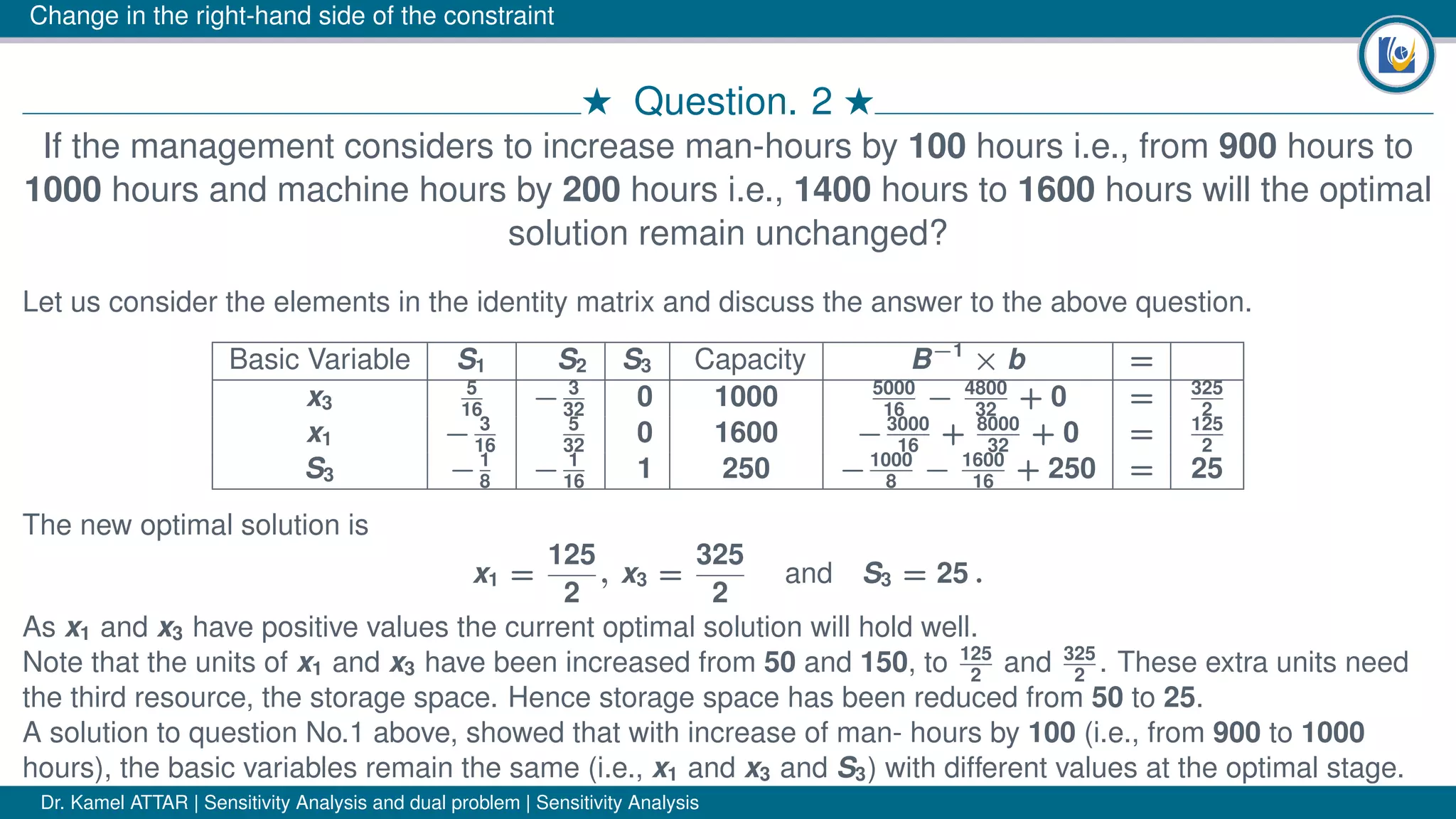
The new optimal solution is
x1 =
125
2
, x3 =
325
2
and S3 = 25 .
As x1 and x3 have positive values the current optimal solution will hold well.
Note that the units of x1 and x3 have been increased from 50 and 150, to 125
2
and 325
2
. These extra units need
the third resource, the storage space. Hence storage space has been reduced from 50 to 25.
A solution to question No.1 above, showed that with increase of man- hours by 100 (i.e., from 900 to 1000
hours), the basic variables remain the same (i.e., x1 and x3 and S3) with different values at the optimal stage.
Dr. Kamel ATTAR | Sensitivity Analysis and dual problem | Sensitivity Analysis
Change in the right-hand side of the constraint
# Question. 3 #
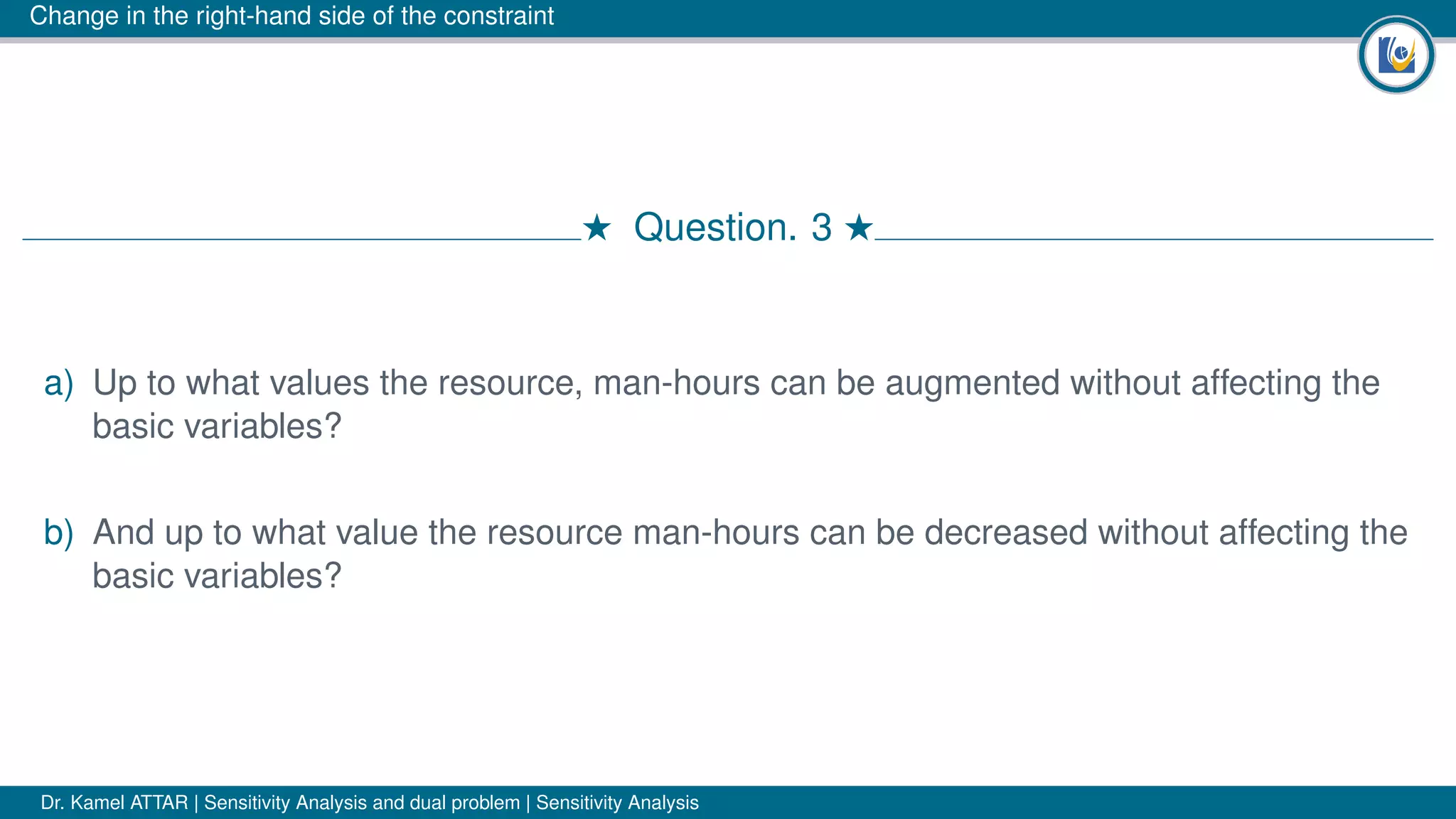
a) Up to what values the resource, man-hours can be augmented without affecting the
basic variables?
b) And up to what value the resource man-hours can be decreased without affecting the
basic variables?
Dr. Kamel ATTAR | Sensitivity Analysis and dual problem | Sensitivity Analysis
Change in the right-hand side of the constraint
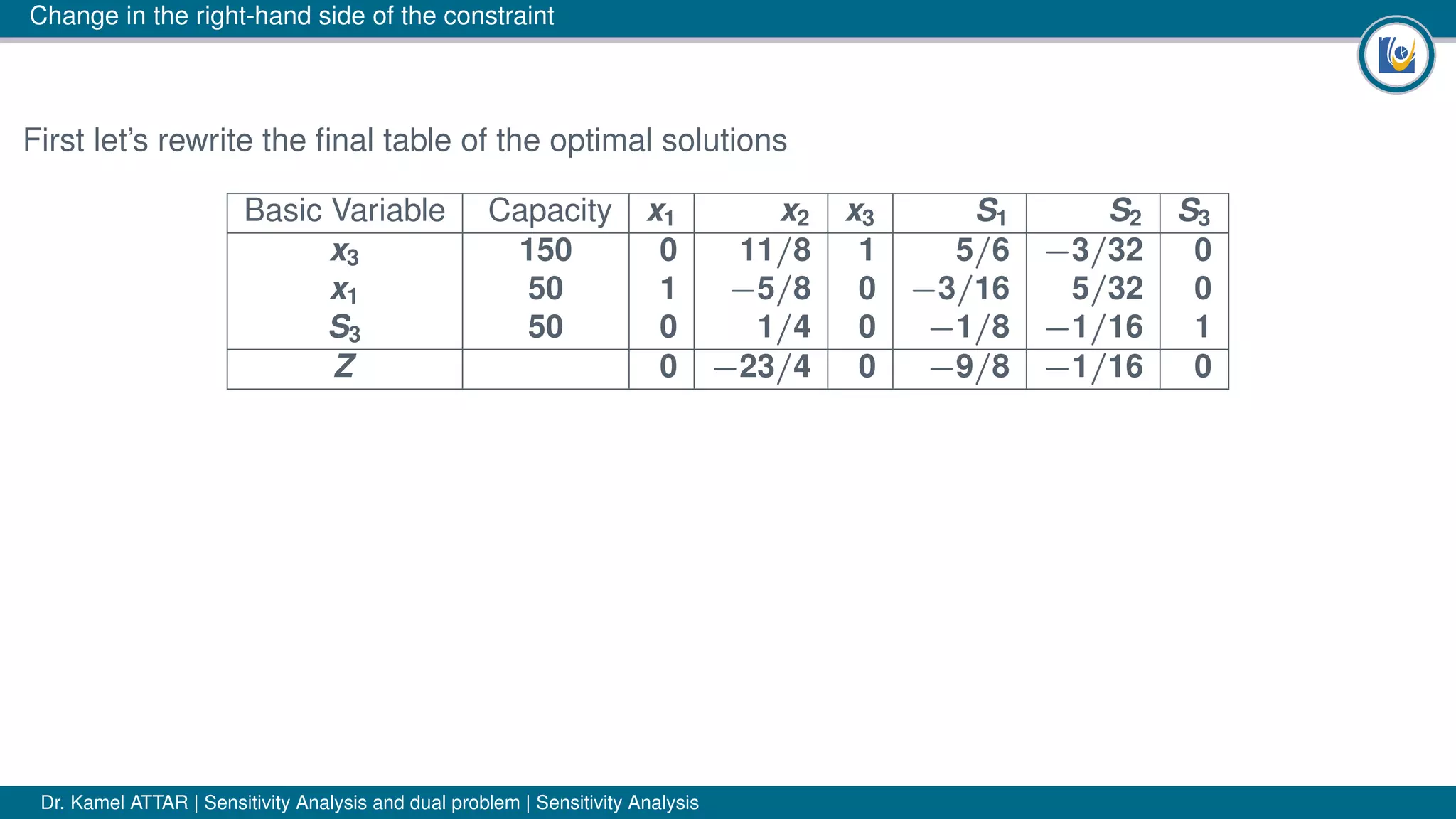
First let’s rewrite the final table of the optimal solutions
Basic Variable Capacity x1 x2 x3 S1 S2 S3
x3 150 0 11/8 1 5/6 −3/32 0
x1 50 1 −5/8 0 −3/16 5/32 0
S3 50 0 1/4 0 −1/8 −1/16 1
Z 0 −23/4 0 −9/8 −1/16 0
Dr. Kamel ATTAR | Sensitivity Analysis and dual problem | Sensitivity Analysis
Change in the right-hand side of the constraint
First let’s rewrite the final table of the optimal solutions
Basic Variable Capacity x1 x2 x3 S1 S2 S3
x3 150 0 11/8 1 5/6 −3/32 0
x1 50 1 −5/8 0 −3/16 5/32 0
S3 50 0 1/4 0 −1/8 −1/16 1
Z 0 −23/4 0 −9/8 −1/16 0
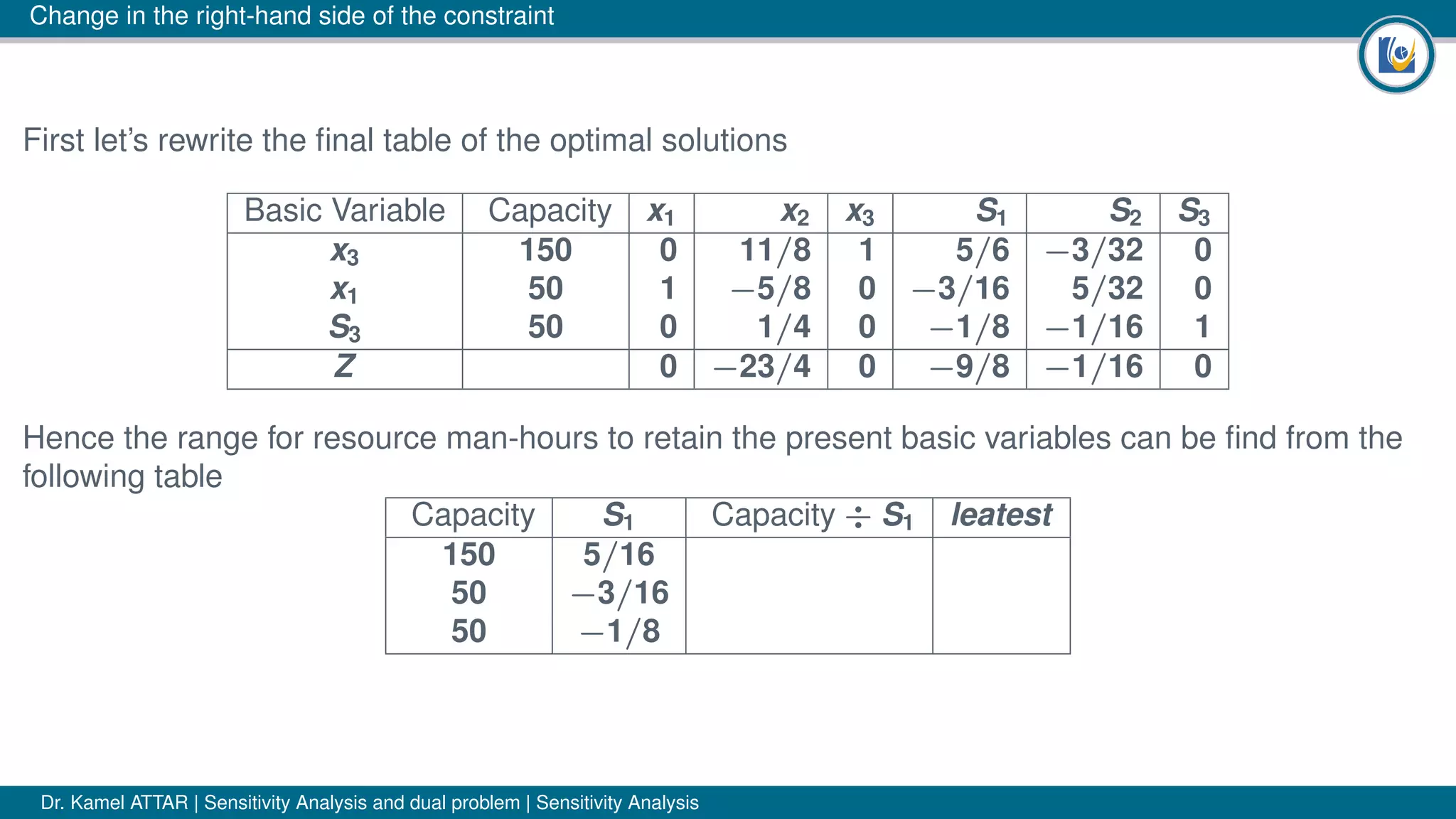
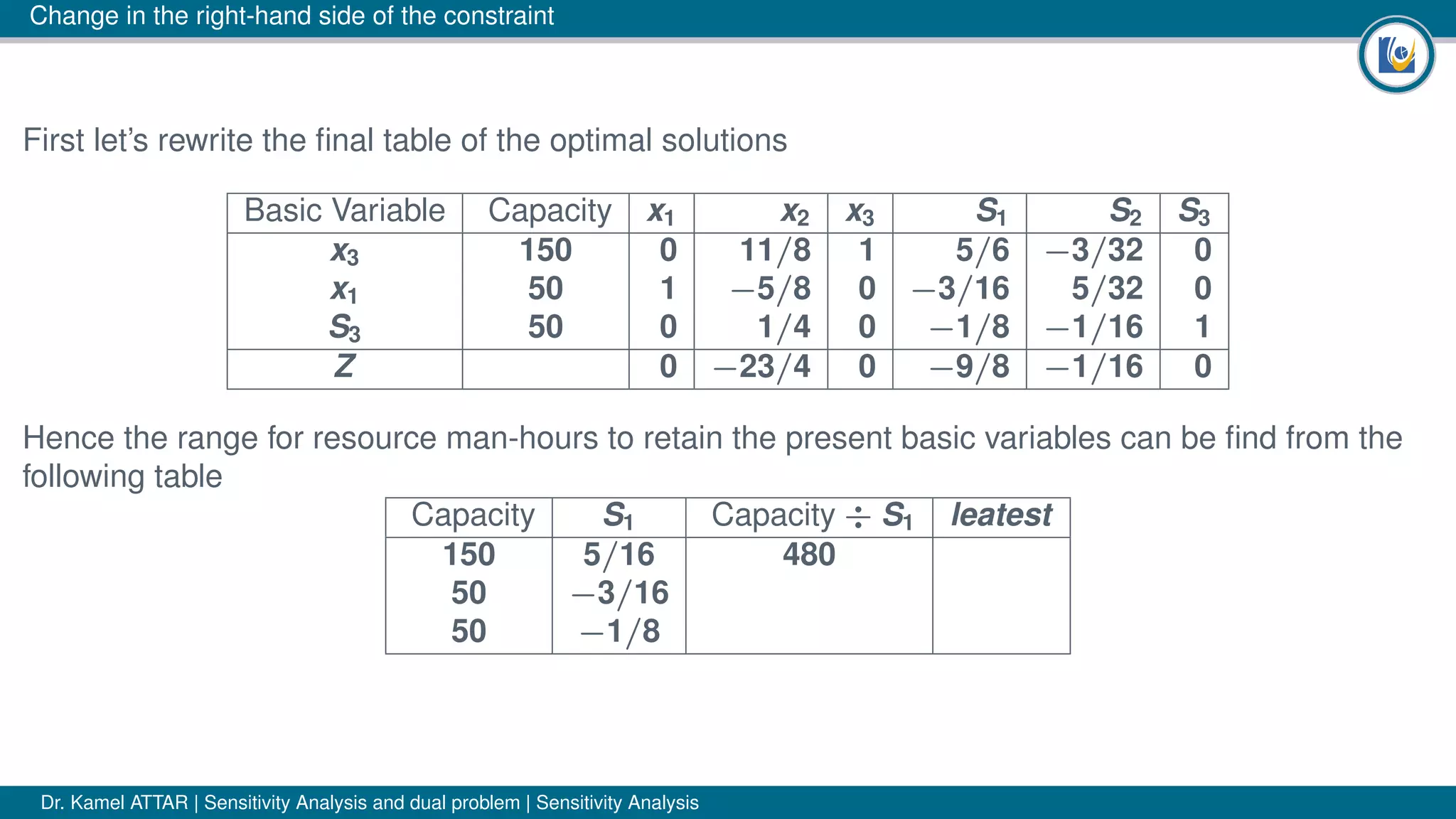
Hence the range for resource man-hours to retain the present basic variables can be find from the
following table
Capacity S1 Capacity ÷ S1 leatest
150 5/16
50 −3/16
50 −1/8
Dr. Kamel ATTAR | Sensitivity Analysis and dual problem | Sensitivity Analysis
Change in the right-hand side of the constraint
First let’s rewrite the final table of the optimal solutions
Basic Variable Capacity x1 x2 x3 S1 S2 S3
x3 150 0 11/8 1 5/6 −3/32 0
x1 50 1 −5/8 0 −3/16 5/32 0
S3 50 0 1/4 0 −1/8 −1/16 1
Z 0 −23/4 0 −9/8 −1/16 0
Hence the range for resource man-hours to retain the present basic variables can be find from the
following table
Capacity S1 Capacity ÷ S1 leatest
150 5/16
50 −3/16
50 −1/8
Dr. Kamel ATTAR | Sensitivity Analysis and dual problem | Sensitivity Analysis
Change in the right-hand side of the constraint
First let’s rewrite the final table of the optimal solutions
Basic Variable Capacity x1 x2 x3 S1 S2 S3
x3 150 0 11/8 1 5/6 −3/32 0
x1 50 1 −5/8 0 −3/16 5/32 0
S3 50 0 1/4 0 −1/8 −1/16 1
Z 0 −23/4 0 −9/8 −1/16 0
Hence the range for resource man-hours to retain the present basic variables can be find from the
following table
Capacity S1 Capacity ÷ S1 leatest
150 5/16 480
50 −3/16
50 −1/8
Dr. Kamel ATTAR | Sensitivity Analysis and dual problem | Sensitivity Analysis
Change in the right-hand side of the constraint
First let’s rewrite the final table of the optimal solutions
Basic Variable Capacity x1 x2 x3 S1 S2 S3
x3 150 0 11/8 1 5/6 −3/32 0
x1 50 1 −5/8 0 −3/16 5/32 0
S3 50 0 1/4 0 −1/8 −1/16 1
Z 0 −23/4 0 −9/8 −1/16 0
Hence the range for resource man-hours to retain the present basic variables can be find from the
following table
Capacity S1 Capacity ÷ S1 leatest
150 5/16 480
50 −3/16 − 800/3
50 −1/8
Dr. Kamel ATTAR | Sensitivity Analysis and dual problem | Sensitivity Analysis
Change in the right-hand side of the constraint
First let’s rewrite the final table of the optimal solutions
Basic Variable Capacity x1 x2 x3 S1 S2 S3
x3 150 0 11/8 1 5/6 −3/32 0
x1 50 1 −5/8 0 −3/16 5/32 0
S3 50 0 1/4 0 −1/8 −1/16 1
Z 0 −23/4 0 −9/8 −1/16 0
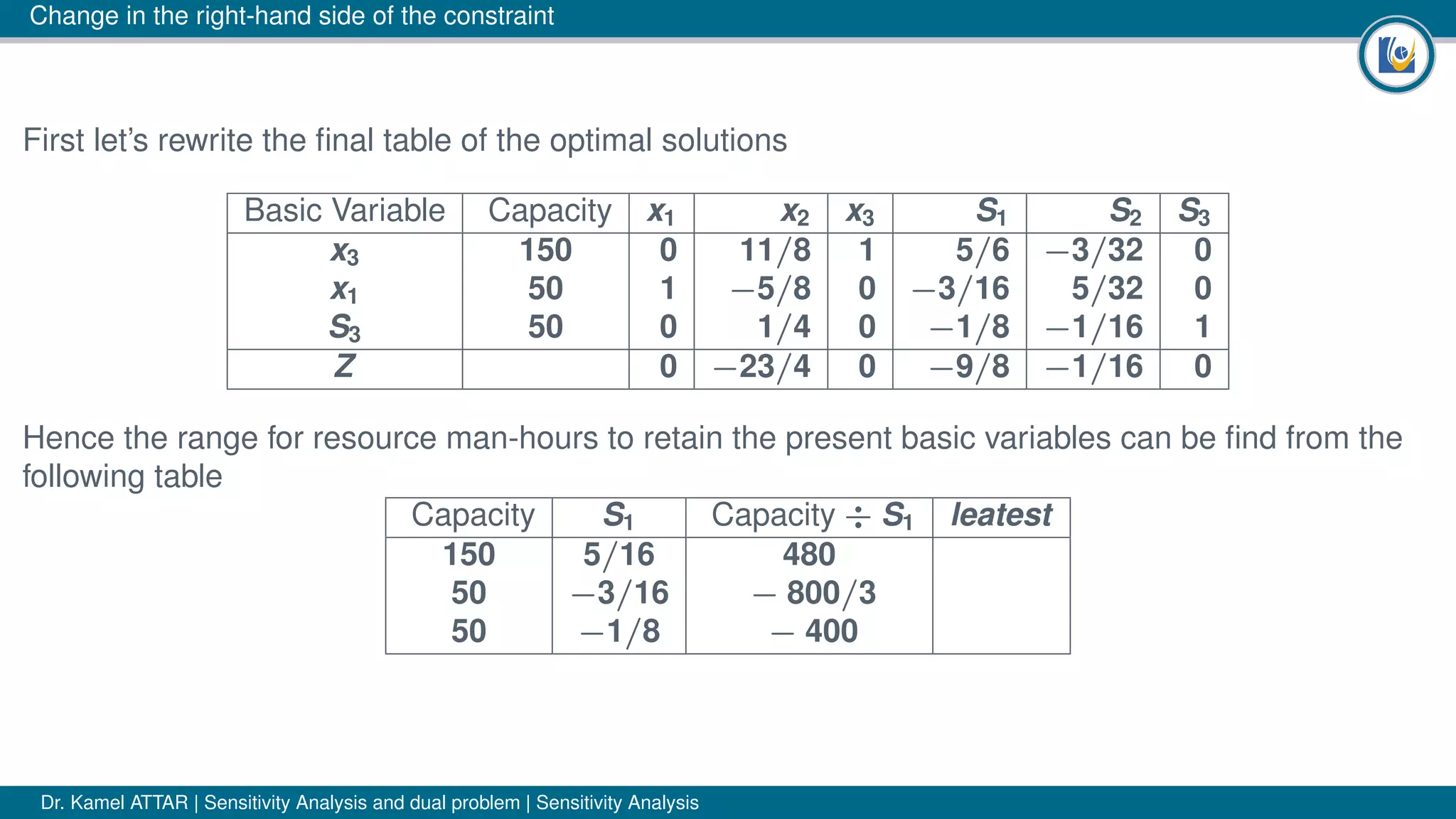
Hence the range for resource man-hours to retain the present basic variables can be find from the
following table
Capacity S1 Capacity ÷ S1 leatest
150 5/16 480
50 −3/16 − 800/3
50 −1/8 − 400
Dr. Kamel ATTAR | Sensitivity Analysis and dual problem | Sensitivity Analysis
Change in the right-hand side of the constraint
First let’s rewrite the final table of the optimal solutions
Basic Variable Capacity x1 x2 x3 S1 S2 S3
x3 150 0 11/8 1 5/6 −3/32 0
x1 50 1 −5/8 0 −3/16 5/32 0
S3 50 0 1/4 0 −1/8 −1/16 1
Z 0 −23/4 0 −9/8 −1/16 0
Hence the range for resource man-hours to retain the present basic variables can be find from the
following table
Capacity S1 Capacity ÷ S1
150 5/16 480 least⊕
50 −3/16 − 800/3 least
50 −1/8 −400
Dr. Kamel ATTAR | Sensitivity Analysis and dual problem | Sensitivity Analysis
Change in the right-hand side of the constraint
First let’s rewrite the final table of the optimal solutions
Basic Variable Capacity x1 x2 x3 S1 S2 S3
x3 150 0 11/8 1 5/6 −3/32 0
x1 50 1 −5/8 0 −3/16 5/32 0
S3 50 0 1/4 0 −1/8 −1/16 1
Z 0 −23/4 0 −9/8 −1/16 0
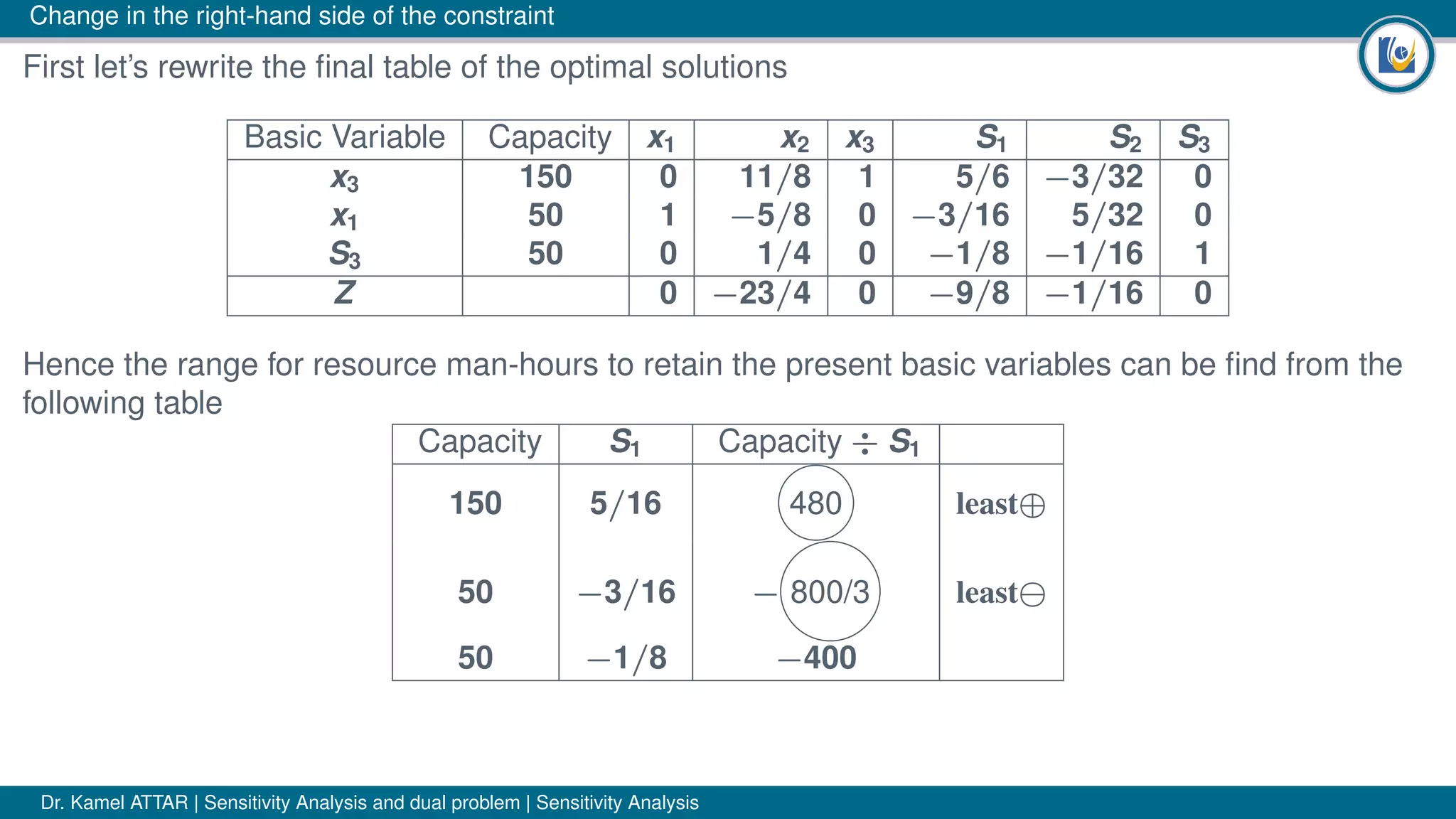
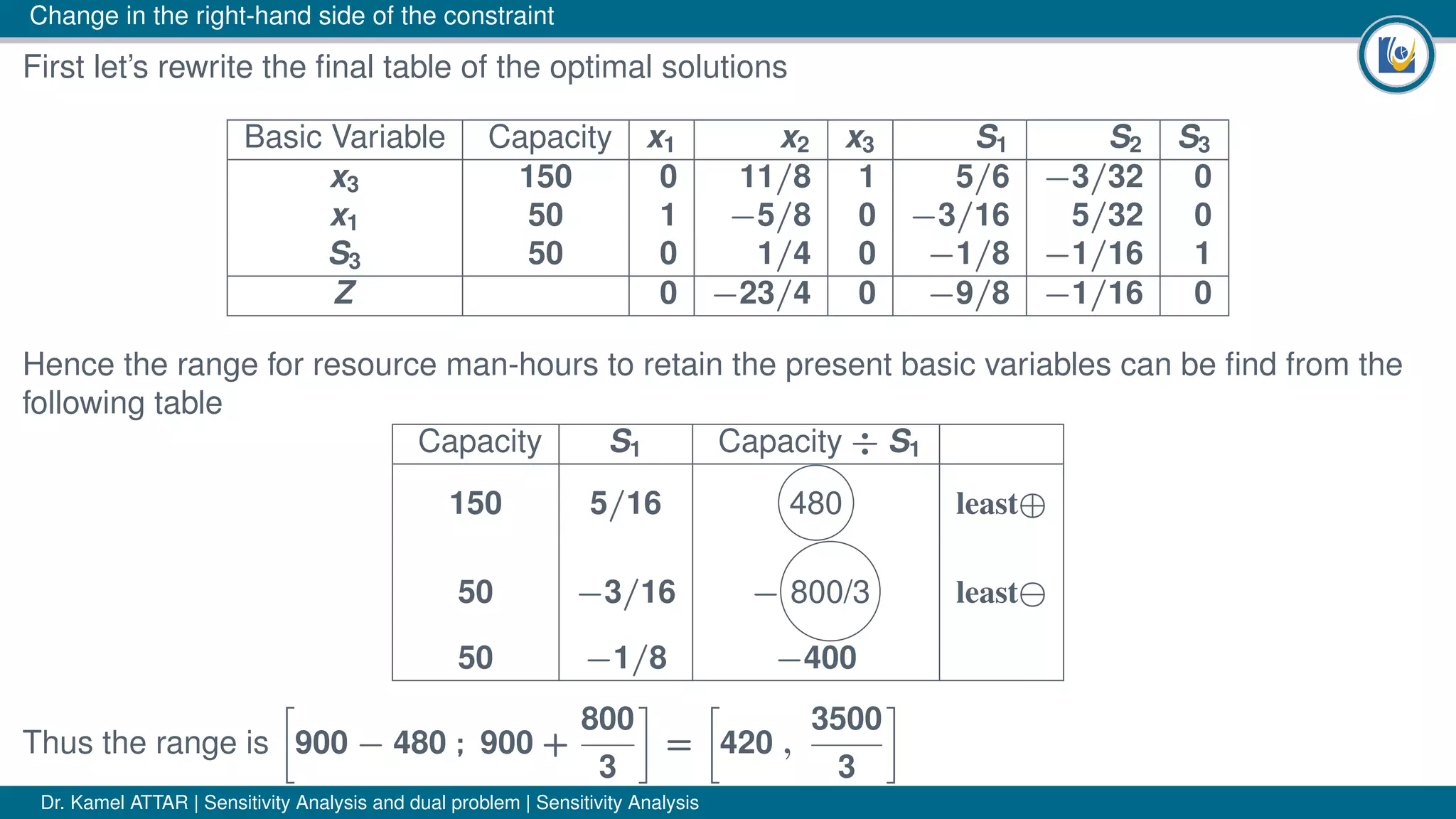
Hence the range for resource man-hours to retain the present basic variables can be find from the
following table
Capacity S1 Capacity ÷ S1
150 5/16 480 least⊕
50 −3/16 − 800/3 least
50 −1/8 −400
Thus the range is 900 − 480 ; 900 +
800
3
= 420 ,
3500
3
Dr. Kamel ATTAR | Sensitivity Analysis and dual problem | Sensitivity Analysis
Non-basic Variables
# Non-basic Variables (Question. 4) #
What is the range of the unit profit for product Y, that will keep the optimal solution
unchanged?
Dr. Kamel ATTAR | Sensitivity Analysis and dual problem | Sensitivity Analysis
Non-basic Variables
# Non-basic Variables (Question. 4) #
What is the range of the unit profit for product Y, that will keep the optimal solution
unchanged?
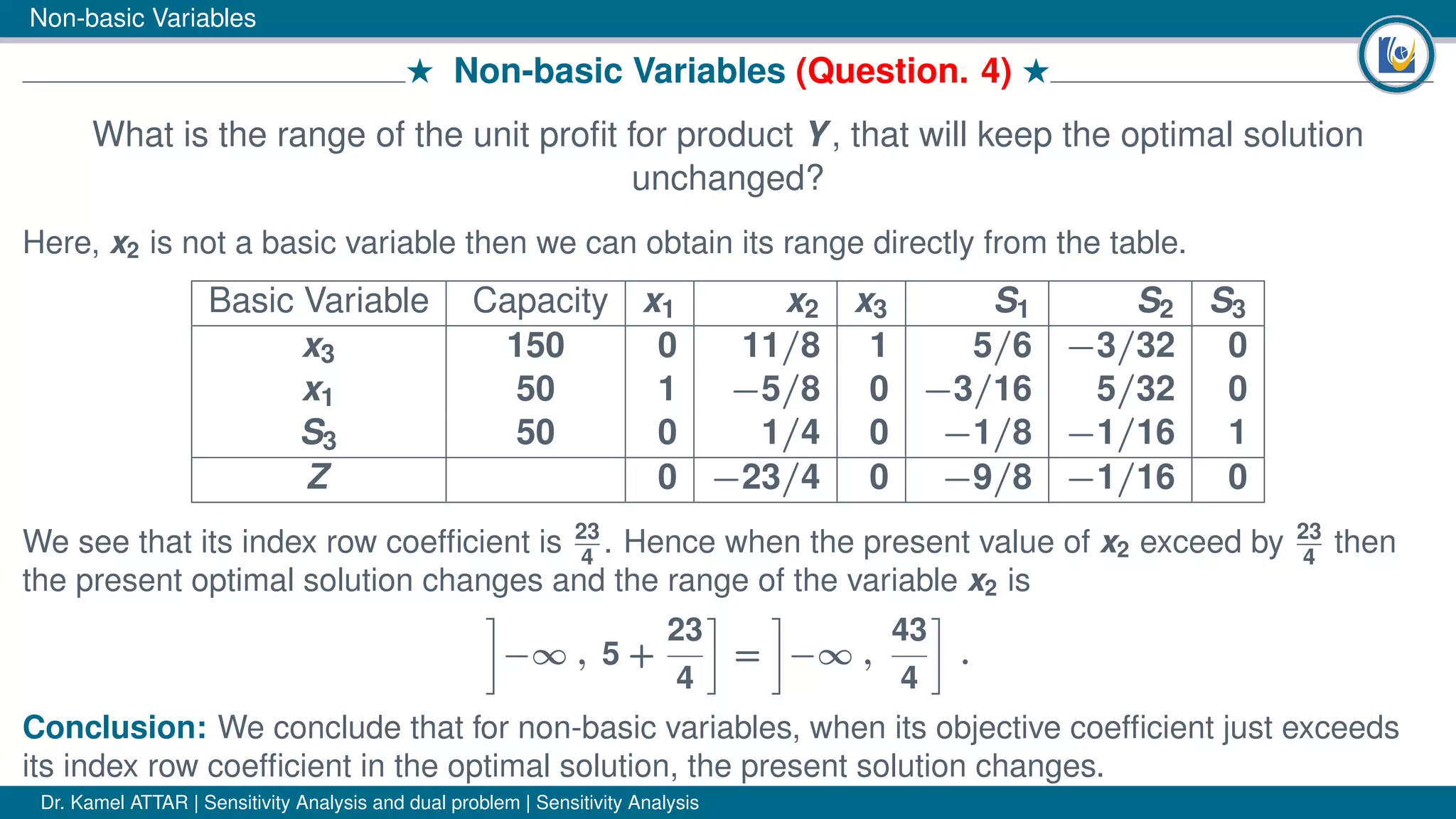
Here, x2 is not a basic variable then we can obtain its range directly from the table.
Basic Variable Capacity x1 x2 x3 S1 S2 S3
x3 150 0 11/8 1 5/6 −3/32 0
x1 50 1 −5/8 0 −3/16 5/32 0
S3 50 0 1/4 0 −1/8 −1/16 1
Z 0 −23/4 0 −9/8 −1/16 0
We see that its index row coefficient is 23
4
. Hence when the present value of x2 exceed by 23
4
then
the present optimal solution changes and the range of the variable x2 is
−∞ , 5 +
23
4
= −∞ ,
43
4
.
Conclusion: We conclude that for non-basic variables, when its objective coefficient just exceeds
its index row coefficient in the optimal solution, the present solution changes.
Dr. Kamel ATTAR | Sensitivity Analysis and dual problem | Sensitivity Analysis
Basic variables
# Basic Variables (Question. 5) #
What is the range of the unit profit for product X and Z, that will keep the optimal solution
unchanged?
Dr. Kamel ATTAR | Sensitivity Analysis and dual problem | Sensitivity Analysis
Basic variables
# Basic Variables (Question. 5) #
What is the range of the unit profit for product X and Z, that will keep the optimal solution
unchanged?
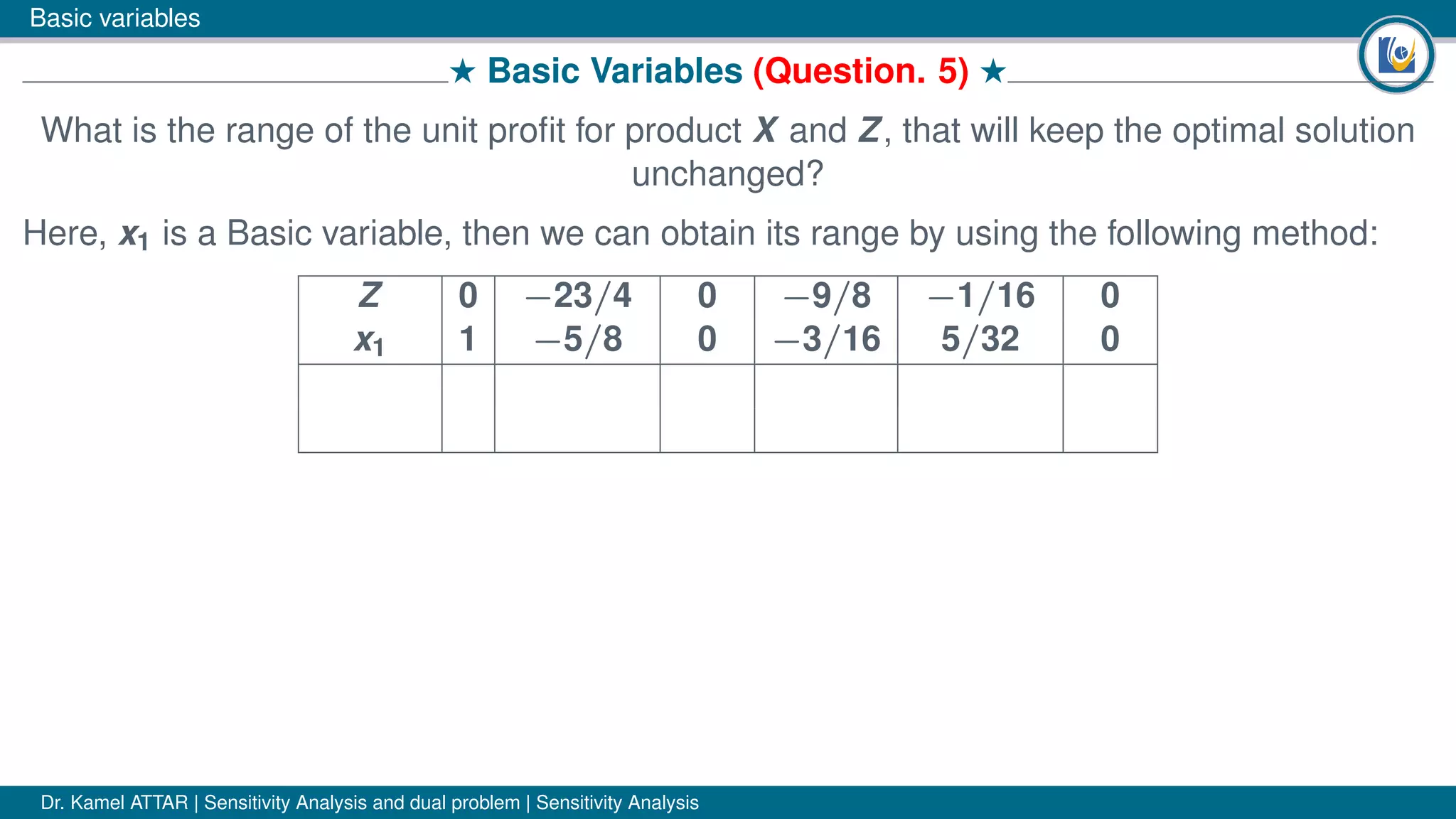
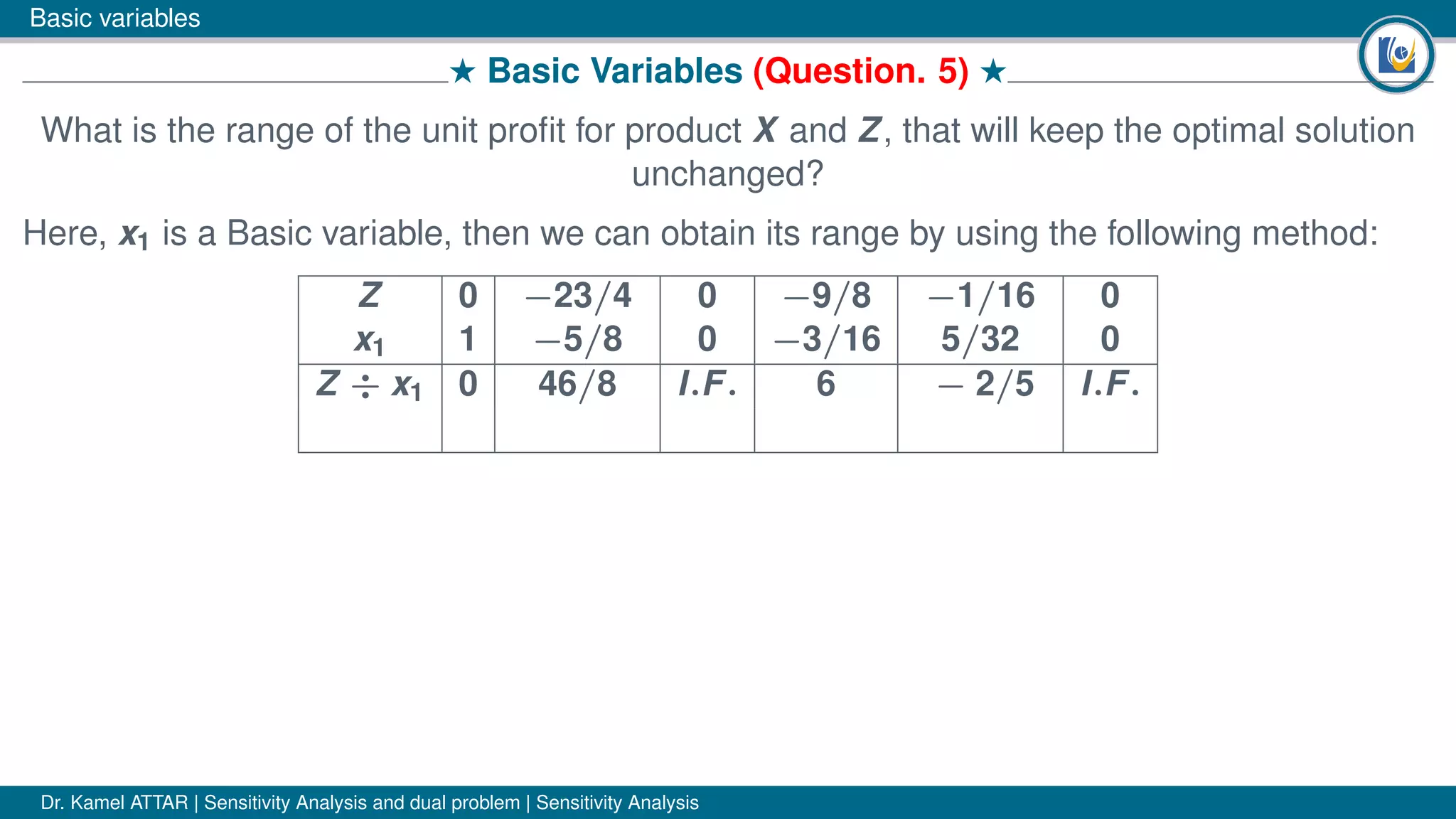
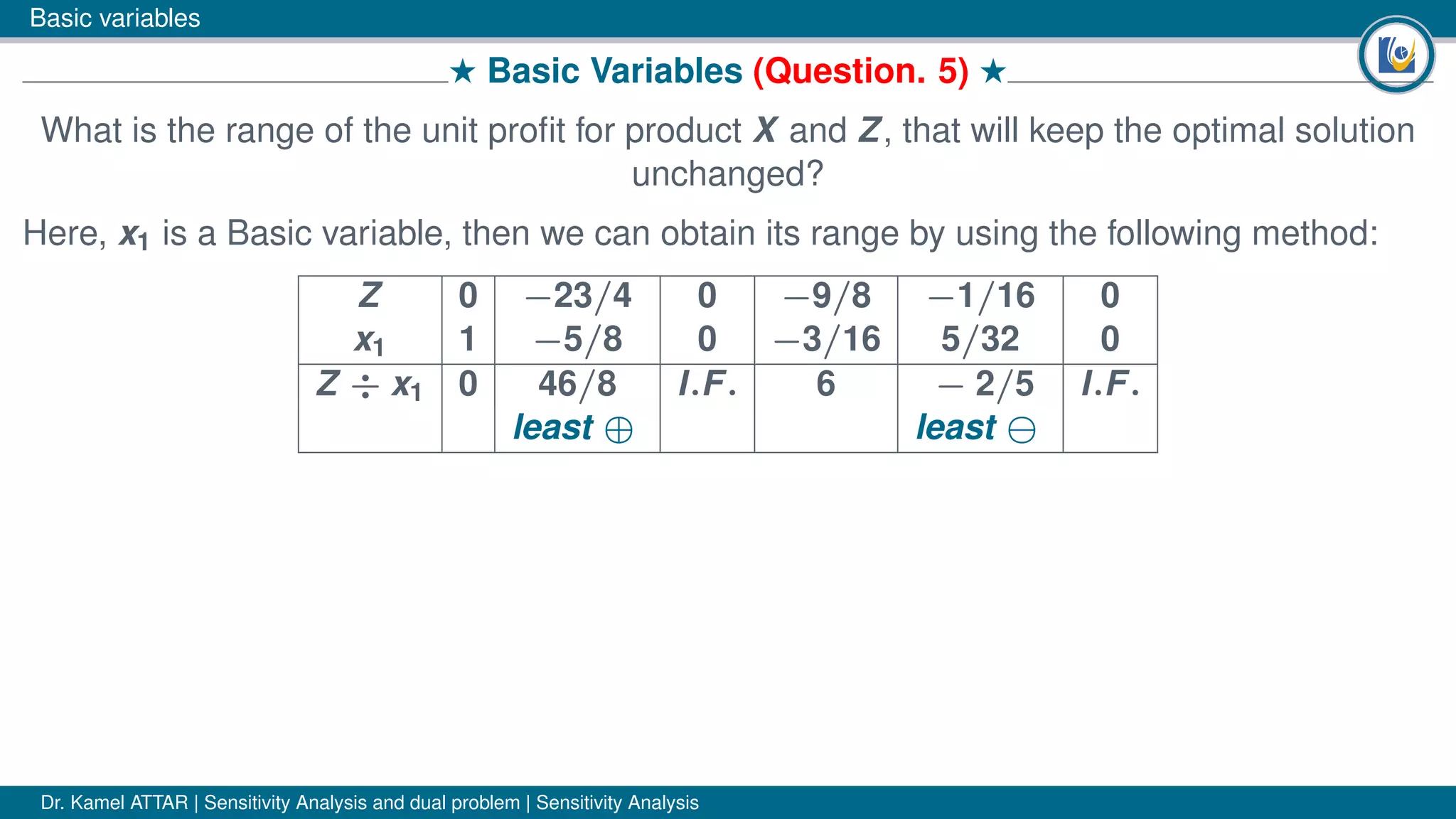
Here, x1 is a Basic variable, then we can obtain its range by using the following method:
Z 0 −23/4 0 −9/8 −1/16 0
x1 1 −5/8 0 −3/16 5/32 0
Dr. Kamel ATTAR | Sensitivity Analysis and dual problem | Sensitivity Analysis
Basic variables
# Basic Variables (Question. 5) #
What is the range of the unit profit for product X and Z, that will keep the optimal solution
unchanged?
Here, x1 is a Basic variable, then we can obtain its range by using the following method:
Z 0 −23/4 0 −9/8 −1/16 0
x1 1 −5/8 0 −3/16 5/32 0
Z ÷ x1 0 46/8 I.F. 6 − 2/5 I.F.
Dr. Kamel ATTAR | Sensitivity Analysis and dual problem | Sensitivity Analysis
Basic variables
# Basic Variables (Question. 5) #
What is the range of the unit profit for product X and Z, that will keep the optimal solution
unchanged?
Here, x1 is a Basic variable, then we can obtain its range by using the following method:
Z 0 −23/4 0 −9/8 −1/16 0
x1 1 −5/8 0 −3/16 5/32 0
Z ÷ x1 0 46/8 I.F. 6 − 2/5 I.F.
least ⊕ least
Dr. Kamel ATTAR | Sensitivity Analysis and dual problem | Sensitivity Analysis
Basic variables
# Basic Variables (Question. 5) #
What is the range of the unit profit for product X and Z, that will keep the optimal solution
unchanged?
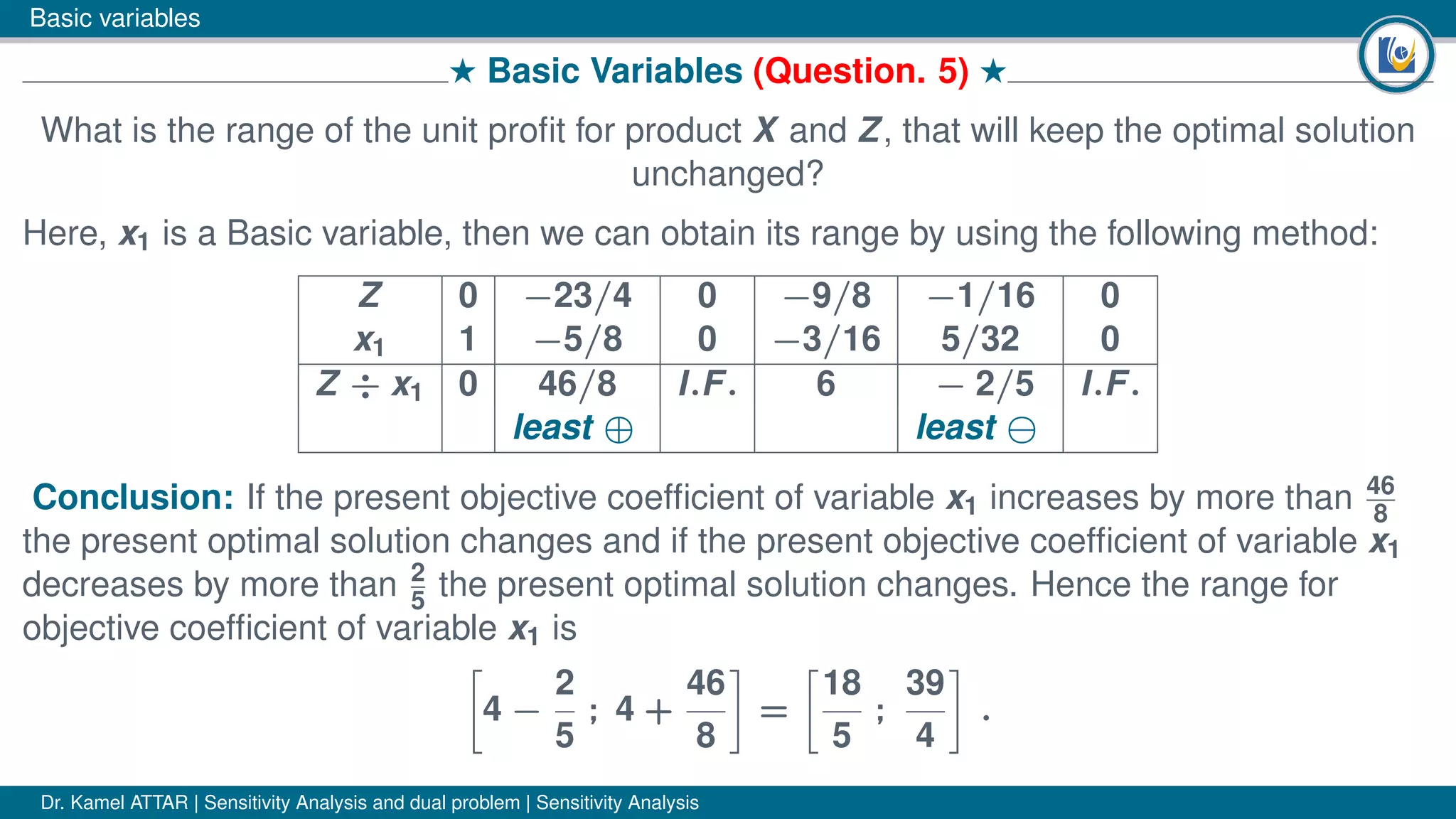
Here, x1 is a Basic variable, then we can obtain its range by using the following method:
Z 0 −23/4 0 −9/8 −1/16 0
x1 1 −5/8 0 −3/16 5/32 0
Z ÷ x1 0 46/8 I.F. 6 − 2/5 I.F.
least ⊕ least
Conclusion: If the present objective coefficient of variable x1 increases by more than 46
8
the present optimal solution changes and if the present objective coefficient of variable x1
decreases by more than 2
5
the present optimal solution changes. Hence the range for
objective coefficient of variable x1 is
4 −
2
5
; 4 +
46
8
=
18
5
;
39
4
.
Dr. Kamel ATTAR | Sensitivity Analysis and dual problem | Sensitivity Analysis
Thank you!

Operations research(Sensitivity analysis)

  • 1.
    Faculty of Economicsand Business Administration Lebanese University Dual Problem and Sensitivity Analysis Sensitivity Analysis Dr. Kamel ATTAR attar.kamel@gmail.com
  • 2.
    Tabel of contentsI 1 Change in the right-hand side of the constraint 2 Change in the objective Coefficient Non-basic Variables Basic variables Dr. Kamel ATTAR | Sensitivity Analysis and dual problem | Sensitivity Analysis
  • 3.
    # Introduction # Whilesolving a linear programming problem for optimal solution, we assume that: Dr. Kamel ATTAR | Sensitivity Analysis and dual problem | Sensitivity Analysis
  • 4.
    # Introduction # Whilesolving a linear programming problem for optimal solution, we assume that: (a) Technology is fixed, Dr. Kamel ATTAR | Sensitivity Analysis and dual problem | Sensitivity Analysis
  • 5.
    # Introduction # Whilesolving a linear programming problem for optimal solution, we assume that: (a) Technology is fixed, (b) Fixed prices, Dr. Kamel ATTAR | Sensitivity Analysis and dual problem | Sensitivity Analysis
  • 6.
    # Introduction # Whilesolving a linear programming problem for optimal solution, we assume that: (a) Technology is fixed, (b) Fixed prices, (c) Fixed levels of resources or requirements, Dr. Kamel ATTAR | Sensitivity Analysis and dual problem | Sensitivity Analysis
  • 7.
    # Introduction # Whilesolving a linear programming problem for optimal solution, we assume that: (a) Technology is fixed, (b) Fixed prices, (c) Fixed levels of resources or requirements, (d) The coefficients of variables in structural constraints (i.e. time required by a product on a particular resource) are fixed, Dr. Kamel ATTAR | Sensitivity Analysis and dual problem | Sensitivity Analysis
  • 8.
    # Introduction # Whilesolving a linear programming problem for optimal solution, we assume that: (a) Technology is fixed, (b) Fixed prices, (c) Fixed levels of resources or requirements, (d) The coefficients of variables in structural constraints (i.e. time required by a product on a particular resource) are fixed, (e) profit contribution of the product will not vary during the planning period. Dr. Kamel ATTAR | Sensitivity Analysis and dual problem | Sensitivity Analysis
  • 9.
    # Introduction # Whilesolving a linear programming problem for optimal solution, we assume that: (a) Technology is fixed, (b) Fixed prices, (c) Fixed levels of resources or requirements, (d) The coefficients of variables in structural constraints (i.e. time required by a product on a particular resource) are fixed, (e) profit contribution of the product will not vary during the planning period. The condition in the real world however, might be different from those that are assumed by the model. It is, therefore, desirable to determine how sensitive the optimal solution is to different types of changes in the problem data and parameters. Dr. Kamel ATTAR | Sensitivity Analysis and dual problem | Sensitivity Analysis
  • 10.
    # Why weuse sensitivity analysis? # Dr. Kamel ATTAR | Sensitivity Analysis and dual problem | Sensitivity Analysis
  • 11.
    # Why weuse sensitivity analysis? # (a) Sensitivity analysis allow us to determine how "sensitive" the optimal solution is to changes in data values. Dr. Kamel ATTAR | Sensitivity Analysis and dual problem | Sensitivity Analysis
  • 12.
    # Why weuse sensitivity analysis? # (a) Sensitivity analysis allow us to determine how "sensitive" the optimal solution is to changes in data values. (b) Sensitivity analysis is important to the manager who must operate in a dynamic environment with imprecise estimates of the coefficients. Dr. Kamel ATTAR | Sensitivity Analysis and dual problem | Sensitivity Analysis
  • 13.
    # Why weuse sensitivity analysis? # (a) Sensitivity analysis allow us to determine how "sensitive" the optimal solution is to changes in data values. (b) Sensitivity analysis is important to the manager who must operate in a dynamic environment with imprecise estimates of the coefficients. (c) Sensitivity analysis is used to determine how the optimal solution is affected by changes, within specified ranges, in: Dr. Kamel ATTAR | Sensitivity Analysis and dual problem | Sensitivity Analysis
  • 14.
    # Why weuse sensitivity analysis? # (a) Sensitivity analysis allow us to determine how "sensitive" the optimal solution is to changes in data values. (b) Sensitivity analysis is important to the manager who must operate in a dynamic environment with imprecise estimates of the coefficients. (c) Sensitivity analysis is used to determine how the optimal solution is affected by changes, within specified ranges, in: (i) the objective function coefficients (cj ), which include: Dr. Kamel ATTAR | Sensitivity Analysis and dual problem | Sensitivity Analysis
  • 15.
    # Why weuse sensitivity analysis? # (a) Sensitivity analysis allow us to determine how "sensitive" the optimal solution is to changes in data values. (b) Sensitivity analysis is important to the manager who must operate in a dynamic environment with imprecise estimates of the coefficients. (c) Sensitivity analysis is used to determine how the optimal solution is affected by changes, within specified ranges, in: (i) the objective function coefficients (cj ), which include: • Coefficients of basic variables. Dr. Kamel ATTAR | Sensitivity Analysis and dual problem | Sensitivity Analysis
  • 16.
    # Why weuse sensitivity analysis? # (a) Sensitivity analysis allow us to determine how "sensitive" the optimal solution is to changes in data values. (b) Sensitivity analysis is important to the manager who must operate in a dynamic environment with imprecise estimates of the coefficients. (c) Sensitivity analysis is used to determine how the optimal solution is affected by changes, within specified ranges, in: (i) the objective function coefficients (cj ), which include: • Coefficients of basic variables. • Coefficients of non basic variables. Dr. Kamel ATTAR | Sensitivity Analysis and dual problem | Sensitivity Analysis
  • 17.
    # Why weuse sensitivity analysis? # (a) Sensitivity analysis allow us to determine how "sensitive" the optimal solution is to changes in data values. (b) Sensitivity analysis is important to the manager who must operate in a dynamic environment with imprecise estimates of the coefficients. (c) Sensitivity analysis is used to determine how the optimal solution is affected by changes, within specified ranges, in: (i) the objective function coefficients (cj ), which include: • Coefficients of basic variables. • Coefficients of non basic variables. (ii) the right-hand side (RHS) values (bi ), (i.e. resource or requirement levels). Dr. Kamel ATTAR | Sensitivity Analysis and dual problem | Sensitivity Analysis
  • 18.
    # Why weuse sensitivity analysis? # (a) Sensitivity analysis allow us to determine how "sensitive" the optimal solution is to changes in data values. (b) Sensitivity analysis is important to the manager who must operate in a dynamic environment with imprecise estimates of the coefficients. (c) Sensitivity analysis is used to determine how the optimal solution is affected by changes, within specified ranges, in: (i) the objective function coefficients (cj ), which include: • Coefficients of basic variables. • Coefficients of non basic variables. (ii) the right-hand side (RHS) values (bi ), (i.e. resource or requirement levels). The above changes may results in one of the following three cases: Dr. Kamel ATTAR | Sensitivity Analysis and dual problem | Sensitivity Analysis
  • 19.
    # Why weuse sensitivity analysis? # (a) Sensitivity analysis allow us to determine how "sensitive" the optimal solution is to changes in data values. (b) Sensitivity analysis is important to the manager who must operate in a dynamic environment with imprecise estimates of the coefficients. (c) Sensitivity analysis is used to determine how the optimal solution is affected by changes, within specified ranges, in: (i) the objective function coefficients (cj ), which include: • Coefficients of basic variables. • Coefficients of non basic variables. (ii) the right-hand side (RHS) values (bi ), (i.e. resource or requirement levels). The above changes may results in one of the following three cases: Case I. The optimal solution remains unchanged, that is the basic variables and their values remain essentially unchanged. Dr. Kamel ATTAR | Sensitivity Analysis and dual problem | Sensitivity Analysis
  • 20.
    # Why weuse sensitivity analysis? # (a) Sensitivity analysis allow us to determine how "sensitive" the optimal solution is to changes in data values. (b) Sensitivity analysis is important to the manager who must operate in a dynamic environment with imprecise estimates of the coefficients. (c) Sensitivity analysis is used to determine how the optimal solution is affected by changes, within specified ranges, in: (i) the objective function coefficients (cj ), which include: • Coefficients of basic variables. • Coefficients of non basic variables. (ii) the right-hand side (RHS) values (bi ), (i.e. resource or requirement levels). The above changes may results in one of the following three cases: Case I. The optimal solution remains unchanged, that is the basic variables and their values remain essentially unchanged. Case II. The basic variables remain the same but their values are changed. Dr. Kamel ATTAR | Sensitivity Analysis and dual problem | Sensitivity Analysis
  • 21.
    # Why weuse sensitivity analysis? # (a) Sensitivity analysis allow us to determine how "sensitive" the optimal solution is to changes in data values. (b) Sensitivity analysis is important to the manager who must operate in a dynamic environment with imprecise estimates of the coefficients. (c) Sensitivity analysis is used to determine how the optimal solution is affected by changes, within specified ranges, in: (i) the objective function coefficients (cj ), which include: • Coefficients of basic variables. • Coefficients of non basic variables. (ii) the right-hand side (RHS) values (bi ), (i.e. resource or requirement levels). The above changes may results in one of the following three cases: Case I. The optimal solution remains unchanged, that is the basic variables and their values remain essentially unchanged. Case II. The basic variables remain the same but their values are changed. Case III. The basic solution changes completely. Dr. Kamel ATTAR | Sensitivity Analysis and dual problem | Sensitivity Analysis
  • 22.
    max Z =c1x1 + c2x2 + · · · + cnxn objective function    a11x1 + a12x2 + · · · + a1nxn ≤ b1 a21x1 + a22x2 + · · · + a2nxn ≤ b2 ... ... ... am1x1 + am2x2 + · · · + amnxn ≤ bm constraints x1, x2, · · · , xn ≥ 0 • Sensitivity of the optimal solution to the changes in the available resources, (i.e. the right hand side RHS of the constraints bij) • Sensitivity of the optimal solution to the changes in the unit profit , (i.e. the coefficient of the objective function cij ) Dr. Kamel ATTAR | Sensitivity Analysis and dual problem | Sensitivity Analysis
  • 23.
    Change in theright-hand side of the constraint The right hand side of the constraint denotes present level of availability of resources (or requirement in minimization problems). When this is increased or decreased, it will have effect on the objective function and it may also change the basic variable in the optimal solution. Example Products Resources (Time required in hours) Available capacity X Y Z Man-Hours 3 5 5 900 Machine Capacity 10 2 6 1400 Storage Place 1 1 1 250 Profit 4 5 6 The linear programming is Maximize Z = 4x1 + 5x2 + 6x3    3x1 + 5x2 + 5x3 ≤ 900 man-hours 10x1 + 2x2 + 6x3 ≤ 1400 machine-hours x1 + x2 + x3 ≤ 250 storage x1, x2, x3 ≥ 0 Dr. Kamel ATTAR | Sensitivity Analysis and dual problem | Sensitivity Analysis
  • 24.
    Change in theright-hand side of the constraint The final table of the solution is Basic Variable Capacity x1 x2 x3 S1 S2 S3 x3 150 0 11/8 1 5/6 −3/32 0 x1 50 1 −5/8 0 −3/16 5/32 0 S3 50 0 1/4 0 −1/8 −1/16 1 Z 0 −23/4 0 −9/8 −1/16 0 The solution is x1 = 50, x2 = 0, x3 = 150, S1 = 0, S2 = 0, S3 = 50 =⇒ Z = 1100$ . • Man-hours are completely utilized hence S1 = 0. • Machine hours are completely utilized, hence S2 = 0. • Storage capacity is not completely utilized hence still we are having a balance of 50 cubic meters of storage place i.e., S3 = 50. The shadow price of the man-hours resource is 9 8 . Hence it means to say that as we go on increasing one hour of man-hour resource, the objective function will go on increasing by 9 8 $ per hour. Similarly the shadow price per unit of machine hour is 1 16 $. Similar reasoning can be given, that is every unit increase in machine hour resource will increase the objective function by 1 16 $. Finally, the shadow price of storage space is 0, then, if we increase the in the unit of the storage place the objective function remains the same. Dr. Kamel ATTAR | Sensitivity Analysis and dual problem | Sensitivity Analysis
  • 25.
    Change in theright-hand side of the constraint # Question. 1 # If the management want to increase the capacity of both man-hours and machine-hours, which one should receive priority? Dr. Kamel ATTAR | Sensitivity Analysis and dual problem | Sensitivity Analysis
  • 26.
    Change in theright-hand side of the constraint # Question. 1 # If the management want to increase the capacity of both man-hours and machine-hours, which one should receive priority? The answer is man-hours, since it is shadow price is greater than the shadow price of machine-hours. Dr. Kamel ATTAR | Sensitivity Analysis and dual problem | Sensitivity Analysis
  • 27.
    Change in theright-hand side of the constraint # Question. 2 # If the management considers to increase man-hours by 100 hours i.e., from 900 hours to 1000 hours and machine hours by 200 hours i.e., 1400 hours to 1600 hours will the optimal solution remain unchanged? Dr. Kamel ATTAR | Sensitivity Analysis and dual problem | Sensitivity Analysis
  • 28.
    Change in theright-hand side of the constraint # Question. 2 # If the management considers to increase man-hours by 100 hours i.e., from 900 hours to 1000 hours and machine hours by 200 hours i.e., 1400 hours to 1600 hours will the optimal solution remain unchanged? Let us consider the elements in the identity matrix and discuss the answer to the above question. Basic Variable S1 S2 S3 Capacity B−1 × b = x3 5 16 − 3 32 0 1000 5000 16 − 4800 32 + 0 = 325 2 x1 − 3 16 5 32 0 1600 −3000 16 + 8000 32 + 0 = 125 2 S3 −1 8 − 1 16 1 250 −1000 8 − 1600 16 + 250 = 25 Dr. Kamel ATTAR | Sensitivity Analysis and dual problem | Sensitivity Analysis
  • 29.
    Change in theright-hand side of the constraint # Question. 2 # If the management considers to increase man-hours by 100 hours i.e., from 900 hours to 1000 hours and machine hours by 200 hours i.e., 1400 hours to 1600 hours will the optimal solution remain unchanged? Let us consider the elements in the identity matrix and discuss the answer to the above question. Basic Variable S1 S2 S3 Capacity B−1 × b = x3 5 16 − 3 32 0 1000 5000 16 − 4800 32 + 0 = 325 2 x1 − 3 16 5 32 0 1600 −3000 16 + 8000 32 + 0 = 125 2 S3 −1 8 − 1 16 1 250 −1000 8 − 1600 16 + 250 = 25 The new optimal solution is x1 = 125 2 , x3 = 325 2 and S3 = 25 . As x1 and x3 have positive values the current optimal solution will hold well. Note that the units of x1 and x3 have been increased from 50 and 150, to 125 2 and 325 2 . These extra units need the third resource, the storage space. Hence storage space has been reduced from 50 to 25. A solution to question No.1 above, showed that with increase of man- hours by 100 (i.e., from 900 to 1000 hours), the basic variables remain the same (i.e., x1 and x3 and S3) with different values at the optimal stage. Dr. Kamel ATTAR | Sensitivity Analysis and dual problem | Sensitivity Analysis
  • 30.
    Change in theright-hand side of the constraint # Question. 3 # a) Up to what values the resource, man-hours can be augmented without affecting the basic variables? b) And up to what value the resource man-hours can be decreased without affecting the basic variables? Dr. Kamel ATTAR | Sensitivity Analysis and dual problem | Sensitivity Analysis
  • 31.
    Change in theright-hand side of the constraint First let’s rewrite the final table of the optimal solutions Basic Variable Capacity x1 x2 x3 S1 S2 S3 x3 150 0 11/8 1 5/6 −3/32 0 x1 50 1 −5/8 0 −3/16 5/32 0 S3 50 0 1/4 0 −1/8 −1/16 1 Z 0 −23/4 0 −9/8 −1/16 0 Dr. Kamel ATTAR | Sensitivity Analysis and dual problem | Sensitivity Analysis
  • 32.
    Change in theright-hand side of the constraint First let’s rewrite the final table of the optimal solutions Basic Variable Capacity x1 x2 x3 S1 S2 S3 x3 150 0 11/8 1 5/6 −3/32 0 x1 50 1 −5/8 0 −3/16 5/32 0 S3 50 0 1/4 0 −1/8 −1/16 1 Z 0 −23/4 0 −9/8 −1/16 0 Hence the range for resource man-hours to retain the present basic variables can be find from the following table Capacity S1 Capacity ÷ S1 leatest 150 5/16 50 −3/16 50 −1/8 Dr. Kamel ATTAR | Sensitivity Analysis and dual problem | Sensitivity Analysis
  • 33.
    Change in theright-hand side of the constraint First let’s rewrite the final table of the optimal solutions Basic Variable Capacity x1 x2 x3 S1 S2 S3 x3 150 0 11/8 1 5/6 −3/32 0 x1 50 1 −5/8 0 −3/16 5/32 0 S3 50 0 1/4 0 −1/8 −1/16 1 Z 0 −23/4 0 −9/8 −1/16 0 Hence the range for resource man-hours to retain the present basic variables can be find from the following table Capacity S1 Capacity ÷ S1 leatest 150 5/16 50 −3/16 50 −1/8 Dr. Kamel ATTAR | Sensitivity Analysis and dual problem | Sensitivity Analysis
  • 34.
    Change in theright-hand side of the constraint First let’s rewrite the final table of the optimal solutions Basic Variable Capacity x1 x2 x3 S1 S2 S3 x3 150 0 11/8 1 5/6 −3/32 0 x1 50 1 −5/8 0 −3/16 5/32 0 S3 50 0 1/4 0 −1/8 −1/16 1 Z 0 −23/4 0 −9/8 −1/16 0 Hence the range for resource man-hours to retain the present basic variables can be find from the following table Capacity S1 Capacity ÷ S1 leatest 150 5/16 480 50 −3/16 50 −1/8 Dr. Kamel ATTAR | Sensitivity Analysis and dual problem | Sensitivity Analysis
  • 35.
    Change in theright-hand side of the constraint First let’s rewrite the final table of the optimal solutions Basic Variable Capacity x1 x2 x3 S1 S2 S3 x3 150 0 11/8 1 5/6 −3/32 0 x1 50 1 −5/8 0 −3/16 5/32 0 S3 50 0 1/4 0 −1/8 −1/16 1 Z 0 −23/4 0 −9/8 −1/16 0 Hence the range for resource man-hours to retain the present basic variables can be find from the following table Capacity S1 Capacity ÷ S1 leatest 150 5/16 480 50 −3/16 − 800/3 50 −1/8 Dr. Kamel ATTAR | Sensitivity Analysis and dual problem | Sensitivity Analysis
  • 36.
    Change in theright-hand side of the constraint First let’s rewrite the final table of the optimal solutions Basic Variable Capacity x1 x2 x3 S1 S2 S3 x3 150 0 11/8 1 5/6 −3/32 0 x1 50 1 −5/8 0 −3/16 5/32 0 S3 50 0 1/4 0 −1/8 −1/16 1 Z 0 −23/4 0 −9/8 −1/16 0 Hence the range for resource man-hours to retain the present basic variables can be find from the following table Capacity S1 Capacity ÷ S1 leatest 150 5/16 480 50 −3/16 − 800/3 50 −1/8 − 400 Dr. Kamel ATTAR | Sensitivity Analysis and dual problem | Sensitivity Analysis
  • 37.
    Change in theright-hand side of the constraint First let’s rewrite the final table of the optimal solutions Basic Variable Capacity x1 x2 x3 S1 S2 S3 x3 150 0 11/8 1 5/6 −3/32 0 x1 50 1 −5/8 0 −3/16 5/32 0 S3 50 0 1/4 0 −1/8 −1/16 1 Z 0 −23/4 0 −9/8 −1/16 0 Hence the range for resource man-hours to retain the present basic variables can be find from the following table Capacity S1 Capacity ÷ S1 150 5/16 480 least⊕ 50 −3/16 − 800/3 least 50 −1/8 −400 Dr. Kamel ATTAR | Sensitivity Analysis and dual problem | Sensitivity Analysis
  • 38.
    Change in theright-hand side of the constraint First let’s rewrite the final table of the optimal solutions Basic Variable Capacity x1 x2 x3 S1 S2 S3 x3 150 0 11/8 1 5/6 −3/32 0 x1 50 1 −5/8 0 −3/16 5/32 0 S3 50 0 1/4 0 −1/8 −1/16 1 Z 0 −23/4 0 −9/8 −1/16 0 Hence the range for resource man-hours to retain the present basic variables can be find from the following table Capacity S1 Capacity ÷ S1 150 5/16 480 least⊕ 50 −3/16 − 800/3 least 50 −1/8 −400 Thus the range is 900 − 480 ; 900 + 800 3 = 420 , 3500 3 Dr. Kamel ATTAR | Sensitivity Analysis and dual problem | Sensitivity Analysis
  • 39.
    Non-basic Variables # Non-basicVariables (Question. 4) # What is the range of the unit profit for product Y, that will keep the optimal solution unchanged? Dr. Kamel ATTAR | Sensitivity Analysis and dual problem | Sensitivity Analysis
  • 40.
    Non-basic Variables # Non-basicVariables (Question. 4) # What is the range of the unit profit for product Y, that will keep the optimal solution unchanged? Here, x2 is not a basic variable then we can obtain its range directly from the table. Basic Variable Capacity x1 x2 x3 S1 S2 S3 x3 150 0 11/8 1 5/6 −3/32 0 x1 50 1 −5/8 0 −3/16 5/32 0 S3 50 0 1/4 0 −1/8 −1/16 1 Z 0 −23/4 0 −9/8 −1/16 0 We see that its index row coefficient is 23 4 . Hence when the present value of x2 exceed by 23 4 then the present optimal solution changes and the range of the variable x2 is −∞ , 5 + 23 4 = −∞ , 43 4 . Conclusion: We conclude that for non-basic variables, when its objective coefficient just exceeds its index row coefficient in the optimal solution, the present solution changes. Dr. Kamel ATTAR | Sensitivity Analysis and dual problem | Sensitivity Analysis
  • 41.
    Basic variables # BasicVariables (Question. 5) # What is the range of the unit profit for product X and Z, that will keep the optimal solution unchanged? Dr. Kamel ATTAR | Sensitivity Analysis and dual problem | Sensitivity Analysis
  • 42.
    Basic variables # BasicVariables (Question. 5) # What is the range of the unit profit for product X and Z, that will keep the optimal solution unchanged? Here, x1 is a Basic variable, then we can obtain its range by using the following method: Z 0 −23/4 0 −9/8 −1/16 0 x1 1 −5/8 0 −3/16 5/32 0 Dr. Kamel ATTAR | Sensitivity Analysis and dual problem | Sensitivity Analysis
  • 43.
    Basic variables # BasicVariables (Question. 5) # What is the range of the unit profit for product X and Z, that will keep the optimal solution unchanged? Here, x1 is a Basic variable, then we can obtain its range by using the following method: Z 0 −23/4 0 −9/8 −1/16 0 x1 1 −5/8 0 −3/16 5/32 0 Z ÷ x1 0 46/8 I.F. 6 − 2/5 I.F. Dr. Kamel ATTAR | Sensitivity Analysis and dual problem | Sensitivity Analysis
  • 44.
    Basic variables # BasicVariables (Question. 5) # What is the range of the unit profit for product X and Z, that will keep the optimal solution unchanged? Here, x1 is a Basic variable, then we can obtain its range by using the following method: Z 0 −23/4 0 −9/8 −1/16 0 x1 1 −5/8 0 −3/16 5/32 0 Z ÷ x1 0 46/8 I.F. 6 − 2/5 I.F. least ⊕ least Dr. Kamel ATTAR | Sensitivity Analysis and dual problem | Sensitivity Analysis
  • 45.
    Basic variables # BasicVariables (Question. 5) # What is the range of the unit profit for product X and Z, that will keep the optimal solution unchanged? Here, x1 is a Basic variable, then we can obtain its range by using the following method: Z 0 −23/4 0 −9/8 −1/16 0 x1 1 −5/8 0 −3/16 5/32 0 Z ÷ x1 0 46/8 I.F. 6 − 2/5 I.F. least ⊕ least Conclusion: If the present objective coefficient of variable x1 increases by more than 46 8 the present optimal solution changes and if the present objective coefficient of variable x1 decreases by more than 2 5 the present optimal solution changes. Hence the range for objective coefficient of variable x1 is 4 − 2 5 ; 4 + 46 8 = 18 5 ; 39 4 . Dr. Kamel ATTAR | Sensitivity Analysis and dual problem | Sensitivity Analysis
  • 46.