
Presented by
Brijlata Sharma
AP,civil department
JECRC,Jaipur
What is?
• Embankment dams are water impounding
structures.
• These are flexible structures which can deform
slightly to conform to the deflection of
the foundation.
• Embankment dam is primarily made out of
earth and rock fragments.
• Thus, the term embankment encompasses
both earth and rock-fill dams.
Types of Embankment Dam.
• 1. Rolled Fill Dam.
• 2. Hydraulic Fill Dam.
• The placed earth-fill type is widely used.
three types, viz., diaphragm, homogeneous, and
zoned.
Components of Embankment Dam.
1. Foundation.
The foundation of a dam is the sole supporting medium resisting the
vertical and horizontal forces.
2. Casing.
As pointed out earlier, the shell imparts stability and protects the core.
3. Core.
The core acts as an impermeable barrier and prevents the free seepage
of water through the body of the dam.
The minimum top width of the core should be 3 meters, and the final
thickness has to be decided based on the practical considerations given
below
(i) availability of suitable impervious material;
(ii) resistance to piping;
(iii) permissible seepage through the dam;
(iv) availability of other materials for casing, filter, etc.
Embankment Dam failures,
1. Hydraulic Failures:
• i. Overtopping of the dam height.
• ii. Wave action towards u/s side of the dam.
• iii. Toe erosion.
• iv. Gullying.
2. Seepage Type Failures:
• i. Piping; and
• ii. Sloughing.
The dam is overtopped when the volume of incoming flow into the
reservoir is more than the actual storage capacity of the reservoir,
or the capacity of spillway is not sufficient.
Sometimes, the faulty operation of spillway also leads to the
overtopping problem.
Similarly, insufficient free board or settlement of foundation as
well as embankment also cause the overtopping problem in
earthen dam.
Overtopping of the dam height
Wave Erosion:
Wave action removes the soil particles from the
unprotected part of upstream face of the dam, continuously.
This is one of the effective factors to cause the hydraulic
type failure in earthen dam.
Toe Erosion:
Toe erosion in the earth fill dam, mainly occurs due to following
reasons:
(i) Erosion caused by the tail water; and
(ii) Erosion due to cross-currents produced by the storage water,
spillway bucket or from the outlet, create the problem of hydraulic
failure. This type of failure can be overcome by providing a thick
layer of stone riprap on the downstream face up to the height of
tail water level.
Gully Erosion
Development of gully in earthen dam is the result of heavy down
pour. Such type of failures can be eliminated by providing a proper
size of berm, turf or good drainage system towards down-stream
side of the dam.
BERM
a flat strip of
land,
raised bank,
or terrace
bordering a
river or canal
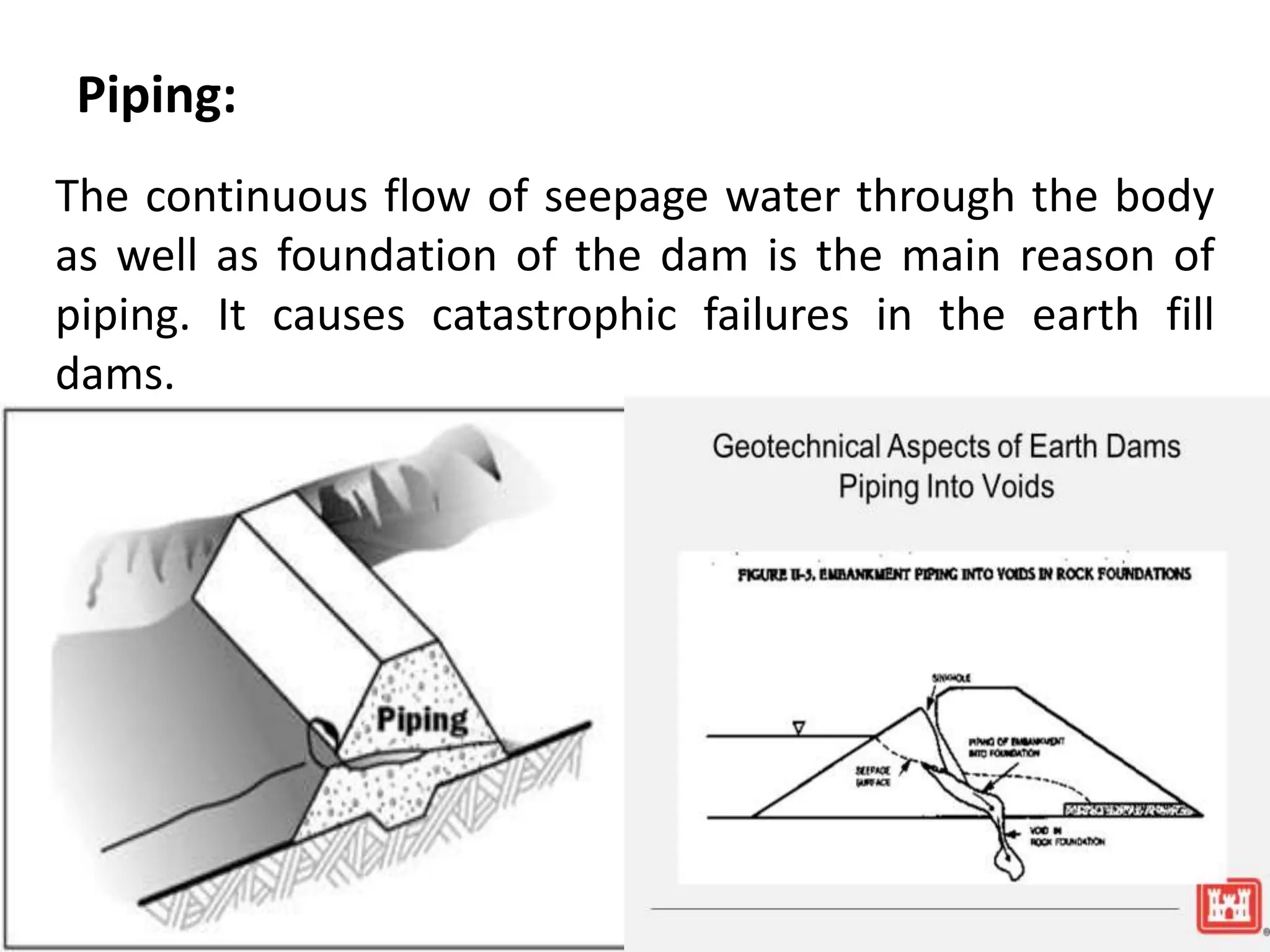
Piping:
The continuous flow of seepage water through the body
as well as foundation of the dam is the main reason of
piping. It causes catastrophic failures in the earth fill
dams.
THANK YOU
ANY QUESTIONS

Embankment dam

  • 1.
  • 2.
    What is? • Embankmentdams are water impounding structures. • These are flexible structures which can deform slightly to conform to the deflection of the foundation. • Embankment dam is primarily made out of earth and rock fragments. • Thus, the term embankment encompasses both earth and rock-fill dams.
  • 3.
    Types of EmbankmentDam. • 1. Rolled Fill Dam. • 2. Hydraulic Fill Dam. • The placed earth-fill type is widely used. three types, viz., diaphragm, homogeneous, and zoned.
  • 4.
  • 5.
    1. Foundation. The foundationof a dam is the sole supporting medium resisting the vertical and horizontal forces. 2. Casing. As pointed out earlier, the shell imparts stability and protects the core. 3. Core. The core acts as an impermeable barrier and prevents the free seepage of water through the body of the dam. The minimum top width of the core should be 3 meters, and the final thickness has to be decided based on the practical considerations given below (i) availability of suitable impervious material; (ii) resistance to piping; (iii) permissible seepage through the dam; (iv) availability of other materials for casing, filter, etc.
  • 6.
    Embankment Dam failures, 1.Hydraulic Failures: • i. Overtopping of the dam height. • ii. Wave action towards u/s side of the dam. • iii. Toe erosion. • iv. Gullying. 2. Seepage Type Failures: • i. Piping; and • ii. Sloughing.
  • 7.
    The dam isovertopped when the volume of incoming flow into the reservoir is more than the actual storage capacity of the reservoir, or the capacity of spillway is not sufficient. Sometimes, the faulty operation of spillway also leads to the overtopping problem. Similarly, insufficient free board or settlement of foundation as well as embankment also cause the overtopping problem in earthen dam. Overtopping of the dam height
  • 8.
    Wave Erosion: Wave actionremoves the soil particles from the unprotected part of upstream face of the dam, continuously. This is one of the effective factors to cause the hydraulic type failure in earthen dam.
  • 9.
    Toe Erosion: Toe erosionin the earth fill dam, mainly occurs due to following reasons: (i) Erosion caused by the tail water; and (ii) Erosion due to cross-currents produced by the storage water, spillway bucket or from the outlet, create the problem of hydraulic failure. This type of failure can be overcome by providing a thick layer of stone riprap on the downstream face up to the height of tail water level.
  • 10.
    Gully Erosion Development ofgully in earthen dam is the result of heavy down pour. Such type of failures can be eliminated by providing a proper size of berm, turf or good drainage system towards down-stream side of the dam. BERM a flat strip of land, raised bank, or terrace bordering a river or canal
  • 11.
    Piping: The continuous flowof seepage water through the body as well as foundation of the dam is the main reason of piping. It causes catastrophic failures in the earth fill dams.
  • 13.

Editor's Notes