Welcome
TO OUR PRESENTATION
Submitted to:
Fahmida Hossain Tithi
Assistant Professor
Department of EEE
Daffodil International University
Nahida Sultana 143-33-2135
Uzzal Hossain 143-33-2287
Parag Rahman 143-33-2269 Sadequr Rahaman
143-33-2268
Tariqul Islam 143-33-2283
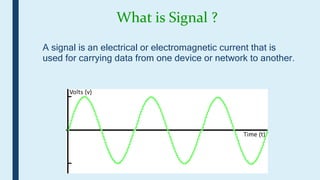
What is Signal ?
A signal is an electrical or electromagnetic current that is
used for carrying data from one device or network to another.
Main signal are two types :
1) Analog signal
2) Digital Signal
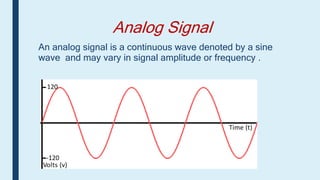
Analog Signal
An analog signal is a continuous wave denoted by a sine
wave and may vary in signal amplitude or frequency .
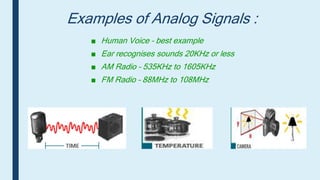
Examples of Analog Signals :
■ Human Voice – best example
■ Ear recognises sounds 20KHz or less
■ AM Radio – 535KHz to 1605KHz
■ FM Radio – 88MHz to 108MHz
Types of analog signal
■ DC Signal
■ Time Domain Signal
■ Frequency Domain Signal
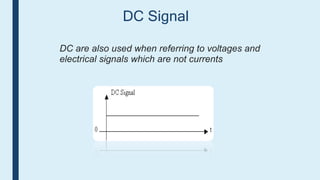
DC Signal
DC are also used when referring to voltages and
electrical signals which are not currents
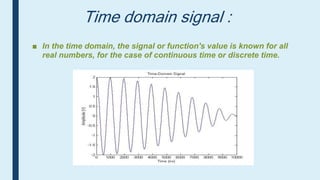
Time domain signal :
■ In the time domain, the signal or function's value is known for all
real numbers, for the case of continuous time or discrete time.
Digital signals
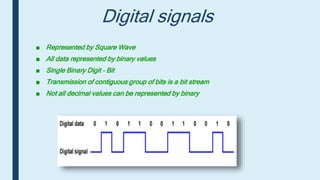
■ Represented by Square Wave
■ All data represented by binary values
■ Single Binary Digit – Bit
■ Transmission of contiguous group of bits is a bit stream
■ Not all decimal values can be represented by binary
Types of Digital signal
■ ON-OFF signal
■ Pulse Train signal
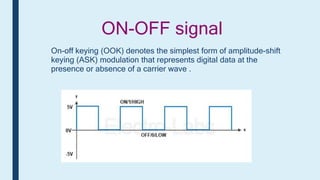
ON-OFF signal
On-off keying (OOK) denotes the simplest form of amplitude-shift
keying (ASK) modulation that represents digital data at the
presence or absence of a carrier wave .
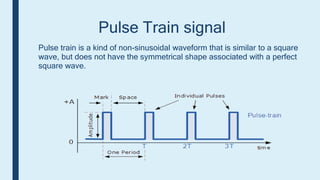
Pulse Train signal
Pulse train is a kind of non-sinusoidal waveform that is similar to a square
wave, but does not have the symmetrical shape associated with a perfect
square wave.
Classification of Signals
There are several classes of signals :
 Continuous time and discrete time signals
 Real and Complex signals
 Periodic and aperiodic signals
 Even and Odd Signals
 Energy and power signal
Continuous time and discrete time
signals
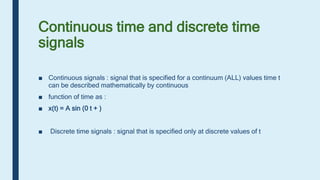
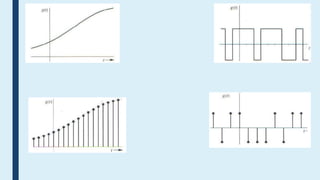
■ Continuous signals : signal that is specified for a continuum (ALL) values time t
can be described mathematically by continuous
■ function of time as :
■ x(t) = A sin (0 t + )
■ Discrete time signals : signal that is specified only at discrete values of t
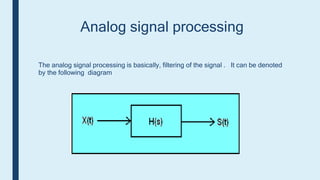
Analog signal processing
The analog signal processing is basically, filtering of the signal . It can be denoted
by the following diagram
Digital signal processing-Block
diagram
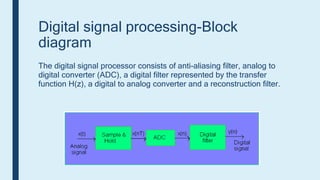
The digital signal processor consists of anti-aliasing filter, analog to
digital converter (ADC), a digital filter represented by the transfer
function H(z), a digital to analog converter and a reconstruction filter.
Signal to Noise
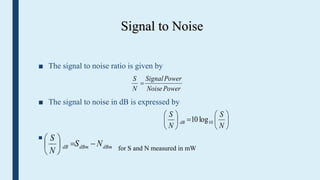
■ The signal to noise ratio is given by
■ The signal to noise in dB is expressed by
■
PowerNoise
PowerSignal
N
S













N
S
N
S
dB 10log10
dBmdBmdB NS
N
S






for S and N measured in mW
Analog vs. Digital
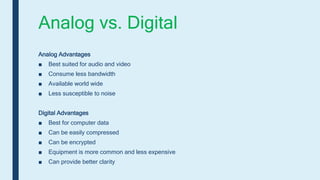
Analog Advantages
■ Best suited for audio and video
■ Consume less bandwidth
■ Available world wide
■ Less susceptible to noise
Digital Advantages
■ Best for computer data
■ Can be easily compressed
■ Can be encrypted
■ Equipment is more common and less expensive
■ Can provide better clarity
Thanks
TO All

Signal analysis

  • 1.
  • 2.
    Submitted to: Fahmida HossainTithi Assistant Professor Department of EEE Daffodil International University Nahida Sultana 143-33-2135 Uzzal Hossain 143-33-2287 Parag Rahman 143-33-2269 Sadequr Rahaman 143-33-2268 Tariqul Islam 143-33-2283
  • 3.
    What is Signal? A signal is an electrical or electromagnetic current that is used for carrying data from one device or network to another.
  • 4.
    Main signal aretwo types : 1) Analog signal 2) Digital Signal
  • 5.
    Analog Signal An analogsignal is a continuous wave denoted by a sine wave and may vary in signal amplitude or frequency .
  • 6.
    Examples of AnalogSignals : ■ Human Voice – best example ■ Ear recognises sounds 20KHz or less ■ AM Radio – 535KHz to 1605KHz ■ FM Radio – 88MHz to 108MHz
  • 7.
    Types of analogsignal ■ DC Signal ■ Time Domain Signal ■ Frequency Domain Signal
  • 8.
    DC Signal DC arealso used when referring to voltages and electrical signals which are not currents
  • 9.
    Time domain signal: ■ In the time domain, the signal or function's value is known for all real numbers, for the case of continuous time or discrete time.
  • 10.
    Digital signals ■ Representedby Square Wave ■ All data represented by binary values ■ Single Binary Digit – Bit ■ Transmission of contiguous group of bits is a bit stream ■ Not all decimal values can be represented by binary
  • 11.
    Types of Digitalsignal ■ ON-OFF signal ■ Pulse Train signal
  • 12.
    ON-OFF signal On-off keying(OOK) denotes the simplest form of amplitude-shift keying (ASK) modulation that represents digital data at the presence or absence of a carrier wave .
  • 13.
    Pulse Train signal Pulsetrain is a kind of non-sinusoidal waveform that is similar to a square wave, but does not have the symmetrical shape associated with a perfect square wave.
  • 14.
    Classification of Signals Thereare several classes of signals :  Continuous time and discrete time signals  Real and Complex signals  Periodic and aperiodic signals  Even and Odd Signals  Energy and power signal
  • 15.
    Continuous time anddiscrete time signals ■ Continuous signals : signal that is specified for a continuum (ALL) values time t can be described mathematically by continuous ■ function of time as : ■ x(t) = A sin (0 t + ) ■ Discrete time signals : signal that is specified only at discrete values of t
  • 17.
    Analog signal processing Theanalog signal processing is basically, filtering of the signal . It can be denoted by the following diagram
  • 18.
    Digital signal processing-Block diagram Thedigital signal processor consists of anti-aliasing filter, analog to digital converter (ADC), a digital filter represented by the transfer function H(z), a digital to analog converter and a reconstruction filter.
  • 19.
    Signal to Noise ■The signal to noise ratio is given by ■ The signal to noise in dB is expressed by ■ PowerNoise PowerSignal N S              N S N S dB 10log10 dBmdBmdB NS N S       for S and N measured in mW
  • 20.
    Analog vs. Digital AnalogAdvantages ■ Best suited for audio and video ■ Consume less bandwidth ■ Available world wide ■ Less susceptible to noise Digital Advantages ■ Best for computer data ■ Can be easily compressed ■ Can be encrypted ■ Equipment is more common and less expensive ■ Can provide better clarity
  • 21.