15EE55C – DIGITAL SIGNAL PROCESSING AND
ITS APPLICATIONS
SIGNALS AND SYSTEMS
Mr. K. Karthik Kumar
AP/EEE
DEPARTMENT OF ELECTRICAL AND ELECTRONICS ENGINEERING
NATIONAL ENGINEERING COLLEGE, K.R. NAGAR, KOVILPATTI – 628 503
(An Autonomous Institution, Affiliated to Anna University – Chennai)
SIGNALS
 In electrical engineering, the fundamental quantity of representing some
information is called a signal.
 It does not matter what the information is i-e: Analog or digital
information.
 In mathematics, a signal is a function that conveys some information.
 In fact any quantity measurable through time over space or any higher
dimension can be taken as a signal.
 A signal could be of any dimension and could be of any form.
 Example: x(t) = 10t & X(t) = 5x2+20xy+30y
ANALOG SIGNALS
 A signal could be an analog quantity that means it is defined with
respect to the time.
 It is a continuous signal.
 These signals are defined over continuous independent variables.
 They are difficult to analyze, as they carry a huge number of values.
 They are very much accurate due to a large sample of values.
 In order to store these signals , you require an infinite memory because
it can achieve infinite values on a real line.
 Analog signals are denoted by sin waves.
EXAMPLE FOR ANALOG SIGNALS
 Human voice
 Human voice is an example of
analog signals.
 When you speak, the voice
that is produced travel through
air in the form of pressure
waves and thus belongs to a
mathematical function, having
independent variables of space
and time and a value
corresponding to air pressure.
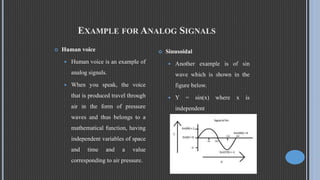
 Sinusoidal
 Another example is of sin
wave which is shown in the
figure below.
 Y = sin(x) where x is
independent
DIGITAL SIGNALS
 As compared to analog signals, digital signals are very easy to analyze.
 They are discontinuous signals.
 They are the appropriation of analog signals.
 The word digital stands for discrete values and hence it means that they use
specific values to represent any information.
 In digital signal, only two values are used to represent something i-e: 1 and
0 (binary values).
 Digital signals are less accurate then analog signals because they are the
discrete samples of an analog signal taken over some period of time.
 However digital signals are not subject to noise.
 So they last long and are easy to interpret. Digital signals are denoted by
square waves.
EXAMPLE FOR DIGITAL SIGNALS
 Computer keyboard
 Whenever a key is pressed from the keyboard, the appropriate
electrical signal is sent to keyboard controller containing the ASCII
value that particular key.
 For example the electrical signal that is generated when keyboard
key a is pressed, carry information of digit 97 in the form of 0 and 1,
which is the ASCII value of character a.
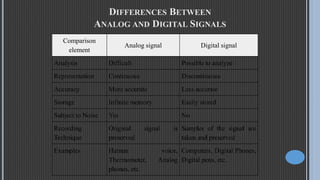
DIFFERENCES BETWEEN
ANALOG AND DIGITAL SIGNALS
Comparison
element
Analog signal Digital signal
Analysis Difficult Possible to analyze
Representation Continuous Discontinuous
Accuracy More accurate Less accurate
Storage Infinite memory Easily stored
Subject to Noise Yes No
Recording
Technique
Original signal is
preserved
Samples of the signal are
taken and preserved
Examples Human voice,
Thermometer, Analog
phones, etc.
Computers, Digital Phones,
Digital pens, etc.
SYSTEMS
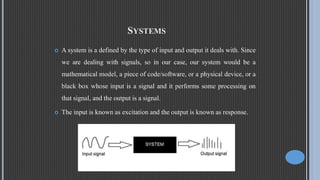
 A system is a defined by the type of input and output it deals with. Since
we are dealing with signals, so in our case, our system would be a
mathematical model, a piece of code/software, or a physical device, or a
black box whose input is a signal and it performs some processing on
that signal, and the output is a signal.
 The input is known as excitation and the output is known as response.

Signals and Systems

  • 1.
    15EE55C – DIGITALSIGNAL PROCESSING AND ITS APPLICATIONS SIGNALS AND SYSTEMS Mr. K. Karthik Kumar AP/EEE DEPARTMENT OF ELECTRICAL AND ELECTRONICS ENGINEERING NATIONAL ENGINEERING COLLEGE, K.R. NAGAR, KOVILPATTI – 628 503 (An Autonomous Institution, Affiliated to Anna University – Chennai)
  • 2.
    SIGNALS  In electricalengineering, the fundamental quantity of representing some information is called a signal.  It does not matter what the information is i-e: Analog or digital information.  In mathematics, a signal is a function that conveys some information.  In fact any quantity measurable through time over space or any higher dimension can be taken as a signal.  A signal could be of any dimension and could be of any form.  Example: x(t) = 10t & X(t) = 5x2+20xy+30y
  • 3.
    ANALOG SIGNALS  Asignal could be an analog quantity that means it is defined with respect to the time.  It is a continuous signal.  These signals are defined over continuous independent variables.  They are difficult to analyze, as they carry a huge number of values.  They are very much accurate due to a large sample of values.  In order to store these signals , you require an infinite memory because it can achieve infinite values on a real line.  Analog signals are denoted by sin waves.
  • 4.
    EXAMPLE FOR ANALOGSIGNALS  Human voice  Human voice is an example of analog signals.  When you speak, the voice that is produced travel through air in the form of pressure waves and thus belongs to a mathematical function, having independent variables of space and time and a value corresponding to air pressure.  Sinusoidal  Another example is of sin wave which is shown in the figure below.  Y = sin(x) where x is independent
  • 5.
    DIGITAL SIGNALS  Ascompared to analog signals, digital signals are very easy to analyze.  They are discontinuous signals.  They are the appropriation of analog signals.  The word digital stands for discrete values and hence it means that they use specific values to represent any information.  In digital signal, only two values are used to represent something i-e: 1 and 0 (binary values).  Digital signals are less accurate then analog signals because they are the discrete samples of an analog signal taken over some period of time.  However digital signals are not subject to noise.  So they last long and are easy to interpret. Digital signals are denoted by square waves.
  • 6.
    EXAMPLE FOR DIGITALSIGNALS  Computer keyboard  Whenever a key is pressed from the keyboard, the appropriate electrical signal is sent to keyboard controller containing the ASCII value that particular key.  For example the electrical signal that is generated when keyboard key a is pressed, carry information of digit 97 in the form of 0 and 1, which is the ASCII value of character a.
  • 7.
    DIFFERENCES BETWEEN ANALOG ANDDIGITAL SIGNALS Comparison element Analog signal Digital signal Analysis Difficult Possible to analyze Representation Continuous Discontinuous Accuracy More accurate Less accurate Storage Infinite memory Easily stored Subject to Noise Yes No Recording Technique Original signal is preserved Samples of the signal are taken and preserved Examples Human voice, Thermometer, Analog phones, etc. Computers, Digital Phones, Digital pens, etc.
  • 8.
    SYSTEMS  A systemis a defined by the type of input and output it deals with. Since we are dealing with signals, so in our case, our system would be a mathematical model, a piece of code/software, or a physical device, or a black box whose input is a signal and it performs some processing on that signal, and the output is a signal.  The input is known as excitation and the output is known as response.