
Vinayak V Khairnar
Medicinal Chemistry
C-O, C-N and C-S
Bond
Formation
Methodologies
1
Content……….
❑ Introduction
❑ Background
❑ Importance of Carbon Heteroatom Bonds in Medicinal &
Organic chemistry
❑ Organic Chemistry Perspective
❑ Literature Review
❑ Conclusion
2
Carbon-Heteroatombonds in drug receptor interactions
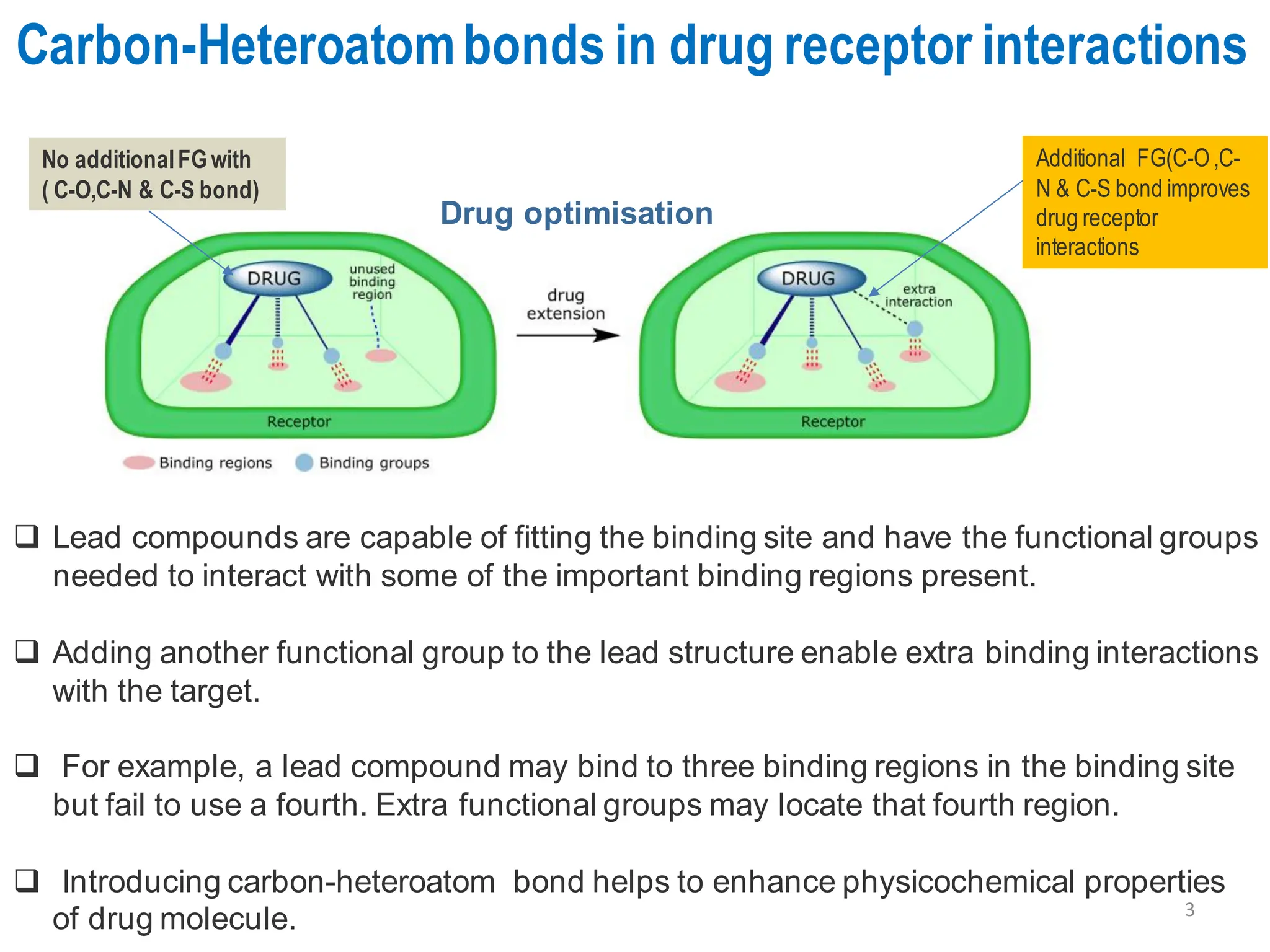
❑ Lead compounds are capable of fitting the binding site and have the functional groups
needed to interact with some of the important binding regions present.
❑ Adding another functional group to the lead structure enable extra binding interactions
with the target.
❑ For example, a lead compound may bind to three binding regions in the binding site
but fail to use a fourth. Extra functional groups may locate that fourth region.
❑ Introducing carbon-heteroatom bond helps to enhance physicochemical properties
of drug molecule.
Additional FG(C-O,C-
N & C-S bond improves
drug receptor
interactions
No additionalFGwith
( C-O,C-N & C-S bond)
Drug optimisation
3
Captopril: Importanceof C-N bond
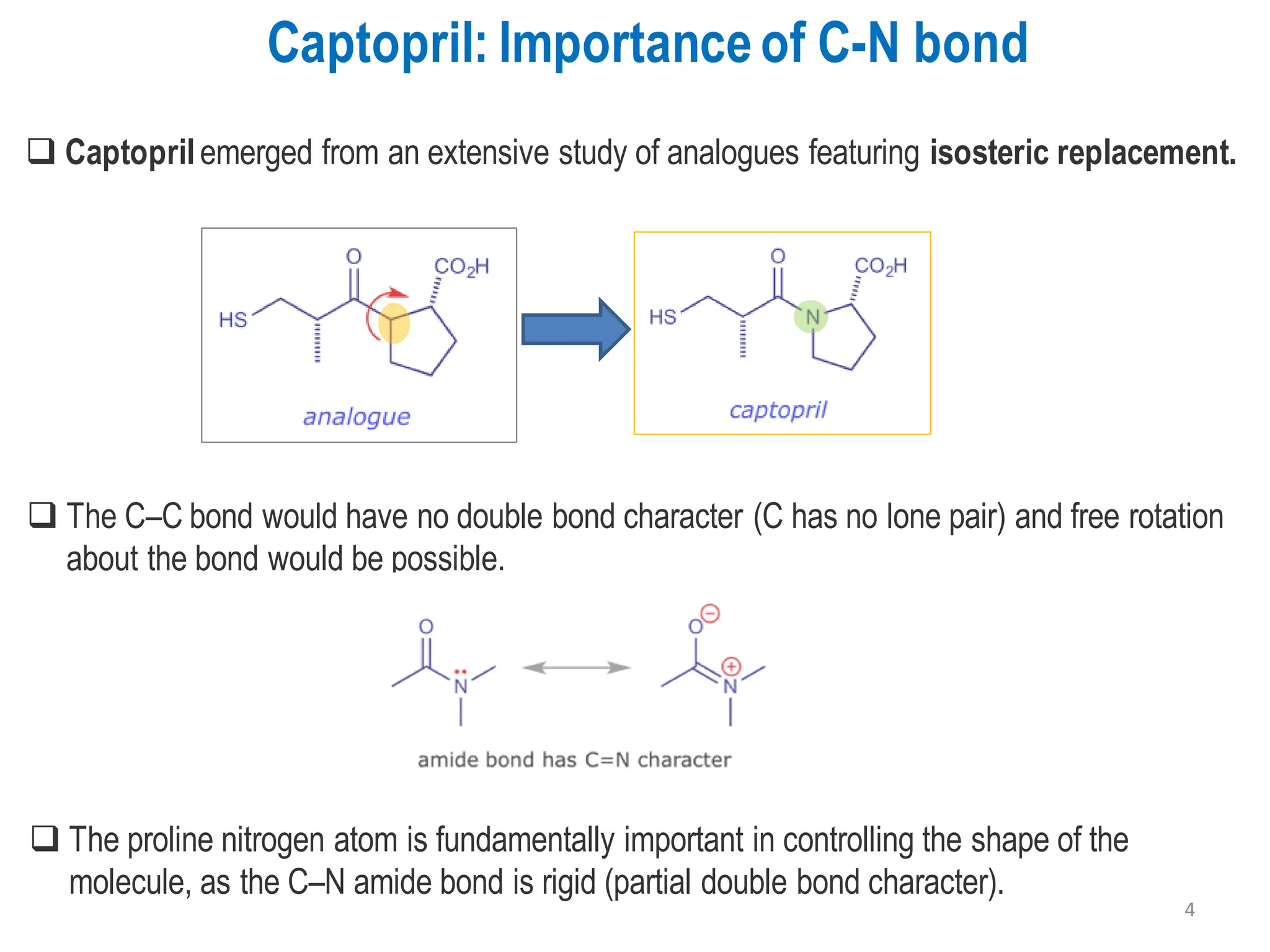
❑ The C–C bond would have no double bond character (C has no lone pair) and free rotation
about the bond would be possible.
❑ Captoprilemerged from an extensive study of analogues featuring isosteric replacement.
❑ The proline nitrogen atom is fundamentally important in controlling the shape of the
molecule, as the C–N amide bond is rigid (partial double bond character).
4
❑ The carbon–heteroatom bond forming reactions are of much importance in academia as
well as pharmaceutical industry.
❑ Carbon-carbon / carbon-heteroatom bond-forming reactions are the backbone of synthetic
organic chemistry
❑ Today’s scientists are constantly trying to develop new methods for such bond forming
reactions as these are one of the valuable tools for the syntheses of structurally diverse
molecular entities.
❑ The hetero atoms and their bond formation play important role in synthesis of drug
molecules.
❑ Construction of C-C, C-O, C-N, and C-S bonds are reviewed with special emphasis on
their synthetic applications.
Organic Chemistry Perspective
5
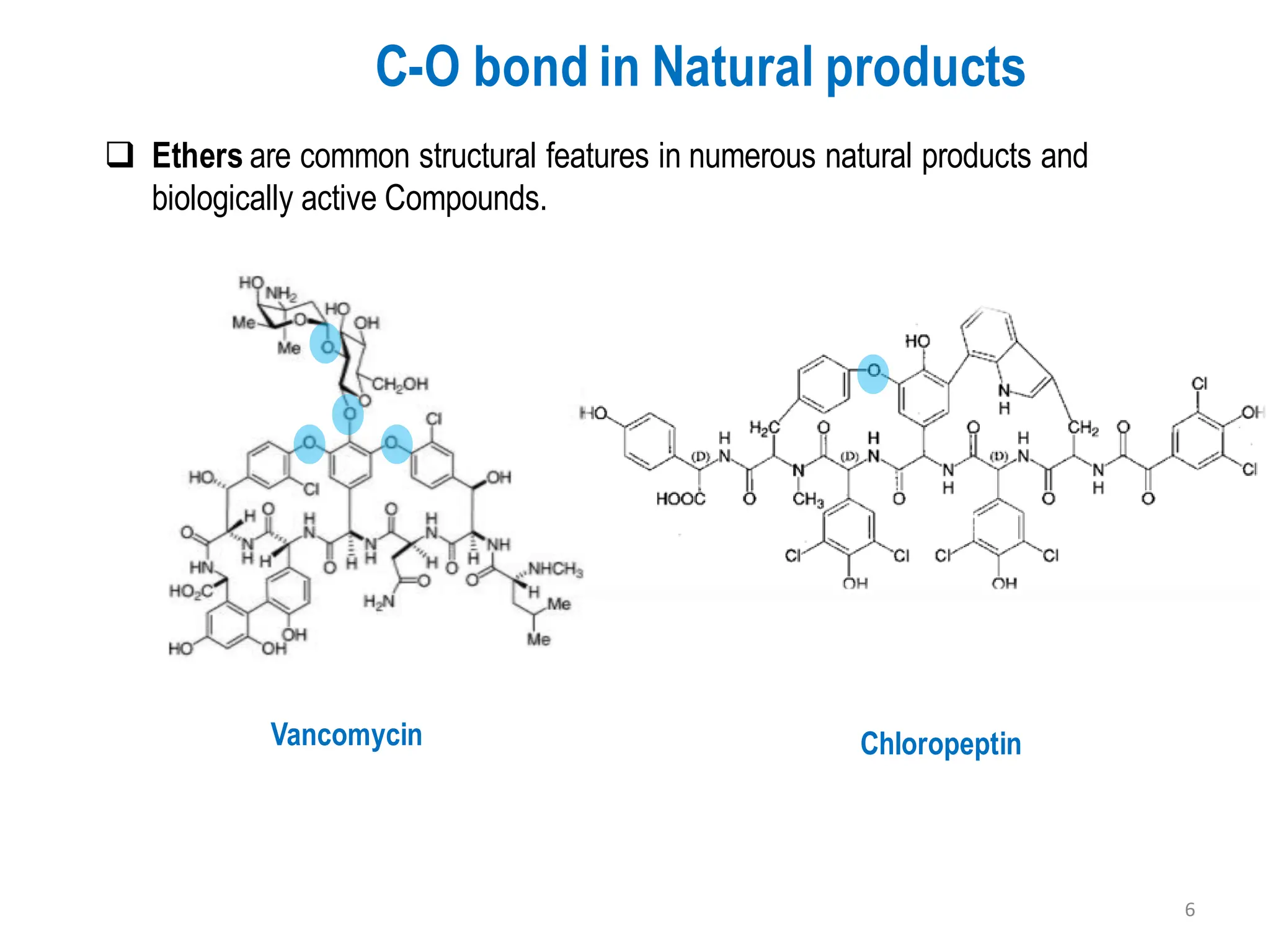
Vancomycin Chloropeptin
C-O bond in Natural products
❑ Ethers are common structural features in numerous natural products and
biologically active Compounds.
6
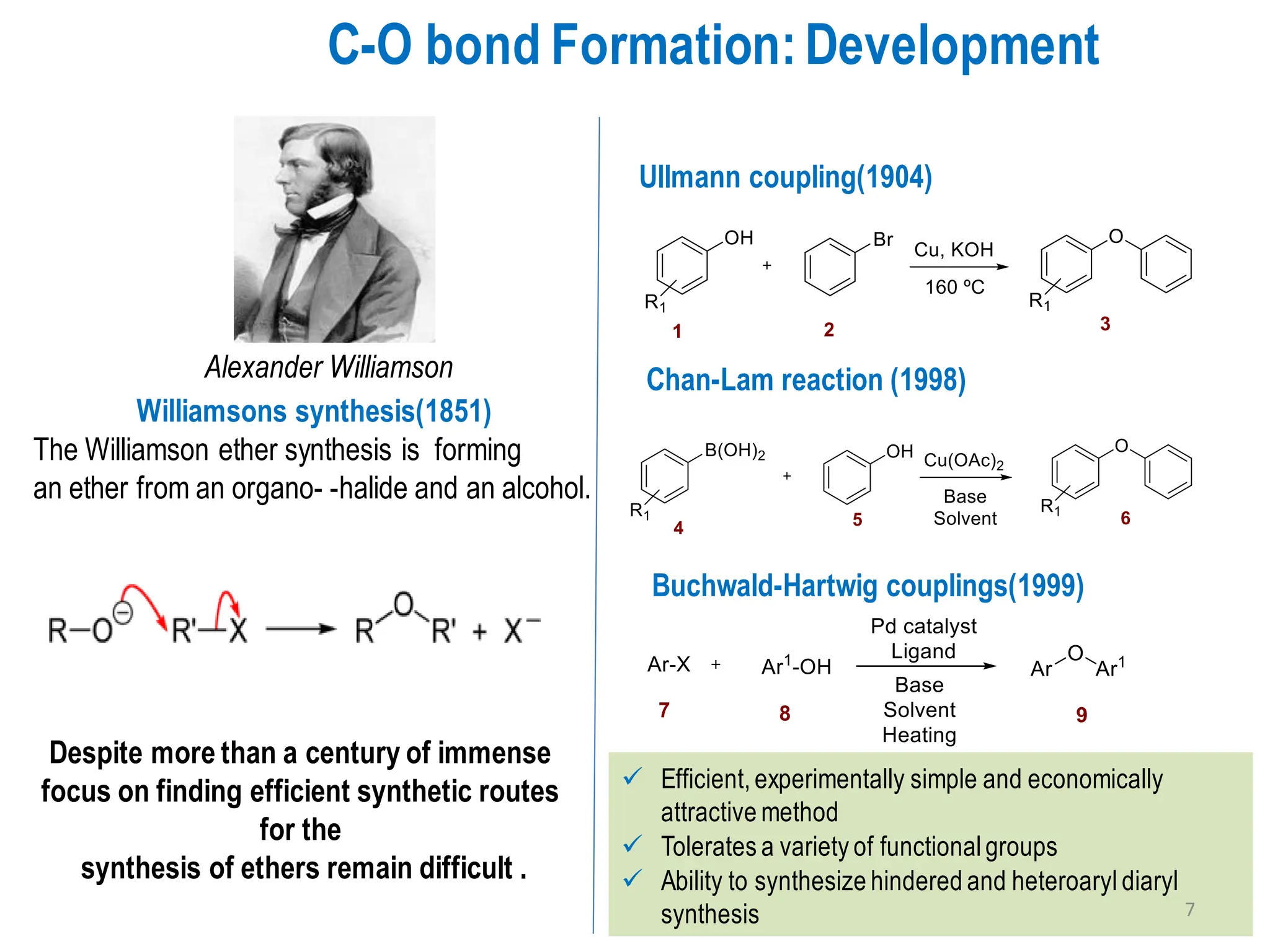
Williamsons synthesis(1851)
The Williamson ether synthesis is forming
an ether from an organo- -halide and an alcohol.
Despite more than a century of immense
focus on finding efficient synthetic routes
for the
synthesis of ethers remain difficult .
Alexander Williamson
C-O bond Formation:Development
Ullmann coupling(1904)
Chan-Lam reaction (1998)
Buchwald-Hartwig couplings(1999)
✓ Efficient, experimentally simple and economically
attractive method
✓ Tolerates a variety of functionalgroups
✓ Ability to synthesize hindered and heteroaryl diaryl
synthesis 7
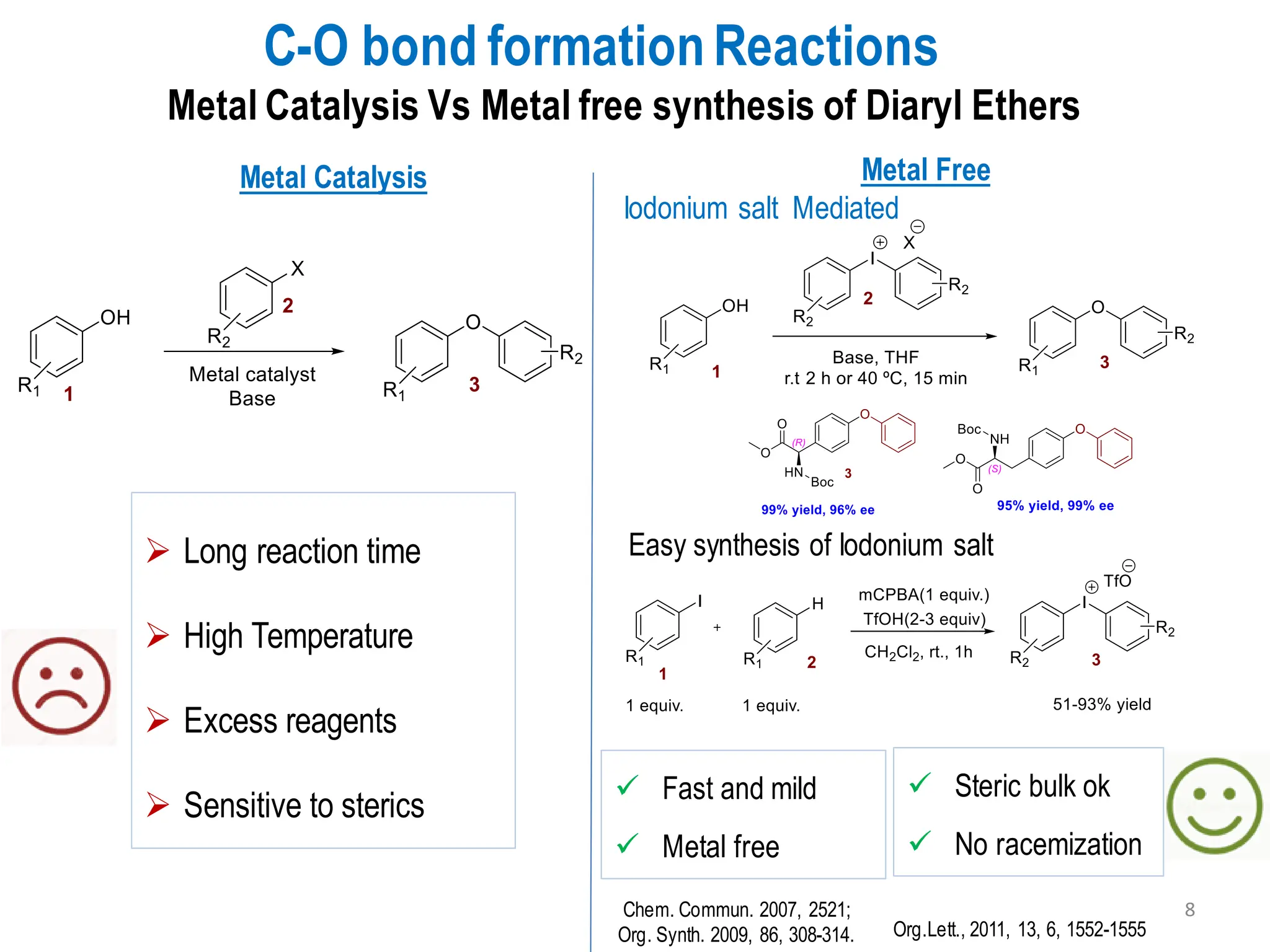
Metal Catalysis Vs Metal free synthesis of Diaryl Ethers
Metal Catalysis
Iodonium salt Mediated
C-O bond formationReactions
➢ Long reaction time
➢ High Temperature
➢ Excess reagents
➢ Sensitive to sterics
Metal Free
Org.Lett., 2011, 13, 6, 1552-1555
✓ Fast and mild
✓ Metal free
✓ Steric bulk ok
✓ No racemization
Easy synthesis of Iodonium salt
Chem. Commun. 2007, 2521;
Org. Synth. 2009, 86, 308-314.
8
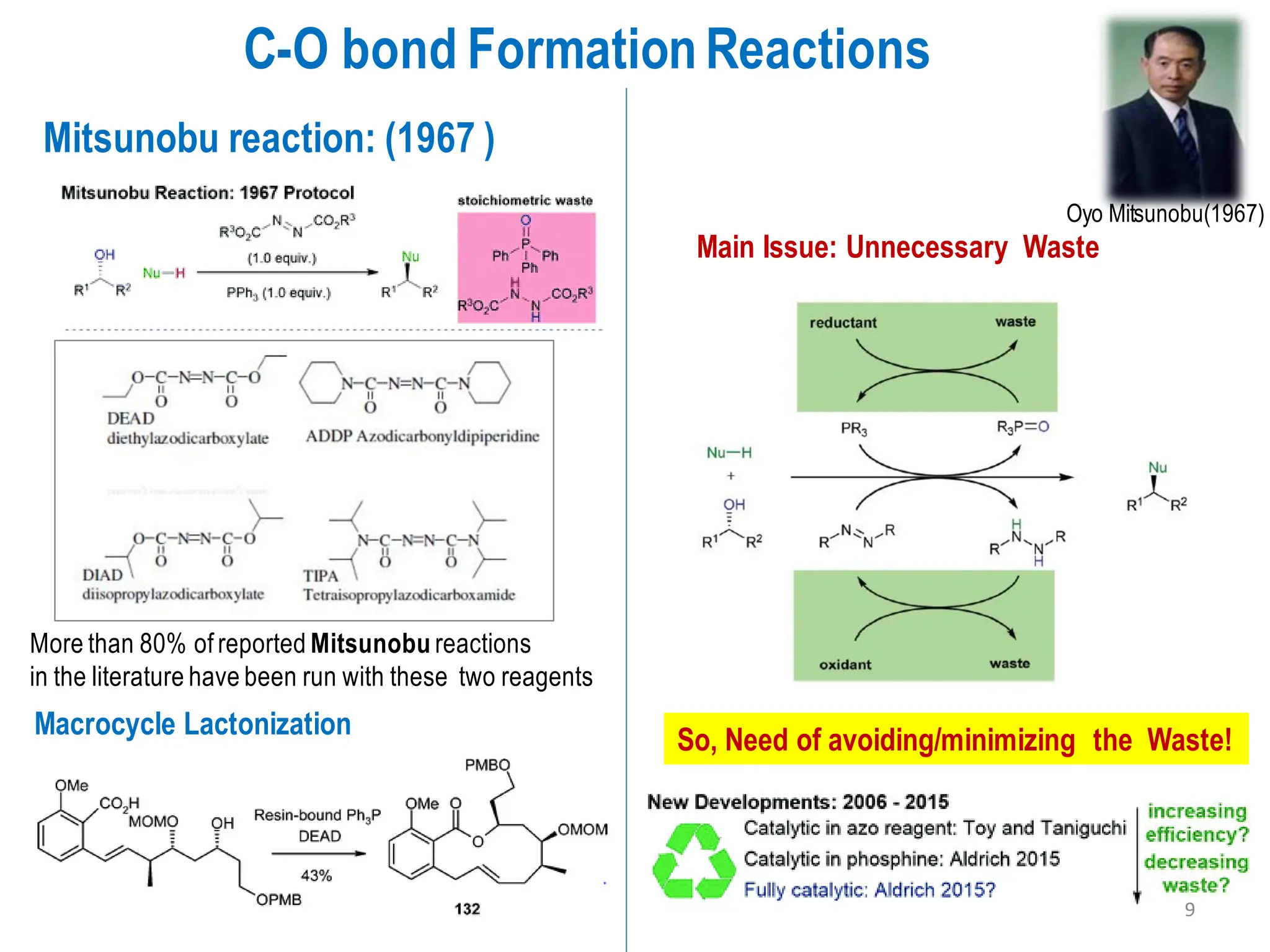
Mitsunobu reaction: (1967 )
More than 80% of reported Mitsunobu reactions
in the literature have been run with these two reagents
C-O bond FormationReactions
Macrocycle Lactonization
Oyo Mitsunobu(1967)
Main Issue: Unnecessary Waste
So, Need of avoiding/minimizing the Waste!
9
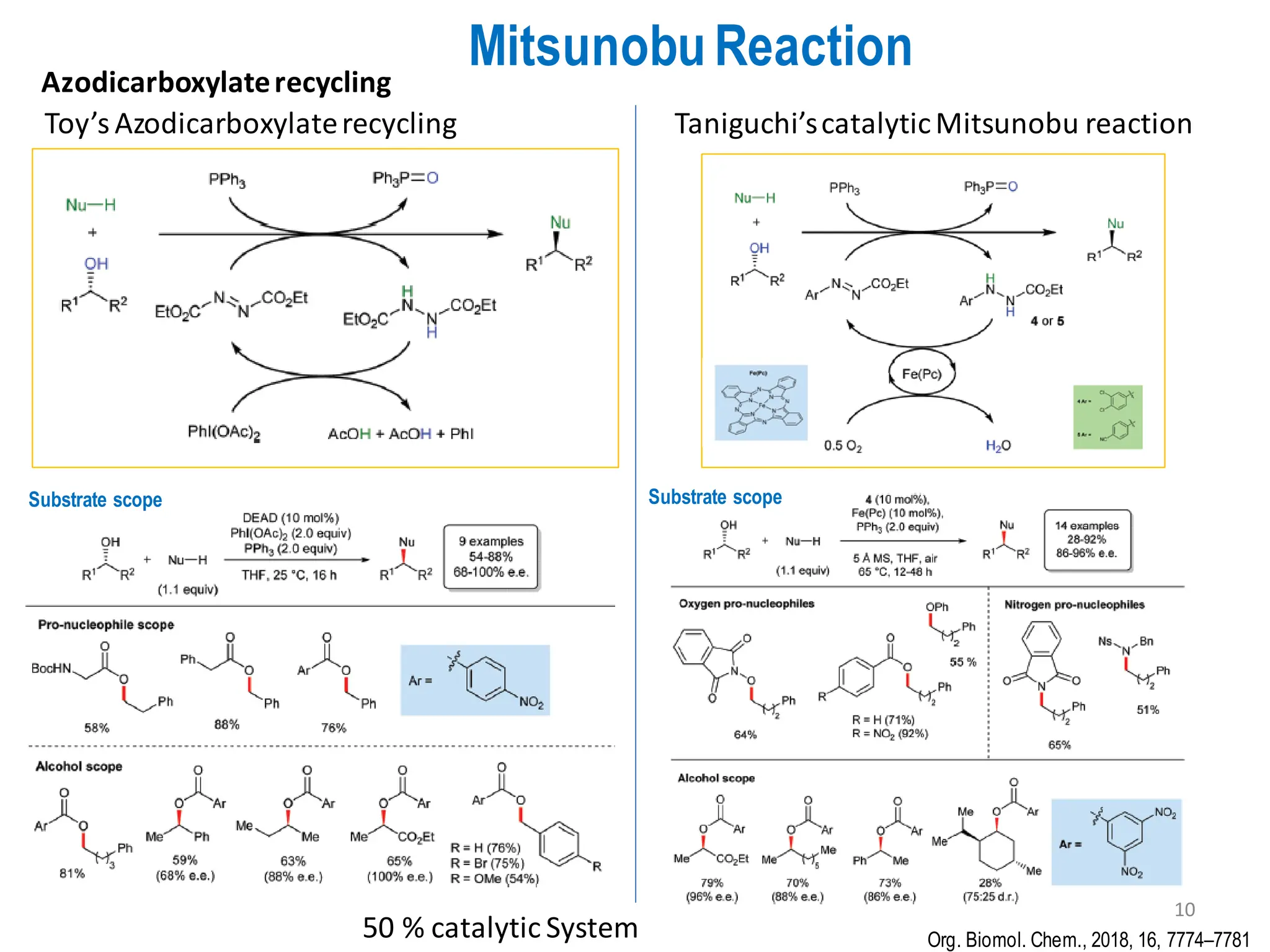
Toy’sAzodicarboxylaterecycling
MitsunobuReaction
Azodicarboxylaterecycling
Taniguchi’scatalyticMitsunobu reaction
Substrate scope Substrate scope
50 % catalytic System Org. Biomol. Chem., 2018, 16, 7774–7781
10
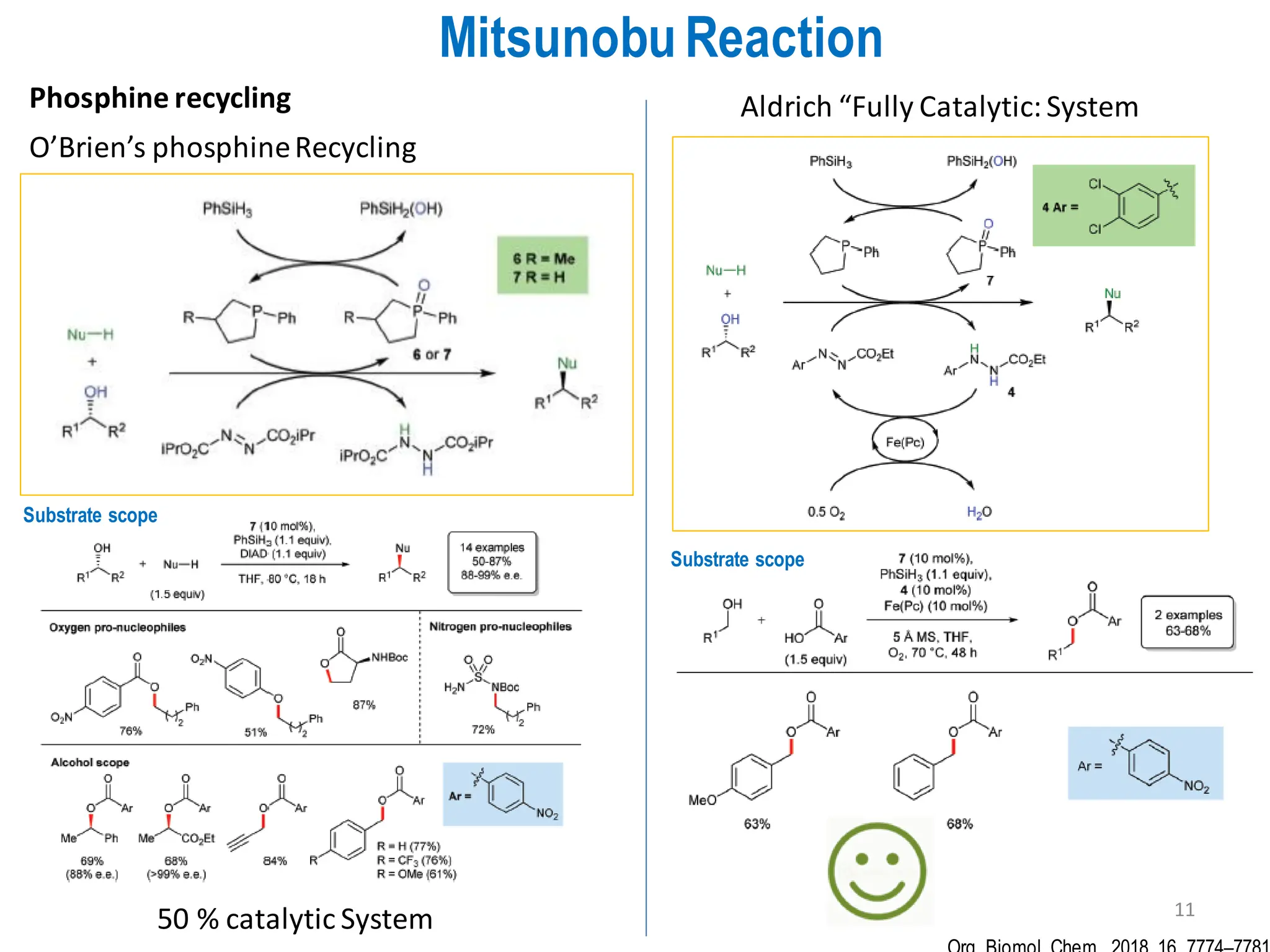
Phosphine recycling
O’Brien’s phosphineRecycling
MitsunobuReaction
Aldrich “Fully Catalytic:System
50 % catalytic System
Substrate scope
Substrate scope
11
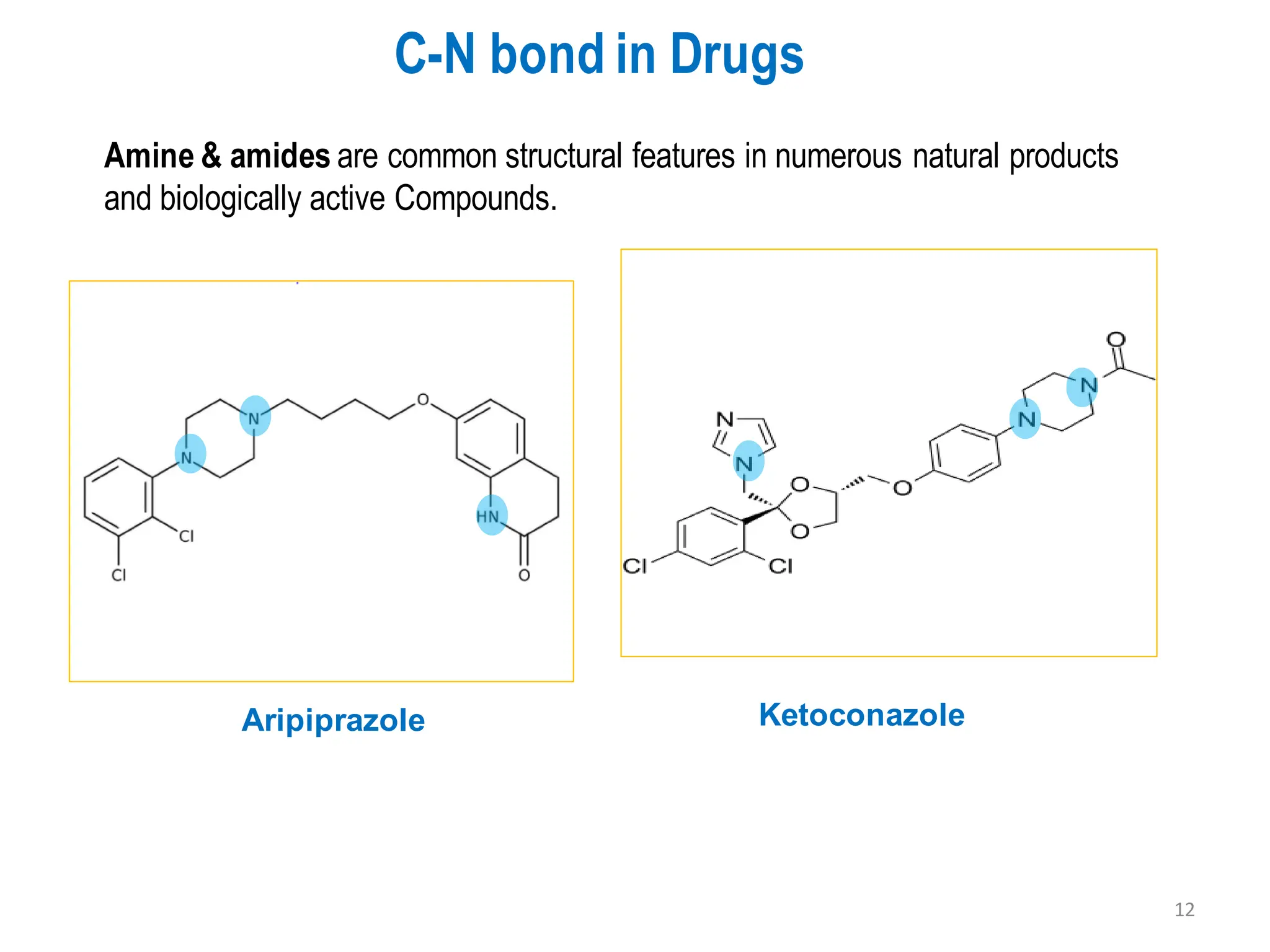
C-N bond in Drugs
Amine & amides are common structural features in numerous natural products
and biologically active Compounds.
Ketoconazole
Aripiprazole
12
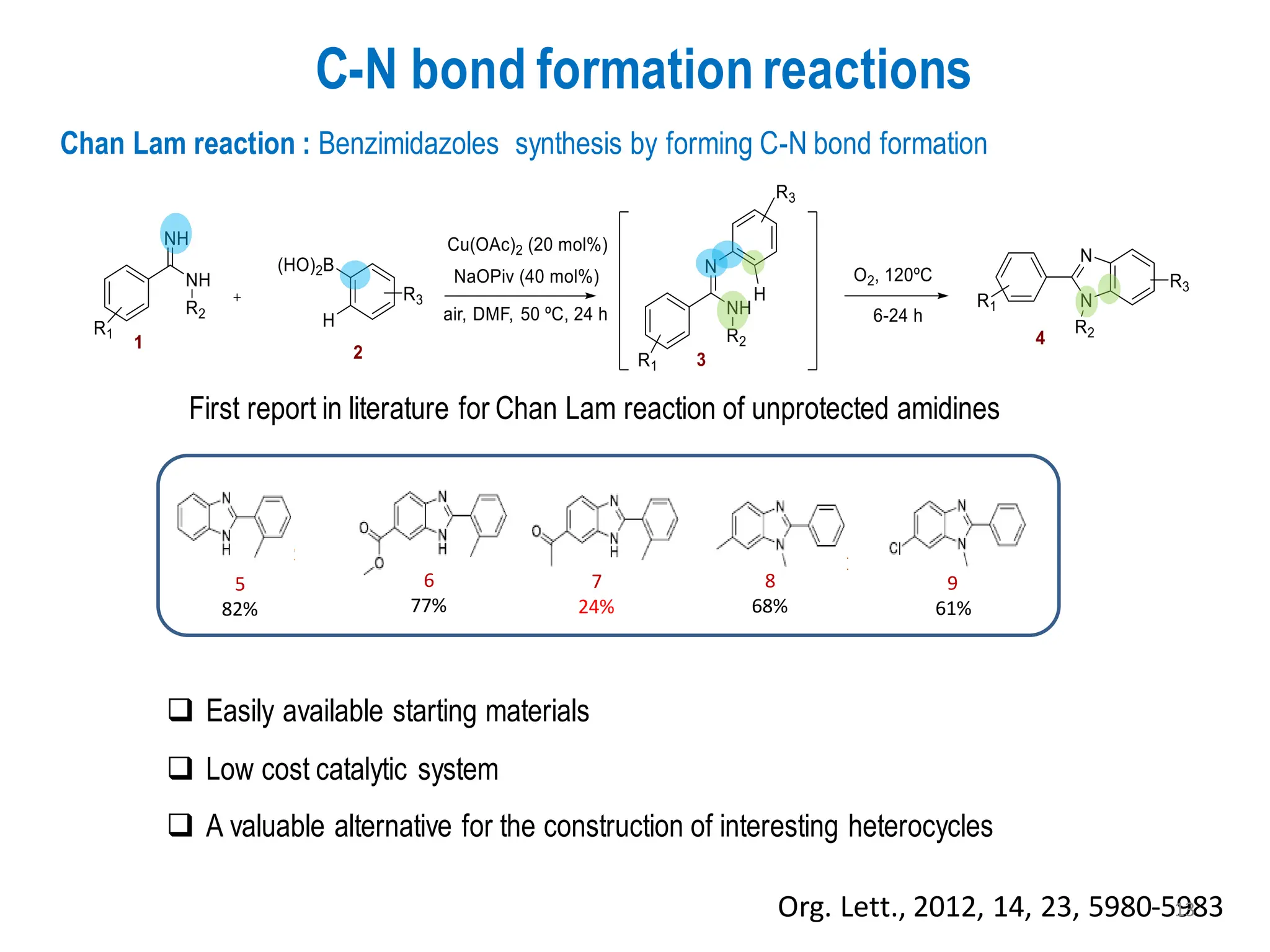
C-N bond formationreactions
❑ Easily available starting materials
❑ Low cost catalytic system
❑ A valuable alternative for the construction of interesting heterocycles
Chan Lam reaction : Benzimidazoles synthesis by forming C-N bond formation
5
82%
6
77%
7
24%
8
68%
9
61%
Org. Lett., 2012, 14, 23, 5980-5983
First report in literature for Chan Lam reaction of unprotected amidines
13
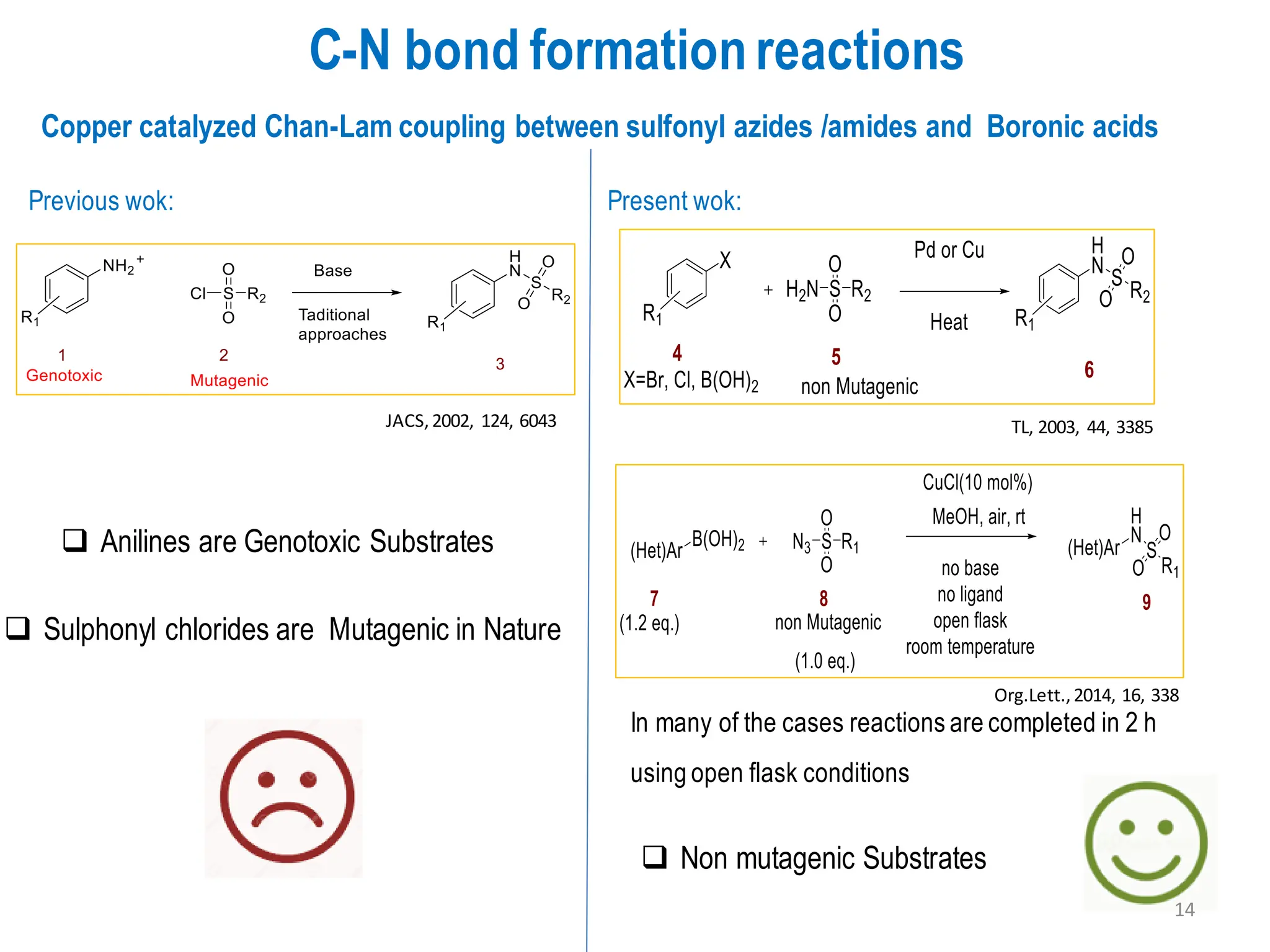
Copper catalyzed Chan-Lam coupling between sulfonyl azides /amides and Boronic acids
Previous wok:
In many of the cases reactions are completed in 2 h
using open flask conditions
Present wok:
TL, 2003, 44, 3385
Org.Lett.,2014, 16, 338
C-N bond formationreactions
JACS,2002, 124, 6043
❑ Anilines are Genotoxic Substrates
❑ Sulphonyl chlorides are Mutagenic in Nature
❑ Non mutagenic Substrates
14
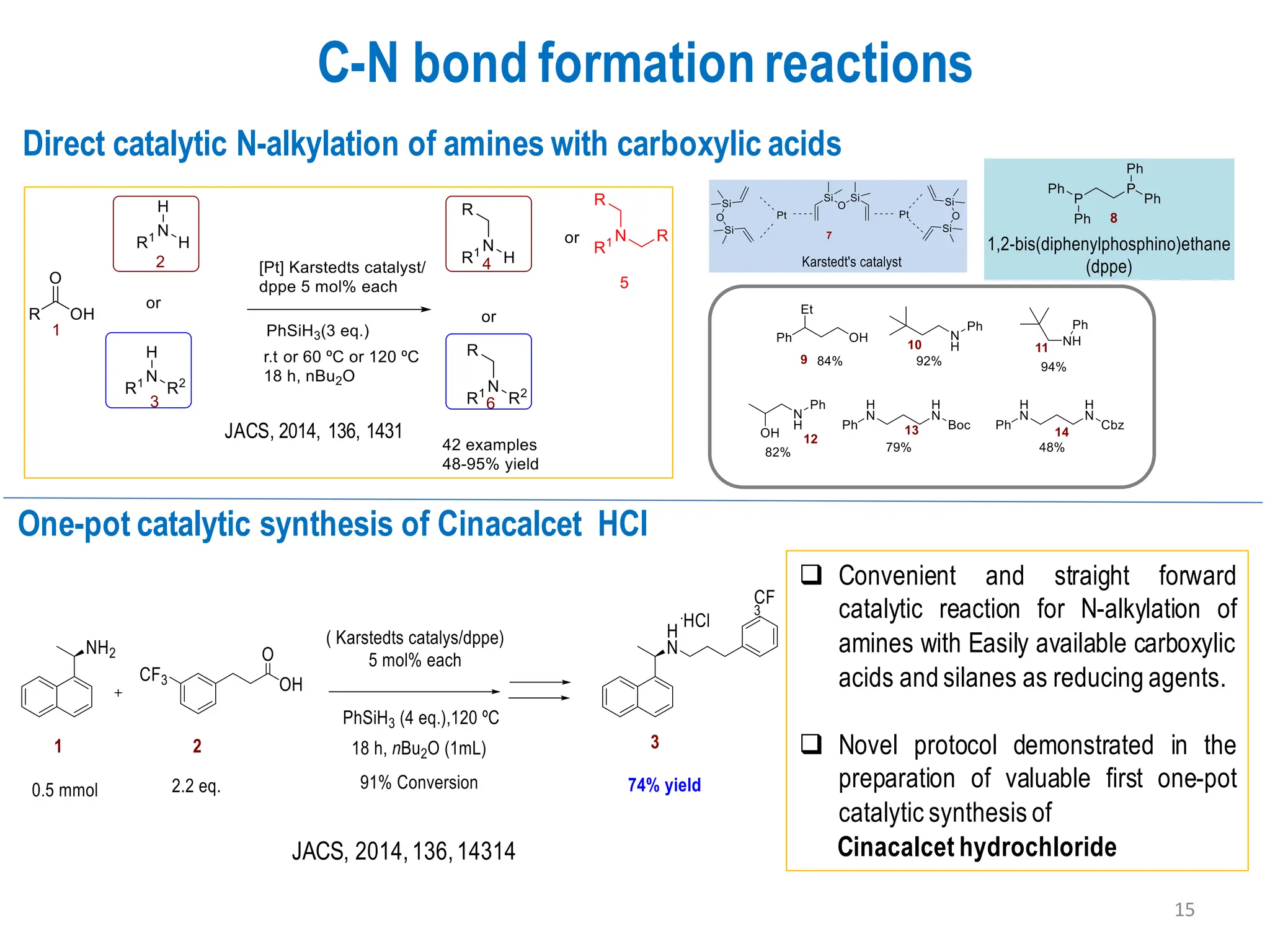
Direct catalytic N-alkylation of amines with carboxylic acids
C-N bond formation reactions
JACS, 2014, 136, 1431
One-pot catalytic synthesis of Cinacalcet HCl
JACS, 2014,136,14314
❑ Convenient and straight forward
catalytic reaction for N-alkylation of
amines with Easily available carboxylic
acids and silanes as reducing agents.
❑ Novel protocol demonstrated in the
preparation of valuable first one-pot
catalytic synthesis of
Cinacalcet hydrochloride
15
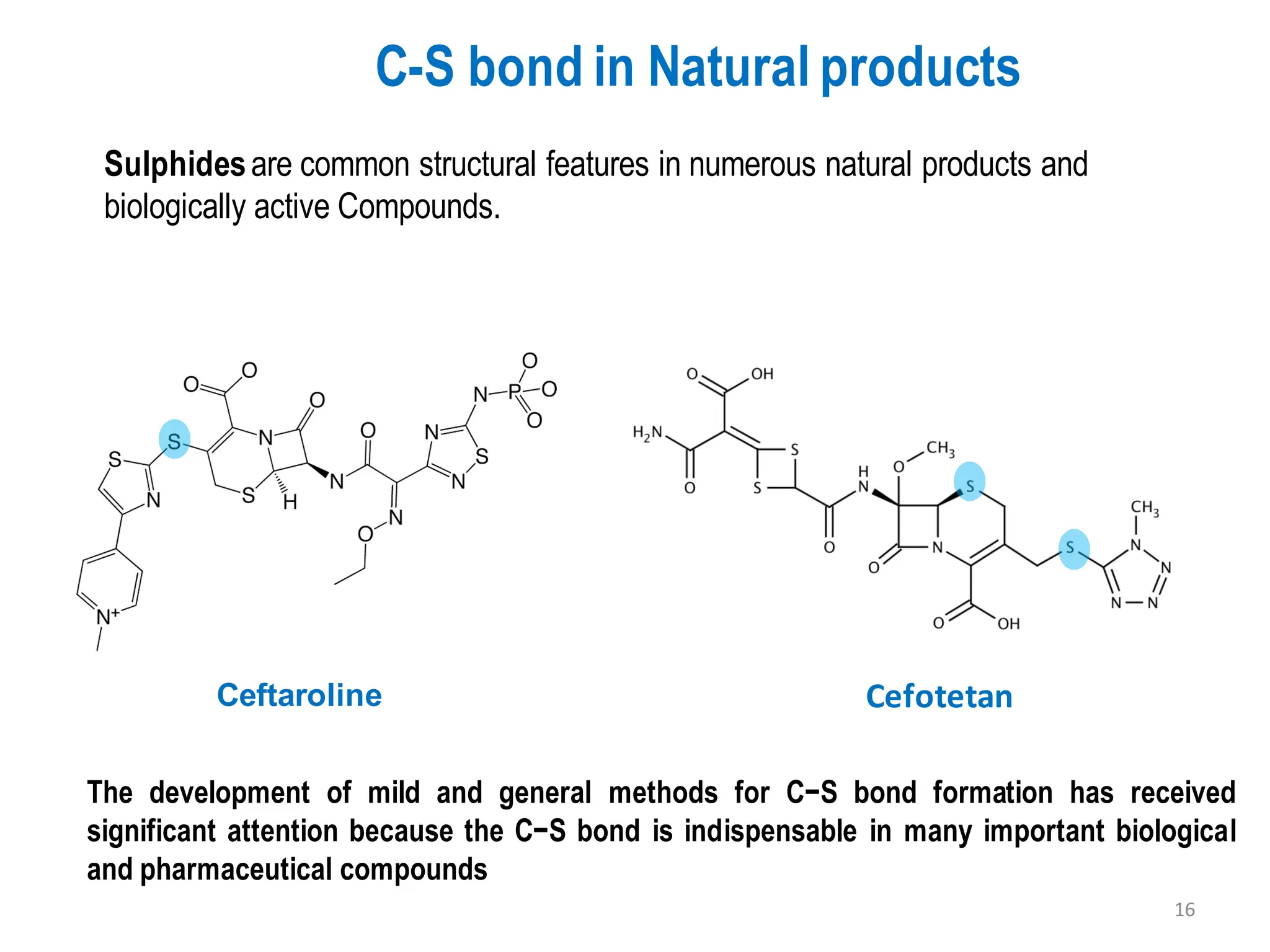
C-S bond in Natural products
Sulphidesare common structural features in numerous natural products and
biologically active Compounds.
Ceftaroline Cefotetan
The development of mild and general methods for C−S bond formation has received
significant attention because the C−S bond is indispensable in many important biological
and pharmaceutical compounds
16
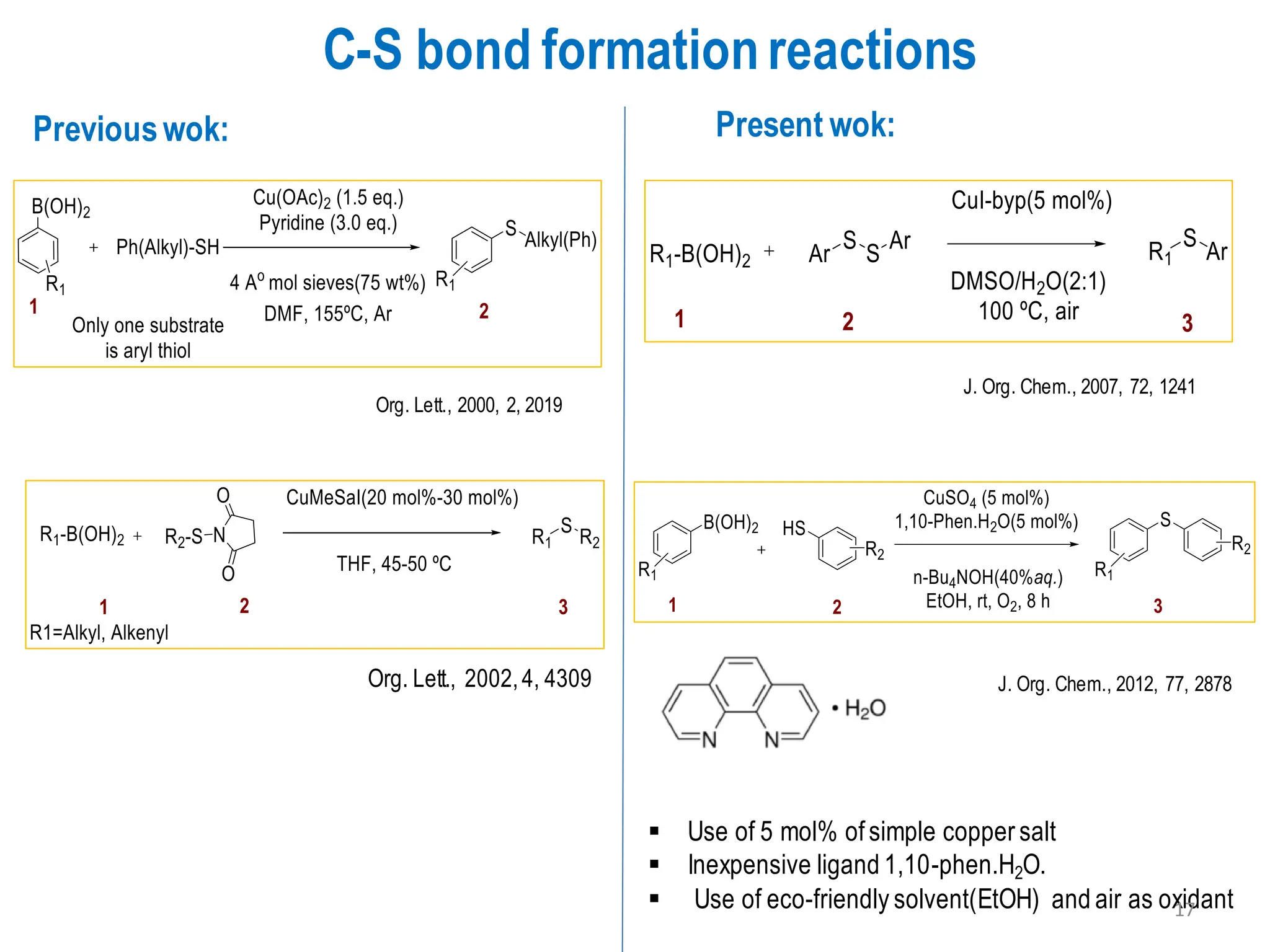
Previouswok:
▪ Use of 5 mol% of simple copper salt
▪ Inexpensive ligand 1,10-phen.H2O.
▪ Use of eco-friendly solvent(EtOH) and air as oxidant
C-S bond formationreactions
Present wok:
Org. Lett., 2000, 2, 2019
Org. Lett., 2002,4, 4309
J. Org. Chem., 2007, 72, 1241
J. Org. Chem., 2012, 77, 2878
17
C-S bond formation reactions
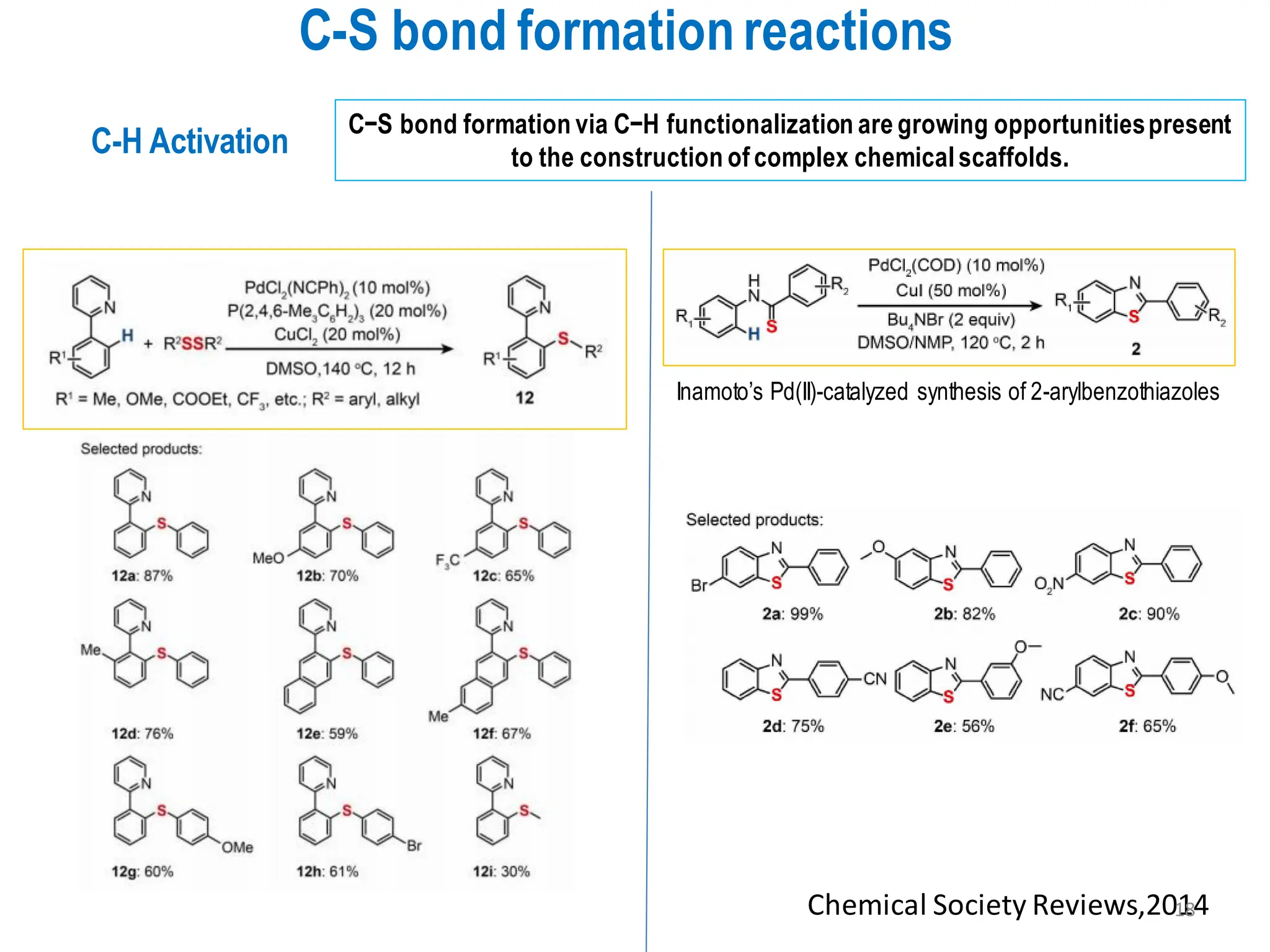
C-H Activation
C−S bond formation via C−H functionalization are growing opportunitiespresent
to the construction of complex chemical scaffolds.
Inamoto’s Pd(II)-catalyzed synthesis of 2-arylbenzothiazoles
Chemical Society Reviews,2014
18
Conclusion
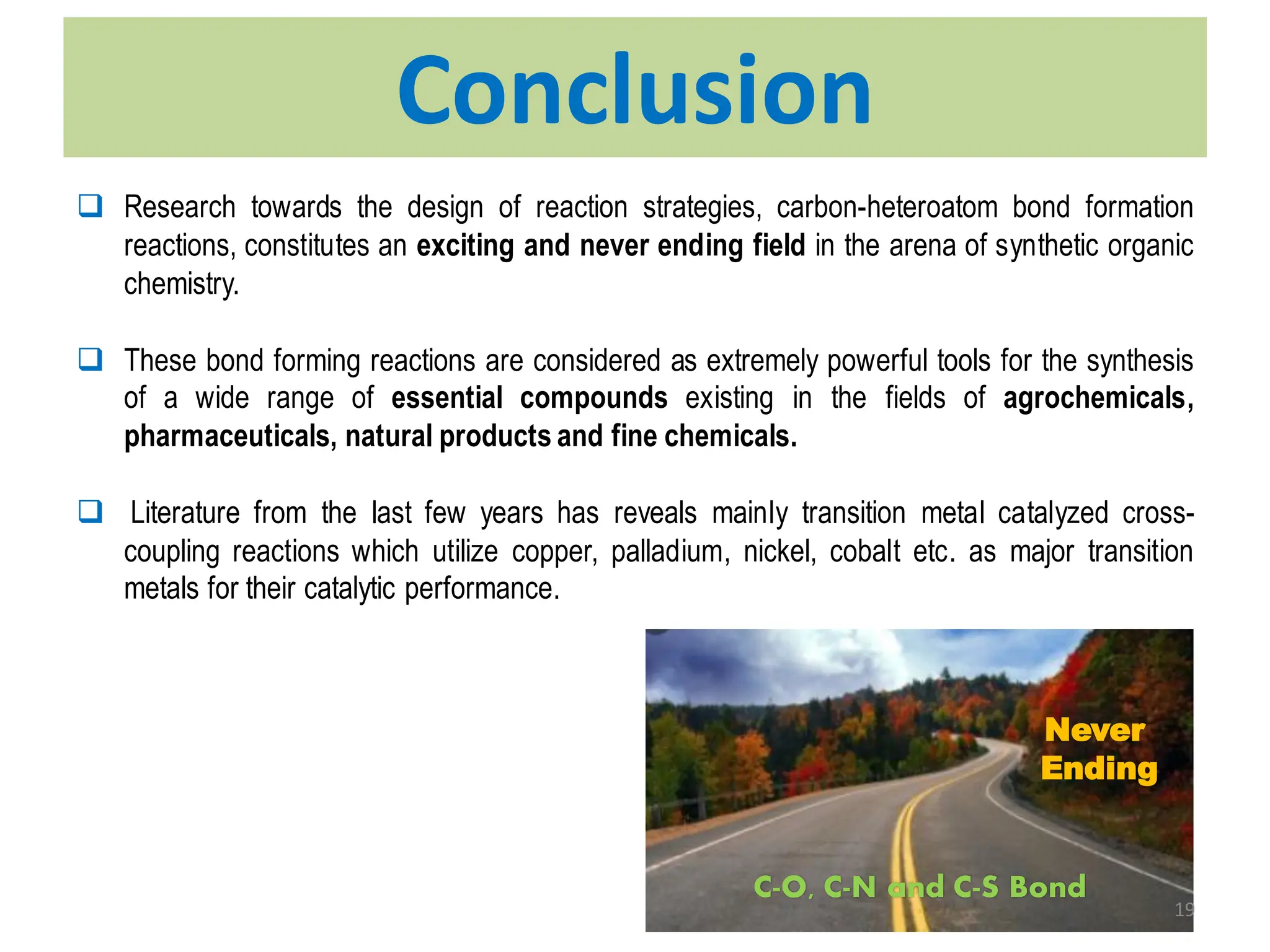
❑ Research towards the design of reaction strategies, carbon-heteroatom bond formation
reactions, constitutes an exciting and never ending field in the arena of synthetic organic
chemistry.
❑ These bond forming reactions are considered as extremely powerful tools for the synthesis
of a wide range of essential compounds existing in the fields of agrochemicals,
pharmaceuticals, natural products and fine chemicals.
❑ Literature from the last few years has reveals mainly transition metal catalyzed cross-
coupling reactions which utilize copper, palladium, nickel, cobalt etc. as major transition
metals for their catalytic performance.
C-O, C-N and C-S Bond
Never
Ending
19
Bibilography
Bibliography
1. Org. Biomol. Chem., 2018, 16, 7774–7781
2. Angew. Chem., 2015, 54, 5662-5665
3. Org. Lett., 2012, 14, 23, 5980-5983
4. J. Org. Chem., 2012, 77, 2878
5. JACS, 2014, 136, 14314
20
21

C-O, C-N and C-S Bond Formation Methods

  • 1.
    Vinayak V Khairnar MedicinalChemistry C-O, C-N and C-S Bond Formation Methodologies 1
  • 2.
    Content………. ❑ Introduction ❑ Background ❑Importance of Carbon Heteroatom Bonds in Medicinal & Organic chemistry ❑ Organic Chemistry Perspective ❑ Literature Review ❑ Conclusion 2
  • 3.
    Carbon-Heteroatombonds in drugreceptor interactions ❑ Lead compounds are capable of fitting the binding site and have the functional groups needed to interact with some of the important binding regions present. ❑ Adding another functional group to the lead structure enable extra binding interactions with the target. ❑ For example, a lead compound may bind to three binding regions in the binding site but fail to use a fourth. Extra functional groups may locate that fourth region. ❑ Introducing carbon-heteroatom bond helps to enhance physicochemical properties of drug molecule. Additional FG(C-O,C- N & C-S bond improves drug receptor interactions No additionalFGwith ( C-O,C-N & C-S bond) Drug optimisation 3
  • 4.
    Captopril: Importanceof C-Nbond ❑ The C–C bond would have no double bond character (C has no lone pair) and free rotation about the bond would be possible. ❑ Captoprilemerged from an extensive study of analogues featuring isosteric replacement. ❑ The proline nitrogen atom is fundamentally important in controlling the shape of the molecule, as the C–N amide bond is rigid (partial double bond character). 4
  • 5.
    ❑ The carbon–heteroatombond forming reactions are of much importance in academia as well as pharmaceutical industry. ❑ Carbon-carbon / carbon-heteroatom bond-forming reactions are the backbone of synthetic organic chemistry ❑ Today’s scientists are constantly trying to develop new methods for such bond forming reactions as these are one of the valuable tools for the syntheses of structurally diverse molecular entities. ❑ The hetero atoms and their bond formation play important role in synthesis of drug molecules. ❑ Construction of C-C, C-O, C-N, and C-S bonds are reviewed with special emphasis on their synthetic applications. Organic Chemistry Perspective 5
  • 6.
    Vancomycin Chloropeptin C-O bondin Natural products ❑ Ethers are common structural features in numerous natural products and biologically active Compounds. 6
  • 7.
    Williamsons synthesis(1851) The Williamsonether synthesis is forming an ether from an organo- -halide and an alcohol. Despite more than a century of immense focus on finding efficient synthetic routes for the synthesis of ethers remain difficult . Alexander Williamson C-O bond Formation:Development Ullmann coupling(1904) Chan-Lam reaction (1998) Buchwald-Hartwig couplings(1999) ✓ Efficient, experimentally simple and economically attractive method ✓ Tolerates a variety of functionalgroups ✓ Ability to synthesize hindered and heteroaryl diaryl synthesis 7
  • 8.
    Metal Catalysis VsMetal free synthesis of Diaryl Ethers Metal Catalysis Iodonium salt Mediated C-O bond formationReactions ➢ Long reaction time ➢ High Temperature ➢ Excess reagents ➢ Sensitive to sterics Metal Free Org.Lett., 2011, 13, 6, 1552-1555 ✓ Fast and mild ✓ Metal free ✓ Steric bulk ok ✓ No racemization Easy synthesis of Iodonium salt Chem. Commun. 2007, 2521; Org. Synth. 2009, 86, 308-314. 8
  • 9.
    Mitsunobu reaction: (1967) More than 80% of reported Mitsunobu reactions in the literature have been run with these two reagents C-O bond FormationReactions Macrocycle Lactonization Oyo Mitsunobu(1967) Main Issue: Unnecessary Waste So, Need of avoiding/minimizing the Waste! 9
  • 10.
  • 11.
    Phosphine recycling O’Brien’s phosphineRecycling MitsunobuReaction Aldrich“Fully Catalytic:System 50 % catalytic System Substrate scope Substrate scope 11
  • 12.
    C-N bond inDrugs Amine & amides are common structural features in numerous natural products and biologically active Compounds. Ketoconazole Aripiprazole 12
  • 13.
    C-N bond formationreactions ❑Easily available starting materials ❑ Low cost catalytic system ❑ A valuable alternative for the construction of interesting heterocycles Chan Lam reaction : Benzimidazoles synthesis by forming C-N bond formation 5 82% 6 77% 7 24% 8 68% 9 61% Org. Lett., 2012, 14, 23, 5980-5983 First report in literature for Chan Lam reaction of unprotected amidines 13
  • 14.
    Copper catalyzed Chan-Lamcoupling between sulfonyl azides /amides and Boronic acids Previous wok: In many of the cases reactions are completed in 2 h using open flask conditions Present wok: TL, 2003, 44, 3385 Org.Lett.,2014, 16, 338 C-N bond formationreactions JACS,2002, 124, 6043 ❑ Anilines are Genotoxic Substrates ❑ Sulphonyl chlorides are Mutagenic in Nature ❑ Non mutagenic Substrates 14
  • 15.
    Direct catalytic N-alkylationof amines with carboxylic acids C-N bond formation reactions JACS, 2014, 136, 1431 One-pot catalytic synthesis of Cinacalcet HCl JACS, 2014,136,14314 ❑ Convenient and straight forward catalytic reaction for N-alkylation of amines with Easily available carboxylic acids and silanes as reducing agents. ❑ Novel protocol demonstrated in the preparation of valuable first one-pot catalytic synthesis of Cinacalcet hydrochloride 15
  • 16.
    C-S bond inNatural products Sulphidesare common structural features in numerous natural products and biologically active Compounds. Ceftaroline Cefotetan The development of mild and general methods for C−S bond formation has received significant attention because the C−S bond is indispensable in many important biological and pharmaceutical compounds 16
  • 17.
    Previouswok: ▪ Use of5 mol% of simple copper salt ▪ Inexpensive ligand 1,10-phen.H2O. ▪ Use of eco-friendly solvent(EtOH) and air as oxidant C-S bond formationreactions Present wok: Org. Lett., 2000, 2, 2019 Org. Lett., 2002,4, 4309 J. Org. Chem., 2007, 72, 1241 J. Org. Chem., 2012, 77, 2878 17
  • 18.
    C-S bond formationreactions C-H Activation C−S bond formation via C−H functionalization are growing opportunitiespresent to the construction of complex chemical scaffolds. Inamoto’s Pd(II)-catalyzed synthesis of 2-arylbenzothiazoles Chemical Society Reviews,2014 18
  • 19.
    Conclusion ❑ Research towardsthe design of reaction strategies, carbon-heteroatom bond formation reactions, constitutes an exciting and never ending field in the arena of synthetic organic chemistry. ❑ These bond forming reactions are considered as extremely powerful tools for the synthesis of a wide range of essential compounds existing in the fields of agrochemicals, pharmaceuticals, natural products and fine chemicals. ❑ Literature from the last few years has reveals mainly transition metal catalyzed cross- coupling reactions which utilize copper, palladium, nickel, cobalt etc. as major transition metals for their catalytic performance. C-O, C-N and C-S Bond Never Ending 19
  • 20.
    Bibilography Bibliography 1. Org. Biomol.Chem., 2018, 16, 7774–7781 2. Angew. Chem., 2015, 54, 5662-5665 3. Org. Lett., 2012, 14, 23, 5980-5983 4. J. Org. Chem., 2012, 77, 2878 5. JACS, 2014, 136, 14314 20
  • 21.