Downloaded 27 times
![5.1. consider the reaction 2A + B 2C. Suppose that
at a particular moment during the reaction, rate of
disappearance of A is 0.076M/s,
a) what is the rate of formation of C?
b) what is the rate of consumption of B?
c) what is the rate of the reaction?
Sol-
c) Rate of reaction= -1d[A] = -d[B] = +1d[C]
2 dt dt 2 dt
a) +1d[C] = -1d[A]
2 dt = 2 dt
d[C] = 0.076 Ms-1
dt
b) -1d[A] = -d[B]
2 dt dt
1 x 0.076 = d[B]
2 dt
d[B] = 0.038 Ms-1
dt](https://image.slidesharecdn.com/kzxbwurbq756gcmwnthv-signature-eeca5ab3084f499dc3e250baee24f240bb6557284a637250808d6220150ab858-poli-160804155057/85/Chemial-kinetic-problem-2-320.jpg)
![5.2. Consider the reaction.
3I-
(aq) + S2O8
2-
(aq) I-3 + 2SO2-
4 at particular time t,
d[SO4
2-] = 2.2 x 10⁻² M/s. what are the value of
dt
a) – d[I-] b) –d[S2O8] c) d[I3
-]
dt dt dt](https://image.slidesharecdn.com/kzxbwurbq756gcmwnthv-signature-eeca5ab3084f499dc3e250baee24f240bb6557284a637250808d6220150ab858-poli-160804155057/85/Chemial-kinetic-problem-3-320.jpg)
![5.3. consider the reaction 2A + 2B 2C + D
from the following data, calculate the order and rate
constant of the reaction. write the rate law.
We have to find-
x&y = ?, k, rate=?
Rate = 𝑘 𝐴 𝑥 𝐵 𝑦
K = __R__ R, [A],[B]
[A]2[B] take any value
R1= k[A]1[B]1,
R2= k[A]2[B]2
R3= k[A]3[B]3
R1 ÷ R2 x = 2
R2 ÷ R3 y = 1
R = k[A]2[B] Order=3
[A]0/M [B]0/M R0/Ms-1
0.488 [A]1 0.160 [B]1 0.24 [R]1
0.244 [A]2 0.160 [B]2 0.06 [R]2
0.244 [A]3 0.320 [B]3 0.12 [R]3](https://image.slidesharecdn.com/kzxbwurbq756gcmwnthv-signature-eeca5ab3084f499dc3e250baee24f240bb6557284a637250808d6220150ab858-poli-160804155057/85/Chemial-kinetic-problem-4-320.jpg)
![5.4. for the reaction 2A + B Products, find the rate
law from the following data.
R= k[A][B]
K= __R__
[A][B]
= __0.15___ = 10M-1s-1
(0.3)(0.05)
R1= k[A]1[B]1,
R2= k[A]2[B]2
R3= k[A]3[B]3
R2 ÷ R1 x = 1
R2 ÷ R3 y = 1
R = k[A][B] Order= 2
[A]/M [B]/M Rate/Ms-1
0.3 [A]1 0.05 [B]1 0.15 [R]1
0.6 [A]2 0.05 [B]2 0.30 [R]2
0.6 [A]3 0.20 [B]3 1.20 [R]3
What is the rate constant and order of the reaction?](https://image.slidesharecdn.com/kzxbwurbq756gcmwnthv-signature-eeca5ab3084f499dc3e250baee24f240bb6557284a637250808d6220150ab858-poli-160804155057/85/Chemial-kinetic-problem-5-320.jpg)
![5.5. the rate law of reaction
C2H4Br2 + 3I- C2H4 + 2Br- + I3
-
is rate = k[C2H4Br2][I]-. The rate of the reaction is
found to be 1.1 x 10⁻⁴ M/s when the concentration of
C2H4Br2 and I- are 0.12M and 0.18M respectively.
Calculate the rate constant of the reaction.
R = k[C2H4Br2][I-]
K = ____R____
[C2H4Br2][I-]
K = 1.1 x 10 -4_
0.12 x 0.18
K = 5.1 x 10⁻³ M-1s-1
Log 1.1 = 0.0414
Log 0.12 = _1.0792
- Log0.18 = 1.2553
- A.l(1.7069) = 5.093x 10-8](https://image.slidesharecdn.com/kzxbwurbq756gcmwnthv-signature-eeca5ab3084f499dc3e250baee24f240bb6557284a637250808d6220150ab858-poli-160804155057/85/Chemial-kinetic-problem-6-320.jpg)
![5.6. Consider the reaction A2 + B products. If the
concentration of A2 and B are halved, the rate of the reaction
decreases by a factor of 8. if the concentration of A2 is
increased by a factor of 2.5, the rate increases by the factors
of 2.5. what is the order of the reaction? Write the rate law.
2) R2÷R1,
R2= k[A2]x
2[B]y
2
R1 k[A2]x
1[B]y
1
2.5R1= k(2.5)x[A2]x
1[B]y
1
R1 k[A2]x
1[B]y
1
2.5
1
= (2.5)
x
X= 1, hence [A2] = 1st order,
y= 2, hence [B] = 2nd order,
1) R2÷R1, y=2
Rate law = k[A2][B]2
Order= x+y= 3(third order)
R1= initial & R2= final
1) [A2]2=1/2[A2]1
[B]2=1/2[B]1 then,
R2=1/8R1
2) [A2]2= 2.5[A2]1 then
R2=2.5R1
Order (x,y)=? Rate law=?
R1= k[A2]x
1[B]y
1
R2= k[A2]x
2[B]y
2](https://image.slidesharecdn.com/kzxbwurbq756gcmwnthv-signature-eeca5ab3084f499dc3e250baee24f240bb6557284a637250808d6220150ab858-poli-160804155057/85/Chemial-kinetic-problem-7-320.jpg)
![5.7. consider the reaction C + D products. The rate
of the reaction increases by a factor of 4 when
concentration of C is doubled. The rate of the reaction
is tripled when D is tripled. What is the order of the
reaction? Write the rate law.
1) R2= 4R1, [C]2= 2[C]1
[D]2=[D]1= const.
1) R2= 3R1, [D]2 = 3[D]1,
[C]2=[C]1= const.
Order (x,y)=? Rate law=?
R1= k[C]x
1[D]y
1
R2= k[C]x
2[D]y
2
1) R2÷R1,
R2= k[C]x
2[D]y
2
R1 k[C]x
1[D]y
1
4R1= k(2)x[C]x
1[D]y
1
R1 k[C]x
1[D]y
1
X= 2, hence [C] = 2nd order,
y= 1, hence [D] = 1st order,
Rate law = k[C]2[D]
Order= x+y= 3(third order)](https://image.slidesharecdn.com/kzxbwurbq756gcmwnthv-signature-eeca5ab3084f499dc3e250baee24f240bb6557284a637250808d6220150ab858-poli-160804155057/85/Chemial-kinetic-problem-8-320.jpg)
![5.8. the reaction, F2(g) + 2ClO2(g) FClO2(g) is first
order in each of the reactants. The rate of the
reaction is 4.88 x 10⁻⁴ M/s when [F2] = 0015M and
[ClO2] = 0.025M. Calculate the rate constant of the
reaction.
By rate law,
R = k[F2][ClO2]
K = ___R____
[F2][ClO2]
K = ___4.88 x 10-4
0.015 x 0.025
K = 1.3 M-1s-1
Log 4.88 = 0.6891
-log 0.015 = 2.1761
-log 0.025 = 2.3979
= 4.1151
A.l(4.1151) =1.303 x10-4x104
= 1.3](https://image.slidesharecdn.com/kzxbwurbq756gcmwnthv-signature-eeca5ab3084f499dc3e250baee24f240bb6557284a637250808d6220150ab858-poli-160804155057/85/Chemial-kinetic-problem-9-320.jpg)
![5.9. the reaction 2H2(g) + 2NO(g) 2H2O(g) + N2(g) is the
first order in H2 and second order in NO. the rate
constant of the reaction at a certain temperature is
0.42M-2s-1. Calculate the rate when [H2]= 0.015M and
[NO] = 0.025M.
By rate law,
R = k[H2]2[NO]2
R = 0.42 x 0.015 x (0.025)2
R = 3.94 x 10⁻⁶Ms-1
Homework](https://image.slidesharecdn.com/kzxbwurbq756gcmwnthv-signature-eeca5ab3084f499dc3e250baee24f240bb6557284a637250808d6220150ab858-poli-160804155057/85/Chemial-kinetic-problem-10-320.jpg)
![5.10. In acidic solution sucrose is converted into a
mixture of glucose and fructose in pseudo first order
reaction. It has been found that the concentration of
sucrose decreases from 20m mol/L to 8m mol/L in
38min. What is the half life of the reaction.
Given- [A]0= 20x10-3molL-1 & [A]t= 8x10⁻³molL-1, t= 38 t1/2=?](https://image.slidesharecdn.com/kzxbwurbq756gcmwnthv-signature-eeca5ab3084f499dc3e250baee24f240bb6557284a637250808d6220150ab858-poli-160804155057/85/Chemial-kinetic-problem-11-320.jpg)
![5.11. the half life of a 1st order reaction is
1.7hrs. How long will it take for 20% of the
reactant to disappear?
Given- [A]0= 100 molL-1 & [A]t= 100 -20= 80, k = ? t1/2=1.7](https://image.slidesharecdn.com/kzxbwurbq756gcmwnthv-signature-eeca5ab3084f499dc3e250baee24f240bb6557284a637250808d6220150ab858-poli-160804155057/85/Chemial-kinetic-problem-12-320.jpg)
![5.12. The gaseous reaction A2→ 2A is first order in
A2. After 12.3 min 65% of A2 remains
undecomposed. How long will it take to decompose
90% of A2? What is the half life of the reaction?
Given-1)[A]0=100molL-1 & [A]t= 65, t= 12.3min , k = ? 2) [A]t = 100-90=
10, t=? t1/2=?](https://image.slidesharecdn.com/kzxbwurbq756gcmwnthv-signature-eeca5ab3084f499dc3e250baee24f240bb6557284a637250808d6220150ab858-poli-160804155057/85/Chemial-kinetic-problem-13-320.jpg)
![5.13. The rate constant of a first order reaction is 6.8x 10⁻⁴
s-1. if the initial concentration of the reactant is 0.04 M,
what is its molarity after 20min? How long will it take for
25% of the reactant to react?
Given-1)[A]0=0.04M & [A]t= ?, t= 20min= 20 x 60 = 1200s , k = 6.8
x 10-4 2) [A]o= 25% of 0.04 = 0.01M, [A]t = 0.04 – 0.01 = 0.03M
2) For 20% reactant to
react, t=?](https://image.slidesharecdn.com/kzxbwurbq756gcmwnthv-signature-eeca5ab3084f499dc3e250baee24f240bb6557284a637250808d6220150ab858-poli-160804155057/85/Chemial-kinetic-problem-14-320.jpg)
![5.14. the rate constant of a certain first order reaction is
2.12 x 10⁻³ min-1. (a) how many minutes does it take for
reactant concentration to drop to 0.02M if the initial
concentration of the reactant is 0.045M?
(b) what is the molarity of the reactant after 1.5 h?
Given-1)[A]0=0.045M & [A]t= 0.02, t= ? , k = 6.8 x 10⁻⁴ 2) t =
1.5hr= 1.5 x 160 = 90 min, [A]t = ?
2) [A]t = 0.034M](https://image.slidesharecdn.com/kzxbwurbq756gcmwnthv-signature-eeca5ab3084f499dc3e250baee24f240bb6557284a637250808d6220150ab858-poli-160804155057/85/Chemial-kinetic-problem-15-320.jpg)
![5.15. the concentration of a reactant in a first order
reaction A → products, varies with time as follows.
Show that the reaction is first order.
t/min 0 10 20 30 40
[A]/M 0.0800
[A]0
0.0536
[A]t
0.0359
[A]t
0.0241
[A]t
0.0161
[A]t](https://image.slidesharecdn.com/kzxbwurbq756gcmwnthv-signature-eeca5ab3084f499dc3e250baee24f240bb6557284a637250808d6220150ab858-poli-160804155057/85/Chemial-kinetic-problem-16-320.jpg)
![5.21. What is the rate law for the reaction
NO2 + CO → NO + CO2
the reaction occurs in the following step?
[(1) NO2 + NO2 → NO3 + NO (slow)
(2) NO3 + CO → NO2 + CO2 (fast)]
what is the role of NO3?
Rate= k[NO2]2
Role of NO3= reaction
intermediate……….](https://image.slidesharecdn.com/kzxbwurbq756gcmwnthv-signature-eeca5ab3084f499dc3e250baee24f240bb6557284a637250808d6220150ab858-poli-160804155057/85/Chemial-kinetic-problem-22-320.jpg)
![5.22. The rate law for the reaction
2NO + Cl2 → 2NOCl is given by rate = k[NO][Cl2]. The
reaction occurs in the following step:
(1) NO + Cl2 → NOCl2
(2) NOCl2 + NO → 2NOCl
(a) is NOCl2 a catalyst or reaction intermediate? Why?
(b) Identify the rate determining step.
NOCl2 is reaction
intermediate.
Since the rate law, Rate =
k[NO][Cl2]
Substance NO & Cl2
present in one step hence
first step is RDS.](https://image.slidesharecdn.com/kzxbwurbq756gcmwnthv-signature-eeca5ab3084f499dc3e250baee24f240bb6557284a637250808d6220150ab858-poli-160804155057/85/Chemial-kinetic-problem-23-320.jpg)
![5.29. from the following data for the liquid
phase reaction A → B, determining the order
of the reaction and calculate its rate constant.
t/s 0 600 1200 1800
[A]/mol L-1 0.624 0.446 0.318 0.226](https://image.slidesharecdn.com/kzxbwurbq756gcmwnthv-signature-eeca5ab3084f499dc3e250baee24f240bb6557284a637250808d6220150ab858-poli-160804155057/85/Chemial-kinetic-problem-30-320.jpg)
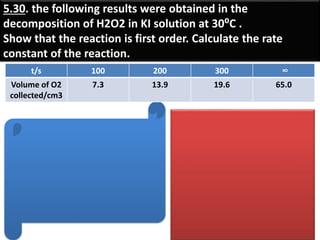
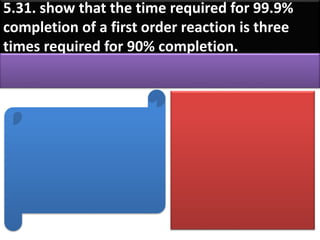
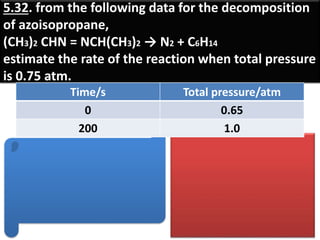

This document contains examples of chemical kinetics problems involving determination of rate laws, rate constants, orders of reactions, and activation energies from experimental data. Several questions ask the reader to identify reaction intermediates and rate-determining steps based on given reaction mechanisms and rate laws. The document demonstrates how kinetic concepts can be applied to analyze reaction rates and mechanisms.


